

Business class is worth flying when its bed or its schedule protects a workday you can't afford to lose. And on some documented fares, it costs less than coach. The familiar advice to save money by choosing economy skips the most useful step: comparing what both cabins cost on the flights you need.
Business Class Cheaper Than Coach on Real Fares
A One Mile at a Time comparison documented economy at $575 versus $471 in business, a $104 saving, and another same-flight comparison at $480 versus $373, making business $107 cheaper. These aren't upgrades purchased with miles. They're examples of a higher cabin carrying a lower cash fare.
Airlines price cabins through separate fare buckets, rather than adding a standard business-class surcharge to the economy price. When cheaper economy inventory sells out, a discounted business bucket can remain available. An airline can also discount business independently to attract bookings.
When business class costs less or barely more
| Comparison | Economy | Business | Gap |
|---|---|---|---|
| Documented same-flight reversal | $575 | $471 | Business $104 cheaper |
| Second same-flight reversal | $480 | $373 | Business $107 cheaper |
| Iberia Madrid–Athens | £454 | £562 | Business only £108 more |
| Study average across routes | Base fare | 250.19% above economy | Average business premium |
| ANA, smallest average markup | Base fare | 82.22% above economy | Smallest gap in the study |
The Iberia comparison and airline averages come from Holidu's business-class fare study, which recorded £454 in economy and £562 in business on Madrid–Athens, an average business premium of 250.19% across its sample, and ANA's smallest average markup of 82.22% above economy.
Read the fare display, not a presumed markup
The important distinction is between an average premium and your available fare. An airline's average tells you little about the remaining inventory on a particular departure. Applying a mental multiplier to the economy price can cause you to reject business without ever searching it.
Compare the same departure, connection, travel dates, passenger count, and ticket direction. A cheaper business itinerary with an inconvenient connection isn't the same proposition as a cheaper business seat on the flight you already wanted.
Booking rule: Search the cabin you think you can't afford before deciding that you can't afford it.
These reversals are unusual, not a dependable pricing pattern. The documented comparisons establish that business can undercut coach, not that those prices remain bookable or that every route produces them.
There's another useful conclusion: a narrow premium deserves a different decision process from a large premium. When the gap is modest, baggage, flexibility, and airport services may settle the comparison. When it's substantial, the bed and the arrival schedule need to justify the additional spending.
That's the practical answer to why fly business class: sometimes it's the lower-priced ticket. When it isn't, you need to know exactly what the extra money buys.
The Lie-Flat Bed Behind the Cabin Name
The principal long-haul benefit isn't a wider chair. It's a usable sleep surface. A cabin that lets you lie down should be evaluated more like overnight accommodation than like an improved seat.
The business-class reference overview describes fully flat seats reclining to approximately 180 degrees, parallel to the floor, with common premium configurations offering roughly 55–65 inches of pitch and 18–23 inches of width, although aircraft and airline specifications differ. Pitch isn't bed length, so don't treat those measurements as interchangeable.
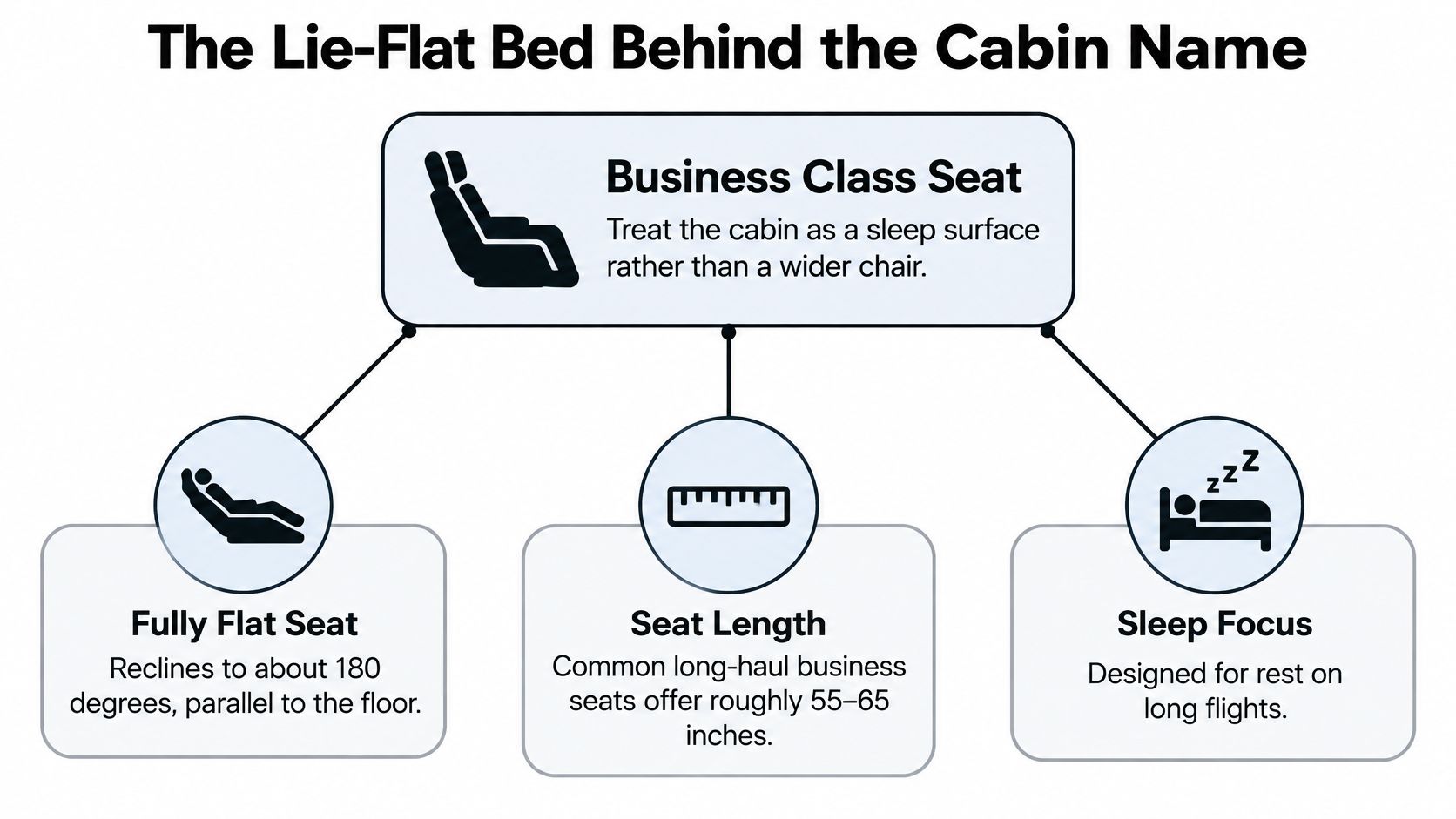
An angled-flat product can look nearly horizontal without giving your body the same alignment as a fully flat bed. Footwell shape also matters: a generous-looking seat can still leave little room to turn comfortably.
Inspect the sleeping position
Before paying, open the operating airline's aircraft-specific seat map and seat description. Our explanation of what a business-class flight includes provides useful context, but the actual aircraft should determine your choice.
- Recline: Confirm a flat sleeping position, not just a reclining seat.
- Footwell: Look for space that accommodates your normal sleeping posture.
- Bedding: Check whether a mattress pad or other sleep surface is included.
- Aisle access: Prefer a layout that doesn't require you or your neighbor to climb over someone.
- Operating aircraft: Verify every long sector, not just the aircraft pictured on the booking page.
Think of an overnight flight as a hotel night you might preserve, or a night you give the airline without getting much rest back. That analogy doesn't make the fare automatically worthwhile. It tells you which part of the product deserves scrutiny.
Buy the opportunity, then protect it
A bed creates an opportunity to sleep, not a guarantee that you will. If you spend the available rest window eating, working, and watching films, you may arrive having paid for a benefit you barely used.
For a practical companion to seat selection, The Sleep Consultant's in-flight sleep planning for busy executives can help you think through how to use that opportunity. Plan your onboard priorities before boarding rather than deciding after the meal service starts.
A useful distinction is sleep capability versus sleep behavior. The airline supplies the former; your schedule and choices determine how much of it you use. Airport perks should be assessed separately, because even an excellent lounge can't turn an unsuitable seat into a bed.
Lounges Bags Miles and the Rest of the Bundle
A premium ticket can change the hours surrounding the flight as much as the flight itself. Assess those benefits as services you'll actually use, not as a list whose length proves value.
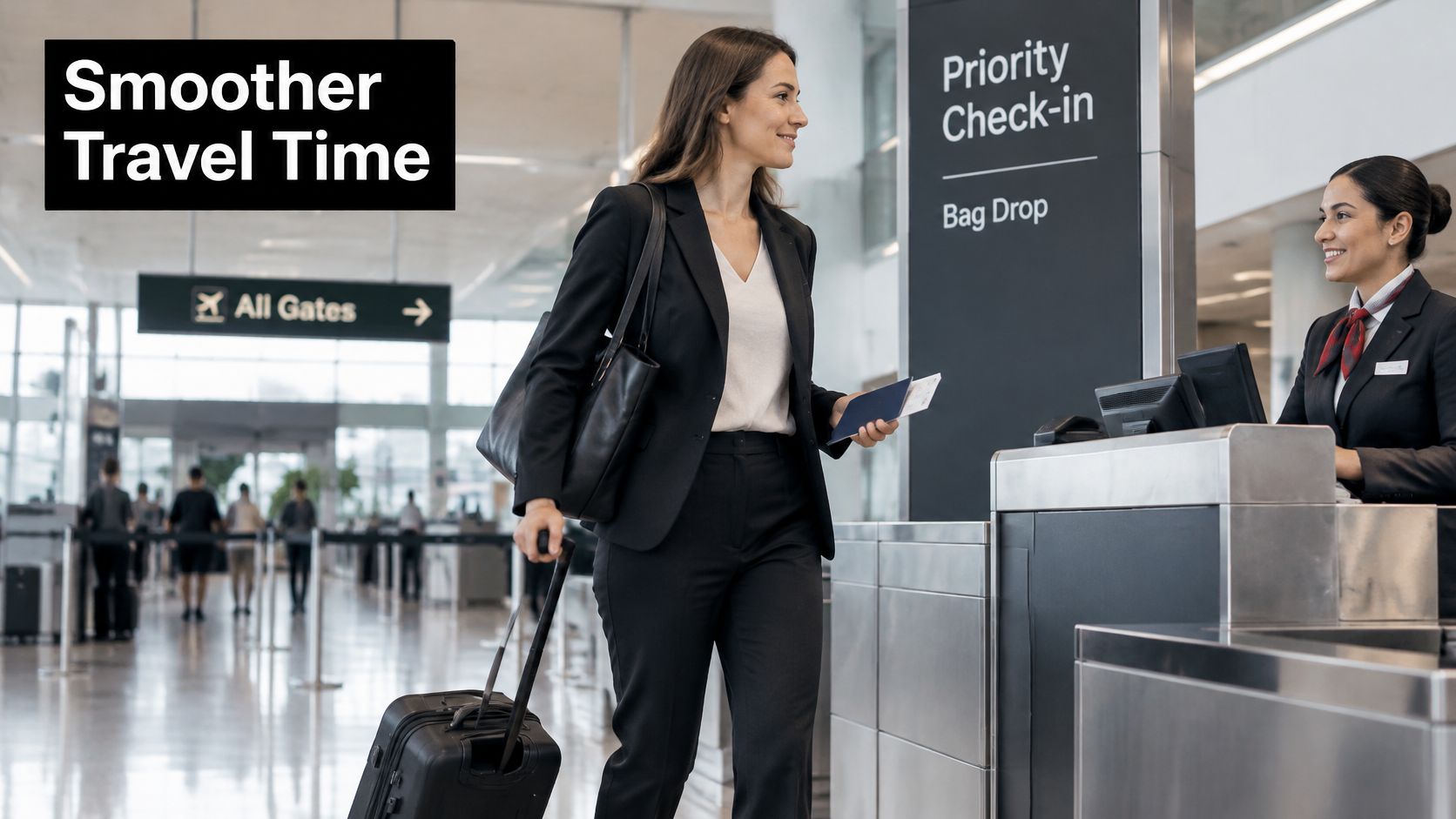
Priority check-in is one example of a benefit worth inspecting before departure.
Assign each benefit a job
Priority check-in, bag drop, and eligible security access can reduce queueing, but they aren't permission to ignore airport deadlines. Their value is greatest when they remove uncertainty from an already demanding itinerary.
A lounge earns its place when you need a table, power, food, or an available shower before an overnight departure. Check the actual departure lounge and opening hours. Access to a room you can't use adds nothing to the fare comparison.
- Checked baggage: Compare the ticket's allowance with your actual luggage, especially if you're carrying presentation equipment or a demonstration kit.
- Dining: Included meals can replace a separate airport purchase, provided the service timing suits your plans.
- Workspace: Check the tray table, power provision, and usable personal space rather than assuming that every premium seat supports comfortable laptop work.
- Loyalty credit: Confirm the booking class's redeemable-mile and status-credit eligibility before assigning either a value.
The cabin can function as a bedroom with an office attached. Economy is closer to a seat in a crowded waiting room. Those are useful descriptions of personal space, not promises that every business-class product delivers the same facilities.
The following video offers another perspective on evaluating the premium-cabin proposition.
Separate immediate savings from loyalty value
For a daytime regional flight, baggage and lounge access may matter more than sleeping capability. For an overnight intercontinental trip, don't let an attractive airport package distract you from the seat.
Tickets bought through Passport Premiere have characteristics consistent with open-market terms, including flexibility and mileage accrual, regardless of the final fare level. That doesn't remove the need to understand the particular fare's conditions.
Our guide to maximizing airline miles helps frame the loyalty side of the calculation. Keep that value conservative: an account balance isn't cash, and earning credit isn't useful if you won't redeem it.
The frequent flyer captures the greatest potential loyalty value. For an occasional traveler, the stronger purchasing case is usually what the ticket delivers on this trip.
When a Work Trip Pays Back the Premium
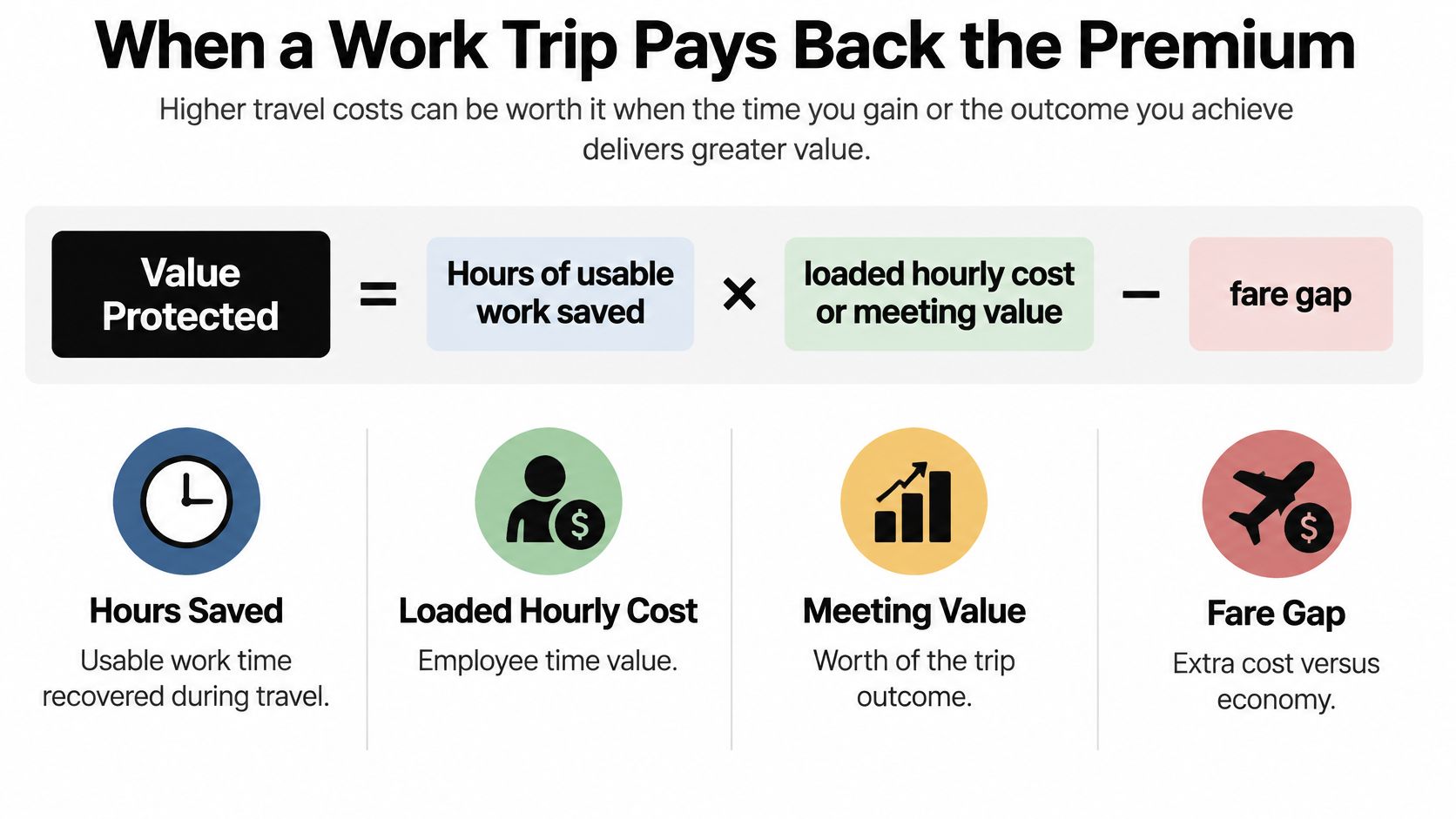
Start with a financial test, not a comfort preference:
Net value protected = usable work hours saved × loaded hourly cost, plus avoidable recovery costs, minus the fare gap.
For a consequential meeting, assess the value of arriving prepared separately. Don't multiply hours by the entire contract value, and don't count both a recovered workday and the same hours again as a recovery expense.
In Deloitte's corporate travel analysis, 86% of surveyed travelers lost at least one productive hour after a stressful trip, 45% of C-level executives reported losing four to eight hours, and 37% said premium or business-class booking would reduce travel stress. These findings support evaluating arrival readiness, but they don't prove that purchasing business recovers every lost hour.
Match the decision to the obligation
The following situations are decision scenarios, not forecasts of the return a particular traveler will receive.
Break-even situations for a business fare
| Situation | Typical stakes | Cabin that fits | Why |
|---|---|---|---|
| Overnight long-haul into a same-day meeting | Potentially several hours of executive time at risk | Business if the seat is fully flat | Helps protect the workday the fare is buying |
| Contract or client trip worth many times the gap | Hypothetically, a four-figure premium against a five-figure outcome | Business when arrival readiness matters | The meeting's expected value may justify the gap |
| Stressful connection with no recovery window | Productive time and readiness at risk | Business on the long sector | Prioritizes rest where it can be most useful |
| Flexible arrival and a free next day | Comfort, with no same-day duty | Economy or premium economy | An existing recovery window weakens the financial case |
| Eastbound with short rest between duties | Continuing fatigue exposure | Business only if the bed adds usable sleep | A better seat doesn't repair an unsuitable schedule |
Consider a consultant who must lead a client workshop immediately after arrival. Estimate the work at risk, then compare its value with the actual premium. Billing rates can inform the calculation, but revenue isn't automatically profit, and not every tired hour becomes lost billable work.
For a sales trip, use expected meeting value, not the headline contract amount. Ask whether arriving better rested could materially affect preparation, judgment, or delivery. If the meeting would be equally effective after a recovery day, compare that alternative too.
Keep the limits in the approval note
Business class doesn't erase jet lag. For eastbound travel or a tightly compressed duty schedule, consider changing the departure, arrival, or meeting time rather than treating a seat purchase as the entire fatigue plan.
A flexible leisure trip or internal visit has a different calculation. If the traveler already has a free arrival day, there may be little productive time to recover financially. Comfort remains a legitimate personal preference, but it shouldn't be presented as a guaranteed business return.
The American Express 2024 Business Travel Edition survey found that 85% of surveyed companies covered business-class seats on longer flights at least case by case. The useful approval request is therefore a concise break-even note: itinerary, arrival obligation, fare difference, and realistic alternative.
For managers defining what counts as business travel, that approach also separates an operational requirement from an employee preference.
Emissions and the Trips That Should Stay in Coach
Business- and first-class travel carry a substantial environmental trade-off. The aviation analysis described in Deloitte's corporate travel discussion puts their per-passenger emissions at two to five times economy's and attributes more than 20% of global passenger-air-traffic carbon dioxide emissions to premium travel.
A discounted fare doesn't remove that trade-off. Price and emissions answer different questions, so a financially attractive upgrade isn't automatically the environmentally preferable booking.
Choose the trip before choosing the cabin
| Travel need | Choice to evaluate first | What must justify premium |
|---|---|---|
| Overnight arrival before essential work | Suitable nonstop itinerary and usable rest | A material arrival-readiness benefit |
| Flexible arrival without immediate duties | Economy or premium economy | A reason beyond routine entitlement |
| Meeting that works remotely | Videoconferencing | A clear need for physical attendance |
| Practical rail alternative | Rail | A genuine operational reason to fly |
| Repeated visits to the same destination | Consolidated, fewer trips | Why separate journeys are necessary |
Aircraft type, seating density, cabin configuration, occupancy, and routing affect the allocation of emissions. That makes a cabin label an incomplete accounting method, even though premium seating generally requires more aircraft space per passenger.
Compare complete itineraries. If someone proposes an additional positioning journey or separate recovery trip, include it rather than assessing only the main flight. An extra hotel night also belongs in the overall travel assessment, but don't assume its footprint automatically outweighs a cabin change.
A lower fare is evidence about purchasing value, not evidence of lower emissions.
Record the reason rather than hiding the choice
For corporate reporting, retain the cabin, route, emissions methodology, and operational reason for the booking. A general travel total won't explain why a premium seat was necessary.
Distinguish a documented emissions estimate from a broad sustainability slogan. Ask what the figure measures and whether it accounts for cabin allocation and connections; don't treat an airline's marketing language as an itinerary calculation.
The defensible position isn't that nobody should fly business. It's that a company should identify when the additional space serves a real purpose. When the productivity case fails and a workable lower-emission option exists, that option is usually the better purchase too.
How to Catch a Discounted Business Fare
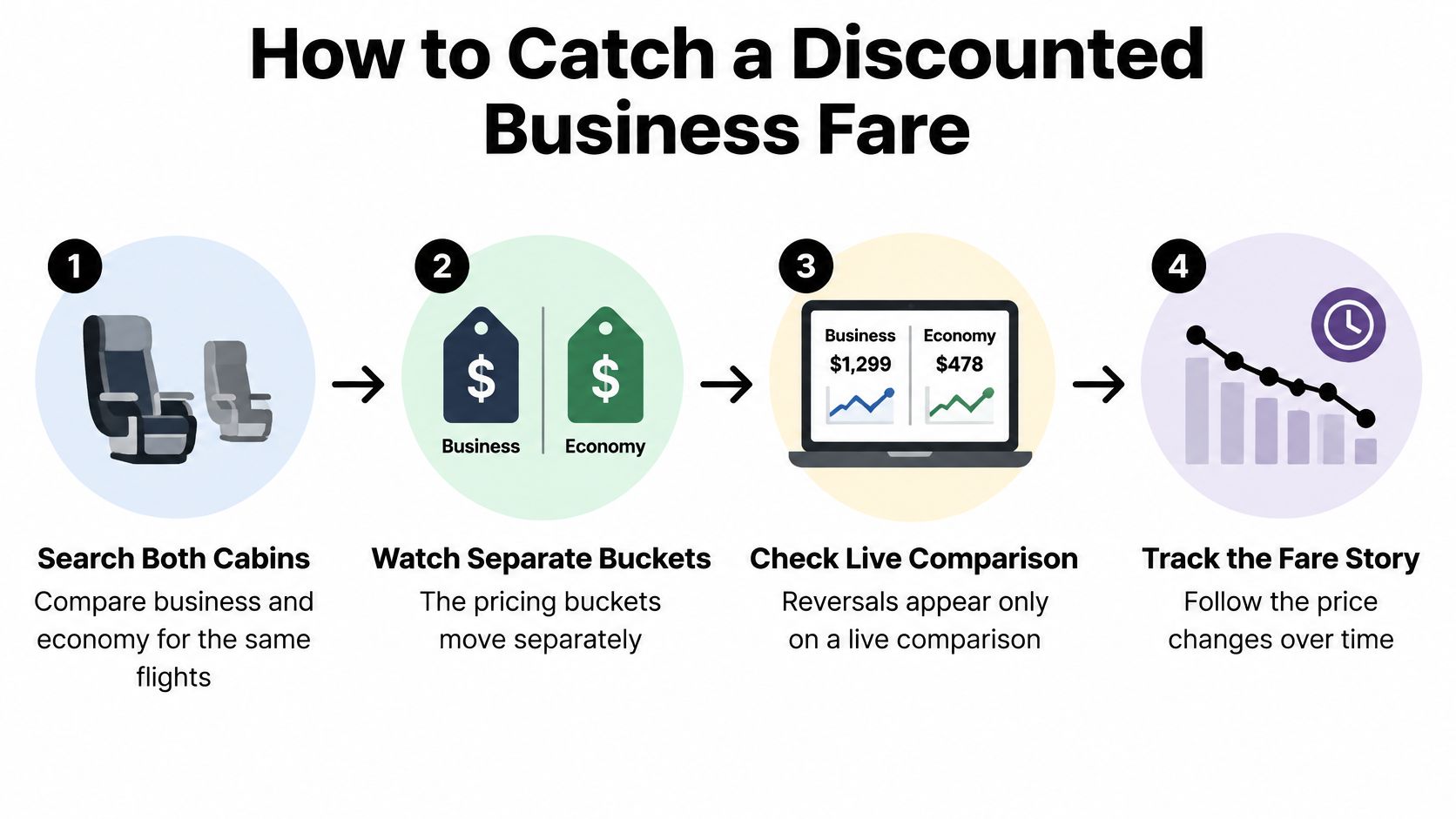
Finding a useful premium fare requires a repeatable buying routine. Search broadly enough to detect a pricing opportunity, then inspect narrowly enough to avoid buying the wrong ticket.
Make the comparison actionable
Search both cabins on matching flights. Keep dates, passenger count, and connections constant. A Passport Premiere member described an international Melbourne–New York booking this way: “I used Passport Premiere for an international flight between Melbourne and New York and managed to obtain a business seat for the price of an economy.” That's an individual testimonial, not a promised result.
Watch route launches and competitive sales. Don't use a carrier's ordinary asking price as your only benchmark. Thrifty Traveler's business-class booking guide reports Condor Europe fares slightly above $2,500 round trip, Air France below $2,000, JetBlue Mint around $2,000 on certain Europe routes, and nonstop Colombia business fares as low as $420 round trip, about one-third of the cited normal price.
Reported business sale levels
| Route or airline | Reported fare | Note |
|---|---|---|
| Condor, to European destinations | Slightly above $2,500 round trip | Business class |
| Air France business | Below $2,000 round trip | Reported sale |
| JetBlue Mint, certain Europe routes | Around $2,000 round trip | Often after new route launches |
| Nonstop business to Colombia | As low as $420 round trip | About one-third of the cited normal price |
These are reported sale examples, not current quotes or promises for every departure. Use them to recognize that meaningful discounts exist, not to set an inflexible target for an unrelated itinerary.
Read the fare brand before celebrating. Executive Traveller's guide to unbundled business fares identifies Air France and KLM Business Light, Emirates Business Class Special, Finnair Business Light, and Qatar Airways Business Class Lite, with potential restrictions affecting changes, refunds, lounges, or baggage; its Finnair Helsinki–Singapore example showed only €136 between Business Light and Business Classic. A small step up may purchase conditions worth more to you than the saving.
Confirm the ticket's actual terms. Establish whether it's a published fare and inspect change conditions, refundability, baggage, and mileage eligibility. Don't infer restrictions solely from a low price, or flexibility solely from the business-class label.
Act on a verified buying opportunity. We issue alerts when fare sales occur. Check the live total and ticket conditions promptly, then purchase if the itinerary meets your requirements rather than assuming the same availability will remain.
Treat savings claims as individual outcomes
Another member, Terry, reported: “Saved $4000 on a single flight.” That testimonial describes Terry's result, not an expected saving for every booking.
The useful habit is to retain your original comparable quote. Without a matching baseline, you can't distinguish a genuine saving from a cheaper but materially different journey.
Book the Cabin Only After the Fare Makes Sense
Make the booking decision with a clear hierarchy: operational fit, comparable price, then purchase timing. A premium label shouldn't substitute for any of those tests.
Apply three purchase rules
- Work on arrival: For an overnight long-haul followed by immediate duties, purchase only after confirming that the actual seat and itinerary support the rest you need.
- Business at or below coach: Choose business when the same-date, same-flight comparison is favorable and its conditions meet your needs.
- A large gap with a free next day: Keep economy or premium economy in contention. Don't manufacture a productivity argument for a comfort purchase.
Once a trip qualifies for premium travel, evaluate the timing rather than accepting the first quote. At Passport Premiere, we anticipate business-class buying events so members can capture savings when fares change. We help assess whether a current premium is justified or likely to fall, without guaranteeing the lowest price.
Our system also lets a customer hold a fare while we monitor for a lower fare, with the held fare preserved. That gives the purchasing decision a defined alternative instead of relying only on a hope that prices will decline.
Keep the service's scope clear
Our pricing methods don't apply to economy-class travel or premium travel within one continent, such as U.S.–Canada or intra-European journeys. The relevant use is international premium-cabin purchasing within our service scope, not every airfare search.
Decision standard: Buy a useful itinerary at a defensible price, not a prestigious cabin at an unexamined price.
For your next long-haul trip, write down the arrival obligation, the acceptable schedule, and the maximum fare gap you can justify. Then compare the available ticket with monitored alternatives before committing. You'll have a reason to buy, a reason to decline, and a baseline against which to measure the outcome.
Passport Premiere combines international business- and first-class fare monitoring with market analysis to help travelers judge when a premium fare makes sense. Visit Passport Premiere to explore membership and assess whether its fare intelligence fits your next qualifying international trip.
