

Finding a business class flight to Europe for less than a coach ticket might sound like a travel myth, but it's a reality that savvy travelers exploit all the time. This isn't about luck; it's about understanding and leveraging the pricing inefficiencies of the airline industry. With the right strategy, you can turn the dream of a lie-flat bed into your next reality, often for a price that defies logic.
Why Business Class Can Be Cheaper Than Coach
The idea of flying business class to Europe for less than an economy seat seems counterintuitive. But the airline industry operates on complex algorithms where price isn't always tied to the quality of the seat. The price you see on Google Flights is just the starting point.
Here’s one of the industry's biggest secrets: those premium cabins are rarely full of passengers who paid the astronomical, publicly listed fare. A staggering 15% or fewer of all premium cabin seats are ever sold at their initial sticker price. Airlines would rather sell a business class seat at a deep discount than fly it empty. This creates a volatile market where a discounted premium seat can, and often does, fall below the price of a last-minute or flexible coach ticket.
Services that live and breathe this market can help you zero in on the true value of that empty seat and predict when prices are about to drop below coach levels.
The Long-Haul Opportunity
Another huge piece of the puzzle is knowing the difference between short-haul and long-haul travel. A quick hop from Paris to Rome is a completely different beast than a flight from New York to Paris.
Flights within Europe are all about volume. Airlines cram as many economy passengers as possible onto planes for those short, two-hour journeys, and the business class cabin is often just a slightly nicer economy seat with a curtain pulled across.
But the transatlantic routes connecting North America to Europe? That's where the real action is. These are the flights where airlines pour millions into their premium products—the lie-flat seats, gourmet dining, and exclusive lounge access. This fierce competition creates the perfect storm for incredible deals to pop up, sometimes dipping below the cost of a standard economy ticket.
The bottom line is this: airlines would much rather sell their premium long-haul seats at a steep discount than let them fly empty across the Atlantic. That's your opening to find business class for less than coach.
To put this in perspective, let's look at how booking behaviors change based on the length of the flight. The difference is night and day.
Booking Patterns Long-Haul vs Short-Haul to Europe
| Route Type | Economy Class Booking % | Business Class Booking % | Key Takeaway for Travelers |
|---|---|---|---|
| Short-Haul (Intra-Europe) | ~92% | ~3% | Airlines focus on volume and price, not premium features. |
| Long-Haul (Transatlantic) | ~65% | ~25% | Premium cabins are a critical revenue source, creating intense competition and opportunities for business class to be cheaper than coach. |
As the table shows, the market for premium seats on long-haul flights is massive compared to short-haul. This is the competitive arena where you can find the best value.
Shifting Your Mindset from Points to Price
While hoarding loyalty points has its place, it's a strategy with a ceiling. The real power comes from playing the cash market and exploiting its pricing gaps. This guide is all about moving past the points game and focusing on tactical, price-based strategies that uncover published fares so low they often undercut economy prices.
You can see exactly how this works in practice by exploring our guide to finding Eurobusiness class deals.
By learning to track fare cycles, spot brewing fare wars, and get inside the heads of airline revenue managers, you can position yourself to score that business class seat for a tiny fraction of its advertised cost. It’s not about luck; it’s about having a strategy.
Mastering Fare Monitoring and Timing
Let's get one thing straight: finding a business class flight to Europe for less than coach isn't about luck. It's not about booking on a Tuesday or some other outdated myth. It’s all about strategy.
The real secret is to master fare monitoring and timing. You need to know when to look and how to look, so you can pounce when the price is right. Airlines use dynamic pricing, which means fares can jump around multiple times a day based on demand, what competitors are doing, and a dozen other factors. Instead of being a victim of that volatility, you can learn to make it your biggest advantage.

Setting Up Smart Fare Alerts
Generic fare alerts from Google Flights are a decent start, but they're often too broad to be truly effective for premium cabins. If you want to find the real gems—the fares that dip below economy—you have to get more specific. An alert for "New York to Paris" just won't cut it.
Here’s how experienced travelers refine their approach:
- Monitor Multiple Departure Airports: Don't just search from your home airport. Include other major hubs within a reasonable driving distance. I’ve seen people save thousands just by being willing to drive three hours to a different airport.
- Track Several Arrival Cities: If your goal is Munich, you should also be setting alerts for Frankfurt and Zurich. A cheap and scenic train ride across Europe is a tiny inconvenience for a massive drop in airfare.
- Use Flexible Date Ranges: Instead of locking yourself into fixed dates, tell the search engine you're looking for something like "a 10-day trip in October." This casts a much wider net and dramatically increases your chances of catching a deal.
This kind of proactive monitoring is how you spot the pricing anomalies that lead to huge savings. It’s how you catch a fare before it vanishes.
Understanding Seasonal Fare Cycles
Airlines aren't just guessing when they set prices. They operate on predictable travel patterns, and understanding these seasonal cycles gives you a massive leg up.
- Peak Season (June-August, Christmas/New Year's): This is when everyone wants to travel. Demand is sky-high, and so are the fares. Finding a true bargain here is like finding a needle in a haystack.
- Shoulder Seasons (April-May, September-October): These are the sweet spots. The weather is fantastic, the crowds have thinned out, and airlines get more competitive with their pricing to fill those lie-flat seats.
- Off-Peak Season (November-March, excluding holidays): This is where you’ll find the absolute lowest baseline prices. If your schedule is flexible, this is the prime hunting ground for an exceptional deal.
For example, I regularly see routes like Chicago to Frankfurt drop by 50-70% in October compared to the exact same flight in July. The airlines know demand is lower, and they price the seats to sell.
A savvy traveler doesn’t just look for a cheap flight; they understand when that cheap flight is most likely to exist. By targeting the shoulder and off-peak seasons, you align your search with the market’s natural rhythm.
Looking ahead, industry forecasts show a controlled rise in premium cabin costs, but smart timing is still the great equalizer. While economy fares in Europe are projected to climb by 2.8%, business class is expected to see a much smaller bump of just 1.2%. This narrowing gap is exactly what creates more opportunities to find business class for not much more than premium economy, or even cheaper than a last-minute coach fare. For a closer look at the data, you can check out the 2025 airfare outlook for Europe.
The Art of Spotting a Fare War
Every once in a while, the best deals pop up when airlines go head-to-head. A "fare war" breaks out when one carrier slashes its price on a popular route, forcing its competitors to either match the price or risk losing customers. These events are almost never announced and can be gone in a matter of hours.
So, how do you know when you've stumbled into one?
- Sudden, Drastic Price Drops: A fare that was $4,000 yesterday and is suddenly $2,500 today is a huge red flag (in a good way).
- Multiple Airlines Match: If you see United, Lufthansa, and Air France all selling the same route for the same unusually low price, you can bet a fare war is on.
This is where specialized services really shine. A basic alert tells you the price dropped. A more sophisticated platform provides a "buy signal"—expert confirmation that a fare has hit a historical low and probably won't get any cheaper. It’s the difference between seeing a sale and knowing it's the best sale you're likely to get. To see this in action, it's worth understanding how business class buying events work and why they matter.
Getting Smart with Your Route and Airline
Your heart might be set on Rome, but the cheapest business class seat to Europe could very well land you in Dublin first. This kind of flexibility is your secret weapon. It transforms a rigid, often expensive search into a dynamic hunt for incredible value. The price difference between a direct flight to a major city and a creatively routed journey can be the key to getting a business class seat for less than coach.
It’s all about thinking like a travel hacker. Instead of getting locked into one specific airport, you have to see the entire European network as your playground. When you treat the continent as one big destination, you can pounce on pricing imbalances that most travelers completely miss.
The Secondary Hub Strategy Is Your Best Friend
Big-name hubs like London Heathrow (LHR), Paris Charles de Gaulle (CDG), and Frankfurt (FRA) are almost always the most expensive gateways into Europe. They’re convenient, sure, but that convenience comes with a hefty premium. Airlines know people target these airports, and they price their fares accordingly.
The smarter move? Fly into a secondary, but still very well-connected, European city. These airports often have lower taxes and are served by airlines fighting tooth and nail for a piece of the transatlantic market, which means better prices for you.
Think about these strategic alternatives:
- Instead of London (LHR), look at Dublin (DUB). The real kicker here is you can clear U.S. customs and immigration in Dublin on your way home, saving you a massive headache and hours of time. From there, a quick, cheap flight on Ryanair or Aer Lingus gets you to London or anywhere else.
- Instead of Paris (CDG), check Amsterdam (AMS) or Lisbon (LIS). Both are fantastic, easy-to-navigate hubs with excellent connections to the rest of Europe on major airlines and budget carriers alike.
- Instead of Munich (MUC), search for fares into Zurich (ZRH) or Milan (MXP). A scenic train ride from either city can become a memorable part of your adventure and cost a fraction of the direct flight premium.
This simple shift in approach widens your net exponentially. You'll uncover fare sales and pricing sweet spots that just don't show up for those high-demand, nonstop routes.
Master the Art of the Positioning Flight
Ready to take it a step further? Let's talk about the positioning flight. This just means you book a separate, short domestic flight to a different U.S. gateway city to catch a much cheaper long-haul business class flight. It sounds like a bit of extra work, but the savings can be absolutely monumental.
For instance, a business class sale from New York (JFK) to Madrid might pop up for $2,200 round-trip. But from your home airport in Charlotte, that same flight might be a stubborn $5,500. You could book an inexpensive round-trip from Charlotte to JFK and still save over $3,000. It's a no-brainer.
This strategy works because transatlantic fares aren't based on distance; they're driven by market competition. Major coastal hubs like NYC, Boston, and Miami constantly see the fiercest fare wars, creating these opportunities.
Look Beyond the Big Three Alliances
Don't just limit your searches to the big airline alliances (Star Alliance, oneworld, and SkyTeam). While they certainly dominate the skies, several independent or smaller carriers offer fantastic business class products. They're often hungrier for your business, which leads to seriously competitive pricing.
Keep these airlines on your radar:
- TAP Air Portugal: These guys are famous for aggressive business class sales to Europe through their Lisbon hub.
- SAS Scandinavian Airlines: They offer a solid premium product and frequently run deals from major U.S. cities to Copenhagen, Stockholm, or Oslo.
- Aer Lingus: Using Dublin as a strategic connecting point, they can be an incredible value, especially from the East Coast.
- Icelandair: It's not a true lie-flat seat, but their Saga Premium class can be a comfortable and extremely cost-effective option—with the added bonus of a potential stopover in Iceland.
By broadening your airline search and staying flexible with your routing, you stop being a price-taker and become a price-hunter. For more advanced tactics, you can find a wealth of information in our guide on how to find cheap business class fares originating from Europe for your flight home. This combination of strategies is exactly how savvy travelers consistently fly up front for less than what others pay for coach.
Using Memberships and Advanced Search Techniques
If you want to consistently score business class for less than coach, you need to upgrade your toolkit. The basic flight search engines everyone uses will only show you the public, advertised fares. They rarely pull back the curtain on the pricing anomalies that make this possible.
This is where you gain a massive advantage. By combining a little-known search savvy with specialized intelligence, you can see what 99% of travelers miss.
Thinking Beyond the Basic Search Bar
Standard search tools aren't useless, but you have to know how to push them to their limits. Mastering the advanced features of flight aggregators is a non-negotiable skill if you're serious about saving money. These tools can uncover complex fare constructions that lead to surprisingly deep discounts.
It’s time to move beyond simple round-trip searches.
- Embrace Multi-City Searches: This is probably the most powerful, and most underused, tool out there. Instead of a simple A-to-B round trip, you can build an "open-jaw" itinerary—say, flying into Paris and then flying home from Rome. You'd be amazed how often airlines price these more complex routes cheaper than a straightforward return ticket.
- Live by the Calendar and Matrix Views: Never just search for one specific set of dates. Use the flexible date calendar or the fare matrix to get a bird's-eye view of prices for an entire month. Shifting your departure by just a single day can sometimes slash the price by hundreds, if not thousands, of dollars.
These aren't hacks; they're about spotting the cracks in an airline's pricing algorithm. A little bit of flexibility lets you exploit the very systems designed to maximize their profits.
The goal is to stop thinking like a typical passenger and start thinking like a fare analyst. When you combine multi-city searches with flexible date views, you start to identify pricing weaknesses that almost everyone else overlooks.
The Role of Specialized Memberships
Free tools are essential for the initial legwork, but they have their limits. They can tell you the price right now, but they can't tell you if that price is a historical bargain or if it’s likely to drop even further. This is precisely the gap that specialized intelligence fills.
Here’s a look at how a dedicated service fundamentally changes the game compared to what you can do on your own with public tools.
Public Flight Search vs. Specialized Intelligence
| Feature | Standard Search Engine (e.g., Google Flights) | Specialized Service (e.g., Passport Premiere) |
|---|---|---|
| Data Source | Publicly available fares scraped in real-time. | Proprietary analysis of historical and current fare data. |
| Core Function | Shows you the current price for a specific route. | Tells you if the current price is a good value and when to buy. |
| Alerts | Price tracking for specific dates you've selected. | Proactive alerts for market-wide "Buying Events" or unadvertised sales. |
| Insight Provided | "The price today is $X." | "This fare is 40% below the historical average. Buy now." |
| Outcome | You might find a decent price if you're lucky. | You consistently book at or near the bottom of the market. |
Services like Passport Premiere aren't just scraping the same public data. They're analyzing market cycles and historical trends to give you a clear "buy" or "wait" signal. This transforms you from a passive price-watcher, hoping for a deal, into an informed buyer who acts with confidence.
This strategic approach is particularly powerful when targeting major European business hubs. In the world of corporate travel, Germany consistently leads the pack as the top destination. On long-haul flights to the continent, the split is remarkably even: business class and economy each capture 44% of travelers. With European business travel spending projected to hit 389.9 billion euros by 2026, the fight for premium passengers is fierce. That competition creates the price volatility that savvy deal-hunters can exploit. You can read more about the European business travel market on the-european.eu.
Don't Underestimate Your Loyalty Programs
Finally, never overlook the power of your airline loyalty programs, even if you don't fly enough to have top-tier status. Their real value goes way beyond just cashing in miles for "free" flights.
Think of your loyalty status as a key that unlocks hidden doors. Even the lowest elite tier can get you access to better seats or put you higher on an upgrade list. More importantly, it gives you access to partner airline award charts, which can be an absolute goldmine. You might find that redeeming your American Airlines miles for a flight on Finnair, or using your United miles for a seat on Turkish Airlines, offers incredible value and a far superior business class to Europe experience.
A Sample Booking Timeline in Action
Theory is one thing, but seeing how this all works in the real world is where the confidence comes from. Let’s walk through a real-world scenario. Imagine a small business owner, Sarah, planning a trip from Boston to a major trade show in Frankfurt, Germany.
Her goal is simple: she needs to fly in comfort to arrive rested and ready for meetings, but she’s not about to drop $6,000+ on a lie-flat seat. Her travel week is fixed for mid-October, which is eight months away.
Eight to Six Months Out: The Benchmarking Phase
Sarah’s first move isn’t to book anything. It’s to get a lay of the land. She spends an afternoon researching what business class fares from Boston (BOS) to Frankfurt (FRA) usually cost for her dates in October. The initial search is a bit of a shock, with prices hovering around $6,500 round-trip on major players like Lufthansa and United.
She doesn't panic. Instead, she uses this as her benchmark. This is the "sucker price"—the high initial fare designed for people who don't know any better. She also broadens her search to include nearby airports, setting up a few low-priority alerts for flights into Zurich (ZRH) and Amsterdam (AMS). She knows a scenic train ride could end up saving her thousands.
This early legwork isn't about snagging a deal. It's about defining what a great deal will look like when it finally pops up. Now she has her target: anything under $3,000 would be a massive win.
This timeline chart breaks down the core process Sarah will follow, moving from initial research to active monitoring before she's ready to pull the trigger.
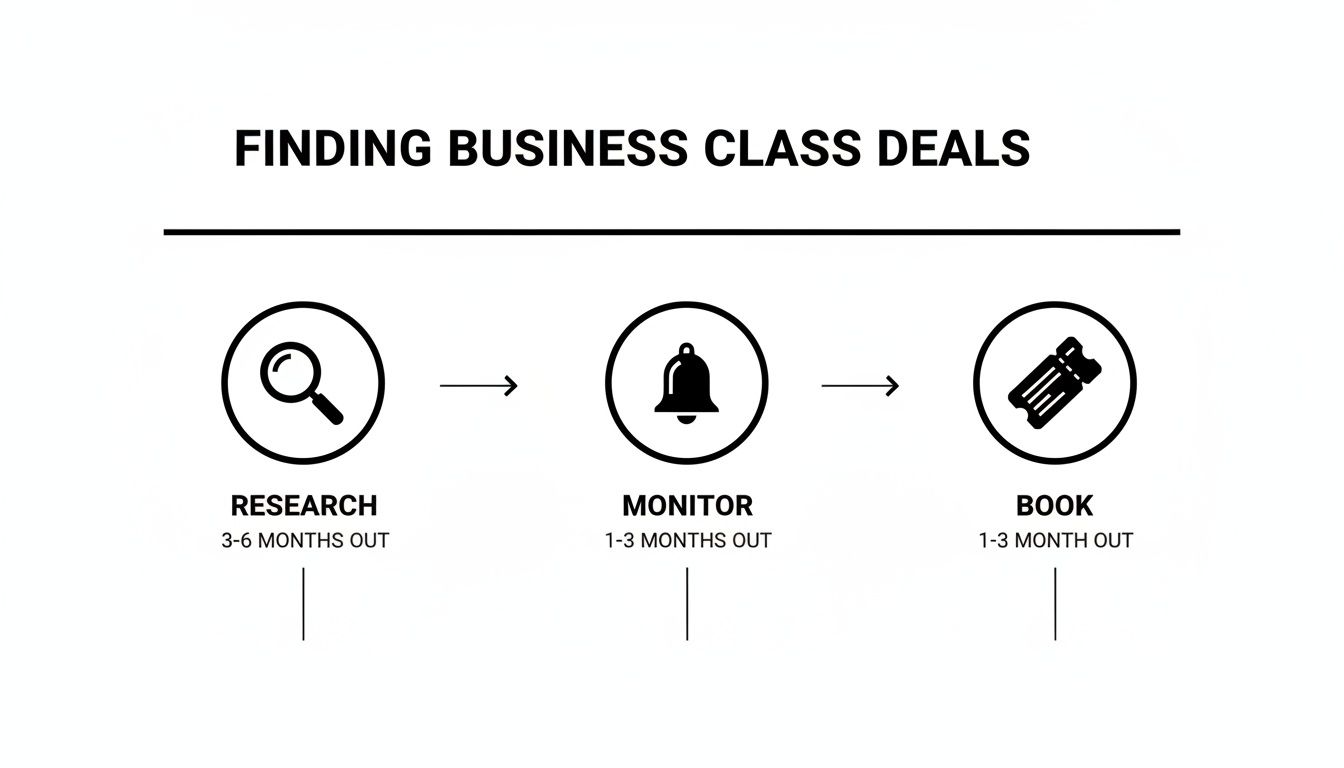
This simple flow—research, monitor, book—is the fundamental rhythm for finding those deeply discounted premium fares.
Five to Three Months Out: Active Monitoring
Now the real work begins. Sarah fires up more aggressive, daily alerts for her target routes. She doesn't just settle for basic notifications; she digs into the advanced calendar views on flight search engines to spot pricing trends across the entire month. It doesn't take long to notice a pattern: fares are consistently about $500 cheaper if she flies on a Tuesday instead of a Sunday.
During this period, she gets an alert from a deal service about a flash sale on TAP Air Portugal through Lisbon. The price is tempting at $3,200, but the connection times are brutal for her schedule. She holds her ground, confident that a better option on a more direct route is coming. Patience is everything right now.
The monitoring phase is a test of discipline. It's so easy to get trigger-happy on a "good" deal, but the real goal is to wait for a great one. By having a clear price target and understanding the market, you can avoid jumping on mediocre offers.
This waiting game is particularly effective on competitive transatlantic routes. The market dynamics are completely different from flights within Europe. Intra-Europe business class has practically vanished over the last decade, dropping from 4.1% of all seats in 2014 to a tiny 0.35% in 2023. But the fierce competition for premium travelers on long-haul flights between giants like Lufthansa, Air France, and KLM creates exactly the kind of price volatility that savvy, patient travelers can use to their advantage. You can learn more about the evolution of European premium cabins from centreforaviation.com.
Three Months to Six Weeks Out: The Buy Signal
Just under three months before her trip, the signal she’s been waiting for arrives. A "Buying Event" notification hits her inbox: Lufthansa and United are in the middle of a mini-fare war on East Coast to Germany routes. The price for her exact dates, Boston to Frankfurt, has cratered to $2,650 round-trip.
She moves fast, verifying the fare on a couple of different sites. It’s real. The price is well below her $3,000 target, the airline is top-tier, and the flight times are perfect. She doesn’t hesitate. In less than 15 minutes, her ticket is booked, locking in a savings of nearly $4,000 off the first price she saw months ago.
Sarah's story isn't about getting lucky. It's proof that a methodical, patient approach to finding a business class to Europe deal really pays off, turning an outrageous luxury into a smart business investment.
You've learned the strategies, you know the tools, and you've seen the proof. But I get it—a few nagging questions probably still come to mind. It's one thing to talk about these deals in theory, another to feel confident enough to go hunt for them yourself.
Let's tackle those last bits of uncertainty. Think of this as the final pep talk before you dive in, because an affordable business class seat to Europe isn't just a fantasy; it's a very real possibility when you know how the game is played.
So, Can You Really Find Business Class Cheaper Than Coach?
Yes, absolutely. While it doesn't happen for every flight every day, the phenomenon of business class being cheaper than coach is a real and repeatable event for those who know how to look. The key is comparing apples to oranges in your favor. A strategically booked, deeply discounted business class fare is often less expensive than a last-minute, inflexible, or full-fare economy ticket.
Picture this: a corporate traveler needs a non-stop to Frankfurt tomorrow. Their company pays the walk-up economy price, easily $2,800. Meanwhile, an airline with too many empty premium seats quietly drops its business class fare to $2,500 to spur sales. It’s a brief, unannounced sale—a pricing anomaly. And that's exactly what we're looking for.
You have to stop thinking about just finding "cheap flights." What you're really hunting for are moments of value inversion—when the premium product temporarily costs less than the standard one.
How Far in Advance Should I Start Looking?
There’s no single magic bullet for timing, but there is absolutely a strategic window that gives you the best shot. Think of it as a phased approach.
- 8-10 Months Out: This is your reconnaissance phase. Start looking at your desired routes and get a feel for the pricing landscape. What's the normal high? What's the low? You're establishing a baseline.
- 3-6 Months Out: This is the sweet spot. Airlines have a solid read on demand by now and start getting serious about filling seats. Prices will fluctuate much more, creating the dips you want to catch.
- 2-4 Weeks Out: Never count out the last minute. If a flight is looking empty up front, carriers sometimes get desperate. They'll slash prices to get some revenue rather than letting a seat fly empty for a total loss.
The key isn't checking once and calling it a day. The market is constantly in motion. You need to keep your eyes open so you can pounce when the right deal appears.
How Flexible Do I Really Need to Be?
Flexibility is your superpower here. The more you can bend on dates and even destinations, the more money you're going to save. It's a simple equation. Flying on a Tuesday instead of a Friday can slice hundreds of dollars off a fare by itself.
But even if your dates are locked in, don't despair. You might miss the absolute jaw-dropping, "fly-anywhere-next-month" deals, but applying these fare-monitoring techniques can still knock 30-50% off the initial prices you were seeing. It's about being strategic within your own constraints.
Are We Talking Budget Airlines or the Real Deal?
Let's be crystal clear: this isn't about cramming into a "premium" seat on a low-cost carrier. We are exclusively targeting top-tier, full-service international airlines. These are the carriers with a true, long-haul business class product.
You'll be finding deals on airlines like:
- Lufthansa
- Air France-KLM
- United Airlines
- British Airways
- TAP Air Portugal
- SAS Scandinavian Airlines
These are the big players locked in a fierce battle for transatlantic passengers. They have large premium cabins to fill, and that competition creates opportunities. The goal here is to get the lie-flat seat, the lounge access, and the high-end service, but at a price that makes you second-guess ever flying coach again. You aren’t trading quality for a low price; you're using market intelligence to get that quality for less.
Ready to stop overpaying for comfort? At Passport Premiere, we specialize in providing the intelligence and alerts that turn market volatility into your advantage. Discover how our members consistently find business class fares for less than coach and transform the way you travel. Learn more and start your journey at https://www.passportpremiere.com.
