
It’s a common misconception that premium travel has to be prohibitively expensive. While the conventional wisdom suggests booking two to four months before an international flight, the real game is about understanding the system. Believe it or not, with the right strategy, you can often find business class tickets for less than what people pay for a last-minute economy seat.
Your Quick Guide to Finding Business Class Deals

Stop thinking you have to overpay for comfort. Securing a great deal on a business class seat isn't about getting lucky; it's about strategy and timing. Too many travelers just assume those front-of-the-plane seats are set at sky-high prices, but that’s rarely the whole story.
Airlines almost never sell out their premium cabins at the initial asking price. Think about it: an empty business class seat is like a piece of fruit about to go bad. Once that plane door closes, its value plummets to zero. This pressure creates "value windows"—specific times when airlines get motivated and slash prices to fill those seats.
Unlocking the Value Windows
These windows of opportunity aren't random. They're tied to predictable cycles in travel demand and the airline's own inventory management. If you learn to spot these patterns, you can put yourself in the perfect position to jump on a significant price drop.
This completely changes the equation. Suddenly, luxury travel isn't just a splurge; it's a smart purchase. Why would you pay a fortune for a cramped economy seat booked at the last minute when a well-timed business class ticket could get you a lie-flat bed, sometimes for less? It’s all about shifting your mindset from just booking a flight to strategically hunting for a deal.
The core principle is simple: An airline would rather sell a premium seat at a deep discount than fly it empty. Your goal is to identify the exact moment they become motivated to sell.
The Myth of Last-Minute Deals
Sure, last-minute bargains can happen, but counting on them is a high-risk gamble. The most reliable savings come from planning ahead and knowing what signs to look for. To do this, you have to understand how airline pricing actually works. Here are the fundamentals:
- Premium Seats are Perishable: Every unsold seat is revenue the airline can never get back. This creates leverage for savvy travelers as the departure date gets closer and seats remain unsold.
- Demand Drives Everything: Fares crater during "dead zones," like the lulls right after a major holiday. When corporate travelers stay home, airlines have to compete for leisure passengers with much lower prices.
- Timing Trumps Loyalty: While your airline status has its perks, nothing beats buying at the right moment. The best deal comes from knowing when to book, not just who to fly with.
This guide will break it all down, giving you the tools to find the absolute best time to buy business class tickets. Once you learn to spot these value windows, you can consistently fly in comfort without paying the premium price.
To get started, let's summarize the key booking periods you should be watching.
Key Timing Windows for Business Class Savings
This table outlines the most effective booking periods and seasonal opportunities to find discounted premium fares. While not every window applies to every route, these are the patterns that consistently yield the best results.
| Booking Window | Typical Savings Potential | Best For |
|---|---|---|
| 2-4 Months Out (International) | 15-25% | The most reliable "sweet spot" for international long-haul flights. |
| 6-8 Months Out (Peak Season) | 10-20% | Locking in holiday or summer travel before demand spikes. |
| Mid-Week (Tues/Wed) | 5-15% | Finding lower fares when airlines launch weekly sales. |
| "Dead Zones" (Post-Holiday) | Up to 40% | Snagging deep discounts for travel in Jan-Feb or Sep-Nov. |
| 21-60 Days Out (Domestic) | 10-20% | The ideal window for finding value on U.S. domestic routes. |
Remember, these are guidelines, not rigid rules. The real key is to combine this timing knowledge with active monitoring to catch the deals as they appear.
Why Business Class Prices Constantly Change
Ever watched a business class fare jump from $3,000 to $7,000 and back down again in a few short weeks? It looks like chaos, but there’s a method to the madness. Airline pricing isn't about setting a simple price tag; think of it more like a high-stakes auction where the opening bid is almost never the final sale price.
The real reason for this wild ride is simple: an airline seat is one of the most perishable products on earth. The second that cabin door closes, an empty seat—especially a premium one—loses 100% of its value. Forever. A hotel can sell an empty room tomorrow, but an airline can't sell yesterday's flight. That reality puts immense pressure on them to fill every single seat, which means they are constantly tweaking prices based on what’s happening in real-time.
This is where the opportunity lies for anyone paying attention. The game isn't just about booking a flight; it’s about figuring out when the airline's desperation to sell is at its absolute peak.
The Forces Driving Fares Down
Airlines live and die by a practice called yield management, which is just a fancy term for squeezing the most possible revenue out of a fixed number of seats. Their dream is to sell every seat at the highest price, but reality often gets in the way. Several powerful forces can push those prices down, sometimes even making business class cheaper than coach.
Three main things make this happen:
- Unsold Inventory: As a flight gets closer, the airline's computers start getting nervous about empty seats. A business class cabin that’s only 40% full two months before departure is a massive red flag. This often triggers automatic price drops to get people booking.
- Booking Velocity: This is all about how fast seats are selling compared to how fast they should be selling based on past flights. If sales are sluggish for a particular New York to London flight, the system will lower fares to speed things up and get back on track.
- Competitive Pressure: If British Airways suddenly launches a big sale, you can bet Virgin Atlantic and United will quietly match those prices to avoid losing customers. They won't send out an email blast about it, but this creates a silent fare war where the only winner is the traveler who spots it.
Here's the secret: an airline's biggest fear is an empty premium seat. That fear is the single most powerful force that creates the deals we all look for.
Timing the Market with Seasonal Data
Beyond what's happening on a specific flight, the calendar plays a huge role. Demand for those lie-flat seats isn't steady year-round; it has predictable peaks and valleys thanks to holidays, school breaks, and business travel cycles. This creates "dead zones" where you can score incredible deals.
For instance, did you know that booking a business class trip in January or April could save you $2,000 to $3,000? It's true. Our analysis consistently shows that December and July are total nightmares for premium fares, with prices jumping 30-60% on most big international routes out of the US. But here’s the kicker: fewer than 15% of all premium cabin seats ever actually sell at those ridiculous peak prices. Airlines almost always have to drop fares later to fill up the plane. You can see how this works by exploring the latest worldwide business class flight data.
In the end, every price you see is just a measure of the airline's confidence. High prices mean they're feeling pretty sure the flight will sell out. But when you see those prices start to fall, that's a signal of their rising anxiety about flying a half-empty—and unprofitable—premium cabin. Once you understand that, you can stop just reacting to fares and start anticipating the drops.
It's one thing to know that airline prices are always in flux; it's another thing entirely to know when they’re most likely to drop. These aren't just random dips. They are predictable windows when the balance of power shifts from the airline to you, the buyer.
Nailing these moments is how you turn theory into real savings on business class tickets.
Certain times of the year are notorious for weak travel demand. Industry insiders call them "dead zones." This is when corporate travelers are home, the holiday crowds have vanished, and airlines are suddenly sitting on a lot of empty, expensive seats.
Think about the weeks right after a major holiday. Demand plummets, and airlines get aggressive with their pricing to get people booking again.
Capitalizing on Seasonal Dead Zones
The most reliable dead zones pop up at the same time every year, creating some fantastic opportunities if you have a bit of flexibility.
- January and February: Right after the New Year's madness, both business and leisure travel grind to a halt. Airlines often roll out big sales to fill planes during this deep freeze.
- The Post-Thanksgiving Lull: That sweet spot between the end of November and mid-December is another prime window. Most people are done with their Thanksgiving travel but haven't left for Christmas yet, causing a short but valuable dip in fares.
- Autumn Shoulder Season: September and October, after the summer vacation rush but before the holiday season really kicks in, often see a drop in demand and lower prices, especially on routes across the Atlantic.
This chart really brings the point home, showing just how much seasonal demand can swing business class fares. You can see the massive price difference between peak and off-peak months.
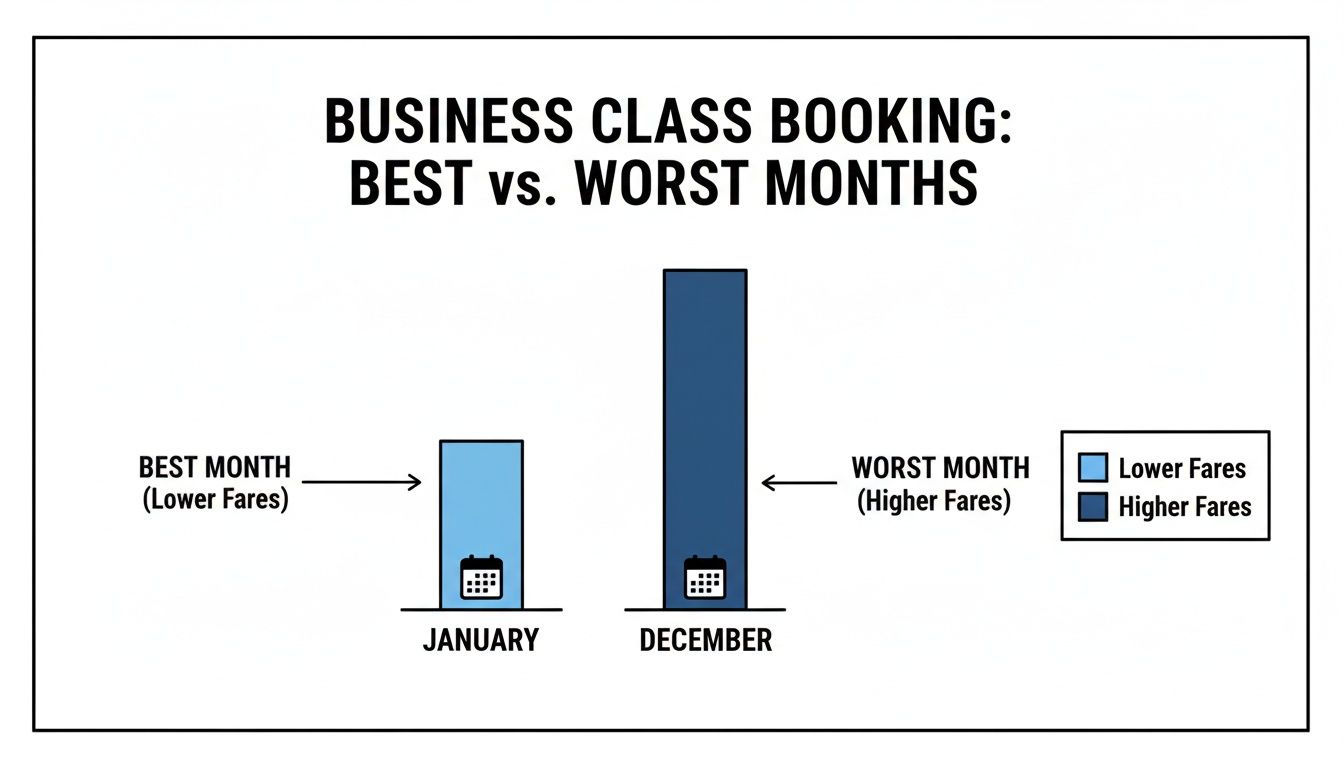
As the numbers show, flying in a low-demand month like January can save you a bundle compared to the sky-high prices you'll see during peak times like December.
The Ideal Advance Purchase Window
Beyond the time of year, when you book relative to your departure date is a huge factor. Book way too early, and you might be paying an inflated opening price. Wait too long, and you're gambling with last-minute surge pricing.
For international travel, the sweet spot is generally two to four months in advance. This window often hits the perfect balance. By this point, airlines have a pretty clear idea of their unsold seats. If sales are sluggish, they’ll start strategically lowering fares to drum up business before the last-minute scramble.
This two-to-four-month period is when an airline’s confidence starts to waver if a flight isn't selling. It's the point where their automated pricing systems are most likely to trigger fare drops to stimulate demand.
The idea is to time your search for the exact moment an airline's motivation to sell spikes. You're not guessing; you're positioning yourself to act when the data says a price drop is likely. This logic applies to more than just flights—understanding these windows is key to smarter travel planning all around. For example, knowing the 9 best time to book hotels strategies can save you just as much on the ground.
The Counterintuitive Last-Minute Opportunity
Now, while banking on last-minute deals is usually a bad idea, they absolutely exist. For the truly flexible traveler, they can offer incredible value. This approach is the complete opposite of planning ahead, but it works on the same core principle: an airline’s fear of an empty seat.
In the final one to three weeks before departure, if a premium cabin has a lot of unsold seats, the airline might slash prices. They’d rather get something for that seat than fly it empty.
This is a high-risk, high-reward game, though. If the flight sells out, those last few seats will be astronomically expensive. This tactic is really only for travelers who have:
- Extreme Flexibility: You're open to tweaking your dates or even your destination to chase a deal.
- A High-Risk Tolerance: You have to be okay with the possibility of paying a fortune—or not going at all—if a deal never shows up.
By combining an understanding of these seasonal dead zones, the ideal booking window, and the potential for a last-minute score, you can build a solid strategy. You'll stop reacting to fare changes and start proactively targeting the moments when airlines are most likely to give you the best price.
How to Spot Fare Wars and Unannounced Price Drops
While good timing is your foundation for finding a decent fare, the most jaw-dropping savings come from a bit of market chaos. I’m talking about fare wars—those brief, intense moments when airlines get into aggressive price battles.
Spotting them is how you snag those massive, unadvertised discounts on business class seats.
Forget the splashy "50% Off!" banners you see plastered everywhere for economy sales. In the world of premium cabins, fare wars are quiet, almost secretive. One airline will discreetly drop its price on a competitive route. Within hours, its rivals have no choice but to silently match it, or risk losing their most valuable customers.
These skirmishes are almost never announced. They play out behind the scenes, visible only to people who are really watching the fares. This is where finding the best deal shifts from a passive waiting game to an active hunt.
Reading the Telltale Signs
A fare war doesn't just pop up out of nowhere. It's almost always a reaction to specific market pressures that throw the usual pricing off-kilter. If you learn to recognize these triggers, you can get a sense of when a route is ripe for a price drop.
Three things, in particular, tend to kick off a fare war:
- A New Airline Enters a Route: Picture a new carrier launching a New York to Paris route. They have to steal customers from the established players like Air France and Delta. The easiest way to do that? Launch with aggressively low introductory business class fares, forcing the big guys to drop their prices to compete.
- An Existing Carrier Adds Capacity: Let's say an airline swaps a smaller plane for a larger one on a particular flight. All of a sudden, they have a bunch of extra premium seats to fill. When supply goes up but demand stays the same, prices often have to come down to get those seats filled.
- A "Shot Across the Bow" Price Drop: This is when one airline tests the waters by dropping its price significantly on a key route. It's a strategic move to see how competitors will react. If they follow suit, you've got a full-blown fare war on your hands, with prices tumbling for a few days—or even just a few hours.
The core of a premium fare war isn't a public sale; it's about competitive survival. Airlines are cornered into matching a lower price or risk losing their most profitable passengers to a rival. Your job is to be there when they flinch.
Why Active Monitoring Is Your Best Weapon
These unannounced price drops are incredibly fleeting. You can't just check fares once a week and hope you get lucky. The best business class deals born from these skirmishes can appear and disappear within 24 to 48 hours. Sometimes, they don't even last through the night.
This is where fare monitoring tools and alert services become absolutely essential. They’re your eyes on the market, tracking prices 24/7 and letting you know the second a significant drop happens. Without that constant vigilance, you're almost guaranteed to miss these brief but incredibly valuable opportunities.
The gap between a good fare and a truly spectacular one often comes down to acting on intelligence gathered through meticulous observation. For a deeper dive, you can explore the perspectives of industry veterans like Phil S., a retired airline captain, who have seen firsthand the operational pressures that force these pricing decisions.
Ultimately, catching these secret sales requires a two-pronged attack. First, understand the market conditions that create them, like new competition or added flight capacity. Second, use active monitoring so you’re ready to pounce the moment an airline makes its move. This proactive strategy is how savvy travelers consistently turn market volatility into their own personal travel discount.
Proven Tactics for Securing Business Class Cheaper Than Coach
It sounds like a tall tale from a frequent flyer forum, but it’s a reality savvy travelers cash in on every single day: booking a lie-flat business class seat for less than a standard economy ticket. This isn't about some rare glitch in an airline's matrix. It’s about knowing how the game is played and recognizing when a discounted premium seat offers infinitely more value than a full-fare coach ticket.
The trick is to completely reframe how you think about airfare. Stop comparing the sticker price of business class to the cheapest economy fare you can find. Instead, pit a strategically purchased, discounted business ticket against the sky-high cost of a last-minute or inflexible economy seat. You’d be surprised how often the difference is minimal—and sometimes, the premium seat is genuinely the cheaper option.
The Value Proposition of a Discounted Premium Fare
Picture this common scenario: someone needs a last-minute flight from Chicago to London. An economy ticket, booked just days out, could easily set them back $2,400. For that price, they get a standard seat, zero flexibility, and all the usual joys of a long-haul flight in the main cabin.
Now, imagine another traveler who had been watching that same route for weeks. They saw a business class fare drop during a lull in demand and snagged a seat for $2,200. For $200 less, they get lounge access, priority everything, a lie-flat bed, and chef-curated meals. They arrive rested and ready to go. That, right there, is the essence of value-based booking.
The goal isn't just to find a cheap flight; it's to secure the maximum amount of comfort and convenience for the lowest possible price. A discounted business class ticket often represents the pinnacle of this value equation.
This opportunity pops up most often on hyper-competitive, high-traffic routes where airlines are constantly tweaking prices to one-up their rivals. Learning to spot these routes is your first step. For a deeper dive, check out our guide on finding cheap international business class flights.
Identifying Routes with High Premium Competition
The secret to this whole strategy lies in finding routes with cutthroat competition. When a half-dozen carriers are all fighting for the same premium passengers between two cities, they’re far more likely to quietly drop prices to fill those front cabins.
You'll want to focus on routes connecting major international business hubs. Think places like:
- New York (JFK) to London (LHR): The classic battleground. You've got British Airways, Virgin Atlantic, American, and United in a constant tug-of-war for business travelers.
- Los Angeles (LAX) to Tokyo (NRT/HND): A crowded field with a mix of top-tier Asian and North American airlines all vying for a piece of the transpacific pie.
- Singapore (SIN) to Sydney (SYD): A crucial artery for both business and leisure travel where competition keeps the big players honest.
On routes like these, a slight dip in demand or an oversupply of premium seats can trigger some seriously aggressive pricing. Even on domestic coast-to-coast flights, like New York to Los Angeles, we've seen business class fares bounce between $950 and $1,400 during airline sales.
Cost vs. Value: A Business Class Scenario
To really see how this plays out, let's put the two options side-by-side. The table below breaks down what your money actually gets you, showing why a discounted business ticket delivers a far better return on your travel investment.
| Feature | Discounted Business Class | Full-Fare Economy Class |
|---|---|---|
| Seat & Comfort | Lie-flat bed, personal space | Standard seat, limited legroom |
| Airport Experience | Priority everything, lounge access | Standard lines, crowded gates |
| Onboard Service | Multi-course dining, premium drinks | Standard meal, limited options |
| Productivity | Ample workspace, power, Wi-Fi | Cramped, difficult to work |
| Arrival Condition | Rested, refreshed, ready to go | Fatigued, jet-lagged, stressed |
Looking at it this way, the choice becomes pretty clear. When the price gap closes, the value gap becomes a chasm. While these strategies are gold for premium cabins, it always pays to have a solid foundation in general booking tactics. For a great all-around primer, you can learn how to find cheap flights with a comprehensive airfare savings guide.
Your Action Plan for Smarter Business Class Booking
Knowing the why behind business class pricing is one thing. Actually turning that theory into a lie-flat seat at a fantastic price is a whole different ballgame. All the data in the world means nothing without a clear, repeatable game plan.
This is your blueprint. It’s how you shift from being a passive observer, waiting for a price to be shown to you, to becoming an active deal hunter who makes the system work for them. We're going to stop reacting and start making deliberate, informed moves that consistently land premium seats for a fraction of what everyone else pays.
Your Step-By-Step Booking Checklist
Before you even start hunting for your next flight, walk through this process. It takes everything we’ve talked about and boils it down into a simple workflow designed to get you the best price with the least amount of stress.
Define Your Flexibility First: Seriously, before you do anything else, figure out where you can bend. Can you shift your travel dates by a week? Is flying on a Tuesday instead of a Friday an option? Every little bit of flexibility is a lever you can pull to find a much lower fare.
Establish a Price Baseline: Start looking at your route at least six months out. The goal here isn't to buy early—it's to learn what a "normal" price looks like. Without this baseline, you'll have no idea if a price drop is a genuine deal or just noise.
Set Up Automated Fare Alerts: Get technology to do the heavy lifting. Use a few different fare tracking tools to watch your route. Set alerts for your perfect dates, but also for the entire month you want to travel. This way, you get an instant ping the moment a price drops.
The ultimate takeaway is simple: patience and preparation are your greatest assets. The best deals reward travelers who do their homework and are ready to act decisively when the perfect opportunity arises.
Recognizing the Buy Signal and Acting Fast
Once your alerts are set, the game is all about pattern recognition. You’re watching for the signals we've discussed—a brewing fare war, a seasonal dip, or an airline getting nervous about an undersold cabin. When an alert pops up showing a price that’s significantly below the baseline you established, that's it. That’s your signal to move.
These deals almost never last. You can learn more about how to spot them on competitive routes by reading up on business class tickets to Europe.
The key is having your decision-making framework ready before the deal appears. Once a fare hits your pre-determined "this is a great price" number, book it. Don't second-guess. This is how you transform from a price-taker into a strategic buyer who never overpays for a premium seat again.
Common Questions About Finding Business Class Deals
Even the most seasoned travelers have questions when it comes to timing their premium cabin purchase just right. Let's tackle some of the most frequent questions we hear, so you can book your next trip with the confidence of a pro.
Can Business Class Really Be Cheaper Than Coach?
Believe it or not, yes. And it happens more than you'd think. This isn't just a myth; it's a strategic opportunity.
The magic happens when you pit a deeply discounted business class fare against a full-fare, last-minute coach ticket. A non-refundable economy seat bought a few days out can easily soar past the price of a lie-flat business seat you snagged during a fare sale months earlier. For example, a last-minute economy flight to Europe can easily cost $2,500, while a well-timed business class deal might be found for $2,200.
The trick is to reframe your comparison. When the price gap between that expensive, inflexible coach seat and a comfortable business class seat shrinks—or even disappears—the value proposition becomes impossible to ignore.
Is It a Myth That Two One-Way Tickets Can Be Cheaper?
Not at all. While the old wisdom was that round-trips always offered the best value, that rule has been broken for years. For business class travel, you should always price out two separate one-way tickets, especially on competitive international routes.
Sometimes, often during a fare war or when you're open to mixing airlines, booking two one-ways can slash the total cost significantly compared to a standard return ticket. This approach gives you far more flexibility and can uncover deals you’d never see in a simple round-trip search.
Pro Tip: The best part of booking two one-ways is mixing and matching carriers. You can grab a fantastic outbound deal on one airline and pair it with a great return fare on another, letting you cherry-pick the best prices for your entire journey.
How Far Out Should I Start Watching Fares?
For any long-haul international trip, start looking about six to eight months ahead of time. The point here isn't to buy that early—it's to do your homework. This is how you establish a baseline and learn what a "normal" price looks like for your specific route.
Once you know that baseline, you'll immediately recognize a genuine price drop when it hits. Active monitoring puts you in the perfect position to pounce when the prime booking window—usually two to four months out—arrives. You'll also be ready to catch those unpredictable flash sales that most other travelers completely miss.
Are Last-Minute Business Class Deals a Real Thing?
They absolutely are, but it's a high-stakes game. These deals usually pop up one to three weeks before a flight when an airline has a painful number of unsold premium seats. Faced with flying that seat empty, the carrier would much rather sell it at a deep discount than get nothing for it.
Here’s the catch: it's a huge gamble. If that flight ends up selling well, those last-minute seats will be priced astronomically high. This strategy is only for travelers with maximum flexibility in their dates and even their destination. For everyone else, it’s a recipe for overpaying.
Ready to stop guessing and start saving? Passport Premiere gives you the intelligence to find business class deals consistently. We monitor the market so you can book with confidence, often for less than the cost of a last-minute coach ticket. Discover how our members save on premium travel at https://www.passportpremiere.com.
