How to Book Cheap Business Class Flights in 2026

Booking a business class flight is simpler than most people think. It's not about blind luck; it's about being flexible, using loyalty points smartly, and keeping an eye out for those sudden, unannounced price drops. The real secret is that airlines often sell premium seats for much less than you'd imagine—sometimes even less than a last-minute coach ticket—if you know precisely when and how to look.

Yes, Business Class Can Be Cheaper Than Coach

Airplane business class interior with a laptop and notebook on a tray table, indicating a productive flight.

It sounds completely backward, but snagging a business class seat for less than a last-minute economy ticket is a very real phenomenon for savvy travelers. This isn't a fluke. It's about understanding the chaotic world of airline pricing and making it work for you. Let's dismantle the myth that premium cabins are always outrageously expensive and show you how business class can be cheaper than coach.

The reality is, airline pricing is pure supply and demand at its most volatile. For long-haul international flights, carriers would much rather sell a premium seat at a huge discount than let it fly empty. This creates a fascinating—and exploitable—market where prices are in constant flux, often making business class cheaper than coach fares bought at the last minute.

The Myth of Full-Price Fares

Here's an insider secret that changes the entire game: very few people ever pay the initial, sky-high price for a premium seat. In fact, industry data shows that fewer than 15% of all business and first-class seats are sold at the full "walk-up" rate. That means the overwhelming majority of those seats sell at a discount, creating a buyer's market for those who are paying attention.

This is where the opportunities lie. When an airline is struggling to fill its fancy seats, it will quietly drop fares to lure in buyers without publicly devaluing its premium product. At the same time, last-minute economy fares are skyrocketing. This is the moment a strategic traveler swoops in and finds business class cheaper than coach.

The goal isn't just to find a deal. It's to figure out the true market value of that empty premium seat. This shift in mindset is what separates casual flyers from the pros who consistently find business class cheaper than coach.

How Pros Turn Complexity into Savings

Corporate travel managers and seasoned globetrotters don't just search for flights—they analyze the market. They know a flight from New York to London can have dozens of different price points depending on the day of the week, the time of year, and even the hour you book.

They use a mix of knowledge and tools to get the upper hand:

  • Fare Monitoring: They don't waste time manually checking prices. They set up automated alerts that notify them the second a route drops into their target price range.
  • Market Intelligence: They spot patterns, like when fare wars erupt between rival airlines on popular routes, which temporarily tanks prices for everyone.
  • Strategic Flexibility: They understand that shifting travel dates by just a day or two, or flying out of a nearby airport, can easily unlock savings of 50% or more.

When you start adopting these professional strategies, you stop being a passive consumer who just accepts the first price they see. You become an active player who knows how to book cheap business class flights by using the industry's own complexity against it. This guide will show you how to start, proving that luxury and savings can absolutely go hand-in-hand.

It’s All About Timing and a Little Bit of Wiggle Room

A person types on a laptop displaying a calendar, holding a phone, next to a passport, with 'TIMING MATTERS' text.

If there's one secret weapon you need to book cheap business class flights, it’s timing. So many travelers operate under the myth that booking as far in advance as possible locks in the best price. I’m here to tell you that for premium cabins, this is almost never true.

Airlines often release their first batch of business class fares at sky-high prices, targeting corporate travelers who need to secure specific dates and are willing to pay for it. But as the departure date gets closer, those unsold seats become a liability. That's when pricing gets interesting.

This is where you gain the upper hand. Instead of booking a year out, the real magic happens in the "smart window"—that data-backed sweet spot when airlines are most likely to discount fares just to fill their remaining business class inventory.

Hitting the Booking Sweet Spot

The key is to sidestep both the ridiculous initial prices and the last-minute surge when desperate travelers will pay anything. For most international routes, this booking window usually falls between 6 and 10 weeks before your trip. Getting your tickets in this timeframe positions you perfectly to catch major fare drops without risking a sold-out cabin.

Recent data shows this is the new normal. Even corporate travelers, who once booked much closer to their travel dates, are adapting. In key European markets like Belgium and the Netherlands, intercontinental flights are now booked an average of 39.2 and 34.8 days in advance, respectively—a huge shift from 2019. They're doing it to get better availability and savings, and it's a strategy you can easily borrow.

Your booking date isn't just a logistical detail; it's a strategic move. Shifting from a passive ticket buyer to a proactive deal hunter means you have to play these fare cycles to your advantage.

Capitalizing on Seasonal and Daily Lulls

Beyond the booking window, when you actually fly has a massive impact on the price tag. Just like with economy tickets, premium cabin fares swing wildly based on demand.

  • Fly on Off-Peak Days: Business travelers tend to fly out on Mondays and return on Fridays. If you can fly on a Tuesday, Wednesday, or Saturday, you can often find significantly cheaper seats on the exact same plane.
  • Target Seasonal Lows: The period right after major holidays is a goldmine. Look for deals during the "dead weeks" in January, early February, or the late-August-to-September slump when demand dries up.
  • Avoid Major Holidays: This one’s a no-brainer. Trying to fly right before Christmas or in the middle of summer is a recipe for inflated fares. Airlines know people will pay, so they charge accordingly.

The Power of Being Flexible

Flexibility is the currency of the savvy traveler. While timing your purchase is a huge piece of the puzzle, being flexible with your actual travel plans can unlock the deepest discounts imaginable.

Let's say you need to fly from Chicago to Frankfurt. A rigid search for a non-stop on October 15th might show you a $5,500 fare. Ouch. But with just a little flexibility, you could uncover a $2,800 fare by making a few simple tweaks:

  1. Shift Your Dates: Check prices for October 14th or 16th. A single-day shift can literally save you thousands.
  2. Consider Nearby Airports: What about flights from Milwaukee (MKE) or into Munich (MUC)? The savings on the airfare might completely dwarf the cost of a short train ride.
  3. Accept a Connection: A one-stop flight through another European hub like Amsterdam or Paris is almost always dramatically cheaper than a non-stop route.

This small amount of flexibility changes the game. You're no longer just finding a flight; you're finding a deal. For a much deeper dive into these strategies, check out our guide on the best time to buy international flights. When you combine the right booking window with a flexible itinerary, you put yourself in a position to snag business class fares that most people will simply never see.

Unlocking Value with Loyalty Programs and Alliances

A smartphone displaying a travel app next to a stack of credit cards for maximizing miles.

Sure, timing and flexibility can save you money. But if you want to know the real secret to flying up front for less, it’s this: start treating your frequent flyer miles like the valuable currency they are.

Too many travelers let their points expire or cash them in for cheap economy seats, completely missing the enormous value they hold. It's time to shift your mindset. Your miles aren't just a small rebate; they are your ticket to the front of the plane.

The math is simple. A business class seat might cost 3x to 4x more than economy if you're paying cash. But when you use miles? The difference is often much, much smaller. This gap is where savvy flyers find incredible deals, effectively turning their credit card points into a lie-flat bed on a 10-hour flight.

This isn't about just earning miles—it's about knowing exactly how and when to redeem them. It’s a strategy, not just a perk.

Leveraging Alliances for Maximum Reach

One of the biggest mistakes I see is people thinking their United miles are only good for flying on United. The true power of these programs is unlocked through airline alliances, which let you use one airline's miles to book flights on dozens of partners.

This opens up a whole world of possibilities.

The three major global alliances you need to know are:

  • Star Alliance: A massive network including United, Lufthansa, Singapore Airlines, and Air Canada.
  • oneworld: Home to heavy-hitters like American Airlines, British Airways, Cathay Pacific, and Qatar Airways.
  • SkyTeam: Features major carriers like Delta, Air France, KLM, and Korean Air.

What does this mean in practice? It means your American Airlines AAdvantage miles aren't just for a trip to Miami. They could get you a seat in Japan Airlines' fantastic business class to Tokyo. The trick is knowing which partners have award seats available and offer the best redemption rates for your route.

Turning Credit Card Points into Premium Seats

Here's a hard truth: the fastest way to rack up a ton of miles isn't by flying. It's from your credit cards.

Cards with transferable points programs—think American Express Membership Rewards or Chase Ultimate Rewards—are the gold standard. These points are like a universal travel currency that you can send to a long list of airline partners.

This flexibility is everything. Let's say you spot a great business class award seat on an Air France flight. You can just transfer your Chase points directly to the Air France/KLM Flying Blue program and book it. This keeps you from being locked into a single airline, so you can jump on the best deal no matter who is flying.

The goal is to build a powerful reserve of points from different sources—flying, credit card sign-up bonuses, and everyday spending. That way, you always have the right type of points ready to transfer when a great redemption opportunity pops up.

Mastering the Art of the Upgrade

Sometimes, the smartest route to business class isn't booking it outright, but by upgrading a cheaper economy ticket. Free upgrades are mostly a thing of the past, but using miles or cash can still be a fantastic deal.

Many airlines will let you confirm an upgrade right away if there’s space, turning a reasonably priced coach fare into a premium experience.

Here are a few ways to play this:

  • Using Miles for Upgrades: This is one of my favorite ways to use points, especially on long-haul flights where the comfort makes a huge difference.
  • Cash Bids: Some airlines will email you before a flight inviting you to bid on an upgrade. I’ve found that a bid around 25% over the minimum often gives you a solid chance.
  • Positioning Flights: Can't find a decent award ticket from your home airport? Look for availability from a bigger hub. Booking a separate, cheap flight to "position" yourself at that airport can slash the number of miles you need for the main international leg.

These strategies take a bit more legwork, but the payoff is huge. To really get into the weeds, you can learn more about how to get upgraded to business class in our detailed guide. By combining smart points transfers, strategic upgrades, and a little creativity, you’ll find yourself flying in business class for a price you never thought was possible.

Advanced Strategies the Pros Use to Find Deals

Ready to think like a travel hacker? The real secret to finding business class for less than a last-minute coach ticket isn't just about flexible dates. It's about outsmarting the airline's own pricing systems by using the structure of airfare against itself.

These aren't shady loopholes. They're legitimate booking methods that airlines have, but don't exactly broadcast. Mastering them is what separates the casual traveler from the pro who consistently finds business class cheaper than coach.

Exploiting Fare Wars and Price Drops

Fare wars are a savvy traveler's absolute best friend. This is when competing airlines on a popular route start a price-slashing war, aggressively undercutting each other to steal market share for premium seats. These battles can be incredibly short-lived—sometimes just a few hours—but they can drop prices by 50% or even more.

The key is being poised to strike the moment one kicks off. Trying to find these manually is a fool's errand, which is why automated fare monitoring is so critical. A perfectly timed alert can literally be the difference between paying $6,000 and $2,800 for the exact same seat.

This is happening more and more as competition heats up. For instance, in 2025, the average business class fare from New York to London dipped to $2,800, a 12% decrease from 2023. That's no fluke. It’s driven by airlines flooding major routes with more premium cabins, forcing them to get aggressive with pricing to avoid flying with empty seats. You can see more of the data behind these trends in business class flight data on SeattlesTravels.com.

Outsmarting Algorithms with Creative Routing

Here’s a core principle: airlines price flights based on demand between two specific cities (the "O&D pair"). If you can break that simple A-to-B pattern, you can often unlock dramatically lower fares.

This is where strategies like open-jaw and multi-city itineraries become your secret weapons.

  • Open-Jaw Tickets: This just means you fly into one city and out of another. Think New York to Paris, then you take a train to Amsterdam and fly home from there. This setup can be much cheaper than a standard round-trip to Paris because you aren't fighting for a seat on the same high-demand return flight.
  • Multi-City Itineraries: This lets you build a more complex trip with several stops. It sounds counterintuitive, but sometimes adding a third, short flight to your itinerary can paradoxically slash the total cost of your long-haul legs. It's all thanks to the wonderfully complex world of fare construction rules.

These techniques work by forcing the airline's pricing engine to pull from different "fare buckets," often tapping into cheaper inventory that would never show up on a simple round-trip search.

How a Fare War Made Business Class Cheaper Than Coach

A consultant I know, based in Chicago, needed to get to Frankfurt for a client meeting. A basic round-trip search on United was showing business class fares stuck around $6,200. Way too high.

She set a fare alert and waited. A week later, an alert popped up: Lufthansa, trying to crush a new competitor, had dropped its Chicago-Frankfurt business class fare to $2,900. United matched it almost instantly. She booked it on the spot, nabbing a seat for less than half the original price—and get this, it was cheaper than a last-minute economy ticket, which was going for over $3,100.

To give you a clearer picture, let's compare how a typical booking approach stacks up against these more advanced strategies.

Fare Strategy Comparison: Traditional vs. Advanced

The table below breaks down the difference in mindset and outcome when booking a hypothetical business class flight from New York (NYC) to London (LHR).

Strategy Booking Method Typical Cost (NYC-LHR) Flexibility Required Potential Savings
Traditional Simple round-trip search on an airline site or OTA. $5,000 – $8,000 Low – Fixed dates Minimal
Advanced Fare alerts, multi-city/open-jaw, timing fare drops. $2,500 – $4,000 Medium to High 50% or more

As you can see, a little bit of strategic thinking completely changes the economics of flying business class. It's not about luck; it's about method.

Leveraging Complex Itineraries for Big Savings

Building on these ideas, you can really start to play with multi-city booking tools. Instead of just searching A to B, start plugging in A to B, then B to C, all on one ticket. Yes, it takes more work, but the results can be absolutely stunning. For an even deeper dive into fare reduction tactics, check out our guide on how to save money on international flights.

These methods require a fundamental shift in how you search for flights. You're no longer just a passenger looking for a ride; you're an analyst hunting for pricing inefficiencies. Once you understand how fare wars ignite and how complex routing disrupts the norm, you're positioned to find deals the average traveler will simply never see.

Your Action Plan for Finding Business Class Bargains

Alright, let's turn all this theory into a repeatable process. Having a solid game plan is what separates the wishful thinkers from the people who actually snag premium seats at a huge discount. This is your new workflow, a way to approach your next flight search with the precision of a seasoned pro.

The idea is to stop passively searching and start proactively hunting. That means setting up the right alerts, knowing which tools give you the best bird's-eye view of fares, and being able to quickly decide if cash or points makes more sense. It’s about building a system.

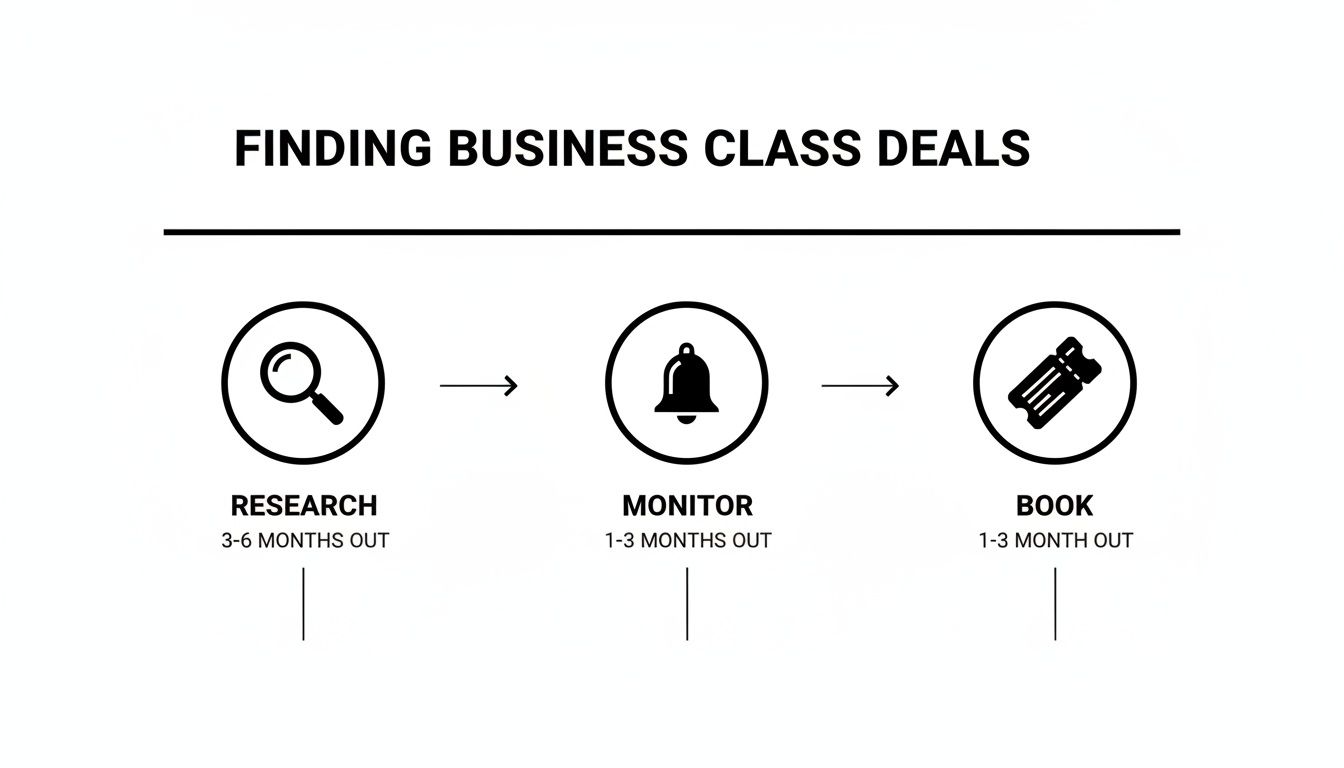
This is the kind of pro-level process the experts use, layering different strategies to find those elusive deals.

A visual guide illustrating a three-step professional deal-finding process for flights.

The real secret? The biggest savings come from combining tactics. You can't just rely on one trick. It's about spotting fare wars, getting creative with open-jaw routes, and using multi-city bookings all together.

Laying the Groundwork for Your Search

Before you even think about typing a destination into a search bar, get your tools lined up. You can't possibly track every single fare fluctuation on your own—that’s where automation comes in.

Start by setting up targeted fare alerts for your most common or dream routes. Don't just set one for "New York to London." Get granular. Create alerts for multiple airport combinations (think JFK/EWR to LHR/LGW) and for a wide range of dates if you’re flexible. This casts a much wider net and seriously ups your chances of catching a sudden price drop.

Next, get comfortable with flexible date search tools. Most good flight search engines let you see prices across an entire month. Just this one step can show you that flying on a Wednesday instead of a Monday could save you 40% or more. It’s a game-changer.

The Cash vs. Points Showdown

The moment a potential deal pops up, you have to make a quick decision: pay with cash or burn some points? Is the cash price a steal, or is this the perfect time to redeem miles for maximum impact?

Here’s how to figure it out with a quick "cents per point" (CPP) calculation.

  1. Take the cash price of the business class ticket (and subtract any taxes you'd pay on an award ticket).
  2. Find out how many miles you need for the same flight.
  3. Divide the cash price by the number of miles.

Let's say a $3,000 ticket costs 100,000 miles. That gives you a value of 3.0 cents per point. If you're aiming for a value of at least 2.0 CPP, this is a fantastic use of your miles. If it's a low value, just pay cash and save your points for a better opportunity.

Making this quick calculation part of your routine is crucial. It stops you from accidentally wasting valuable points on mediocre redemptions and is the cornerstone of how to book cheap business class flights. You only use miles when they deliver incredible value.

Side-Stepping Common Deal-Killing Mistakes

Even the best plan can be derailed by a few common slip-ups. Keep this checklist in mind so you don’t leave a great deal on the table.

  • Ignoring "Budget" Airlines: Don't automatically write off carriers known for their economy seats. Airlines like JetBlue have an incredible transatlantic business class product (Mint) that often undercuts the legacy carriers, especially during fare sales.
  • Forgetting About Surcharges: An award ticket is rarely "free." Some airlines, especially if you're flying through London, will tack on massive fuel surcharges that can top $1,000. Always, always check the final cash co-pay on an award ticket before you transfer any points.
  • Obsessing Over Non-Stop Flights: Sure, they're convenient, but non-stop routes are almost always the most expensive. A comfortable one-stop connection can easily slice your fare in half. In a lie-flat seat, that little bit of extra travel time is more than manageable.

While you're zeroed in on business class, remember that mastering the fundamentals of finding any low fare will sharpen your overall strategy on how to book cheap flights. This simple, repeatable process—alert, analyze, and avoid errors—is your ticket to making premium travel a regular part of your life.

A Few Lingering Questions

Even with a solid game plan, you probably still have a few questions. The world of premium airfare can seem impossibly complex from the outside, but once you grasp the core principles, it all starts to click. Let’s tackle some of the most common points of confusion head-on.

Think of this as moving from theory to practice. The goal is to get you feeling confident enough to pounce on the next great business class deal without a second thought.

Is Business Class Actually Cheaper Than Economy Sometimes?

Believe it or not, yes. But the context here is everything. This is the holy grail of travel deals: finding business class cheaper than coach.

It happens most often on long-haul international flights when you're looking at a discounted business class fare versus an expensive, last-minute economy ticket. A walk-up, fully-flexible coach seat can sometimes cost more than a business class seat an airline is desperate to sell.

Picture a 10-hour flight. A last-minute, fully flexible economy ticket might have shot up to $2,500. At the very same time, the airline could slash the price of an unsold business class seat to $2,200 just to get someone in it. You have to be watching for it, but these fare anomalies where business class is cheaper than coach are very real.

How Much Can I Realistically Expect to Save?

This really depends on your route, timing, and how much wiggle room you have. But aiming for 30-60% off the initial price you see is a completely realistic target. That business class flight to Europe first listed at $6,000 can absolutely be found for somewhere between $2,500 and $3,500 if you layer these strategies correctly.

And when you start weaving in points and miles? The cash savings can easily jump past 90%, though you'll still have to cover the taxes and fees. The biggest wins come from combining tactics—marrying smart timing with creative routing and a good loyalty redemption.

Here's the truth: The single biggest mistake you can make is being inflexible. Locking yourself into exact dates and a specific non-stop flight is the fastest way to overpay. The entire system is built to penalize rigidity.

What Are the Biggest Booking Mistakes to Avoid?

Besides being inflexible, a few other classic blunders can sabotage your hunt for a good deal. Knowing what not to do is just as important.

  • Forgetting About Your Points: So many travelers are sitting on a small fortune in miles and don't even know it. They have more than enough for a huge upgrade or a full award ticket but never even think to check.
  • Booking Way, Way in Advance: The old myth that booking 9-12 months out gets you the best price is one of the most expensive misconceptions in travel. For premium cabins, that's often when fares are at their absolute peak.
  • Ignoring Surcharges on Award Tickets: A "free" ticket can come with a nasty surprise in the form of over $1,000 in carrier-imposed surcharges. Always, always check the final cash co-pay before you transfer a single point.

Steering clear of these simple traps is half the battle when you're learning how to find these fares consistently.

Do I Really Need a Subscription Service to Find Deals?

You can absolutely find these deals on your own. But it takes a serious amount of time and constant vigilance. A specialized service essentially acts as your personal intel partner, doing the most grueling part of the job for you—constantly monitoring fare changes and making sense of the market data.

For busy professionals, travel managers, or really anyone who puts a high value on their time, a membership pays for itself almost instantly. It cuts through the noise and delivers real, actionable alerts that translate directly into savings, often covering its own cost in just one trip.


Stop overpaying and start flying smarter. With Passport Premiere, you gain access to the same market intelligence the pros use to find business class seats for less than coach. Discover how our members save on every international trip.

Business Class Can Be Cheaper Than Coach: Here’s How

Picture this: you're settling into your lie-flat seat for an overseas flight, kicking your feet up, and realizing you paid less than the person sitting upright in a full-fare coach seat.

That’s not a fantasy. It’s what happens when you learn how to master business class fare sales. We're about to pull back the curtain on how airlines really price their premium seats and show you how to find those incredible moments when business class is cheaper than coach.

The Truth: Business Class Can Be Cheaper Than Coach

Man relaxing in a luxurious airplane business class seat with a laptop and footrest.

It sounds almost too good to be true, but it's a specific market anomaly that savvy travelers leverage all the time. The secret is to stop thinking of those fancy seats as having a fixed, sky-high price.

Instead, see them for what they are: perishable assets. Once that cabin door closes, an empty business class seat is pure lost revenue for the airline. That pressure creates incredible price swings and opens the door to finding premium seats for less than a last-minute economy ticket.

Why You Should Never Pay Full Price

The eye-watering price you see on an airline's website is rarely what most people pay. In fact, industry data shows that fewer than 15 percent of all premium cabin seats sell at their initial, full-fare price.

So, where do the rest go? They're sold through promotions, corporate contracts, or specialized booking platforms at deep discounts. You can get a deeper dive into these kinds of dynamics from industry reports like those from FCM Travel.

That huge gap between the advertised price and what a seat actually sells for is your playground. Airlines would much rather fill a seat for less than let it fly empty.

How to Master the Market

Finding these deals consistently requires a shift in your thinking. You need to move from being a passive ticket-buyer to an active market-watcher. It all comes down to a few core principles that create those rare moments where the front of the plane is cheaper than the back.

Before we dive into the specific tactics, let's get our mindset right. These are the foundational ideas that separate the people who find amazing deals from those who don't.

Key Principles for Finding Premium Fare Deals

A quick overview of the essential mindset shifts and tactics for securing business class sales, which we'll unpack in detail throughout this guide.

Principle Why It Works
Timing Is Everything Learning fare cycles can reveal business class prices that undercut full-fare economy.
Flexibility Is Your Advantage Shifting dates can turn an expensive business ticket into a fare cheaper than a restrictive coach seat.
Intelligence Is Power Using specialized services gives you access to alerts when business class prices fall below coach.

Understanding these pillars is the first step toward never overpaying for a premium seat again.

Forget everything you assume about the cost of luxury travel. Once you understand the true market value of an unsold premium seat, you can turn an airline's inventory problem into your travel advantage.

This guide will give you the playbook. We'll cover everything from decoding complex fare rules to using professional-grade intelligence services like Passport Premiere, so you can consistently find and book incredible business class deals.

Why Business Class Fares Suddenly Drop

To find those incredible business class fare sales, you first have to understand what makes them happen. It’s not random. Airline pricing is a complex game of supply, demand, and brutal competition. Think of it this way: a business class seat isn't just a luxury—it's a highly perishable asset.

The second an airplane door closes, any empty seat up front represents thousands of dollars in lost revenue for the airline. That simple fact is the single biggest reason why you'll see premium fares plummet, creating a perfect opening for travelers who know what to look for.

The Dynamics of Fare Wars

One of the best catalysts for a cheap business class ticket is a good old-fashioned fare war. You'll usually see these flare up on hyper-competitive routes, like New York to London or Los Angeles to Tokyo, where a handful of major airlines are all fighting over the same premium travelers.

When one carrier blinks and launches a sale to fill its front cabins, its rivals often have no choice but to match or even beat that price. This can set off a domino effect, kicking off a brief but intense window where business class can become cheaper than a walk-up coach ticket.

The key to winning a fare war is speed. These battles are almost never announced and can be over in a matter of hours. If you see a sudden, sharp price drop on a competitive route, that’s your signal to act fast before things go back to normal.

A classic example is when a new airline starts flying a popular route. When Alaska Airlines recently expanded to Rome, you can bet they offered aggressive introductory fares to steal market share. This pressures the legacy carriers on that route to drop their own prices, creating a ripple effect of savings for everyone.

New Planes and Changing Capacity

Another huge factor is a change in aircraft. When an airline puts a bigger plane on a route—say, swapping a Boeing 777 for a massive Airbus A380—it suddenly has a lot more premium seats to sell on every single flight.

This glut of new inventory can easily outpace demand, forcing the airline to run business class fare sales to avoid flying with empty lie-flat seats. You can get ahead of these by keeping an eye on airline news about new aircraft deliveries or updated route schedules.

  • Upsizing Aircraft: An airline might go from 28 business class seats to 48 on a route overnight. That's an extra 20 premium seats they need to sell for every single departure.
  • New Route Launches: To build buzz for a brand-new international destination, airlines almost always offer deeply discounted introductory fares to get people on board.
  • Seasonal Adjustments: Airlines often use larger planes during peak season and smaller ones in the off-season. Those transition periods are a prime time to find deals as they adjust capacity.

Knowing about these operational shifts gives you a serious edge. It helps you anticipate when a sale might be just around the corner. For a deeper dive into timing, check out our guide on the best time to buy international flights.

Seasonal Lulls and Regional Economics

Even on the busiest routes, demand is never constant. Business travel dries up during major holidays and in the middle of summer, leaving airlines with premium seats that are usually filled by corporate travelers.

This is your moment. Flying to a business hub like Frankfurt or Singapore in late December or August can turn up fantastic deals. The planes are still flying; the usual pinstriped crowd is just on vacation.

On top of that, regional economies play a massive role. A recent analysis from Julius Baer showed just how different pricing can be around the world. In the Americas, business class fares shot up by 39.3% year-over-year. Meanwhile, the Asia-Pacific region saw a more modest 12.6% increase, and Europe, the Middle East, and Africa saw fares rise by only 5.9%.

What this data tells you is that a deal in one part of the world has no bearing on another. By understanding these undercurrents—from fare wars to aircraft swaps and seasonal lulls—you stop searching passively and start hunting strategically for that next great deal.

Practical Strategies for Hunting Down Fare Sales

Knowing why a fare drops is interesting, but actually finding that deal before it vanishes is the real game. Forget about spending hours randomly searching. Nailing down a great business class fare sale is all about a tactical approach—part smart tools, part strategic flexibility, and a dash of insider know-how.

Let’s get one thing straight: you don't have time to manually check dozens of routes every single day. The foundation of any smart fare hunting is setting up automated, intelligent alerts that do the work for you.

Tools like Google Flights are a good starting point, but the basic "track this flight" feature won't cut it. The real magic is in the advanced filters. Instead of tracking a rigid "New York to Paris" flight, set a broad alert like, "New York to anywhere in Europe in Business Class for under $2,000 in September." This casts a much wider net and lets the deals come to you.

Pinpoint the Ideal Booking Window

Sure, unadvertised sales can pop up anytime, but the data doesn't lie: there’s a definite sweet spot for booking. For most international business class trips, that window swings open about 6-10 weeks before departure. This is usually when airlines get serious about filling those unsold premium seats and start tweaking prices to drum up demand.

Book too early, and you're paying a premium for peace of mind. Wait too long, and you're competing with last-minute business travelers who drive prices through the roof. Aiming for that 6-10 week mark puts you right in the prime position to catch a sale.

The goal isn't just finding a cheap flight; it's knowing the pricing landscape so well that you recognize an incredible deal the second you see it. A $2,500 round-trip fare to Asia might be average, but spotting one for $1,800 means you book it—no hesitation.

So what actually triggers these price drops? It usually boils down to a few key factors.

Flowchart showing factors for business class fare drops: fare wars, low demand, and new planes, leading to lower prices.

As you can see, things like fare wars, seasonal lulls in demand, or airlines launching a new aircraft are the big signals that deals are on the horizon.

Your Secret Weapon: Flexibility

Your single greatest advantage is flexibility. The more rigid you are about dates and destinations, the more you're going to pay. The ability to shift your plans, even by a day or two, can literally unlock thousands of dollars in savings.

Here are a few tactics I always use:

  • Fly Mid-Week: Most business travelers fly out on a Monday and back on a Friday. If you can fly on a Tuesday, Wednesday, or Saturday, you'll often find much lower fares on the exact same route.
  • Check Secondary Airports: Flying into London Gatwick (LGW) instead of Heathrow (LHR), or Paris Orly (ORY) instead of Charles de Gaulle (CDG), can uncover cheaper fares from airlines that focus on those less-congested hubs.
  • Embrace the Connection: A one-stop flight is almost always cheaper than a nonstop. If you’re willing to add a couple of hours to your travel time, you can often slice 30-50% off your ticket price.

I see this all the time. A nonstop flight from Chicago to Rome might be listed at $4,000. But a one-stop itinerary through Zurich or Frankfurt on the same airline could be just $2,500. You still get the same lie-flat seat for the long-haul leg of the journey for a fraction of the cost.

For a broader overview, many of the core principles of smart booking still apply, and this guide on 10 Actionable Tips for Booking Cheap Flights is a great resource, even if it's not specific to premium cabins.

Manual Fare Hunting vs Membership Intelligence

You can absolutely find deals on your own, but it’s a grind. It takes serious time and effort. The alternative is to use a specialized service that does the heavy lifting for you. Let's break down the difference.

Manual Fare Hunting vs Membership Intelligence

Strategy Time Investment Expertise Required Typical Savings Best For
Manual Fare Hunting High (Hours per week) Moderate to High Good to Great Travelers with very flexible schedules and a passion for the hunt.
Membership Intelligence Low (Minutes per alert) Low Great to Exceptional Busy professionals and anyone who values their time and wants expert-vetted deals.

The DIY approach can work, but a service built for this changes the entire equation.

Services like Passport Premiere move beyond simple price alerts. They provide genuine market analysis and clear buy/sell signals, focusing specifically on the volatility of premium cabin fares. Their entire model is built around finding those rare, incredible instances where business class is actually cheaper than coach.

This kind of intelligence-driven approach flips the script, shifting the power from the airline to you, the informed buyer.

Using Professional Intelligence to Win the Airfare Game

Sure, you can spend hours manually searching for a decent fare, and you might even get lucky once in a while. But let's be honest, it's a frustrating and time-consuming grind. A dedicated professional intelligence service is your secret weapon, turning the complex, rigged game of airline pricing into one you can actually win. These platforms are lightyears beyond the simple fare alerts you get from Google Flights.

Hands typing on a laptop displaying business intelligence dashboards with charts and graphs, showcasing data analysis.

Think of a service like Passport Premiere less as a booking engine and more as your personal market intelligence firm. Its entire mission is to watch the wildly volatile premium cabin market, crunch historical data, and send you crystal-clear signals on exactly when to pull the trigger.

Moving Beyond Simple Price Alerts

Standard fare alerts are purely reactive. They tell you after a price has already changed. Professional intelligence is proactive—it helps you see why a price is about to move and whether that new price is a genuine bargain. This is a critical distinction.

Instead of just getting a generic email that a flight dropped by $200, you get analysis that puts that price into context. You learn the true market value of an unsold seat on that specific route, turning the airline's price volatility from a risk into your biggest opportunity.

The real holy grail is finding those moments where a business class fare is cheaper than a standard coach ticket. It’s not a myth. It's a specific market condition that requires sophisticated, 24/7 tracking and the ability to act fast—exactly what an intelligence service is built for.

These platforms are always scanning for the precise conditions that trigger deep discounts, like unannounced fare wars, last-minute aircraft swaps, or a sudden dip in demand. This empowers you to book with confidence, knowing you're not just getting a discount, but likely the lowest price possible.

How Expert Analysis Unlocks Deals You'd Never See

The secret is in the data. Professional services tap into fare construction rules and historical pricing troves that are completely invisible to the public. This lets them spot anomalies that signal a hidden sale or even a mistake fare.

  • Fare War Detection: They can see when competing airlines start aggressively one-upping each other on a route, often well before the "sale" is officially announced.
  • Capacity Monitoring: They know when an airline subs in a larger plane for a flight, creating a sudden surplus of premium seats that they have to unload cheaply.
  • Value Assessment: They give you a baseline "fair market value" for any given route, so you know instantly when a fare drops from "okay" to "exceptional."

This level of insight is a game-changer. A corporate travel manager can use this data to slash their company's T&E budget without cramming executives into economy. Instead of getting stuck with a $7,000 last-minute business class ticket, they can book a $2,500 fare three weeks out, armed with intelligence that the price is at its floor.

A Powerful Tool for Every Type of Traveler

The benefits aren't just for road warriors. A couple planning a dream anniversary trip can set alerts for their destination and simply wait for the perfect deal to land in their inbox, freeing up more of their budget for the trip itself. A small business owner can finally make international premium travel an affordable, justifiable expense.

This targeted approach is more important than ever. The global airline seat sales market, valued at USD 182.5 billion, is on track to hit USD 274.8 billion, with business class as a key driver. As more travelers vie for those lie-flat seats, having an expert edge is what separates the savvy buyers from everyone else. You can explore more about these market dynamics to understand the full picture.

Ultimately, using a professional intelligence service is about shifting your mindset. You stop being a price-taker who hopes for a deal and become a strategic buyer who leverages data to create their own opportunities. It’s the single most effective way to consistently find business class fare sales so good, they often beat the price of flying coach.

Making Fare Sales Part of Your Corporate Travel Program

For any sharp business, snagging a great deal on a business class fare isn't just a nice-to-have; it's a powerful cost-control strategy that too many companies completely miss. When you start proactively hunting for these sales, premium travel shifts from being a major line-item expense to a smart investment in your team's well-being and productivity.

The first move is to stop booking reactively. Forget waiting for travel requests to land on your desk and then scrambling for whatever fares are available. The real goal is to build a system that anticipates travel needs and lines them up with predictable pricing cycles. This means you need a solid blueprint for training your team and rewriting your travel policies to support a much more strategic game plan.

Getting Your Team to Book Smarter

A travel policy is only as good as the people following it. The key is to show your team the undeniable financial win of planning ahead. Imagine showing them how a business class ticket, booked eight weeks out during a fare sale, can actually cost less than a last-minute economy seat bought in a panic.

This training should hammer home a few core ideas:

  • The Golden Booking Window: Teach your travelers and managers about the 6-10 week sweet spot. This is when premium cabin prices often hit their lowest point before creeping back up.
  • The High Cost of Being Inflexible: Use real-life examples from your own company's travel. Show them how shifting a trip by a single day or flying out of a different airport can slash costs by 40% or more.
  • Why Business Class Makes Sense: You need to reframe the conversation. Business class isn't about luxury; it's a tool to make sure your people arrive rested, sharp, and ready to perform—especially when you can get it for less than a full-fare coach ticket.

When you do this, the company culture starts to change. It moves from "just book the cheapest seat you can find today" to "let's plan ahead and lock in the best possible value."

It’s a huge misconception that all business class seats are outrageously expensive. The truth is, a smartly booked premium fare—especially one found through a service like Passport Premiere—often delivers a much better ROI. You eliminate the hidden costs of travel fatigue and lost productivity that come standard with a 10-hour flight in economy.

By getting this message across, your team stops being just rule-followers and becomes an active part of your cost-control efforts.

Weaving Intelligence into Your Booking Process

To make this strategy really work, you need to give your travel managers the right intel. A professional intelligence service like Passport Premiere can plug right into your existing booking workflow, giving your team the data they need to make smarter buys.

Instead of just checking public search engines, your people get access to deep market analysis. They get alerts the moment a fare war kicks off or when an airline suddenly has too much inventory on a key route. This is their signal to act decisively. You can see how this fits into the bigger picture of cost reduction in our guide on corporate travel expense management.

This kind of data-driven approach takes all the guesswork out of it. It gives you the hard evidence needed to justify a premium cabin purchase, showing exactly how it stacks up against both last-minute economy and the typical full fare.

Tracking and Reporting the Wins

The last, and most critical, piece of the puzzle is proving the ROI. You absolutely must have a system for tracking and reporting the savings you're generating from these business class fare sales. This isn't just about showing smaller numbers on an expense report; it's about proving you have a smarter, more efficient procurement process.

Your reports need to highlight the right metrics:

  1. Fare Sale Savings: Show the gap between the sale price you paid and what the average business class fare was for that same route.
  2. The Coach Comparison: Document every time you booked a business class seat for less than a walk-up coach fare would have cost.
  3. The Big Picture: Roll up all these savings quarterly and annually. Show leadership the direct, bottom-line impact of your proactive strategy.

While landing these fare sales is huge, optimizing all parts of your travel program is what truly pays off. For a wider view on managing expenses, a good guide on corporate car rental services can help round out your strategy. When you track these wins, you build an airtight case for a travel program that champions both your employees' well-being and the company's bottom line.

Your Final Checklist Before Booking the Deal

Flat lay of travel essentials: tablet with 'Booking Checklist', airplane model, passport, and notebook on wood.

You’ve found it. That incredible business class fare sale that seems almost too good to be true. Before you pull the trigger and punch in your credit card number, it's worth running through a quick final check. This is that last-mile diligence that separates a good deal from a great one, making sure there are no nasty surprises waiting for you down the road.

First things first: dig into the fare rules. This is where a cheap ticket can suddenly become very expensive. You’re looking for the fine print on change fees, cancellation policies, and any associated penalties. A fantastic fare with a $1,000 change fee isn't much of a bargain if your schedule is even slightly up in the air.

Confirming the In-Flight Experience

Next up, let's talk about the hardware. You need to verify the exact aircraft and seat configuration for your flight. Not all business class is created equal, and the difference between a fully lie-flat bed and an old-school recliner is night and day.

The last thing you want is to spend 10 hours in a seat you thought would be a private pod. Use a site like SeatGuru or dig into the airline's own fleet information for your specific flight number. This confirms you're actually getting the premium experience you’re paying for.

Want to go deeper? Our guide on airline seat pitch and what it means for comfort breaks down everything you need to know.

Remember the core principles: Stay flexible on your dates, act fast when a true sale appears, and use expert intelligence to confirm you’re getting an unbeatable price. This mindset is what separates savvy buyers from the rest.

Final Logistical Checks

Alright, one last look at the practical details before you book. Double-check—then triple-check—that your travel dates are correct. It’s a simple mistake that can be costly to fix.

Also, take a minute to verify any visa requirements for not just your final destination, but also for any countries where you'll have a connection. A surprise transit visa requirement can completely derail a trip before it even gets off the ground.

Once you’ve ticked these boxes, you're ready. You’ve done the work, found the deal, and can finally book that flight with total confidence.

Your Top Business Class Fare Questions, Answered

Let's cut through the noise. Here are some straight answers to the most common questions I get about snagging those elusive business class fare sales. This is the practical advice you need to book with confidence.

Is Finding Business Class Cheaper Than Coach Just a Myth?

Not at all. It’s the holy grail for savvy travelers, and it absolutely happens, especially on hyper-competitive international routes.

It’s not an everyday thing, mind you. But when fare wars erupt or airlines find themselves with a sudden surplus of premium seats, prices can plummet—sometimes dipping below the cost of a last-minute, full-fare economy ticket.

This exact scenario is why an intelligence service exists. They are built to do one thing: monitor the market for these rare conditions and ping you the second a "cheaper-than-coach" deal materializes. It's about turning a long shot into a real opportunity.

When Is the Absolute Best Time to Book a Business Class Ticket?

There's no single magic day on the calendar, but the data points to a pretty reliable sweet spot: 6-10 weeks before your international flight. This is typically when airlines start getting serious about moving unsold inventory.

But here’s the thing—the real incredible, unadvertised sales can pop up anytime. The key isn't just timing; it's constant vigilance. You have to be ready to pull the trigger the moment a deep discount appears because the best ones are often gone within hours, if not minutes.

How Can a Service Find Deals I Can't See Myself?

It comes down to technology and deep market insight that public search engines just don't have. A professional intelligence service isn't just scraping Google Flights; they're using proprietary tech to analyze historical fare data, decode complex fare construction rules, and spot pricing anomalies that signal a hidden sale.

Think of it this way: an individual might see a price, but a service sees the patterns behind the price. This specialized focus allows them to catch incredibly short-lived deals and even mistake fares that the average person would almost certainly miss. They understand the true market value of an empty seat, which turns the airline's price volatility into your advantage.


Stop overpaying for comfort and start traveling smarter. Passport Premiere blends fare monitoring and market analysis to provide the intelligence you need to secure international Business and First Class fares for less. Find out how members convert price volatility into tangible savings.

7 Ways to Find Business Class Cheaper Than Coach in 2026

Imagine stretching out in a lie-flat bed, sipping champagne, and arriving refreshed and ready to go, all for less than the price of a cramped economy ticket. This isn’t a travel fantasy; securing the best business class flight deals often makes this an achievable reality. The key isn't luck, it's about having the right strategy and tools. Airlines rarely sell their entire premium cabin inventory at the initial, sky-high prices. This creates a volatile market where dramatic price drops are common, presenting incredible value for savvy travelers who know where to look and how to find business class cheaper than coach.

This guide is your direct route to those savings. We'll bypass the generic advice and dive straight into the seven most effective platforms and services that transform premium cabin fare volatility into your advantage. From advanced, data-driven fare monitoring to specialized deal alert subscriptions, each method is designed to help you locate and book luxury travel without the luxury price tag. For each tool, we provide screenshots, direct links, and actionable steps, so you can start your search immediately. While this guide focuses on discounted premium seats, applying broader strategies on how to plan a family vacation on a budget can also help make your entire trip more affordable. Prepare to change how you find and book flights forever.

1. Passport Premiere

For frequent flyers, corporate travel managers, and discerning leisure travelers, Passport Premiere offers a sophisticated, data-driven approach to securing the best business class flight deals. Instead of acting as a simple booking engine, it functions as an intelligence service, transforming airline pricing volatility into a strategic advantage for its members. The platform operates on a core principle: premium-cabin seats are perishable assets, and fewer than 15% sell at their initial high price. Passport Premiere equips its members to capitalize on the inevitable price drops that occur as departure dates approach.

This membership-based service provides the tools and insights necessary to purchase international Business and First Class tickets for significantly less, with the company noting that fares can often be found for cheaper than coach. It achieves this by combining continuous, automated fare monitoring with deep airline market analysis, signaling the optimal moments to book.

Passport Premiere Fare Monitor showcasing business class flight deals

Why It Stands Out: From Price Volatility to Tangible Savings

Passport Premiere distinguishes itself by focusing exclusively on the premium cabin market, where price fluctuations are most dramatic. Rather than just finding today's lowest fare, its system analyzes historical data and market trends to predict when prices are likely to fall, helping members avoid overpaying. The service is built for those who understand that timing is everything in airfare purchasing.

The platform's proprietary Fare Monitor is the engine behind its success. Members can track specific routes and receive alerts when prices dip below a certain threshold or when a "fare war" is detected. This proactive approach empowers travelers to act with confidence, backed by data, not guesswork. The site's transparent model and educational resources, including a video gallery and detailed demonstrations, demystify the complex world of airline pricing.

Core Features & How to Use Them Effectively

To get the most out of the service, members should actively engage with its tools.

  • Fare Monitor: Set up alerts for your desired international routes (e.g., New York to London, San Francisco to Tokyo). The system will continuously track fares and notify you of significant drops, allowing you to book at the optimal time.
  • Market Analysis: Pay attention to the market insights provided. This context helps you understand why prices are dropping, whether it’s due to a new competitor on a route or seasonal demand shifts.
  • Educational Resources: Before joining, watch the Fare Monitor demo on their website. It provides a clear overview of how the service converts market data into actionable savings. The platform's video gallery and news updates further equip members to make informed decisions.

Membership and Accessibility

Passport Premiere operates on a clear membership model with published fees, catering to different types of travelers.

Membership Tier Ideal User Key Benefit
Premiere Frequent individual travelers, luxury leisure planners Core fare monitoring and alert capabilities
Premiere Pro Corporate travel managers, travel advisors, SMB owners Advanced analytics, multi-user access, and reporting

The service requires a membership fee, and the savings are realized through active monitoring and timing, not a one-time discount code. This structure is ideal for those who fly premium cabins internationally multiple times a year, where the savings on a single ticket can easily exceed the annual membership cost.

Pros and Cons

Pros:

  • Specialized Premium Focus: Concentrates exclusively on Business and First Class, where the most substantial savings are possible.
  • Data-Driven Timing: Moves beyond simple price comparison to help members buy when fares are at their market-driven low point.
  • Transparent Model: Published membership fees and a wealth of educational resources help users understand the value proposition before committing.
  • High Credibility: Backed by real member testimonials citing significant savings, media coverage, and a professional interface.

Cons:

  • Membership Required: Access to the core tools and insights is behind a paywall.
  • No Price Guarantees: Savings are dependent on market volatility and a member's ability to act on alerts; not every trip will yield a massive discount.

For a deeper dive into how their system works, you can explore more about their approach to finding business class flight deals directly on their site.

Website: https://www.passportpremiere.com

2. Google Flights

For a powerful, free tool that puts vast amounts of airline data at your fingertips, Google Flights is an essential starting point. As a metasearch engine, it aggregates fares directly from airlines and online travel agencies (OTAs), offering a comprehensive, real-time snapshot of the market. This transparency makes it one of the best places to begin your search for premium cabin deals, allowing you to compare options side-by-side without bias.

Its interface is clean and intuitive, making complex searches simple. You can easily filter for business or first class, and even drill down into specific amenities. This feature is crucial for ensuring you book a true, long-haul business class product, letting you see at a glance which flights offer lie-flat seats, Wi-Fi, and in-seat power.

Google Flights business class search interface showing filters for stops, airlines, and amenities like lie-flat seats.

How to Use Google Flights for Premium Deals

The real power of Google Flights lies in its data-driven tools that help you identify value and optimal booking times.

  • Price Graph & Date Grid: These visual tools allow you to quickly see how prices fluctuate over weeks or months. You can instantly spot cheaper travel days, potentially saving hundreds or even thousands of dollars just by shifting your departure or return by a day or two.
  • Track Prices Feature: If you’re not ready to book, this is your best friend. Set an alert for your desired route and cabin, and Google will email you when prices change significantly. It also provides insights on whether the current fare is low, typical, or high based on historical data.
  • Explore Map: For flexible travelers, the Explore feature is a goldmine. You can set a departure point, select "Business Class," and see prices populate on a world map. This is perfect for discovering destinations where premium fares are unusually low.

Uncovering Hidden Value

Google Flights excels at uncovering fare anomalies that can lead to incredible deals. By searching for "Premium Economy" and then checking the price of a business class upgrade on the airline's site, you can sometimes find a backdoor route to a cheaper lie-flat seat. In rare but rewarding cases, glitches or unadvertised sales can even lead to a scenario where you can find business class cheaper than coach.

Pro Tip: Always cross-reference prices. After finding a deal on Google Flights, which deep-links you to the airline or OTA, open a separate tab and check the airline's website directly. Sometimes, booking direct can offer better terms, more loyalty points, or even a slightly lower price.

While Google Flights doesn't handle the booking itself-it passes you off to the airline or OTA-its powerful discovery and monitoring capabilities make it an indispensable tool for finding the best business class flight deals on the web.

Website: https://www.google.com/flights

3. Skyscanner

For travelers who prioritize casting the widest possible net, Skyscanner is a powerful metasearch engine that excels at comparing a vast network of airlines and online travel agencies (OTAs). It aggregates fares from a massive inventory of partners, often unearthing booking options and price points that other search tools might miss. This makes it a go-to platform for cross-market comparisons, ensuring you see a comprehensive view of available business class seats from multiple sellers.

The platform allows you to specify your desired cabin class, such as business or first, right from the initial search page. Once results are displayed, you can further refine them with filters for stops, airlines, and departure times, making it easy to narrow down the options to fit your specific travel needs. Its strength lies in presenting multiple booking paths for the same flight, clearly showing if it’s cheaper to book via the airline or a specific OTA.

Skyscanner's search interface displaying business class flight options with filters for stops, duration, and airlines.

How to Use Skyscanner for Premium Deals

Skyscanner’s true value for premium cabin hunters comes from its flexible search capabilities and broad OTA comparisons, which can reveal significant savings.

  • Whole Month & Cheapest Month View: If your dates are flexible, these features are invaluable. You can view prices across an entire month or even find the absolute cheapest month to travel, instantly highlighting the best time to buy business class tickets for your route.
  • Price Alerts: Similar to other search engines, you can set up price alerts for a specific route and cabin class. Skyscanner will notify you via email when the price drops, allowing you to act quickly on a deal. An account is required to use this feature.
  • Multi-City Search: This tool is particularly useful for complex itineraries, allowing you to piece together a trip with multiple destinations while still searching for premium cabin availability across all legs of the journey.

Uncovering Hidden Value

Because Skyscanner queries so many different OTAs across various countries, it can sometimes uncover fare discrepancies based on the point of sale. This can lead to surprisingly low prices, especially on international routes served by multiple carriers. In some rare instances, these fare anomalies can even result in finding a business class cheaper than coach ticket offered by a specific online travel agent.

Pro Tip: Pay close attention to the booking provider. While Skyscanner may find a fantastic deal through a lesser-known OTA, always perform due diligence. Check reviews for the travel agency before purchasing, as customer service levels and booking flexibility can vary significantly compared to booking directly with an airline.

While Skyscanner itself is just the search tool and not the booking agent, its extensive reach across hundreds of OTAs and airlines makes it an essential resource for finding some of the best business class flight deals available online.

Website: https://www.skyscanner.com

4. Momondo

For travelers willing to explore a wider network of online travel agencies (OTAs), Momondo often uncovers business class fares that other metasearch engines miss. It functions similarly to its competitors by aggregating prices from across the web, but its key advantage lies in its ability to find unique combinations and deals from lesser-known international OTAs. This can lead to significant savings, especially for complex or long-haul international routes.

Momondo’s interface is vibrant and user-friendly, designed to visually guide you toward a better price. It prioritizes transparency, showing you a range of booking options from various suppliers for the same flight. This allows you to weigh the savings offered by a smaller OTA against the security of booking directly with a major airline, empowering you to make the best decision for your needs.

How to Use Momondo for Premium Deals

Momondo’s strength is in its creative deal-finding tools that go beyond standard search parameters to deliver some of the best business class flight deals.

  • Mix & Match: This is Momondo's standout feature. It automatically searches for one-way tickets on different airlines or from different sellers for your outbound and return journeys. By booking two separate tickets instead of a traditional round-trip, you can often construct an itinerary for a fraction of the standard cost.
  • Price Calendar: Similar to other engines, this feature provides a clear, color-coded calendar view of prices over a month. For business class travel, where a single day's difference can alter the price by thousands, this tool is invaluable for identifying the most cost-effective travel window.
  • Price Forecast & Alerts: Momondo uses historical data to advise whether you should book now or wait for a potential price drop. You can also set up alerts for your specific route and receive notifications when the fare changes, ensuring you don’t miss a deal.

Uncovering Hidden Value

The platform's deep network of OTAs is its greatest asset. These smaller agencies sometimes have access to negotiated fares or fare classes that aren't available elsewhere. While it requires an extra layer of diligence to vet the OTA, the savings can be substantial. In some cases, these unique fare constructions can result in a rare but highly sought-after find: business class cheaper than coach on the same route when booked through a specific combination.

Pro Tip: When using the Mix & Match feature, be aware that you are making two separate bookings. This means that if you need to change or cancel your trip, you will have to manage each ticket independently, which can add complexity. Always check the change and cancellation policies for both OTAs or airlines before booking.

While the booking is ultimately handled by a third party, Momondo’s powerful search algorithm and unique Mix & Match capability make it an essential tool for any serious deal hunter looking to secure premium travel at the lowest possible price.

Website: https://www.momondo.com

5. American Express Travel – International Airline Program (IAP)

For those holding premium American Express cards, the International Airline Program (IAP) offers exclusive access to discounted premium fares that aren't available to the general public. This program leverages Amex's relationships with over 25 world-class airlines to provide special pricing on international first, business, and premium economy tickets. It’s a powerful, often-overlooked benefit for eligible cardmembers that transforms the Amex Travel portal from a standard booking site into a source for proprietary deals.

The key advantage is that these are negotiated contract rates, meaning the discounts are applied directly to the base fare, often resulting in significant savings compared to booking directly with the airline or through other travel agencies. This makes it an essential tool for anyone in the Amex ecosystem looking for the best business class flight deals.

American Express Travel – International Airline Program (IAP)

How to Use IAP for Premium Deals

Accessing IAP deals is straightforward for eligible cardmembers. You simply log into the Amex Travel portal and search for an international premium cabin flight. The portal automatically flags and displays IAP-eligible fares, making them easy to identify.

  • Eligibility is Key: This program is exclusively available to U.S.-based holders of The Platinum Card, The Business Platinum Card, and the Centurion Card. The discounts apply to bookings for the cardmember and up to seven additional passengers on the same itinerary.
  • Earn Double Rewards: One of the most compelling aspects of IAP is the ability to stack rewards. You not only get the discounted fare but also earn airline miles and elite status credit by adding your frequent flyer number to the booking. Additionally, eligible flights booked with your card through Amex Travel earn 5X Membership Rewards points.
  • Compare with Public Fares: Always run a parallel search on Google Flights or the airline’s website. While IAP often provides the best price, especially on last-minute or traditionally expensive routes, it's wise to confirm you're getting a superior deal.

Uncovering Hidden Value

The IAP shines on routes where premium fares are typically high and rarely discounted, such as direct flights to Europe or Asia on flagship carriers like Emirates, Etihad, or Cathay Pacific. The fixed discount can turn a prohibitively expensive ticket into a justifiable expense.

While IAP deals are typically focused on the front of the plane, the combined value can be surprising. When stacked with other Amex offers or when a particular route has a deep IAP discount, it can create unique value propositions. Though rare, the significant IAP discount on a premium economy ticket, when paired with an airline sale, could theoretically make it competitive with full-fare economy, creating a scenario where a more comfortable journey is priced similarly to, or even cheaper than, coach.

Pro Tip: Don't just search for round-trip tickets. IAP discounts apply to one-way and multi-city itineraries as well. This flexibility is perfect for complex business trips or open-jaw leisure travel, where IAP can provide savings on each premium segment of your journey.

For eligible Amex cardholders, the International Airline Program is a must-check resource that provides direct, tangible savings on premium international travel, combining discounts with robust rewards earning.

Website: https://www.americanexpress.com/en-us/travel/international-airline-program/

6. Going (Elite)

For travelers who prefer to have deals delivered directly to them, Going (formerly Scott's Cheap Flights) offers a premium subscription called Elite. This service is a proactive deal-finding powerhouse that saves you countless hours of searching. Instead of you hunting for deals, a team of human experts finds and vets deeply discounted premium economy, business, and first-class fares, sending them straight to your inbox. This curated approach is ideal for time-sensitive travelers who need to act fast on exceptional offers.

The service's value lies in its human touch and speed. Alerts often include rare mistake fares and unadvertised sales, which can disappear in a matter of hours. By focusing on both cash and award availability, Going Elite provides a comprehensive solution for finding the best business class flight deals, whether you're paying with money or points.

Going (Elite) email alert showing a business class deal to Europe.

How to Use Going (Elite) for Premium Deals

Success with Going Elite hinges on preparation and speed. The service does the hard work of finding the deal, but you must be ready to book it.

  • Set Up Your Alerts: Customize your home airports in the settings. While Elite sends deals from all U.S. airports, prioritizing your local hubs ensures you see the most relevant offers first. Use the mobile app for instant push notifications.
  • Act Immediately: The best deals, especially mistake fares, don't last. When you receive an alert, review it quickly. The email will detail the airlines, travel dates, and estimated deal longevity. Book first and ask questions later.
  • Leverage the 24-Hour Rule: Going's alerts consistently remind members of the U.S. Department of Transportation's 24-hour cancellation rule. This allows you to lock in a phenomenal fare without risk while you finalize your plans.

Uncovering Hidden Value

The true magic of Going Elite is its ability to uncover fares that are simply not findable through standard search methods. These are often the result of "fat finger" errors or complex pricing glitches that can result in unbelievable savings. While not a daily occurrence, the service has a track record of finding deals where business class is cheaper than coach.

Pro Tip: Be flexible with your departure airport. A phenomenal deal from a city a short flight away can still represent a massive saving. The alert may be from an airport three hours away, but the thousands saved on the international business class ticket could make the connecting flight a worthwhile investment. You can learn more about how to find cheap international business class flights and apply those strategies here.

While Going Elite requires an annual subscription fee, a single booked deal can pay for the service many times over. It transforms the deal-finding process from an active hunt into a passive alert system, ensuring you never miss an opportunity to fly premium for less.

Website: https://www.going.com/elite

7. Thrifty Traveler Premium

For travelers who prefer to have deals delivered directly to them, Thrifty Traveler Premium is a powerful subscription-based alert service. Unlike search engines where you actively hunt for fares, this service does the heavy lifting for you, sending curated cash and award-space alerts straight to your inbox. It specializes in finding deeply discounted fares, mistake fares, and rare award availability, making it a favorite for those seeking exceptional value in premium cabins.

The service's U.S. and Canada focus means that alerts are highly relevant for North American travelers. Members select their home airports from over 200 options, ensuring the deals they receive are actionable. This targeted approach saves you from sifting through irrelevant offers and allows you to act quickly when a deal from your local airport appears.

Thrifty Traveler Premium deal alert showing business class flights to Europe for under $2,000.

How to Use Thrifty Traveler Premium for Premium Deals

Success with this service relies on speed and flexibility. The best deals, especially mistake fares, don't last long, so being prepared to book is key.

  • Set Up Your Airport Alerts: Upon subscribing, immediately select your home airport(s). This is the most crucial step to ensure you only receive alerts that are relevant to you.
  • Enable Instant Notifications: Configure your email to send you instant notifications for Thrifty Traveler alerts. For the most time-sensitive "Unicorn" or mistake fares, members receive a text message, giving them a critical head start.
  • Act on Both Cash and Points Deals: The alerts cover both cash fares and award space. Each alert includes clear, step-by-step instructions on how to find and book the deal, whether it's on Google Flights or through an airline's loyalty program.

Uncovering Hidden Value

Thrifty Traveler Premium excels at uncovering fares that are nearly impossible to find with manual searches. Their team constantly scours for pricing anomalies, such as unpublished sales or system glitches. This is where you'll find incredible deals like transatlantic business class for under $2,000 roundtrip or even rare instances where business class is cheaper than coach due to a fare filing error.

Pro Tip: Have your frequent flyer numbers and credit card information ready. The best premium cabin mistake fares can disappear in minutes, not hours. Being able to complete a booking within 5-10 minutes of receiving an alert significantly increases your chances of securing the deal.

While it is a paid service, a single successful booking can easily cover the annual subscription cost many times over. For travelers who value their time and want access to some of the most exclusive best business class flight deals, Thrifty Traveler Premium is a must-have tool.

Website: https://thriftytraveler.com/premium

Top 7 Business Class Deal Comparison

Tool Complexity 🔄 Resources & Speed ⚡ Expected Outcomes ⭐📊 Ideal Use Cases 💡 Key Advantages ⭐
Passport Premiere Moderate–High — membership + active monitoring required Paid subscription + time investment to act on signals ⭐⭐⭐ High upside for premium‑cabin savings on volatile routes; no guaranteed outcome Frequent/corporate travelers who buy Business/First and can time purchases Specialized premium fare monitoring, market analysis, educational demos
Google Flights Low — self‑serve metasearch with intuitive tools Free; fast searches and price‑track alerts ⭐⭐ Reliable discovery and timing insights; must complete booking externally Shoppers comparing airlines/dates and tracking premium fares Real‑time metasearch, strong filters, price tracking, AI deals tool
Skyscanner Low — simple search then redirect to seller Free; quick cross‑market lookups (alerts optional) ⭐⭐ Good cross‑market visibility; experience and results can vary Travelers seeking OTA vs airline price comparisons and flexible dates Broad partner coverage, multi‑currency/OTA paths
Momondo Low–Medium — standard metasearch; Mix & Match adds complexity Free; may require managing split bookings for best price ⭐⭐ Often surfaces OTA combos and split‑ticket savings; booking may be more complex Flexible planners and last‑minute searchers willing to handle separate tickets Price Calendar, Mix & Match combos, broad fare discovery
American Express IAP Medium — must be eligible cardmember and book via Amex Travel Requires Amex Platinum/Centurion; booking through Amex ⭐⭐⭐ Contract discounts on base fares + points potential; savings vary by route U.S. Amex cardholders booking international premium cabins Member‑only contract rates, 5X MR on eligible IAP bookings, companion booking options
Going (Elite) Medium–High — subscription alerts require rapid action Paid alerts; fast booking required to capture short‑lived deals ⭐⭐⭐ High chance of deep discounted/mistake fares if acted on quickly Deal‑hunters flexible on dates/airports and able to book instantly Human‑vetted premium deals, deal quality labels, 24‑hour cancellation guidance
Thrifty Traveler Premium Medium — subscription + tailored alerts per airport Paid subscription; targeted alerts to home airports; rapid response needed ⭐⭐⭐ High alert volume for cash/award premium deals; time‑sensitive availability Members at selected gateways who can act fast on cash or award alerts Frequent, instructional premium cabin alerts and award opportunity coverage

Transform Your Travel from Coach to First Class

Navigating the complex world of premium air travel no longer requires insider connections or sheer luck. As we've explored, finding the best business class flight deals is a skill that can be mastered with the right strategy and a powerful toolkit. The journey from the back of the plane to a lie-flat bed at the front is paved with data, strategic timing, and proactive monitoring.

The core takeaway from this guide is simple yet profound: premium cabin airfare is not static. Prices fluctuate wildly due to airline revenue management systems, seasonal demand, and even currency exchange rates. This volatility isn't a barrier; it's your single greatest opportunity. By leveraging the tools we've detailed, you transform from a passive price-taker into an active, informed buyer, ready to pounce when the price is right.

Recapping Your Path to Premium Savings

Let’s distill the key strategies that will change how you book travel:

  • Proactive Monitoring Over Passive Searching: Tools like Passport Premiere fundamentally shift your approach. Instead of sporadically searching for deals, you set your parameters and let technology monitor the market 24/7, alerting you when prices drop into your desired range. This is the difference between hoping for a deal and engineering one.
  • A Multi-Tool Approach: No single platform is the silver bullet. Combine the broad-spectrum search capabilities of Google Flights and Skyscanner with the member-exclusive deals from services like Going (Elite), Thrifty Traveler Premium, and Amex’s IAP. Each serves a unique purpose in your deal-finding arsenal.
  • Flexibility is Your Ultimate Currency: Whether it’s your travel dates, departure airport, or even your destination, a willingness to be flexible can unlock savings of 50% or more. Use tools like Momondo's 'Anywhere' search to discover where your budget can take you in style.
  • Embrace the "Cheaper Than Coach" Reality: We've demonstrated through real-world examples that it's not a myth. By capitalizing on fare anomalies, mistake fares, and deeply discounted sales, you can and will find business class seats that cost less than a last-minute economy ticket. This mindset shift is crucial; stop assuming premium is out of reach.

Putting Your Toolkit into Action

So, how do you choose the right starting point? Your traveler profile will guide your decision.

  • For the Data-Driven Planner (Corporate or Leisure): If you have specific, recurring routes and a longer planning horizon, Passport Premiere is your essential tool. Its historical data and continuous monitoring provide the deep insights needed to strike at the optimal moment, maximizing your budget.
  • For the Spontaneous and Flexible Traveler: If your destination is less important than the deal itself, subscription services like Going (Elite) or Thrifty Traveler Premium are perfect. They bring the deals to you, sparking travel ideas you might not have considered.
  • For the Hands-On Deal Hunter: If you enjoy the thrill of the chase, master the advanced features of Google Flights and Skyscanner. Use their calendar views, multi-city search functions, and price alerts to manually uncover hidden gems.

Ultimately, securing an incredible business class deal is just the first step in elevating your travel experience. The true goal is to arrive at your destination feeling rested, recharged, and ready to go. Beyond just finding the best business class flight deals, true transformation in your journey comes from arriving refreshed; choosing the right comfortable clothing for long haul flights is essential for this. Pairing a great fare with in-flight comfort creates a truly seamless and luxurious journey from door to door.

The era of paying full price for business class is over. With the strategies and tools outlined in this article, you are now fully equipped to fly better, smarter, and for significantly less.


Ready to stop searching and start saving on every premium flight? Let Passport Premiere do the heavy lifting by continuously monitoring fares for your specific routes and alerting you the moment your target price is reached. Turn market volatility into your personal savings tool and make luxury travel your new standard.

Business Class Flight Deals That Are Cheaper Than Coach

Believe it or not, you can absolutely find business class flight deals that cost less than a standard economy ticket. This isn't a fluke or a travel myth. It's about knowing how the airline pricing game is played and leveraging the often counterintuitive economics of premium cabins to your advantage. This guide will show you how to find business class for cheaper than coach.

Why Flying Business Class Can Be Cheaper Than You Think

The very idea of a lie-flat business class seat being cheaper than a cramped coach fare seems impossible, but it happens far more often than you'd imagine. The key is to stop thinking of airfare as a static price tag and start seeing it for what it is: a highly perishable, constantly shifting inventory where a last-minute economy ticket can easily cost more than a discounted business class seat.

For an airline, every empty seat on a flight taking off is money lost forever. That reality creates immense pressure to fill the plane, especially those high-margin premium cabins.

This pressure cooker environment leads to wild price swings. The initial sticker price you see when a flight is first released? That's just the opening offer. It’s a well-known fact in the industry that fewer than 15% of all premium cabin seats ever sell at their initial, full-fare price. The rest are sold at varying discounts, creating opportunities to find business class fares that are genuinely cheaper than full-fare economy.

The Myth of Fixed Pricing

Most travelers fall into the trap of thinking airline prices move in one direction: up. They assume fares start low and steadily climb as the departure date gets closer. While that can be true for last-minute economy tickets, the premium cabin market is a completely different beast where prices can plummet unexpectedly.

Airlines use incredibly complex pricing algorithms that react to dozens of variables in real time. They're constantly trying to find the sweet spot between maximizing revenue and filling seats.

A few things can trigger a sudden price drop, making business class cheaper than coach:

  • Fare Wars: One airline drops its business class price on a route, and its competitors instantly follow suit, sometimes bringing premium fares below the cost of flexible economy.
  • Weak Demand: If a flight to London in August isn't selling premium seats, the airline will quietly slash fares to drum up interest, creating incredible bargains.
  • Seasonal Dips: Business travel slows during major holidays. Suddenly, those business-heavy routes have tons of empty premium seats that need to be sold at a discount.
  • Aircraft Swaps: The airline might swap in a larger plane, instantly creating a surplus of business class seats that they need to sell cheaply.

This guide will show you how to spot these opportunities, making true luxury travel more accessible than ever.

Airfare Pricing Myths vs Reality

Common Myth Market Reality
"Booking far in advance always gets the best price." Not for premium cabins. The best deals often appear in specific buying windows, sometimes just weeks before departure.
"Prices only go up as the flight date gets closer." Airlines will slash premium fares if a flight is undersold, which is why last-minute business class can sometimes be cheaper than last-minute coach.
"Business class is always a fixed multiple of the economy price." There's no fixed ratio. A discounted business class seat can often be cheaper than a flexible, last-minute economy ticket on the same flight.
"Sales are random and unpredictable." Sales are driven by predictable factors like demand forecasts and competition. They aren't random, and you can learn to anticipate them.

The key takeaway is that the market for premium seats is far more dynamic than coach. This creates opportunities for savvy travelers to fly up front for less.

Turning Volatility into Your Advantage

Once you understand that prices are constantly in flux, you can stop being a passive price-taker. The goal is to monitor these shifts so you're ready to act when a deal pops up that makes business class cheaper than economy. You don’t have to be an industry insider; you just need the right strategy.

The real secret isn't just about finding a sale. It's about knowing when a business class fare has dropped so low that it represents better value—or even a lower price—than an economy ticket.

This is exactly where a service like Passport Premiere comes in. We do the heavy lifting, analyzing fare cycles to alert you the moment prices drop. We turn the airline's pricing game into your advantage, letting you confidently book business class at prices that are often cheaper than what others pay for coach.

Understanding the Secret Rhythm of Premium Airfares

Finding a business class deal that's cheaper than economy isn't about getting lucky. It’s about knowing the game. Premium fares follow a predictable rhythm, a cycle driven by the constant push and pull between an airline's supply and passenger demand. Once you learn to read these cycles, you can stop guessing and start buying with an insider's edge.

Airlines don't just set a price and forget it. Think of the initial price you see for a business class seat—often listed a full 11 months out—as an opening offer. It's usually a high, full-fare rate. But that's rarely the final price.

The Life of a Business Class Fare

Behind the scenes, sophisticated algorithms are constantly tracking how well a flight is selling. If that premium cabin isn't filling up fast enough, the system automatically starts making price corrections. And that's exactly where you can find business class for cheaper than coach.

This timeline gives you a bird's-eye view of how a premium fare evolves, from its sky-high starting point to the prime buying window.

As you can see, patience pays off. The real action happens in the "deal window," when airlines get serious about filling those unsold seats at a discount.

Spotting the Price Drops and Fare Wars

A price correction is the airline's quiet admission that their first guess was wrong—the price was too high. These adjustments can be massive, creating incredible deals out of thin air that bring premium fares down to economy levels.

Even better is a full-blown fare war. This is what happens when one airline on a competitive route gets aggressive and slashes its business class prices. Rivals almost always match the new, lower price within hours, sparking a route-wide sale where business class can briefly become cheaper than coach.

An empty seat is a 100% loss for an airline. That simple fact forces them to discount unsold premium cabins, which is the very reason why business class tickets can sometimes be found for less than economy.

These price drops are almost never advertised and can vanish quickly. The only way to win is to have a system in place to catch them. That's precisely what Passport Premiere was built for—we track these cycles and alert our members the second a deal worth booking goes live.

The Strange New Economics of Flying Up Front

It’s an interesting time in air travel. While economy tickets have seen inflation, the front of the plane is a different story. Increased competition and more premium seats have created better value, making business class cheaper than you think.

Hard to believe? Look at the numbers. Transatlantic business class fares actually decreased by 3% between 2019 and 2023. In that same timeframe, economy prices jumped 14%. It's a clear signal that the price gap is shrinking. The takeaway is clear: finding business class flight deals that beat economy prices is more possible now than ever before.

How to Time Your Purchase Perfectly

So, when's the right time to pull the trigger? It's less about a specific day and more about catching the right phase of the fare cycle. For international flights, that sweet spot usually opens up between one and four months before departure.

Here are the signs you're in a prime buying window:

  • Multiple airlines drop their prices: This signals a fare war is on, and prices could dip below economy levels.
  • The price is way off: The current fare is significantly below the historical average for that route.
  • You're flying off-peak: Fares for travel during non-holiday periods are far more likely to see deep discounts.

When you understand these patterns, you can anticipate when prices are most likely to drop. For a deeper dive, check out our guide on the best time to buy business class tickets. Passport Premiere’s fare monitoring gives you the real-time intelligence to catch that perfect moment when business class is cheaper than coach.

Your Tactical Toolkit for Hunting Down Deals

Knowing how fare cycles work is one thing, but actually catching the deals they create is another. It means shifting your mindset to a proactive hunter who builds a system to find them. This is how you consistently find those unbelievable business class flight deals—the ones that are genuinely cheaper than coach.

A winning strategy isn't about endlessly refreshing browser tabs. It’s about setting up an intelligent, automated monitoring system that does the heavy lifting for you.

Let’s break down how to build this toolkit.

Build Your Proactive Monitoring System

First things first: stop searching and start monitoring. Targeted fare alerts are your new best friend. Instead of randomly checking a flight, you set up alerts that notify you when any premium fare on that route drops below a certain price—ideally, below the current cost of economy.

This simple shift changes the entire dynamic. You’re no longer chasing prices; you're letting the best prices come to you.

Try these monitoring techniques to get started:

  • Go Wide on Dates: When setting up alerts, select flexible options like "the entire month of September." This is how you catch a flash sale you would have otherwise missed.
  • Think Beyond Your Home Airport: Are you only searching from JFK? Add nearby airports like Newark (EWR) or Philadelphia (PHL) to your alerts. A fare war might erupt from a secondary airport, saving you hundreds.
  • Track Airlines and Alliances: Create a broad alert for the entire route to see what all competitors are doing. You never know who might launch a deal that makes business class cheaper than coach.

Supercharge Your Strategy with Expert Intelligence

Standard fare alerts are a great start, but they have their limits. They’ll tell you when a price has dropped, but not why or if it's a genuine bargain. This is where a specialized service gives you a massive advantage.

Passport Premiere members get access to a much more sophisticated level of monitoring. We don't just track the price; we analyze its context. Our system identifies the "true market value" of a premium seat.

This means when you get an alert, you know immediately if you're seeing a routine price dip or a significant anomaly where business class has become cheaper than economy—a fantastic buying opportunity.

This kind of intelligence helps you pull the trigger with confidence. It’s the difference between just seeing a fare and truly understanding its value. While some travelers enjoy digging deep into airline pricing, exploring various travel tweaks and discount codes is another crucial part of your toolkit that can seriously reduce costs.

This proactive approach is what separates casual travelers from savvy deal hunters who regularly fly in business class for less than the price of coach.

Finding Global Opportunities and Regional Sweet Spots

Not all business class deals are created equal. The biggest mistake travelers make is thinking a great fare can pop up anywhere. The reality is, the best opportunities—where business class becomes cheaper than coach—are often concentrated on specific, hyper-competitive routes.

Knowing where these regional fare wars happen is the key to unlocking serious savings. It's less about luck and more about geography.

Why Some Routes Are Paved with Gold

So, what turns a route into a potential goldmine for deals? It all boils down to a few key market dynamics.

The biggest driver is intense airline competition. When multiple flag carriers are battling for the same premium passengers, they use their primary weapon: price. This constant pressure creates pricing volatility that savvy travelers can turn into incredible bargains.

Another major factor is the introduction of new aircraft with larger business class cabins. This can create an oversupply of premium seats, forcing airlines to slash fares just to fill them.

The most competitive air corridors are a battleground for airlines. This is what creates the pricing volatility that allows savvy travelers to find business class tickets that are cheaper than economy.

This is where having a bird's-eye view of the global market is crucial. By analyzing fare trends, you can pinpoint the exact markets where your travel budget will stretch the furthest. This global perspective is the entire foundation of Passport Premiere—we help our members capitalize on these regional opportunities.

Capitalizing on Global Pricing Disparities

The global airfare market is anything but uniform. While prices are climbing in one region, they can be plummeting in another.

For example, recent data shows a significant business class price surge in the Americas. But at the same time, prices in Europe, the Middle East, and Africa (EMEA) saw a much smaller increase, with hubs like Frankfurt and Dubai actually seeing prices drop. You can see how global premium fare trends are shifting.

This disparity happens when there's an uneven match between premium seats and demand. For travelers with flexibility, this means you can often save thousands by strategically picking your destination, sometimes finding business class for less than economy. We cover more of these strategies in our guide on finding affordable business class tickets to Europe.

Here's a look at how dramatically fares can vary, creating opportunities where premium is cheaper than coach.

Sample Business Class Fare Trends on Key International Routes

Route Average Fare Observed Deal Price
New York (JFK) to London (LHR) $5,500 $2,150
Los Angeles (LAX) to Tokyo (NRT) $6,200 $2,800
Chicago (ORD) to Paris (CDG) $5,800 $2,300
San Francisco (SFO) to Singapore (SIN) $7,100 $3,500

As you can see, the difference between the average price and a well-timed promotional fare is often more than 50%. These aren't just minor discounts; they can bring business class fares well below the cost of a last-minute economy ticket.

The lesson is clear: knowing where in the world the best pricing is can uncover value you would have completely missed otherwise.

Real Savings on Real Flights: Case Studies

Theory is great, but let's look at a few case studies that show how travelers locked in business class flight deals for less than what others were paying for economy.

These stories prove that finding business class cheaper than coach isn't just talk; it gets repeatable, significant results. They show how having an inside edge, like the alerts from Passport Premiere, can turn an outrageously expensive trip into a steal.

The Corporate Team Trip to Asia

A travel manager for a mid-sized tech company needed to get six executives from San Francisco to Singapore. Airline quotes were coming back at over $8,500 per person. Booking way ahead of time wasn't making a dent.

  • The Strategy: She cast a wide net, setting up fare monitoring for the entire month around the conference dates for all major carriers.
  • The Opportunity: A Passport Premiere alert hit her inbox, flagging a sudden, unannounced fare war. For a 72-hour window, prices on her exact route plummeted.
  • The Outcome: She jumped on it instantly and booked all six business class tickets for just $4,900 each. The move saved her company over $21,000, a massive 42% reduction from the initial quotes.

The Last-Minute Consultant Flight to Europe

A freelance consultant needed to be in London in just ten days. The cheapest last-minute economy tickets were over $2,200, and business class was north of $6,000. It seemed like a miserable, expensive flight was her only option.

Facing this grim reality, she decided to play the fare cycle game, knowing airlines sometimes slash premium prices to fill empty seats.

The consultant's win hinged on a critical piece of market knowledge: a last-minute, flexible economy ticket is often priced higher than a deeply discounted business class seat. This is the ultimate "business class cheaper than coach" scenario.

Her focus shifted from finding the cheapest ticket to finding the best value. A timely alert pointed her to a non-refundable business class deal on another airline for only $1,950. She booked it on the spot, securing a lie-flat seat for $250 less than the miserable economy option. This is the holy grail: a business class deal that is genuinely cheaper than coach.

Planning a Dream Anniversary Trip

A couple planning a special anniversary trip from Chicago to Rome was working with a fixed budget. Flying business class felt like a pipe dream, with typical fares around $6,000 a person. They had resigned themselves to flying economy.

But they decided to give it one last strategic shot. This taps into a broader trend: as data from evolving business class pricing trends worldwide shows, premium travel is becoming more attainable, moving from a C-suite perk to a smart option for savvy travelers.

  • The Strategy: Four months out, the couple started monitoring fares, keeping their dates flexible within a two-week window.
  • The Opportunity: An airline launched a seasonal sale for off-peak travel to Europe, with the best deals on specific days of the week.
  • The Outcome: They snagged two round-trip business class tickets for $2,400 each, saving more than $7,000 compared to the average price. They got the luxury trip they wanted and stayed comfortably within their budget.

It's Time to Stop Overpaying and Start Flying Smarter

Finding business class for less than coach isn't some travel-hacking myth—it's a skill, and now you know how to do it. The strategy boils down to a few core ideas.

First, airline pricing is dynamic. An empty premium seat at takeoff is 100% lost revenue, which creates windows of opportunity for deep discounts that can make business class cheaper than coach.

Second, your most powerful tool is proactive monitoring. You have to stop passively looking for flights and set up a system that watches the market for you, ready to alert you the second a deal pops up. This is how you catch those unadvertised fare wars.

A Quick Mindset Shift

If you take one thing away from this guide, it should be this: you need to shift your perspective from being a passive price-taker to a proactive deal-hunter. That initial sticker price you see? It's just a suggestion.

Once you recognize the true value of an airline seat—and you have the patience to wait for the right moment—you're the one in control.

Flying business class isn't about spending more; it's about buying smarter. When you find a business class fare that's cheaper than economy, you’re not splurging—you’re making a sound investment in your comfort and the entire travel experience.

This is exactly where a service like Passport Premiere becomes a critical part of your strategy. We provide the intelligence and the signals that turn market volatility into your personal advantage, helping you consistently find business class for less.

You now have the framework to fly smarter, more comfortably, and for far less than you thought possible.

Common Questions About Finding Business Class Deals

Let's tackle some of the most common questions about landing a premium seat for a price that can be less than what others pay for economy.

What's the Best Time to Book Business Class?

There’s no single magic number. However, booking way too early or waiting until the very last minute are usually the worst times.

The real sweet spot tends to be in the mid-cycle correction period, typically 1-4 months before you fly internationally. This is the window when airlines start adjusting prices to fill seats, which is precisely when deals that make business class cheaper than coach pop up.

Are One-Way Business Class Tickets Ever a Good Deal?

They absolutely can be. For a long time, one-way premium tickets were absurdly expensive, but that's changing. With more competition, many airlines now offer reasonable one-way fares.

Sometimes, booking two separate one-way tickets on different airlines is even cheaper than a round-trip. It's a great strategy to keep in your back pocket.

It's a total myth that round-trips are always the better deal. Always price out your trip as two one-ways. You might be shocked to find a business class deal that costs a lot less than a standard round-trip coach ticket.

Can I Really Find Deals During Peak Season?

Yes, it’s possible, though it takes more work. Even during busy travel times, airlines are under pressure to sell every seat.

Deals can surface out of nowhere—think unannounced sales or sudden fare wars. The key is to be watching constantly and to stay flexible. If you can shift your dates by a day or two or fly out of a different nearby airport, you can open up new possibilities. This is where automated monitoring is a game-changer.


Stop overpaying and start flying smarter. With Passport Premiere, you get the expert intelligence needed to turn airline price volatility into your personal advantage, consistently finding business class fares for less. Learn how Passport Premiere can transform your travel at https://www.passportpremiere.com.

How to Find Business Class Flights Cheaper Than Coach

Let's get one thing straight: the idea that a business class seat always comes with a jaw-dropping price tag is one of the biggest myths in travel. The truth is, finding business class flight discounts that make a lie-flat seat cheaper than a full-fare economy ticket happens more often than most people realize. You just have to know where, and when, to look.

The Real Story Behind Premium Airfare

Too many travelers see the initial price for a business class seat and just give up, assuming it’s set in stone. That single assumption costs them thousands of dollars and the chance to arrive rested and refreshed after a long-haul flight.

Airline pricing isn't static. It's an incredibly dynamic beast, constantly shifting based on competition, real-time demand, and timing.

Airlines almost never sell out their premium cabins at those eye-watering initial prices. In fact, the market for those front-of-the-plane seats is surprisingly volatile. For a savvy flyer, that volatility is where you find business class cheaper than coach. Stop thinking of business class as a fixed-price luxury and start seeing it for what it is: a product with a market value that's always in flux.

So, Why Do Prices Actually Drop?

A few key forces are constantly at play, working together to push down the cost of premium seats well after they first go on sale. Once you understand them, you're halfway to finding a great deal.

  • Fierce Competition: On major international routes—think New York to London or Los Angeles to Tokyo—you have a dogfight. Multiple airlines are all chasing the same pool of premium travelers, and this often sparks fare wars where they slash prices just to fill seats and keep their rivals from gaining ground.
  • Seasonal Ebbs and Flows: Corporate travel has a predictable rhythm. It slows to a crawl during certain periods, especially in summer months like July and August. When the suits aren't flying, airlines get desperate to fill those empty premium seats and start rolling out discounts to entice leisure travelers.
  • The Algorithm Decides: Airlines run on complex pricing algorithms that adjust fares by the second. If a flight's business class cabin isn't selling as fast as the system predicted, it will often trigger automatic price drops to kickstart demand.

Here's the bottom line: An empty seat is pure lost revenue for an airline. They would much, much rather sell that seat at a massive discount than have it fly empty across an ocean.

The Myth of the Full-Price Cabin

That mental picture of a business class cabin filled with people who all paid a fortune? It’s pure fiction. The data shows that deep discounts are more common than ever. Often, fewer than 15% of seats are actually sold at the airline’s initial, sky-high asking price. Fare cycles always dip before they spike again right before departure. You can actually see these cycles in action on interactive route graphs over at the Passport Premiere website.

Of course, for international business travelers, snagging a great fare is only half the battle. You also have to nail the logistics. Making sure you have the right documents, like what’s covered in this essential guide to the business visa for Saudi Arabia, is just as crucial.

When you pair that kind of logistical prep with smart fare-hunting, you've got a serious advantage. For more strategies, you can check out our other guide on how to save money on international flights. Now, let's dive into the specific, actionable tactics you can use to make these market dynamics work for you.

Mastering Premium Fare Cycles and Booking Windows

When it comes to finding a deal on business class flights, you need to throw out everything you know about booking economy. The rules are completely different. That old advice about booking six months out? Forget it. For premium cabins, that’s often when prices are at their peak.

Airlines initially set their business class fares sky-high, targeting corporate travelers who need to lock in specific dates and are far less sensitive to price. But those seats don't always sell. As the departure date gets closer, those prices almost always come down. The game is to snag a ticket at its lowest point before the last-minute scramble sends fares soaring again.

This is the typical pricing journey for a premium seat—a predictable cycle of high, low, and then high again.

Flowchart illustrating the business class flight pricing journey: initial price, mid-week sales price dip, and pre-departure last-minute pricing.

As you can see, the real action happens in that middle window, long after the initial sticker shock but just before the final price surge.

Finding the Premium Booking Sweet Spot

Unlike economy, where booking early is often rewarded, the best deals on international business class tend to pop up two to four months before departure. This is the window where the supply and demand dynamics really start to work in your favor. Airlines get a much clearer picture of their unsold seats and start getting aggressive with pricing to fill the front of the plane.

Take a hyper-competitive route like New York to London. The intense rivalry between carriers like Delta, American Airlines, and JetBlue has pushed the average business class fare down to around $2,800. That’s a significant 12% drop from what it used to be. This kind of pressure creates constant fare wars and sudden price drops, and they almost always happen right in that two-to-four-month timeframe.

This isn’t a passive game, though. You have to be watching the fares to see the signs of a price drop and be ready to jump on it.

Learning to Read the Signals

Knowing the window is one thing; knowing the exact moment to buy is what saves you thousands. Prices don't just fall once—they fluctuate. If you watch them, you'll start to recognize the difference between a small dip and a genuine buying opportunity.

Here are a few classic signals that it might be time to book:

  • Mid-Week Adjustments: Airlines often quietly release their best unadvertised discounts on Tuesdays and Wednesdays. This is when they’re adjusting inventory based on the weekend's booking (or lack thereof).
  • Competitor Matching: Keep an eye on the competition. If one airline launches a sale or drops its fares on a major route, its rivals will almost always follow suit within hours to stay competitive.
  • Seasonal Lulls: Business travel essentially stops in late summer (July and August) and around major holidays. To avoid flying empty planes, airlines will often push out huge discounts to lure leisure travelers into their premium cabins.

The most reliable way to find business class cheaper than coach is to identify an airline's fare cycle for a specific route and time your purchase for the lowest point. This requires more diligence than a simple search, but the savings are substantial.

Understanding these cycles is the core of the strategy. It’s a dynamic field, and for a much deeper look, you can learn more about the best time to buy business class tickets in our detailed guide.

Ultimately, mastering these fare patterns changes you from a price-taker to a strategic buyer. You're using inside knowledge of how the market works to turn the airlines' complex pricing into a personal advantage. It’s how you make that lie-flat seat a reality for a lot less than you ever thought possible.

Advanced Tactics for Slashing Premium Fares

Sure, timing your purchase is a great start, but the real art of finding those jaw-dropping business class flight discounts comes from mastering a few strategies most travelers completely overlook. This is about actively hunting for value, not just passively waiting for a sale to pop into your inbox.

When you start thinking creatively about how and where you fly, you can unlock savings that make a lie-flat seat not just affordable, but sometimes even cheaper than a last-minute economy ticket. It’s true.

A person at an airport lounge planning routes with a paper map and a smartphone, beside luggage.

The Power of Creative Routing and Positioning

Here’s a secret the airlines don’t advertise: they price routes based on demand between two specific cities, not just distance. This creates all sorts of pricing quirks that savvy flyers can exploit. A direct flight from your home airport might be eye-wateringly expensive, but a flight from a city a few hours away could be thousands less. This is where positioning flights come into play.

A positioning flight is just a separate, short flight you book to get yourself to an airport with a much cheaper long-haul deal.

Let's say a business class ticket from San Francisco (SFO) to Paris is stubbornly stuck at $5,000. But after a little digging, you find the exact same airline is selling the exact same seat on the exact same transatlantic flight for only $2,500… if it originates from Los Angeles (LAX). A quick hop from SFO to LAX on a separate ticket might cost you $100, saving you a fortune.

This single tactic is one of the most powerful ways to cut premium travel costs. You just have to break the habit of searching only from your home airport. Treat the long-haul journey as its own booking, and you’ll uncover pricing hidden from direct searches.

Demystifying Fare Classes for Maximum Value

Not all business class tickets are created equal, even if the seat is identical. In the same cabin, airlines sell tickets across multiple fare classes (or "fare buckets"), each with its own price and rules. You'll see them as single letters like J, C, D, I, or Z.

Airlines release a handful of seats in their cheapest buckets first (think 'Z' or 'I' class). Once those are gone, the price automatically jumps to the next, more expensive bucket (like 'D' or 'C'), even though you’re getting the same seat and service.

Knowing this changes how you book. If you spot a fantastic fare, grab it. It won’t last. That cheap fare bucket could sell out in minutes. This is also critical for anyone using miles for upgrades, as many of the cheapest fare classes aren't eligible.

Upgrading From Premium Economy The Smart Way

One of my favorite ways to fly up front is by booking premium economy and then upgrading. This strategy can save you a ton compared to buying a business class ticket right from the start.

Premium economy gives you a comfortable ride and is often priced much closer to economy than business. From there, you have a few shots at getting into that lie-flat seat:

  • Using Points and Miles: This is almost always the best value. Upgrading from premium economy takes far fewer miles than booking a business class award from scratch.
  • Bidding on an Upgrade: Many airlines will email you an invitation to bid on an upgrade. You can often snag a business class seat for just a few hundred dollars this way.
  • Paying with Cash: As the flight date approaches, airlines sometimes offer cash upgrades at check-in or the gate. If the cabin has a lot of empty seats, these offers can be surprisingly cheap.

The beauty of this method is you’ve already secured a comfortable seat, so you’re not stuck in the back. You just create multiple chances to move up for a fraction of the retail price.

Leveraging Airline Alliances for Partner Awards

Don't get tunnel vision and only look at one airline. The three major airline alliances—Star Alliance, oneworld, and SkyTeam—are your best friends for finding value. You can use the miles you’ve earned with one airline to book a business class seat on a partner airline.

This is where you find the real "sweet spots." For example, using an American carrier’s points to book a flight on a partner airline in Asia can often cost significantly fewer miles than booking a similar route on the American airline itself.

By combining these advanced tactics, you stop being a passive fare-checker and start seeing the airline pricing system for what it is: a puzzle. With a bit of flexibility and know-how, you can consistently find business class cheaper than coach, turning an occasional luxury into your new standard.

Using Airfare Intelligence to Your Advantage

When you’re playing the high-stakes game of airline pricing, trying to track fares on your own is like trying to catch rain in a thimble. Prices can shift multiple times a day, and the truly spectacular deals often vanish within hours, sometimes minutes. This is where using the right technology and expert analysis gives you a serious leg up.

Instead of spending your valuable time glued to airline websites, you can let airfare intelligence do the heavy lifting. This isn't about setting a simple price alert on Google Flights and hoping for the best. It’s about tapping into deep market analysis that understands the why behind a price drop, not just the when.

This is exactly where specialized membership services come into their own. They are built to capitalize on market volatility, turning an ocean of complex data into simple, actionable signals that tell you the precise moment to buy for maximum savings.

The Limits of Free Search Tools

Look, public search engines and basic fare alert apps are fantastic for simple, economy-class searches. They show you the current price for a flight and can ping you if it changes. But they operate with a massive blind spot.

These tools are built for the masses and just don't have the specialized focus needed to consistently unearth deep business class flight discounts. They aren’t analyzing historical fare cycles for premium cabins or factoring in the subtle competitive dogfights happening on specific international routes. They simply report a price—they don’t interpret what it means.

For instance, a free tool might alert you to a $200 price drop, which seems decent on the surface. What it can't tell you is if that same fare is likely to plummet another $800 in three weeks based on historical patterns and current market pressures. This is the crucial context that separates a good deal from an unbelievable one.

The real value isn't just knowing the price changed; it's understanding whether that new price represents the true bottom of the market for that specific route and time. This is the intelligence that transforms a hopeful search into a repeatable strategy for finding business class cheaper than coach.

How Membership Services Provide a Deeper Edge

Specialized services like Passport Premiere operate on a completely different wavelength. Think of them less like a search engine and more like a dedicated market analyst working just for you. Their entire model is built around finding predictable patterns in the chaos of airline pricing.

Instead of just tracking prices, these platforms synthesize enormous amounts of data to give you a clear, curated view of the market. They monitor everything from fare wars between rival airlines to the historical performance of specific fare classes on thousands of routes worldwide.

This unlocks insights you'd never get from a public tool:

  • Fare Cycle Analysis: They pinpoint the predictable high-low-high pricing patterns for specific premium routes, signaling the absolute optimal buying window.
  • True Market Value: They help you understand what an empty premium seat is actually worth to an airline at any given moment, so you never overpay.
  • Proactive Alerts: The alerts aren't just about price drops. They're about opportunity. You get notified when market conditions are perfect for a deal, sometimes even before the price has hit rock bottom.

Free Tools vs. Membership Services: A Comparison

Choosing the right tool depends entirely on your goal. For the casual traveler, free tools are often enough. But for flyers serious about securing premium seats at the lowest possible price, the difference is night and day.

Feature Free Flight Search Tools Specialized Membership (e.g., Passport Premiere)
Price Monitoring Basic real-time price change alerts. Deep analysis of fare cycles and historical data.
Market Context None. Shows current price without interpretation. Provides insights into why fares are dropping (e.g., fare wars, low demand).
Deal Curation Overwhelming list of all available flights. Curated list of genuine deals and buying opportunities.
Target User Casual travelers looking for standard fares. Savvy flyers seeking the lowest possible premium cabin prices.
Primary Goal To show you prices. To signal the absolute best time to buy.

Ultimately, investing in this kind of airfare intelligence is about shifting from a reactive to a proactive mindset. You're no longer just hoping a deal appears. You're using expert analysis to anticipate when and where the best business class flight discounts will emerge, putting you in a position to lock in fares you would have otherwise missed entirely.

Proof: When Business Class is Cheaper Than Coach

All the theory and tactics are great, but what really matters is seeing how these strategies save real people real money. This is where abstract ideas like fare cycles and creative routing turn into tangible, sometimes jaw-dropping, results.

The following scenarios aren't just hypotheticals. They’re the kind of wins that happen every day when you stop accepting the first price you see and start thinking like a pro.

Finding deep business class flight discounts isn't about blind luck. It's about knowing a good opportunity when you see one and having the confidence to jump on it. These stories are proof that flying up front for less than the folks in the back is a reality you can absolutely achieve.

Happy couple on a business class flight smiling while looking at a card or document about real savings.

Case Study One: The Last-Minute Corporate Crisis

A corporate travel manager was in a serious bind. She had to get two executives from Chicago to Frankfurt for a client meeting—in just ten days.

The initial search results were brutal. Direct flights were clocking in at an astronomical $8,500 per person. That kind of money would have completely torched her department's travel budget.

Instead of just eating the cost, she remembered the creative routing tactic. Direct routes, especially last-minute, are almost always priced at a massive premium. A quick search showed a much more palatable business class fare on the same airline from Washington D.C. to Frankfurt for only $3,200 a seat.

She locked in the transatlantic flights immediately. Then, she booked two cheap, separate positioning flights from Chicago to D.C. for $180 each. By simply starting the international journey from a different city, she got the team where they needed to go and came in way under budget.

  • Problem: Absurdly expensive last-minute direct flights.
  • Tactic Used: Creative routing with positioning flights.
  • Total Savings: An incredible $10,240 on two tickets, turning a budget disaster into a huge win.

Case Study Two: The Dream Anniversary Trip

A couple was planning their 15th-anniversary trip to Southeast Asia, a multi-city adventure hitting Singapore and Bangkok. They'd been saving for years, but their hearts sank when they saw that a single full-fare business class ticket from New York to Singapore was over $7,000. Their dream of a luxurious trip suddenly felt out of reach.

But they didn't give up. Instead, they got smart about fare cycles and flexibility. They knew from experience that business travel slows to a crawl in late August. Using a fare monitoring service, they set alerts for a two-week window during this exact off-peak period.

It only took a week for an alert to hit their inbox. A major airline had launched an unadvertised sale to fill its premium cabins during the summer lull.

The result? They snagged roundtrip business class tickets from New York to Singapore for just $2,900 each. This one move saved them so much money that their entire premium-cabin trip for two cost less than one of the original full-fare tickets.

By aligning their travel with a predictable dip in corporate demand, they unlocked a discount that made their entire luxury trip possible. It’s a perfect example of how timing the market always beats paying the market rate.

Case Study Three: The Small Business Owner’s Smart Play

The owner of a small consulting firm was heading from Boston to London for a conference. A direct, roundtrip business class ticket was hovering around $4,500—a major expense for his business. He decided to see if he could leverage airline alliances and fare classes to bring that cost down.

He discovered that a partner airline was offering a much cheaper business class fare on the exact same route, but it came with a short layover in Dublin. While a direct flight is always nice, the savings were too good to pass up. He booked the one-stop itinerary for $2,300, instantly cutting his cost by nearly half.

This strategy worked because he understood that blind loyalty to one airline is rarely the most cost-effective path. Different carriers within the same alliance often price the same routes very differently. You can see more personal success stories, like the one from a member who consistently saves on premium travel, that show how these tactics work across all kinds of itineraries.

By being flexible with his routing, he got the same lie-flat seat and service for a fraction of the price.

Your Top Questions About Business Class Deals, Answered

Look, even after you’ve learned the ropes, it's totally normal to have some questions. When you see a business class fare that looks too good to be true, you should be a little skeptical. It’s smart. Let's tackle some of the most common things people ask, so you can feel confident you’re booking the right way.

Think of this as pulling back the curtain a little further, clearing up any lingering doubts before you jump on your next great premium fare.

Can Business Class Really Be Cheaper Than Coach?

Yes, it absolutely can. It’s not an every-day, every-route kind of thing, but it happens a lot more than you'd think, especially on competitive international routes. You’ll often see this when last-minute economy tickets are priced through the roof because of high demand, but a handful of business class seats are still sitting empty.

Here's the bottom line: A full-fare, last-minute economy ticket can easily cost more than a discounted business class seat you booked with a bit of strategy. Once you factor in the cost of checked bags and other fees, the premium cabin doesn't just look better—it can be the smarter financial move.

What's the Real "Best Time" to Book Business Class?

Forget the myth about booking on a Tuesday. There’s no magic day, but there is an optimal window. For international premium cabins, the sweet spot is generally two to four months before your flight.

Here’s a quick rundown of why that window is so important:

  • The Initial High Price: Airlines first load these fares at sky-high prices, targeting corporate travelers who need specific dates and aren’t paying from their own pocket.
  • The Dip: As time goes on, if those expensive seats aren't selling, the airline’s computers will quietly release cheaper fare buckets—often "I" or "Z" class—to get some bookings on the board. This is your moment.
  • The Last-Minute Spike: In the final few weeks, prices almost always shoot back up to catch desperate, last-minute travelers who have no other choice.

Timing that dip is the most reliable play for locking in a fantastic deal.

So, Are Last-Minute Business Class Deals a Myth?

They’re real, but they’re a gamble. Think of it as a high-risk, high-reward game. An airline would much rather sell a seat for a steep discount than fly with it empty, so you can sometimes find incredible deals in the last 7-14 days before a flight.

But it’s just as likely the prices will be astronomical. You can't build a reliable travel strategy on last-minute luck. The smarter, more repeatable approach is to watch the fare cycles and buy in that two-to-four-month sweet spot we just talked about.

Do I Actually Need a Special Membership for This?

You can definitely find some business class flight discounts on your own with public tools, but a specialized membership service gives you a serious edge. These platforms are built on deep market intelligence that goes way beyond what you'll find for free.

They do the heavy lifting—the constant monitoring, the historical data analysis—and turn all that market noise into a clear signal that says, "Buy now." It's about spotting opportunities that the average person would completely miss.


Ready to stop overpaying for comfort? Passport Premiere provides the airfare intelligence and timely alerts you need to convert price volatility into tangible savings. Learn more and start finding fares cheaper than coach at https://www.passportpremiere.com.

Your Guide to Booking Business Class to Europe for Less Than Coach

Finding a business class flight to Europe for less than a coach ticket might sound like a travel myth, but it's a reality that savvy travelers exploit all the time. This isn't about luck; it's about understanding and leveraging the pricing inefficiencies of the airline industry. With the right strategy, you can turn the dream of a lie-flat bed into your next reality, often for a price that defies logic.

Why Business Class Can Be Cheaper Than Coach

The idea of flying business class to Europe for less than an economy seat seems counterintuitive. But the airline industry operates on complex algorithms where price isn't always tied to the quality of the seat. The price you see on Google Flights is just the starting point.

Here’s one of the industry's biggest secrets: those premium cabins are rarely full of passengers who paid the astronomical, publicly listed fare. A staggering 15% or fewer of all premium cabin seats are ever sold at their initial sticker price. Airlines would rather sell a business class seat at a deep discount than fly it empty. This creates a volatile market where a discounted premium seat can, and often does, fall below the price of a last-minute or flexible coach ticket.

Services that live and breathe this market can help you zero in on the true value of that empty seat and predict when prices are about to drop below coach levels.

An empty business class airplane seat next to two bright windows, with a glass and a clutch.

The Long-Haul Opportunity

Another huge piece of the puzzle is knowing the difference between short-haul and long-haul travel. A quick hop from Paris to Rome is a completely different beast than a flight from New York to Paris.

Flights within Europe are all about volume. Airlines cram as many economy passengers as possible onto planes for those short, two-hour journeys, and the business class cabin is often just a slightly nicer economy seat with a curtain pulled across.

But the transatlantic routes connecting North America to Europe? That's where the real action is. These are the flights where airlines pour millions into their premium products—the lie-flat seats, gourmet dining, and exclusive lounge access. This fierce competition creates the perfect storm for incredible deals to pop up, sometimes dipping below the cost of a standard economy ticket.

The bottom line is this: airlines would much rather sell their premium long-haul seats at a steep discount than let them fly empty across the Atlantic. That's your opening to find business class for less than coach.

To put this in perspective, let's look at how booking behaviors change based on the length of the flight. The difference is night and day.

Booking Patterns Long-Haul vs Short-Haul to Europe

Route Type Economy Class Booking % Business Class Booking % Key Takeaway for Travelers
Short-Haul (Intra-Europe) ~92% ~3% Airlines focus on volume and price, not premium features.
Long-Haul (Transatlantic) ~65% ~25% Premium cabins are a critical revenue source, creating intense competition and opportunities for business class to be cheaper than coach.

As the table shows, the market for premium seats on long-haul flights is massive compared to short-haul. This is the competitive arena where you can find the best value.

Shifting Your Mindset from Points to Price

While hoarding loyalty points has its place, it's a strategy with a ceiling. The real power comes from playing the cash market and exploiting its pricing gaps. This guide is all about moving past the points game and focusing on tactical, price-based strategies that uncover published fares so low they often undercut economy prices.

You can see exactly how this works in practice by exploring our guide to finding Eurobusiness class deals.

By learning to track fare cycles, spot brewing fare wars, and get inside the heads of airline revenue managers, you can position yourself to score that business class seat for a tiny fraction of its advertised cost. It’s not about luck; it’s about having a strategy.

Mastering Fare Monitoring and Timing

Let's get one thing straight: finding a business class flight to Europe for less than coach isn't about luck. It's not about booking on a Tuesday or some other outdated myth. It’s all about strategy.

The real secret is to master fare monitoring and timing. You need to know when to look and how to look, so you can pounce when the price is right. Airlines use dynamic pricing, which means fares can jump around multiple times a day based on demand, what competitors are doing, and a dozen other factors. Instead of being a victim of that volatility, you can learn to make it your biggest advantage.

A laptop displays 'TRACK FARES' and an airplane icon, next to coffee, a notebook, and a plant on a wooden desk.

Setting Up Smart Fare Alerts

Generic fare alerts from Google Flights are a decent start, but they're often too broad to be truly effective for premium cabins. If you want to find the real gems—the fares that dip below economy—you have to get more specific. An alert for "New York to Paris" just won't cut it.

Here’s how experienced travelers refine their approach:

  • Monitor Multiple Departure Airports: Don't just search from your home airport. Include other major hubs within a reasonable driving distance. I’ve seen people save thousands just by being willing to drive three hours to a different airport.
  • Track Several Arrival Cities: If your goal is Munich, you should also be setting alerts for Frankfurt and Zurich. A cheap and scenic train ride across Europe is a tiny inconvenience for a massive drop in airfare.
  • Use Flexible Date Ranges: Instead of locking yourself into fixed dates, tell the search engine you're looking for something like "a 10-day trip in October." This casts a much wider net and dramatically increases your chances of catching a deal.

This kind of proactive monitoring is how you spot the pricing anomalies that lead to huge savings. It’s how you catch a fare before it vanishes.

Understanding Seasonal Fare Cycles

Airlines aren't just guessing when they set prices. They operate on predictable travel patterns, and understanding these seasonal cycles gives you a massive leg up.

  • Peak Season (June-August, Christmas/New Year's): This is when everyone wants to travel. Demand is sky-high, and so are the fares. Finding a true bargain here is like finding a needle in a haystack.
  • Shoulder Seasons (April-May, September-October): These are the sweet spots. The weather is fantastic, the crowds have thinned out, and airlines get more competitive with their pricing to fill those lie-flat seats.
  • Off-Peak Season (November-March, excluding holidays): This is where you’ll find the absolute lowest baseline prices. If your schedule is flexible, this is the prime hunting ground for an exceptional deal.

For example, I regularly see routes like Chicago to Frankfurt drop by 50-70% in October compared to the exact same flight in July. The airlines know demand is lower, and they price the seats to sell.

A savvy traveler doesn’t just look for a cheap flight; they understand when that cheap flight is most likely to exist. By targeting the shoulder and off-peak seasons, you align your search with the market’s natural rhythm.

Looking ahead, industry forecasts show a controlled rise in premium cabin costs, but smart timing is still the great equalizer. While economy fares in Europe are projected to climb by 2.8%, business class is expected to see a much smaller bump of just 1.2%. This narrowing gap is exactly what creates more opportunities to find business class for not much more than premium economy, or even cheaper than a last-minute coach fare. For a closer look at the data, you can check out the 2025 airfare outlook for Europe.

The Art of Spotting a Fare War

Every once in a while, the best deals pop up when airlines go head-to-head. A "fare war" breaks out when one carrier slashes its price on a popular route, forcing its competitors to either match the price or risk losing customers. These events are almost never announced and can be gone in a matter of hours.

So, how do you know when you've stumbled into one?

  • Sudden, Drastic Price Drops: A fare that was $4,000 yesterday and is suddenly $2,500 today is a huge red flag (in a good way).
  • Multiple Airlines Match: If you see United, Lufthansa, and Air France all selling the same route for the same unusually low price, you can bet a fare war is on.

This is where specialized services really shine. A basic alert tells you the price dropped. A more sophisticated platform provides a "buy signal"—expert confirmation that a fare has hit a historical low and probably won't get any cheaper. It’s the difference between seeing a sale and knowing it's the best sale you're likely to get. To see this in action, it's worth understanding how business class buying events work and why they matter.

Getting Smart with Your Route and Airline

Your heart might be set on Rome, but the cheapest business class seat to Europe could very well land you in Dublin first. This kind of flexibility is your secret weapon. It transforms a rigid, often expensive search into a dynamic hunt for incredible value. The price difference between a direct flight to a major city and a creatively routed journey can be the key to getting a business class seat for less than coach.

A passport, smartphone, world map, and airplane model on a wooden table, symbolizing travel planning.

It’s all about thinking like a travel hacker. Instead of getting locked into one specific airport, you have to see the entire European network as your playground. When you treat the continent as one big destination, you can pounce on pricing imbalances that most travelers completely miss.

The Secondary Hub Strategy Is Your Best Friend

Big-name hubs like London Heathrow (LHR), Paris Charles de Gaulle (CDG), and Frankfurt (FRA) are almost always the most expensive gateways into Europe. They’re convenient, sure, but that convenience comes with a hefty premium. Airlines know people target these airports, and they price their fares accordingly.

The smarter move? Fly into a secondary, but still very well-connected, European city. These airports often have lower taxes and are served by airlines fighting tooth and nail for a piece of the transatlantic market, which means better prices for you.

Think about these strategic alternatives:

  • Instead of London (LHR), look at Dublin (DUB). The real kicker here is you can clear U.S. customs and immigration in Dublin on your way home, saving you a massive headache and hours of time. From there, a quick, cheap flight on Ryanair or Aer Lingus gets you to London or anywhere else.
  • Instead of Paris (CDG), check Amsterdam (AMS) or Lisbon (LIS). Both are fantastic, easy-to-navigate hubs with excellent connections to the rest of Europe on major airlines and budget carriers alike.
  • Instead of Munich (MUC), search for fares into Zurich (ZRH) or Milan (MXP). A scenic train ride from either city can become a memorable part of your adventure and cost a fraction of the direct flight premium.

This simple shift in approach widens your net exponentially. You'll uncover fare sales and pricing sweet spots that just don't show up for those high-demand, nonstop routes.

Master the Art of the Positioning Flight

Ready to take it a step further? Let's talk about the positioning flight. This just means you book a separate, short domestic flight to a different U.S. gateway city to catch a much cheaper long-haul business class flight. It sounds like a bit of extra work, but the savings can be absolutely monumental.

For instance, a business class sale from New York (JFK) to Madrid might pop up for $2,200 round-trip. But from your home airport in Charlotte, that same flight might be a stubborn $5,500. You could book an inexpensive round-trip from Charlotte to JFK and still save over $3,000. It's a no-brainer.

This strategy works because transatlantic fares aren't based on distance; they're driven by market competition. Major coastal hubs like NYC, Boston, and Miami constantly see the fiercest fare wars, creating these opportunities.

Look Beyond the Big Three Alliances

Don't just limit your searches to the big airline alliances (Star Alliance, oneworld, and SkyTeam). While they certainly dominate the skies, several independent or smaller carriers offer fantastic business class products. They're often hungrier for your business, which leads to seriously competitive pricing.

Keep these airlines on your radar:

  • TAP Air Portugal: These guys are famous for aggressive business class sales to Europe through their Lisbon hub.
  • SAS Scandinavian Airlines: They offer a solid premium product and frequently run deals from major U.S. cities to Copenhagen, Stockholm, or Oslo.
  • Aer Lingus: Using Dublin as a strategic connecting point, they can be an incredible value, especially from the East Coast.
  • Icelandair: It's not a true lie-flat seat, but their Saga Premium class can be a comfortable and extremely cost-effective option—with the added bonus of a potential stopover in Iceland.

By broadening your airline search and staying flexible with your routing, you stop being a price-taker and become a price-hunter. For more advanced tactics, you can find a wealth of information in our guide on how to find cheap business class fares originating from Europe for your flight home. This combination of strategies is exactly how savvy travelers consistently fly up front for less than what others pay for coach.

Using Memberships and Advanced Search Techniques

If you want to consistently score business class for less than coach, you need to upgrade your toolkit. The basic flight search engines everyone uses will only show you the public, advertised fares. They rarely pull back the curtain on the pricing anomalies that make this possible.

This is where you gain a massive advantage. By combining a little-known search savvy with specialized intelligence, you can see what 99% of travelers miss.

Thinking Beyond the Basic Search Bar

Standard search tools aren't useless, but you have to know how to push them to their limits. Mastering the advanced features of flight aggregators is a non-negotiable skill if you're serious about saving money. These tools can uncover complex fare constructions that lead to surprisingly deep discounts.

It’s time to move beyond simple round-trip searches.

  • Embrace Multi-City Searches: This is probably the most powerful, and most underused, tool out there. Instead of a simple A-to-B round trip, you can build an "open-jaw" itinerary—say, flying into Paris and then flying home from Rome. You'd be amazed how often airlines price these more complex routes cheaper than a straightforward return ticket.
  • Live by the Calendar and Matrix Views: Never just search for one specific set of dates. Use the flexible date calendar or the fare matrix to get a bird's-eye view of prices for an entire month. Shifting your departure by just a single day can sometimes slash the price by hundreds, if not thousands, of dollars.

These aren't hacks; they're about spotting the cracks in an airline's pricing algorithm. A little bit of flexibility lets you exploit the very systems designed to maximize their profits.

The goal is to stop thinking like a typical passenger and start thinking like a fare analyst. When you combine multi-city searches with flexible date views, you start to identify pricing weaknesses that almost everyone else overlooks.

The Role of Specialized Memberships

Free tools are essential for the initial legwork, but they have their limits. They can tell you the price right now, but they can't tell you if that price is a historical bargain or if it’s likely to drop even further. This is precisely the gap that specialized intelligence fills.

Here’s a look at how a dedicated service fundamentally changes the game compared to what you can do on your own with public tools.

Public Flight Search vs. Specialized Intelligence

Feature Standard Search Engine (e.g., Google Flights) Specialized Service (e.g., Passport Premiere)
Data Source Publicly available fares scraped in real-time. Proprietary analysis of historical and current fare data.
Core Function Shows you the current price for a specific route. Tells you if the current price is a good value and when to buy.
Alerts Price tracking for specific dates you've selected. Proactive alerts for market-wide "Buying Events" or unadvertised sales.
Insight Provided "The price today is $X." "This fare is 40% below the historical average. Buy now."
Outcome You might find a decent price if you're lucky. You consistently book at or near the bottom of the market.

Services like Passport Premiere aren't just scraping the same public data. They're analyzing market cycles and historical trends to give you a clear "buy" or "wait" signal. This transforms you from a passive price-watcher, hoping for a deal, into an informed buyer who acts with confidence.

This strategic approach is particularly powerful when targeting major European business hubs. In the world of corporate travel, Germany consistently leads the pack as the top destination. On long-haul flights to the continent, the split is remarkably even: business class and economy each capture 44% of travelers. With European business travel spending projected to hit 389.9 billion euros by 2026, the fight for premium passengers is fierce. That competition creates the price volatility that savvy deal-hunters can exploit. You can read more about the European business travel market on the-european.eu.

Don't Underestimate Your Loyalty Programs

Finally, never overlook the power of your airline loyalty programs, even if you don't fly enough to have top-tier status. Their real value goes way beyond just cashing in miles for "free" flights.

Think of your loyalty status as a key that unlocks hidden doors. Even the lowest elite tier can get you access to better seats or put you higher on an upgrade list. More importantly, it gives you access to partner airline award charts, which can be an absolute goldmine. You might find that redeeming your American Airlines miles for a flight on Finnair, or using your United miles for a seat on Turkish Airlines, offers incredible value and a far superior business class to Europe experience.

A Sample Booking Timeline in Action

Theory is one thing, but seeing how this all works in the real world is where the confidence comes from. Let’s walk through a real-world scenario. Imagine a small business owner, Sarah, planning a trip from Boston to a major trade show in Frankfurt, Germany.

Her goal is simple: she needs to fly in comfort to arrive rested and ready for meetings, but she’s not about to drop $6,000+ on a lie-flat seat. Her travel week is fixed for mid-October, which is eight months away.

Eight to Six Months Out: The Benchmarking Phase

Sarah’s first move isn’t to book anything. It’s to get a lay of the land. She spends an afternoon researching what business class fares from Boston (BOS) to Frankfurt (FRA) usually cost for her dates in October. The initial search is a bit of a shock, with prices hovering around $6,500 round-trip on major players like Lufthansa and United.

She doesn't panic. Instead, she uses this as her benchmark. This is the "sucker price"—the high initial fare designed for people who don't know any better. She also broadens her search to include nearby airports, setting up a few low-priority alerts for flights into Zurich (ZRH) and Amsterdam (AMS). She knows a scenic train ride could end up saving her thousands.

This early legwork isn't about snagging a deal. It's about defining what a great deal will look like when it finally pops up. Now she has her target: anything under $3,000 would be a massive win.

This timeline chart breaks down the core process Sarah will follow, moving from initial research to active monitoring before she's ready to pull the trigger.

Flowchart showing three steps to finding business class deals: Research, Monitor, and Book, with timelines.

This simple flow—research, monitor, book—is the fundamental rhythm for finding those deeply discounted premium fares.

Five to Three Months Out: Active Monitoring

Now the real work begins. Sarah fires up more aggressive, daily alerts for her target routes. She doesn't just settle for basic notifications; she digs into the advanced calendar views on flight search engines to spot pricing trends across the entire month. It doesn't take long to notice a pattern: fares are consistently about $500 cheaper if she flies on a Tuesday instead of a Sunday.

During this period, she gets an alert from a deal service about a flash sale on TAP Air Portugal through Lisbon. The price is tempting at $3,200, but the connection times are brutal for her schedule. She holds her ground, confident that a better option on a more direct route is coming. Patience is everything right now.

The monitoring phase is a test of discipline. It's so easy to get trigger-happy on a "good" deal, but the real goal is to wait for a great one. By having a clear price target and understanding the market, you can avoid jumping on mediocre offers.

This waiting game is particularly effective on competitive transatlantic routes. The market dynamics are completely different from flights within Europe. Intra-Europe business class has practically vanished over the last decade, dropping from 4.1% of all seats in 2014 to a tiny 0.35% in 2023. But the fierce competition for premium travelers on long-haul flights between giants like Lufthansa, Air France, and KLM creates exactly the kind of price volatility that savvy, patient travelers can use to their advantage. You can learn more about the evolution of European premium cabins from centreforaviation.com.

Three Months to Six Weeks Out: The Buy Signal

Just under three months before her trip, the signal she’s been waiting for arrives. A "Buying Event" notification hits her inbox: Lufthansa and United are in the middle of a mini-fare war on East Coast to Germany routes. The price for her exact dates, Boston to Frankfurt, has cratered to $2,650 round-trip.

She moves fast, verifying the fare on a couple of different sites. It’s real. The price is well below her $3,000 target, the airline is top-tier, and the flight times are perfect. She doesn’t hesitate. In less than 15 minutes, her ticket is booked, locking in a savings of nearly $4,000 off the first price she saw months ago.

Sarah's story isn't about getting lucky. It's proof that a methodical, patient approach to finding a business class to Europe deal really pays off, turning an outrageous luxury into a smart business investment.

You've learned the strategies, you know the tools, and you've seen the proof. But I get it—a few nagging questions probably still come to mind. It's one thing to talk about these deals in theory, another to feel confident enough to go hunt for them yourself.

Let's tackle those last bits of uncertainty. Think of this as the final pep talk before you dive in, because an affordable business class seat to Europe isn't just a fantasy; it's a very real possibility when you know how the game is played.

So, Can You Really Find Business Class Cheaper Than Coach?

Yes, absolutely. While it doesn't happen for every flight every day, the phenomenon of business class being cheaper than coach is a real and repeatable event for those who know how to look. The key is comparing apples to oranges in your favor. A strategically booked, deeply discounted business class fare is often less expensive than a last-minute, inflexible, or full-fare economy ticket.

Picture this: a corporate traveler needs a non-stop to Frankfurt tomorrow. Their company pays the walk-up economy price, easily $2,800. Meanwhile, an airline with too many empty premium seats quietly drops its business class fare to $2,500 to spur sales. It’s a brief, unannounced sale—a pricing anomaly. And that's exactly what we're looking for.

You have to stop thinking about just finding "cheap flights." What you're really hunting for are moments of value inversion—when the premium product temporarily costs less than the standard one.

How Far in Advance Should I Start Looking?

There’s no single magic bullet for timing, but there is absolutely a strategic window that gives you the best shot. Think of it as a phased approach.

  • 8-10 Months Out: This is your reconnaissance phase. Start looking at your desired routes and get a feel for the pricing landscape. What's the normal high? What's the low? You're establishing a baseline.
  • 3-6 Months Out: This is the sweet spot. Airlines have a solid read on demand by now and start getting serious about filling seats. Prices will fluctuate much more, creating the dips you want to catch.
  • 2-4 Weeks Out: Never count out the last minute. If a flight is looking empty up front, carriers sometimes get desperate. They'll slash prices to get some revenue rather than letting a seat fly empty for a total loss.

The key isn't checking once and calling it a day. The market is constantly in motion. You need to keep your eyes open so you can pounce when the right deal appears.

How Flexible Do I Really Need to Be?

Flexibility is your superpower here. The more you can bend on dates and even destinations, the more money you're going to save. It's a simple equation. Flying on a Tuesday instead of a Friday can slice hundreds of dollars off a fare by itself.

But even if your dates are locked in, don't despair. You might miss the absolute jaw-dropping, "fly-anywhere-next-month" deals, but applying these fare-monitoring techniques can still knock 30-50% off the initial prices you were seeing. It's about being strategic within your own constraints.

Are We Talking Budget Airlines or the Real Deal?

Let's be crystal clear: this isn't about cramming into a "premium" seat on a low-cost carrier. We are exclusively targeting top-tier, full-service international airlines. These are the carriers with a true, long-haul business class product.

You'll be finding deals on airlines like:

  • Lufthansa
  • Air France-KLM
  • United Airlines
  • British Airways
  • TAP Air Portugal
  • SAS Scandinavian Airlines

These are the big players locked in a fierce battle for transatlantic passengers. They have large premium cabins to fill, and that competition creates opportunities. The goal here is to get the lie-flat seat, the lounge access, and the high-end service, but at a price that makes you second-guess ever flying coach again. You aren’t trading quality for a low price; you're using market intelligence to get that quality for less.


Ready to stop overpaying for comfort? At Passport Premiere, we specialize in providing the intelligence and alerts that turn market volatility into your advantage. Discover how our members consistently find business class fares for less than coach and transform the way you travel. Learn more and start your journey at https://www.passportpremiere.com.