When Is the Best Time to Buy First Class Tickets?

Hunting for the right moment to buy a first-class ticket? Forget the idea of a single magic day. The real sweet spot is typically 3-6 months out for international travel and about 1-3 months before you fly domestic. This window is where you find the best shot at decent prices before airlines start aggressively managing inventory based on fluctuating demand.

Finding First Class Fares Cheaper Than Coach

It might sound like a travel urban legend, but paying less for a first-class seat than others do for coach is absolutely possible. This isn't about luck—it’s about strategy. The common assumption that premium seats always carry an astronomical price tag is a very expensive mistake to make, often leading travelers to overpay for economy when a business class deal was within reach.

The reality is that fewer than 15% of premium seats are ever sold at their initial, eye-watering asking price. That gap between the sticker price and the final sale price creates a huge opportunity for savvy travelers to find business class cheaper than coach, but only if you know when and how to look.

Think of an unsold premium seat as a perishable good. Once that cabin door closes, an empty seat is worth exactly zero to the airline. By understanding the cycles of how fares are priced and discounted, you can snag that seat for its true market value—sometimes even less than a standard economy ticket.

This is the playbook for buying smarter, not just spending more.

The Myth of Premium Pricing

Too many travelers see the price of a first or business class ticket as a fixed, non-negotiable number. The truth is far more flexible. Airlines are constantly tweaking fares with complex algorithms that react to all sorts of data.

What are they looking at?

  • Time of year: A flight during the peak Christmas rush has a completely different demand profile than one on a random Tuesday in February.
  • Competitor moves: A fare war on a popular route can suddenly drag premium prices down, sometimes creating situations where business class is cheaper than coach.
  • Booking demand: If an airline's system shows a flight to London isn't selling up front, they're far more likely to quietly offer deep discounts.
  • Route type: A business-heavy route like New York to London is priced very differently from a leisure-focused flight to the Caribbean.

Getting a handle on these basics is the critical first step. You're not just hoping for a "cheap" ticket; you're learning to spot when the market dynamics are tilted in your favor. This is exactly how you find yourself in a lie-flat seat that cost less than what the person behind you paid for a cramped spot in economy. For anyone flying to Europe, mastering these patterns is a game-changer. Our dedicated guide on finding the cheapest first class flights to Europe dives even deeper into this.

Optimal First Class Booking Windows at a Glance

While specific tactics vary, timing your purchase is one of the most powerful factors you can control. Think of these windows as your fundamental framework for when to start looking and when to pull the trigger.

The table below gives you a quick-reference guide for planning.

Travel Scenario Optimal Booking Window (Days in Advance) Avoid Booking Within (Days to Departure)
International (Peak Season) 120-180 0-30
International (Off-Peak) 90-150 0-21
Domestic (Business Route) 45-90 0-14
Domestic (Leisure Route) 30-75 0-21

Use this as your starting point, but remember that these are general guidelines. The real deals often appear when you combine this knowledge with active fare monitoring.

How to Decode Premium Fare Cycles and Seasonality

First-class pricing isn't a lottery. It’s a system, and like any system, you can learn to beat it. Airlines rely on complex yield management software to squeeze every last dollar out of each seat, which in turn creates predictable buying cycles. Once you understand the rhythm, you’ll know exactly when to pull the trigger and find those rare deals where business class is cheaper than coach.

Think of it this way: airlines set ridiculously high initial fares to catch corporate travelers and others who have no choice but to book early. They’re betting you’ll panic and pay. But your best move is to wait. As the flight gets closer, those empty premium seats become a massive liability, and the airline’s game shifts from maximizing price to just getting bodies into those seats.

The Two Key Windows for Buying First Class

Timing is everything. From all the data, two distinct windows emerge, each with its own level of risk and potential reward. The right one for you depends entirely on your travel flexibility and how much of a gambler you are.

Your best bet is what I call the ‘First Class Sweet Spot’. For international flights, this typically opens up 3-6 months before departure. In this window, airlines have a decent read on early demand but haven't started panicking yet. It's the perfect balance—you get good availability without paying the last-minute desperation premium.

Then there’s the ‘Last-Minute Gamble’. This is a high-stakes play that happens within 14 days of departure. If the front of the plane is still wide open, you can see airlines suddenly slash fares to fill those seats. The deals can be incredible, but it’s a real roll of the dice. The flight could just as easily sell out, or prices could double overnight.

The real secret is this: if you track prices for a specific route over the long term, you'll gain a massive advantage. You’ll know a true bargain when it pops up instead of just hoping you got a good deal.

Seasonality Is Everything in Premium Cabins

The time of year you fly can swing premium cabin prices more dramatically than anything else. Business and leisure travel have their own distinct high and low seasons, and if you're smart, you can use these predictable lulls to your advantage.

Let's look at a classic real-world example: New York (JFK) to London (LHR).

  • Flying in October: This is a shoulder season. The summer vacationers are gone, and the holiday madness hasn't kicked in. A first-class seat booked three months out might run you $4,500.
  • Flying in December: This is absolute peak season. The route is jammed with holiday travelers and execs closing out year-end business. That exact same seat, booked on the same timeline, can easily shoot up to $8,000 or even higher.

That’s a 75%+ price hike based only on the time of year. Just by choosing your dates carefully and targeting shoulder seasons, you’re giving yourself a huge discount before you even start the search. This is a core strategy we cover in-depth in our guide on the best time to buy international flights.

A Look at the Bigger Picture on Airfare

It also pays to understand the broader economic trends affecting air travel. We've seen a lot of headlines about airfare inflation, and it's true that U.S. airfares jumped 7.1% between February 2025 and February 2026. That followed a 2.2% increase in January 2026 alone.

But when you zoom out, the story changes completely. Despite the recent spikes, airfares are actually down 1.0% over the past decade compared to February 2016. That’s astonishing when you consider that the price of just about everything else has surged 37.4% in that same timeframe. For travel managers and frequent flyers, the takeaway is clear: in the grand scheme of things, air travel remains a relative bargain.

A Tactical Playbook for Finding and Booking Deals

Alright, enough theory. Let’s get our hands dirty. This is the part where we move from understanding the market to actively playing it. I’m going to walk you through the repeatable, tactical steps for tracking down and snagging those deeply discounted premium fares—including the holy grail: a business class seat that costs less than coach.

The whole strategy boils down to two key concepts: creating a "watch window" to monitor fares and setting "trigger thresholds" for your ideal price. It’s a disciplined approach that takes the guesswork out of fare hunting and turns it into a calculated hunt.

Establishing Your Watch Window

First things first, you need to define your monitoring period. This isn't about randomly checking prices whenever you remember; it's about focused observation when a deal is most likely to pop up. Based on the fare cycles we’ve already talked about, you should start actively tracking prices within a very specific timeframe.

  • For International Travel: Start your serious monitoring 6 months out. The real action, where the best prices tend to surface, usually happens between 3 and 5 months before departure.
  • For Domestic Travel: You can use a much shorter window here. Begin tracking 3 to 4 months out. The prime booking period often falls between 1 and 3 months from your travel date.

During this window, your only job is to establish a baseline. You have to know what a "normal" price for your route looks like. Only then can you spot a true bargain when it hits. Don't just glance at the price on a single day—track it for at least a week to see how it naturally fluctuates.

This infographic breaks down the key phases of a typical fare cycle, helping you visualize when to watch and when to pounce.

As you can see, the process moves from the "sweet spot" for initial planning, into the active "monitor" phase, and finally ends with the high-risk, high-reward "last-minute" window.

Setting a Trigger Threshold

Once you know the baseline price, you need to decide on your "trigger threshold." This is your magic number—the price at which you will book immediately, no hesitation, no second-guessing. This is probably the most important part of the process because it takes emotion out of the equation. A great first-class deal can vanish in minutes.

Your trigger threshold should be ambitious but grounded in reality. A solid starting point is 30-40% below the average baseline fare you found during your initial monitoring. For example, if the average first-class ticket to Tokyo is running $6,000, your trigger might be $4,200 or less.

This isn't a number you just pull out of thin air. It's based on your own research and represents a major dip from the norm, flagging a genuine sale or a rare fare anomaly. This disciplined method is exactly how savvy travelers avoid getting taken for a ride. You're not just buying a ticket; you're executing a purchase at a pre-determined price.

Configuring Fare Monitoring Tools

Checking prices manually every day is a recipe for frustration and missed opportunities. Let technology do the heavy lifting. Set up fare monitoring tools and alerts from services like Google Flights or Kayak, or use specialized premium cabin alert services. They are absolutely essential for catching the flash sales where business class is cheaper than coach.

When you configure your alerts, get specific:

  • Track Specific Routes: Don't just set an alert for "London." Track the exact airport pairs, like JFK to LHR.
  • Select Your Cabin: Always specify "First Class" or "Business Class." A generic airfare alert is just noise.
  • Be Flexible with Dates: If your schedule allows, track a date range (like the first two weeks of October) instead of a single day. This hugely increases your chances of catching a deal.

The real skill is learning to interpret the data these tools send you. An alert tells you the price changed, but your research tells you if that new price is a steal. When an alert hits your inbox that meets or beats your trigger threshold, you book. Instantly.

Case Study: Finding Business Class Cheaper Than Coach

Let’s look at a real-world example. A traveler needed to fly from San Francisco (SFO) to Singapore (SIN) for a conference. The going rate for an economy ticket was about $1,400. Business class, meanwhile, was priced at a seemingly impossible $7,500.

Instead of throwing in the towel, the traveler set up specific alerts for business class on that exact route for the week of the conference. Through monitoring, they knew a "good" deal on this route was around $4,000. They set an aggressive trigger threshold at anything under $2,000.

Sure enough, three months before the trip, an alert fired. A lesser-known carrier had launched a flash sale, and its business class fare plummeted to $1,250—a full $150 cheaper than the standard economy ticket. Because they had a plan and the right tools, the traveler snagged a lie-flat seat for less than the cost of sitting in the back. This is the power of a disciplined monitoring strategy.

And for those who often find themselves booking under pressure, our guide on securing last-minute business class flights dives into more high-stakes tactics.

Advanced Strategies for Unlocking Hidden Value

Once you’ve got your alerts set and have a handle on timing, it’s time to move into the big leagues. This is where you can find those rare, almost unbelievable deals—the ones that get you into business class for less than a standard economy ticket.

It's less about simple price tracking and more about understanding the finer points of how airlines actually work. You're looking for inefficiencies in the system, and with the right approach, you can position yourself to take advantage of them before anyone else notices.

Understanding the Baseline Premium

You can't spot a great deal if you don't know what a normal price looks like. The price gap between an economy seat and a first-class one is anything but static. It swings wildly based on the airline, the route, and even the time of day. That difference is what we call the baseline premium.

On major U.S. routes, for instance, we see first-class upgrades ranging from $235.85 to $284.55 above the coach fare. After analyzing a ton of high-traffic routes, we found that American Airlines often offers the most competitive premium at around $235.85, while Delta typically commands the highest at $284.55.

Take the hyper-competitive flight from New York (JFK) to Los Angeles (LAX). An economy ticket might run you $188.29, but a first-class seat on that same plane could be $846.00—a massive $657.71 difference. You can explore a detailed breakdown of these first-class cost comparisons to get a feel for the market. Knowing your baseline is everything; it’s how you recognize a true bargain the second it appears.

Capitalizing on Micro Fare Wars

Forget the major fare wars that make the news. The real action happens in what I call "micro" fare wars. These are brief, undeclared pricing battles that pop up constantly on specific routes as carriers fight for a temporary edge. They can last for just a few hours and are never announced.

So, how do you find them?

  • Look for sudden, deep drops. If a premium fare plummets by more than 50% across a few airlines on the same route, you've probably stumbled into a micro-war.
  • Watch for competitor matching. One airline makes a move, and an hour later, its direct competitors follow suit. This is a dead giveaway.

These are the moments when a business class seat can actually dip below the cost of a full-fare economy ticket. Your fare alerts are your secret weapon here. When an alert hits your inbox with a price that’s way below the baseline you've established, it’s go-time.

The key is to act decisively. These fares are not designed to last. They are surgical strikes intended to fill a few specific flights, and once the airline's algorithm hits its target, the prices will shoot right back up. Hesitation means missing the opportunity entirely.

The Calculated Risk of Operational Upgrades

Sometimes the cheapest first-class seat is the one you don't actually buy. Airlines will occasionally issue an operational upgrade (or "op-up") when they need to move people from an oversold economy cabin to empty seats up front. It's never a guarantee, but you can absolutely improve your odds of being chosen.

Airlines have a pretty clear pecking order for op-ups:

  1. Top-Tier Elite Status: High-level frequent flyers are almost always at the top of the list.
  2. Full-Fare Economy Tickets: Passengers on expensive, flexible tickets (fare classes Y or B) are next in line.
  3. Solo Travelers: It's just easier for a gate agent to upgrade a single person than it is to find space for a group or family.

This is a high-risk play if a premium seat is non-negotiable. But for frequent business travelers with elite status, it's a very real possibility, especially on busy routes that are often oversold.

Adapting Corporate Travel Policy for Value

For anyone managing corporate travel, rigid booking policies are often a fast track to overspending. A blanket rule to "book the lowest logical fare in economy" sounds smart, but it can actually lead to higher costs and burned-out employees. A more flexible, value-first approach is a game-changer, especially when it creates opportunities to book business class for less than coach.

Think about tweaking your policy to empower travelers to snag great deals:

  • Set a "Not-to-Exceed" Budget: Instead of forcing economy, give your traveler a maximum budget for the trip. If they can find a business class ticket under that budget, they should be able to book it.
  • Factor in Productivity: For a long-haul international trip, what's the real value of arriving rested and ready for a meeting? It often far outweighs the slightly higher cost of a discounted business class seat.
  • Approve Anomaly Fares: Create a fast-track approval process for those rare moments when a business class fare drops below the standard economy price. This allows your team to act fast and lock in the savings.

When a company shifts its mindset from pure cost to overall value, it can secure premium travel for the same price—or even less—than it was paying for coach. Your travel budget stops being just an expense and becomes a strategic tool for improving business performance.

How to Measure Your Premium Travel Success

Finding one great deal is just luck. Building a system that consistently saves you money on business and first-class tickets—that's a strategy. For any travel manager or serious traveler, the real goal isn't the one-off win; it's proving you have a repeatable, cost-saving process.

You have to look past the final ticket price. To show the real value, you need to track the right data. This is how you prove the ROI of your efforts, whether that’s to your CFO or just for your own travel budget.

The Metrics That Actually Matter for Premium Fares

If you want to know if your strategy is working, you need to look at a few powerful numbers. This isn't about guesswork; it's about cold, hard data that tells the story of every booking.

Here are the only KPIs you really need to be watching:

  • Percentage Saved Against Initial Fare: This is your bread and butter. It’s the discount you secured from the very first price you saw. Nailing a 25-40% savings from that initial quote means you timed your purchase perfectly.
  • Cost Per Mile (CPM) in a Premium Cabin: To get this, just divide the ticket price by the flight distance. A lower CPM always means a better value, and it’s the best way to compare deals on routes of different lengths.
  • Average Booking Window for Optimal Deals: Keep a running log of how far in advance you book your best fares. You might find your sweet spot for Europe is consistently 120 days out, but domestic routes are best at 60 days. This is how you stop guessing and start knowing.
  • Success Rate of Anomaly Fares: How often are you actually booking business class for less than the price of coach? Even if this only happens on 5-10% of trips, the massive savings on those few flights can justify your entire monitoring effort.

Tracking these numbers shifts the conversation from "How much did we spend?" to "How much value did we get?"

A Dead-Simple Performance Dashboard

You don't need fancy software. All of this can be tracked in a simple spreadsheet. A performance dashboard gives you a bird's-eye view of your trends, wins, and losses, making the results of your strategy impossible to ignore.

A simple table for each trip is all it takes.

Route Monitored Fare Final Price Savings % Booking Window CPM (Premium) Economy CPM Notes
JFK-LHR $7,200 $4,500 37.5% 115 Days $0.65 $0.20 Booked during fare war
SFO-NRT $8,100 $7,800 3.7% 25 Days $0.72 $0.18 Last-minute booking
ORD-LAX $950 $550 42.1% 58 Days $0.16 $0.15 Business cheaper than coach

This kind of dashboard tells you everything at a glance. You can immediately see the JFK-LHR flight was a massive success. In contrast, the SFO-NRT trip was booked too close to departure, wiping out any real savings. And that ORD-LAX flight? A perfect example of catching a rare anomaly fare where business was actually cheaper than economy.

With this data, you're no longer just a ticket buyer reacting to prices. You're an analyst with a proven method, ready to show exactly how much money you’re saving and constantly refining your hunt for the best time to buy first class tickets.

Your First Class Booking Questions Answered

We’ve gone through the playbook, but a few questions always come up. Here are the straight answers to the most common dilemmas travelers face when trying to outsmart the system and land a great premium fare.

Is It Ever Cheaper to Book First Class at the Last Minute?

Yes, but it's a gamble. Airlines hate flying with empty premium seats, so they sometimes slash prices on unsold inventory inside of 14 days of departure. You’ll see this happen most often on routes heavy with business travelers, but during times they aren't flying, like a holiday week. These are prime opportunities to find business class cheaper than coach.

The risk? It’s huge. That flight could just as easily sell out, or the price could jump into the stratosphere as desperate travelers are forced to pay whatever it takes. It's a high-stakes game. A much safer bet is to follow a structured approach inside that 3-to-6-month window.

Here's a pro move: book a fully refundable economy ticket for your dates. This gives you a safety net. Then, you can watch for a last-minute deal on business or first. If a great fare pops up, you grab it and cancel your economy ticket for a full refund.

Do Fare Alerts From Sites Like Google Flights Actually Work?

They work, but they only tell you part of the story. An alert from Google Flights is great at its one job: telling you the price has changed. That’s step one.

The problem is, they have no context. They can't distinguish a genuinely good deal from the market's normal daily jitters. The alert tells you the price moved, but not if it’s a price you should actually pay. This is where specialized services come in—they analyze fare cycles and historical data to signal when a price is a true bargain, not just noise.

How Can I Find Business Class Cheaper Than Coach?

This is the holy grail of air travel, and it absolutely happens. These "anomaly fares" are rare but real. They pop up when airlines get into unannounced fare wars, try to fill seats on new routes, or need to move inventory on less popular days like a Tuesday or Wednesday.

The trick is knowing what a "normal" price is for both cabins on your route. When you see a business class seat drop near—or even below—the typical coach price, you have to book it instantly. These deals don't last.

Of course, you have to be ready to act. For frequent flyers, getting caught with a passport running out of pages can mean missing out on a once-in-a-year fare. Being prepared is just as important as finding the deal itself.


At Passport Premiere, we take the guesswork and luck out of it. Our service combines sophisticated fare monitoring with deep market analysis, alerting you the moment a business or first-class seat drops to its rock-bottom price. Stop overpaying and start flying smarter. Learn more at https://www.passportpremiere.com.

How Far in Advance to Purchase Airline Tickets for the Best Price

Trying to figure out exactly when to buy an airline ticket can feel like playing the lottery. But what most people don't realize is that behind the curtain, airline pricing follows predictable patterns. Get the timing right, and you can lock in some serious savings.

For a standard domestic trip, you'll generally want to book somewhere between 1 to 3 months out. For international flights, that window stretches quite a bit, typically from 2 to 8 months in advance. Nailing these timeframes is the first, most crucial step to avoiding those eye-watering last-minute fares.

The Real Sweet Spots for Booking Your Next Flight

Forget all the old myths you've heard about booking on a Tuesday or frantically clearing your browser cookies. The real strategy lies in understanding the rhythm of airline pricing and buying within specific, data-backed booking windows.

Airlines don't just pick numbers out of a hat. Their prices are controlled by complex algorithms designed for one thing: maximizing what they earn from every single seat. Once you learn to anticipate these cycles, you stop being a reactive buyer and start becoming a strategic one.

And this isn't just about snagging a deal on a cramped economy seat. With the right timing and strategy, it's entirely possible to find a business class ticket for less than what someone else pays for a last-minute coach seat. This is where the real value lies—transforming your travel experience without breaking the bank.

Unlocking the Prime Booking Windows

Years of airfare data have shown us that there are clear "sweet spots" for different kinds of trips. If you book inside these windows, you're positioning yourself to buy before the prices inevitably start climbing as your departure date gets closer.

Wait too long, and you'll pay a premium as the airline cashes in on last-minute demand. But book too early, and you're also likely overpaying on speculative fares set long before the airline has a real sense of demand.

This timeline gives you a great visual of the ideal booking periods.

A flight booking timeline showing optimal booking times for domestic, sweet spot, and international flights.

The biggest takeaway? You need a much longer planning horizon for international travel. For domestic flights, the best deals often pop up much closer to your travel date.

To give you a clearer picture, we've broken down the key booking windows in the table below.

Quick Guide to Optimal Flight Booking Windows

This table summarizes the ideal timeframes to book different types of airline tickets for the best prices, based on extensive data analysis.

Travel Type Optimal Booking Window Key Considerations
Domestic Economy 1 to 3 months (21-52 days) Prices are highest within the last two weeks. The absolute sweet spot is often around 38 days out.
International Economy 2 to 8 months Last-minute deals are extremely rare due to high demand and complex routes. Plan well ahead.
International Premium 2 to 8 months Fares fluctuate wildly. Active monitoring can reveal deals where business class is cheaper than last-minute coach.

These windows aren't just guesswork; they're based on real-world data and experience.

Applying Data to Your Travel Plans

For flights within the U.S., the strategy is pretty straightforward. Booking domestic trips between 21 and 52 days in advance is where you'll usually find the lowest prices. Google's analysis of flight data points to the ultimate sweet spot being around 38 days before you fly. You can dig into more of these flight booking trends to see the patterns for yourself.

But remember, these windows are just a guide. The principles are the same, but the timing changes depending on where and how you're flying.

  • International Economy: The best prices are almost always found 2 to 8 months before your departure. Because demand is consistently high and the routes are more complex, waiting for a last-minute deal is a losing game.
  • International Premium Cabins: Business and First Class operate in their own world. While the 2 to 8 month window is a solid starting point, the fares can swing dramatically. This volatility is actually a good thing—it creates unexpected opportunities for massive savings if you're watching prices closely.

The biggest mistake most travelers make is thinking of airfare as a fixed cost. Instead, think of it as a dynamic market. Your goal is to buy when the value is high and the price is low, which requires knowing when to look.

Why Do Airline Ticket Prices Change So Much?

A person planning a trip, looking at flight bookings on a laptop with a passport and coffee.

Have you ever found the perfect flight, stepped away to make a call, and come back to find the price shot up by a few hundred dollars? It’s a maddeningly common experience. But it’s not random—it’s by design.

Airline pricing is a ruthlessly efficient system built to squeeze the most money out of every single seat.

Think of it less like buying a product and more like a high-stakes auction. The airline is the auctioneer, and every seat is on the block. The value of that seat changes by the minute, all based on who’s bidding, how many other people are looking, and how close you are to the departure date. This is the world of dynamic pricing, where the "right" price is simply whatever the market will tolerate at that exact moment.

The engine driving this whole operation is a strategy called yield management. Airlines feed massive amounts of data into complex algorithms to forecast demand and constantly tweak fares. Their goal is to fill the plane at the highest possible average price. This is exactly why the person sitting next to you might have paid a wildly different amount for their ticket.

What Goes Into the Pricing Algorithm?

The airline's pricing algorithm is a recipe, and it's constantly tasting and adjusting. It pulls in data from dozens of sources to decide what you'll pay. Knowing the key ingredients is the first step to beating the system.

A few factors have an outsized impact on the price you see:

  • Historical Demand: The algorithm knows exactly how full this flight was last year, and the year before that. It uses that history to predict how this year's flight will sell.
  • Real-Time Bookings: As seats sell, the price for the remaining ones often goes up. If a flight is filling up faster than the algorithm predicted, prices will jump to cash in on the demand.
  • Competition (or Lack Thereof): If you're flying a route with only one carrier, expect to pay a premium. When multiple airlines fly the same route, they often get into price wars to win you over.
  • Time of Year: A flight to Aspen in January is priced very differently than the same flight in July. The system is programmed to jack up prices for holidays, school breaks, and major events months in advance.

To really get a handle on this, you have to understand the patterns behind finding cheaper airfare. Spotting when prices are likely to dip is a crucial skill for any traveler.

The Achilles' Heel of Premium Cabin Pricing

While this whole system seems rigged against you, it has a serious weakness—especially up front in the premium cabins.

Here’s the thing: airlines would much rather sell a business class seat for a big discount than let it fly empty. An empty seat is a perishable good. The second that plane pushes back from the gate, that seat's value drops to zero.

This simple fact creates a fascinating inefficiency that smart travelers can exploit. The dirty little secret of the airline industry is that fewer than 15% of premium cabin seats are ever sold at their initial, eye-watering asking price. The rest are sold at fluctuating discounts as the departure date gets closer and the airline gets nervous.

The airline’s goal isn’t to sell every seat at the highest possible price, but to maximize the total revenue for the flight. This creates a window of opportunity where a flight with weak premium demand can see business class fares drop below the cost of a last-minute economy ticket.

This is where the game completely changes. Once you understand that most premium fares are intentionally overpriced from the start, you stop being a passive price-taker and become an active strategist.

Your goal is no longer just to find a cheap flight, but to identify the true market value of that unsold seat and pounce when the airline's need to sell is at its absolute peak. This is the key to flying in luxury for a fraction of what you thought it cost.

Mastering Domestic Flights with the 38-Day Rule

When it comes to booking flights inside the U.S., there’s a definite sweet spot. It’s that perfect moment between paying the inflated "early-bird" fares and getting hammered by last-minute price gouging. For domestic travel, that window generally opens up between three to seven weeks before you plan to fly.

Think of it like buying concert tickets. The die-hard fans who buy the day they go on sale often pay top dollar. But wait too long, and you're at the mercy of scalpers charging a fortune for the last few seats. Airlines play a similar game, setting prices to catch both the eager planners and the desperate, last-minute travelers. Your job is to jump in when supply and demand find their equilibrium.

This isn’t just a hunch; it’s backed by mountains of flight data. The three-to-seven-week period is consistently when airlines get a real sense of a flight's demand and start tweaking prices to fill the plane, which is exactly when the best deals tend to pop up.

The Logic Behind the 38-Day Rule

Within that broader three-to-seven-week window, the 38-day mark often shines as the best target. It’s not some magic number, but a data-backed average where domestic fares frequently bottom out. If you book around this time, you sidestep the high placeholder prices airlines set months in advance, and you get in just before the serious price hikes begin inside the one-month mark.

This lines up perfectly with how most people actually plan their trips. A 2017 U.S. survey revealed that 42% of travelers book their personal domestic flights anywhere from 22 days to three months ahead of time, which is by far the most common booking pattern. You can see the full breakdown of these travel booking habits on Statista—it’s a clear case of real-world behavior confirming the data.

The 38-day rule isn't about circling a single day on your calendar. It's a strategic target. Aim for that three-to-seven-week window, paying close attention around five to six weeks out. That’s how you position yourself to win an airline's pricing game before the final countdown starts.

When to Break the Rules

Of course, no rule is absolute. This 38-day guideline works beautifully for regular travel periods, but you have to throw it out the window when everyone else wants to fly, too. If your dates are set in stone for a popular time, you need to change your strategy.

  • Major Holidays: Thinking about Thanksgiving or Christmas? You need to book way, way earlier. The sweet spot shifts to three to six months in advance. Waiting until October to book a Thanksgiving flight is just asking to pay a fortune.
  • Special Events: Big-ticket events like the Super Bowl, Mardi Gras, or a massive convention in Vegas create their own bubbles of insane demand. Treat these trips like holiday travel and book several months out to dodge the inevitable price surge.

Avoiding the Dreaded "Sucker Window"

Whether you’re a leisure traveler with a flexible schedule or a business professional who needs to be somewhere, there’s one period you must avoid at all costs: the last 14 days before a flight. This is what many in the industry call the "sucker window."

Why? Because airlines know that anyone booking this late is either a business traveler whose company is footing the bill or someone with a personal emergency. In either case, price isn't the main concern.

During this two-week run-up, prices don't just inch up; they skyrocket. The cheaper fare classes vanish, leaving only the most expensive seats. Simply planning ahead to book outside this window is one of the most powerful and reliable ways to cut your domestic travel costs. It’s a foundational move for anyone serious about mastering how far in advance to purchase airline tickets.

Navigating International Fares for Global Travel

Once you start crossing borders, you have to throw the domestic playbook out the window. That common "38-day rule" you hear about for flights within the US? It's completely irrelevant for international travel. For trips abroad, you need to think much further ahead—the sweet spot for booking typically falls somewhere between two and eight months before you plan to fly.

Why such a massive difference? International routes are just a whole different beast. They often involve complex partnerships between airlines, logistics across multiple countries, and are incredibly sensitive to global demand shifts. Trying to snag a last-minute deal is a recipe for disaster; the best prices are almost always locked in by those who plan far in advance.

A smartphone displaying '38-DAY' and '38-DAY RULE' on its screen, with a financial graph underneath.

This long-range view gives airlines the time they need to manage their seats on long-haul flights. More importantly, it gives you a much bigger window to spot a good deal. When you're planning a global trip, knowing how to book international flights cheap can make all the difference to your budget.

The Real Action Is in the Premium Cabins

That two-to-eight-month window is a great rule of thumb for economy seats, but the real game for savvy travelers is played at the front of the plane. The pricing for Business and First Class is notoriously volatile, and this is where you can find some absolutely staggering deals if you know when and where to look.

Airlines start by pricing these premium seats at eye-watering levels that almost no one actually pays. As the flight date gets closer, if those seats are still empty, the airline's thinking changes. Their goal shifts from getting the highest possible price to just getting something. An empty seat is a total loss, so they become much more willing to drop the price to get someone in it.

This creates a fascinating dynamic where patience truly pays off. We dive deeper into this in our guide on the best time to buy international flights.

The key is to treat premium cabin fares not as a fixed cost, but as a fluctuating market. Your goal is to buy when the airline's urgency to sell is high and the price reflects it, turning their unsold inventory into your opportunity.

How a Fare War Can Make Business Class Cheaper Than Coach

This isn't just a hypothetical situation; we see it happen all the time. On popular international routes, competing airlines will often get into "fare wars," aggressively dropping prices to poach each other's customers. These price drops are almost never announced and might only last for a few hours.

Let's say you need a last-minute flight from New York to London. An economy ticket booked just one week out could easily run you $1,800. Ouch.

But imagine another traveler who started watching that same route three months earlier. They might have caught a brief, intense fare war between two major carriers. In that skirmish, round-trip business class seats suddenly plummeted to just $1,650. By jumping on it, that traveler scored a lie-flat bed for $150 less than what someone else paid to sit in the back.

This is the very heart of traveling smart in premium cabins. It's all about understanding the market's volatility and having the right tools to act the moment these incredible, fleeting opportunities pop up. It proves that with the right strategy, you can have an experience you thought was completely out of reach.

How to Book Business Class Cheaper Than Coach

The idea of flying business class for less than a coach ticket feels like an insider’s myth, but it happens more often than you’d think. This isn't about finding a system glitch or just getting lucky. It’s about understanding the game airlines play with their most expensive seats and knowing the precise moment to make your move.

Think of an unsold business class seat like a luxury car that’s still sitting on the dealer’s lot at the end of the month. Every day it goes unsold, its value plummets. For an airline, that value hits zero the moment the cabin door closes. That empty seat is pure lost revenue, which gives them a powerful reason to sell it—even at a huge discount—rather than let it fly empty.

This is the exact principle savvy travelers exploit. They're not just buying a ticket; they're timing their purchase to coincide with the moment the airline's panic to fill the seat outweighs its desire for a premium price.

Spotting the Price Dips Most Travelers Miss

The trick is to stop thinking like a regular passenger and start acting like a market trader. Months in advance, airlines flood the market with sky-high "sticker prices" for their premium cabins, knowing full well almost no one will pay them. They’re just setting an anchor. From there, they watch the data.

If a flight isn’t selling as fast as their algorithms predicted, the airline gets nervous. That’s when they quietly release discounted fare classes or kick off unannounced "fare wars" to stir up demand. These price drops are often surgical—lasting only hours or a few days—and go completely unnoticed by anyone who isn’t actively looking.

The secret is this: an airline’s main goal isn't to get the highest possible price for every single seat. It’s to maximize the total revenue for the entire flight. They are often more than willing to slash the price of a few business class seats to avoid the total loss of letting them fly empty.

This dynamic creates a window where a business class ticket can, shockingly, drop below the price of a last-minute economy fare, particularly on competitive international routes. To find these deals, you have to be ready to act when the window opens. Our complete guide on finding business class cheaper than coach reveals even more of these strategies.

Using Fare Monitoring as Your Secret Weapon

You can’t jump on a price drop you never see. This is where active fare monitoring becomes your most valuable tool. Instead of burning hours manually checking prices, specialized services can watch the market for you, sending an alert the second a flight on your radar hits your target price.

This completely changes the dynamic from reactive to proactive. It lets you:

  • Establish a Baseline: After tracking a route for a few weeks, you'll know what a "normal" price is. That way, you can instantly recognize a true bargain versus a minor fluctuation.
  • Catch Fleeting Sales: Get notified the moment a fare war kicks off, so you can book before the cheap seats are gone.
  • Act with Confidence: When you get that alert, you know it’s backed by data, not just a hunch. You can pull the trigger on the purchase without hesitation.

Imagine you need a flight from Chicago to Tokyo. A desperate, last-minute economy ticket is going for $2,200. But because you've been monitoring that route, you get an alert about a 48-hour business class sale. You snag a lie-flat seat for $1,950. You didn't just save money—you completely transformed your travel experience.

This table shows just how different the outcomes can be.

Economy vs. Strategic Business Class Booking Comparison

Here’s a simple comparison that illustrates how a strategically timed premium cabin purchase can be far more cost-effective than a standard or last-minute economy booking.

Booking Scenario Economy Class Fare Business Class Fare Outcome & Savings
Last-Minute Reactive $2,200 $7,500+ Pays a premium for a standard seat.
Strategic & Monitored $950 (booked 4 months out) $1,950 (booked during a fare war) Flies business for $250 less than last-minute coach.

By combining a real understanding of how airlines price their seats with the right monitoring tools, you can consistently put yourself in a position to find these incredible deals. It’s all about turning the airline’s own complex system against them to secure a level of comfort you might have thought was out of reach.

Tools and Tactics for Finding the Best Fares

Empty airplane seat with a 'Upgrade for Less' banner, boarding pass, and bright windows.

Knowing the "right" time to buy is a good start, but it’s not enough. To consistently land the best deals, you have to move from defense to offense. That means ditching the endless manual searches and using the right tools to bring the deals directly to you.

This is how you stop being a passive price-taker and become a strategic buyer who can pounce on an opportunity the second it appears.

Fare monitoring tools are your best friend here. Think of them as your personal market analyst, working 24/7 to track prices for you. By setting up alerts for your key routes and dates, you establish a price baseline. You’ll know instantly when a fare drops out of the ordinary and becomes a true bargain.

These tools are absolutely essential for catching those unannounced fare wars and flash sales. When a premium cabin fare suddenly plummets, you’ll be one of the first to know—giving you the critical head start you need to book before it's gone.

Your Secret Weapon: A Flexible Mindset

While timing is crucial, flexibility is where the real savings are hiding. Airlines price their flights based on the unique supply and demand of every single route. If you’re willing to make small adjustments to your plans, you can often sidestep the highest prices entirely.

This isn’t about overhauling your trip. It’s about looking beyond one date and one airport.

  • Date Flexibility: Can you leave on a Tuesday instead of a Friday? A simple one-day shift can sometimes slash your fare by hundreds of dollars, moving you from a peak to an off-peak travel day.
  • Airport Flexibility: Flying into a major hub like London? Check fares into Gatwick (LGW) or even Stansted (STN) instead of just Heathrow (LHR). The savings can easily make a short train ride worth the minor inconvenience.

The most expensive way to fly is with a rigid mindset. The simple willingness to consider alternate dates or airports opens up entirely new avenues for finding a better price, turning a potentially costly trip into a smart buy.

Using Advanced Intelligence Services

For anyone serious about flying in premium cabins, standard price alerts are just the beginning. This is where specialized intelligence services come in. They don’t just tell you that a price dropped; they give you the context to understand why and anticipate when it might happen again.

These platforms analyze historical fare data, track airline inventory levels, and spot the patterns that often precede a price drop. This is the kind of insight that separates casual deal-finders from serious strategists who consistently book business class for less than others are paying for coach.

When you understand the market dynamics at play, you can make your move with far more confidence.

This is especially true for complex international trips. Our guide on how to save money on international flights gets into even more advanced strategies for multi-city itineraries. By pairing powerful tools with a flexible approach, you put yourself firmly in control of the booking process.

Common Questions We Hear All the Time

Even with all the data and a solid game plan, a few questions always seem to surface right when you're about to pull the trigger on a flight. Getting these sorted will help you act decisively when a great fare pops up. Let's dig into some of the most common hangups.

The single biggest mistake we see is people falling into one of two traps. First, booking way too early—sometimes more than eight months out for an international trip—and locking in an inflated, placeholder price. The other is waiting too long and getting hit with a massive last-minute penalty, especially inside that final 14-day window before departure.

The core lesson here is to avoid the extremes. You want to hit the booking "sweet spot" we've been talking about, which is when airlines are actively managing their seats and prices are at their most competitive. This one discipline will save you more money than any other trick in the book.

Does the Day I Book Still Matter?

The old advice to “always book on a Tuesday” is pretty much a relic. While you might see some minor price shifts during the week, modern airline pricing algorithms are working around the clock, 24/7.

Based on what we see today, the day of the week you buy your ticket is far less important than how far in advance you buy it. It's better to focus your energy on booking within those prime windows (1-3 months out for domestic, 2-8 for international) instead of trying to time the market on a specific day.

Should I Book One-Ways or a Round-Trip?

For domestic economy flights, a round-trip ticket is usually the cheaper way to go. But that logic often gets turned on its head for international travel, especially if you're flying up front in business or first class.

Airlines frequently price one-way premium cabin tickets very competitively. In fact, booking two separate one-way tickets can sometimes unlock serious savings and give you a lot more flexibility. This is a fantastic strategy when you find a great deal on your outbound flight but want to hold out for a potential price drop on the return leg. Always price it out both ways before you commit—it’s a key tactic for finding business class cheaper than coach.


At Passport Premiere, we cut through this complex market intelligence and deliver simple, actionable alerts. Our service finds international Business and First Class fares that are often cheaper than a last-minute coach seat, so you never have to overpay for comfort. Learn how Passport Premiere can transform your travel planning.

The Best Time to Buy Business Class Tickets and Save Big

It’s a common misconception that premium travel has to be prohibitively expensive. While the conventional wisdom suggests booking two to four months before an international flight, the real game is about understanding the system. Believe it or not, with the right strategy, you can often find business class tickets for less than what people pay for a last-minute economy seat.

Your Quick Guide to Finding Business Class Deals

A man sits at an airport gate, using his phone and laptop, next to a 'FIND DEALS FAST' sign.

Stop thinking you have to overpay for comfort. Securing a great deal on a business class seat isn't about getting lucky; it's about strategy and timing. Too many travelers just assume those front-of-the-plane seats are set at sky-high prices, but that’s rarely the whole story.

Airlines almost never sell out their premium cabins at the initial asking price. Think about it: an empty business class seat is like a piece of fruit about to go bad. Once that plane door closes, its value plummets to zero. This pressure creates "value windows"—specific times when airlines get motivated and slash prices to fill those seats.

Unlocking the Value Windows

These windows of opportunity aren't random. They're tied to predictable cycles in travel demand and the airline's own inventory management. If you learn to spot these patterns, you can put yourself in the perfect position to jump on a significant price drop.

This completely changes the equation. Suddenly, luxury travel isn't just a splurge; it's a smart purchase. Why would you pay a fortune for a cramped economy seat booked at the last minute when a well-timed business class ticket could get you a lie-flat bed, sometimes for less? It’s all about shifting your mindset from just booking a flight to strategically hunting for a deal.

The core principle is simple: An airline would rather sell a premium seat at a deep discount than fly it empty. Your goal is to identify the exact moment they become motivated to sell.

The Myth of Last-Minute Deals

Sure, last-minute bargains can happen, but counting on them is a high-risk gamble. The most reliable savings come from planning ahead and knowing what signs to look for. To do this, you have to understand how airline pricing actually works. Here are the fundamentals:

  • Premium Seats are Perishable: Every unsold seat is revenue the airline can never get back. This creates leverage for savvy travelers as the departure date gets closer and seats remain unsold.
  • Demand Drives Everything: Fares crater during "dead zones," like the lulls right after a major holiday. When corporate travelers stay home, airlines have to compete for leisure passengers with much lower prices.
  • Timing Trumps Loyalty: While your airline status has its perks, nothing beats buying at the right moment. The best deal comes from knowing when to book, not just who to fly with.

This guide will break it all down, giving you the tools to find the absolute best time to buy business class tickets. Once you learn to spot these value windows, you can consistently fly in comfort without paying the premium price.

To get started, let's summarize the key booking periods you should be watching.

Key Timing Windows for Business Class Savings

This table outlines the most effective booking periods and seasonal opportunities to find discounted premium fares. While not every window applies to every route, these are the patterns that consistently yield the best results.

Booking Window Typical Savings Potential Best For
2-4 Months Out (International) 15-25% The most reliable "sweet spot" for international long-haul flights.
6-8 Months Out (Peak Season) 10-20% Locking in holiday or summer travel before demand spikes.
Mid-Week (Tues/Wed) 5-15% Finding lower fares when airlines launch weekly sales.
"Dead Zones" (Post-Holiday) Up to 40% Snagging deep discounts for travel in Jan-Feb or Sep-Nov.
21-60 Days Out (Domestic) 10-20% The ideal window for finding value on U.S. domestic routes.

Remember, these are guidelines, not rigid rules. The real key is to combine this timing knowledge with active monitoring to catch the deals as they appear.


Why Business Class Prices Constantly Change

Ever watched a business class fare jump from $3,000 to $7,000 and back down again in a few short weeks? It looks like chaos, but there’s a method to the madness. Airline pricing isn't about setting a simple price tag; think of it more like a high-stakes auction where the opening bid is almost never the final sale price.

The real reason for this wild ride is simple: an airline seat is one of the most perishable products on earth. The second that cabin door closes, an empty seat—especially a premium one—loses 100% of its value. Forever. A hotel can sell an empty room tomorrow, but an airline can't sell yesterday's flight. That reality puts immense pressure on them to fill every single seat, which means they are constantly tweaking prices based on what’s happening in real-time.

This is where the opportunity lies for anyone paying attention. The game isn't just about booking a flight; it’s about figuring out when the airline's desperation to sell is at its absolute peak.

The Forces Driving Fares Down

Airlines live and die by a practice called yield management, which is just a fancy term for squeezing the most possible revenue out of a fixed number of seats. Their dream is to sell every seat at the highest price, but reality often gets in the way. Several powerful forces can push those prices down, sometimes even making business class cheaper than coach.

Three main things make this happen:

  • Unsold Inventory: As a flight gets closer, the airline's computers start getting nervous about empty seats. A business class cabin that’s only 40% full two months before departure is a massive red flag. This often triggers automatic price drops to get people booking.
  • Booking Velocity: This is all about how fast seats are selling compared to how fast they should be selling based on past flights. If sales are sluggish for a particular New York to London flight, the system will lower fares to speed things up and get back on track.
  • Competitive Pressure: If British Airways suddenly launches a big sale, you can bet Virgin Atlantic and United will quietly match those prices to avoid losing customers. They won't send out an email blast about it, but this creates a silent fare war where the only winner is the traveler who spots it.

Here's the secret: an airline's biggest fear is an empty premium seat. That fear is the single most powerful force that creates the deals we all look for.

Timing the Market with Seasonal Data

Beyond what's happening on a specific flight, the calendar plays a huge role. Demand for those lie-flat seats isn't steady year-round; it has predictable peaks and valleys thanks to holidays, school breaks, and business travel cycles. This creates "dead zones" where you can score incredible deals.

For instance, did you know that booking a business class trip in January or April could save you $2,000 to $3,000? It's true. Our analysis consistently shows that December and July are total nightmares for premium fares, with prices jumping 30-60% on most big international routes out of the US. But here’s the kicker: fewer than 15% of all premium cabin seats ever actually sell at those ridiculous peak prices. Airlines almost always have to drop fares later to fill up the plane. You can see how this works by exploring the latest worldwide business class flight data.

In the end, every price you see is just a measure of the airline's confidence. High prices mean they're feeling pretty sure the flight will sell out. But when you see those prices start to fall, that's a signal of their rising anxiety about flying a half-empty—and unprofitable—premium cabin. Once you understand that, you can stop just reacting to fares and start anticipating the drops.

It's one thing to know that airline prices are always in flux; it's another thing entirely to know when they’re most likely to drop. These aren't just random dips. They are predictable windows when the balance of power shifts from the airline to you, the buyer.

Nailing these moments is how you turn theory into real savings on business class tickets.

Certain times of the year are notorious for weak travel demand. Industry insiders call them "dead zones." This is when corporate travelers are home, the holiday crowds have vanished, and airlines are suddenly sitting on a lot of empty, expensive seats.

Think about the weeks right after a major holiday. Demand plummets, and airlines get aggressive with their pricing to get people booking again.

Capitalizing on Seasonal Dead Zones

The most reliable dead zones pop up at the same time every year, creating some fantastic opportunities if you have a bit of flexibility.

  • January and February: Right after the New Year's madness, both business and leisure travel grind to a halt. Airlines often roll out big sales to fill planes during this deep freeze.
  • The Post-Thanksgiving Lull: That sweet spot between the end of November and mid-December is another prime window. Most people are done with their Thanksgiving travel but haven't left for Christmas yet, causing a short but valuable dip in fares.
  • Autumn Shoulder Season: September and October, after the summer vacation rush but before the holiday season really kicks in, often see a drop in demand and lower prices, especially on routes across the Atlantic.

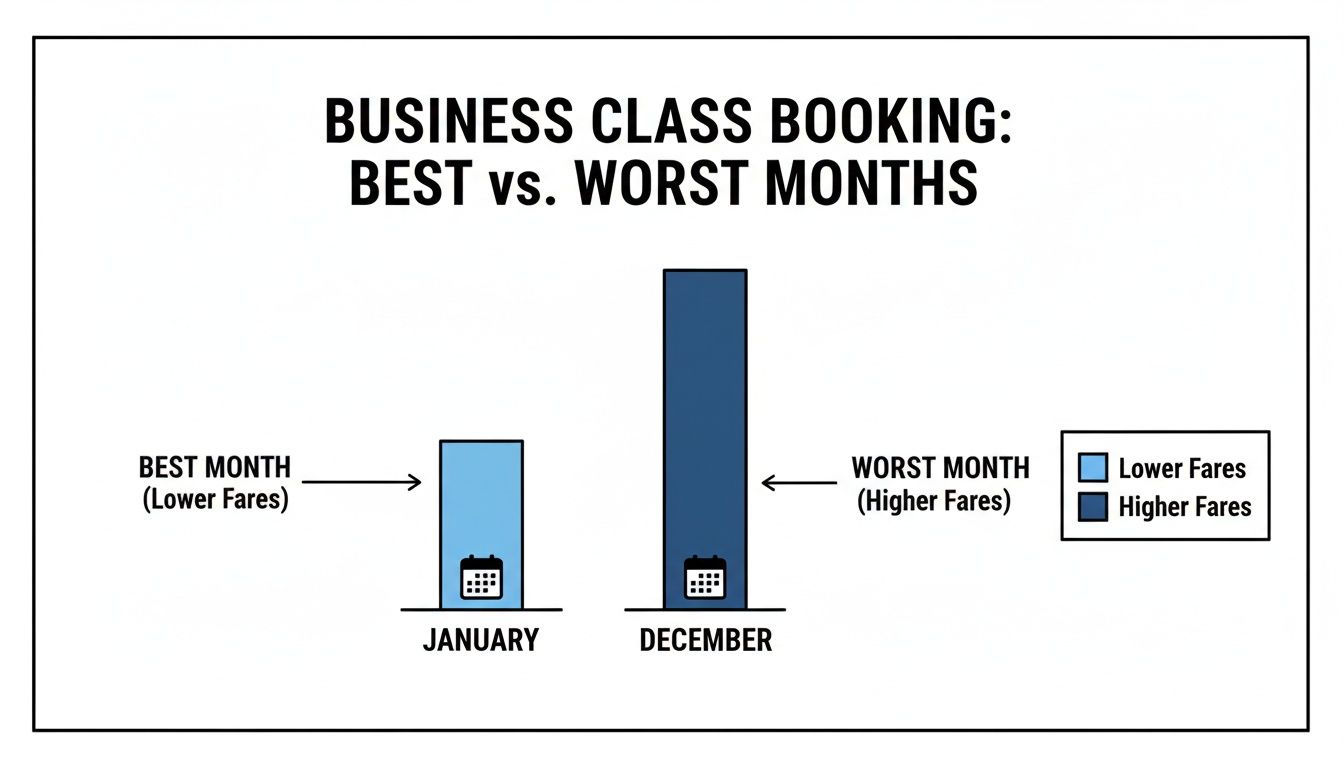
This chart really brings the point home, showing just how much seasonal demand can swing business class fares. You can see the massive price difference between peak and off-peak months.

Bar chart comparing business class fares: January offers lower fares, December has higher fares.

As the numbers show, flying in a low-demand month like January can save you a bundle compared to the sky-high prices you'll see during peak times like December.

The Ideal Advance Purchase Window

Beyond the time of year, when you book relative to your departure date is a huge factor. Book way too early, and you might be paying an inflated opening price. Wait too long, and you're gambling with last-minute surge pricing.

For international travel, the sweet spot is generally two to four months in advance. This window often hits the perfect balance. By this point, airlines have a pretty clear idea of their unsold seats. If sales are sluggish, they’ll start strategically lowering fares to drum up business before the last-minute scramble.

This two-to-four-month period is when an airline’s confidence starts to waver if a flight isn't selling. It's the point where their automated pricing systems are most likely to trigger fare drops to stimulate demand.

The idea is to time your search for the exact moment an airline's motivation to sell spikes. You're not guessing; you're positioning yourself to act when the data says a price drop is likely. This logic applies to more than just flights—understanding these windows is key to smarter travel planning all around. For example, knowing the 9 best time to book hotels strategies can save you just as much on the ground.

The Counterintuitive Last-Minute Opportunity

Now, while banking on last-minute deals is usually a bad idea, they absolutely exist. For the truly flexible traveler, they can offer incredible value. This approach is the complete opposite of planning ahead, but it works on the same core principle: an airline’s fear of an empty seat.

In the final one to three weeks before departure, if a premium cabin has a lot of unsold seats, the airline might slash prices. They’d rather get something for that seat than fly it empty.

This is a high-risk, high-reward game, though. If the flight sells out, those last few seats will be astronomically expensive. This tactic is really only for travelers who have:

  • Extreme Flexibility: You're open to tweaking your dates or even your destination to chase a deal.
  • A High-Risk Tolerance: You have to be okay with the possibility of paying a fortune—or not going at all—if a deal never shows up.

By combining an understanding of these seasonal dead zones, the ideal booking window, and the potential for a last-minute score, you can build a solid strategy. You'll stop reacting to fare changes and start proactively targeting the moments when airlines are most likely to give you the best price.

How to Spot Fare Wars and Unannounced Price Drops

While good timing is your foundation for finding a decent fare, the most jaw-dropping savings come from a bit of market chaos. I’m talking about fare wars—those brief, intense moments when airlines get into aggressive price battles.

Spotting them is how you snag those massive, unadvertised discounts on business class seats.

Forget the splashy "50% Off!" banners you see plastered everywhere for economy sales. In the world of premium cabins, fare wars are quiet, almost secretive. One airline will discreetly drop its price on a competitive route. Within hours, its rivals have no choice but to silently match it, or risk losing their most valuable customers.

These skirmishes are almost never announced. They play out behind the scenes, visible only to people who are really watching the fares. This is where finding the best deal shifts from a passive waiting game to an active hunt.

Reading the Telltale Signs

A fare war doesn't just pop up out of nowhere. It's almost always a reaction to specific market pressures that throw the usual pricing off-kilter. If you learn to recognize these triggers, you can get a sense of when a route is ripe for a price drop.

Three things, in particular, tend to kick off a fare war:

  • A New Airline Enters a Route: Picture a new carrier launching a New York to Paris route. They have to steal customers from the established players like Air France and Delta. The easiest way to do that? Launch with aggressively low introductory business class fares, forcing the big guys to drop their prices to compete.
  • An Existing Carrier Adds Capacity: Let's say an airline swaps a smaller plane for a larger one on a particular flight. All of a sudden, they have a bunch of extra premium seats to fill. When supply goes up but demand stays the same, prices often have to come down to get those seats filled.
  • A "Shot Across the Bow" Price Drop: This is when one airline tests the waters by dropping its price significantly on a key route. It's a strategic move to see how competitors will react. If they follow suit, you've got a full-blown fare war on your hands, with prices tumbling for a few days—or even just a few hours.

The core of a premium fare war isn't a public sale; it's about competitive survival. Airlines are cornered into matching a lower price or risk losing their most profitable passengers to a rival. Your job is to be there when they flinch.

Why Active Monitoring Is Your Best Weapon

These unannounced price drops are incredibly fleeting. You can't just check fares once a week and hope you get lucky. The best business class deals born from these skirmishes can appear and disappear within 24 to 48 hours. Sometimes, they don't even last through the night.

This is where fare monitoring tools and alert services become absolutely essential. They’re your eyes on the market, tracking prices 24/7 and letting you know the second a significant drop happens. Without that constant vigilance, you're almost guaranteed to miss these brief but incredibly valuable opportunities.

The gap between a good fare and a truly spectacular one often comes down to acting on intelligence gathered through meticulous observation. For a deeper dive, you can explore the perspectives of industry veterans like Phil S., a retired airline captain, who have seen firsthand the operational pressures that force these pricing decisions.

Ultimately, catching these secret sales requires a two-pronged attack. First, understand the market conditions that create them, like new competition or added flight capacity. Second, use active monitoring so you’re ready to pounce the moment an airline makes its move. This proactive strategy is how savvy travelers consistently turn market volatility into their own personal travel discount.

Proven Tactics for Securing Business Class Cheaper Than Coach

An empty, comfortable beige airplane seat by a window with travel documents on it.

It sounds like a tall tale from a frequent flyer forum, but it’s a reality savvy travelers cash in on every single day: booking a lie-flat business class seat for less than a standard economy ticket. This isn't about some rare glitch in an airline's matrix. It’s about knowing how the game is played and recognizing when a discounted premium seat offers infinitely more value than a full-fare coach ticket.

The trick is to completely reframe how you think about airfare. Stop comparing the sticker price of business class to the cheapest economy fare you can find. Instead, pit a strategically purchased, discounted business ticket against the sky-high cost of a last-minute or inflexible economy seat. You’d be surprised how often the difference is minimal—and sometimes, the premium seat is genuinely the cheaper option.

The Value Proposition of a Discounted Premium Fare

Picture this common scenario: someone needs a last-minute flight from Chicago to London. An economy ticket, booked just days out, could easily set them back $2,400. For that price, they get a standard seat, zero flexibility, and all the usual joys of a long-haul flight in the main cabin.

Now, imagine another traveler who had been watching that same route for weeks. They saw a business class fare drop during a lull in demand and snagged a seat for $2,200. For $200 less, they get lounge access, priority everything, a lie-flat bed, and chef-curated meals. They arrive rested and ready to go. That, right there, is the essence of value-based booking.

The goal isn't just to find a cheap flight; it's to secure the maximum amount of comfort and convenience for the lowest possible price. A discounted business class ticket often represents the pinnacle of this value equation.

This opportunity pops up most often on hyper-competitive, high-traffic routes where airlines are constantly tweaking prices to one-up their rivals. Learning to spot these routes is your first step. For a deeper dive, check out our guide on finding cheap international business class flights.

Identifying Routes with High Premium Competition

The secret to this whole strategy lies in finding routes with cutthroat competition. When a half-dozen carriers are all fighting for the same premium passengers between two cities, they’re far more likely to quietly drop prices to fill those front cabins.

You'll want to focus on routes connecting major international business hubs. Think places like:

  • New York (JFK) to London (LHR): The classic battleground. You've got British Airways, Virgin Atlantic, American, and United in a constant tug-of-war for business travelers.
  • Los Angeles (LAX) to Tokyo (NRT/HND): A crowded field with a mix of top-tier Asian and North American airlines all vying for a piece of the transpacific pie.
  • Singapore (SIN) to Sydney (SYD): A crucial artery for both business and leisure travel where competition keeps the big players honest.

On routes like these, a slight dip in demand or an oversupply of premium seats can trigger some seriously aggressive pricing. Even on domestic coast-to-coast flights, like New York to Los Angeles, we've seen business class fares bounce between $950 and $1,400 during airline sales.

Cost vs. Value: A Business Class Scenario

To really see how this plays out, let's put the two options side-by-side. The table below breaks down what your money actually gets you, showing why a discounted business ticket delivers a far better return on your travel investment.

Feature Discounted Business Class Full-Fare Economy Class
Seat & Comfort Lie-flat bed, personal space Standard seat, limited legroom
Airport Experience Priority everything, lounge access Standard lines, crowded gates
Onboard Service Multi-course dining, premium drinks Standard meal, limited options
Productivity Ample workspace, power, Wi-Fi Cramped, difficult to work
Arrival Condition Rested, refreshed, ready to go Fatigued, jet-lagged, stressed

Looking at it this way, the choice becomes pretty clear. When the price gap closes, the value gap becomes a chasm. While these strategies are gold for premium cabins, it always pays to have a solid foundation in general booking tactics. For a great all-around primer, you can learn how to find cheap flights with a comprehensive airfare savings guide.

Your Action Plan for Smarter Business Class Booking

Knowing the why behind business class pricing is one thing. Actually turning that theory into a lie-flat seat at a fantastic price is a whole different ballgame. All the data in the world means nothing without a clear, repeatable game plan.

This is your blueprint. It’s how you shift from being a passive observer, waiting for a price to be shown to you, to becoming an active deal hunter who makes the system work for them. We're going to stop reacting and start making deliberate, informed moves that consistently land premium seats for a fraction of what everyone else pays.

Your Step-By-Step Booking Checklist

Before you even start hunting for your next flight, walk through this process. It takes everything we’ve talked about and boils it down into a simple workflow designed to get you the best price with the least amount of stress.

  1. Define Your Flexibility First: Seriously, before you do anything else, figure out where you can bend. Can you shift your travel dates by a week? Is flying on a Tuesday instead of a Friday an option? Every little bit of flexibility is a lever you can pull to find a much lower fare.

  2. Establish a Price Baseline: Start looking at your route at least six months out. The goal here isn't to buy early—it's to learn what a "normal" price looks like. Without this baseline, you'll have no idea if a price drop is a genuine deal or just noise.

  3. Set Up Automated Fare Alerts: Get technology to do the heavy lifting. Use a few different fare tracking tools to watch your route. Set alerts for your perfect dates, but also for the entire month you want to travel. This way, you get an instant ping the moment a price drops.

The ultimate takeaway is simple: patience and preparation are your greatest assets. The best deals reward travelers who do their homework and are ready to act decisively when the perfect opportunity arises.

Recognizing the Buy Signal and Acting Fast

Once your alerts are set, the game is all about pattern recognition. You’re watching for the signals we've discussed—a brewing fare war, a seasonal dip, or an airline getting nervous about an undersold cabin. When an alert pops up showing a price that’s significantly below the baseline you established, that's it. That’s your signal to move.

These deals almost never last. You can learn more about how to spot them on competitive routes by reading up on business class tickets to Europe.

The key is having your decision-making framework ready before the deal appears. Once a fare hits your pre-determined "this is a great price" number, book it. Don't second-guess. This is how you transform from a price-taker into a strategic buyer who never overpays for a premium seat again.

Common Questions About Finding Business Class Deals

Even the most seasoned travelers have questions when it comes to timing their premium cabin purchase just right. Let's tackle some of the most frequent questions we hear, so you can book your next trip with the confidence of a pro.

Can Business Class Really Be Cheaper Than Coach?

Believe it or not, yes. And it happens more than you'd think. This isn't just a myth; it's a strategic opportunity.

The magic happens when you pit a deeply discounted business class fare against a full-fare, last-minute coach ticket. A non-refundable economy seat bought a few days out can easily soar past the price of a lie-flat business seat you snagged during a fare sale months earlier. For example, a last-minute economy flight to Europe can easily cost $2,500, while a well-timed business class deal might be found for $2,200.

The trick is to reframe your comparison. When the price gap between that expensive, inflexible coach seat and a comfortable business class seat shrinks—or even disappears—the value proposition becomes impossible to ignore.

Is It a Myth That Two One-Way Tickets Can Be Cheaper?

Not at all. While the old wisdom was that round-trips always offered the best value, that rule has been broken for years. For business class travel, you should always price out two separate one-way tickets, especially on competitive international routes.

Sometimes, often during a fare war or when you're open to mixing airlines, booking two one-ways can slash the total cost significantly compared to a standard return ticket. This approach gives you far more flexibility and can uncover deals you’d never see in a simple round-trip search.

Pro Tip: The best part of booking two one-ways is mixing and matching carriers. You can grab a fantastic outbound deal on one airline and pair it with a great return fare on another, letting you cherry-pick the best prices for your entire journey.

How Far Out Should I Start Watching Fares?

For any long-haul international trip, start looking about six to eight months ahead of time. The point here isn't to buy that early—it's to do your homework. This is how you establish a baseline and learn what a "normal" price looks like for your specific route.

Once you know that baseline, you'll immediately recognize a genuine price drop when it hits. Active monitoring puts you in the perfect position to pounce when the prime booking window—usually two to four months out—arrives. You'll also be ready to catch those unpredictable flash sales that most other travelers completely miss.

Are Last-Minute Business Class Deals a Real Thing?

They absolutely are, but it's a high-stakes game. These deals usually pop up one to three weeks before a flight when an airline has a painful number of unsold premium seats. Faced with flying that seat empty, the carrier would much rather sell it at a deep discount than get nothing for it.

Here’s the catch: it's a huge gamble. If that flight ends up selling well, those last-minute seats will be priced astronomically high. This strategy is only for travelers with maximum flexibility in their dates and even their destination. For everyone else, it’s a recipe for overpaying.


Ready to stop guessing and start saving? Passport Premiere gives you the intelligence to find business class deals consistently. We monitor the market so you can book with confidence, often for less than the cost of a last-minute coach ticket. Discover how our members save on premium travel at https://www.passportpremiere.com.