Philippines Airlines First Class: Business Class Cheaper Than Coach in 2026

If you've been searching for "Philippine Airlines First Class," you might have hit a wall. That's because what you're really looking for is the airline's exceptional Business Class—a product that delivers a true first-class experience in everything but name.

This guide will show you exactly what that experience is and, more importantly, how to get it for less than you'd pay for a coach ticket.

What Happened to Philippine Airlines First Class?

Luxurious airplane business class cabin with lie-flat seats, white bedding, pillows, and large windows.

Many frequent flyers remember when Philippine Airlines (PAL) was a trailblazer in luxury travel. They made waves in the industry by being one of the first airlines to introduce a fully flat bed in the sky.

On January 4, 1980, PAL’s Boeing 747 made history on its trans-Pacific route with 14 exclusive 'Skybeds' on the upper deck. It was a revolutionary concept that set the standard for premium travel decades before lie-flat seats became the norm. You can dive deeper into PAL's groundbreaking aviation history to see just how far ahead of the curve they were.

The Business Class of Today

So, where did that iconic First Class go? The airline eventually shifted its strategy, retiring the dedicated First Class cabin and its famous Skybeds. But its essence—the core of that premium experience—was rolled into PAL's modern, long-haul Business Class. This is now their top-tier offering, and it’s designed to go head-to-head with the best in the business.

For anyone looking for a philippines airlines first class flight, this is it. The product includes all the key elements that define a premium cabin:

  • Lie-flat seats that let you get real sleep on long-haul journeys.
  • Top-notch dining with menus featuring both Filipino specialties and international dishes.
  • Personalized service delivered with the airline's well-known hospitality.
  • Exclusive lounge access to make your time at the airport comfortable and productive.

It wasn't a downgrade; it was a smart consolidation. PAL distilled the best parts of a first-class ticket into a more modern and competitive Business Class product.

The Pricing Secret: Business Class Cheaper Than Coach

This is where things get interesting. Most people see a lie-flat seat and assume it costs a fortune—thousands more than an economy ticket. That assumption is often dead wrong.

Here's the most valuable secret in air travel: A Business Class seat can often be bought for less than a last-minute or even a flexible Economy ticket.

How is that possible? Airline pricing isn't straightforward. It’s a complex game of timing and supply and demand. An empty seat is a lost opportunity, and airlines would much rather sell it cheap than not at all. This creates massive pricing gaps that informed travelers can take advantage of.

We're going to give you the playbook to find these deals. You'll learn how to spot the exact conditions—from fare sales to smart timing—that make premium comfort cheaper than coach. It’s time to stop overpaying and start flying smarter.

Inside PAL's Modern Premium Cabin Experience

Luxurious lie-flat airplane seat with a gourmet meal, white wine, pillow, and blanket.

Let's clear something up right away. While you might be searching for philippines airlines first class, you won't find a dedicated First Class cabin on their planes today. That chapter of PAL's history is closed.

What you will find is a modern, competitive Business Class that delivers what most international travelers are actually after: a comfortable, private space to rest and work. For all practical purposes, this is the top-tier experience on Philippine Airlines, blending solid comfort with that distinct Filipino hospitality.

On a long-haul flight, especially across the Pacific, one thing matters above all else: arriving well-rested. PAL’s premium cabin is built around a fully lie-flat seat that converts into a bed. This isn't just about reclining. It's the difference between enduring a 14-hour flight and actually getting meaningful sleep.

This commitment to a better premium product comes from a massive fleet overhaul. With 83 aircraft now in service, including modern long-haul jets like the Boeing 777-300ER and Airbus A350, PAL has made serious investments. These upgrades were key to the airline finally securing a 4-Star rating from Skytrax in 2018, a nod to their much-improved cabin experience. You can dig into the specifics of PAL's fleet history and service changes over at Simple Flying.

The Hard Product: Your Seat and Personal Space

The physical seat, the "hard product," is where you can really see the investment pay off. The exact setup depends on which aircraft is flying your route, and savvy travelers know which ones to look for.

  • Boeing 777-300ER: This is PAL’s long-haul workhorse. It features 42 Business Class seats that turn into fully flat beds. The 2-3-2 configuration isn't ideal—someone in the middle seat will have to climb over a neighbor—but the cabin is spacious and a world away from premium economy.
  • Airbus A350-900: This is widely seen as PAL’s best product. The A350 has a more modern 1-2-1 layout, which is the gold standard. Every single passenger has direct access to the aisle, offering a major boost in privacy and a more exclusive feel.
  • Reconfigured Airbus A330: Some of PAL's A330s have been updated with a similar 1-2-1 configuration, featuring 18 lie-flat seats. These are fantastic for regional hops and even some long-haul routes.

To help you compare the options at a glance, here’s a breakdown of the premium cabins on PAL's main long-haul aircraft.

Philippine Airlines Long-Haul Premium Cabin at a Glance

Feature Boeing 777-300ER Airbus A350-900 Airbus A330 (Reconfigured)
Seat Type Fully Lie-Flat Fully Lie-Flat Fully Lie-Flat
Configuration 2-3-2 1-2-1 1-2-1
Direct Aisle Access No (for all seats) Yes (for all seats) Yes (for all seats)
Total Premium Seats 42 30 18
Best For High-capacity routes Privacy, solo travelers Regional, select long-haul

As you can see, if you value privacy and easy aisle access, the A350 and reconfigured A330 are your best bets. The 777 is still a comfortable ride, but the 1-2-1 layout is a clear winner.

Of course, the experience goes beyond the seat itself. You'll get plush bedding, including a proper duvet and pillows, to make sleep feel less like you’re on a plane. You also get a L'Occitane amenity kit with all the essentials to freshen up before you land.

The core value proposition is simple: a fully flat bed. This transforms a 14-hour flight from an endurance test into a productive and restful experience, allowing you to hit the ground running upon arrival.

The Soft Product: Service and Dining

The other half of the equation is the "soft product"—the service, food, and general atmosphere. This is where PAL's Filipino culture really comes through. The cabin crew are consistently praised for their warm, attentive service. They often make a point of addressing passengers by name and seem genuinely happy to help, which isn't something you can say for every airline.

Dining is another standout. You can expect multi-course meals that feature both international dishes and elevated Filipino cuisine. From a classic chicken adobo to perfectly prepared fish, the menu is a real point of pride for the airline, all paired with a curated selection of wines and other drinks.

It's this blend of a solid hard product and standout service that creates the experience people are looking for when they search for philippines airlines first class. It’s a genuinely comfortable way to fly long distances, especially if you know the tricks to finding it for less than a coach ticket. In the next section, we’ll get into exactly that—how a seat like this can cost a lot less than you might think.

Why a Business Class Seat Can Be Cheaper Than Coach

A comfortable premium airplane seat with a document, in-flight screen, and window view.

It sounds impossible, doesn't it? But it's one of the most important realities in air travel: a business class seat can, and often does, sell for less than a seat in economy. This isn't some rare computer glitch. It's a predictable result of how airlines actually manage their flights, and understanding it is your ticket to massive savings.

Think about it this way: an empty seat on an airplane is like milk on its expiration date. Once that cabin door closes and the plane pushes back, that seat is worthless. It's a perishable asset. The airline can no longer make a single cent from it.

That reality puts airlines like Philippine Airlines in a tough spot. They would always rather sell a philippines airlines first class equivalent seat for a huge discount than watch it fly empty across the Pacific. For them, it’s a loss. For you, it’s an opportunity.

The Myth of the Sticker Price

Airlines love to advertise their premium seats for astronomical prices, often running into thousands of dollars. But here’s the secret: almost nobody pays that price.

In reality, market data shows that fewer than 15% of all premium cabin seats ever sell at the initial, full-fare sticker price. The other 85% are sold through corporate deals, frequent flyer upgrades, and—most importantly for you—to the public during fare sales.

An airline's goal isn't to sell every business class seat for $8,000. Its real goal is to make as much money as possible from the entire plane. If that means quietly selling the last few premium seats for less than a last-minute economy ticket, they will do it every single time.

This is all run by complex computer systems that change fares by the minute based on hundreds of factors. They're built to maximize revenue, but they also create pricing gaps that smart travelers can jump right through.

Key Factors That Make Business Class Cheaper Than Coach

Several forces are constantly at play, creating the price swings that lead to incredible deals on business and first class. When they line up just right, it’s the perfect storm for a cheap premium fare.

  • Fare Classes and Inventory Buckets
    Airlines don't just have "Economy" and "Business." They have dozens of hidden fare classes, each with its own price and rules. A last-minute, flexible economy ticket (a 'Y' fare) might cost $2,000. But on that same flight, a discounted, advance-purchase business class ticket (an 'I' or 'Z' fare) could be on sale for $1,500. Knowing that the cheapest business class tickets often come from these specific fare buckets is a game-changer.

  • Intense Airline Competition
    On major routes like Manila to Los Angeles or New York, Philippine Airlines is in a dogfight with competitors like Cathay Pacific and EVA Air. The minute one of them launches a business class sale, PAL often has to match it or risk losing customers. These fare wars are a goldmine for anyone paying attention.

  • Seasonal Demand and Timing
    A business class cabin can be packed with corporate suits on a Tuesday, but nearly empty on a Saturday. Likewise, premium demand often plummets during major holidays when everyone is flying coach. Airlines will slash prices to fill those seats during off-peak windows, creating amazing deals for flyers with flexible dates.

Once you realize an airline seat's value is in a constant state of decay, your whole approach changes. You're no longer just accepting whatever price the airline shows you. Instead, you become a strategic buyer, waiting for the airline’s need to sell its expiring inventory to create a price that works for you.

Your Playbook for Finding Discounted PAL Fares

Grabbing a premium seat on Philippine Airlines for less than the cost of economy isn't about luck—it's about knowing how the game is played. Once you understand why these deals pop up, you can stop being a passive buyer and start actively hunting them down.

Think of it like learning the tells in a poker game. Airlines have patterns, and their pricing has predictable triggers. Once you learn to spot them, you can turn their own market dynamics to your advantage. It starts with a couple of simple habits and builds from there.

The Simple Habits That Catch Most Deals

Before you dive into the deep end, let's cover the basics. These two moves are non-negotiable and, with almost no effort, are responsible for flagging the majority of deals that come and go.

  1. Set Up Fare Alerts: This is your first line of defense. Use a tool like Google Flights or Kayak to create alerts for your target routes, like "Manila to Los Angeles" in Business Class. You'll get an email the second a price drops, giving you the jump you need before the fare disappears.
  2. Be Flexible (Even a Little): Rigidity is the arch-nemesis of a good deal. If you can move your travel dates by just a day or two, your odds of finding a bargain go through the roof. Premium demand is a creature of habit, peaking on Mondays and Fridays. Look for deals on Tuesdays, Wednesdays, and Saturdays when the suits aren't flying.

Just doing these two things puts you ahead of 90% of other travelers. You're setting a simple trap and letting the deals come to you.

Mastering the Advanced Hunt

With your alerts humming in the background, it’s time to go on the offensive. These are the pro-level tactics that require a sharper eye for market behavior but can land you that coveted philippines airlines first class seat for a fraction of the sticker price.

Hunt for Fare Wars

Competition is your absolute best friend. PAL's prime long-haul routes are battlegrounds, especially those flying into North American hubs like LAX, SFO, YVR, and JFK. When a rival like Cathay Pacific or EVA Air kicks off a business class sale, PAL often has to match it within hours or risk losing customers. Keep an eye on these routes, even when you're not planning a trip, just to get a feel for the pricing rhythm.

Learn to Spot Mistake Fares

Every now and then, an airline's massive, complicated pricing system glitches. A misplaced decimal, a bungled currency conversion—it happens. The result can be jaw-droppingly cheap business class tickets. They are the unicorns of airfare, rare and gone in a flash, but they're real. Your best bet for catching one is to be active in online travel forums or follow fare-watcher accounts on social media.

Understand Fare Cycles and Seasonality

Airlines have sales cycles, just like retailers. Knowing when to buy is half the battle. Prices for premium seats often dip dramatically inside specific booking windows.

Here's the inside track: leisure travelers book economy seats way in advance, but corporate travelers book premium seats much closer to departure. This creates a "dead zone" about 2-4 months out, where the airline gets nervous about all its empty business class seats and starts slashing fares to fill them.

This window is your sweet spot. It’s the time to strike before last-minute demand sends prices soaring. To get a better handle on this timing, you can read our complete guide on the best time to buy international flights.

Using Miles and Upgrades as Your Ace in the Hole

Cash isn't the only currency for getting to the front of the plane. If you play your cards right, loyalty points can be your ticket to a lie-flat seat.

  • Mabuhay Miles Upgrades: PAL's own program, Mabuhay Miles, is your most direct path. You can use miles to upgrade from Economy or Premium Economy, but there's a catch: you have to book an upgrade-eligible fare class. The cheapest "Supersaver" tickets usually don't qualify, so always read the fine print on the fare rules before you click "purchase."
  • Cash or Bidding for Upgrades: As the flight date nears, PAL will sometimes send out emails offering a shot at an upgrade. If the business cabin is looking empty, you might be able to bid for a seat. A few hundred dollars can sometimes be enough to win, which is an incredible bargain for what you get.
  • Leverage Partner Airline Programs: Don't get tunnel vision on Mabuhay Miles. PAL has partners, and you can often book a PAL business class seat using miles from another airline's program. Sometimes, it even costs fewer points. Always check what the partners are offering for award availability.

By weaving these tactics together—alerts, flexibility, fare war hunting, and smart use of miles—you're no longer just taking whatever price the airline gives you. You're building a system to find real value and pounce when the perfect deal on a philippines airlines first class seat finally shows itself.

How PAL’s Premium Cabin Stacks Up Against Competitors

When you’re flying across the Pacific, picking an airline isn't just about who has the newest seat. It's about the total value you get for your money. And while Philippine Airlines (PAL) goes head-to-head with heavy hitters like Cathay Pacific and EVA Air, it’s carved out a smart niche for itself by blending aggressive pricing, direct routes, and genuinely warm hospitality.

This is where you have to remember the biggest secret in premium travel: a business class seat can actually be cheaper than an economy ticket. While a competitor might have a shinier, newer cabin, a well-timed PAL Business Class ticket often gets you a lie-flat bed for less than what others are charging for a cramped seat in the back. It’s all about finding the smartest deal, not just the fanciest one.

The Value Play in a Crowded Market

Flying from North America to Southeast Asia, you’ve got plenty of options. Cathay Pacific is legendary for its consistency and incredible lounges in Hong Kong. EVA Air consistently gets high marks for its stellar hard product and top-notch food. So where does that leave Philippine Airlines?

PAL’s real power is in its unique value proposition, especially if your travel involves the Philippines.

  • The Non-Stop Advantage: For many travelers, PAL offers the only non-stop flight between Manila and major hubs in North America. This completely cuts out the time and stress of a connection, a perk that’s honestly hard to put a price on after a long-haul flight.
  • Price Swings Mean Opportunity: PAL's premium fares are known to fluctuate quite a bit. This creates huge opportunities for travelers who know what they're looking for. While competitors tend to have more stable (and higher) pricing, PAL’s dynamic model means deep discounts pop up far more often.
  • Genuinely Warm Service: The authentic, heartfelt service from PAL's cabin crew is a consistent bright spot. Other airlines are professional, sure, but PAL's hospitality just feels more personal and less by-the-book. It adds a human touch that really makes a difference.

This simple three-step process is the key to spotting these kinds of deals, whether on PAL or another carrier.

Three-step process to find PAL flight deals: Set Alerts, Be Flexible, and Compare Routes.

The takeaway is pretty clear: finding a great fare isn’t a passive activity. You have to set alerts, be flexible with your dates, and compare different routes to see where the best value is hiding.

Trans-Pacific Premium Cabin Value Comparison

So, how does a discounted PAL Business Class ticket really compare against the full-fare competition on the things that matter most? I've put together a quick qualitative comparison to help you see where each airline shines.

Airline Seat & Hard Product Service & Catering Typical Fare Volatility Best For
Philippine Airlines Good to excellent, with the A350 being a standout. Consistency can vary by aircraft. Genuinely warm and attentive service with strong Filipino culinary options. High. Frequent sales create opportunities for significant bargains. Value-focused travelers and those prioritizing non-stop flights to the Philippines.
Cathay Pacific Consistently excellent across its long-haul fleet. Known for a well-designed product. Professional and efficient, though sometimes perceived as less personal. Moderate. Sales exist but deep discounts are less frequent than on PAL. Travelers who value consistency and a top-tier lounge experience in Hong Kong.
EVA Air Excellent, particularly its renowned hard product and amenity kits. Highly rated for its attention to detail and unique catering (like Hello Kitty jets). Moderate to Low. Fares are often stable and reflect its premium positioning. Travelers prioritizing a pristine hard product and a refined in-flight experience.

At the end of the day, the "best" airline is rarely the one with the highest rating—it’s the one that delivers the most value for what you need on a particular trip.

A non-stop, lie-flat seat on PAL for $1,800 is always a better deal than a one-stop journey on a competitor for $4,500.

While another airline might have a slightly more polished seat, PAL holds its own. The Mabuhay Lounge in Manila has gotten much better, offering a comfortable space and a solid food selection. And more importantly, PAL is often more generous with releasing award seats to its own Mabuhay Miles members, making upgrades and redemptions a more realistic goal.

When your search for philippines airlines first class is really a search for the best possible experience at the best possible price, PAL's unique strengths—direct flights, friendly service, and a high chance of a great deal—often make it the smartest choice on the board.

Common Questions About Booking PAL First Class

When you're trying to book a premium flight, the airline jargon alone can be a headache. It's easy to get tangled up in terms like "First Class" and "Business Class," especially when they seem to mean different things on different carriers. Let's clear up a few of the biggest questions so you can find and book the best possible seat on Philippine Airlines.

Think of this as your cheat sheet—quick, direct answers that build on the strategies we've covered, getting you ready to book your next trip like a pro.

Does Philippine Airlines Still Have a True First Class?

The short answer is no. If you’re looking for a dedicated First Class cabin on PAL, you won’t find one. The airline retired its famous "Skybeds"—which were a big deal back in the 1980s—a long time ago.

Today, PAL’s top-tier product is Business Class. On their long-haul workhorses like the Boeing 777 and Airbus A350, this is the cabin that really matters. It’s where you’ll find the lie-flat seats, premium meals, and upgraded service. For all practical purposes, when people search for a philippines airlines first class ticket, this is the experience they're actually looking for.

How Can Business Class Be Cheaper Than Economy?

This one trips a lot of people up, but it’s a situation we see all the time. It all comes down to how airlines price their seats, which often defies logic. A last-minute, fully flexible Economy ticket for an urgent business trip can cost a fortune.

Meanwhile, the airline might be getting nervous about the last few unsold Business Class seats on that very same flight. Rather than let them fly empty, they’ll quietly slash the price for anyone willing to book in advance. This creates a market breakdown where a savvy traveler who plans ahead can snag a Business Class seat for cheaper than a full-fare Economy ticket.

What Are the Best Routes for PAL Premium Cabin Deals?

The best deals almost always pop up on routes where airlines are fighting for customers. If you want to find a bargain on PAL's premium cabin, you need to look at flights between Manila (MNL) and the major North American gateways.

These routes are your primary hunting grounds:

  • Manila (MNL) to Los Angeles (LAX)
  • Manila (MNL) to San Francisco (SFO)
  • Manila (MNL) to New York (JFK)
  • Manila (MNL) to Vancouver (YVR)
  • Manila (MNL) to Toronto (YYZ)

On these corridors, carriers are in a constant price war, which forces them to drop fares for premium seats just to stay in the game.

Is Upgrading to Business Class on PAL Worth It?

On a flight stretching over 12 hours, a smart, affordable upgrade isn't just worth it—it's a game-changer. It turns a long-haul flight from an endurance test into a genuinely restful experience.

The ability to lie flat and get several hours of quality sleep is the single most valuable perk. Arriving at your destination rested, refreshed, and ready to go—whether for a business meeting or the start of a vacation—is a massive advantage.

Once you factor in the better food, attentive service, and sheer personal space, the value is undeniable. The trick, of course, is getting that upgrade without paying the sticker price. To really dig into the tactics, our complete guide on how to get upgraded to first class lays out more of these strategies. By leveraging bidding systems, miles, or just timing your purchase right, you can make the jump to the front for a fraction of what most people pay.


At Passport Premiere, we believe that premium comfort shouldn't come with an outrageous price tag. Our service is dedicated to finding these market inefficiencies, helping members secure international Business and First Class fares that are often cheaper than Coach. Stop overpaying and start flying smarter. Learn more at https://www.passportpremiere.com.

Your Guide to Business Class Kuwait Airways: How to Fly for Less Than Coach

Picture this: you're settling into your spacious, lie-flat business class seat, but you paid less for it than many of the folks stuck back in economy. That’s not a hypothetical. It’s a very real—and surprisingly common—possibility when you fly business class Kuwait Airways, which they call Pearl Class. This guide is all about how to find those unicorn deals and make flying business class cheaper than coach a reality.

Why Fly Business Class With Kuwait Airways

A man relaxes in a premium airplane seat, listening to music and reading a document.

For travelers in the know, Kuwait Airways is often a smart, under-the-radar pick for scoring premium seats without the usual sticker shock. It sounds completely backward—a business class ticket costing less than coach—but it happens all the time because of how airline pricing actually works.

Airlines don't price tickets based on how far you're flying. It’s all about raw supply and demand on any given route. On hyper-competitive routes, like New York to India, Kuwait Airways has to get aggressive with its pricing to even be in the running against the major carriers. This can trigger fare wars where premium seat prices plummet, sometimes making a Pearl Class seat shockingly cheaper than a last-minute economy ticket on a competitor.

Understanding the Value Proposition

The whole trick is knowing where to look and when. Some flyers might write off the airline as a second-tier option, but with its fleet getting younger and its network hitting key international hubs, it's a really strategic choice. For anyone managing corporate travel or just looking for a better way to fly, this creates a massive opportunity.

Here’s why Kuwait Airways Business Class should be on your radar:

  • Exceptional Fare Potential: On the right routes, finding business class for less than economy isn't just a fluke. It's a realistic, bookable goal.
  • Modern Aircraft: With newer planes like the Airbus A330neo in the fleet, the seats are more comfortable and private than you might expect.
  • Solid Service: It’s a "dry" airline, meaning no alcohol is served. But the onboard service, meals, and amenities are absolutely a premium experience.

Of course, for many business travelers, a comfortable flight is only one part of the equation. A truly seamless trip requires thinking door-to-door, which means factoring in the reliability of a good corporate car service on the ground.

In this guide, we'll get into the specifics of the fleet, the service, and most importantly, the proven strategies to actually find and book these fares that are cheaper than coach. It’s about turning the messy world of airline pricing into your personal travel hack.

Diving Into the Business Class Cabins and Fleet

Not all business class seats are created equal, and with Kuwait Airways, the specific plane you're on makes all the difference. Knowing the fleet is the key to booking the right flight, as the aircraft determines everything from your privacy and comfort to whether you even get a lie-flat bed.

This is especially true when you're hunting for those rare business class fares that dip below coach prices. A lower fare might be tied to an older, less desirable cabin, so it’s critical to know what you’re paying for. Let's break down exactly what you can expect on board.

The New Gold Standard: Airbus A330-800neo

The undisputed star of the Kuwait Airways fleet is the new Airbus A330-800neo. The airline was the launch customer for this plane, and they used the opportunity to install their best and most modern business class product. If you see this aircraft on your route, you've hit the jackpot.

Inside, you'll find a 1-2-1 reverse herringbone layout. This is the configuration every savvy traveler looks for because it guarantees two things for every single passenger: a fully lie-flat bed and direct, unimpeded access to the aisle. No more awkward shuffling past a sleeping seatmate.

For solo flyers, any window seat (A or K) on the A330-800neo is your best bet for maximum privacy and a great view. If you’re traveling with a partner, the “honeymoon” seats in the middle (E and F) are perfect for conversation.

This setup is a world away from their older configurations, offering a huge leap in personal space and privacy. It's the top choice for anyone flying long-haul on Kuwait Airways.

The Long-Haul Workhorse: Boeing 777-300ER

The Boeing 777-300ER is the backbone of the airline’s long-distance network, flying the most popular routes like the one to New York (JFK). While it’s a perfectly reliable aircraft, the business class cabin feels a bit more traditional. The seats are arranged in a 2-2-2 configuration.

So, what does that mean for you? While every seat does go fully flat, if you're in a window seat, you're stuck. You will have to step over the person next to you to get out. This layout simply doesn't offer the privacy of the newer A330-800neo, which is a major drawback for solo travelers on an overnight flight.

The Regional Jet: Airbus A320neo

For shorter hops around the region, you'll most likely be on an Airbus A320neo. These modern jets handle the bulk of the airline's short and medium-haul routes. The most important thing to know is that these planes do not have lie-flat beds.

Instead, business class consists of comfortable recliner-style seats. They’re perfectly fine for a quick two or three-hour flight, but you wouldn't want to be stuck in one for a long-haul journey.

The airline's fleet has seen some major upgrades. The standout A330-800neos, which started arriving in late 2020, feature 32 of those excellent fully-flat beds. You even see the flagship Boeing 777s sometimes used for quick trips, like the three-hour flight to Cairo, showing how flexibly they use their planes. You can read more about the fleet modernization and when the airline took delivery of its newer jets.

To make it easier to choose, here's a simple breakdown of what you get on each aircraft.

Kuwait Airways Business Class Seat Comparison by Aircraft

Aircraft Model Seat Configuration Seat Type Privacy Level Best For
Airbus A330-800neo 1-2-1 Fully Lie-Flat High Long-haul flights, solo travelers, and anyone wanting maximum privacy.
Boeing 777-300ER 2-2-2 Fully Lie-Flat Medium Long-haul flights, especially for couples who don't mind the shared space.
Airbus A320neo 2-2 Recliner Low Short-haul regional flights where a lie-flat bed isn't necessary.

As you can see, the aircraft type is the single biggest factor in your onboard experience. Always check the plane operating your route before you book to make sure it matches your expectations for comfort and privacy.

The Onboard Experience From Service to Amenities

Beyond the physical seat, the real test of a business class Kuwait Airways flight comes down to the service you receive and the perks you get. This is what separates a simple flight from a genuinely premium experience, and it starts long before you ever step on the plane.

You’ll feel it right away at the airport with priority check-in, expedited security, and dedicated boarding lanes. Once you’re in your seat, the cabin crew’s service defines the rest of the journey. In my experience and from what I hear from other frequent flyers, the crew is consistently professional and attentive, making sure your needs are handled efficiently throughout the flight, even if the warmth of the service can vary.

Dining and Onboard Service

The food is often a real highlight. Kuwait Airways puts together a multi-course dining service that features a mix of international dishes and some excellent Middle Eastern cuisine. Appetizers and desserts usually come out looking beautifully plated, though the main courses can sometimes be a bit more straightforward in their presentation.

Now, for a critical point many international travelers need to know: Kuwait Airways is a "dry" airline. This means you won’t find any alcoholic beverages served, and you can’t bring your own on board. Instead, the crew offers a pretty good selection of fresh juices, soft drinks, and specialty non-alcoholic mocktails to go with your meal.

The specific aircraft you're on will also shape your experience, from the service flow to the amenities. This chart breaks down the planes you'll most likely encounter.

Hierarchy diagram showing Kuwait Airways fleet with A330neo, B777, and A320neo aircraft types.

As you can see, there's a big difference between the modern A330neo, the workhorse B777, and the regional A320neo. Paying attention to the aircraft type when you book can make all the difference.

Amenities and Practical Perks

On their long-haul routes, business class passengers get a standard amenity kit. Inside, you’ll find the essentials like some skincare products, an eye mask, and socks—all designed to make a long flight more comfortable. One thing to note for overnight flights, though, is that pajamas aren't typically part of the deal.

One of the best practical benefits of flying Pearl Class is the fantastic baggage allowance. You're generally allowed:

  • Two checked bags, each weighing up to a hefty 32 kg (70 lbs).
  • One carry-on bag up to 11 kg (24 lbs).
  • A personal item like a laptop bag or purse.

For anyone on a long trip or traveling with extra gear, this generous allowance is a huge plus and adds some serious real-world value to your ticket.

It's also worth pointing out that the airline is getting noticed for its improvements. In 2023, Skytrax even named Kuwait Airways the "World's Most Improved Airline," which shows their efforts to elevate the entire passenger experience are paying off.

When you're connecting through the airline’s hub at Kuwait International Airport (KWI), your ticket gets you into the Pearl Lounge. It’s a decent spot to relax, get some work done, or grab a bite before your next flight. However, travelers often report that the lounge can feel a bit small and, importantly, may not have amenities like showers. That's a key detail to remember if you’re facing a long layover.

Where You Can Fly: Key Routes and Network Strategy

To find those unbelievable deals—like business class Kuwait Airways tickets for less than an economy fare—you first have to understand where they fly. An airline’s route map isn't just a list of cities; it’s a battle plan. Kuwait Airways has drawn its lines to compete head-on along some of the world's most crowded and profitable flight paths.

This is exactly where the opportunities for business class cheaper than coach arise. It’s like a price war on a main shopping street. When several huge department stores are all selling the same popular item, a smaller, more aggressive shop might dramatically cut its prices just to get customers in the door. That's what Kuwait Airways does, and it creates incredible buying events for travelers.

The US-to-India Corridor: A Goldmine for Deals

For any airline, the routes connecting North America to India are a cash cow. Kuwait Airways has planted its flag firmly in this territory, going up against Gulf powerhouses like Emirates and Qatar Airways. Its daily flight from New York (JFK) is the anchor of this entire strategy.

Because this route is so fiercely competitive, it’s one of the best places to hunt for deeply discounted Pearl Class seats. The airline knows it has to make a compelling offer to convince travelers to pick a one-stop flight through Kuwait City instead of flying direct or connecting through a mega-hub like Dubai.

For both business and vacation travelers, this intense competition makes the New York JFK route a prime target for fare monitoring. The daily Boeing 777-300ER flight has 36 lie-flat seats in Pearl Class. That's a lot of premium inventory to fill every single day, which often results in some surprisingly good fares. You can get a closer look at this plane's setup and a full review over at BusinessClass.com.

This same dynamic plays out across their network. Once you learn to spot which routes have the most competition, you can start predicting where the next big fare drop will happen.

Key Routes with High Competition

It’s not just about the New York flight. Several other routes are hotbeds for fare drops because of the sheer number of airlines fighting for passengers. If you have some flexibility, aiming for these destinations can dramatically improve your odds of snagging a cheap business class ticket.

Keep a close watch on flights connecting Kuwait with these major hubs:

  • London (LHR): As a top-tier global and financial hub, the London route is always a battleground. Multiple carriers run daily flights, which constantly puts downward pressure on prices.
  • Major Asian Hubs: Cities like Bangkok (BKK) and Manila (MNL) are massive leisure and business destinations, meaning they have a ton of air traffic from all sorts of airlines.
  • European Capitals: Routes into Paris (CDG), Rome (FCO), and Geneva (GVA) also face stiff competition, forcing airlines to get creative with their premium cabin pricing to win over travelers.

When you understand this strategy, you can stop just passively searching for flights and start actively hunting for the deals. For example, if you’re trying to get to Europe in comfort, our guide on finding business class flights to London gives you more specific tactics. The trick is to identify these competitive arenas and be ready to pull the trigger when the fares inevitably fall.

How to Find Business Class Flights Cheaper Than Coach

Man in airport lounge using laptop and credit card to find business class deals, with passport nearby.

It sounds like a tall tale from a travel forum: flying in business class Kuwait Airways for less than what most people paid to sit in coach. But this isn't about getting lucky. It’s about understanding how airline pricing actually works and using a specific strategy to your advantage.

Think of it this way. An airline's worst nightmare is an empty seat on a plane that’s about to depart. That seat is perishable inventory, just like fresh produce at a market. A seller would rather discount their produce at the end of the day than let it go to waste, and an airline would always rather sell a premium seat cheap than not at all. This is the secret to getting business class cheaper than coach.

Why Airline Fares Are So Volatile

This simple reality—an empty seat is lost revenue forever—creates massive price swings. The sky-high fare you see when a flight is first announced is rarely the final word. It's just an opening offer.

The truth is, fewer than 15% of premium seats are ever sold at their initial, full walk-up price. This creates a huge window of opportunity for savvy flyers. Consider that a reviewer once managed to book a First Class seat (a step above Business) on Kuwait Airways from Dubai to New York for just $1,847. This isn't a glitch; it's a perfect example of the dramatic price drops that happen when you know when and how to look.

These deals are especially common on competitive routes, like the daily Kuwait Airways flight from New York to India, where their Boeing 777-300ERs go head-to-head with other major carriers.

The key takeaway is this: Airline pricing isn’t fixed. It's a dynamic game that constantly reacts to competition, how fast seats are selling, and the calendar. Your job is to turn their pricing complexity into your advantage.

Once you grasp this, your mindset shifts. You stop being a passive buyer accepting the first price you see and become an active deal hunter. The question is no longer "How much does it cost?" but "When will this flight hit its lowest price?"

Core Strategies for Finding Lower Fares

While a bit of luck never hurts, a methodical approach will always get you better results. You don't need to be an industry insider to start finding these fares. It all begins with a few foundational strategies.

  • Be Flexible With Your Dates: This is the single most powerful tool you have. Flying on a Tuesday instead of a Friday can literally save you thousands of dollars. The price difference between days of the week is often staggering.

  • Fly During the "Shoulder Seasons": Avoid the obvious peak travel times like Christmas or the middle of summer. Aim for the weeks just before or after the rush. During these shoulder seasons, demand drops, and airlines get more aggressive with discounts to fill their premium cabins.

  • Look for Fare Wars: As we’ve mentioned, routes with heavy competition are where the real deals are found. When carriers like Kuwait Airways, Emirates, and Qatar all fight for the same passengers, they use price as a weapon, and you can be the one to benefit.

These steps are a great start, but to really master finding business class seats for less than economy, you need to go deeper. For more advanced timing techniques, take a look at our guide on the best time to buy business class tickets.

The ultimate strategy, however, comes down to consistent, systematic monitoring. This is where a service like Passport Premiere shines, by turning the chaotic world of airfare into a predictable system for finding incredible deals.

Your Questions Answered About Business Class Kuwait Airways

Let's clear up some of the most common questions people have about flying with Kuwait Airways. Think of this as the practical advice you need to make a smart booking decision.

Is Kuwait Airways a Dry Airline?

Yes, it is. Kuwait Airways is a "dry" airline, which means you won't find any alcohol served—or allowed—onboard. This applies to all flights, regardless of the route or class you're flying.

For travelers accustomed to a glass of wine with their meal or a pre-departure champagne, this is a key detail. Instead, the airline offers a pretty extensive list of non-alcoholic drinks, including juices, sodas, and often a menu of custom mocktails to choose from.

What Is the Best Seat in Kuwait Airways Business Class?

The "best" seat completely depends on which plane you're on. Your choice can make a huge difference in privacy and comfort, so it’s always smart to check the aircraft type when you book.

  • Airbus A330-800neo: On this jet, any window seat (A or K) is your best bet. The 1-2-1 reverse herringbone layout means these seats offer the most privacy and direct access to the aisle—perfect for anyone flying solo on a long haul.
  • Boeing 777-300ER: This aircraft uses a 2-2-2 configuration. If you're traveling alone, grab an aisle seat. It lets you get up and move around without having to climb over your seatmate. If you take the window, you're boxed in.

How Can I Find Business Class Fares Cheaper Than Economy?

Finding these deals isn't about luck; it’s about strategy. The dream of flying business class for less than coach is achievable if you know where and when to look for the specific conditions that force airlines to drop their premium cabin prices.

First, focus your search on routes with intense competition, like the New York (JFK) to India corridor. Second, be flexible. Flying mid-week or during the shoulder seasons—just before or after peak travel times—can uncover massive savings. But the most effective approach is using a fare monitoring service that does the work for you, tracking price drops and alerting you the second a premium seat falls to an unusually low price. It takes the guesswork out of the equation. To learn more about this, you can check out our guide on how to get upgraded to business class and the factors that make it happen.

What Is the Baggage Allowance for Kuwait Airways Business Class?

Passengers in Pearl Class (Business) get a very generous baggage allowance, which is a huge perk. The standard allowance is typically:

  • Checked Luggage: Two bags, each up to 32 kg (70 lbs).
  • Carry-On Luggage: One piece, up to 11 kg (24 lbs).
  • Personal Item: A small handbag, laptop case, or similar personal bag.

It's always a good idea to double-check the exact baggage rules for your specific flight on the Kuwait Airways website before you head to the airport. Allowances can sometimes change depending on your final destination.


Finding business class seats for less than economy is no longer just for travel insiders. Passport Premiere gives you the tools and intelligence to track these deals, turning volatile airline pricing into your greatest advantage. Stop overpaying and start flying smarter by visiting https://www.passportpremiere.com.
Your Guide to Booking Business Class to Europe for Less Than Coach

Finding a business class flight to Europe for less than a coach ticket might sound like a travel myth, but it's a reality that savvy travelers exploit all the time. This isn't about luck; it's about understanding and leveraging the pricing inefficiencies of the airline industry. With the right strategy, you can turn the dream of a lie-flat bed into your next reality, often for a price that defies logic.

Why Business Class Can Be Cheaper Than Coach

The idea of flying business class to Europe for less than an economy seat seems counterintuitive. But the airline industry operates on complex algorithms where price isn't always tied to the quality of the seat. The price you see on Google Flights is just the starting point.

Here’s one of the industry's biggest secrets: those premium cabins are rarely full of passengers who paid the astronomical, publicly listed fare. A staggering 15% or fewer of all premium cabin seats are ever sold at their initial sticker price. Airlines would rather sell a business class seat at a deep discount than fly it empty. This creates a volatile market where a discounted premium seat can, and often does, fall below the price of a last-minute or flexible coach ticket.

Services that live and breathe this market can help you zero in on the true value of that empty seat and predict when prices are about to drop below coach levels.

An empty business class airplane seat next to two bright windows, with a glass and a clutch.

The Long-Haul Opportunity

Another huge piece of the puzzle is knowing the difference between short-haul and long-haul travel. A quick hop from Paris to Rome is a completely different beast than a flight from New York to Paris.

Flights within Europe are all about volume. Airlines cram as many economy passengers as possible onto planes for those short, two-hour journeys, and the business class cabin is often just a slightly nicer economy seat with a curtain pulled across.

But the transatlantic routes connecting North America to Europe? That's where the real action is. These are the flights where airlines pour millions into their premium products—the lie-flat seats, gourmet dining, and exclusive lounge access. This fierce competition creates the perfect storm for incredible deals to pop up, sometimes dipping below the cost of a standard economy ticket.

The bottom line is this: airlines would much rather sell their premium long-haul seats at a steep discount than let them fly empty across the Atlantic. That's your opening to find business class for less than coach.

To put this in perspective, let's look at how booking behaviors change based on the length of the flight. The difference is night and day.

Booking Patterns Long-Haul vs Short-Haul to Europe

Route Type Economy Class Booking % Business Class Booking % Key Takeaway for Travelers
Short-Haul (Intra-Europe) ~92% ~3% Airlines focus on volume and price, not premium features.
Long-Haul (Transatlantic) ~65% ~25% Premium cabins are a critical revenue source, creating intense competition and opportunities for business class to be cheaper than coach.

As the table shows, the market for premium seats on long-haul flights is massive compared to short-haul. This is the competitive arena where you can find the best value.

Shifting Your Mindset from Points to Price

While hoarding loyalty points has its place, it's a strategy with a ceiling. The real power comes from playing the cash market and exploiting its pricing gaps. This guide is all about moving past the points game and focusing on tactical, price-based strategies that uncover published fares so low they often undercut economy prices.

You can see exactly how this works in practice by exploring our guide to finding Eurobusiness class deals.

By learning to track fare cycles, spot brewing fare wars, and get inside the heads of airline revenue managers, you can position yourself to score that business class seat for a tiny fraction of its advertised cost. It’s not about luck; it’s about having a strategy.

Mastering Fare Monitoring and Timing

Let's get one thing straight: finding a business class flight to Europe for less than coach isn't about luck. It's not about booking on a Tuesday or some other outdated myth. It’s all about strategy.

The real secret is to master fare monitoring and timing. You need to know when to look and how to look, so you can pounce when the price is right. Airlines use dynamic pricing, which means fares can jump around multiple times a day based on demand, what competitors are doing, and a dozen other factors. Instead of being a victim of that volatility, you can learn to make it your biggest advantage.

A laptop displays 'TRACK FARES' and an airplane icon, next to coffee, a notebook, and a plant on a wooden desk.

Setting Up Smart Fare Alerts

Generic fare alerts from Google Flights are a decent start, but they're often too broad to be truly effective for premium cabins. If you want to find the real gems—the fares that dip below economy—you have to get more specific. An alert for "New York to Paris" just won't cut it.

Here’s how experienced travelers refine their approach:

  • Monitor Multiple Departure Airports: Don't just search from your home airport. Include other major hubs within a reasonable driving distance. I’ve seen people save thousands just by being willing to drive three hours to a different airport.
  • Track Several Arrival Cities: If your goal is Munich, you should also be setting alerts for Frankfurt and Zurich. A cheap and scenic train ride across Europe is a tiny inconvenience for a massive drop in airfare.
  • Use Flexible Date Ranges: Instead of locking yourself into fixed dates, tell the search engine you're looking for something like "a 10-day trip in October." This casts a much wider net and dramatically increases your chances of catching a deal.

This kind of proactive monitoring is how you spot the pricing anomalies that lead to huge savings. It’s how you catch a fare before it vanishes.

Understanding Seasonal Fare Cycles

Airlines aren't just guessing when they set prices. They operate on predictable travel patterns, and understanding these seasonal cycles gives you a massive leg up.

  • Peak Season (June-August, Christmas/New Year's): This is when everyone wants to travel. Demand is sky-high, and so are the fares. Finding a true bargain here is like finding a needle in a haystack.
  • Shoulder Seasons (April-May, September-October): These are the sweet spots. The weather is fantastic, the crowds have thinned out, and airlines get more competitive with their pricing to fill those lie-flat seats.
  • Off-Peak Season (November-March, excluding holidays): This is where you’ll find the absolute lowest baseline prices. If your schedule is flexible, this is the prime hunting ground for an exceptional deal.

For example, I regularly see routes like Chicago to Frankfurt drop by 50-70% in October compared to the exact same flight in July. The airlines know demand is lower, and they price the seats to sell.

A savvy traveler doesn’t just look for a cheap flight; they understand when that cheap flight is most likely to exist. By targeting the shoulder and off-peak seasons, you align your search with the market’s natural rhythm.

Looking ahead, industry forecasts show a controlled rise in premium cabin costs, but smart timing is still the great equalizer. While economy fares in Europe are projected to climb by 2.8%, business class is expected to see a much smaller bump of just 1.2%. This narrowing gap is exactly what creates more opportunities to find business class for not much more than premium economy, or even cheaper than a last-minute coach fare. For a closer look at the data, you can check out the 2025 airfare outlook for Europe.

The Art of Spotting a Fare War

Every once in a while, the best deals pop up when airlines go head-to-head. A "fare war" breaks out when one carrier slashes its price on a popular route, forcing its competitors to either match the price or risk losing customers. These events are almost never announced and can be gone in a matter of hours.

So, how do you know when you've stumbled into one?

  • Sudden, Drastic Price Drops: A fare that was $4,000 yesterday and is suddenly $2,500 today is a huge red flag (in a good way).
  • Multiple Airlines Match: If you see United, Lufthansa, and Air France all selling the same route for the same unusually low price, you can bet a fare war is on.

This is where specialized services really shine. A basic alert tells you the price dropped. A more sophisticated platform provides a "buy signal"—expert confirmation that a fare has hit a historical low and probably won't get any cheaper. It’s the difference between seeing a sale and knowing it's the best sale you're likely to get. To see this in action, it's worth understanding how business class buying events work and why they matter.

Getting Smart with Your Route and Airline

Your heart might be set on Rome, but the cheapest business class seat to Europe could very well land you in Dublin first. This kind of flexibility is your secret weapon. It transforms a rigid, often expensive search into a dynamic hunt for incredible value. The price difference between a direct flight to a major city and a creatively routed journey can be the key to getting a business class seat for less than coach.

A passport, smartphone, world map, and airplane model on a wooden table, symbolizing travel planning.

It’s all about thinking like a travel hacker. Instead of getting locked into one specific airport, you have to see the entire European network as your playground. When you treat the continent as one big destination, you can pounce on pricing imbalances that most travelers completely miss.

The Secondary Hub Strategy Is Your Best Friend

Big-name hubs like London Heathrow (LHR), Paris Charles de Gaulle (CDG), and Frankfurt (FRA) are almost always the most expensive gateways into Europe. They’re convenient, sure, but that convenience comes with a hefty premium. Airlines know people target these airports, and they price their fares accordingly.

The smarter move? Fly into a secondary, but still very well-connected, European city. These airports often have lower taxes and are served by airlines fighting tooth and nail for a piece of the transatlantic market, which means better prices for you.

Think about these strategic alternatives:

  • Instead of London (LHR), look at Dublin (DUB). The real kicker here is you can clear U.S. customs and immigration in Dublin on your way home, saving you a massive headache and hours of time. From there, a quick, cheap flight on Ryanair or Aer Lingus gets you to London or anywhere else.
  • Instead of Paris (CDG), check Amsterdam (AMS) or Lisbon (LIS). Both are fantastic, easy-to-navigate hubs with excellent connections to the rest of Europe on major airlines and budget carriers alike.
  • Instead of Munich (MUC), search for fares into Zurich (ZRH) or Milan (MXP). A scenic train ride from either city can become a memorable part of your adventure and cost a fraction of the direct flight premium.

This simple shift in approach widens your net exponentially. You'll uncover fare sales and pricing sweet spots that just don't show up for those high-demand, nonstop routes.

Master the Art of the Positioning Flight

Ready to take it a step further? Let's talk about the positioning flight. This just means you book a separate, short domestic flight to a different U.S. gateway city to catch a much cheaper long-haul business class flight. It sounds like a bit of extra work, but the savings can be absolutely monumental.

For instance, a business class sale from New York (JFK) to Madrid might pop up for $2,200 round-trip. But from your home airport in Charlotte, that same flight might be a stubborn $5,500. You could book an inexpensive round-trip from Charlotte to JFK and still save over $3,000. It's a no-brainer.

This strategy works because transatlantic fares aren't based on distance; they're driven by market competition. Major coastal hubs like NYC, Boston, and Miami constantly see the fiercest fare wars, creating these opportunities.

Look Beyond the Big Three Alliances

Don't just limit your searches to the big airline alliances (Star Alliance, oneworld, and SkyTeam). While they certainly dominate the skies, several independent or smaller carriers offer fantastic business class products. They're often hungrier for your business, which leads to seriously competitive pricing.

Keep these airlines on your radar:

  • TAP Air Portugal: These guys are famous for aggressive business class sales to Europe through their Lisbon hub.
  • SAS Scandinavian Airlines: They offer a solid premium product and frequently run deals from major U.S. cities to Copenhagen, Stockholm, or Oslo.
  • Aer Lingus: Using Dublin as a strategic connecting point, they can be an incredible value, especially from the East Coast.
  • Icelandair: It's not a true lie-flat seat, but their Saga Premium class can be a comfortable and extremely cost-effective option—with the added bonus of a potential stopover in Iceland.

By broadening your airline search and staying flexible with your routing, you stop being a price-taker and become a price-hunter. For more advanced tactics, you can find a wealth of information in our guide on how to find cheap business class fares originating from Europe for your flight home. This combination of strategies is exactly how savvy travelers consistently fly up front for less than what others pay for coach.

Using Memberships and Advanced Search Techniques

If you want to consistently score business class for less than coach, you need to upgrade your toolkit. The basic flight search engines everyone uses will only show you the public, advertised fares. They rarely pull back the curtain on the pricing anomalies that make this possible.

This is where you gain a massive advantage. By combining a little-known search savvy with specialized intelligence, you can see what 99% of travelers miss.

Thinking Beyond the Basic Search Bar

Standard search tools aren't useless, but you have to know how to push them to their limits. Mastering the advanced features of flight aggregators is a non-negotiable skill if you're serious about saving money. These tools can uncover complex fare constructions that lead to surprisingly deep discounts.

It’s time to move beyond simple round-trip searches.

  • Embrace Multi-City Searches: This is probably the most powerful, and most underused, tool out there. Instead of a simple A-to-B round trip, you can build an "open-jaw" itinerary—say, flying into Paris and then flying home from Rome. You'd be amazed how often airlines price these more complex routes cheaper than a straightforward return ticket.
  • Live by the Calendar and Matrix Views: Never just search for one specific set of dates. Use the flexible date calendar or the fare matrix to get a bird's-eye view of prices for an entire month. Shifting your departure by just a single day can sometimes slash the price by hundreds, if not thousands, of dollars.

These aren't hacks; they're about spotting the cracks in an airline's pricing algorithm. A little bit of flexibility lets you exploit the very systems designed to maximize their profits.

The goal is to stop thinking like a typical passenger and start thinking like a fare analyst. When you combine multi-city searches with flexible date views, you start to identify pricing weaknesses that almost everyone else overlooks.

The Role of Specialized Memberships

Free tools are essential for the initial legwork, but they have their limits. They can tell you the price right now, but they can't tell you if that price is a historical bargain or if it’s likely to drop even further. This is precisely the gap that specialized intelligence fills.

Here’s a look at how a dedicated service fundamentally changes the game compared to what you can do on your own with public tools.

Public Flight Search vs. Specialized Intelligence

Feature Standard Search Engine (e.g., Google Flights) Specialized Service (e.g., Passport Premiere)
Data Source Publicly available fares scraped in real-time. Proprietary analysis of historical and current fare data.
Core Function Shows you the current price for a specific route. Tells you if the current price is a good value and when to buy.
Alerts Price tracking for specific dates you've selected. Proactive alerts for market-wide "Buying Events" or unadvertised sales.
Insight Provided "The price today is $X." "This fare is 40% below the historical average. Buy now."
Outcome You might find a decent price if you're lucky. You consistently book at or near the bottom of the market.

Services like Passport Premiere aren't just scraping the same public data. They're analyzing market cycles and historical trends to give you a clear "buy" or "wait" signal. This transforms you from a passive price-watcher, hoping for a deal, into an informed buyer who acts with confidence.

This strategic approach is particularly powerful when targeting major European business hubs. In the world of corporate travel, Germany consistently leads the pack as the top destination. On long-haul flights to the continent, the split is remarkably even: business class and economy each capture 44% of travelers. With European business travel spending projected to hit 389.9 billion euros by 2026, the fight for premium passengers is fierce. That competition creates the price volatility that savvy deal-hunters can exploit. You can read more about the European business travel market on the-european.eu.

Don't Underestimate Your Loyalty Programs

Finally, never overlook the power of your airline loyalty programs, even if you don't fly enough to have top-tier status. Their real value goes way beyond just cashing in miles for "free" flights.

Think of your loyalty status as a key that unlocks hidden doors. Even the lowest elite tier can get you access to better seats or put you higher on an upgrade list. More importantly, it gives you access to partner airline award charts, which can be an absolute goldmine. You might find that redeeming your American Airlines miles for a flight on Finnair, or using your United miles for a seat on Turkish Airlines, offers incredible value and a far superior business class to Europe experience.

A Sample Booking Timeline in Action

Theory is one thing, but seeing how this all works in the real world is where the confidence comes from. Let’s walk through a real-world scenario. Imagine a small business owner, Sarah, planning a trip from Boston to a major trade show in Frankfurt, Germany.

Her goal is simple: she needs to fly in comfort to arrive rested and ready for meetings, but she’s not about to drop $6,000+ on a lie-flat seat. Her travel week is fixed for mid-October, which is eight months away.

Eight to Six Months Out: The Benchmarking Phase

Sarah’s first move isn’t to book anything. It’s to get a lay of the land. She spends an afternoon researching what business class fares from Boston (BOS) to Frankfurt (FRA) usually cost for her dates in October. The initial search is a bit of a shock, with prices hovering around $6,500 round-trip on major players like Lufthansa and United.

She doesn't panic. Instead, she uses this as her benchmark. This is the "sucker price"—the high initial fare designed for people who don't know any better. She also broadens her search to include nearby airports, setting up a few low-priority alerts for flights into Zurich (ZRH) and Amsterdam (AMS). She knows a scenic train ride could end up saving her thousands.

This early legwork isn't about snagging a deal. It's about defining what a great deal will look like when it finally pops up. Now she has her target: anything under $3,000 would be a massive win.

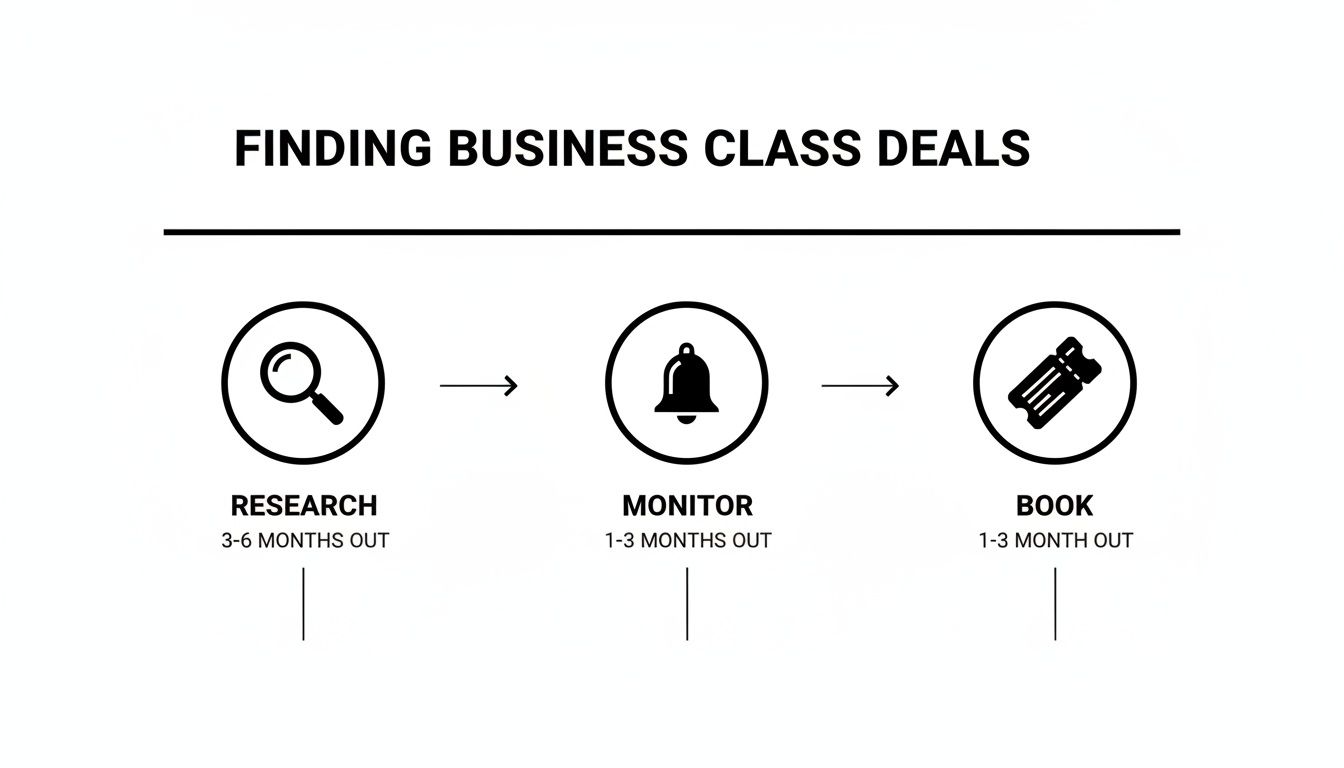
This timeline chart breaks down the core process Sarah will follow, moving from initial research to active monitoring before she's ready to pull the trigger.

Flowchart showing three steps to finding business class deals: Research, Monitor, and Book, with timelines.

This simple flow—research, monitor, book—is the fundamental rhythm for finding those deeply discounted premium fares.

Five to Three Months Out: Active Monitoring

Now the real work begins. Sarah fires up more aggressive, daily alerts for her target routes. She doesn't just settle for basic notifications; she digs into the advanced calendar views on flight search engines to spot pricing trends across the entire month. It doesn't take long to notice a pattern: fares are consistently about $500 cheaper if she flies on a Tuesday instead of a Sunday.

During this period, she gets an alert from a deal service about a flash sale on TAP Air Portugal through Lisbon. The price is tempting at $3,200, but the connection times are brutal for her schedule. She holds her ground, confident that a better option on a more direct route is coming. Patience is everything right now.

The monitoring phase is a test of discipline. It's so easy to get trigger-happy on a "good" deal, but the real goal is to wait for a great one. By having a clear price target and understanding the market, you can avoid jumping on mediocre offers.

This waiting game is particularly effective on competitive transatlantic routes. The market dynamics are completely different from flights within Europe. Intra-Europe business class has practically vanished over the last decade, dropping from 4.1% of all seats in 2014 to a tiny 0.35% in 2023. But the fierce competition for premium travelers on long-haul flights between giants like Lufthansa, Air France, and KLM creates exactly the kind of price volatility that savvy, patient travelers can use to their advantage. You can learn more about the evolution of European premium cabins from centreforaviation.com.

Three Months to Six Weeks Out: The Buy Signal

Just under three months before her trip, the signal she’s been waiting for arrives. A "Buying Event" notification hits her inbox: Lufthansa and United are in the middle of a mini-fare war on East Coast to Germany routes. The price for her exact dates, Boston to Frankfurt, has cratered to $2,650 round-trip.

She moves fast, verifying the fare on a couple of different sites. It’s real. The price is well below her $3,000 target, the airline is top-tier, and the flight times are perfect. She doesn’t hesitate. In less than 15 minutes, her ticket is booked, locking in a savings of nearly $4,000 off the first price she saw months ago.

Sarah's story isn't about getting lucky. It's proof that a methodical, patient approach to finding a business class to Europe deal really pays off, turning an outrageous luxury into a smart business investment.

You've learned the strategies, you know the tools, and you've seen the proof. But I get it—a few nagging questions probably still come to mind. It's one thing to talk about these deals in theory, another to feel confident enough to go hunt for them yourself.

Let's tackle those last bits of uncertainty. Think of this as the final pep talk before you dive in, because an affordable business class seat to Europe isn't just a fantasy; it's a very real possibility when you know how the game is played.

So, Can You Really Find Business Class Cheaper Than Coach?

Yes, absolutely. While it doesn't happen for every flight every day, the phenomenon of business class being cheaper than coach is a real and repeatable event for those who know how to look. The key is comparing apples to oranges in your favor. A strategically booked, deeply discounted business class fare is often less expensive than a last-minute, inflexible, or full-fare economy ticket.

Picture this: a corporate traveler needs a non-stop to Frankfurt tomorrow. Their company pays the walk-up economy price, easily $2,800. Meanwhile, an airline with too many empty premium seats quietly drops its business class fare to $2,500 to spur sales. It’s a brief, unannounced sale—a pricing anomaly. And that's exactly what we're looking for.

You have to stop thinking about just finding "cheap flights." What you're really hunting for are moments of value inversion—when the premium product temporarily costs less than the standard one.

How Far in Advance Should I Start Looking?

There’s no single magic bullet for timing, but there is absolutely a strategic window that gives you the best shot. Think of it as a phased approach.

  • 8-10 Months Out: This is your reconnaissance phase. Start looking at your desired routes and get a feel for the pricing landscape. What's the normal high? What's the low? You're establishing a baseline.
  • 3-6 Months Out: This is the sweet spot. Airlines have a solid read on demand by now and start getting serious about filling seats. Prices will fluctuate much more, creating the dips you want to catch.
  • 2-4 Weeks Out: Never count out the last minute. If a flight is looking empty up front, carriers sometimes get desperate. They'll slash prices to get some revenue rather than letting a seat fly empty for a total loss.

The key isn't checking once and calling it a day. The market is constantly in motion. You need to keep your eyes open so you can pounce when the right deal appears.

How Flexible Do I Really Need to Be?

Flexibility is your superpower here. The more you can bend on dates and even destinations, the more money you're going to save. It's a simple equation. Flying on a Tuesday instead of a Friday can slice hundreds of dollars off a fare by itself.

But even if your dates are locked in, don't despair. You might miss the absolute jaw-dropping, "fly-anywhere-next-month" deals, but applying these fare-monitoring techniques can still knock 30-50% off the initial prices you were seeing. It's about being strategic within your own constraints.

Are We Talking Budget Airlines or the Real Deal?

Let's be crystal clear: this isn't about cramming into a "premium" seat on a low-cost carrier. We are exclusively targeting top-tier, full-service international airlines. These are the carriers with a true, long-haul business class product.

You'll be finding deals on airlines like:

  • Lufthansa
  • Air France-KLM
  • United Airlines
  • British Airways
  • TAP Air Portugal
  • SAS Scandinavian Airlines

These are the big players locked in a fierce battle for transatlantic passengers. They have large premium cabins to fill, and that competition creates opportunities. The goal here is to get the lie-flat seat, the lounge access, and the high-end service, but at a price that makes you second-guess ever flying coach again. You aren’t trading quality for a low price; you're using market intelligence to get that quality for less.


Ready to stop overpaying for comfort? At Passport Premiere, we specialize in providing the intelligence and alerts that turn market volatility into your advantage. Discover how our members consistently find business class fares for less than coach and transform the way you travel. Learn more and start your journey at https://www.passportpremiere.com.