Is Business Class Cheaper Than Coach? How to Fly Premium for Less

Finding a business class ticket that's cheaper than coach isn't a travel myth; it's about strategy, not luck. The entire game revolves around a simple truth: airlines would much rather sell you a premium seat at a deep discount than see it fly empty.

Let's break down how you can turn that basic economic reality into a serious advantage and find business class for less than the price of a last-minute economy ticket.

Why Business Class Can Be Cheaper Than You Think

That image of business class as a stratosphere of untouchable luxury? It’s completely outdated. Sure, the advertised "rack rates" are astronomical, but almost no one actually pays that price. The market is just too competitive, and airline revenue management is too sophisticated. This churn creates a constant stream of opportunities for anyone paying attention.

Think about it from the airline's perspective. The second that cabin door closes, an empty premium seat becomes a total loss. It generates zero revenue. That's a huge incentive for carriers to get creative with their pricing, leading to situations where a discounted business class seat can actually be cheaper than coach.

The Myth of the Full-Price Fare

Airlines exist in a ridiculously volatile market. They are constantly tweaking fares based on demand, what their competitors are doing, and real-time booking patterns.

The result? On many international routes, it’s estimated that fewer than 15% of premium seats ever sell at the full, initial asking price. The other 85% are offloaded at various discounts through different channels and at different times.

This isn't new, but the scale of it is. Over the last few decades, premium travel has become way more accessible. A cross-country flight that might have run you the equivalent of $4,439 in 1941 is projected to cost just $120 in 2026 after adjusting for inflation. That's a mind-boggling 97% plunge.

Deregulation and a massive boom in passenger numbers have forced airlines to fight tooth and nail on price, even for their best seats.

The key is a mental shift. Stop seeing business class as a fixed, exorbitant product. Start seeing it for what it is: a commodity with a fluctuating price that can sometimes be cheaper than a full-fare economy ticket. Your job is to buy when the market is low.

Turning Volatility into Your Advantage

Market volatility isn't something to avoid; it’s your single biggest asset in this hunt. Fare wars, seasonal lulls, and airlines launching new routes all trigger price drops you can jump on.

By learning to spot these trends, you can put yourself in a position to snag premium seats for prices that sometimes dip below what people are paying for a last-minute economy ticket. Our guide on how to save money on international flights dives even deeper into these kinds of strategies.

Ultimately, landing a real deal requires an active, strategic approach, not just passive searching on Google Flights. You have to understand:

  • Airline Pricing Models: A basic grasp of how their revenue management systems work to fill planes.
  • Market Dynamics: The competitive pressures that force prices down.
  • Strategic Timing: Knowing when to look and when to book for the biggest savings.

Get a handle on these elements, and you can consistently find fares that make flying up front not just a luxury, but a genuinely smart financial move. The rest of this guide will give you the exact tools and actionable steps to make that happen.

How to Time Your Booking for Maximum Savings

Timing is everything when you're hunting for the best business class fares. Forget those old myths about booking on a Tuesday; the real strategy is about understanding the rhythm of the airline's own systems. Once you learn to read the predictable pricing cycles, you can pounce on some incredible deals.

It’s not about guesswork. It's about building a framework to anticipate when prices are most likely to drop. This means looking beyond the calendar and zeroing in on the specific days—and even entire months—when airlines get a little more desperate to fill those premium cabins.

Decoding the Weekly Fare Cycle

Airlines are constantly tweaking prices all week long, and it's far from random. The pattern is usually tied to corporate booking habits. Business travelers tend to book their flights mid-week, while the rest of us are usually shopping for deals over the weekend.

That creates a clear window of opportunity. In fact, booking a business class flight on a Sunday could slash your costs by up to 17%. Insights from the 2026 Air Hacks Report backed this up, noting the price gap between premium and economy cabins shrank by 10% compared to 2019. It seems the best deals pop up when the airline's algorithms are trying to capture the attention of weekend shoppers.

The Surprising Power of Seasonal Lulls

Everyone assumes that peak travel season means peak prices, but that's not always the case for business class. While economy seats are packed with vacationers, premium cabins can see a real dip in demand when the corporate crowd stays home.

August is a perfect example. Right in the middle of the summer rush, it often turns out to be the cheapest month for premium travel. Why? Because while families are cramming into coach, business travel has slowed to a crawl, leaving airlines with empty lie-flat seats they need to fill.

This counter-intuitive trend is your secret weapon. By targeting periods when corporate demand wanes—like August or the weeks around major holidays—you can find business class seats at a fraction of their usual cost.

To get a sense of just how much more accessible flying has become, this timeline shows the dramatic drop in the real cost of airfare over the decades.

Timeline showing airfare cost reduction from $4,439 in 1941 to $120 in 2026, a 97% decrease.

The chart highlights a massive 97% reduction in real cost since 1941. It’s a powerful reminder of how competition and efficiency have made all travel, including the front of the plane, more attainable than ever.

Finding Your Booking Sweet Spot

So, when’s the right time to pull the trigger? There's no single magic day, but there is absolutely a strategic window. Book too early, and you’ll be looking at inflated "rack rates." Wait too long, and you'll pay a steep premium for last-minute seats.

The sweet spot for most international routes is somewhere between two and six months before you plan to fly.

To give you a clearer idea, here’s a calendar to guide your booking strategy.

Strategic Booking Calendar for Premium Cabins

This table breaks down the best and worst times to book your international business class flight, based on historical data and what we're seeing in the market right now.

Booking Window Potential Savings Best For Pro Tip
6-11 months out Low (0-5%) Planners needing specific dates or using points. Prices are high. Only book if your dates are completely inflexible.
4-6 months out High (15-30%) The "sweet spot" for most international routes. This is when airlines often release discounted fare buckets. Start monitoring now.
2-4 months out Moderate (10-20%) Good balance of price and availability. Fare sales are common in this window. Be ready to book if you see a good deal.
1-2 months out Low to Moderate Last-minute deals can appear, but it's a gamble. Risky. Fares can spike dramatically as the departure date nears.
Within 30 days Very Low (-20%+) Emergency travel only. Expect to pay a significant premium. Avoid this window at all costs.

Think of it as a game of patience and precision. Mastering these timing strategies is what separates savvy travelers from everyone else. For a much deeper dive into scheduling your purchase, check out our complete guide on the best time to buy international flights.

And remember, saving money doesn't stop once you've booked your flight. Getting a handle on your ground transportation costs can make a huge difference to your overall budget. Finding affordable transfer services, for instance, is another smart move. It all adds up.

Unlocking Deals with Creative Routing Strategies

The most direct flight from A to B is almost never the cheapest, especially when you're hunting for a deal in business class. To consistently land the best fares, you have to stop thinking like a typical traveler and start thinking like a deal hunter. It's a total mindset shift that can save you thousands.

Forget the simple roundtrip search. The real magic happens when you treat your journey like a series of strategic moves. By being a little flexible and understanding a few core concepts, you can find pricing gaps that most people completely miss. A single extra stop or a quick hop to a nearby airport can be the difference between a decent fare and a phenomenal one.

Laptop screen with 'ROUTE HACKS' logo, world map, and toy airplane showing a flight path.

The Power of Positioning Flights

One of the most powerful tools in your arsenal is the positioning flight. This just means you take a separate, cheap flight to a different city to catch your main long-haul business class flight. Why? Because major international hubs have way more competition, which hammers down prices on premium seats.

Let's look at a real-world scenario. A business class ticket from a smaller airport like Charlotte (CLT) to Paris (CDG) might run you $5,500. At the same time, the exact same flight on the same airline could be going for just $2,800 from a major hub like New York (JFK) during a sale.

Instead of booking the expensive flight from your home airport, you’d simply:

  • Buy the $2,800 roundtrip business class ticket from JFK to Paris.
  • Book a separate cheap economy ticket from Charlotte to JFK for about $200.

Just like that, you’ve saved over $2,500. The key is to check fares from multiple hubs, not just the airport closest to your house. It takes a little more effort, but the savings can be massive.

Leveraging Airline Alliances

You don't have to be loyal to a single airline to get where you're going. In fact, you'll find better prices if you aren't. Learning to use the big global airline alliances—Star Alliance, oneworld, and SkyTeam—opens up a whole new world of routing options.

These partnerships let you mix and match different airlines on the same ticket. This is a game-changer for finding cheap business class seats. One airline might have a great deal on the long transatlantic leg, while its partner has a better price for the short hop into your final destination in Europe or Asia.

Think about a trip from Chicago to Bangkok. A direct search on a single airline might come back with a crazy high price. But by tapping into the alliance network, you could book a single ticket that puts you on United from Chicago to Frankfurt, then on Lufthansa or Thai Airways for the final leg to Bangkok. This kind of "codeshare" ticket is often significantly cheaper than sticking with one carrier the whole way.

Uncovering Fifth-Freedom Routes

Now for a tactic that separates the amateurs from the pros: fifth-freedom routes. These are flights operated by an airline between two countries where neither is its home base. A perfect example is the flight Emirates—an airline based in the UAE—operates every day between New York (JFK) and Milan (MXP).

Why are these special? The airline is mostly trying to fill the plane for the full journey from its hub (in this case, Dubai) to the final stop. The segment in the middle, like JFK to Milan, is often priced incredibly competitively to attract local travelers and fill what would otherwise be empty seats.

Fifth-freedom routes are a goldmine for finding luxury for less. You get the incredible service of a top-tier international carrier like Emirates or Singapore Airlines, but on a route where they are fighting hard on price.

Some of the most well-known examples include:

  • Emirates: New York (JFK) to Milan (MXP)
  • Singapore Airlines: New York (JFK) to Frankfurt (FRA)
  • KLM: Singapore (SIN) to Denpasar (DPS)

Booking these flights often gets you a lie-flat seat for a fraction of what other airlines charge for the same trip. It’s a perfect illustration of how thinking outside the box turns complex airline networks into your personal treasure map.

Let Technology Hunt for Deals For You

Forget spending hours manually refreshing airline websites. That's a surefire way to burn out and miss the best deals. Instead, let technology do the heavy lifting, working around the clock to spot price drops the second they appear.

Setting up a basic alert on a platform like Google Flights is a decent first step. It's fine for tracking a specific route and getting an email when the price shifts. But when you're hunting for premium cabin fares, these simple alerts just don't cut it. They tell you that the price changed, not why it changed or if it's actually a good deal.

Laptop displaying stock charts, a 'DEAL Alerts' sign, and a smartphone on a wooden desk.

Go Beyond Simple Price Drop Alerts

Standard alerts lack the context you need to make a smart buying decision. They can’t tell the difference between a minor price fluctuation and a full-blown fare war. They certainly can't tell you the underlying value of an unsold seat. This is where specialized services come in, offering a much deeper level of market intelligence.

Services like Passport Premiere go way beyond simple price tracking. They use proprietary analysis to figure out the true market value of an empty seat on any given flight. This means you get an alert not just when a price moves, but when it drops to a level that represents a genuine buying opportunity. It’s the difference between hearing random noise and getting a clear signal to buy.

The goal isn't just to find a cheaper fare; it's to find the right fare at the right time. Specialized technology helps you understand a seat's actual worth, so you can book with confidence when the price is at its lowest point.

This kind of analytical approach is crucial, especially now. Fierce competition among major players like Delta, American Airlines, and JetBlue is pushing premium cabin prices down on popular transatlantic routes. By 2026, you'll be able to find a business class seat from New York to London for as low as $2,800—a 12% drop from 2023 levels. This isn't just a local trend; we're seeing similar drops on routes from Paris to Tokyo and Singapore to Sydney. With the right tools, you can time your purchase perfectly to catch these dips.

How Specialized Services Give You an Edge

So, what's the real advantage of a dedicated service? It’s their ability to sift through massive amounts of data and send you simple, actionable alerts. It's about knowing when an airline is about to launch a sale or when a competitor's move is likely to start a price war.

For a clearer picture, let's compare what you get from a standard tool versus a specialized intelligence service.

Fare Monitoring Tools Comparison

Feature Standard Fare Alerts (e.g., Google Flights) Specialized Service (e.g., Passport Premiere)
Alert Trigger Any price change (up or down) on a tracked route. Price drops to a level representing high value.
Analysis None. Simply reports the new price. Calculates a seat's "true value" based on historical data.
Context Lacks context. Can't distinguish minor shifts from major sales. Identifies fare wars, sales, and strategic buying windows.
Predictive Power Reactive. Alerts you after a price has already changed. Proactive. Often identifies patterns that precede fare drops.
Focus Broad, mass-market travel (mostly economy). Niche, focused on premium cabin (Business/First) travelers.

As you can see, it's a completely different ballgame. One gives you raw data; the other provides real intelligence.

This is what sets these platforms apart:

  • True Value Analysis: They don't just track prices; they calculate what a seat should cost based on demand, historical data, and what competitors are doing.
  • Predictive Insights: They spot the patterns that usually show up right before a big fare sale, giving you a head start.
  • Targeted Notifications: You get alerts that actually matter for your specific travel plans, cutting through the noise.

You simply won't get this level of detail from a mainstream search engine. They’re built for the masses, not for someone who understands the nuances of premium cabin pricing. In fact, you can see how one traveler used this exact data-driven strategy to save over $10,000 on flights.

By automating your search with the right technology, you stop playing a guessing game and start making strategic moves. You’ll spend less time searching and more time saving, snagging the cheapest business class fares with confidence.

Insider Tactics for Finding Deep Discounts

Alright, now that you've got the basics of timing and routing down, let's get into the good stuff. These are the advanced moves the pros use to snag those almost-too-good-to-be-true business class deals.

I'm talking about the kinds of fares that make you do a double-take—the ones where a lie-flat seat actually costs less than a last-minute economy ticket. It’s all about knowing where to look, understanding the system, and being ready to pull the trigger instantly. This is what separates the casual searchers from the serious deal hunters.

Hunting for the Legendary Error Fare

Every now and then, someone, somewhere, makes a big mistake. A misplaced decimal point, a currency glitch, a simple fat-finger typo—and just like that, an error fare is born.

These are the white whales of cheap travel. Think New York to Paris in business class for $400 roundtrip, or a first-class suite to Asia for the price of premium economy. They are real, but they don't last long. Once an airline's system catches the mistake, it's gone in a flash.

The only way to catch one is to be in the right place at the right time, which usually means being plugged into the communities and newsletters that broadcast these deals the second they pop up.

If you spot one, you have to move fast:

  • Book Immediately. Don't think. Don't ask your boss for the time off. Don't even check with your partner. Book it first, and sort out the details later. Remember, most tickets have a 24-hour free cancellation period.
  • Do Not Call the Airline. This is the cardinal rule. Phoning them up to ask if the "amazing deal" is real is the quickest way to get it shut down for everyone.
  • Hold Off on Other Plans. There’s a small chance the airline might not honor the ticket. Give it a week or two for the dust to settle before you book any non-refundable hotels or tours.

Decoding Airline Fare Classes

Here's a little secret: not all business class tickets are created equal. Airlines use a whole alphabet of fare classes (or "fare buckets") to price their seats. You'll see them as single letters like J, C, D, Z, P, or I. Learning this alphabet is a game-changer.

A "J" class ticket, for example, is typically a full-fare, completely flexible business class seat. It's also the most expensive. On the flip side, "P" or "Z" class tickets are usually the deeply discounted, non-refundable business fares. These are the ones we're after.

Knowing this helps in two ways. First, it tells you exactly what you're buying. That cheap "P" fare gets you the same lie-flat bed, but it might not earn as many miles or be eligible for an upgrade. Second, it can tip you off when an airline releases a fresh batch of cheap inventory, often right before a public sale begins.

The Premium Economy Upgrade Strategy

Sometimes, the cheapest way into business class is to not buy a business class ticket at all. Instead, you can book a premium economy seat and then upgrade it. When the stars align, this move is a financial masterstroke.

This strategy works best when:

  • An airline is running a sale on premium economy.
  • You have frequent flyer miles or elite status that unlocks low-cost or complimentary upgrades.
  • The business class cabin on your flight is looking pretty empty as the departure date gets closer.

Airlines are far more willing to upgrade someone from premium economy than from the back of the bus. The combined cost of a discounted premium economy ticket plus the miles or cash for an upgrade can easily be hundreds—sometimes thousands—of dollars cheaper than buying even a discounted business class ticket from the start.

The real secret is that an upgradeable premium economy fare (often a W or S class ticket) can be a backdoor into a lie-flat seat. It takes a little homework on your airline's loyalty program, but the savings can be huge.

Many of these principles overlap with general advice for finding good deals on any international flight. Building a solid foundation of booking knowledge makes these advanced tactics even more effective. You can find more great advice in this guide on 10 Game-Changing Tips for Booking International Flights.

Common Questions About Finding Business Class Deals

Even after you've learned all the tricks of the trade, a few questions always seem to pop up when you're hunting for that perfect business class deal. Let's tackle some of the most common ones I hear, so you can book your next flight feeling like you've got this completely under control.

Can You Really Find Business Class Cheaper Than Economy?

Yes, absolutely. It sounds crazy, but you can often find business class cheaper than coach. This isn't some urban legend—it happens more than you'd think, especially on those highly competitive routes across the Atlantic or Pacific where airlines are in a constant dogfight for passengers.

Think about it from the airline's perspective: an empty seat in business class is a total loss the second that cabin door closes. They’d much rather sell it for something than get nothing. This is where savvy travelers win. When you combine the airline's need to fill seats with the strategies we've covered—like smart timing and flexible routing—you hit these perfect moments where a discounted premium fare actually dips below the price of a last-minute, full-fare economy ticket. It’s a market inefficiency just waiting to be exploited.

What Are the Real Risks of Booking an Error Fare?

The biggest risk is simple: the airline catches its mistake and cancels your ticket. If that happens, you get a full refund, but you're back to square one without the incredible deal. It’s a bummer, for sure.

To protect yourself, the best move is to wait a week or two before booking any non-refundable hotels or tours. This gives the airline enough time to either honor the fare (which happens a lot, surprisingly) or pull the plug. Many carriers will eat the cost just to avoid a PR headache, and when they do, you've just scored one of the best bargains in travel.

The cardinal rule of error fares is to book immediately and never, ever call the airline to ask if the price is real. The second you do, you've flagged it for them, and they'll vaporize the deal for you and everyone else. Just book it and wait.

How Far in Advance Should I Book for the Best Deal?

There’s no single magic number, but for international business class, a great rule of thumb is to start seriously tracking fares four to six months before you plan to fly. Prices are almost always sky-high when they're first released (around 11 months out) and then again in the last few weeks before departure.

The sweet spot is usually in that middle period. That's when airlines start getting a real sense of demand and begin releasing cheaper fare buckets to fill the cabin. The key isn't to fixate on one date but to watch the fare cycle and pounce when you see a significant dip. This is exactly where a good monitoring service pays for itself—it does the obsessive watching for you.

Are Premium Travel Membership Services Worth the Cost?

For anyone flying internationally in a premium cabin more than once a year, the answer is a resounding yes. The savings from just one well-timed business class ticket can easily cover the entire annual fee, often with thousands to spare.

These services offer a level of market intelligence that free tools just can't match. They don't just show you price drops; they dig into the complex fare data to send you genuinely actionable alerts when it’s the right time to buy. Instead of guessing, you’re making a move based on data that shows the true market value of that seat. It’s about securing the absolute cheapest business class tickets with confidence and saving a ton of money in the process.


Ready to stop overpaying for comfort and start finding business class fares cheaper than coach? Passport Premiere provides the specialized intelligence and timely alerts you need to convert airline price volatility into real savings. Discover how our members save thousands on premium travel.

Learn more and start saving at Passport Premiere

7 Best Business Class Deals for 2026: When Business is Cheaper Than Coach

Imagine settling into a lie-flat seat, savoring a gourmet meal, and arriving refreshed and ready to go, all for a price that can be less than a last-minute economy ticket. This isn't a traveler's fantasy; it's the reality for those who know where to find the best business class deals. Most people assume premium cabins are financially out of reach, unaware that airlines rarely sell all their front-of-plane seats at the initial high prices. The secret to affordable luxury lies in market timing, fare volatility, and using the right platforms to turn an airline's empty seat problem into your opportunity. Some deals even make business class cheaper than coach.

This guide is built to deliver actionable results, not just theories. We cut through the noise to show you exactly which services and strategies consistently uncover deeply discounted premium fares, sometimes finding business class cheaper than coach. You'll learn how to find and act on specific opportunities, from regional fare disparities to mistake fares and mileage sweet spots. We'll explore seven proven methods and platforms that unlock these savings, transforming how you approach international travel.

Each entry in our list provides clear guidance on how it works, its ideal use case, and what to expect, complete with screenshots and direct links to get you started immediately. Forget endlessly searching airline websites or overpaying for comfort. It's time to learn the strategies that make premium travel not just possible, but a practical and repeatable part of your travel planning.

1. Passport Premiere

For travelers who regularly book international premium-cabin travel, Passport Premiere offers a distinct, data-driven method for securing some of the best business class deals. Instead of just aggregating publicly available fares, this membership-based service operates on a core principle: airline pricing is volatile, and that volatility creates opportunity. Passport Premiere’s platform is designed to identify the precise moments when airlines discreetly lower premium fares to fill seats, often to levels where business class is cheaper than coach.

The service’s value proposition is its specialized focus on the premium cabin market. It acknowledges that fewer than 15% of business and first-class seats sell at their initial high prices. By using continuous fare monitoring and market cycle analysis, Passport Premiere detects fare wars and price drops that standard search engines might miss. For its members, this translates into actionable intelligence, signaling the optimal time to purchase tickets and avoid overpaying. The platform's analysis is so effective that it often uncovers situations where a business class ticket can be secured for less than the price of a standard coach fare.

Passport Premiere's Fare Monitor showing business class deal examples

What Makes It a Standout Choice

Passport Premiere is built for a specific type of traveler: the frequent long-haul flyer, corporate travel manager, or luxury vacationer who understands that timing is everything. It moves beyond simple fare alerts by providing context and education through its resources. Members gain access to Fare Monitor demonstrations, a Video Gallery explaining pricing mechanics, and news updates that equip them to act with confidence. This educational component is crucial, as it helps users understand the "why" behind a price drop, not just the "what."

Another key differentiator is its utility for corporate travel. The service provides a transparent, systematic approach that appeals to SMB owners and travel managers tasked with controlling costs without sacrificing comfort for their executives on long-haul flights. The clear membership terms and practical guidance make it a justifiable tool for managing travel budgets effectively. While many services focus on points and miles, Passport Premiere’s expertise is in the cash-fare market, offering a direct path to savings. This approach complements traditional points strategies and provides another powerful tool for lowering travel expenses.

Expert Insight: The most significant advantage of Passport Premiere is its focus on market timing. It teaches members to recognize pricing patterns, turning them from passive buyers into strategic purchasers who can act when fare algorithms create temporary discounts where business class can be cheaper than coach.

How to Use Passport Premiere Effectively

To maximize the benefits of the service, flexibility is key. The deals uncovered are often tied to specific travel windows when airlines are trying to increase load factors in their premium cabins.

  • Monitor Actively: Regularly check the Fare Monitor and alerts to stay ahead of emerging fare wars or price drops on your target routes.
  • Plan Ahead: The system works best for those who can plan their travel a few months in advance, allowing them to wait for an optimal buying window to open.
  • Use the Educational Resources: Take time to watch the demonstration videos. Understanding the fundamentals of airline pricing will help you spot a truly exceptional deal from a standard sale.

While its subscription model requires an initial investment, the potential return for a frequent international traveler can be substantial, often realized in the savings from a single trip. The platform doesn't just find deals; it provides the market intelligence needed to consistently secure them. For those interested in mastering more than just points, Passport Premiere also offers guidance on other premium travel tactics, and you can learn more about their strategies for getting upgraded to business class on their blog.

Website: https://www.passportpremiere.com

2. Going (Elite membership)

Going, formerly known as Scott’s Cheap Flights, has expanded its highly regarded deal-finding service into the premium cabin space with its Elite membership. This tier moves beyond economy fares to actively hunt for exceptional cash prices and points-and-miles redemptions in premium economy, business, and first class. It stands out by delivering a curated, high-signal stream of alerts directly to your inbox, removing the need for constant, manual searches for the best business class deals.

For travelers who value their time, Going’s Elite service acts as a proactive monitor, identifying fare anomalies and unadvertised sales that often last for only a short window. The platform's human-led team of flight experts vets each deal, ensuring the prices are genuinely low and the routes are practical, avoiding convoluted itineraries with overnight layovers. The result? You get notified of unbelievable opportunities, sometimes when business class is cheaper than coach.

A screenshot of the Going website showcasing a business class deal alert to Paris.

Key Features and How to Use Them

The Elite membership is designed for travelers with flexibility. Users set their home airports, and Going sends alerts when a qualifying deal appears. This "set it and forget it" approach is ideal for discovering destinations you may not have considered or snagging a fantastic price for a future trip. It's not an on-demand search tool but rather a system for opportunistic booking.

  • Premium-Cabin Cash & Points Deals: Receive alerts for both cash fares and award travel, often highlighting scenarios where round-trip business class can be booked for what many travelers expect to pay for coach.
  • Mistake Fare Alerts: Get immediate notifications for rare but valuable mistake fares, which can disappear within hours. The alerts provide clear instructions on how to book quickly.
  • Airport Targeting: Customize your alerts by selecting multiple departure airports across the US, increasing your chances of finding a deal that works for you.
  • Booking Guidance: Each alert includes detailed information on which airlines are involved, the typical price for the route, and direct links to book through Google Flights or directly with the airline.

Expert Tip: Enable mobile app notifications for Going. Mistake fares and flash sales are extremely time-sensitive, and the fastest way to act on them is through an immediate push notification rather than waiting to check your email. These are often the deals where you'll find business class cheaper than coach.

The membership costs $299 per year, though a 14-day free trial is available to test the service. While alerts are not guaranteed on your desired route and dates, the value of just one booked deal often exceeds the annual fee by a significant margin. For anyone looking to understand more about the full spectrum of premium travel savings, from mistake fares to strategic upgrades, Passport Premiere provides a detailed breakdown of how these opportunities arise and how to catch them. Going Elite excels at finding those deals for you.

Website: https://www.going.com/elite/

3. Thrifty Traveler (Premium and Premium+)

Thrifty Traveler has earned a dedicated following by delivering a potent mix of deeply discounted cash fares and, more importantly for premium flyers, rare award space availability. The platform's Premium and Premium+ memberships serve travelers who are fluent in both cash and points, offering a steady stream of deals that cover the full spectrum of air travel. It distinguishes itself by unearthing hard-to-find business and first-class award seats, making it a powerful tool for finding the best business class deals using miles.

For the points-and-miles enthusiast, Thrifty Traveler’s alerts are a game-changer. The service's team actively searches for unicorn-level award availability, such as multiple business class seats on desirable routes to Europe or Asia, and immediately notifies members. This saves countless hours of manual searching on airline websites and provides a direct path to booking aspirational travel for a fraction of the cash price.

A screenshot of the Thrifty Traveler website, displaying a flight deal for a business class trip.

Key Features and How to Use Them

Thrifty Traveler operates on an alert-based system where users select their home airport and receive curated deals via email. The platform's real strength lies in its dual focus, giving users the flexibility to book a cheap cash fare one day and a stellar award ticket the next. Its alerts are known for being clear, actionable, and often highlighting deals where business class is cheaper than coach would typically be.

  • Premium Cabin Cash & Award Deals: The service sends alerts for both discounted cash tickets in business/first class and exceptionally valuable award space openings, catering to both kinds of deal seekers.
  • Instant Text Alerts: For the most time-sensitive mistake fares and award space dumps, members can opt-in for text message notifications, giving them a critical head start before the deal disappears.
  • Airport-Specific Curation: You receive only the deals departing from your chosen home airport(s), eliminating the noise of irrelevant offers and keeping your inbox focused on what matters to you.
  • Detailed Booking Instructions: Each alert comes with step-by-step guidance on how to find and book the fare, including the best credit card points to transfer for award deals.

Expert Tip: To get the most from Thrifty Traveler's award alerts, ensure you have a healthy balance of transferable points (like American Express Membership Rewards, Chase Ultimate Rewards, or Capital One Miles). The best award deals require quick action, and having points ready to transfer is essential.

The Premium membership costs $89.99 annually. While the service requires having the right kind of points to act on award alerts, the value from a single booked business class award flight can easily save thousands of dollars, making the subscription fee a small investment for massive returns.

Website: https://thriftytraveler.com/premium/

4. Dollar Flight Club (Premium+ for business/first)

Dollar Flight Club offers a straightforward, alert-based system for travelers looking for lower airfares, with its Premium+ tier dedicated specifically to premium economy, business, and first-class cabins. It operates on a simple premise: set your home airport(s), and receive email and SMS notifications when a notable cash deal emerges. This service is designed for the cost-conscious premium traveler who prioritizes simplicity and wants a low-effort way to find the best business class deals.

The platform distinguishes itself with an accessible price point for entering the premium deal alert space. While it focuses primarily on cash fares rather than points redemptions, its alerts can highlight significant price drops and fare wars that make business class surprisingly affordable. The goal is to deliver actionable deals that can be booked quickly, often showcasing fares where business class is cheaper than what many travelers expect to pay for a standard coach ticket.

A screenshot of the Dollar Flight Club website showcasing their premium plans for business class deals.

Key Features and How to Use Them

The Premium+ membership is built for opportunistic travelers. Users configure their departure airports and can also specify "dream destinations" to watch. When the system's algorithm and human flight-finders identify a qualifying deal from one of your selected hubs, an alert is dispatched with booking instructions. It’s a passive monitoring system, not a real-time search engine.

  • Premium & Business Class Alerts: The Premium+ plan is the only tier that includes business and first-class deals. Alerts typically show potential savings of up to $2,000 or more on round-trip international flights.
  • Airport & Destination Targeting: Users can select their home airport and add specific destinations they wish to track, though deal flow is always dependent on market availability.
  • SMS Notifications: In addition to email, Premium+ members receive SMS alerts, which are critical for acting on time-sensitive fares that can vanish within hours.
  • Partner Perks: Membership includes discounts on products and services from travel partners, adding a bit of extra value beyond the flight deals themselves.

Expert Tip: Add several major international hubs near you to your departure airport list, even if they require a short connecting flight. Deals from large airports like JFK, LAX, or ORD are often more frequent and substantial, and the savings on the long-haul leg can easily justify the cost of a separate positioning flight.

The Premium+ plan is priced at $169 per year, positioning it as a more affordable entry point compared to some competitors. While some third-party user reviews mention concerns about cancellation processes and the perceived value based on their home airport, the service can pay for itself with a single booked trip. For travelers primarily interested in discounted cash fares without the complexity of award charts, Dollar Flight Club offers a simple and direct path to savings.

Website: https://dollarflightclub.com/premium-plans/

5. Business Class Consolidator (agency)

Business Class Consolidator represents a more traditional, high-touch approach to securing premium-cabin airfare. As an ARC-accredited consolidator based in California, this agency provides access to unpublished, privately negotiated fares that are not available through online travel agencies or airline websites. This service is tailored for travelers who prefer human expertise and hand-curated itineraries, especially for complex, multi-city international trips. They specialize in finding best business class deals by accessing a different inventory of fares altogether.

This agency acts as an intermediary, purchasing tickets in bulk from major airlines and reselling them to consumers at a reduced price. The key difference is the direct interaction with an agent who can build custom itineraries, navigate complex fare rules, and potentially find savings that algorithms miss. In some cases, their access to these private fares can result in finding business class cheaper than coach on last-minute or high-demand routes.

A screenshot of the Business Class Consolidator website homepage showing the quote request form.

Key Features and How to Use Them

Unlike a self-service search engine, Business Class Consolidator operates on a quote-based model. Travelers submit their itinerary details through a web form or by phone, and a dedicated agent responds with curated options. This process is best suited for those who have definite travel plans and are looking for pricing power rather than speculative searching.

  • Access to Unpublished Fares: The core offering is access to consolidator fares in business and first class across major international airlines, which can offer significant discounts over public prices.
  • Dedicated Agent Support: Each inquiry is handled by a human agent who can assist with complex routes, multi-city stopovers, and specific airline or aircraft requests.
  • Complex Itinerary Specialization: The service excels at piecing together difficult multi-destination trips where standard online searches often fail to produce optimal or cost-effective results.
  • Multiple Payment Options: They provide flexibility in payment, an important feature for high-cost business travel. Their industry credentials (ARC/ASTA/CST) offer a layer of consumer protection.

Expert Tip: Be as specific as possible in your initial request. Provide your exact dates, preferred airlines, and any flexibility you have. The more information an agent has, the better they can search their private fare databases for a match that delivers maximum savings.

There is no fee to request a quote, so you can compare their offers against public fares without commitment. While savings are not guaranteed for every route, their strong Trustpilot rating suggests a consistent record of customer satisfaction. However, be aware that consolidator tickets often come with stricter rules regarding changes and cancellations. To better understand how timing impacts ticket prices, Passport Premiere offers insights into the best time to buy business class tickets, which can complement the quotes you receive from a consolidator.

Website: https://businessclassconsolidator.com/

6. TravelBusinessClass (agency)

TravelBusinessClass operates as a specialized travel agency focused on securing privately negotiated, unpublished fares in premium cabins. This US-based service positions itself as a powerful alternative for travelers who prioritize significant savings and dedicated support over DIY booking platforms. By accessing fare inventories not available to the general public, they aim to deliver substantial discounts of 15-60% on business and first-class tickets, making it a key resource for finding the best business class deals, especially on complex or last-minute international trips.

The core of their model is human-centric; each client is assigned a dedicated travel advisor who handles the entire booking process. This approach is particularly valuable for intricate multi-stop itineraries or situations where direct airline prices are prohibitively high. Their team works to find creative routings and utilize consolidated fares to construct trips that can sometimes make business class cheaper than coach when compared to full-fare economy tickets on the same last-minute route.

TravelBusinessClass (agency)

Key Features and How to Use Them

Unlike search engines, TravelBusinessClass is a quote-driven service. The process begins by submitting a request via an online form or a direct phone call, after which a travel expert contacts you with curated options. This hands-on method is designed for travelers who know their destination and dates but want an expert to find the best possible price and routing.

  • Unpublished Fare Access: The agency's primary value comes from its access to private and consolidated fares that are not listed on public search engines like Google Flights or the airlines' own websites.
  • Dedicated Advisor Support: Clients receive one-on-one service from a travel expert who can manage complex requests, handle changes, and provide assistance during travel with 24/7 support.
  • Complex Itinerary Construction: They specialize in building multi-stop, open-jaw, or mixed-cabin itineraries that are often difficult and expensive to book through conventional channels.
  • Quote-Driven Booking: The service is not a self-serve tool. You provide your travel requirements, and they return with specific, bookable itineraries and prices for your approval.

Expert Tip: For the best results, provide your advisor with as much flexibility as possible regarding your travel dates and even nearby airports. The most significant savings are often found on flights a day or two before or after your ideal departure date.

There is no membership fee to use TravelBusinessClass; you only pay when you book a flight. Their strong Trustpilot rating reflects a high level of customer satisfaction with both the savings and the service provided. While the advertised "from" prices are illustrative, their ability to navigate contract-fare rules and build custom trips makes them a powerful ally for both business and luxury leisure travelers seeking premium cabin value.

Website: https://travelbusinessclass.com/

7. Business-Class.com (agency)

For travelers who prefer a human touch and access to fares not available to the public, Business-Class.com operates as a specialized travel agency focused exclusively on premium cabins. This service functions as a high-volume consolidator, negotiating bulk fares with airlines and passing those savings on to consumers. They advertise discounts of 15-60% off published prices, making them a strong contender for finding some of the best business class deals, particularly for last-minute or complex international itineraries.

The agency’s model is built on direct interaction, connecting clients with a personal travel advisor via phone, chat, or email. This approach is ideal for those who find online search engines overwhelming or who need assistance building a multi-city trip. Their advisors source unpublished inventory to construct itineraries that can sometimes result in a business class seat being cheaper than a last-minute coach fare on the same flight.

A screenshot of the Business-Class.com website interface, showing fields to input flight search details.

Key Features and How to Use Them

Unlike a self-serve booking site, Business-Class.com requires you to submit a flight request or call their 24/7 US-based toll-free number. An agent then contacts you with curated options. The process is designed for speed, with a focus on delivering quotes quickly so you can compare them against publicly available fares. Their high Trustpilot score and large volume of recent reviews suggest a consistent service level for many travelers.

  • Unpublished Fare Access: The core value is access to discounted business and first-class tickets that airlines do not offer directly to the public. These are often the result of consolidator contracts.
  • Personal Travel Advisors: Every customer is assigned an agent who handles the search, booking, and any subsequent questions. This provides a single point of contact throughout the process.
  • Flexible Payment Options: The service accepts multiple payment methods, including financing through partners like Affirm, allowing travelers to pay for expensive tickets over time.
  • 24/7 Phone Support: Round-the-clock availability via US toll-free lines means you can get assistance with booking or travel issues regardless of your time zone.

Expert Tip: Before calling, do a quick search on Google Flights for your desired route and dates. This gives you a baseline price to compare against the quote from your Business-Class.com agent, helping you instantly recognize the value of the deal they offer.

While the agency provides significant savings, it’s important to act like a savvy consumer. Always ask your agent to clarify the fare rules, including cancellation policies and change fees, as consolidator tickets can have more restrictions than standard fares. Verifying these details ensures a smooth journey, especially if your plans might change.

Website: https://www.business-class.com/

Top 7 Business Class Deals Comparison

Service 🔄 Implementation complexity ⚡ Resource requirements 📊 Expected outcomes 💡 Ideal use cases ⭐ Key advantages
Passport Premiere Moderate — membership setup and learning curve for tools Paid membership + time to monitor and act High potential savings on timed long‑haul premium fares (timing-dependent) Frequent long‑haul flyers, corporate travel managers, luxury leisure, travel advisors Specialized premium-fare timing signals; data-driven monitoring
Going (Elite) Low — simple sign-up; alert-driven workflow Elite subscription; flexibility to book when alerted Good chance for premium-cabin deals 2–9 months out; time-sensitive Flexible travelers near US gateways seeking premium deal alerts Broad deal coverage including mistake fares; clear booking guidance
Thrifty Traveler (Premium / Premium+) Low–Moderate — sign-up + optional instant alerts Subscription (Premium/Premium+); transferable points for awards Strong award-availability finds and cash premium deals; frequent promos Award-savvy travelers with transferable points; timely deal hunters Award alerts, instant text notifications, 100‑day guarantee
Dollar Flight Club (Premium+) Low — lightweight email/SMS alert setup Lower annual fee for Premium+; airport targeting choices Moderate results; alert frequency varies by market and airports Budget-conscious users wanting simple premium cash alerts Affordable premium alert tier; SMS notifications and perks
Business Class Consolidator (agency) High — agent interactions and quote process Payment at booking; time with agent; adherence to consolidator rules Potential savings on complex/multi-city premium itineraries (variable) Travelers with complex routing or who prefer human-curated itineraries Access to unpublished consolidator fares; dedicated agent support
TravelBusinessClass (agency) High — quote-driven, advisor coordination required Possibly higher-touch service fees; 24/7 advisor time Advertised 15–60% savings vs full fares (results vary) Last‑minute or complex multi‑stop premium trips needing advisor help 24/7 dedicated advisors; negotiated unpublished fares
Business‑Class.com (agency) High — rapid agent sourcing; phone/chat booking Multiple payment/financing options; agent time Advertised substantial savings; outcome varies by route Travelers wanting fast quotes, phone support, and payment flexibility Large advisor team, quick quote turnaround, financing options

Choosing Your Path to Affordable Luxury

Finding the best business class deals has shifted from a game of chance to a matter of deliberate strategy. The journey through the various tools and services we've explored, from alert-based platforms like Going and Thrifty Traveler to specialized agencies such as Business Class Consolidator, reveals a core truth: premium cabin pricing is not static. This constant fluctuation, once a source of frustration, is now the very mechanism that creates incredible opportunities for savings.

The key takeaway is that the conventional wisdom of high, fixed prices for business class is outdated. By understanding the dynamics of fare wars, regional pricing imbalances, and even the occasional mistake fare, you can systematically position yourself to secure these seats at a fraction of their typical cost. It's no longer a fantasy to hear of business class cheaper than coach; with the right approach, it can be a repeatable reality for your own travel.

Matching the Tool to Your Travel Style

The effectiveness of your search for the best business class deals depends on selecting a service that aligns with your specific needs. Your choice will dictate the level of effort required and the type of opportunities you'll see.

  • For the Opportunistic Traveler: If your schedule is flexible and your primary goal is to jump on a great deal regardless of the destination, services like Going or Dollar Flight Club are excellent. They cast a wide net and deliver alerts directly to you, requiring minimal effort beyond monitoring your inbox and being ready to book.
  • For the Hands-Off Planner: If you prefer a more traditional, high-touch approach and want an expert to handle the search and booking process, a business class consolidator is your best option. You provide the destination and dates, and they do the work of finding unpublished fares, saving you valuable time.
  • For the Strategic Planner: Corporate travel managers, frequent long-haul flyers, and meticulous planners need more than just alerts. You require market intelligence and predictive insights. A platform like Passport Premiere is built for this purpose, offering deep analysis of fare cycles and pricing data to help you book proactively, not reactively.

Final Considerations for Success

Whichever path you choose, a few principles remain constant. Flexibility is your greatest asset. Being able to adjust your travel dates by even a day or two can unlock significant savings. Secondly, speed is critical, especially for mistake fares or limited-time fare sales that can disappear within hours. Have your passport information and payment details ready to act quickly. Finally, always understand the fare rules and conditions before booking, particularly with deeply discounted tickets, to avoid any unwelcome surprises.

The era of passively accepting exorbitant premium cabin fares is over. The tools and strategies discussed in this guide empower you to take control. You can now access the comfort, service, and convenience of business class travel without decimating your budget. The path to affordable luxury is clear; you just need to choose your first step and prepare for a fundamentally better way to fly.


Ready to stop chasing deals and start predicting them? Passport Premiere provides the market intelligence and data-driven analysis needed to find the best business class deals consistently, often well below economy pricing. Explore how our platform turns fare volatility into your strategic advantage at Passport Premiere.

Decoding Airline Seat Pitch for Ultimate Comfort in the Sky

Let’s talk about one of the most misunderstood—and most important—numbers in air travel: seat pitch.

It’s not just legroom. Think of it as your personal bubble in the sky. Officially, it's the distance from one point on your seat to the very same point on the seat right in front of you. This single measurement, which can be as tight as 28 inches in economy or as generous as 60+ inches up front, is the best indicator of how comfortable (or cramped) you're going to be.

If you want to book a better flight, you need to understand what this number really means.

What Airline Seat Pitch Really Means for Your Comfort

Many flyers hear "seat pitch" and immediately think "legroom." That's part of it, but it's not the whole story.

Imagine you're in a movie theater. The pitch isn't just the space for your legs; it's the entire row's depth—the space for the physical chair, your knees, and whatever you’ve stashed under the seat. A bigger pitch gives you room to stretch out. A smaller one? That’s when your knees start making friends with the seatback in front of you.

It gets even more complicated with modern seats. Airlines are installing "slimline" seats that are much thinner than older, bulkier models. This clever design can sometimes give you a bit more knee room, even if the official pitch measurement seems low. On the flip side, an older plane with plush, thick seats can make a standard 31-inch pitch feel incredibly tight.

The Impact on Your Flight Experience

Why obsess over a few inches? Because on a long-haul flight, those inches are the difference between a relaxing journey and eight hours of misery. Not having enough space can leave you feeling stiff, sore, and trapped.

Here's a quick breakdown of what to expect:

  • Economy Class: Brace yourself for a pitch of 28 to 32 inches. This is where airlines pack 'em in, and you'll feel the squeeze.
  • Premium Economy: A real step up. With 34 to 38 inches, you get that crucial extra space to work, read, or just breathe.
  • Business & First Class: This is a completely different world. Pitches can range from 39 to over 70 inches, often with seats that convert into fully flat beds.

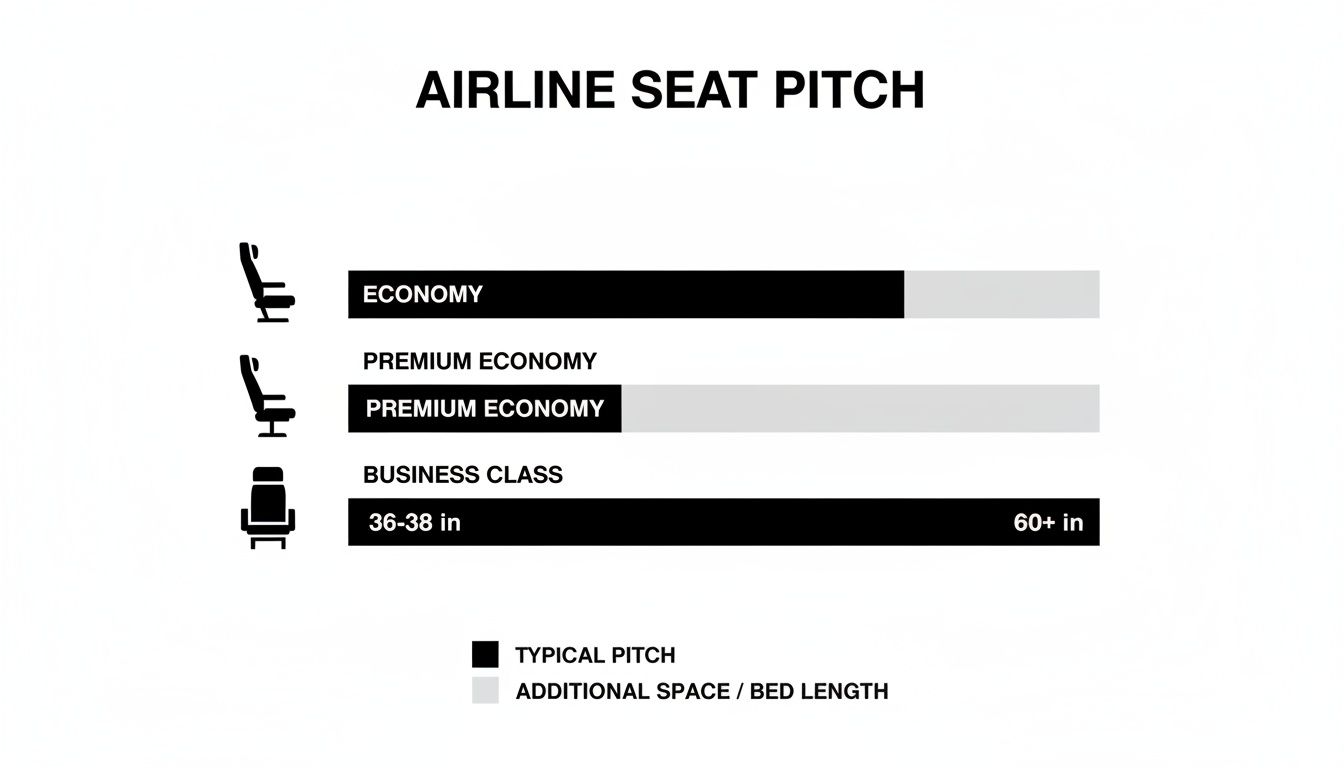
This chart really puts the difference into perspective.

Chart comparing typical airline seat pitch and bed length for economy, premium economy, and business class flights.

The jump from economy to the premium cabins isn't just a small upgrade; it's a massive increase in personal territory.

Typical Airline Seat Pitch by Cabin Class

Here's a quick reference guide to the average seat pitch you can expect in different airline cabins.

Cabin Class Typical Seat Pitch Range (Inches)
Economy 28" – 32"
Premium Economy 34" – 38"
Business 39" – 70"+
First 60" – 80"+

Keep these numbers in mind when comparing flights—they provide a solid baseline for what you're actually getting for your money.

The Value Equation

Once you understand these numbers, you can start making smarter decisions. It stops being about just finding the cheapest ticket and starts being about assessing the true value of what you're buying. For a lot of us, paying a bit more for a few extra inches of space is a no-brainer.

The surprising truth is that securing a spacious business class seat is often cheaper than you'd expect. With the right fare intelligence, it's possible to find business class tickets for less than the cost of a full-fare coach ticket.

When you look beyond the price tag and consider the physical space you're getting, you start to fly smarter. To see how fare analysis uncovers these kinds of deals, it's worth checking out insights from industry veterans like Michael K.

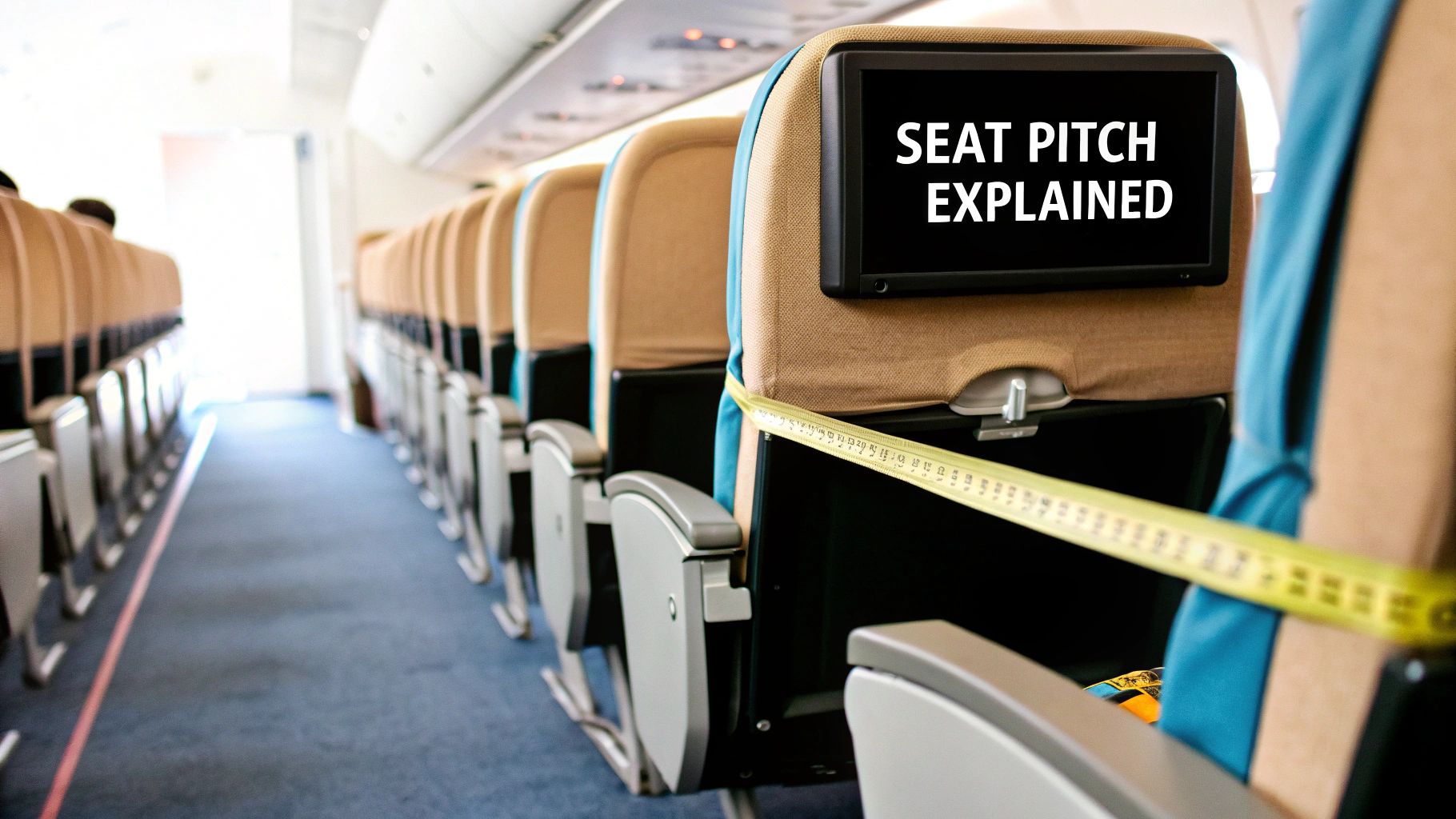
If you've ever boarded a flight and felt like the walls were closing in, you're not wrong. That feeling of being squeezed into your seat isn't just in your head; it’s the result of a deliberate, decades-long trend by airlines to shrink your personal space. What used to be a fairly standard, comfortable journey is now often a fight for every last inch of knee and elbow room.

An airline cabin showing rows of seats and a measuring tape demonstrating seat pitch with on-screen explanation.

This big squeeze really took off after airline deregulation in the late 1970s. The floodgates of competition opened, and carriers scrambled to find ways to make more money on every flight. Their simplest, most effective solution? Pack more people onto the plane. And so, they started shaving off the airline seat pitch, inch by painful inch.

From Roomy Rows to Cramped Cabins

The difference between flying then and now is pretty stark. Back in 1985, you could expect a relatively generous 31 to 36 inches of seat pitch on major U.S. airlines. It was enough to stretch out a bit. Today, that number has been whittled down to a tight 30 to 31 inches on many carriers. To put it in perspective, United's maximum economy pitch today is less than the minimum offered back then. It's a clear story of how much space we've lost, and you can discover more insights about shrinking airline seats to see just how dramatic the change has been.

This isn't just about being uncomfortable for a few hours. For frequent business travelers on long-haul flights, being stuck in a cramped seat poses real health risks. It can increase the odds of developing serious conditions like deep vein thrombosis (DVT), where blood clots form in the legs from prolonged immobility.

The Math Behind the Squeeze

So why would airlines risk unhappy customers and potential health issues? Simple economics.

Every single row of seats they can cram onto an aircraft translates into a massive revenue boost over that plane's lifetime. Think about it: reducing the airline seat pitch by just one inch across a cabin can free up enough space to add an entire extra row of six seats.

Over a year, that one extra row can generate hundreds of thousands of dollars in ticket sales for that aircraft alone. Now multiply that across an entire fleet, and you can see why the financial incentive to shrink your space is overwhelming.

This is the fundamental trade-off of modern air travel. Airlines have bet that travelers will tolerate less personal space in exchange for lower fares, pushing anyone who needs a reasonable amount of room toward more expensive premium cabins.

Understanding this history is key. It shows why paying attention to seat pitch is no longer just for picky travelers—it's essential for anyone who wants a tolerable, let alone comfortable, flight. The good news? Sometimes, securing that comfortable seat is cheaper than you'd ever guess.

How to Find Accurate Seat Pitch Information Before You Book

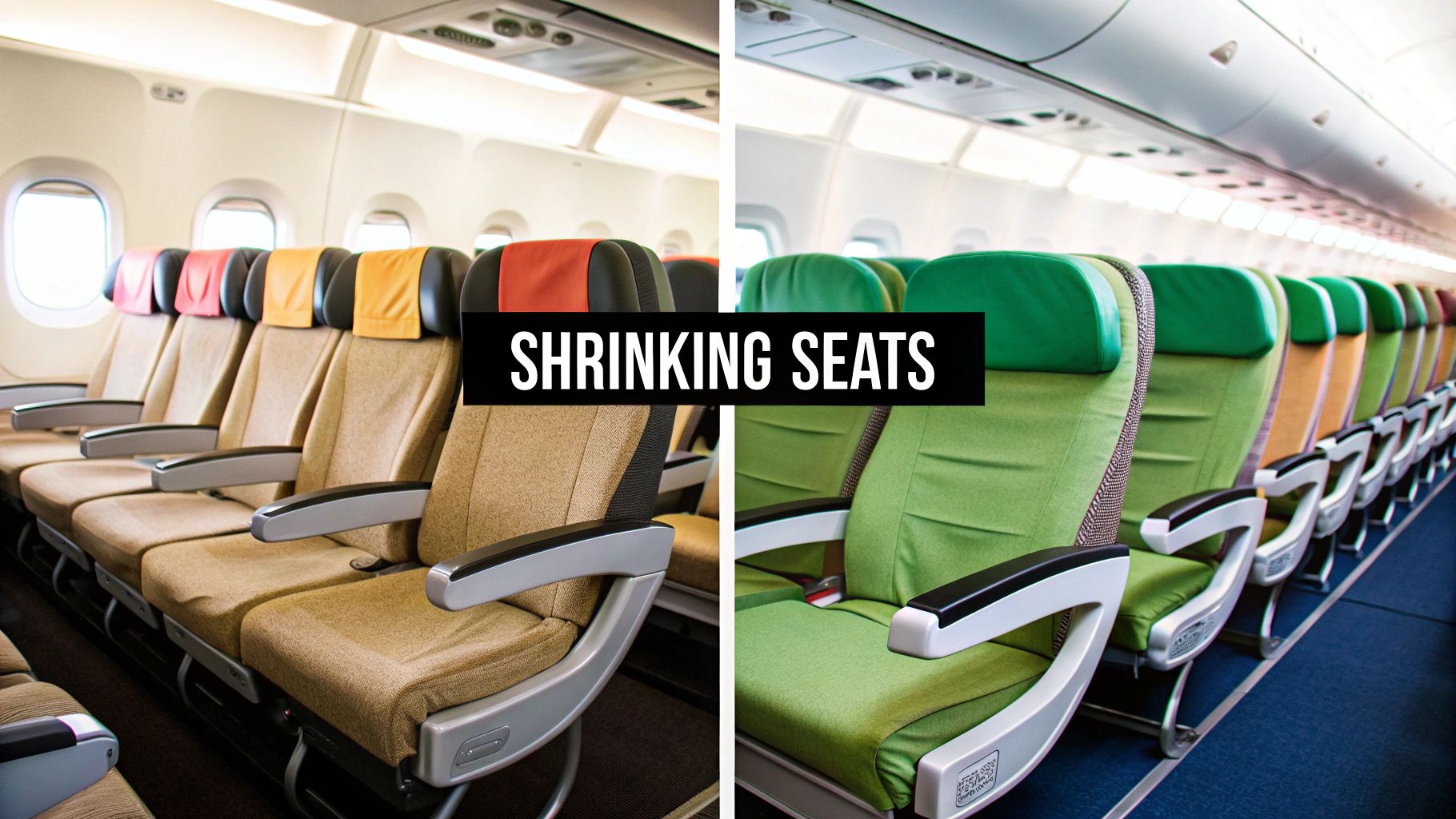
Side-by-side comparison of two airplane cabins with rows of economy seats, highlighting "SHRINKING SEATS".

You don't have to leave your in-flight comfort to chance anymore. With the right intel, you can track down the exact airline seat pitch for your flight long before you ever click "purchase," making sure you actually get the space you’re paying for.

Your first stop should probably be the airline's own website. Most have a "Fleet" or "Our Aircraft" section that gives a general overview of their planes' layouts. While it’s a decent starting point, this information is often broad. The real-time seat map shown during the booking process is more specific to your actual flight, but even that has its limits.

The problem is, airline-provided maps almost never list the hard numbers for pitch. To get the full story on your seat's true comfort level, you need to turn to the pros.

Using Third-Party Tools for Unbiased Data

This is where dedicated travel tools like SeatGuru and ExpertFlyer become invaluable. Think of them as the private investigators of the airline world. They aggregate data from countless sources to create detailed, aircraft-specific seat maps that reveal what the airlines won't. You get the critical stats: seat pitch, width, and even reviews from fellow passengers who've sat in that exact spot.

They make it incredibly simple with a color-coding system that flags the best and worst seats on the plane:

  • Green: A "good" seat. This usually means extra legroom, a great view, or some other perk.
  • Yellow: A mixed bag. It might be too close to a lavatory, have limited recline, or a misaligned window.
  • Red: Avoid at all costs. These are the seats with significant drawbacks you'll regret booking.

Using this visual guide alongside the listed pitch numbers gives you a crystal-clear picture of which seats are worth choosing and which ones are a guaranteed bad time.

Why Verification Is So Critical

Doing this homework is absolutely essential because airlines are notorious for flying multiple versions of the same exact aircraft model. The Boeing 777 you're taking from New York to London could have a totally different cabin layout and airline seat pitch than the one that same airline flies from Los Angeles to Tokyo.

Relying on the aircraft type alone is one of the most common mistakes travelers make. You have to verify the specific configuration for your exact flight number to avoid a very unpleasant surprise at 30,000 feet.

By layering the airline's own data with the deep insights from specialized tools, you can book with confidence, knowing precisely the kind of space and comfort you're getting. It's a simple step that ensures your trip starts off right—long before you ever step on the plane.

Looking Beyond Pitch to Width and Recline

While a decent seat pitch is a good starting point, it’s only one piece of the in-flight comfort puzzle. Any seasoned traveler knows that true comfort comes from a mix of factors, and you have to look beyond a single number. Two other critical dimensions—seat width and recline—play just as big a role in defining your personal space at 30,000 feet.

Just as pitch has been quietly shrinking over the years, so has seat width. We’re talking about the distance between your armrests, and losing even half an inch there is something you feel immediately in your shoulders. That lateral space is what stands between you and a constant battle for elbow room with your neighbor.

The Shrinking Shoulder Room

The move toward narrower seats has been just as aggressive as the cutbacks in legroom. Over the last 30 years, economy seat width has shrunk by as much as four inches, with some of the tightest seats now a mere 16 inches across. This squeeze is happening while passengers, on average, are getting larger—creating a major disconnect between seat design and the reality of who's sitting in them. You can read the full research about shrinking airline seats to see just how bad it’s gotten.

And it’s not just the numbers. The cabin’s overall layout has a huge impact on your sense of space. A 2-4-2 configuration on a wide-body jet feels far more open and gives more people aisle access than a packed 3-4-3 or 3-3-3 arrangement on the very same plane. These details matter just as much as the seat itself.

Why Recline and Amenities Matter

Then you have recline—the simple ability to lean your seat back and get some rest. Even an extra inch or two of tilt can make all the difference in whether you can actually sleep on a long-haul flight. Premium cabins, of course, take this to another level with deep-recline cradles or seats that go completely flat.

You also have to think about the practical things that make your space work. A well-placed power outlet or USB port means you don't have to clutter up your already-limited footwell with a bulky power bank. A thoughtfully designed seatback pocket can help you keep your things organized without them digging into your knees.

When you're looking at a seat, think about your total "comfort envelope." This isn't just about legroom (pitch) and shoulder room (width). It also includes your ability to recline, plug in your devices, and store your belongings without feeling cramped.

And while you're focused on the physical space, don't forget other essentials. For some travelers, the availability of seat belt extenders for airplanes is non-negotiable for both comfort and safety.

This is why premium cabins offer a fundamentally better experience—they deliver more space in every direction, not just forward. For long flights, investing in that all-around comfort is often a smart move, especially when fare intelligence can reveal opportunities to book business class cheaper than coach.

Finding Premium Comfort Without the Premium Price Tag

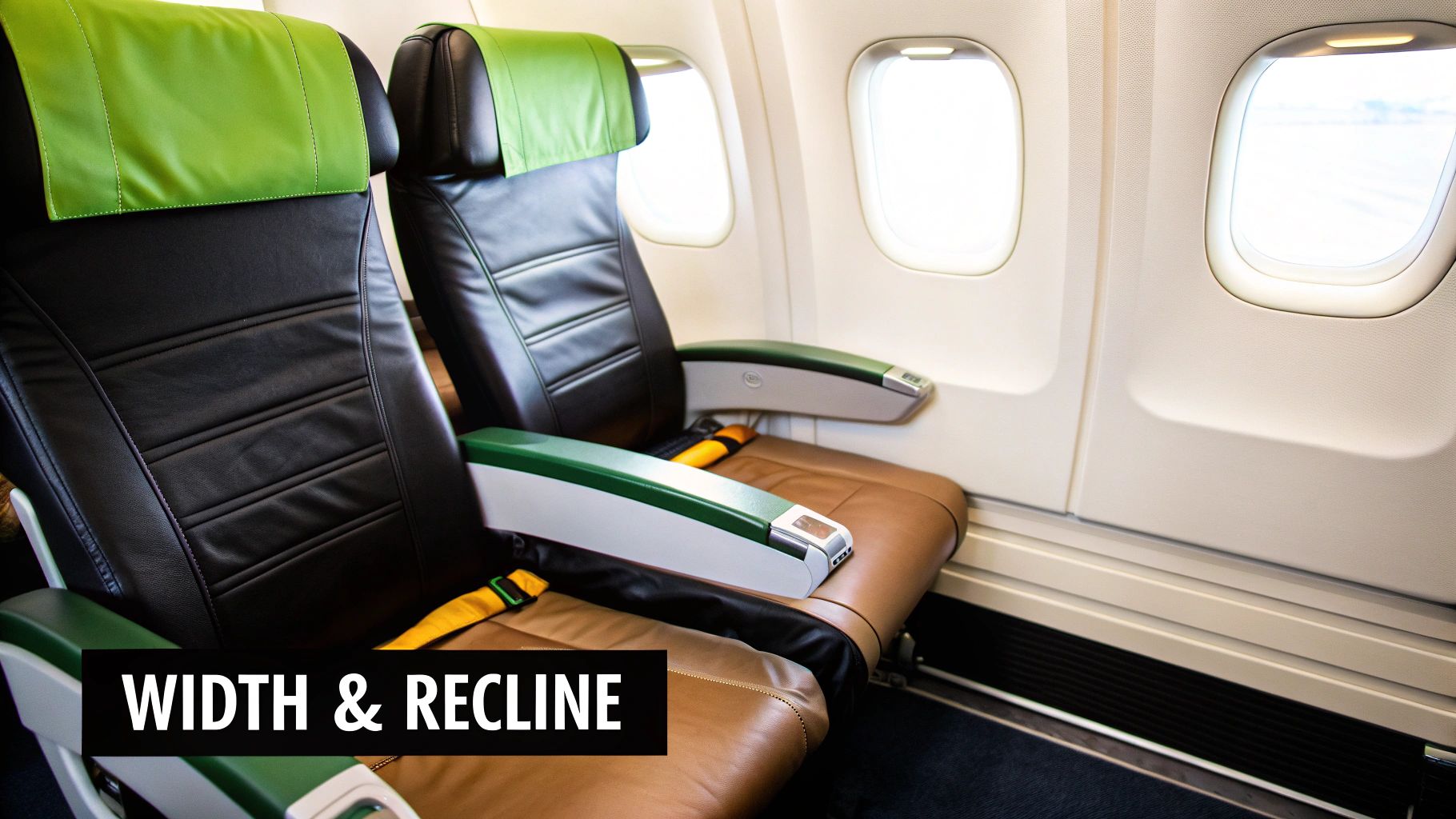
Two airplane seats with black and brown upholstery and green headrests, next to bright windows.

Now that you have a handle on what really goes into a comfortable seat—pitch, width, and recline—you can stop just avoiding bad seats and start hunting for genuine value. Too many travelers operate under the assumption that a spacious seat in a premium cabin is an out-of-reach luxury, forcing a painful choice between budget and comfort.

This is one of the biggest myths in air travel. You don't have to pick one over the other.

The secret is knowing that not all Business or First Class seats are the same, and their prices swing wildly based on the route, the time of year, and simple demand. Just because an airline slaps a high price tag on a seat doesn't mean anyone is actually going to pay it. This is where a little market intelligence completely changes the game for a savvy traveler.

If you can track fare anomalies and understand what an unsold premium seat is really worth to an airline, you can find some incredible deals. The whole game is timing your purchase to catch the price drops, which happen a lot more often than you'd think.

From Luxury Expense to Smart Investment

Think about that premium cabin ticket differently. It’s not just an expense; it’s a strategic investment in your own well-being and productivity. There's real, tangible value in arriving at your destination rested and sharp, whether it's for a critical business meeting or the first day of a long-awaited vacation.

The ability to work without being cramped, get some real sleep, and actually enjoy the journey transforms the entire experience.

This shift in mindset is even more powerful when you realize that premium comfort doesn't always have to come with a premium price. In fact, it's often possible to book a roomy Business Class seat for less than what you’d pay for a standard, full-fare economy ticket. You can learn more about how to score these kinds of deals on business class flights to Europe.

Fare intelligence services exist to expose these pricing games. By monitoring the fare cycles, you can pinpoint the exact moments airlines get desperate to fill unsold seats, turning their problem into your opportunity for massive savings.

Tapping into Market Intelligence

This strategy is especially powerful on long-haul international flights. For travel advisors and corporate travel managers booking trips across the Atlantic or to Asia, the data is overwhelming: the upgrade is almost always worth it. Premium cabins on these routes consistently offer a generous 38 to 60+ inches of seat pitch, and the seats are frequently discounted in fare wars that specialized services can track.

Here’s a fact most people don't know: fewer than 15% of premium seats ever sell at their initial, full-fare price. Members of services like Passport Premiere get the intelligence they need to see an empty seat's true market value. They learn to time their purchase to lock in Business or First Class tickets for cheaper than coach.

This approach combines hard data with expert analysis, letting both corporate and leisure travelers save money without sacrificing the legroom and comfort that are so crucial for health and productivity on flights over ten hours. You can dig into the data yourself in studies on passenger seat size.

Here’s your game plan for making sure you never get stuck in a cramped seat again. Knowing the numbers is one thing, but using that knowledge to lock in a better experience is what really matters.

Your Smart Traveler Checklist for Maximizing In-Flight Space

Pre-Booking Intelligence Gathering

Before you even pull out your credit card, a little homework goes a long way. These are the crucial first steps to dodge a miserable eight-hour flight.

  1. Verify the Aircraft Type: Never just assume. Airlines often swap different versions of the same plane on the same route, and the seating can vary wildly. Pinpoint the exact aircraft model for your specific flight number.

  2. Cross-Reference Seat Data: Don't just take the airline's word for it. Use a tool like SeatGuru to get a more objective look at the seat pitch, width, and recline. Compare those numbers against the airline’s own seat map to find the sweet spots.

  3. Think Beyond Pitch: Remember, pitch is only part of the puzzle. Pay attention to the cabin layout—a 2-4-2 configuration feels a world away from a packed 3-3-3. Also, check for seat width and must-have amenities like power outlets.

The real goal here is to figure out the flight's total value, not just the ticket price. That cheap fare might look tempting, but it could be a one-way ticket to misery. Spending a little more for a few extra inches of airline seat pitch is almost always the smartest money you'll spend on your trip.

Smart Booking and Final Checks

Once you’ve zeroed in on the right flight and seat, it’s time to book it like a pro.

  • Evaluate Premium Fares: Don’t write off Business Class. With the right intel, you can sometimes snag a premium seat for less than what others are paying for a full-fare economy ticket. Check out how experienced flyers like Steve S make it happen.

  • Book and Select Early: This is simple: the good seats always go first. Lock in your booking as soon as you can to claim your preferred spot.

And don't forget, the space you have is also about how you use it. Beyond just the seat specs, smart packing can make a huge difference. Getting savvy by optimizing your underseat carry-on is a simple move that can free up a surprising amount of precious foot room.

Your Questions About Airline Seat Pitch, Answered

When it comes to booking a flight, the nuances of seat pitch can feel overwhelming. But getting a handle on it is the key to an enjoyable trip, not one you have to endure. Let's break down some of the most common questions travelers have about their personal space in the sky.

Is an Economy Plus Seat Worth the Extra Cost?

Those Economy Plus or "extra legroom" seats definitely offer a noticeable improvement, usually giving you another 3 to 7 inches of pitch. On a long-haul flight, that can absolutely be the difference between a restless, miserable journey and a reasonably comfortable one.

But here’s a pro tip: don't just reflexively pay the upgrade fee.

Before paying for a marginal upgrade, always check the price of a discounted Business Class ticket first. With the right fare intelligence, you can often find premium cabin seats for a price that's surprisingly close to—or sometimes even less than—a full-fare economy ticket.

It's a total re-think of the value proposition. You're not just buying a few extra inches of legroom; you're investing in a fundamentally better experience with a wider seat, top-notch service, and maybe even a lie-flat bed.

Does Seat Pitch Vary Within the Same Airline?

It sure does. And it’s a trap that catches a lot of travelers off guard. No major airline has a perfectly uniform fleet. They fly a mixed bag of aircraft from Boeing and Airbus, and even different versions of the same plane—say, a Boeing 777-200 versus a 777-300ER—can have completely different cabin layouts.

This is why you have to check the specific aircraft assigned to your flight number. The airline seat pitch you get flying from New York to London can be worlds apart from what the same airline offers on its Los Angeles to Tokyo route, even if both are sold as the same class of service.

How Does Seat Pitch Affect Flight Safety?

This is where comfort bleeds into a much more serious conversation. Airline seat pitch is actually a critical safety factor. Aviation authorities like the FAA mandate minimum spacing to ensure everyone can evacuate an aircraft within 90 seconds during an emergency. If rows are jammed too close together, it can create a dangerous bottleneck.

It's a hot-button issue. Advocacy groups have been sounding the alarm for years, arguing that the constant squeeze on seat pitch isn't just about comfort—it's a potential safety hazard. Tighter cabins could make it harder to get out fast and might increase injury risk during severe turbulence, which is why the debate over legally mandated minimums is far from over.


Finding real value in air travel means looking past the advertised price to understand the actual comfort and experience you're paying for. Passport Premiere gives you the fare intelligence to book premium cabin seats for less than you think is possible, turning that cramped flight into a genuinely restful journey. See how you can fly better at https://www.passportpremiere.com.