First Class Airfare to Australia: A Pro’s Guide to Value

Most travelers shop for first class airfare to Australia as if it has a fixed market price. It doesn't. It behaves more like a thinly traded premium inventory pool where timing, route choice, and cabin verification matter as much as budget.

The evidence is blunt. KAYAK shows first class flights to Australia starting from about $1,235, while Momondo reports an average first class fare of $6,622 and also shows deals as low as $3,308 on the same broad U.S. to Australia market view, which tells you the headline price and the payable price can be very different depending on when and how you search (KAYAK first class fares to Australia, Momondo first class fares to Australia).

That's the wrong market for passive buyers. It's a good market for disciplined ones.

Why You Should Never Pay Full Price for First Class Flights

Paying the posted first class fare to Australia is usually a pricing mistake, not a luxury decision.

This market is too erratic for blind acceptance. What shows up first in search is often the airline's highest workable ask for a specific date, routing, and booking class. Buyers who treat that number as fixed often overpay for the same seat, or for a materially similar seat, by a wide margin.

I treat Australia-bound first class as a trade, not a retail purchase. The job is not to admire the product. The job is to identify when the market has priced that product poorly.

The sticker price is often just the opening ask

True first class to Australia sits in a narrow band of supply. There are only so many routes, only so many aircraft with a genuine first cabin, and only so many seats that airlines are willing to sell at any given moment. That limited inventory makes fares unstable, but not in a way that favors rushed buyers.

Airlines understand who pays full freight. Late corporate bookings, travelers tied to school holidays, and passengers fixated on one nonstop flight all create cover for high pricing. If you show up with fixed dates and no flexibility, the system rarely rewards you.

That is why the first fare on the screen is a reference point, not a decision point.

Practical rule: If you have not checked alternate departure days, at least one backup gateway, and whether every segment is actually booked into true first class, you have not priced the market. You have sampled it.

Professional buyers usually test three things before taking a premium fare seriously:

  • Cabin integrity: Many itineraries advertise first class even when only one leg is first and the long-haul segment is business.
  • Structural scarcity: Some Australia routings almost never produce meaningful first class value because seat count is too tight.
  • Fare quality: A high number can be a default filing, while a lower one can reflect a temporary inventory imbalance worth acting on.

Premium buyers should think like traders

The smartest premium purchase is often the one that looks wrong at first glance. Sometimes first class prices dip close enough to business that the incremental cost makes sense. Sometimes business is the sharper buy because first is carrying a prestige premium with no corresponding jump in value. The market does not care about cabin mythology. It cares about inventory pressure, booking windows, and what each carrier needs to sell right now.

That is the frame to use here.

For first class airfare to Australia, the lesson is simple. Do not anchor to “expensive.” Anchor to variance.

Once you start watching spread instead of headline price, the market gets easier to read. You stop asking, “Can I afford first class?” and start asking, “Is this fare mispriced enough to justify action?” That shift keeps you from rewarding the first inflated fare an airline posts, which is how full-price first class tickets get sold in the first place.

Decoding the Market Cycles of Premium Australian Fares

Australia-bound premium fares don't move randomly. They move in cycles shaped by seat release patterns, seasonal demand, and whether an airline needs to stimulate sales on a specific route.

An infographic showing five stages of premium airline fare cycles from early release to seasonal promotions.

Why these fares swing so much

Australia is a long-haul market with limited true first class capacity. That matters because when supply is thin, pricing gets jumpy. A single cabin reconfiguration, a schedule change, or a carrier defending a flagship route can alter what buyers see in search almost overnight.

Three forces usually drive the rhythm:

  • Advance inventory release: Airlines open premium inventory well ahead of departure, but not all at one price level.
  • Demand spikes: School holiday periods and major leisure windows put pressure on premium cabins, especially on nonstop or marquee routes.
  • Promotional intervention: If a carrier has unsold premium seats on a strategically important market, it may lower fares or refile combinations that create unusually strong value.

What to look for instead of booking myths

Forget blanket advice like “book on Tuesday.” That's consumer folklore. Serious fare hunting is about identifying when airlines have a reason to move inventory.

I watch for signs like these:

Signal What it usually means
Fare drops appear on one carrier but not all A route-specific pricing move, not a broad market shift
Nearby departure cities price differently Inventory pressure is local, so repositioning may help
Mixed cabin or odd routing combinations surface The pricing engine is constructing value from fragmented inventory
Premium fares soften outside obvious holiday peaks An airline may be trying to fill unsold high-yield seats

Airlines don't lower premium fares because travelers deserve a break. They lower them because a seat that departs empty has no recovery value.

Shoulder seasons tend to reward flexibility

The most reliable opportunities usually sit outside the periods everyone wants. Shoulder windows often produce cleaner pricing because business demand and leisure demand don't peak at the same time. You don't need a calendar myth. You need date flexibility and the patience to track changes across several weeks rather than one exact departure day.

Last-minute pricing is the least reliable part of the cycle. Sometimes an airline trims a premium fare close to departure. Sometimes it does the opposite and holds firm for urgent corporate demand. If you need certainty, don't build your strategy around last-minute hope.

The useful mindset is this: premium fares to Australia cycle through release, pressure, adjustment, and occasional promotional distortion. Buyers who understand that rhythm stop chasing “cheap first class” as a fantasy and start identifying the windows where the market briefly stops behaving like a luxury boutique and starts behaving like inventory management.

Strategic Route and Carrier Selection for True First Class

The fastest way to waste money on first class to Australia is to shop it like a normal premium cabin. This market does not behave like a broad retail category. True first is a thin, irregular slice of inventory tied to a small number of routes, aircraft, and carriers. If you search too broadly, booking tools will blend real first class with excellent business class, mixed-cabin itineraries, and branded products that sound more exclusive than they are.

A four-step infographic illustrating how to book a genuine first-class flight experience to Australia.

Search city pairs, not countries

Route discipline matters more than fare discipline at this stage. A country-to-country search encourages the engine to fill the page with anything expensive and premium sounding. That is how buyers end up comparing products that are not competing with each other.

Point Hacks highlights how limited true first class service into Australia really is, with only a small set of legitimate first class options such as American's Sydney to Los Angeles Flagship First and British Airways' Sydney to Singapore or London First (Point Hacks first class seats to Australia). That scarcity changes the job. You are not browsing. You are hunting specific flights that occasionally price out of line with their usual premium.

A practical workflow looks like this:

  1. List the exact long-haul routes that still sell a real first class cabin.
  2. Start with major North American or partner gateways where those flights operate.
  3. Check the operating carrier and aircraft before you look at fare rules or points pricing.
  4. Compare options only after you confirm the cabin is genuine first.

One bad assumption here can distort the whole search.

Gateway discipline matters

Major gateways are where true first class inventory tends to appear, and they are also where pricing anomalies show up first. Smaller origin cities often add domestic segments that turn a clean premium fare into a messy bundled itinerary. That can hide the actual long-haul fare, inflate the total, or produce a mixed-cabin result that looks better on the first screen than it does in the fare details.

I usually price the long-haul segment first, then add the feeder leg only if the numbers still make sense. That extra step catches a lot of false bargains.

If you want a broader premium-cabin reference point before narrowing to first, this overview of airlines with the best business class helps clarify how often a top-tier business product gets mistaken for first class once search results start collapsing categories.

Use a strict filter:

  • Operating carrier first: The operator determines the seat, service flow, and lounge access.
  • Flagship long-haul routes first: That is where a real first cabin is most likely to survive schedule changes and aircraft swaps.
  • Ignore vague premium labels: “Premium,” “business first,” or similar wording often signals marketing language, not a distinct first class cabin.

Later, a cabin video can help verify that the product matches the fare.

The carrier list is shorter than most travelers expect

For Australia, true first class usually comes down to a short list of viable operators and a narrow band of routes. That concentration matters because it creates two opposing effects at once. Choice is limited, but mispricing becomes easier to spot once you know which flights are even eligible.

Broad shopping wastes effort. Focused shopping reveals the market structure. If a fare looks unusually low, the first question is not whether you found a miracle. It is whether the itinerary is on one of the few flights where true first exists, on the right aircraft, under the right operating carrier.

Buyers who verify the route first see the market more clearly. Buyers who search broadly often pay first class prices for a premium product that was never true first to begin with.

That marks a fundamental shift in strategy. Stop asking which airlines fly first class to Australia in theory. Ask which exact flights are selling a genuine first class seat today, and whether that seat is pricing like a luxury product or like inventory an airline wants off the books.

Securing Value with Award Points and Upgrades

First class to Australia gets mispriced in two currencies. Cash is one. Miles are the other. A seat can look "free" on points and still be a poor trade if the airline is charging a heavy mileage premium for a marginal improvement over business class, or if the award only appears on dates that force an expensive repositioning.

An infographic comparing the pros and cons of using award points for booking First Class flights.

Business class is often the smarter luxury redemption

NerdWallet reports that Alaska, American, and United price one-way business-class awards to Australia around 80,000 to 88,000 miles, while an ANA first-class round trip to Australia can cost 225,000 miles (NerdWallet Australia points and miles analysis). That spread is large enough to change the decision, not just the cabin.

I rarely treat first class awards to Australia as the default target. I treat them as opportunistic buys. If the incremental comfort costs a large jump in miles, reduces your routing options, and depends on scarce inventory, the better move is often a strong business-class redemption and a cleaner trip.

That matters more on Australia than on shorter premium routes. The market is thin, the number of true first class seats is limited, and airlines protect that inventory aggressively until late in the booking cycle.

Search award space like a trader, not a collector

Award hunters lose value when they search emotionally. They see one aspirational seat and force the whole trip around it. Better results come from watching patterns.

Start with programs and routes that regularly show premium long-haul space to Australia. Then compare three things side by side: the mileage cost, the taxes and surcharges, and the odds that the seat is bookable through your program. Partner charts can look attractive right up until transfer times, phantom space, or carrier-imposed fees erase the advantage.

A practical workflow looks like this:

  • Search gateway-to-gateway first: Price the long-haul segment on its own before adding your home airport.
  • Use a date range, not a single date: Premium inventory to Australia often appears in pockets rather than across a whole week.
  • Check more than one program: The same seat may price differently, or fail to appear at all, depending on partner access.
  • Compare first against business in real time: If first requires a major mileage jump for one leg only, the premium is often hard to defend.

The point is not to chase first class at any cost. It is to buy the right premium product at the right inventory moment.

If you want another angle beyond direct redemption, this guide on how to get upgraded to first class covers the fare and eligibility issues that usually decide whether an upgrade path is realistic.

When upgrades beat direct awards

Upgrades work best when cash fares and award inventory move out of sync. That happens more often than travelers expect. An airline may release a tolerable business-class fare while keeping first-class awards nearly shut, or it may sell a lower cabin aggressively while holding premium seats for operational upgrades and elite instruments.

In that setup, buying the right business fare and applying points or instruments can outperform a pure first-class redemption. The catch is obvious. Upgrade space is uncertain, fare rules can be restrictive, and some cheap business fares are not upgradeable at all.

Use a simple filter before committing:

Strategy Best use case Main risk
Direct award booking You find true first class inventory and want a confirmed seat Availability is extremely limited
Upgrade with points You find an eligible premium fare and can tolerate uncertainty Upgrade space may never clear
Business class redemption You want a premium trip with broader access and lower mileage cost You give up the small incremental gains of first

A disciplined buyer compares all three at once.

If first class requires a large extra points outlay, awkward dates, and weak backup options, business class is usually the better use of miles to Australia. If an upgrade path starts from a well-priced eligible fare, it can be the sharper play. The value is rarely in the label. The value is in catching the mismatch between what the airline is charging in cash, what it is charging in miles, and how much certainty each path gives you.

Mastering Cash Fares with Monitoring and Alerts

The biggest pricing mistake in this market is treating first class to Australia like a stable retail product. It is not. Fares move in short, uneven windows, and the buyers who get value are usually tracking a small set of real opportunities before the market shifts.

That means fewer alerts, not more.

Generic “Australia first class” tracking creates noise because it mixes true first, mixed-cabin itineraries, and routings you would never book. A tighter watchlist works better. Focus on the specific carriers that operate a true first-class cabin on the long-haul sectors you want, then track only the gateways and dates you would realistically ticket.

Build a watchlist around what can actually be bought

A useful setup has three layers:

  • Carrier-level tracking: Follow verified first-class operators on U.S. to Australia routings, not every airline in a metasearch result.
  • Route-level tracking: Monitor the exact city pairs you would accept, including any repositioning gateway only if you would use it.
  • Date-range tracking: Watch a narrow cluster of nearby departure dates because premium fare cuts often hit one or two departures, not an entire month.

I separate “interesting” fares from “deployable” fares. If a routing needs an extra domestic connection, a long layover, or a departure point you would never position to, it does not belong in the same alert stack as a fare you are prepared to buy that day.

Read the drop like an analyst

A lower fare is only useful if the construction is clean. Premium airfare alerts often fire on technical price changes that look attractive until you inspect the ticket.

Run every alert through the same screen:

  1. Cabin integrity: Are the long-haul flights booked in first, or is part of the trip in business?
  2. Fare basis and rules: What are the change, cancellation, and refund terms?
  3. Operating carrier: Is the airline operating the flight the one whose first-class product you intended to buy?
  4. Connection quality: Did the fare drop because the itinerary added a weak transfer or bad transit timing?
  5. Ticketing deadline: Is this a real window, or a fare that expires before you can verify it?

For travelers who want tighter monitoring than public search tools usually provide, airline price drop alerts can help track premium itineraries with more precision.

The point is simple. A good alert identifies a fare you can act on, not just a fare that moved.

Speed matters after the work is done

True first-class fare dips to Australia can disappear within hours, especially when they are tied to a filing error, a short-lived competitive response, or a small inventory adjustment. The advantage goes to buyers who already know their acceptable price, preferred routing, and fallback option before the email arrives.

That is also where workflow matters. If you use tools to Manage flight reservations, keep them downstream from your fare verification process, not in place of it. Organization helps after you confirm the cabin, rules, and routing quality.

The market rewards preparation. By the time a public alert hits your inbox, the main decision should already be half made.

Your Executive Booking Workflow and Checklist

The cleanest way to book first class airfare to Australia is to treat it like a procurement process. That's true for a luxury vacation and even more true for a company-funded trip. Premium travel decisions get better when they follow a repeatable workflow instead of a one-night impulse search.

A six-step checklist infographic detailing an executive workflow for booking first class airfare to Australia.

The workflow I'd use

For award-focused travelers, independent analysis found Star Alliance partners and Virgin Australia had the strongest premium-cabin availability patterns, with United-operated flights from San Francisco and Los Angeles appearing most often in successful searches (The Points Guy premium-cabin availability findings). That makes those gateways and alliance checks a practical starting point before you spend time on fringe options.

Use this sequence:

  • Phase 1, define the trip correctly: Fixed dates or flexible dates. Cash or points. Nonstop priority or routing tolerance.
  • Phase 2, narrow to real first-class options: Only track routes that operate a true first cabin.
  • Phase 3, compare against premium alternatives: If business class delivers the schedule and comfort you need, don't force first for ego.
  • Phase 4, monitor with discipline: Use alerts on exact routes and carriers, not broad destination searches.
  • Phase 5, verify before payment: Check operating carrier, aircraft, fare rules, and cabin consistency.
  • Phase 6, ticket decisively: Once the fare matches your target and the cabin is verified, issue the ticket.

How corporate buyers should justify the purchase

A travel manager doesn't need to defend first class as a luxury if the purchase was made through a disciplined market process. The defensible case is usually one of these:

Booking context Rational justification
Executive or revenue-critical trip Schedule protection, rest, and lower disruption risk
Long-haul trip with volatile premium pricing Purchase made below normal market expectations
No viable first option but strong premium alternative Book business instead of paying irrationally for scarce first

This is also where operational tools matter after purchase. Teams that need to Manage flight reservations across changes, confirmations, and traveler communications often benefit from having one place to keep itinerary handling organized, especially when premium tickets carry stricter rules and higher stakes.

The final checklist buyers should keep open

Before you click purchase, confirm each of these:

  • Route reality: Is this one of the limited flights that offers true first class?
  • Cabin match: Are all key segments booked in the cabin you expect?
  • Value test: Would business class be the smarter buy on this itinerary?
  • Alert context: Is this a meaningful drop or just routine movement?
  • Execution readiness: Can you ticket now if the fare is right?

The professionals who book this market well don't chase luxury branding. They buy dislocated premium inventory with intent.


Passport Premiere helps travelers monitor and interpret premium-cabin fare movements so they can book international Business and First Class with better timing and clearer market context. If you want a more disciplined way to stop overpaying for long-haul premium travel, explore Passport Premiere.

How to Find Business Class Flights to Australia Cheaper Than Coach

It’s a line I hear all the time: "Business class is for the corporate bigwigs and the ultra-rich." But after years in this game, I can tell you that’s one of the biggest myths in travel. The truth is, snagging cheap business class flights to Australia isn't just about getting a good deal—it's about flying up front for less than what others pay to be in the back of the plane.

Believe it or not, finding a lie-flat seat for the long haul to Sydney for less than a last-minute economy ticket is more common than airlines would ever admit. It's not luck; it's a skill you can master.

The Real Deal on Premium Flights to Australia

Let's get one thing straight right away: airlines almost never sell out their business or first-class cabins at those eye-watering prices you see when you first search. That 14+ hour flight across the Pacific is a long time for a seat to sit empty, and carriers would much rather sell it at a deep discount than get nothing for it at all.

This is where your opportunity lies. The premium airfare market is constantly in flux. New routes, carrier competition, and even lulls in corporate travel all create a pricing battlefield that works in your favor. When a new airline starts flying into Melbourne, for example, you can bet a fare war is about to kick off, and prices will drop across the board.

So, How Can Business Class Be Cheaper Than Coach?

Think of it this way: an unsold business class seat is like a perishable good. Its value plummets to zero the second that cabin door closes. Airlines know this, and their sophisticated pricing algorithms are designed to avoid that outcome. As the departure date gets closer, their focus shifts from maximizing profit on every single seat to just getting some revenue from their unsold inventory.

This creates a sweet spot where prices can absolutely crater, often falling below what you'd pay for a full-fare, last-minute economy ticket. This isn't random; it's a predictable pattern for anyone who knows what to look for.

Here's the inside scoop: fewer than 15% of premium cabin seats are ever sold at their initial, full "rack rate." The airlines are constantly playing with the numbers, and that's where the deals are born. Services like Passport Premiere are built to track these cycles, flagging price drops that can slash long-haul fares to Australia, sometimes even beating coach prices.

The market forces at play aren't a mystery. They are specific, predictable factors that create the very discounts we're hunting for.

Why Business Class Fares to Australia Fluctuate

Market Factor Impact on Business Class Prices Your Strategic Advantage
Fluctuating Corporate Demand When business travel dips (think summer or holidays), airlines are left with a surplus of premium seats. These "empty suit" seats get offered to leisure travelers at significantly lower prices. This is your prime time to book.
Fierce Carrier Competition Hubs in Asia and the Middle East mean airlines are fighting for your business on one-stop routes. Airlines like Qatar, Emirates, and Singapore Airlines often use aggressive pricing to lure passengers, creating fare wars.
Aircraft Upgrades (Upsizing) An airline swaps a smaller plane for a larger one (like a 777 for an A380) on a specific route. Suddenly, there's more business class inventory than the airline planned for, forcing them to drop prices to fill the extra seats.
Seasonal Lulls & Off-Peak Travel Demand for Australia is highest during their summer (our winter). The shoulder seasons see a natural drop-off. Flying during Australia's autumn or spring (March-May, Sep-Nov) almost always guarantees lower fares and better availability.

These factors are what turn a $12,000 ticket into a $4,000 opportunity. It's not magic, it's just market dynamics.

And the opportunities are only growing. Industry data shows that international seats to Australia are projected to hit 4.519 million by September 2025. More seats mean more chances for some to go unsold, especially on those less-traveled, off-peak routes.

Knowing the game is one thing, but knowing the hardware is another. Understanding the subtle but important differences between various seat products can also give you a huge advantage. You can learn more about what to look for in our detailed guide to airline seat pitch.

Mastering Your Booking Timeline for a Better Price

When it comes to the hunt for cheap business class flights to Australia, timing is everything. Seriously. Forget all that outdated advice you’ve heard about booking on a Tuesday or a Wednesday. The real wins come from understanding the booking windows and seasonal ebbs and flows on long-haul routes Down Under.

Your goal is to book when the airlines are most desperate to fill those premium seats.

This means you need to be targeting Australia’s shoulder seasons. The absolute peak demand—and the eye-watering prices that come with it—hits during their summer, from December through February. If you can shift your travel plans to months like March, April, May, September, or October, you’ll neatly sidestep the holiday crowds and put yourself in a prime position for much lower fares. During these sweet spots, airlines often find themselves with more empty business class seats than they’d like, which creates a fantastic buyer's market.

Seizing the Moment During Fare Wars

One of the best opportunities to score a massive discount is by jumping on a fare war. This is when airlines get into a pricing battle and aggressively slash their fares on a popular route, like Los Angeles to Sydney. These aren’t just random price drops; they’re often kicked off when a new airline enters the route or an existing carrier launches a big sale to grab a bigger slice of the market.

For example, you might see a major Middle Eastern or Asian airline announce a huge sale on their connecting flights to Australia. Almost like clockwork, you can expect carriers like Qantas, United, and Delta to quickly match or even beat those prices to stay in the game. These windows of opportunity can be incredibly short, sometimes lasting just a few days or even a matter of hours. You have to be ready to pull the trigger.

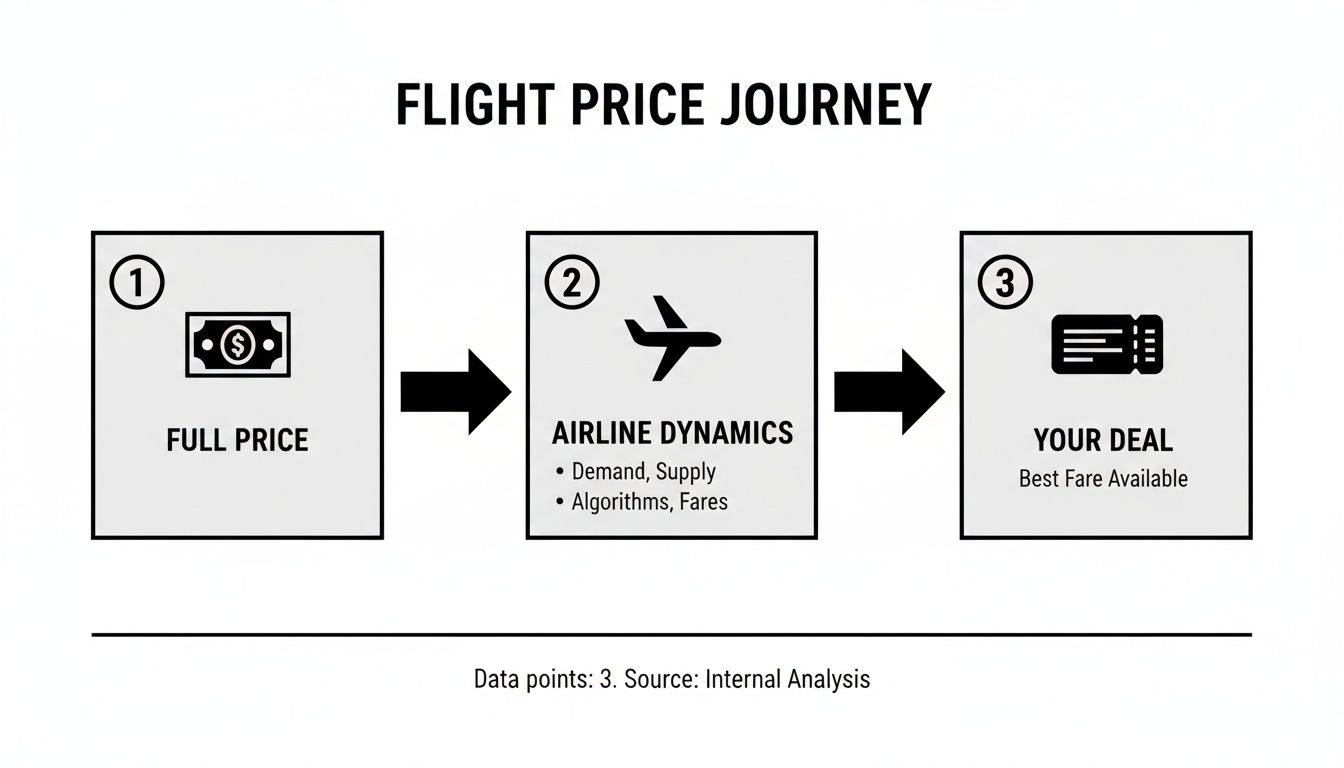
This whole process shows how market dynamics can turn a sky-high initial price into a deal you can actually book.

Infographic showing the journey of flight price from full price through airline dynamics to the best deal.

The key takeaway? The price you see first is almost never the one you should pay. The best price is a product of smart timing and good old-fashioned competition.

Automate Your Search with Targeted Alerts

Let’s be honest, manually checking fares every day is a recipe for frustration. The smart play is to set up targeted fare alerts that do the heavy lifting for you. This is how you pounce on a deal the second it goes live.

Here’s how to set up alerts that actually deliver results:

  • Get Specific: Don't just set a vague "USA to Australia" alert. Create individual alerts for specific city pairs you're interested in, like LAX-SYD, DFW-MEL, and SFO-BNE.
  • Use Multiple Date Ranges: If you have some wiggle room in your schedule, set up several alerts for different weeks within those shoulder seasons. This massively increases your odds.
  • Cast a Wider Net: Don't put all your eggs in one basket. Use a few different flight search engines to set up your alerts, as some might catch a deal that others miss.

This proactive strategy ensures you get a notification the moment a fare war kicks off or a new promotional fare is released. It puts you in the perfect position to snag a business class ticket for a price that, in some cases, can be even cheaper than a last-minute economy fare.

For a deeper dive into finding these deals all over the world, you can learn more about securing cheap international business class flights in our comprehensive guide.

Choosing Your Route and Carrier for Maximum Savings

The specific path you take to Australia—and the airline you fly with—can literally slash thousands of dollars off your ticket price. Most people's first instinct is to search for a direct flight to Sydney, but that convenience almost always comes with the highest price tag.

You have to think like a chess player. The real trick is to consider the alternative routes and carriers that airlines use to compete fiercely for your business. Being flexible is your greatest asset here. Instead of locking yourself into one specific route, broadening your search to include different arrival cities and connecting hubs can uncover deals that everyone else misses.

It's often the less-obvious itinerary that delivers the best value for that long haul down under.

Overhead view of a world map with heart pins, dotted routes, a toy airplane, and travel accessories.

Think Beyond The Obvious Gateways

While Sydney (SYD) and Melbourne (MEL) are the most popular entry points, they are also usually the most expensive. Airlines know this and price their premium cabins accordingly. You can often find significant savings just by shifting your search to secondary international gateways.

Consider looking for cheap business class flights to Australia that land in:

  • Brisbane (BNE): A major hub with tons of competition from international carriers.
  • Perth (PER): Often the cheapest entry point for travelers coming from Europe or the Middle East.

From these cities, a quick and inexpensive domestic flight on an airline like Qantas or Virgin Australia can get you to your final destination. The total cost of this two-step journey can easily be 20-30% lower than a direct flight into Sydney, more than making up for the extra connection.

Embrace The Power of a Strategic Layover

Here’s the secret weapon for finding business class fares that can sometimes be cheaper than economy: the one-stop itinerary.

Direct flights are priced for convenience, but connecting flights through major international hubs are priced for competition. This is where you find the real deals. Airlines based in Asia and the Middle East use their hubs to funnel passengers from all over the world to Australia, and they often price their business class seats aggressively to fill those planes.

By introducing a single, well-planned stop, you dramatically expand your airline options. This creates a price war between top-tier carriers like Singapore Airlines, Cathay Pacific, Emirates, and Qatar Airways—a war that you, the savvy traveler, can win.

The savings on these routes can be massive. Plus, the layover gives you a welcome chance to stretch your legs. The lounges in hubs like Singapore (SIN), Hong Kong (HKG), and Doha (DOH) are world-class, turning your transit time into part of the premium experience.

This same strategic thinking applies no matter where you're flying; you can see similar principles in our guide on booking business class to Europe. The fundamentals of smart routing are universal.

Comparing Route Strategies to Australia

To see this in action, let's compare what a direct flight from Los Angeles (LAX) to Sydney (SYD) looks like versus a one-stop option. The difference in price and airline choice is often staggering.

Route Type Example Itinerary (LAX-SYD) Typical Business Class Price Range Key Airlines Pros and Cons
Direct LAX -> SYD (Non-stop) $8,000 – $15,000+ Qantas, United, Delta, American Pro: Fastest travel time. Con: Extremely expensive, limited airline choice, less award availability.
One-Stop LAX -> NAN -> SYD $4,500 – $7,500 Fiji Airways, Air New Zealand, Cathay Pacific, Singapore Airlines Pro: Significant cost savings (often 50% or more), more airline options. Con: Longer travel time, potential for connection issues.

As you can see, simply adding one connection through a hub like Nadi (NAN) with Fiji Airways can cut the price in half. This is the kind of strategic flexibility that turns an unaffordable dream trip into a reality.

Thinking Outside the Cash Ticket Box

Let's be honest: paying the full sticker price for a lie-flat seat is almost never the smart play. The real pros know that the best deals are found by sidestepping the advertised fare altogether. It’s about unlocking a world of premium travel that, believe it or not, can sometimes cost less than a last-minute economy ticket.

These methods take a bit more legwork, but the payoff is massive.

Your two most powerful tools are going to be loyalty points and specialized airfare services. Getting good at just one of these can completely change the way you book flights to Australia, turning a five-figure price tag from a dream into something you can actually book.

The secret is to stop thinking the cash price is the only price.

The Art of the Upgrade

Trying to book a business class award ticket to Australia outright with points can be a frustrating game of cat and mouse due to insane demand. I've found a much more effective strategy is to book a Premium Economy ticket with cash and then use your miles to jump up to business.

This little trick often gives you the best of both worlds: a reasonable cash spend and a much lower number of miles needed.

Here's why it works so well:

  • Better Odds: Airlines tend to open up more seats for upgrades from Premium Economy than they do for pure award bookings in business class.
  • Serious Value: The number of miles you'll need for an upgrade is often a fraction of what it would cost to book that same business seat with points from the get-go.
  • A Comfortable Safety Net: Worst case scenario, your upgrade doesn't clear. You're still in Premium Economy, which is a huge improvement over coach for a flight that long.

Think about programs like United MileagePlus or American AAdvantage. They're perfect for upgrading their own flights or on partners like Qantas. You might snag a Premium Economy fare for $2,500 and use just 40,000 miles for the upgrade—an absolute steal compared to a $9,000 business class cash ticket.

The World of Unpublished Fares

Now, let's step away from points. There's a whole other world out there: airfare consolidators and specialized services like Passport Premiere. These aren't your everyday travel websites. Consolidators buy tickets in massive blocks directly from the airlines at wholesale prices, which lets them sell those seats for way less than what you see publicly.

This is where you find the unpublished fares—those deeply discounted business class tickets that will never show up on Google Flights or even the airline’s own site. For travelers who want consistent value without the headache of managing points, this is the secret weapon.

This strategy is especially powerful for finding cheap business class flights to Australia, a route notorious for sky-high premium fares. It taps into a well-known travel trend: Australians have a real love for flying up front.

One analysis of Google Trends data actually found that search interest for "Business Class" among Australians is even higher than among Americans. It’s a cultural thing, as an article on DMarge.com explains. By using a consolidator, you're essentially plugging into a hidden market built to meet that exact demand, and you can often find yourself in business class for less than what others are paying for a full-fare economy seat.

Decoding Fare Rules to Avoid Costly Mistakes

You've found it. A fantastic price on a business class flight to Australia. It’s an incredible feeling, but hold on before you hit "purchase." A great deal is only great if you actually understand the fine print.

The cheapest fares, the ones that make you do a double-take, almost always come with the strictest rules. Overlooking them can turn your dream trip into a very expensive lesson.

Business Saver vs. Business Flex: Know What You're Buying

Think of yourself as a mini-detective for a few minutes. Airlines slice and dice their business class cabins into different "fare classes," and they are not created equal. This is where you'll see terms like Business Saver versus Business Flex.

A Business Saver fare is usually the rock-bottom price you'll find. The catch? It’s often non-refundable, comes with eye-watering change fees, and probably won't be eligible for a mileage upgrade.

On the other hand, a Business Flex ticket costs more upfront but might offer free changes or even a full refund. If your plans aren't set in stone, that flexibility could easily be worth the extra cost.

The rule of thumb is simple: the lower the price, the less flexibility you get. Always, always click to expand the fare rules during booking to see what you're actually buying. A cheap ticket you can't use is the most expensive ticket of all.

Desk with laptop, 'FARE RULES' sign, documents, pen, and magnifying glass for travel planning.

Spotting Common Fare Restrictions

The most deeply discounted cheap business class flights to Australia often have specific conditions designed to filter out corporate travelers paying top dollar. These are the traps you need to spot.

  • Minimum and Maximum Stays: Many of the best sale fares require a Saturday night stay or a minimum of several days at your destination. This is a classic airline trick to ensure the ticket is used for leisure, not a quick in-and-out business trip.
  • Advance Purchase Requirements: Don't expect to find a steal for a flight next week. The best deals usually require booking 21 to 30 days in advance, sometimes more.
  • Routing Rules: Your cheap ticket might be valid only on specific connecting flights or through certain hubs. If you try to change a connection, even on the same airline, it could invalidate the entire fare.

And here’s a big one that people forget: look beyond the airline's rules. If your amazing deal involves a connection, you must check the transit visa requirements for that country. Getting denied boarding because you needed a visa for a two-hour layover is a nightmare scenario that happens far more than you'd think, especially if you book through a third-party site that doesn't flag these things for you.

This complex web of rules exists for one reason: competition. As airlines battle for your business on long-haul routes, they slash premium fares to fill seats. This intense pressure, detailed in reports like the ACCC's analysis on airline competition, creates a prime hunting ground for deals—if you know how to navigate the system.

Common Questions About Finding Business Class Deals

When you're trying to snag a lie-flat seat without paying a fortune, a lot of questions come up. Let's tackle the most common ones I hear from travelers trying to book a comfortable trip to Australia.

Can Business Class Really Be Cheaper Than Economy?

Believe it or not, yes. This isn't just some travel myth; it absolutely happens. It all comes down to comparing the right tickets. A strategically planned, discounted business class fare booked months in advance can easily be cheaper than a full-fare, flexible, or last-minute economy ticket.

Imagine an inflexible economy ticket for a flight next week is selling for $3,000. If you were savvy and booked a business class seat three months ago during a fare war for $2,800, you’ve already won.

This kind of price flip is most common during big airline sales, through services that have access to unpublished fares, or simply when corporate travel slumps. It's not a guarantee for every single flight, but the opportunity pops up often enough for a sharp traveler to take advantage of it.

What's the Best Month to Score a Deal to Australia?

For the best shot at a great price on a business class flight to Australia, you need to aim for the "shoulder seasons."

I always tell people to look for flights from February through May and then again from September to November.

The weather Down Under is still incredible during these months, but you're avoiding the peak holiday crowds. Airlines have to work a lot harder to fill those premium cabins, which translates into aggressive sales and price drops you just won't find in the December-January high season.

Here's a pro tip: Set your fare alerts for mid-week travel (think Tuesday or Wednesday) within those shoulder months. Combining the right season with the least popular travel days can unlock a whole other level of savings.

Are One-Stop Flights Actually That Much Cheaper?

In most cases, yes—and the savings can be huge. A nonstop flight is a premium product, and airlines charge for that convenience.

Once you introduce a single stop in a major hub like Singapore (SIN), Dubai (DXB), or Hong Kong (HKG), you blow your options wide open. You can now tap into a dozen other airlines that are pricing their fares aggressively to pull in transit passengers.

The savings can easily be hundreds, if not thousands, of dollars. Honestly, a short layover spent in a world-class airport lounge is a fantastic trade-off for knocking 30-50% off your ticket price. And for those traveling on business, remember that getting the right Business Visitor Stream (subclass 600) visa is just as important as finding the perfect flight.

How Far in Advance Should I Book for the Best Price?

There isn't a magic number, but the sweet spot for tracking fares to Australia is generally 3 to 6 months before you plan to fly.

This window gives you enough time to watch the price trends, pounce on an airline sale when it drops, and lock in a great fare before the last-minute rush sends prices through the roof.

Booking more than nine months out is usually too early; the airlines often haven't released their best promotional fares yet. On the flip side, waiting until the last two months is almost always a mistake, as the prices for the few remaining premium seats tend to soar.


At Passport Premiere, we take the guesswork out of finding these deals. Our service provides the intelligence and timely alerts you need to convert airline price volatility into real, tangible savings, ensuring you never overpay for comfort. Discover how our members consistently fly in business and first class for less at https://www.passportpremiere.com.