How to Find Business Class Flights to Australia Cheaper Than Coach

It’s a line I hear all the time: "Business class is for the corporate bigwigs and the ultra-rich." But after years in this game, I can tell you that’s one of the biggest myths in travel. The truth is, snagging cheap business class flights to Australia isn't just about getting a good deal—it's about flying up front for less than what others pay to be in the back of the plane.

Believe it or not, finding a lie-flat seat for the long haul to Sydney for less than a last-minute economy ticket is more common than airlines would ever admit. It's not luck; it's a skill you can master.

The Real Deal on Premium Flights to Australia

Let's get one thing straight right away: airlines almost never sell out their business or first-class cabins at those eye-watering prices you see when you first search. That 14+ hour flight across the Pacific is a long time for a seat to sit empty, and carriers would much rather sell it at a deep discount than get nothing for it at all.

This is where your opportunity lies. The premium airfare market is constantly in flux. New routes, carrier competition, and even lulls in corporate travel all create a pricing battlefield that works in your favor. When a new airline starts flying into Melbourne, for example, you can bet a fare war is about to kick off, and prices will drop across the board.

So, How Can Business Class Be Cheaper Than Coach?

Think of it this way: an unsold business class seat is like a perishable good. Its value plummets to zero the second that cabin door closes. Airlines know this, and their sophisticated pricing algorithms are designed to avoid that outcome. As the departure date gets closer, their focus shifts from maximizing profit on every single seat to just getting some revenue from their unsold inventory.

This creates a sweet spot where prices can absolutely crater, often falling below what you'd pay for a full-fare, last-minute economy ticket. This isn't random; it's a predictable pattern for anyone who knows what to look for.

Here's the inside scoop: fewer than 15% of premium cabin seats are ever sold at their initial, full "rack rate." The airlines are constantly playing with the numbers, and that's where the deals are born. Services like Passport Premiere are built to track these cycles, flagging price drops that can slash long-haul fares to Australia, sometimes even beating coach prices.

The market forces at play aren't a mystery. They are specific, predictable factors that create the very discounts we're hunting for.

Why Business Class Fares to Australia Fluctuate

Market Factor Impact on Business Class Prices Your Strategic Advantage
Fluctuating Corporate Demand When business travel dips (think summer or holidays), airlines are left with a surplus of premium seats. These "empty suit" seats get offered to leisure travelers at significantly lower prices. This is your prime time to book.
Fierce Carrier Competition Hubs in Asia and the Middle East mean airlines are fighting for your business on one-stop routes. Airlines like Qatar, Emirates, and Singapore Airlines often use aggressive pricing to lure passengers, creating fare wars.
Aircraft Upgrades (Upsizing) An airline swaps a smaller plane for a larger one (like a 777 for an A380) on a specific route. Suddenly, there's more business class inventory than the airline planned for, forcing them to drop prices to fill the extra seats.
Seasonal Lulls & Off-Peak Travel Demand for Australia is highest during their summer (our winter). The shoulder seasons see a natural drop-off. Flying during Australia's autumn or spring (March-May, Sep-Nov) almost always guarantees lower fares and better availability.

These factors are what turn a $12,000 ticket into a $4,000 opportunity. It's not magic, it's just market dynamics.

And the opportunities are only growing. Industry data shows that international seats to Australia are projected to hit 4.519 million by September 2025. More seats mean more chances for some to go unsold, especially on those less-traveled, off-peak routes.

Knowing the game is one thing, but knowing the hardware is another. Understanding the subtle but important differences between various seat products can also give you a huge advantage. You can learn more about what to look for in our detailed guide to airline seat pitch.

Mastering Your Booking Timeline for a Better Price

When it comes to the hunt for cheap business class flights to Australia, timing is everything. Seriously. Forget all that outdated advice you’ve heard about booking on a Tuesday or a Wednesday. The real wins come from understanding the booking windows and seasonal ebbs and flows on long-haul routes Down Under.

Your goal is to book when the airlines are most desperate to fill those premium seats.

This means you need to be targeting Australia’s shoulder seasons. The absolute peak demand—and the eye-watering prices that come with it—hits during their summer, from December through February. If you can shift your travel plans to months like March, April, May, September, or October, you’ll neatly sidestep the holiday crowds and put yourself in a prime position for much lower fares. During these sweet spots, airlines often find themselves with more empty business class seats than they’d like, which creates a fantastic buyer's market.

Seizing the Moment During Fare Wars

One of the best opportunities to score a massive discount is by jumping on a fare war. This is when airlines get into a pricing battle and aggressively slash their fares on a popular route, like Los Angeles to Sydney. These aren’t just random price drops; they’re often kicked off when a new airline enters the route or an existing carrier launches a big sale to grab a bigger slice of the market.

For example, you might see a major Middle Eastern or Asian airline announce a huge sale on their connecting flights to Australia. Almost like clockwork, you can expect carriers like Qantas, United, and Delta to quickly match or even beat those prices to stay in the game. These windows of opportunity can be incredibly short, sometimes lasting just a few days or even a matter of hours. You have to be ready to pull the trigger.

This whole process shows how market dynamics can turn a sky-high initial price into a deal you can actually book.
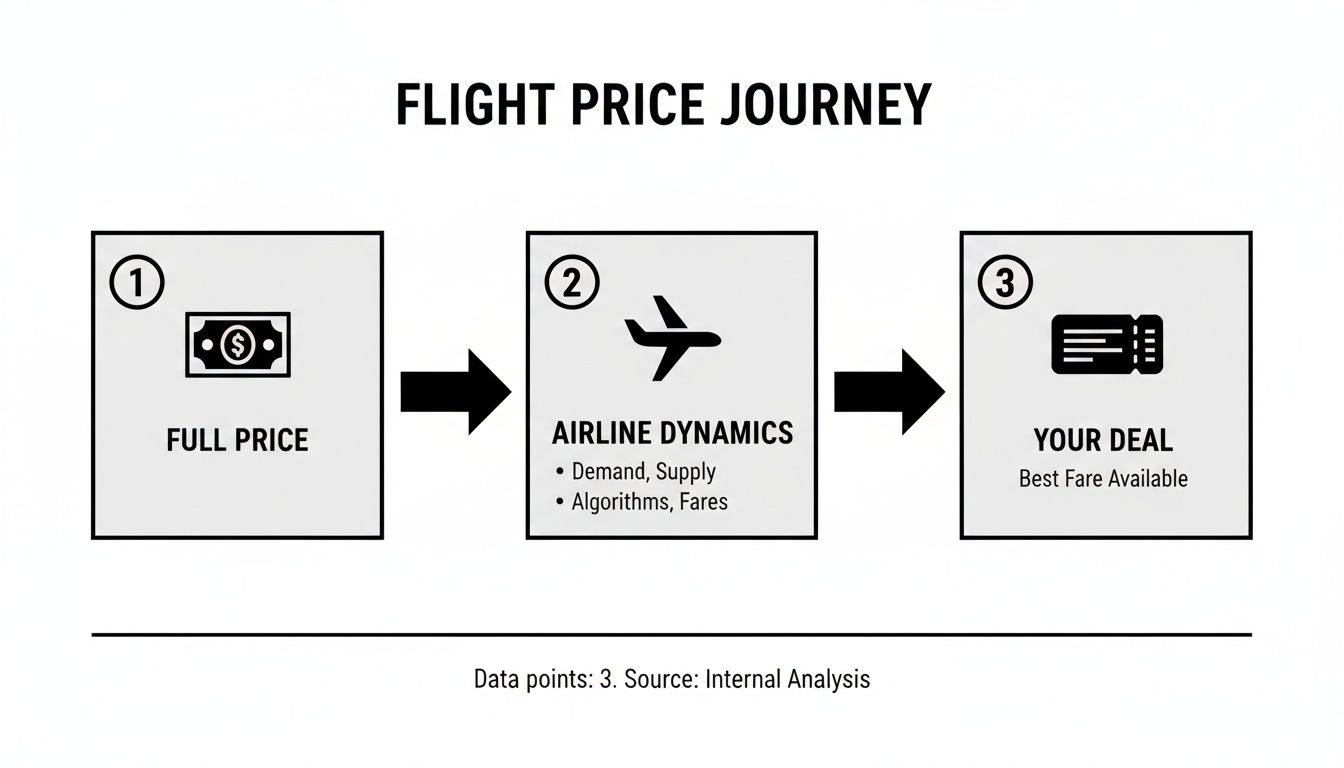
Infographic showing the journey of flight price from full price through airline dynamics to the best deal.

The key takeaway? The price you see first is almost never the one you should pay. The best price is a product of smart timing and good old-fashioned competition.

Automate Your Search with Targeted Alerts

Let’s be honest, manually checking fares every day is a recipe for frustration. The smart play is to set up targeted fare alerts that do the heavy lifting for you. This is how you pounce on a deal the second it goes live.

Here’s how to set up alerts that actually deliver results:

  • Get Specific: Don't just set a vague "USA to Australia" alert. Create individual alerts for specific city pairs you're interested in, like LAX-SYD, DFW-MEL, and SFO-BNE.
  • Use Multiple Date Ranges: If you have some wiggle room in your schedule, set up several alerts for different weeks within those shoulder seasons. This massively increases your odds.
  • Cast a Wider Net: Don't put all your eggs in one basket. Use a few different flight search engines to set up your alerts, as some might catch a deal that others miss.

This proactive strategy ensures you get a notification the moment a fare war kicks off or a new promotional fare is released. It puts you in the perfect position to snag a business class ticket for a price that, in some cases, can be even cheaper than a last-minute economy fare.

For a deeper dive into finding these deals all over the world, you can learn more about securing cheap international business class flights in our comprehensive guide.

Choosing Your Route and Carrier for Maximum Savings

The specific path you take to Australia—and the airline you fly with—can literally slash thousands of dollars off your ticket price. Most people's first instinct is to search for a direct flight to Sydney, but that convenience almost always comes with the highest price tag.

You have to think like a chess player. The real trick is to consider the alternative routes and carriers that airlines use to compete fiercely for your business. Being flexible is your greatest asset here. Instead of locking yourself into one specific route, broadening your search to include different arrival cities and connecting hubs can uncover deals that everyone else misses.

It's often the less-obvious itinerary that delivers the best value for that long haul down under.
Overhead view of a world map with heart pins, dotted routes, a toy airplane, and travel accessories.

Think Beyond The Obvious Gateways

While Sydney (SYD) and Melbourne (MEL) are the most popular entry points, they are also usually the most expensive. Airlines know this and price their premium cabins accordingly. You can often find significant savings just by shifting your search to secondary international gateways.

Consider looking for cheap business class flights to Australia that land in:

  • Brisbane (BNE): A major hub with tons of competition from international carriers.
  • Perth (PER): Often the cheapest entry point for travelers coming from Europe or the Middle East.

From these cities, a quick and inexpensive domestic flight on an airline like Qantas or Virgin Australia can get you to your final destination. The total cost of this two-step journey can easily be 20-30% lower than a direct flight into Sydney, more than making up for the extra connection.

Embrace The Power of a Strategic Layover

Here’s the secret weapon for finding business class fares that can sometimes be cheaper than economy: the one-stop itinerary.

Direct flights are priced for convenience, but connecting flights through major international hubs are priced for competition. This is where you find the real deals. Airlines based in Asia and the Middle East use their hubs to funnel passengers from all over the world to Australia, and they often price their business class seats aggressively to fill those planes.

By introducing a single, well-planned stop, you dramatically expand your airline options. This creates a price war between top-tier carriers like Singapore Airlines, Cathay Pacific, Emirates, and Qatar Airways—a war that you, the savvy traveler, can win.

The savings on these routes can be massive. Plus, the layover gives you a welcome chance to stretch your legs. The lounges in hubs like Singapore (SIN), Hong Kong (HKG), and Doha (DOH) are world-class, turning your transit time into part of the premium experience.

This same strategic thinking applies no matter where you're flying; you can see similar principles in our guide on booking business class to Europe. The fundamentals of smart routing are universal.

Comparing Route Strategies to Australia

To see this in action, let's compare what a direct flight from Los Angeles (LAX) to Sydney (SYD) looks like versus a one-stop option. The difference in price and airline choice is often staggering.

Route Type Example Itinerary (LAX-SYD) Typical Business Class Price Range Key Airlines Pros and Cons
Direct LAX -> SYD (Non-stop) $8,000 – $15,000+ Qantas, United, Delta, American Pro: Fastest travel time. Con: Extremely expensive, limited airline choice, less award availability.
One-Stop LAX -> NAN -> SYD $4,500 – $7,500 Fiji Airways, Air New Zealand, Cathay Pacific, Singapore Airlines Pro: Significant cost savings (often 50% or more), more airline options. Con: Longer travel time, potential for connection issues.

As you can see, simply adding one connection through a hub like Nadi (NAN) with Fiji Airways can cut the price in half. This is the kind of strategic flexibility that turns an unaffordable dream trip into a reality.

Thinking Outside the Cash Ticket Box

Let's be honest: paying the full sticker price for a lie-flat seat is almost never the smart play. The real pros know that the best deals are found by sidestepping the advertised fare altogether. It’s about unlocking a world of premium travel that, believe it or not, can sometimes cost less than a last-minute economy ticket.

These methods take a bit more legwork, but the payoff is massive.

Your two most powerful tools are going to be loyalty points and specialized airfare services. Getting good at just one of these can completely change the way you book flights to Australia, turning a five-figure price tag from a dream into something you can actually book.

The secret is to stop thinking the cash price is the only price.

The Art of the Upgrade

Trying to book a business class award ticket to Australia outright with points can be a frustrating game of cat and mouse due to insane demand. I've found a much more effective strategy is to book a Premium Economy ticket with cash and then use your miles to jump up to business.

This little trick often gives you the best of both worlds: a reasonable cash spend and a much lower number of miles needed.

Here's why it works so well:

  • Better Odds: Airlines tend to open up more seats for upgrades from Premium Economy than they do for pure award bookings in business class.
  • Serious Value: The number of miles you'll need for an upgrade is often a fraction of what it would cost to book that same business seat with points from the get-go.
  • A Comfortable Safety Net: Worst case scenario, your upgrade doesn't clear. You're still in Premium Economy, which is a huge improvement over coach for a flight that long.

Think about programs like United MileagePlus or American AAdvantage. They're perfect for upgrading their own flights or on partners like Qantas. You might snag a Premium Economy fare for $2,500 and use just 40,000 miles for the upgrade—an absolute steal compared to a $9,000 business class cash ticket.

The World of Unpublished Fares

Now, let's step away from points. There's a whole other world out there: airfare consolidators and specialized services like Passport Premiere. These aren't your everyday travel websites. Consolidators buy tickets in massive blocks directly from the airlines at wholesale prices, which lets them sell those seats for way less than what you see publicly.

This is where you find the unpublished fares—those deeply discounted business class tickets that will never show up on Google Flights or even the airline’s own site. For travelers who want consistent value without the headache of managing points, this is the secret weapon.

This strategy is especially powerful for finding cheap business class flights to Australia, a route notorious for sky-high premium fares. It taps into a well-known travel trend: Australians have a real love for flying up front.

One analysis of Google Trends data actually found that search interest for "Business Class" among Australians is even higher than among Americans. It’s a cultural thing, as an article on DMarge.com explains. By using a consolidator, you're essentially plugging into a hidden market built to meet that exact demand, and you can often find yourself in business class for less than what others are paying for a full-fare economy seat.

Decoding Fare Rules to Avoid Costly Mistakes

You've found it. A fantastic price on a business class flight to Australia. It’s an incredible feeling, but hold on before you hit "purchase." A great deal is only great if you actually understand the fine print.

The cheapest fares, the ones that make you do a double-take, almost always come with the strictest rules. Overlooking them can turn your dream trip into a very expensive lesson.

Business Saver vs. Business Flex: Know What You're Buying

Think of yourself as a mini-detective for a few minutes. Airlines slice and dice their business class cabins into different "fare classes," and they are not created equal. This is where you'll see terms like Business Saver versus Business Flex.

A Business Saver fare is usually the rock-bottom price you'll find. The catch? It’s often non-refundable, comes with eye-watering change fees, and probably won't be eligible for a mileage upgrade.

On the other hand, a Business Flex ticket costs more upfront but might offer free changes or even a full refund. If your plans aren't set in stone, that flexibility could easily be worth the extra cost.

The rule of thumb is simple: the lower the price, the less flexibility you get. Always, always click to expand the fare rules during booking to see what you're actually buying. A cheap ticket you can't use is the most expensive ticket of all.
Desk with laptop, 'FARE RULES' sign, documents, pen, and magnifying glass for travel planning.

Spotting Common Fare Restrictions

The most deeply discounted cheap business class flights to Australia often have specific conditions designed to filter out corporate travelers paying top dollar. These are the traps you need to spot.

  • Minimum and Maximum Stays: Many of the best sale fares require a Saturday night stay or a minimum of several days at your destination. This is a classic airline trick to ensure the ticket is used for leisure, not a quick in-and-out business trip.
  • Advance Purchase Requirements: Don't expect to find a steal for a flight next week. The best deals usually require booking 21 to 30 days in advance, sometimes more.
  • Routing Rules: Your cheap ticket might be valid only on specific connecting flights or through certain hubs. If you try to change a connection, even on the same airline, it could invalidate the entire fare.

And here’s a big one that people forget: look beyond the airline's rules. If your amazing deal involves a connection, you must check the transit visa requirements for that country. Getting denied boarding because you needed a visa for a two-hour layover is a nightmare scenario that happens far more than you'd think, especially if you book through a third-party site that doesn't flag these things for you.

This complex web of rules exists for one reason: competition. As airlines battle for your business on long-haul routes, they slash premium fares to fill seats. This intense pressure, detailed in reports like the ACCC's analysis on airline competition, creates a prime hunting ground for deals—if you know how to navigate the system.

Common Questions About Finding Business Class Deals

When you're trying to snag a lie-flat seat without paying a fortune, a lot of questions come up. Let's tackle the most common ones I hear from travelers trying to book a comfortable trip to Australia.

Can Business Class Really Be Cheaper Than Economy?

Believe it or not, yes. This isn't just some travel myth; it absolutely happens. It all comes down to comparing the right tickets. A strategically planned, discounted business class fare booked months in advance can easily be cheaper than a full-fare, flexible, or last-minute economy ticket.

Imagine an inflexible economy ticket for a flight next week is selling for $3,000. If you were savvy and booked a business class seat three months ago during a fare war for $2,800, you’ve already won.

This kind of price flip is most common during big airline sales, through services that have access to unpublished fares, or simply when corporate travel slumps. It's not a guarantee for every single flight, but the opportunity pops up often enough for a sharp traveler to take advantage of it.

What's the Best Month to Score a Deal to Australia?

For the best shot at a great price on a business class flight to Australia, you need to aim for the "shoulder seasons."

I always tell people to look for flights from February through May and then again from September to November.

The weather Down Under is still incredible during these months, but you're avoiding the peak holiday crowds. Airlines have to work a lot harder to fill those premium cabins, which translates into aggressive sales and price drops you just won't find in the December-January high season.

Here's a pro tip: Set your fare alerts for mid-week travel (think Tuesday or Wednesday) within those shoulder months. Combining the right season with the least popular travel days can unlock a whole other level of savings.

Are One-Stop Flights Actually That Much Cheaper?

In most cases, yes—and the savings can be huge. A nonstop flight is a premium product, and airlines charge for that convenience.

Once you introduce a single stop in a major hub like Singapore (SIN), Dubai (DXB), or Hong Kong (HKG), you blow your options wide open. You can now tap into a dozen other airlines that are pricing their fares aggressively to pull in transit passengers.

The savings can easily be hundreds, if not thousands, of dollars. Honestly, a short layover spent in a world-class airport lounge is a fantastic trade-off for knocking 30-50% off your ticket price. And for those traveling on business, remember that getting the right Business Visitor Stream (subclass 600) visa is just as important as finding the perfect flight.

How Far in Advance Should I Book for the Best Price?

There isn't a magic number, but the sweet spot for tracking fares to Australia is generally 3 to 6 months before you plan to fly.

This window gives you enough time to watch the price trends, pounce on an airline sale when it drops, and lock in a great fare before the last-minute rush sends prices through the roof.

Booking more than nine months out is usually too early; the airlines often haven't released their best promotional fares yet. On the flip side, waiting until the last two months is almost always a mistake, as the prices for the few remaining premium seats tend to soar.


At Passport Premiere, we take the guesswork out of finding these deals. Our service provides the intelligence and timely alerts you need to convert airline price volatility into real, tangible savings, ensuring you never overpay for comfort. Discover how our members consistently fly in business and first class for less at https://www.passportpremiere.com.
How to Find Business Class Flights Cheaper Than Coach

Here's a little secret most travelers don't know: finding cheap international business class flights isn't about luck. It's a repeatable strategy.

And no, I'm not talking about just a small discount. I mean securing a lie-flat bed in a premium cabin for less than what some people pay for a standard coach ticket. This isn't a myth. It's simply about understanding how airlines really work and knowing exactly when to pull the trigger.

Forget What You Think You Know About Business Class Pricing

The biggest mistake travelers make is assuming the sticker price on a premium seat is the final word. They see a five-figure fare and immediately give up, thinking it's completely out of reach. But the airline industry is far more complex than that.

The truth is, the vast majority of seats in those fancy cabins are sold at a deep discount. This creates a huge opening for anyone willing to look past the first search result.

This guide will show you how to find those openings. We’re not talking about hoping for a lucky glitch. We're talking about actionable intelligence—how airlines react to demand, how to use fare volatility to your advantage, and how to spot the moments when business class is genuinely cheaper than coach.

How Can Business Class Ever Be Cheaper Than Economy?

It sounds crazy, right? How could a seat with premium dining, lounge access, and a bed cost less than one in the back of the plane? The answer is all about revenue management.

Airlines live by a simple rule: they would much rather sell an empty seat for something than let it fly empty and make nothing. An unsold premium seat is a lost opportunity they're desperate to fill.

A few key market dynamics create these strange pricing situations.


Why Premium Fares Can Drop Below Economy Prices

This table breaks down the core market dynamics that create opportunities for finding business class deals cheaper than standard economy tickets.

Market Factor Impact on Business Class Fares How You Can Benefit
Unsold Inventory As the departure date gets closer, an airline's focus shifts from maximizing profit to just filling the plane. An empty seat is a perishable good, and they'll drop prices to avoid zero revenue. By monitoring fares closer to departure (but not last-minute), you can catch these "desperation" discounts as the airline tries to fill the cabin.
Aggressive Fare Wars When rival airlines start a price war on a competitive route, the deep discounts often bleed into the premium cabins as they fight for high-value customers. Set up alerts for popular transatlantic or transpacific routes. A fare war can drop a $6,000 ticket to $2,500 overnight.
Economy Demand Imbalance If the economy cabin on a specific flight is almost full, the last few seats can skyrocket in price due to high demand. A discounted business class seat can suddenly look cheap in comparison. When searching, always compare the price of the last few economy seats against the available business class fares. You might be shocked at the result.

This isn't just a theory; we see it happen all the time. The market has shifted dramatically, with average global business class fares dropping 10-15% in recent years.

On the hyper-competitive New York to London route, for instance, we’ve seen average business class fares fall to around $2,800—a 12% drop. The key takeaway? Data shows that fewer than 15% of premium seats ever sell at their initial, full asking price. The rest are all sold at a discount. You can find more global business class flight data and pricing trends to see just how these market shifts create new opportunities.

It's All Strategy, Not Luck

The key is to stop thinking like a typical passenger and start acting like a strategic buyer. It means being flexible and knowing that the value goes way beyond just a bigger seat.

If you're curious about the real, tangible benefits you get upfront, you can check out our deep dive into airline seat pitch and comfort.

Ultimately, the goal is to stop overpaying. It's time to fly smarter by using the same market forces the airlines use to set their prices. This guide gives you the playbook to do exactly that.

Mastering Fare Cycles and Strategic Timing

If there’s one secret to finding cheap international business class flights, it’s this: timing is everything. It’s the absolute foundation of any smart booking strategy. Forget about luck or stumbling upon a random deal. The best fares are almost always part of a predictable pattern, and learning the rhythm of these cycles is how you turn a $7,000 ticket into a $2,500 one.

Most people book flights based on their own schedule, and that's exactly why they overpay. Airlines, on the other hand, play a completely different game. They use massive amounts of historical data and predictive algorithms to set their prices. To beat them, you have to think like them and anticipate the dips in their pricing before they happen.

This goes way beyond the old "book on a Tuesday" advice. While there's a kernel of truth to it—leisure travelers often hunt for deals on weekends, and corporate fares get filed mid-week—the real money is saved by understanding the much larger booking windows and seasonal trends.

The Myth of the Last-Minute Business Class Deal

Let's get one thing straight right away: waiting until the last minute to book a premium cabin is a terrible idea. It’s probably the worst thing you can do.

Unlike economy, where an airline might frantically slash prices to fill a few last seats, business class prices almost always skyrocket as the departure date gets closer. Why? Because airlines know that last-minute premium travelers are usually corporate flyers whose companies are footing the bill. They’re banking on these folks paying top dollar because they have no other choice. Your real opportunity is to book long before that final price surge even begins.

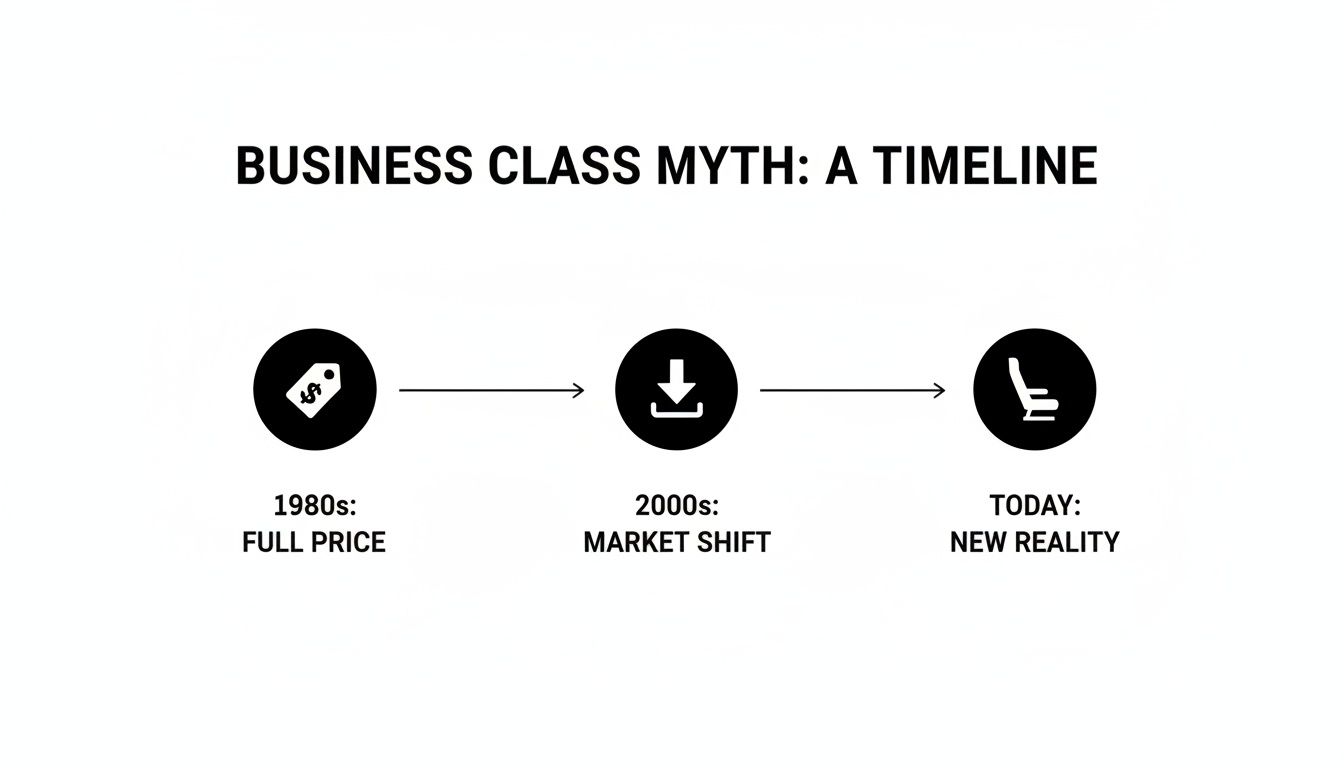
This timeline really shows how the game has changed. The old model of fixed, sky-high premium fares is gone, creating a new reality where smart timing can unlock incredible value.

A timeline showing the evolution of business class from full price in the 1980s to today's new reality.

The market has shifted dramatically. What was once a fixed, non-negotiable price is now a dynamic number that you can influence with the right strategy.

Finding the Optimal Booking Window

The sweet spot for booking international business class isn't a specific day, but a window of time. And this window shifts depending on where you're going, reflecting different travel seasons and demand patterns.

Based on what I’ve seen tracking fares for years, here are some solid guidelines for popular routes:

  • Flights to Europe: The magic window here is usually 3 to 6 months out. This is your best chance to lock in a great price before the summer and holiday rush sends fares through the roof.
  • Flights to Asia: You'll want to plan a bit further ahead for Asia. The best deals pop up 4 to 7 months in advance, especially if you’re trying to hit a peak event like cherry blossom season in Japan.
  • Flights to South America: Things are a little more forgiving here. A window of 2 to 5 months is often enough, as demand isn't quite as rigid as on the big transatlantic or transpacific routes.
  • Flights to Australia/New Zealand: These are ultra-long-haul flights, so start your search early. The prime booking window is typically 5 to 8 months before you plan to fly.

The biggest mistake people make is treating these windows like they're set in stone. The real pro move is to start monitoring fares at the start of the window and be ready to pounce the moment you see a significant drop. Hesitating and hoping it drops further is a gamble that almost never pays off.

Capitalizing on Shoulder Seasons and Fare Wars

Beyond just when you book, when you fly makes a massive difference. Traveling during the shoulder season—those perfect months right before or after peak season—can lead to some truly incredible deals. Think Europe in April or October instead of the chaos of July. With lower demand, airlines are much more willing to discount their premium seats.

For instance, a business class flight from New York to Rome in August can easily hit $6,000. That exact same seat in October? I’ve seen it drop to $3,500 or even less. And you get better weather and fewer crowds as a bonus. We dive deeper into these seasonal patterns in our guide on booking business class to Europe.

But the ultimate prize for a strategic timer is catching a fare war. This is when competing airlines get into a pricing battle on a specific route, aggressively slashing fares to steal customers from each other. These events are almost always unannounced and don't last long, but they can cut business class prices by 50% or more.

A fare war usually looks like a sudden, dramatic price drop across multiple airlines on the exact same route. This is where having fare alerts set up is your secret weapon. It allows you to act instantly, sometimes within hours, before the sale vanishes and prices snap back to normal.

Unlocking Savings with Creative Routing Techniques

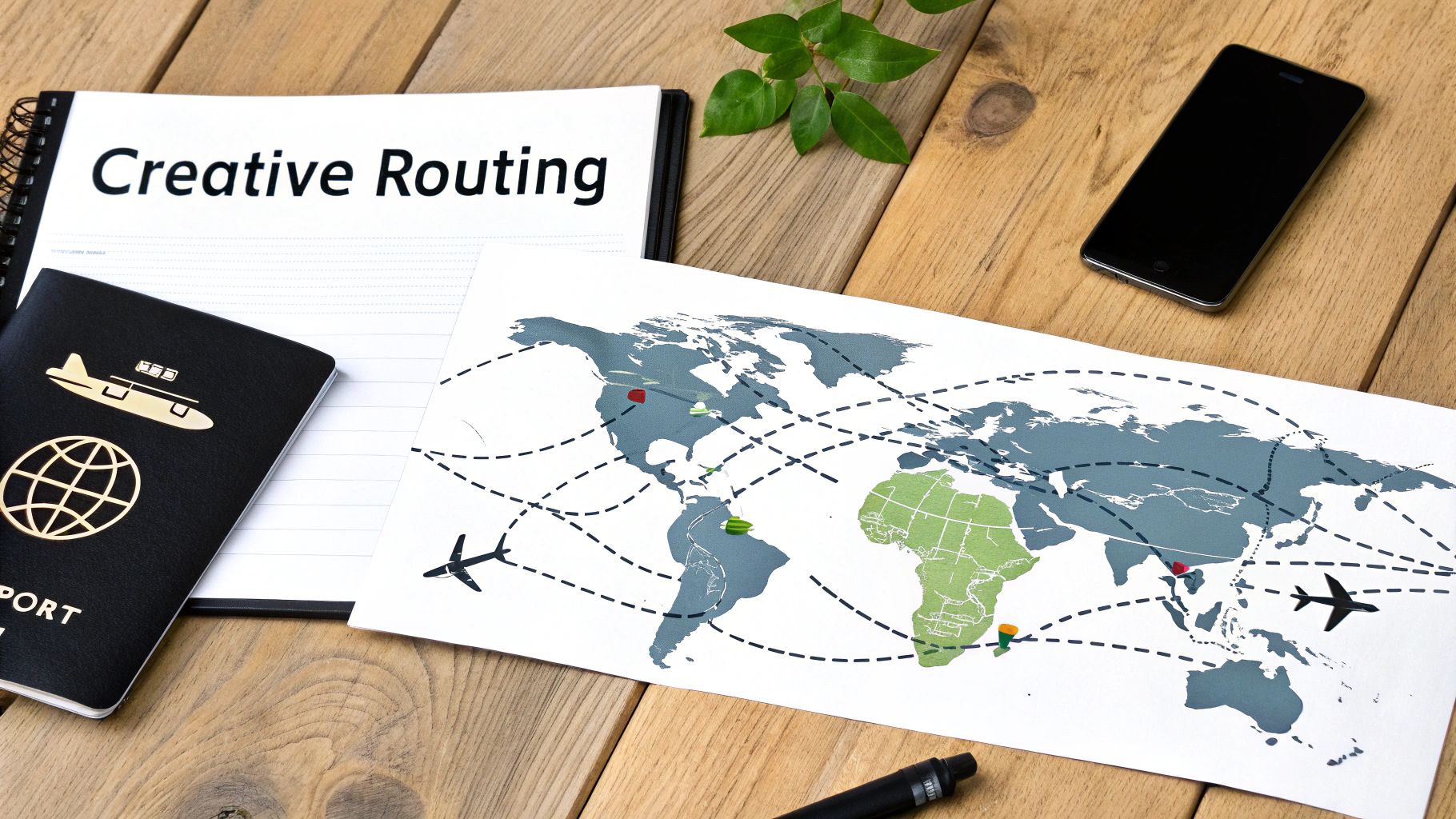
A passport, notebook with 'Creative Routing', world map with flight routes, and smartphone on a wooden desk.

This is where the real magic happens. Forget simple round-trip searches; creative routing is how savvy travelers consistently find deals that others miss. It's about rethinking the journey itself and knowing how to manipulate fare rules to your advantage. A little bit of planning here can literally slash thousands off the final price.

Airlines sort their premium seats into different categories, or "buckets," each with a specific letter code like J, C, or D. These aren't just random letters; they dictate the price, flexibility, and availability of your ticket. Getting a handle on these is the first step to snagging those deeply discounted seats before anyone else.

Understanding Fare Buckets

Think of fare buckets as different inventory lanes for the same lie-flat seat. A J bucket is usually the full-fare, no-questions-asked ticket with maximum flexibility. A C bucket often signals a sale price but with decent availability, while the elusive D bucket is where you find those shockingly cheap fares with tighter rules.

Here's a quick cheat sheet:

  • J bucket: Highest price, most flexible. The 'walk-up' business class fare.
  • C bucket: Moderate restrictions, but can offer 20-30% discounts.
  • D bucket: Strictest rules, but where you find flash sale fares at 40-60% off.

The key is that these buckets are dynamic. Airlines constantly shift inventory between them. When you see a fare drop from a C to a D bucket, that’s your signal. It’s time to book.

Positioning Flights For Big Savings

A positioning flight is simply a separate, cheap ticket you buy to get to another city to start your main international journey. Sounds like a hassle, but the savings can be enormous. For instance, a direct flight from Los Angeles (LAX) to Hong Kong might be outrageously expensive, but starting that same trip from Seattle could be thousands cheaper.

The strategy is simple:

  1. Find the low-cost international flight (e.g., SEA to HKG).
  2. Book a separate, cheap positioning flight to get there (e.g., LAX to SEA).
  3. Compare the total cost against the direct flight.

Often, a domestic hop only adds $150-$200 to your trip but can carve $1,000 or more off the long-haul segment. You're basically arbitraging regional airline promotions.

Using Multi-City and Open-Jaw Itineraries

Don't box yourself into a simple round-trip. Multi-city and open-jaw tickets are powerful tools for finding cheap international business class flights.

They let you do things like:

  • Fly into one city and out of another, avoiding high departure taxes.
  • Build in a stopover in a city with lower fares.
  • Stitch together flights from different partner airlines for a single, cheaper fare.

These aren't just for complex vacations; they are strategic cost-cutting maneuvers.

To see just how effective these strategies are, let's compare them to a standard booking. The difference is often staggering.

Advanced Routing Strategies Vs Standard Booking

Booking Strategy Example Itinerary (e.g., LAX to Paris) Typical Business Class Cost Potential Savings
Standard Round-Trip LAX to Paris, direct return $6,000 $0
Positioning Flight LAX→SFO→Paris→SFO→LAX $3,800 $2,200
Open-Jaw Multi-City LAX→Paris; London→LAX $4,200 $1,800

The takeaway is clear. Getting creative with your route can easily shave 30-40% off premium airfare if you know what you're doing.

I put this to the test on a recent trip to Bangkok. A direct LAX to BKK flight was quoted at $5,200. Instead, I booked a multi-city ticket: LAX to Bangkok via Vancouver, with an open-jaw return from Singapore back to LAX. The final price? $3,100. That’s a $2,100 savings—a 40% discount—for a bit of extra clicking.

Maximizing Miles and Upgrades

Stop thinking about upgrades as a last-minute perk at the gate. The best value comes from searching for award availability in premium fare buckets from the get-go. Many airlines release more award seats around five months out.

  • Air France/KLM's Flying Blue program has off-peak awards to Asia for as low as 50,000 miles one-way in business class.
  • Alaska Mileage Plan is fantastic for finding partner award seats, sometimes as low as 55,000 miles.
  • Use your miles to cover the short positioning legs for next to nothing, keeping your cash for the main ticket.

By blending a savvy cash fare with a partial award ticket, it's possible to get your total cost under $2,000 for routes that typically cost triple that.

Framing Savings For Corporate Approvals

Getting your company to approve a more complex itinerary can be a challenge, but it’s all about how you frame it. A simple comparison chart works wonders.

  1. Show the standard, direct-flight cost versus your creatively routed, cheaper option.
  2. Highlight that the core benefits—lie-flat seat, lounge access, priority services—are exactly the same.
  3. Point out that the added flexibility can even help accommodate meeting changes without huge rebooking fees.

One corporate travel manager I work with put it perfectly: “Routing ingenuity unlocked a 45% reduction on our business class travel budget last year.”

It definitely takes more effort than a quick search on Google Flights, but the rewards are undeniable. When you combine these routing tactics with smart timing and the right tools, you can consistently find cheap international business class flights for less than what most people pay for economy.

Next, we’ll dive into the specific tools and alerts I use to monitor these fares and automate much of this process.

Using the Right Tools and Airline Alliances

Endlessly searching for deals by hand is a surefire way to get frustrated and miss out. The real secret to consistently finding cheap international business class flights isn’t about brute force—it’s about using smarter tools to let the deals come to you. This is where a little tech and industry know-how give you a massive advantage.

You can actually automate the hunt with professional-grade fare monitors. These aren’t your everyday travel websites. Think of them as powerful platforms built to track specific routes, dates, and even fare classes, shooting you an alert the second a price drops into your sweet spot. That real-time intelligence is what lets you pounce on a deal before it’s gone.

Setting Up Your Digital Toolkit

The goal is to build a system that does the heavy lifting for you. Instead of randomly checking fares, you’ll get a ping when that New York to Milan business class seat drops below $2,800 or when a fare war suddenly breaks out on a route to Asia.

Your essential toolkit should include:

  • Fare Monitors and Alerts: This is non-negotiable. Set up precise alerts for your dream routes, specifying your target price, travel window, and cabin class.
  • Points and Miles Trackers: A good service keeps all your loyalty accounts in one place. It helps you see at a glance if you have enough miles for an award ticket or an upgrade when an opportunity pops up.

Beyond the usual platforms, savvy flyers use a few other tricks. For instance, you can learn to use a VPN for cheaper flights to unlock some serious savings. By changing your virtual location, you can sometimes tap into fares priced for entirely different markets, which can be dramatically cheaper.

Leveraging the Power of Airline Alliances

You have to think bigger than just one airline. The three major global alliances—Star Alliance, oneworld, and SkyTeam—are much more than just marketing fluff. They're powerful networks you can use to find better availability, more creative routes, and ultimately, lower prices.

Let’s say you’re looking for a flight on United (a Star Alliance member) and their own site shows zero award seats. A deeper dive might reveal a fantastic business class seat on a partner like Turkish Airlines or Lufthansa for the exact same route, often for fewer miles. This happens all the time, and basic searches almost always miss it.

This strategy is a game-changer for complex trips. You can stitch together flights from multiple partner airlines on a single ticket, often unlocking pricing you’d never find by booking them separately. It gives you an exponentially larger pool of seats to choose from. For a more personal take on navigating these strategies, you might be interested in reading Ryan D's insights on premium travel.

Knowing When to Use Points vs. Cash

The classic points-versus-cash dilemma is at the heart of finding true value. While using miles to upgrade an economy ticket sounds great, it's often a terrible deal. Many airlines force you into a super-expensive, full-fare economy ticket (think Y or B class) just to be eligible. That can end up costing nearly as much as a discounted business class ticket would have in the first place.

The smartest move is often paying cash for a deeply discounted business class fare. Save your miles for when cash prices are ridiculously high. An award ticket is a fantastic value during peak season when revenue tickets are north of $8,000, but a good cash deal is almost always the winner for off-season travel.

This dynamic is only getting more relevant as demand for premium travel grows. International premium class has seen impressive growth, with business and first-class traffic climbing 11.8% year-over-year, even outpacing economy's 11.5% growth. With Europe alone representing 39.3 million premium passengers, airlines are fighting hard for your business, which means more opportunities for fare sales. You can learn more about these global premium travel trends and regional growth.

By combining these automated tools with a solid understanding of airline alliances, you stop being a passive price-taker and become an active deal-hunter, ready to jump on the market’s next move.

Your Game Plan for Booking Premium Fares

A 'Booking Checklist' sign with a clipboard showing two checked boxes, a smartphone, and office supplies.

All the theory in the world doesn't matter if it doesn't save you money. This is where we turn strategy into action. Think of this as your repeatable game plan, a checklist to run through every single time you start looking for a flight. Follow it, and you'll stop missing out on those incredible premium fare deals.

This isn't just a to-do list; it’s your roadmap to consistently finding cheap international business class flights. Working through these steps methodically will transform you from a passive fare-checker into a strategic deal hunter, ready to pounce the moment the right opportunity appears.

Phase One: Define Your Search

Before you even start plugging in destinations, you need to get your own plans in order. Your greatest asset in this game is flexibility, so figuring out just how flexible you can be is the first, non-negotiable step. A rigid plan is a recipe for paying top dollar.

  • Map Out Your Flexibility Window: What are your absolute earliest departure and latest return dates? Even giving yourself a buffer of +/- three days can open up a completely different, and much cheaper, world of fares.
  • Identify Your Alternate Airports: Make a list of at least two or three other airports you're willing to fly from or into. A short positioning flight can often slash the total cost, especially since some airports have significantly lower taxes and fees.
  • Set a "Buy Now" Price: Know your route. Based on what you’ve seen, decide on a target price that makes you pull the trigger instantly. The best deals don't last—they’re often gone in a matter of hours.

Don’t just hunt for the lowest price; hunt for the best value. A flight that's slightly more expensive but has better timing, a superior aircraft, or grants you lounge access during a long layover can be a far better deal than the absolute rock-bottom fare.

Phase Two: Execute the Hunt

Alright, now you’re ready to start the active search. This is all about using the right tools and comparing your options across different platforms and alliances. The biggest mistake people make is checking only one airline's website, which leaves you blind to countless deals offered through their partners.

  1. Set Your Fare Alerts: Get a fare monitoring tool working for you. Track your desired routes within that flexible date window you defined earlier. Make sure you set specific alerts for the business class cabin and your target price.
  2. Dig into Alliance Partners: Don't just look for a direct flight on a single carrier. Use alliance search tools to see what’s available on partner airlines. This is often where you'll find cheaper seats or more creative routing options.
  3. Test Multi-City and Open-Jaw Scenarios: Get creative. Try flying into one city and out of another. This simple trick can often break the fare rules in your favor, leading to a much lower overall ticket price.

The global aviation industry is booming again. We recently saw a peak of 123,798 commercial flights in a single day—a 3.06% annual jump that puts us well past pre-pandemic numbers. Carriers like American Airlines are leading the charge with an average of 6,360 daily flights. More planes in the sky means more premium seats to fill, which forces competition and creates more opportunities for us to find a deal.

Phase Three: Justify and Finalize

If you're traveling for work, this is your final hurdle: getting the green light. The key here is to frame your find not as an indulgence, but as a smart, value-driven decision for the company. It’s all in how you present the numbers.

Pull together a quick comparison. Show the cost of a standard, full-fare economy ticket right next to the discounted business class fare you found. Emphasize the productivity gains—arriving rested and ready to go straight into a meeting. When you can show a premium ticket that costs the same or just slightly more than a last-minute coach seat, it makes the decision a no-brainer for any manager.

And while you're focused on the flight, don't forget the small things that add up. A little prep can help you avoid roaming charges on your international trip and keep you connected without a nasty surprise on your phone bill.

Once you get approval, book it. Immediately. The best fares wait for no one.

You've learned the strategies, you've seen the tools—now let's tackle the questions that probably just popped into your head. After years of doing this, I've heard them all.

This isn't just a recap; it's the final briefing before you go out and snag your own premium flight deals. Let's clear up any lingering doubts so you can book with total confidence.

Can You Really Find Business Class Flights Cheaper Than Economy?

Absolutely. It doesn’t happen every day on every flight, but it happens way more often than most people think. For those of us who know where to look, it’s a golden opportunity.

So, how can this happen? Think of it from the airline's perspective. They might have a flight where the economy cabin is packed and selling at top dollar, but the business class cabin is wide open. An empty lie-flat seat is a perishable good—once that plane takes off, the revenue is lost forever. Slashing the price to get some money for that seat is better than getting nothing at all.

This is especially true when you factor in strategies like positioning flights or jumping on a sudden fare war between two rival carriers. It's not uncommon to see a business class ticket on one airline drop below the price of a full-fare economy seat on another. It's all about finding those specific imbalances in the market.

What Are the Biggest Mistakes People Make When Hunting for Premium Fares?

It almost always boils down to two things: being inflexible and using the wrong tools.

Most people plug one specific route and one specific date into a basic search engine, see a sky-high price, and just give up. The real secret to unlocking cheap international business class flights is to be willing to play with your dates, departure airports, and maybe even your final destination. Shifting your travel by just a day or two, or flying out of a different nearby city, can literally save you thousands.

The other major mistake is relying on the same travel sites everyone else uses. You're completely missing out on historical pricing data, fare cycle trends, and the crucial real-time alerts that specialized fare monitors provide. And a final classic blunder: waiting until the last minute. Unlike coach, last-minute business class "deals" are a myth. Those prices almost always skyrocket in the final weeks before departure.

How Much Time Do I Really Need to Spend to Find These Deals?

There’s a bit of a learning curve at the very beginning, sure. But the goal here isn't to chain yourself to your computer for hours every day. The whole point is to set up smart, automated systems that do the heavy lifting for you.

The real shift is moving your time away from tedious manual searching and toward strategic monitoring. Once you set up a few targeted fare alerts for trips you’re interested in—which only takes a few minutes—the deals come straight to your inbox. Your only job is to be ready to pull the trigger when the right one hits.

That small initial time investment can pay off with thousands of dollars in savings on a single trip. It’s easily one of the most valuable travel skills you can develop.

Are These Discounted Tickets "Real" Business Class with All the Perks?

Yes, 100%. Let me be crystal clear: a discounted fare never means a discounted experience. The price you pay is simply a function of the ticket's fare code and market demand when you book. It has absolutely nothing to do with the service you'll get on board.

Whether you paid the eye-watering full fare or found an incredible deal for less than the guy in coach, you get the exact same treatment. You'll get the lie-flat seat, full lounge access, the multi-course meal, the champagne—all of it. You are getting the complete, undiluted business class experience, just for a much, much smarter price.


At Passport Premiere, we connect the dots for our members. We blend constant fare monitoring, deep market analysis, and years of expertise to pinpoint the exact moment to buy. We track the fare cycles, spot the fare wars as they erupt, and deliver the kind of airfare intelligence that turns market volatility into your advantage. Stop overpaying. Start flying smarter. Learn more at https://www.passportpremiere.com.

Decoding Airline Seat Pitch for Ultimate Comfort in the Sky

Let’s talk about one of the most misunderstood—and most important—numbers in air travel: seat pitch.

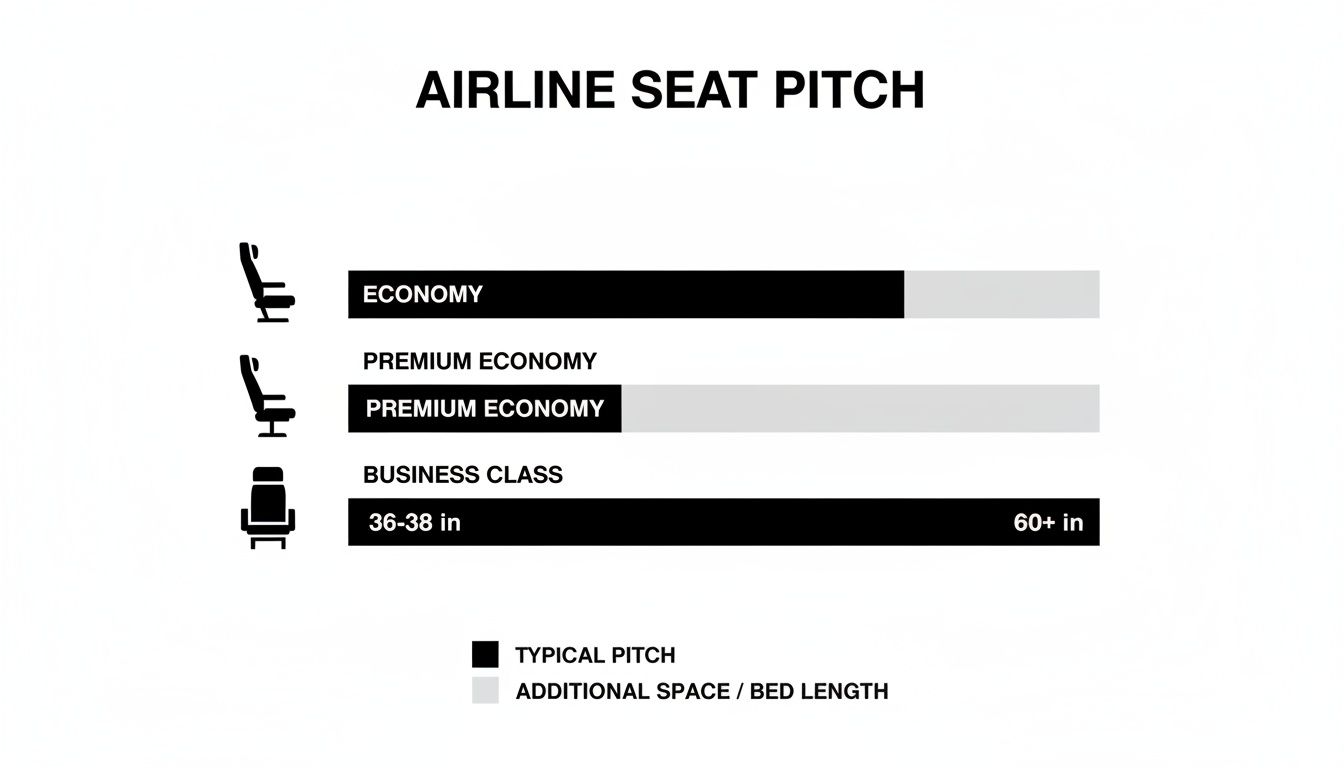
It’s not just legroom. Think of it as your personal bubble in the sky. Officially, it's the distance from one point on your seat to the very same point on the seat right in front of you. This single measurement, which can be as tight as 28 inches in economy or as generous as 60+ inches up front, is the best indicator of how comfortable (or cramped) you're going to be.

If you want to book a better flight, you need to understand what this number really means.

What Airline Seat Pitch Really Means for Your Comfort

Many flyers hear "seat pitch" and immediately think "legroom." That's part of it, but it's not the whole story.

Imagine you're in a movie theater. The pitch isn't just the space for your legs; it's the entire row's depth—the space for the physical chair, your knees, and whatever you’ve stashed under the seat. A bigger pitch gives you room to stretch out. A smaller one? That’s when your knees start making friends with the seatback in front of you.

It gets even more complicated with modern seats. Airlines are installing "slimline" seats that are much thinner than older, bulkier models. This clever design can sometimes give you a bit more knee room, even if the official pitch measurement seems low. On the flip side, an older plane with plush, thick seats can make a standard 31-inch pitch feel incredibly tight.

The Impact on Your Flight Experience

Why obsess over a few inches? Because on a long-haul flight, those inches are the difference between a relaxing journey and eight hours of misery. Not having enough space can leave you feeling stiff, sore, and trapped.

Here's a quick breakdown of what to expect:

  • Economy Class: Brace yourself for a pitch of 28 to 32 inches. This is where airlines pack 'em in, and you'll feel the squeeze.
  • Premium Economy: A real step up. With 34 to 38 inches, you get that crucial extra space to work, read, or just breathe.
  • Business & First Class: This is a completely different world. Pitches can range from 39 to over 70 inches, often with seats that convert into fully flat beds.

This chart really puts the difference into perspective.

Chart comparing typical airline seat pitch and bed length for economy, premium economy, and business class flights.

The jump from economy to the premium cabins isn't just a small upgrade; it's a massive increase in personal territory.

Typical Airline Seat Pitch by Cabin Class

Here's a quick reference guide to the average seat pitch you can expect in different airline cabins.

Cabin Class Typical Seat Pitch Range (Inches)
Economy 28" – 32"
Premium Economy 34" – 38"
Business 39" – 70"+
First 60" – 80"+

Keep these numbers in mind when comparing flights—they provide a solid baseline for what you're actually getting for your money.

The Value Equation

Once you understand these numbers, you can start making smarter decisions. It stops being about just finding the cheapest ticket and starts being about assessing the true value of what you're buying. For a lot of us, paying a bit more for a few extra inches of space is a no-brainer.

The surprising truth is that securing a spacious business class seat is often cheaper than you'd expect. With the right fare intelligence, it's possible to find business class tickets for less than the cost of a full-fare coach ticket.

When you look beyond the price tag and consider the physical space you're getting, you start to fly smarter. To see how fare analysis uncovers these kinds of deals, it's worth checking out insights from industry veterans like Michael K.

If you've ever boarded a flight and felt like the walls were closing in, you're not wrong. That feeling of being squeezed into your seat isn't just in your head; it’s the result of a deliberate, decades-long trend by airlines to shrink your personal space. What used to be a fairly standard, comfortable journey is now often a fight for every last inch of knee and elbow room.

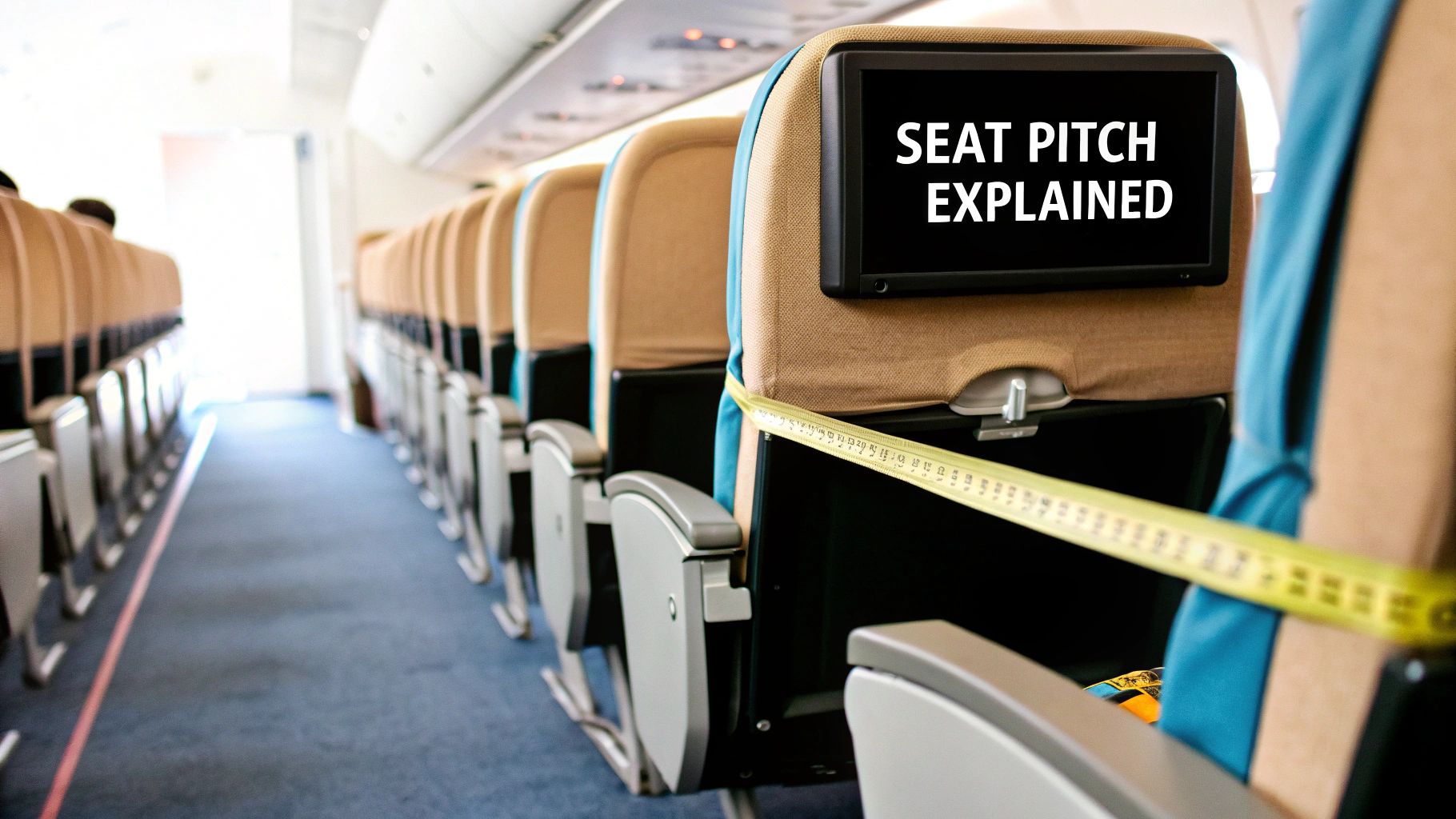
An airline cabin showing rows of seats and a measuring tape demonstrating seat pitch with on-screen explanation.

This big squeeze really took off after airline deregulation in the late 1970s. The floodgates of competition opened, and carriers scrambled to find ways to make more money on every flight. Their simplest, most effective solution? Pack more people onto the plane. And so, they started shaving off the airline seat pitch, inch by painful inch.

From Roomy Rows to Cramped Cabins

The difference between flying then and now is pretty stark. Back in 1985, you could expect a relatively generous 31 to 36 inches of seat pitch on major U.S. airlines. It was enough to stretch out a bit. Today, that number has been whittled down to a tight 30 to 31 inches on many carriers. To put it in perspective, United's maximum economy pitch today is less than the minimum offered back then. It's a clear story of how much space we've lost, and you can discover more insights about shrinking airline seats to see just how dramatic the change has been.

This isn't just about being uncomfortable for a few hours. For frequent business travelers on long-haul flights, being stuck in a cramped seat poses real health risks. It can increase the odds of developing serious conditions like deep vein thrombosis (DVT), where blood clots form in the legs from prolonged immobility.

The Math Behind the Squeeze

So why would airlines risk unhappy customers and potential health issues? Simple economics.

Every single row of seats they can cram onto an aircraft translates into a massive revenue boost over that plane's lifetime. Think about it: reducing the airline seat pitch by just one inch across a cabin can free up enough space to add an entire extra row of six seats.

Over a year, that one extra row can generate hundreds of thousands of dollars in ticket sales for that aircraft alone. Now multiply that across an entire fleet, and you can see why the financial incentive to shrink your space is overwhelming.

This is the fundamental trade-off of modern air travel. Airlines have bet that travelers will tolerate less personal space in exchange for lower fares, pushing anyone who needs a reasonable amount of room toward more expensive premium cabins.

Understanding this history is key. It shows why paying attention to seat pitch is no longer just for picky travelers—it's essential for anyone who wants a tolerable, let alone comfortable, flight. The good news? Sometimes, securing that comfortable seat is cheaper than you'd ever guess.

How to Find Accurate Seat Pitch Information Before You Book

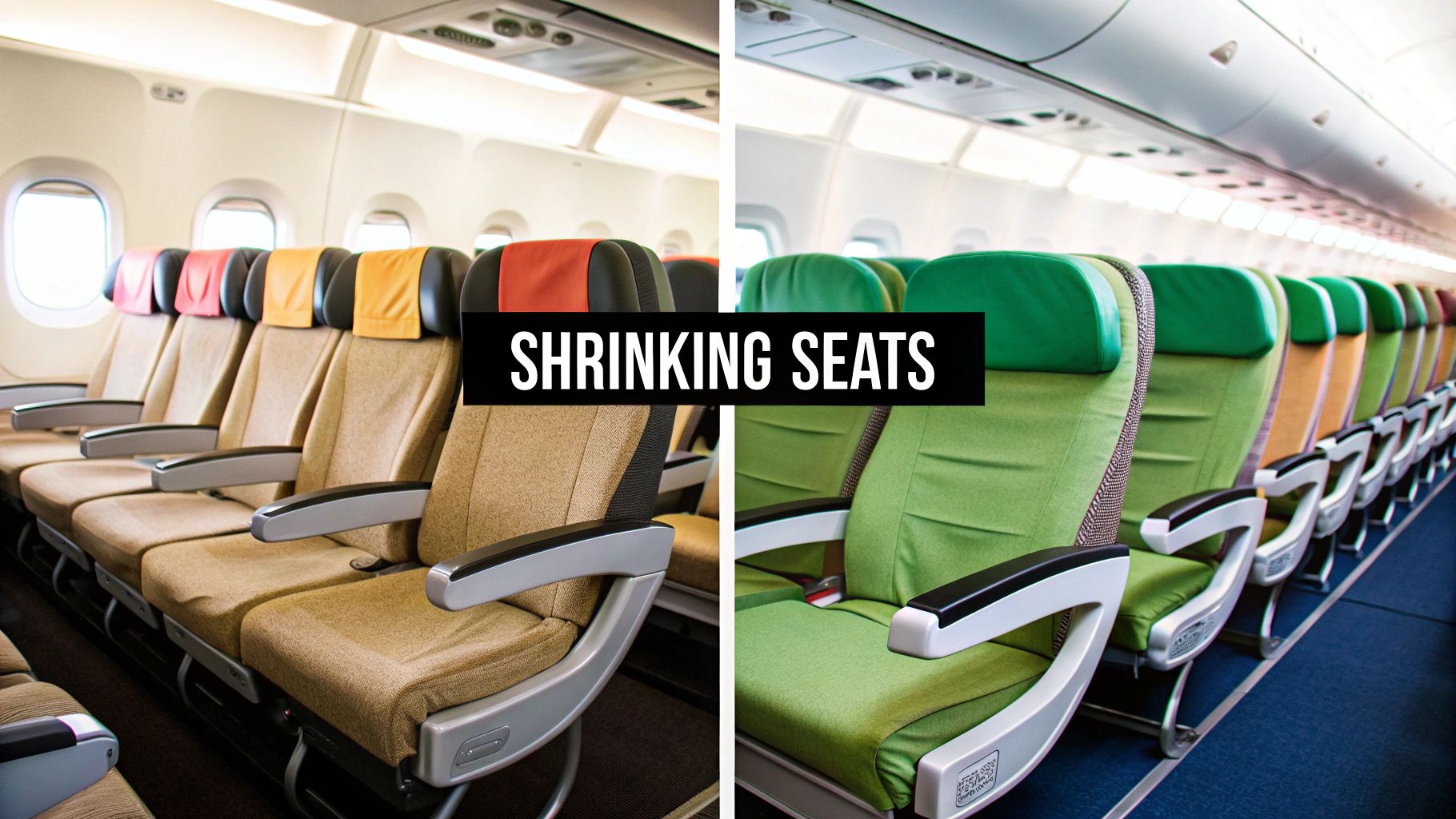
Side-by-side comparison of two airplane cabins with rows of economy seats, highlighting "SHRINKING SEATS".

You don't have to leave your in-flight comfort to chance anymore. With the right intel, you can track down the exact airline seat pitch for your flight long before you ever click "purchase," making sure you actually get the space you’re paying for.

Your first stop should probably be the airline's own website. Most have a "Fleet" or "Our Aircraft" section that gives a general overview of their planes' layouts. While it’s a decent starting point, this information is often broad. The real-time seat map shown during the booking process is more specific to your actual flight, but even that has its limits.

The problem is, airline-provided maps almost never list the hard numbers for pitch. To get the full story on your seat's true comfort level, you need to turn to the pros.

Using Third-Party Tools for Unbiased Data

This is where dedicated travel tools like SeatGuru and ExpertFlyer become invaluable. Think of them as the private investigators of the airline world. They aggregate data from countless sources to create detailed, aircraft-specific seat maps that reveal what the airlines won't. You get the critical stats: seat pitch, width, and even reviews from fellow passengers who've sat in that exact spot.

They make it incredibly simple with a color-coding system that flags the best and worst seats on the plane:

  • Green: A "good" seat. This usually means extra legroom, a great view, or some other perk.
  • Yellow: A mixed bag. It might be too close to a lavatory, have limited recline, or a misaligned window.
  • Red: Avoid at all costs. These are the seats with significant drawbacks you'll regret booking.

Using this visual guide alongside the listed pitch numbers gives you a crystal-clear picture of which seats are worth choosing and which ones are a guaranteed bad time.

Why Verification Is So Critical

Doing this homework is absolutely essential because airlines are notorious for flying multiple versions of the same exact aircraft model. The Boeing 777 you're taking from New York to London could have a totally different cabin layout and airline seat pitch than the one that same airline flies from Los Angeles to Tokyo.

Relying on the aircraft type alone is one of the most common mistakes travelers make. You have to verify the specific configuration for your exact flight number to avoid a very unpleasant surprise at 30,000 feet.

By layering the airline's own data with the deep insights from specialized tools, you can book with confidence, knowing precisely the kind of space and comfort you're getting. It's a simple step that ensures your trip starts off right—long before you ever step on the plane.

Looking Beyond Pitch to Width and Recline

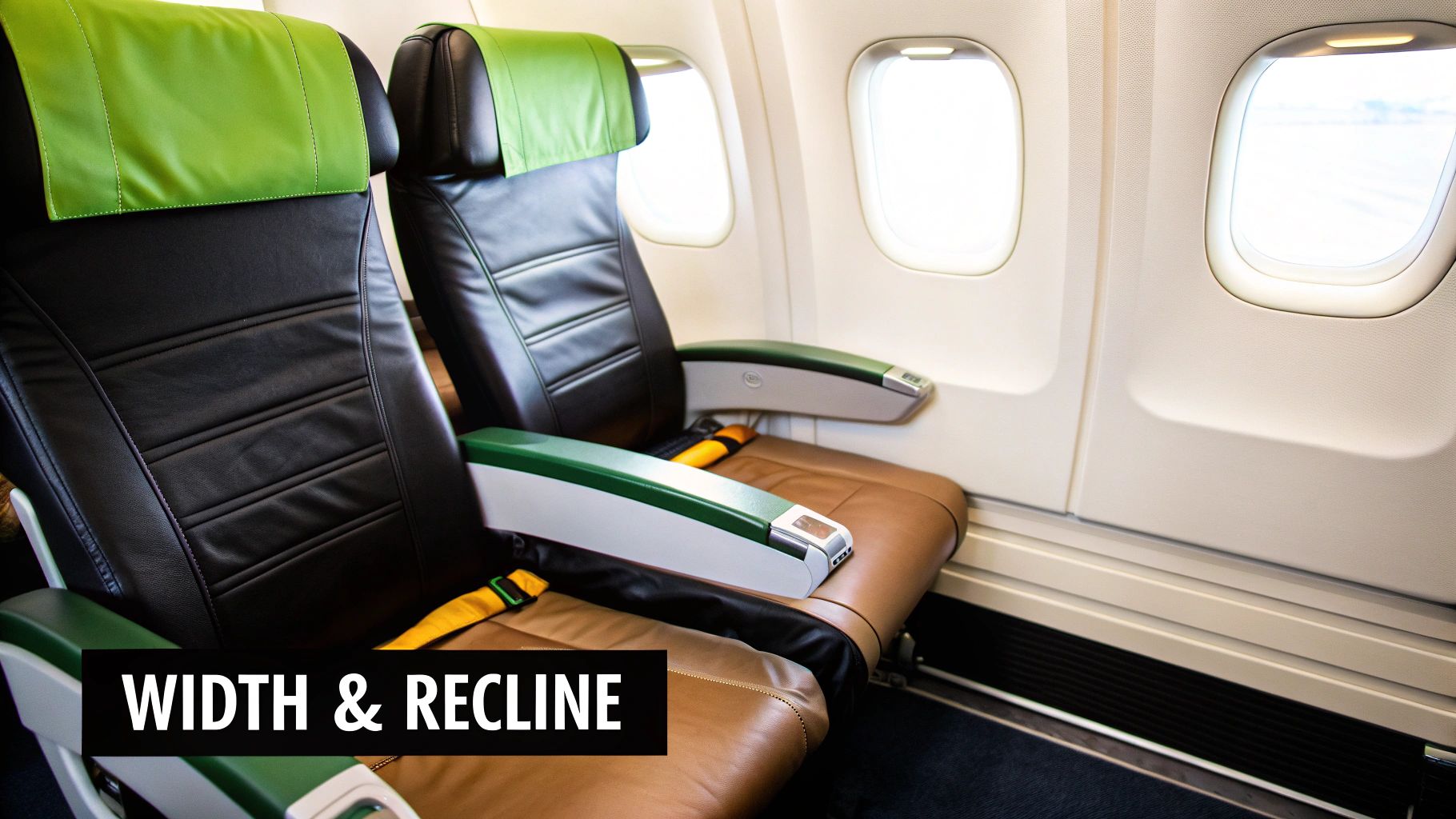
While a decent seat pitch is a good starting point, it’s only one piece of the in-flight comfort puzzle. Any seasoned traveler knows that true comfort comes from a mix of factors, and you have to look beyond a single number. Two other critical dimensions—seat width and recline—play just as big a role in defining your personal space at 30,000 feet.

Just as pitch has been quietly shrinking over the years, so has seat width. We’re talking about the distance between your armrests, and losing even half an inch there is something you feel immediately in your shoulders. That lateral space is what stands between you and a constant battle for elbow room with your neighbor.

The Shrinking Shoulder Room

The move toward narrower seats has been just as aggressive as the cutbacks in legroom. Over the last 30 years, economy seat width has shrunk by as much as four inches, with some of the tightest seats now a mere 16 inches across. This squeeze is happening while passengers, on average, are getting larger—creating a major disconnect between seat design and the reality of who's sitting in them. You can read the full research about shrinking airline seats to see just how bad it’s gotten.

And it’s not just the numbers. The cabin’s overall layout has a huge impact on your sense of space. A 2-4-2 configuration on a wide-body jet feels far more open and gives more people aisle access than a packed 3-4-3 or 3-3-3 arrangement on the very same plane. These details matter just as much as the seat itself.

Why Recline and Amenities Matter

Then you have recline—the simple ability to lean your seat back and get some rest. Even an extra inch or two of tilt can make all the difference in whether you can actually sleep on a long-haul flight. Premium cabins, of course, take this to another level with deep-recline cradles or seats that go completely flat.

You also have to think about the practical things that make your space work. A well-placed power outlet or USB port means you don't have to clutter up your already-limited footwell with a bulky power bank. A thoughtfully designed seatback pocket can help you keep your things organized without them digging into your knees.

When you're looking at a seat, think about your total "comfort envelope." This isn't just about legroom (pitch) and shoulder room (width). It also includes your ability to recline, plug in your devices, and store your belongings without feeling cramped.

And while you're focused on the physical space, don't forget other essentials. For some travelers, the availability of seat belt extenders for airplanes is non-negotiable for both comfort and safety.

This is why premium cabins offer a fundamentally better experience—they deliver more space in every direction, not just forward. For long flights, investing in that all-around comfort is often a smart move, especially when fare intelligence can reveal opportunities to book business class cheaper than coach.

Finding Premium Comfort Without the Premium Price Tag

Two airplane seats with black and brown upholstery and green headrests, next to bright windows.

Now that you have a handle on what really goes into a comfortable seat—pitch, width, and recline—you can stop just avoiding bad seats and start hunting for genuine value. Too many travelers operate under the assumption that a spacious seat in a premium cabin is an out-of-reach luxury, forcing a painful choice between budget and comfort.

This is one of the biggest myths in air travel. You don't have to pick one over the other.

The secret is knowing that not all Business or First Class seats are the same, and their prices swing wildly based on the route, the time of year, and simple demand. Just because an airline slaps a high price tag on a seat doesn't mean anyone is actually going to pay it. This is where a little market intelligence completely changes the game for a savvy traveler.

If you can track fare anomalies and understand what an unsold premium seat is really worth to an airline, you can find some incredible deals. The whole game is timing your purchase to catch the price drops, which happen a lot more often than you'd think.

From Luxury Expense to Smart Investment

Think about that premium cabin ticket differently. It’s not just an expense; it’s a strategic investment in your own well-being and productivity. There's real, tangible value in arriving at your destination rested and sharp, whether it's for a critical business meeting or the first day of a long-awaited vacation.

The ability to work without being cramped, get some real sleep, and actually enjoy the journey transforms the entire experience.

This shift in mindset is even more powerful when you realize that premium comfort doesn't always have to come with a premium price. In fact, it's often possible to book a roomy Business Class seat for less than what you’d pay for a standard, full-fare economy ticket. You can learn more about how to score these kinds of deals on business class flights to Europe.

Fare intelligence services exist to expose these pricing games. By monitoring the fare cycles, you can pinpoint the exact moments airlines get desperate to fill unsold seats, turning their problem into your opportunity for massive savings.

Tapping into Market Intelligence

This strategy is especially powerful on long-haul international flights. For travel advisors and corporate travel managers booking trips across the Atlantic or to Asia, the data is overwhelming: the upgrade is almost always worth it. Premium cabins on these routes consistently offer a generous 38 to 60+ inches of seat pitch, and the seats are frequently discounted in fare wars that specialized services can track.

Here’s a fact most people don't know: fewer than 15% of premium seats ever sell at their initial, full-fare price. Members of services like Passport Premiere get the intelligence they need to see an empty seat's true market value. They learn to time their purchase to lock in Business or First Class tickets for cheaper than coach.

This approach combines hard data with expert analysis, letting both corporate and leisure travelers save money without sacrificing the legroom and comfort that are so crucial for health and productivity on flights over ten hours. You can dig into the data yourself in studies on passenger seat size.

Here’s your game plan for making sure you never get stuck in a cramped seat again. Knowing the numbers is one thing, but using that knowledge to lock in a better experience is what really matters.

Your Smart Traveler Checklist for Maximizing In-Flight Space

Pre-Booking Intelligence Gathering

Before you even pull out your credit card, a little homework goes a long way. These are the crucial first steps to dodge a miserable eight-hour flight.

  1. Verify the Aircraft Type: Never just assume. Airlines often swap different versions of the same plane on the same route, and the seating can vary wildly. Pinpoint the exact aircraft model for your specific flight number.

  2. Cross-Reference Seat Data: Don't just take the airline's word for it. Use a tool like SeatGuru to get a more objective look at the seat pitch, width, and recline. Compare those numbers against the airline’s own seat map to find the sweet spots.

  3. Think Beyond Pitch: Remember, pitch is only part of the puzzle. Pay attention to the cabin layout—a 2-4-2 configuration feels a world away from a packed 3-3-3. Also, check for seat width and must-have amenities like power outlets.

The real goal here is to figure out the flight's total value, not just the ticket price. That cheap fare might look tempting, but it could be a one-way ticket to misery. Spending a little more for a few extra inches of airline seat pitch is almost always the smartest money you'll spend on your trip.

Smart Booking and Final Checks

Once you’ve zeroed in on the right flight and seat, it’s time to book it like a pro.

  • Evaluate Premium Fares: Don’t write off Business Class. With the right intel, you can sometimes snag a premium seat for less than what others are paying for a full-fare economy ticket. Check out how experienced flyers like Steve S make it happen.

  • Book and Select Early: This is simple: the good seats always go first. Lock in your booking as soon as you can to claim your preferred spot.

And don't forget, the space you have is also about how you use it. Beyond just the seat specs, smart packing can make a huge difference. Getting savvy by optimizing your underseat carry-on is a simple move that can free up a surprising amount of precious foot room.

Your Questions About Airline Seat Pitch, Answered

When it comes to booking a flight, the nuances of seat pitch can feel overwhelming. But getting a handle on it is the key to an enjoyable trip, not one you have to endure. Let's break down some of the most common questions travelers have about their personal space in the sky.

Is an Economy Plus Seat Worth the Extra Cost?

Those Economy Plus or "extra legroom" seats definitely offer a noticeable improvement, usually giving you another 3 to 7 inches of pitch. On a long-haul flight, that can absolutely be the difference between a restless, miserable journey and a reasonably comfortable one.

But here’s a pro tip: don't just reflexively pay the upgrade fee.

Before paying for a marginal upgrade, always check the price of a discounted Business Class ticket first. With the right fare intelligence, you can often find premium cabin seats for a price that's surprisingly close to—or sometimes even less than—a full-fare economy ticket.

It's a total re-think of the value proposition. You're not just buying a few extra inches of legroom; you're investing in a fundamentally better experience with a wider seat, top-notch service, and maybe even a lie-flat bed.

Does Seat Pitch Vary Within the Same Airline?

It sure does. And it’s a trap that catches a lot of travelers off guard. No major airline has a perfectly uniform fleet. They fly a mixed bag of aircraft from Boeing and Airbus, and even different versions of the same plane—say, a Boeing 777-200 versus a 777-300ER—can have completely different cabin layouts.

This is why you have to check the specific aircraft assigned to your flight number. The airline seat pitch you get flying from New York to London can be worlds apart from what the same airline offers on its Los Angeles to Tokyo route, even if both are sold as the same class of service.

How Does Seat Pitch Affect Flight Safety?

This is where comfort bleeds into a much more serious conversation. Airline seat pitch is actually a critical safety factor. Aviation authorities like the FAA mandate minimum spacing to ensure everyone can evacuate an aircraft within 90 seconds during an emergency. If rows are jammed too close together, it can create a dangerous bottleneck.

It's a hot-button issue. Advocacy groups have been sounding the alarm for years, arguing that the constant squeeze on seat pitch isn't just about comfort—it's a potential safety hazard. Tighter cabins could make it harder to get out fast and might increase injury risk during severe turbulence, which is why the debate over legally mandated minimums is far from over.


Finding real value in air travel means looking past the advertised price to understand the actual comfort and experience you're paying for. Passport Premiere gives you the fare intelligence to book premium cabin seats for less than you think is possible, turning that cramped flight into a genuinely restful journey. See how you can fly better at https://www.passportpremiere.com.