
Airbus A380 Business Class: What Makes It Premium

Business class can cost less than coach on select long-haul flights, with examples of economy fares at $575 versus $471 for business, and $480 versus $373 for business. Airlines sometimes discount unsold premium seats before departure, so the usual assumption that a better cabin must cost more doesn't always hold.

That pricing surprise is only part of the Airbus A380 business class story. The aircraft changed the physical experience of long-haul travel by placing passengers across two decks, giving airlines an unusually large canvas for premium seating, wider aisles, social areas, and lie-flat beds. Yet the A380 isn't one uniform product. A quiet, spacious 1-2-1 cabin can feel like a private hotel corridor, while a denser layout on the same aircraft can feel much less restful.

The key is to evaluate the airline's seat map, cabin density, bed design, and fare conditions, not just the aircraft badge on the booking page.

Why the Airbus A380 Became a Premium-Cabin Benchmark

The A380 entered commercial service with Singapore Airlines on 25 October 2007. Its inaugural aircraft had 60 business-class seats on the upper deck within a 471-seat, three-class layout, a configuration that immediately showed how the aircraft could separate premium passengers from the larger economy cabin below. Airbus describes the A380's scale and passenger-cabin design as a defining feature of the aircraft.

The easiest analogy is a two-story loft compared with a single-floor apartment. A conventional widebody gives the airline one main passenger level to divide among cabins. The A380 offers a full-length upper deck as another planning surface, allowing carriers to create a more distinct premium environment rather than placing business class directly beside a large economy cabin.

Airbus says the aircraft is certified for up to 853 seats, making it the only passenger jet capable of carrying more than 500 seats. That capacity matters economically. Airlines can carry a large number of passengers while reserving valuable upper-deck space for business and first class, which helps explain why the aircraft became associated with flagship routes and premium-cabin experimentation.
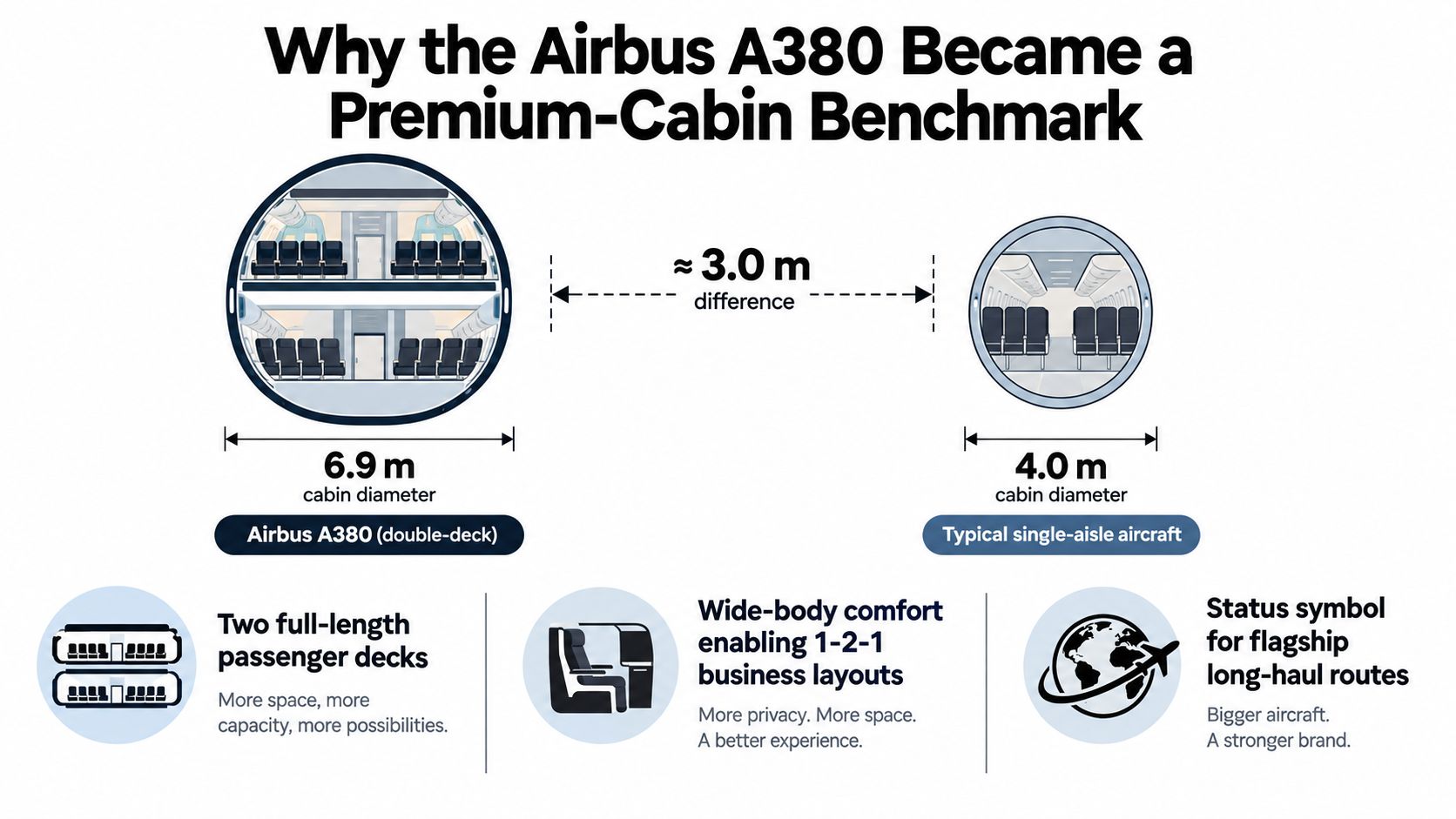
A comparison infographic showing the wider cabin diameter of the Airbus A380 versus a typical single-aisle aircraft.

Why the upper deck changes the mood

The upper deck gives airlines room to create a calmer visual rhythm. Curved sidewalls, indirect lighting, and the separation from the main economy cabin can make the aircraft feel less like a tube filled with rows and more like a sequence of smaller rooms.

That doesn't guarantee good sleep. The airline still decides how many seats to install, how much space to allocate between rows, and whether passengers receive direct aisle access. The aircraft provides the opportunity, but the carrier determines whether the finished cabin feels residential or crowded.

Practical rule: Treat the A380 as a platform, not a promise. The aircraft's size creates potential for comfort, but the operator's layout decides whether you receive it.

The A380 also helped establish a modern premium benchmark through seat width and cabin scale. Singapore Airlines said its first-generation A380 business-class seat measured 34 inches wide, and described it as the widest business-class seat of its time. That detail captures the aircraft's influence. Airlines weren't merely adding a more expensive fare. They were using the superjumbo's space to make business class visibly different from the cabin behind it.

The value proposition can become even more unusual when fares are flexible. A premium seat that remains unsold may be discounted, while economy demand holds coach prices firm. In those situations, the A380's business class isn't only a luxury upgrade. It can become the rational choice for the same journey.

How Major Airlines Configure Their A380 Business Cabins

The phrase A380 business class describes several very different products. Singapore Airlines, Emirates, ANA, Lufthansa, Qatar Airways, and Qantas each use the airframe differently, and even one airline may operate more than one cabin generation.

Singapore Airlines set an early benchmark with its inaugural upper-deck business cabin. Its first A380 carried 60 business-class seats, and the airline's wide first-generation seat showed how much room could be devoted to premium passengers. That early design emphasized width and a distinctive upper-deck setting, even though newer products from other airlines later put greater emphasis on direct aisle access.

Emirates demonstrates another approach. One publicly described A380 configuration has 14 First Class suites, 76 Business Class seats, and 426 Economy seats, while a later retrofit retained 76 business seats and added Premium Economy. Airbus' Emirates fleet announcement illustrates why the A380 remains commercially useful to the carrier. The upper deck can support a substantial premium cabin, a bar or social area on selected aircraft, and a wide range of fare products.

ANA takes a more selective approach to cabin design. Its A380 seat map shows a 1-2-1-style staggered business cabin across rows 5 to 18, giving each passenger a route to the aisle without climbing over a seatmate. ANA's A380 seat map is especially useful because it shows why row position matters, not just the headline cabin name.

Airline Seat Count Layout Bed Length Privacy Level
Singapore Airlines 60 on the inaugural aircraft Upper-deck premium layout Not specified in the verified source High sense of separation from economy
Emirates 76 in the cited configuration Operator-dependent, including later retrofit variations Not specified in the verified source Varies by seat position and aircraft
ANA Rows 5 to 18 shown on the seat map Staggered 1-2-1 style Not specified in the verified source Strong for solo travelers
Lufthansa Reduced from 78 to 68 in the upgraded cabin 1-2-1 79-inch lie-flat bed Direct aisle access for every passenger
Qatar Airways Not specified in the verified source Operator-specific premium layout Not specified in the verified source Depends on pitch and seat position
Qantas 70 1-2-1 About 2 meters, or 80 inches Strong individual access and privacy

Lufthansa's retrofit shows the clearest density trade-off. The airline reduced its A380 business cabin from 78 to 68 seats when it moved from 2-2-2 to 1-2-1, pairing the new arrangement with 22.8-inch-wide seats, a 44-inch pitch, and 79-inch lie-flat beds. The change sacrifices seats to remove the need to step over a neighbor, a trade that usually benefits nighttime access and personal space.

The business-class airline comparison guide is useful when the decision involves more than aircraft type. Compare the seat map, flight timing, and fare before assuming that a familiar airline will deliver the same experience on every A380.

Seat Layouts and What They Mean for Your Experience

A seat map tells you more about sleep quality than the word “business” on the ticket. The central question is simple: Can you reach the aisle without disturbing another passenger? If the answer is yes, the cabin will usually feel more practical for solo travelers and overnight flights.
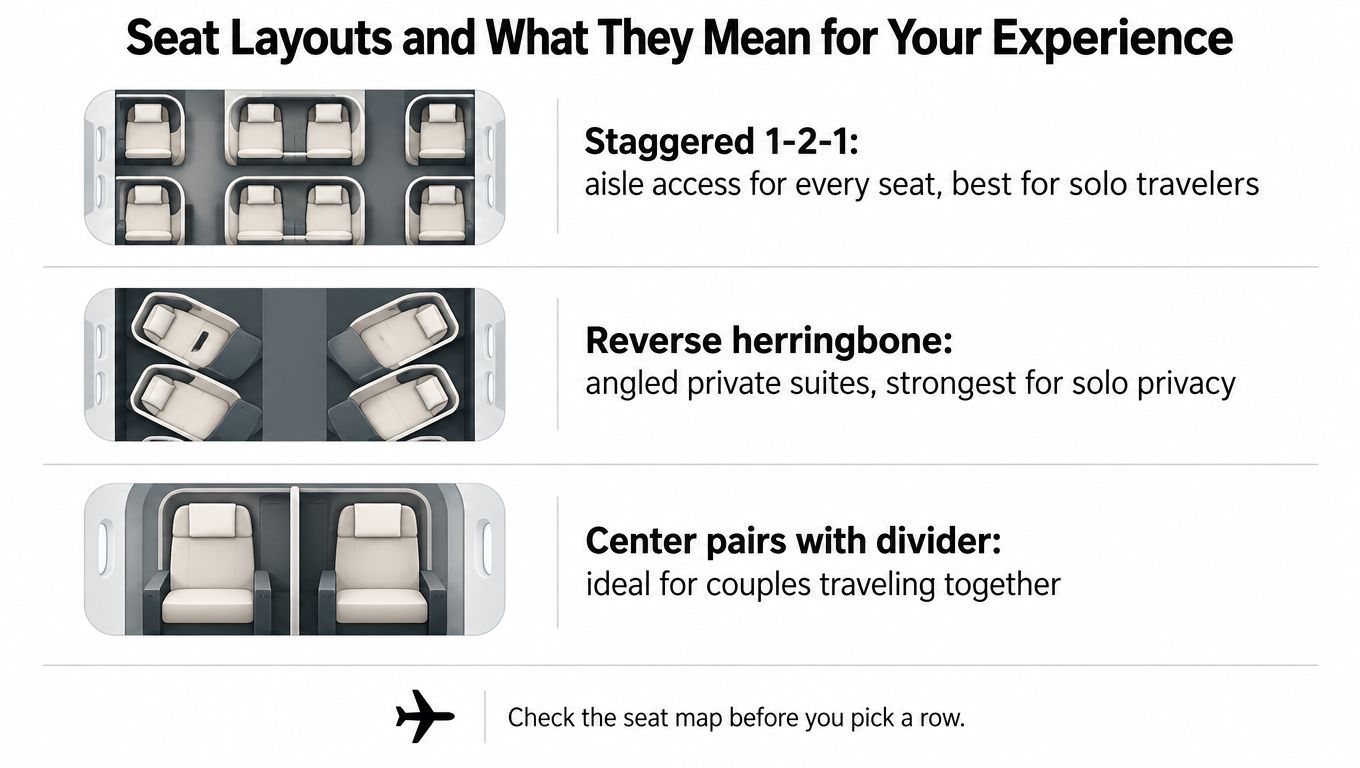
A diagram comparing three different airplane business class seat layouts for passengers to choose their preferred seating.

1-2-1 staggered seating

A staggered 1-2-1 layout gives every passenger direct aisle access. Seats alternate between positions closer to the aisle and positions tucked farther toward the window or sidewall. The farther seat typically offers more privacy, while the closer seat may make it easier to speak with crew or reach the aisle.

For a solo traveler, this is usually the safest layout to select. Couples can still sit together in the center section, but they shouldn't assume that two adjacent seats will feel equally connected. In a staggered pair, one passenger may be closer to the aisle and the other farther away, with a console or divider between them.

Reverse herringbone seating

Reverse herringbone seats angle toward the aisle and often place the passenger's head near the window. That geometry creates a strong private-shell effect, especially for sleeping or working. The compromise is reduced face-to-face interaction, so it suits solo travelers better than couples who want to talk during the flight.

2-2-2 seating

A 2-2-2 arrangement is friendlier for partners who want to sit side by side. It also carries a major nighttime drawback: one passenger may need to step over the other to reach the aisle. Some travelers accept that compromise for companionship, while others find it disruptive on a long overnight sector.

The same airframe can therefore produce very different results. Lufthansa's upgraded A380 cabin moved from 2-2-2 to 1-2-1 and reduced the business-class seat count from 78 to 68, specifically to provide direct aisle access for every passenger.

Traveler type Best starting point What to check
Solo sleeper Staggered 1-2-1 or reverse herringbone Seat farther from the aisle, privacy shield, footwell position
Couple prioritizing conversation Center pair in a 1-2-1 cabin or 2-2-2 Divider height, seat alignment, access to shared space
Couple prioritizing sleep Two seats in the same staggered center pair Confirm that the seats are paired, not merely adjacent
Tall traveler Any lie-flat product with a published bed measurement Footwell width, bed length, and shoulder room
Light sleeper A seat away from galleys, lavatories, and social areas Cabin map, traffic patterns, and rear-cabin location

Window-seat pairing deserves special attention. On staggered cabins, two seats beside each other on the map may not be the best pair in practice. Choose the same center pair when traveling together, and check whether one seat is exposed to the aisle while the other sits behind a console.

Storage also changes by row. Bulkhead seats may offer more open foot space but can have different personal-storage arrangements, while standard rows often provide a more predictable console and footwell. Review the A380 seat map guide before selecting a seat, especially when the flight uses an unfamiliar aircraft configuration.

Onboard Amenities and Service Features by Operator

A premium cabin is a chain of connected experiences. The seat matters most while you're sleeping, but the lounge, boarding process, meal timing, bedding, connectivity, and service rhythm determine how much of the journey feels effortless.

Lufthansa and Qatar Airways illustrate the importance of airline character. Lufthansa's A380 upgrade centers on consistent seat access and a more orderly cabin flow. Qatar Airways lists its A380 business seat at 23 inches wide with 51 to 52 inches of pitch, while its first-class cabin has a listed 90-inch pitch. Qatar's A380 fleet information makes the distinction clear. Business class can be spacious and lie-flat without being identical to first class.

The ground experience

Start with lounge eligibility, because a business-class ticket doesn't guarantee the same lounge at every airport or on every itinerary. Check the operating carrier's access rules, the departure terminal, and whether a connecting airport provides a partner lounge.

Qatar's Doha operation is associated with the Al Mourjan lounge experience, while Lufthansa travelers may encounter different lounge products in Frankfurt depending on ticket class and itinerary. Don't assume that an impressive lounge name automatically applies to every business fare. Confirm access when you book.

Dining and bedding

Meal style varies as much as seat design. Some carriers deliver a carefully timed sequence that keeps the cabin moving; others offer greater flexibility, including meals selected around the passenger's sleep schedule. Qatar is known for an à la carte, dine-on-demand approach on selected premium products, while other operators may use a more structured service flow.

Ask four practical questions before booking:

  • Bed preparation: Does the crew provide a mattress pad, pillow, and separate bedding?
  • Sleep timing: Can you decline the first meal and sleep immediately?
  • Headphones: Are noise-cancelling headphones supplied, and can you keep them during rest?
  • Power access: Is the USB or AC outlet beside the seat, under the console, or near the floor?

Entertainment screens and content libraries can make a long flight feel shorter, but screen size matters less than placement. A screen that sits directly in front of you is easier to use in bed mode than one that requires awkward viewing from an angled position. Wi-Fi packages also vary, so treat connectivity as a bonus to verify rather than a guaranteed feature.

The Emirates business-class overview can help travelers compare the carrier's A380 experience with other premium options. Emirates is particularly associated with an onboard bar and lounge on selected A380 aircraft, while other airlines use the upper deck for a quieter cabin without a social area.

Feature Lufthansa A380 Qatar Airways A380
Seat access Direct aisle access in the upgraded cabin Depends on the installed layout
Published business seat width 22.8 inches in the upgraded cabin 23 inches
Published business pitch 44 inches in the upgraded cabin 51 to 52 inches
Bed information 79-inch lie-flat bed Not specified in the verified source
Dining style Confirm current flight-specific service Flexible dining may be available on applicable products
Lounge access Verify by airport and fare Verify by airport and fare

A380 Business Class Compared with Other Widebodies

The A380's biggest advantage is architectural rather than decorative. Its double-deck structure gives airlines more ways to separate cabins, place premium seats, and create spaces that feel less compressed. A Boeing 777 or 787 can offer an excellent business seat, but the passenger experience usually comes from a single primary cabin level.

That distinction affects the ground-level feel of the journey. The A380's main passenger deck sits lower than the upper deck, which can make boarding feel more connected to the terminal and can reduce the sense of climbing into a tall aircraft. The upper deck, meanwhile, offers the quiet, separated atmosphere that many passengers associate with premium long-haul travel.

Feature Airbus A380 Boeing 777 Boeing 787
Cabin architecture Two passenger decks Single main passenger deck Single main passenger deck
Premium-cabin flexibility Extensive room for separate upper-deck products Strong, but dependent on fuselage and operator Strong, with emphasis on modern cabin design
Social areas Available on selected A380 products Less commonly built into business class Less commonly built into business class
Window experience Large upper-deck and main-deck cabin environment Traditional widebody view Larger windows are a notable design feature
Cabin atmosphere Spacious and often calm Varies widely by airline and seat density Often feels modern and fresh
Best reason to choose it Architecture, cabin scale, and distinctive premium spaces Route availability and strong operator-specific seats Window design and newer-aircraft feel

The 787 has a freshness advantage for some travelers because of its larger windows and higher cabin humidity. The A380 counters with separation and interior volume. Noise is also operator-dependent, but the A380's size and divided cabin can make the aircraft feel calmer, especially when the business cabin sits away from the main economy flow.

The comparison becomes less flattering when an A380 operator installs a dense 2-2-2 business cabin and a 787 operator offers a well-designed 1-2-1 suite. In that contest, the smaller aircraft may provide better sleep. Aircraft size creates possibilities, but seat geometry remains the deciding factor.

Social spaces are where the A380 feels markedly different. An onboard bar or lounge gives passengers a place to stretch, talk, and leave the seat environment for a while. The feature isn't present on every A380 and isn't necessary for good sleep, but it changes the journey from a sequence of meals and movies into something more like a small private terminal in the sky.

When Business Class Actually Costs Less Than Coach

The phrase “business class cheaper than coach” sounds like a pricing error, but it can happen when airlines manage seats dynamically. A flight has separate fare buckets, and the last available economy seat can remain expensive while a discounted business fare opens lower in the premium cabin.

A 2026 explanation of airline pricing describes the mechanism clearly: when lower-cabin demand catches up, the last economy seat can cost more than the first business-class seat in a particular fare combination. The important word is “particular.” This isn't a permanent rule or a guarantee on every route. The explanation of why business class can cost less than economy provides useful context for the pricing logic.

Real examples show how strange the comparison can become. One report cited economy at $575 against business at $471, and another cited economy at $480 against business at $373. The fare examples and explanation of cabin-price inversions show why travelers should compare the final prices rather than assume the cabin hierarchy determines the cost.
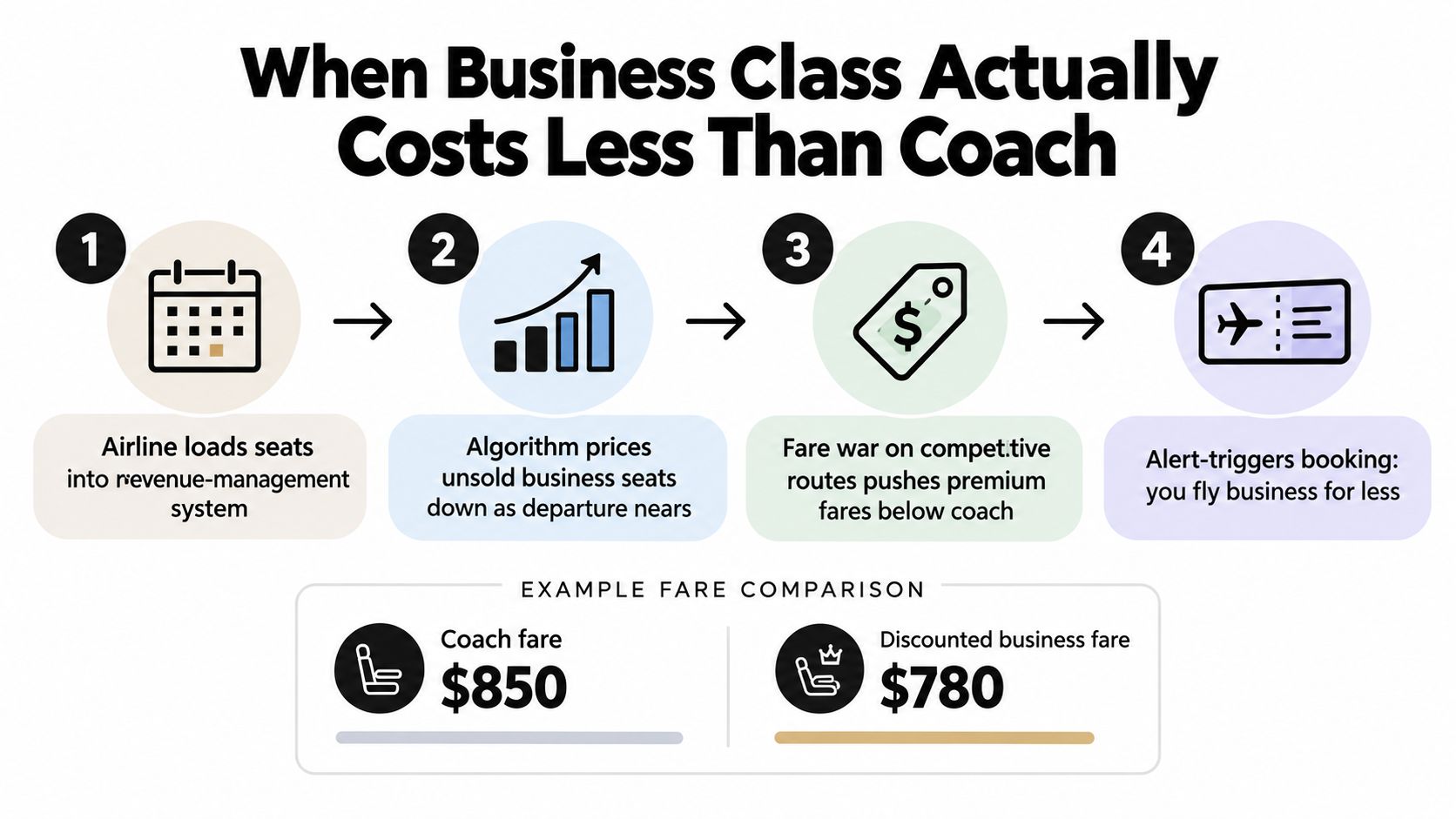
An infographic showing the four steps of how airline business class tickets can sometimes cost less than coach.

Why the A380 creates opportunities

The A380 was designed around exceptional scale, and operators can place a substantial number of premium seats upstairs. If demand for those seats weakens, the airline has a commercial reason to adjust fares rather than allow inventory to fly empty.

Travelers shouldn't treat every lower price as a bargain. Check the fare rules, cancellation conditions, baggage allowance, seat selection cost, lounge eligibility, and whether the ticket is a true business-class fare or a restricted premium tier. A low headline price can lose its value if the conditions are unusually restrictive.

A 2026 guide to cheap business-class tickets says mistake fares can push international business fares as low as $300, and that such prices can match or undercut typical economy fares. The guide to finding cheap business-class tickets also reinforces the need for speed, because mistake fares and competitive discounts can disappear quickly.

The best mental model is not “business is cheap.” It's “airline inventory can become irrational for a short period.” Search both cabins, compare the complete fare conditions, and be ready to book when the premium price drops below the coach alternative.

Practical Tips for Booking A380 Business Class

Booking the aircraft is only the first step. You also need to confirm that the aircraft, cabin generation, and seat map match the experience you want. Airlines can change equipment, and a familiar route can operate with more than one A380 interior.

Begin with flexible dates. Midweek departures can produce different inventory from weekend flights, while a flexible-date calendar exposes price gaps that a fixed search hides. Fare alerts are useful because most travelers won't manually check every possible departure.
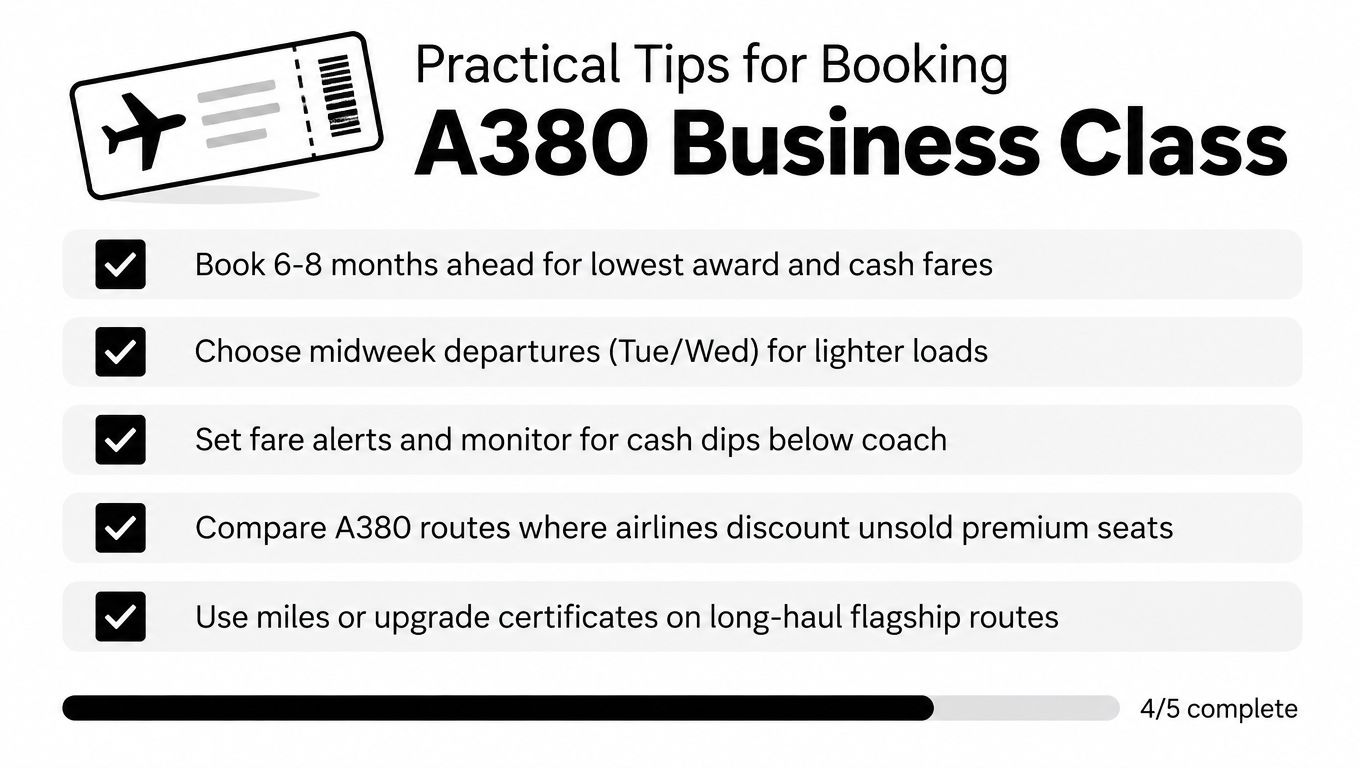
A checklist infographic providing five practical tips for booking affordable Airbus A380 business class flight tickets.

A disciplined booking process

  1. Confirm the aircraft: Check the booking page for the A380 designation, then verify it again before departure because equipment can change.
  2. Open the seat map: Look for 1-2-1, 2-2-2, staggered rows, and proximity to galleys or lavatories.
  3. Compare both cabins: Search economy and business on the same flight. Business class can occasionally undercut coach, especially when premium inventory is discounted.
  4. Check the full fare: Review changes, refunds, baggage, seat selection, lounge access, and upgrade restrictions.
  5. Recheck after booking: Monitor schedule changes and seat-map updates so you can react if the airline swaps aircraft or changes the cabin.

Award travelers should also compare transferable points and upgrade instruments, but don't move points until the desired seat is available and the program's cancellation rules are clear. A points booking can be excellent value, yet taxes, surcharges, and poor availability can change the calculation.

For timing and search habits, Easy Travel Bookings air hacks advice offers another perspective on choosing booking dates and monitoring fare movement. Use any booking advice as a starting point, then test it against the route, airline, and actual inventory available for your trip.

A final check prevents most avoidable mistakes: verify the aircraft type, inspect the seat-map width and layout, confirm lounge rights, and read recent reviews that identify the exact aircraft and cabin generation. Don't rely on a review of one airline's A380 if your booking uses another operator's configuration.


Passport Premiere helps travelers monitor international business and first-class fares, compare premium-cabin pricing, and identify moments when an A380 business fare may be lower than coach. Visit Passport Premiere to review its fare-monitoring service and learn how to evaluate premium tickets before you purchase.

8 Best Seats in Business Class for Every Traveler

The most expensive-looking business-class seat isn't automatically the best seat. A private suite may be poor for a light sleeper if it sits beside a galley, while a less celebrated bulkhead seat may give a tall traveler the space needed to sleep. Couples, solo travelers, people working in the air, and passengers racing to a connection all need different things from the same cabin.

Start by identifying the exact aircraft and cabin configuration. Business-class layouts vary even within one aircraft family, and seat maps can change row numbers, aisle access, privacy, and proximity to lavatories or galleys. Tools such as AeroLOPA's flight-specific seat maps are useful because they focus on the aircraft version rather than applying a universal rule to every route.

The list below ranks opportunities by aircraft position, cabin design, traveler profile, comfort, noise, privacy, and total fare value. It also distinguishes a strong seat from a cheap way to reach a premium cabin. Passport Premiere fits into the fare side of that decision through fare monitoring and market analysis, including situations where business class can be cheaper than coach. No seat is always best, so check the row, the aircraft, the fare conditions, and the complete routing before paying.

1. Bulkhead Business-Class Seats for Space Without the Usual Premium

A bulkhead business-class seat can be the better choice for a tall traveler, yet the same row may be a poor place to sleep. With no passenger seat directly ahead, it often provides a more open footwell and easier access to personal items. Its position can also place you beside a galley, lavatory, cabin curtain, or bassinet location, where light and movement may continue throughout the flight.

The aircraft layout determines whether the extra space is useful. On some configurations, the divider creates room to stretch. On others, the fixed wall removes under-seat storage during takeoff and landing, while the tray table or entertainment screen sits inside the armrest. Recline and bed length can vary as well. Check the aircraft-specific seat map and product details before choosing the row. Passport Premiere's Dreamliner seat-map guide offers another way to inspect a Dreamliner configuration before comparing options.

Who should choose it

Bulkhead seats generally fit tall travelers, daytime workers, and passengers who value an open footwell. They are less suitable for travelers whose priority is quiet or strong separation from cabin activity. A front bulkhead may receive more light and foot traffic, while a rear bulkhead can sit close to another cabin, a galley, or a lavatory.

Practical rule: Choose a bulkhead for usable space, not automatically for silence.

Seat position and fare price are separate decisions. A bulkhead row does not reliably carry a discount, and a standard business-class seat may cost the same or less on a particular booking. The stronger comparison is the complete business-class fare against coach, including the aircraft, schedule, baggage terms, and connection pattern.

Business-class inventory can become unusually inexpensive when airlines have surplus premium seats or face stronger fare competition. Passport Premiere's fare-sale analysis remains relevant for monitoring those opportunities, but the final price still depends on route, dates, availability, and booking conditions. A less popular bulkhead may therefore offer good total value, while an alternate flight or routing could make the premium cabin cheaper than coach. Verify both the seat and the full itinerary before paying.

2. Off-Peak Business-Class Fares for Travelers Who Can Move Their Dates

A less popular departure can produce the better business-class seat and a lower total fare. Airlines may reduce premium-cabin prices when demand is weaker, especially on competitive long-haul routes. Flexible dates therefore affect both the fare and the aircraft product available for the trip.

Search by departure day, travel season, and alternate dates, then inspect the aircraft for every promising result. The cheapest option may use an older angled-recline seat, while a nearby departure may provide a fully flat bed and direct aisle access. A lower price has limited value if the seat fails the purpose of buying business class.

A comparison chart highlighting the benefits and considerations of bulkhead versus standard business class airline seats.

Match the fare window to the seat

For overnight travel, prioritize a fully flat bed and, where possible, a layout with direct aisle access. Daytime travelers may accept a comfortable recliner when the schedule or fare is substantially better. The business-class label alone does not identify the seat's privacy, sleeping position, or access to the aisle.

Fare strategy also changes the comparison with economy. Excess premium inventory and strong competition can occasionally place business-class fares below a last-minute, full-fare economy ticket. That outcome is unusual, so monitor it without accepting an unsuitable aircraft, schedule, or connection merely because the cabin appears inexpensive.

  • Search flexible dates: Test nearby departures instead of fixing one calendar day.
  • Inspect the aircraft: Confirm the bed type, aisle access, and cabin layout.
  • Compare the whole fare: Review baggage, change rules, connection time, and seat-selection conditions.
  • Monitor multiple carriers: A competing airline may offer the stronger seat at the lower total price.

Passport Premiere's guide to when airlines drop prices can inform that monitoring process. Treat the guidance as general market context, then verify the live fare, operating aircraft, seat map, and itinerary rules before booking. A less popular flight or alternate routing may make business class cheaper than coach, but only the complete trip cost shows whether it is better value.

3. Redemption Seats When Cash Prices Stop Making Sense

Award seats make sense when the cash fare is too high to justify. A traveler who needs an overnight bed can compare the points requirement with the cash alternative, then decide whether the redemption delivers enough value for that itinerary. The calculation should include the seat, schedule, and booking conditions, not the cabin label alone.

Aircraft position still determines comfort. A points booking in an older 2-2-2 cabin may force a window passenger to climb over a neighbor. Reverse-herringbone and staggered layouts generally provide a stronger mix of privacy, a fully flat bed, and direct aisle access. Check the seat map before transferring points, because award availability does not guarantee a desirable seat.

Protect flexibility before transferring points

Cash and award prices can move independently, creating useful comparisons without guaranteeing a bargain. Award programs vary, but common restrictions include taxes, change fees, limited availability, and the risk that points lose value through expiration or devaluation.

Use this sequence before committing:

  1. Find the aircraft first: Confirm the operating carrier, aircraft version, and business-class layout.
  2. Check the seat map: Look for direct aisle access, privacy, and distance from galleys or lavatories.
  3. Compare the cash fare: If the cash price is reasonable, preserve points for a costlier itinerary.
  4. Review the rules: Confirm cancellation, change, transfer, and partner-booking conditions.
  5. Transfer last: Move points only after the award seat and booking terms are available.

Passport Premiere's MileagePlus upgrade-award information can support research into United-related options. It does not promise award inventory. The stronger redemption combines an acceptable schedule, a suitable aircraft, a seat position that fits the traveler, and booking conditions that leave room to adjust. An unpopular departure or alternate routing may also make the points choice more attractive, but only the complete itinerary shows whether the trade-off works.

4. Domestic Business-Class Upgrades for a Shorter Path to Premium Comfort

Domestic upgrades can be appealing because they let travelers buy an economy ticket first and pursue a premium seat later. That approach works best when the route uses a lie-flat business-class product, not just a wider recliner marketed under a premium cabin name.

The aircraft is decisive. A domestic wide-body route may offer a bed, while another flight in the same airline's network may provide a conventional recliner. The route length alone doesn't tell you what you'll receive. Check the seat map, aircraft type, and upgrade inventory before assuming the cabin will deliver international-style sleep.

Select the upgrade for the actual mission

For a daytime meeting trip, an aisle seat with a workspace and quick access to the exit may matter more than a window seat. For an overnight domestic flight, prioritize a lie-flat row away from galleys and lavatories. If you're traveling with a colleague or partner, inspect the center pair rather than assuming two window seats provide the best interaction.

The upgrade strategy also has a risk. You may pay for an eligible economy fare and still fail to clear the upgrade, leaving you in the original cabin. That makes the fare rules and refund conditions important. Don't value the upgrade as confirmed until the airline confirms the premium seat.

The cheapest route to a business-class seat isn't useful if the aircraft doesn't offer the bed or privacy you need.

Passport Premiere can help identify routes where premium inventory and fare conditions deserve closer attention, but it can't remove airline upgrade uncertainty. Compare the cost of the eligible economy fare, upgrade instrument, points, and confirmed business-class alternative. Sometimes the direct purchase is the better value because it eliminates the risk of traveling without the seat you planned around.

5. Error Fares and Flash Sales for Fast, Careful Buyers

An error fare or flash sale can make business class cheaper than coach, but it isn't a dependable seat-selection strategy. The opportunity may disappear quickly, and the airline or booking channel may correct a displayed price. The correct response is speed paired with verification, not an assumption that every unusually low fare is valid.

Start with the basics. Confirm that the itinerary shows the intended cabin on every segment, the correct dates, the operating carrier, and a valid ticketing confirmation. A mixed itinerary can appear premium in search results while placing a short connecting segment in economy. That may be perfectly acceptable, but you should know before booking.

Treat the fare and seat as separate checks

The cheapest premium fare may be attached to an older seat layout. If the flight is overnight, inspect whether the bed is fully flat and whether the seat offers direct aisle access. A flash sale is only a good result when the cabin matches the purpose of the journey.

Use a fast review process:

  • Verify the cabin segment by segment: Check the booking details, not only the search display.
  • Inspect the aircraft: Confirm the seat architecture and likely row locations.
  • Review ticketing status: A reservation without a properly issued ticket may not be secure.
  • Check the rules: Understand cancellation, schedule-change, and refund terms.
  • Avoid nonrefundable commitments too early: Wait until the itinerary and ticket status are clear when possible.

A hand holding a smartphone showing a flight fare alert notification with a boarding pass and laptop nearby.

Passport Premiere's fare-monitoring model is relevant to travelers who want signals about distressed premium inventory and sudden fare movement. It doesn't make an error fare permanent, and no service can guarantee that an airline will honor a pricing mistake. Book only when the schedule, terms, and confirmation status make sense.

6. Alliance and Partner Pricing for Travelers Willing to Compare the Network

The airline selling the ticket may not operate the strongest business-class product. Star Alliance, oneworld, and SkyTeam partners often publish different fares because each carrier competes in different markets. A lower fare can therefore expose better value, provided the operating aircraft, connection, and ticket conditions still fit the trip.

Start with the operating carrier, not the logo on the booking page. A marketing carrier may describe the itinerary broadly while a partner operates an older cabin, a different seat layout, or a less convenient connection. Open the aircraft details and seat map for every long-haul segment before comparing fares.

A partner itinerary works well when three conditions align:

  • The operating carrier has the right seat: A fully flat bed, direct aisle access, or a private window position may matter more than the airline name.
  • The connection suits the traveler: A large hub can add terminal changes, transfer time, or more exposure to disruption.
  • The fare rules remain usable: Review changes, cancellations, missed-connection protection, and any restrictions before treating the lower price as a saving.

Seat choice still depends on the traveler. A solo passenger may value a window with privacy and direct aisle access. Two passengers may prefer a center pair when the layout keeps them together. An aisle seat can suit a traveler who works, moves frequently, or dislikes climbing over a neighbor, even when the window offers better privacy.

Compare the total trip, not the headline fare: aircraft, seat, connection, change rules, and loyalty value.

Earning and redemption rules can change the calculation again. A cheaper partner ticket may earn less toward a preferred loyalty plan, while a slightly higher fare may provide more useful credit. Check the booking class and program treatment before assuming the cheaper option wins.

Passport Premiere's market analysis can help identify partner-fare differences, but the final decision should follow the exact flight, aircraft, seat map, and fare conditions displayed during booking.

7. Contract Fares and Agency Deals for Frequent Corporate Travelers

A negotiated corporate fare can change the seat decision, not merely reduce the price. Companies with recurring international travel may arrange terms through an airline, travel management company, or specialist agency. The agreement may cover fare flexibility, preferred inventory, change treatment, and reporting. Its value depends on those conditions together, rather than on the headline fare alone.

Seat quality still needs a separate standard. One contract may apply to several business-class products, from a newer suite to an older angled-recline seat. A travel manager should therefore specify preferred aircraft, acceptable connections, and the routes where a weaker product is unacceptable.

Set the seat standard before negotiating

A practical policy can define four levels:

  • Required features: A fully flat bed on qualifying long-haul overnight flights.
  • Preferred features: Direct aisle access, privacy doors, and a quieter cabin position.
  • Acceptable alternatives: A recliner on shorter daytime sectors or routes without a bed product.
  • Seat exclusions: Rows beside galleys or lavatories, plus seats with restricted recline.

This approach links the fare discussion to the actual travel experience. It also gives an advisor clearer instructions when partner offers appear similar but use different aircraft or cabin layouts.

Compare the negotiated fare with the seat, schedule, flexibility, and total employee travel cost.

Passport Premiere's fare intelligence can help a company compare an opportunity with current market conditions before discussing rates with an airline or agency. It does not establish that a particular organization has access to a confidential discount. Contract terms vary by company, route, volume, carrier, and negotiation.

Smaller businesses can apply the same discipline without a formal contract. Record the aircraft, fare classes, routes, and booking channels that repeatedly produce acceptable seats. Then compare the negotiated result with public business-class fares and the cost of sending an employee in coach.

The result may favor business class in an unusual situation. Premium inventory can be available while economy fares rise sharply close to departure, making the contracted business fare cheaper than coach. That outcome requires checking the exact fare rules and seat assignment, not assuming that every corporate deal delivers the same value.

8. Positioning Flights and Multi-Carrier Routes for Total Trip Value

A cheaper business-class itinerary may begin with an economy flight. A traveler could position to another city, then take a more competitive long-haul fare, or combine carriers across the trip. The lower ticket price matters only after adding travel time, baggage charges, ground transport, meals, hotels, and the risk of managing separate tickets.

The strongest case usually appears when business class covers the segment that changes the trip most, such as an overnight intercontinental flight with a fully flat bed. Paying for premium service on a short positioning leg may add little comfort. Using economy there can preserve the budget for the longer sector and improve the total fare strategy.

Start with the segment that delivers the real recovery benefit, then test whether the positioning cost and connection risk preserve the saving.

Check the connection before booking the lower fare

A separate-ticket itinerary can leave the traveler responsible for a missed onward flight. If a delay causes the second carrier to mark the booking as a no-show, buying a replacement ticket may erase the original saving. A protected through-ticket can cost more, while offering stronger assistance during disruption.

Assess the proposed route in this order:

  • Premium starting point: Identify where the bed, privacy, and meaningful rest begin.
  • Connection security: Allow time for delays, terminal changes, baggage collection, and immigration.
  • Disruption rules: Read each carrier's separate-ticket, missed-connection, and rebooking conditions.
  • Complete cost: Include fares, bags, transport, meals, hotels, and the value of additional travel time.

One short sentence can define the decision: a cheap route is poor value if it turns a manageable journey into an exhausting chain of connections.

A well-timed positioning flight can still make a premium itinerary affordable when the direct option is outside budget. Compare the alternate departure city, aircraft, seat layout, connection protection, and fare restrictions before paying. Passport Premiere's premium fare-monitoring and market-analysis service can help travelers review alternate departure points and multi-carrier opportunities, but the booking choice should rest on the exact itinerary and its total cost.

8-Point Comparison of Business-Class Seat Strategies

Strategy 🔄 Implementation complexity ⚡ Resource requirements 📊 Expected outcomes 💡 Ideal use cases ⭐ Key advantages
Bulkhead Business-Class Seats: Extra Legroom at Coach Prices Low, simple booking and seat verification Low, cash fare monitoring, fare alerts Moderate, sizable legroom; fares often 30–40% below standard J Tall or mobility-impaired travelers; shoulder-season travel Spacious forward legroom, full biz service at reduced price
Off-Peak Business-Class Fares: Timing Volatility for Maximum Savings Medium, requires demand-cycle tracking Medium, time, monitoring tools, planning 2–6 months ahead High, documented 50–70% savings when timed correctly Flexible schedules; corporate planning for non-peak trips Deep, repeatable discounts across routes and carriers
Redemption Business-Class Seats: Converting Points When Cash Fares Spike High, award availability strategy and timing High, large point balances; account management Very high, 70–85% value vs. peak cash fares (points arbitrage) Travelers with sizable mileage balances during peak cash periods Converts inflated cash fares to excellent value via awards
Domestic Business-Class Upgrades: Premium Cabin Access at Minimum Cost Low, bid/upgrade submission workflows Low, modest cash or points; elite status helps Moderate, premium experience for $200–600 vs. $1,200+ Domestic business travelers aiming for lie-flat or recliner perks Low-cost entry to premium cabin; accelerates elite status
Error Fares and Flash Sales: Capturing Mispriced Business-Class Inventory High, extremely time-sensitive execution High, instant booking readiness, membership alerts Variable, occasional 40–80%+ discounts; unpredictable Highly flexible travelers ready to book immediately Potential for unprecedented, near-economy pricing on biz seats
Airline Partnerships & Alliance-Carrier Arbitrage: Hidden Business-Class Discounts Medium, requires alliance-routing knowledge Medium, research time; fare-comparison tools High, consistent 30–50% savings on same routing International routes with multiple alliance options Identical service via cheaper partner fares; maintains FF benefits
Corporate Contract Fares & Agency Negotiation: Unlocking Hidden Discounts High, contract setup and ongoing management High, substantial corporate volume; TMC expertise Stable, predictable 20–40% savings under contract Large employers and TMC-managed corporate programs Reliable discounts, custom terms, predictable budgeting
Positioning Flights & Multi-Carrier Routings: Lower Total Premium-Cabin Cost Medium, itinerary planning and connection risk management Medium, extra segments, time, possible hotel stays High, total trip savings 30–50% at cost of longer travel time Travelers prioritizing price over nonstop convenience Significant overall cost reduction while retaining long-haul biz segments

Turn Seat Knowledge Into a Better Booking

The best seats in business class depend on the traveler's main constraint. A tall passenger may rationally choose a bulkhead for the open footwell, even if the row sits closer to a service area. A sleeper should prioritize a quiet, fully flat position away from galleys and lavatories. A worker may prefer an aisle with easy access and fewer interruptions from climbing over a neighbor. A couple should look for paired center seats when the cabin layout permits conversation without giving up too much privacy.

The cabin's architecture should come before the row number. Business class moved toward fully flat beds around 2000, after British Airways introduced a lie-flat business-class seat in Club World on its London Heathrow to New York JFK service in March 2000, as described in Business Traveller's business-class seat guide. That shift changed the question from “Is this business class?” to “What kind of business-class seat is this?”

There still isn't one global design. Industry guidance identifies at least 14 distinct business-class seat types, and five principal categories still don't go fully flat, according to Runway Girl Network's seat overview. Leading long-haul products increasingly use fully flat beds around 78 to 80 inches, direct aisle access in a 1-2-1 layout, and privacy doors or high sidewalls, based on BlackJet's business-class benchmarking. Those features are useful benchmarks, but they don't eliminate aircraft-specific differences.

Before payment, confirm the aircraft and open the live seat map. Check for rows beside galleys, lavatories, cabin curtains, bassinet positions, and restricted-recline seats. A forward bulkhead can improve space or deplaning speed, while a rear row may be quieter in one cabin and noisier in another. Odd-row window seats can be more private on some layouts, while center pairs suit couples, as discussed in SeatCompare's American Airlines 777-200 guide.

Finally, compare the complete fare, not just the seat label. Look at off-peak dates, alliance partners, upgrade risk, award availability, flash sales, contract options, and positioning routes. Passenger-satisfaction data from a 2023 to 2024 survey placed Singapore Airlines at 89/100, Qatar Airways at 87/100, and Emirates at 85/100, while Singapore's business-class seat was described as 26 inches wide with a 78-inch bed and full doors in Quantumrun's long-flight airline comparison. Those figures illustrate why measurable space and privacy matter, but they don't make every Singapore seat the right choice for every itinerary.

Even small practical details can affect the trip. If you're packing personal-care items for the cabin, review the guidance on whether you can bring toothpaste on a plane before departure. Then make the final selection based on your purpose, the exact aircraft, seat availability, schedule, and booking terms. Passport Premiere's fare monitoring and market analysis can help identify premium-cabin opportunities, including occasions when business class is cheaper than coach, but the strongest booking is the one that combines a suitable seat with a workable total journey.


Passport Premiere offers fare monitoring and market analysis for travelers comparing international Business and First Class opportunities, including distressed premium inventory and alternate fare patterns. Visit Passport Premiere to review how its membership service can help you compare premium-cabin timing, routes, and booking opportunities before your next trip.

Airline Seat Pitch Definition: Maximize Your Travel Comfort

Most travelers treat seat pitch as a comfort detail. Airlines treat it as a revenue lever.

That difference matters because it explains two things at once. First, why economy has become tighter over time. Second, why premium cabins are often mispriced relative to the actual product you get. In 1958, the Boeing 707 offered 34 inches of seat pitch, while today standard economy is usually 30 to 31 inches and low-cost carriers push to 28 inches. At the other end of the cabin, First Class can offer 60 inches or more, yet fewer than 15% of premium seats are sold at their initial asking price, which creates openings for travelers who understand what those seats are really worth (historical seat pitch trends and premium pricing context).

That’s why the airline seat pitch definition matters far beyond leg comfort. It tells you how an airline is balancing cabin density, yield, and perceived value. Once you understand that, you stop shopping for a fare label and start shopping for space.

Your Key to Finding Business Class Fares Cheaper Than Coach

The strange part of premium airfare is that the published price often has little to do with the seat’s eventual selling price.

Airlines know the product has high perceived value. More space, better rest, fewer physical trade-offs, and a much better arrival condition all justify a premium. But premium cabins also have a structural problem. Empty seats in the front of the plane are expensive inventory. If they don’t sell early at a high price, airlines often have to adjust later without openly signaling weakness.

That’s where seat pitch becomes useful as an analytical tool rather than a comfort stat. A seat with far more personal space than standard economy isn’t just “nicer.” It’s a different travel product. When you compare the physical product to the market price, you can spot situations where a premium fare has dropped into value territory.

Smart buyers don’t ask only, “What does this ticket cost?” They ask, “What amount of space and function am I buying for that cost?”

In practice, this is how business class can sometimes become cheaper than a rigid coach fare. Not cheaper than every coach seat on the plane. Cheaper than the wrong coach fare, especially on long-haul itineraries where a late-stage premium adjustment creates a mismatch between cabin value and posted price.

Seat pitch is the cleanest signal because airlines can rebrand meals, boarding, and amenity kits. They can’t hide the physical footprint of the seat. If you know what space the cabin offers, you can judge whether the fare reflects transport, rest, or genuine working room.

The Official Airline Seat Pitch Definition

Seat pitch is the distance between a fixed point on one seat and the same point on the seat in front of it. It is not the empty gap for your legs. It is the full row-to-row measurement that the airline allocates inside the cabin.

A simple way to think about the airline seat pitch definition is a parking space. The marked space is the total footprint. Your usable room depends on what’s already occupying that footprint. In an aircraft, seatback thickness, tray table hardware, and seat design all consume part of the pitch.

An infographic explaining airline seat pitch, showing the distance between seats and clarifying it differs from legroom.

What airlines are actually measuring

The measurement is point-to-point, not knee-to-seat. That’s why two cabins with similar published numbers can feel different in real use.

For a practical walk-through of how carriers and travelers use this measurement, Passport Premiere’s seat pitch guide is a useful reference.

The reason airlines care so much about pitch is simple. It determines how many rows fit in the cabin. According to this explanation of seat pitch and density trade-offs, reducing pitch from 32 inches to 28 inches can increase seating density by 10% to 15%, while also increasing deep vein thrombosis risk on flights over 4 hours because knee flexion becomes more restricted.

Why the definition matters when you book

If you confuse pitch with legroom, you’ll misread the product you’re buying. You’ll assume one extra inch always means more comfort. Sometimes it doesn’t.

What matters is the combination of:

  • Published pitch that shows total row allocation
  • Seatback design that determines how much of that allocation you feel
  • Cabin class purpose because a business seat is built to use extra pitch for recline, access, and rest, not just knee clearance

Practical rule: Pitch tells you how much territory the airline assigned to your row. Legroom tells you how much of that territory you can actually use.

Seat Pitch vs Legroom and Other Comfort Metrics

The easiest mistake in flight shopping is treating every space number as interchangeable. They aren’t.

Seat pitch is the bookshelf width. Legroom is the open space left once the books and supports are already in place. A cabin can post a respectable pitch number and still feel cramped if the seat structure is bulky.

Passengers wearing green shorts and socks sitting in airplane seats, highlighting legroom and space.

Why identical pitch can feel different

Many travelers are adversely affected, as Executive Traveller’s explanation of legroom and seat pitch notes that global economy pitch averages 31 inches, but fixed seatback depths of 8 to 12 inches can reduce effective knee space to 16 to 20 inches, which amounts to a 25% to 40% reduction in perceived legroom.

So a carrier with slimline seats may feel better at the same nominal pitch than a carrier using older, thicker seatbacks. The published number is still useful, but only when you interpret it correctly.

Other comfort metrics that matter

A smart comparison uses several inputs at once:

  • Legroom or knee clearance matters most for tall travelers and anyone carrying tension in hips or knees.
  • Seat width controls shoulder space and whether you feel boxed in by armrests.
  • Recline changes the experience behind you as much as for you. In tight economy rows, recline often shifts discomfort to the next passenger.
  • Cabin layout matters because bulkheads, exit rows, and staggered premium seats can change the lived experience more than the marketing name of the fare.

A 31-inch economy seat and a 31-inch economy seat are not necessarily the same product.

That’s one reason premium upgrades keep attracting buyers. The extra value isn’t only more inches on paper. It’s the fact that additional pitch gives designers room to create a seat that functions properly.

Typical Seat Pitch Ranges by Cabin Class

Cabin class pricing starts to make more sense when you see it as a ladder of physical space.

Going’s overview of seat pitch benchmarks places standard economy at 30 to 31 inches on major carriers, with low-cost carriers at 28 to 29 inches. Premium economy runs about 36 to 40 inches, while business class starts around 38 inches and often reaches 60+ inches in lie-flat setups.

Airline Seat Pitch by Cabin Class

Cabin Class Low Range High Range Typical Experience
Economy on low-cost carriers 28 inches 29 inches Tight seating, transport-focused, minimal personal space
Economy on major carriers 30 inches 31 inches Standard short-to-medium haul experience
Premium economy 36 inches 40 inches Noticeably more room, better for longer flights
Business class 38 inches 60+ inches Recline, workspace, and in many cases lie-flat comfort

How to read the ranges as a buyer

The useful question isn’t which number is highest. It’s whether the price jump matches the product jump.

A move from dense economy into premium economy can be meaningful. A move from premium economy into a discounted business seat can be even more meaningful because the physical product changes more dramatically. That’s where value mismatches show up most often.

If you’re comparing carriers for long-haul premium travel, this business class airline comparison helps frame what different cabins deliver beyond the fare name.

Why Pitch is the Master Metric for Comfort and Value

On a long-haul flight, seat pitch isn’t a vanity metric. It shapes circulation, movement, sleep quality, laptop usability, and how functional you are after landing.

That matters for corporate travelers because the cheapest ticket isn’t always the lowest-cost trip. If a traveler arrives stiff, underslept, and unable to work, the fare saved in booking can be lost in performance the next day.

A passenger sitting in an airplane seat working on a laptop, emphasizing airline seat pitch and comfort.

The health and productivity case

According to Wikipedia’s airline seat overview, deep vein thrombosis risk rises by 20% to 30% on flights over 4 hours when seat pitch is under 31 inches. The same source links the greater space in premium cabins at 38 to 60+ inches with 10% higher productivity and 40% fewer sick days for frequent corporate flyers.

Those numbers line up with what experienced travelers already know from repeated long-haul flying. Cramped seating isn’t just uncomfortable. It limits movement, makes sustained work harder, and turns rest into a struggle.

Why airlines protect premium space

Airlines compress economy because each inch has revenue implications. But they preserve premium pitch because they need a visible, defensible reason for travelers to pay more. In other words, they monetize scarcity in the back and recovery in the front.

That creates a useful distortion. Premium cabins carry more intrinsic value than their eventual selling price on some departures. When premium demand is soft, airlines may cut fares to fill seats that would otherwise depart empty. The seat itself hasn’t changed. Only the market price has.

What works and what doesn’t

The practical trade-offs are straightforward:

  • What works for short flights is often fine in standard economy if arrival condition doesn’t matter much.
  • What fails on long-haul is pretending that a restrictive seat is “good enough” for overnight work or recovery.
  • What creates value is catching a premium fare after the airline lowers price but before the cabin fills.

If a seat gives you room to sleep, move, and work, that seat has operational value. The fare only becomes a deal when the market temporarily prices it below that value.

How to Find and Verify Seat Pitch Before You Book

Most booking mistakes happen before payment, not after. Travelers rely on fare class names, assume “extra legroom” means a lot, and never verify the actual aircraft configuration.

The fix is simple. Check the exact plane and the exact seat map before you commit.

A person holds a tablet displaying a seat selection interface for a Delta flight booking application.

A practical verification workflow

Use a repeatable process instead of guessing.

  1. Start with the operating airline
    Codeshares create confusion. What matters is who is flying the aircraft.

  2. Confirm the aircraft type
    A Boeing 777-300ER and an Airbus A330 can support very different seat products, even within the same cabin label.

  3. Check third-party seat maps
    Tools like SeatGuru, SeatMaps, and aeroLOPA can help you inspect layout, row position, and seat notes before booking.

  4. Look for exceptions, not averages
    Exit rows, bulkheads, misaligned windows, bassinets, and galley-adjacent seats can all change the experience.

  5. Verify the cabin’s purpose
    In premium cabins, you’re checking whether the extra space supports real rest and work, or whether the seat is just a slightly larger recliner.

A short visual explainer can help if you want to see how seat selection tools fit into the booking process:

What experienced buyers look for

Published pitch is only the start. Experienced travelers also check whether:

  • The seat shell protects your space in recline
  • The footwell looks usable for sleeping
  • Aisle access is direct or blocked
  • The row sits near noise sources like lavatories or galleys

This is also where fare monitoring can complement seat research. Some travelers use airline sites for schedules, seat-map tools for verification, and services such as Passport Premiere for tracking premium cabin fare changes on international routes.

The Passport Premiere Method for Assessing Seat Value

The core idea is simple. Airlines publish a fare. Travelers decide whether that fare matches the product. Typically, travelers stop there. Better buyers go one step further and ask whether the fare is likely to move.

That matters because premium seats often begin overpriced relative to what the market will finally bear. As noted earlier, fewer than 15% of premium seats sell at their initial asking price. For anyone trying to book real working space or lie-flat rest, that means the first price is often just an opening position, not the true market value.

How the method works in practice

The decision process looks more like market analysis than leisure shopping:

  • Establish the physical product by identifying the cabin’s real seat pitch and layout.
  • Judge intrinsic value by asking what that extra space is worth on the specific route and trip purpose.
  • Track fare behavior rather than buying on first sight.
  • Act when price disconnects from product, especially when premium drops toward or below inflexible coach pricing.

For travelers who want to understand the pricing logic behind those movements, this explanation of airline dynamic pricing gives useful context.

The practical takeaway is that a premium seat doesn’t become a smart buy because it’s labeled business class. It becomes a smart buy when the market temporarily prices a materially better seat like distressed inventory.


Passport Premiere helps travelers monitor international premium-cabin fare cycles so they can assess when a Business or First Class seat is priced below its likely market value. If you want a more disciplined way to buy space, rest, and productivity instead of overpaying published fares, explore Passport Premiere.

Top 7: Which Airlines Have The Best Business Class 2026?

Choosing the right airline for a premium experience can feel overwhelming, with carriers constantly updating seats and services. This guide cuts through the marketing noise to deliver a clear, actionable ranking of which airlines have the best business class right now. We move beyond generic praise to give you the specific details needed to make an informed decision, whether you're a corporate travel manager, a frequent flyer, or planning a special trip.

You'll get a detailed look at the top-tier products, from Qatar Airways' groundbreaking Qsuite to Japan Airlines' new A350-1000 suites. Each profile is structured for quick comparison, covering the essential elements: the seat product itself, service standards, bedding and amenities, and lounge access. We'll also provide practical booking tips, including how to find the best routes for each carrier’s premier product.

More importantly, this article addresses a critical pain point for savvy travelers: cost. We provide specific strategies for securing these premium seats, sometimes for less than the price of an economy ticket.

You will learn data-driven timing strategies and fare-watching techniques designed to help you book business class for less than you might think. In some cases, you can find business class cheaper than coach, especially when compared to last-minute economy tickets.

This resource is your direct path to understanding the real-world differences between leading airlines. Forget wading through endless reviews. Here, you'll find everything you need-including screenshots, pros and cons, and direct links-to confidently select and book the best business class experience for your next long-haul journey.

1. Qatar Airways — Qsuite

Often hailed as a first-class experience at a business-class price point, Qatar Airways’ Qsuite has fundamentally changed the conversation around premium cabin travel. It’s not just a seat; it’s a private room in the sky, complete with a sliding door for maximum privacy. This feature alone places it at the top of many lists asking which airlines have the best business class, but the innovation doesn’t stop there. Qsuite’s design is a standout, catering to solo travelers, couples, and even groups.

Qatar Airways — Qsuite

The unique quad configuration allows a group of four to create a shared social space, while center-aisle pairs can be converted into a double bed. This flexibility is unmatched in the industry. The service consistently receives high marks, featuring a dine-on-demand menu that allows passengers to eat what they want, when they want. Combined with premium amenities from Diptyque and comfortable bedding from The White Company, the soft product complements the excellent hard product.

Product & Booking Insights

Booking a Qsuite requires careful attention to detail on the Qatar Airways website. During the flight selection process, you must look for the "Qsuite" icon next to the flight details. This confirms the aircraft is scheduled to feature the premium product. However, be aware that last-minute aircraft swaps can happen. For travelers interested in the specific aircraft that offer this premium product, further details can be found regarding particular Qsuite aircraft details.

Pros & Cons of Flying Qsuite:

Pros Cons
Fully private suites with sliding doors Not all aircraft are equipped with Qsuite; requires verification
Center seats convert to double beds or a four-person "quad" Last-minute aircraft swaps can lead to a standard business-class seat
Exceptional dine-on-demand service and amenities Availability can be limited on certain routes or during peak seasons
Extensive network with multiple US gateways (JFK, IAD, LAX) connecting through Doha (DOH)

Actionable Tip: Find Business Class Cheaper Than Coach

It sounds impossible, but strategic booking can land you in Qsuite for a price that makes business class cheaper than coach. Using fare-finding tools and setting alerts for Qatar's frequent sales promotions is key. For example, a round-trip ticket from a secondary European city (like Sofia or Budapest) to Asia via Doha can sometimes be priced significantly lower than a direct, last-minute economy flight from a major hub like London. These positioning flights can make an otherwise expensive ticket surprisingly affordable. To learn more about mastering these booking strategies and finding incredible value, you can get a deeper look into booking Qatar business class.

2. Singapore Airlines — Long‑haul Business Class

Renowned for its legendary service culture, Singapore Airlines consistently ranks among the best for business class travel, particularly on its long-haul routes. While it may not feature the fully enclosed suites of some rivals, it excels through a combination of spacious seating, refined dining, and an almost intuitive level of inflight service. The experience is built on a foundation of consistency and quality that many travelers seek out.

The signature business class seats on its flagship A380, A350, and 777 aircraft are exceptionally wide, providing a sense of personal space that is hard to beat. Each seat offers direct aisle access in a 1-2-1 layout and converts into a fully flat bed. The famous "Book the Cook" service allows passengers to pre-order restaurant-quality main courses before their flight, elevating the dining experience far beyond standard cabin fare. This, combined with the extensive KrisWorld entertainment system, makes even the longest flights, like their nonstop US-Singapore services, genuinely enjoyable.

Product & Booking Insights

When booking on the Singapore Airlines website, it’s important to verify the aircraft type to ensure you get the latest long-haul product. The flagship experience is found on A380, A350, and 777 aircraft, which operate the carrier's premier long-haul and ultra-long-haul routes, including nonstops from New York (EWR/JFK), Los Angeles (LAX), and San Francisco (SFO) to Singapore (SIN). While booking, the seat map preview can offer clues about the cabin layout, confirming the desirable 1-2-1 configuration.

Pros & Cons of Flying Singapore Business Class:

Pros Cons
Exceptionally wide seats and consistent 1-2-1 layout on long-haul aircraft Seat style and storage options vary by aircraft; not a standardized suite product
World-class service culture and premium soft product (catering, IFE) Amenity kits and some service elements can differ depending on route and flight length
"Book the Cook" pre-order dining provides a personalized, high-quality meal experience The "cubby" style footwell on some seats can be restrictive for certain flyers
Robust network of nonstop ultra-long-haul flights from the US to Asia

Actionable Tip: Find Value on Ultra-Long-Haul Routes

While rarely "cheap," Singapore Airlines business class can offer tremendous value. The key is booking well in advance and being flexible with your dates. A business class seat on an ultra-long-haul route can sometimes be found for a price that isn't dramatically higher than a flexible, last-minute economy ticket—a scenario where finding business class cheaper than coach in terms of overall value becomes a reality. By setting fare alerts and monitoring prices, you can capitalize on moments when the price gap narrows, making the premium cabin a surprisingly logical choice.

3. ANA (All Nippon Airways) — THE Room / THE Room FX

All Nippon Airways (ANA) makes a powerful statement in the debate over which airlines have the best business class with its product, aptly named “THE Room.” Found on select 777-300ER aircraft, this seat is less of a seat and more of a personal living space, offering an almost unheard-of amount of width. The design features a full-height sliding door, a large 4K entertainment screen, and a forward-and-rear-facing layout that creates an exceptionally private and spacious environment.

ANA (All Nippon Airways) — THE Room / THE Room FX

This product pairs its expansive physical space with ANA's renowned Japanese hospitality, which emphasizes precision, respect, and quiet attention to detail. The catering is a highlight, with thoughtfully curated Japanese menus and premium sakes. Recognizing the success of this design, ANA is also introducing “THE Room FX,” a new suite with similar privacy doors, to other aircraft types, signaling its commitment to a top-tier, consistent passenger experience across its long-haul fleet.

Product & Booking Insights

Booking ANA's THE Room requires navigating the ANA website with a specific focus on the aircraft type. During the booking process, the site displays the aircraft assigned to the flight, which is your primary clue. To secure a flight with THE Room, you must select a route operated by a Boeing 777-300ER (often designated as 77W). While the seat map can provide confirmation, be mindful of last-minute aircraft changes. You can verify aircraft details on the ANA website's fleet information pages.

Pros & Cons of Flying THE Room:

Pros Cons
Class-leading space and privacy with a wide seat and closing door Product inconsistency; not all long-haul aircraft have THE Room yet
Exceptional Japanese service and meticulously curated dining options Limited award and upgrade inventory for THE Room on prime US-Japan routes
Strong operational reliability and a seamless transit experience via Tokyo (HND/NRT) The rear-facing seats are not preferred by all travelers
New "THE Room FX" is expanding suite-style seating to more aircraft

Actionable Tip: Find Business Class Cheaper Than Coach

Securing "THE Room" using points is a powerful way to make business class cheaper than coach. ANA's loyalty program, Mileage Club, offers some of the most attractive redemption rates for its own flights. A round-trip business class award from North America to Japan can cost as few as 75,000 miles during the low season. By transferring points from a partner like American Express Membership Rewards, you can book a $10,000+ seat for a fraction of the cost, delivering value that makes a premium ticket far more accessible than a prohibitively expensive last-minute coach fare.

4. Emirates — A380 and Refitted 777 Business Class

Emirates Business Class is often synonymous with a certain kind of glamour, pairing a polished onboard product with an incredibly broad network through its Dubai hub. The experience is best known for the A380's iconic upper-deck lounge and bar, a social space that remains a major draw for premium passengers. While fleet inconsistency has been a long-standing issue, Emirates is actively addressing it by refitting its 777 fleet with modern, all-aisle-access suites, making it a more consistent contender for which airlines have the best business class.

The ground experience at Dubai International Airport (DXB) is a key part of the journey. Multiple dedicated business-class lounges in Terminal 3 offer extensive dining options, quiet areas, and direct boarding to the aircraft, creating a seamless transition from lounge to flight. This integrated approach, combined with extensive coverage across the United States, makes Emirates a powerful one-stop option for travel to Africa, South Asia, and Australasia.

Product & Booking Insights

Booking the right Emirates business class seat requires checking the aircraft type on the Emirates website. The A380 guarantees a 1-2-1 configuration with direct aisle access for all passengers and entry to the onboard lounge. When booking a 777 flight, you'll need to check the seat map to see if you are on a newly refitted aircraft with the desirable 1-2-1 layout or an older plane with the less-private 2-3-2 configuration. Emirates is generally transparent about this during the booking process.

Pros & Cons of Flying Emirates Business:

Pros Cons
A380 onboard lounge/bar creates a unique social space Significant fleet variation; not all 777s are refitted with the new business-class seats
Wide network offers convenient one-stop connections from the US to many global destinations The A380 and 777 experiences differ greatly, from seat type to the availability of the lounge/bar
Consistent soft product and a strong, integrated lounge ecosystem at its Dubai (DXB) hub High carrier-imposed surcharges on award tickets can diminish value for points redemptions
New refitted 777s feature modern suites, eliminating the old middle seat

Actionable Tip: Find Business Class Cheaper Than Coach

The idea of flying business class cheaper than coach on Emirates is a real possibility, especially with its "Special Fares." Emirates regularly runs companion sales where two passengers traveling together can book business-class seats for a fraction of the standard price. To find these, visit the "Special Offers" section on the Emirates website and be flexible with your dates. A business-class companion fare from a US gateway like New York (JFK) to Milan (MXP) can sometimes be cheaper than two premium economy tickets on a competing airline. Using fare alerts for these specific sales can unlock an exceptional experience at an unexpected price.

5. Air France — New Business Suite with Doors

Long a symbol of European elegance, Air France is reasserting its position in the premium travel market with its newly designed long-haul business class suite. Rolling out on its refurbished Boeing 777-300ER aircraft and planned for a wider fleet upgrade, this new product addresses a key modern demand: privacy. The addition of a sliding door transforms the seat into a private cocoon, a significant upgrade that helps it compete for a spot on lists asking which airlines have the best business class.

Air France — New Business Suite with Doors

The redesigned cabin features a reverse-herringbone layout, granting every passenger direct aisle access and a fully lie-flat bed. Air France complements this improved hard product with its signature soft product, which includes refined French cuisine, high-quality amenity kits, and a curated wine list. This combination of a modern, private seat with classic French service creates a compelling and comfortable transatlantic experience.

Product & Booking Insights

Securing a flight with the new suite requires diligence when booking on the Air France website. During the flight selection process, Air France now displays a "New Business Class" label on flights operated by the refitted aircraft. It is critical to look for this specific indicator, as the airline operates a mixed fleet and not all long-haul planes feature the upgraded product. The rollout is ongoing, so checking the aircraft type and seat map is a vital step before confirming your reservation.

Pros & Cons of Flying Air France Business Class:

Pros Cons
New enclosed suites with sliding doors and direct aisle access Inconsistent product across the long-haul fleet during the retrofit period
High flight frequencies between Paris (CDG) and major US hubs like JFK, LAX, and SFO Premium pricing can be very high, especially during peak European travel seasons
Excellent catering with pre-order options and a focus on French gastronomy Award availability can be challenging to find on popular routes
Strong brand appeal and refined service standards

Actionable Tip: Find Business Class Cheaper Than Coach

While it sounds counterintuitive, finding business class cheaper than coach on Air France is possible through strategic timing and flexible origins. Flying Blue, the airline's loyalty program, regularly releases "Promo Rewards," which can discount award tickets by 25% or even 50% on select routes. By combining these promotions with a transfer of points from a credit card partner, you can dramatically lower the cost of a business class seat. This strategy often makes a lie-flat bed to Europe more attainable than a last-minute economy ticket purchased with cash.

6. Japan Airlines (JAL) — A350-1000 Business Suites

Japan Airlines has made a significant leap forward in premium travel with its brand-new A350-1000 business class suites. In a direct challenge to the top products in the sky, JAL introduced fully enclosed "rooms" with high-walled privacy doors, setting a new standard for transpacific flights. This modern cabin is a thoughtful response to what discerning travelers want: privacy, comfort, and advanced technology. The product is a strong contender when asking which airlines have the best business class, especially for routes between Japan and the US.

Japan Airlines (JAL) — A350-1000 Business Suites

Inside the suite, passengers are treated to an enormous 24-inch 4K screen, a first for JAL, which can be paired with personal devices via Bluetooth. A unique feature is the inclusion of speakers built directly into the headrest, allowing for entertainment enjoyment without wearing headphones. This focus on a tech-forward experience, combined with JAL's legendary service culture and refined Japanese dining, creates a well-rounded and appealing product. The 1-2-1 configuration ensures every passenger has direct aisle access and personal space.

Product & Booking Insights

Securing a seat in this new suite requires checking the aircraft type when booking on the Japan Airlines website. The A350-1000 is currently being rolled out on the flagship New York (JFK) to Tokyo (HND) route, with plans for expansion. During the booking process, look for "A350-1000" listed in the flight details. Given its novelty and superior features, award availability can be very tight, and cash fares may command a premium over JAL's older, yet still comfortable, business class products on other aircraft.

Pros & Cons of Flying JAL A350 Business Suites:

Pros Cons
One of the newest business class hard products with excellent privacy doors Currently limited to the A350-1000 on the JFK-HND route
Large 4K screen with Bluetooth and innovative headrest speakers Availability is extremely tight, both for cash and award bookings
JAL’s exceptional service and high-quality dining Other aircraft in the fleet feature different, less-private lie-flat seats
Strong oneworld partner network for connections from Tokyo (NRT/HND)

Actionable Tip: Find Business Fares Cheaper Than Coach

It may sound far-fetched, but partner airline award redemptions can make JAL business class cheaper than coach. JAL releases award seats to partners like Alaska Airlines and American Airlines, often offering better value than booking with JAL's own Mileage Bank. For example, a one-way flight can cost as few as 60,000 miles through a partner program. The key is to book far in advance—ideally 10-11 months out—when JAL first releases inventory. By transferring points from credit card programs to an airline partner, you can access this premium product for a fraction of its cash price, making it an incredible deal compared to walk-up economy fares.

7. Delta Air Lines — Delta One Suites

As a major US carrier, Delta Air Lines brings a competitive, door-equipped business-class product to the forefront with its Delta One Suites. This offering directly answers the growing demand for privacy and comfort on long-haul routes. Found on its flagship Airbus A350-900 and A330-900neo aircraft, these suites provide a significant upgrade over traditional business class, solidifying Delta's place in conversations about which airlines have the best business class for US-based travelers. The convenience of departing from numerous US gateways is a major advantage.

Delta Air Lines — Delta One Suites

Arranged in a 1-2-1 configuration, every suite features a sliding door, direct aisle access, and a fully lie-flat seat. The product delivers a comfortable and private space, enhanced by premium amenities and curated meal services. Delta's extensive domestic network allows for seamless connections to international flights, while its strong partnerships with Air France-KLM, Virgin Atlantic, and Korean Air expand its global reach. The ground experience, including access to Delta Sky Clubs and premium check-in, adds to the overall value proposition.

Product & Booking Insights

Booking a Delta One Suite requires checking the aircraft type on the Delta website during the booking process. The suites are primarily on the A350 and A330neo, so looking for these specific aircraft in the flight details is crucial. Unlike some carriers, Delta's seat map will clearly show the enclosed suite layout, giving you confidence in your selection. Still, it's wise to be aware that operational changes can lead to aircraft substitutions. To better understand how fare classes impact your booking and potential upgrades, you can get more information on airline fare codes for Delta.

Pros & Cons of Flying Delta One Suites:

Pros Cons
Private suites with sliding doors available from a major US airline Product inconsistency across the fleet; not all Delta One is a "Suite"
Extensive network of US departure points, minimizing positioning flights Service quality can vary depending on the route and crew
Strong partner network (SkyTeam and others) for global connectivity Suite availability is concentrated on flagship long-haul routes
Can be a compliant choice for corporate travel policies requiring US carriers

Actionable Tip: Find Business Class Cheaper Than Coach

Scoring business class cheaper than coach on Delta is possible, especially when you book smart. Look for "Z" class fares, which often represent Delta's lowest discounted business-class tickets. These can appear during fare sales or on less competitive routes. For example, a round-trip flight from a secondary US city like Raleigh-Durham (RDU) to Paris (CDG) during the off-season might be priced surprisingly low compared to a last-minute economy ticket. Using fare alert tools to track these specific fare classes can unlock tremendous value, making a lie-flat experience more accessible than you might think.

Top 7 Business Class Suites Comparison

Product Implementation Complexity 🔄 Resource Requirements ⚡ Expected Quality & Impact ⭐📊 Ideal Use Cases 💡 Key Advantages ⭐
Qatar Airways — Qsuite High — bespoke sliding-door suites and convertible center seats require significant cabin design High — major capital retrofit, specialized crew service and limited aircraft fit Very high privacy and comfort; strong soft product on long-haul routes Couples/families and premium long-haul via Doha; travelers prioritizing privacy Extremely private suites; convertible double/quad seating; acclaimed catering/service
Singapore Airlines — Long‑haul Business Class Moderate — standard 1-2-1 layouts widely implemented, fewer enclosed-suite retrofits Moderate — fleet-dependent seat installs and premium IFE/catering investments High consistency in service, wide seats and top-tier entertainment; excellent for ultra-long flights Nonstop US–Asia routes and ultra-long-haul travelers seeking consistent service Consistent service culture; wide seats; Book-the-Cook and premium KrisWorld IFE
ANA — THE Room / THE Room FX High — full-height doors and wide suites require significant redesign and selective rollout High — phased fleet upgrades and limited seat inventory on key aircraft Very high in fitted aircraft — class-leading space and privacy where available Premium transpacific travel via Tokyo when THE Room is installed; privacy-focused flyers Exceptionally spacious enclosed suites; curated Japanese catering; reliable operations
Emirates — A380 and Refitted 777 Business Class High — A380 lounge and 777 refits involve extensive interior modification and lounge space Very high — large capital outlay for refits and DXB lounge ecosystem; variable fleet adoption High network impact and premium ground/lounging experience; onboard experience varies by aircraft Travelers using Dubai HUB for one-stop connections to Africa/South Asia/Australasia Broad network; A380 lounge experience; strong DXB lounges and consistent service
Air France — New Business Suite with Doors High — sliding-door suites rolled out fleetwide via staged retrofit program High — retrofit program plus enhanced catering and cabin finishes Improved privacy and brand-aligned premium experience; impact grows as rollout completes Transatlantic US–Paris travelers seeking enclosed suites and refined catering Enclosed suites with doors; frequent US–CDG schedules; refined soft product
Japan Airlines (JAL) — A350-1000 Business Suites Moderate–High — new A350-1000 design includes enclosed rooms but limited to that type Moderate — new aircraft procurement/fit; advanced IFE and tech features Very high on A350-1000 — excellent privacy, large 4K screens and modern amenities US–Japan nonstop passengers prioritizing privacy and tech-forward cabins Newest hardware among transpacific carriers; large 4K IFE and Bluetooth audio; strong service
Delta Air Lines — Delta One Suites Moderate — suites added to newer A350/A330neo frames but not across entire fleet Moderate — targeted retrofit/installation with US-based operational advantages High where fitted — enclosed suites with convenient US schedules; consistency varies Corporate and US-based premium travelers wanting door-equipped suites without repositioning Door-equipped suites on US carrier aircraft; broad US gateway coverage and partner connectivity

Final Thoughts

Determining which airlines have the best business class ultimately comes down to a blend of personal preference, route availability, and financial strategy. Throughout this guide, we've explored the industry's top contenders, from the unparalleled privacy of Qatar Airways' Qsuite to the meticulous design of ANA's "THE Room." Each carrier offers a distinct flavor of luxury and a different approach to the premium travel experience.

What this deep dive reveals is a fundamental shift in premium air travel. The competition is no longer just about a wider seat or better champagne. It's about creating a private, productive, and restorative environment at 35,000 feet. Airlines are investing heavily in features like sliding doors, direct aisle access for every passenger, and residential-style finishes, making the journey itself a key part of the destination.

Key Takeaways: Your Flight Booking Checklist

As you plan your next trip, remember that the "best" is subjective. An airline that excels in catering might not offer the most private seat, and the carrier with the most advanced hard product might not serve your specific destination. To make the right choice, focus on what matters most to you.

  • For Unmatched Privacy: Look to Qatar Airways Qsuite and Delta One Suites. Their closing doors set the standard for a "business class as a first class" experience.
  • For Couples or Colleagues: The Qsuite's double bed and "quad" configuration remain unique. For a side-by-side but separate experience, ANA's THE Room is an excellent choice.
  • For Culinary Excellence and Service: Singapore Airlines and Air France consistently receive top marks for their onboard dining and polished, attentive service.
  • For Ground Experience: The onboard bar on an Emirates A380 is an iconic social hub, while its lounge network offers a consistently high-quality pre-flight experience.

More importantly, remember the core strategic insight woven throughout this analysis: premium travel doesn't always command a premium price.

The most crucial takeaway is that strategic timing and data-driven tools can often unlock business class fares for less than what others pay for economy. The idea that you can find business class cheaper than coach is not a myth; it's a reality for informed travelers.

Putting It All into Action

So, how do you move from simply knowing which airlines have the best business class to actually flying in one without overspending? The answer lies in shifting your mindset from a passive ticket buyer to an active fare strategist.

First, be flexible with your carrier. While you might have a preference for Japan Airlines' new A350 suite, a similar product on Air France might become available at a fraction of the cost if you're watching the right routes. Second, be flexible with your timing. As we discussed, fare algorithms often drop prices for specific departure windows, especially for mid-week travel or during less conventional booking periods.

Finally, and most critically, you need the right tool to spot these opportunities. Manually searching for these price drops across multiple airlines, routes, and dates is an impossible task. The airlines' pricing systems are designed to maximize revenue, not to give you the best deal. To win this game, you need a tool that can monitor the market for you, alerting you the moment a pricing anomaly or a deep discount appears. This is where you can turn a theoretical "best" business class into your actual, booked reality.

The journey to finding the perfect premium flight is about combining product knowledge with smart booking tactics. By understanding what makes each business class seat special and using data to guide your purchase, you position yourself to fly better, smarter, and often, for much less than you'd expect.


Ready to stop guessing and start booking smarter? Passport Premiere is the professional tool designed to find the pricing anomalies and unpublished fare drops discussed in this article. We monitor premium cabin airfare 24/7 so you can book the world's best business class seats for less. Explore how it works at Passport Premiere.