
Is Business Class Worth It? a Real Cost-Benefit Guide

The most popular advice about business class is also the least useful: compare the cheapest economy ticket with the most expensive business fare, then call the upgrade a waste of money. That comparison answers the wrong question. Business class can sometimes be cheaper than coach, but only when airline pricing becomes distorted. The normal relationship is still heavily tilted toward economy, with KAYAK listing typical global averages of about US$868 for international economy versus US$4,227 for international business (KAYAK's fare guide).

The sharper question is this: when is the published business fare inflated enough that a discount changes the entire calculation? That depends on the route, the departure date, your need for sleep, the value of your arrival-day time, and whether the airline is carrying unsold premium inventory. This guide gives you a practical way to decide instead of relying on the lazy “business is worth it for long flights” rule.

The Question Most Travelers Ask Wrong

Airlines don't price business class as a simple comfort upgrade. They price it as a high-yield product, and premium cabins now contribute disproportionately to airline revenue. McKinsey reports that between 2019 and 2025, business-class and first-class cabins across several major markets contributed a growing share of passengers and an even faster-growing share of revenue, while IATA says premium fares contribute about 15% of passenger revenue excluding ancillary income despite occupying a much smaller share of seats (McKinsey's premium-cabin analysis).

That structure creates a misleading comparison. A traveler sees a discounted economy fare beside a protected, high-yield business fare and concludes that the front cabin is irrational. Often, the traveler is right about that specific fare. But the conclusion doesn't apply to every business-class ticket, because airlines don't always sell premium seats at the initial asking price.

List price isn't the same as market value

A University of North Carolina paper on airline revenue management found an economy-to-premium seat ratio of about 11 to 1 across operated flights, with both cabins averaging just above 80% load factor at departure in the study dataset. Average premium fares were about $379, compared with $184 for economy, making the premium fare roughly 106% higher in that sample (the UNC revenue-management paper).

The implication is important. Airlines may have fewer premium seats, protect them for high-yield buyers, and still depart with some of them empty. An empty seat has no value after takeoff, but the carrier may prefer to leave it unsold rather than train customers to expect permanent discounts. When demand softens, fare events, competitive pressure, or inventory changes can force the airline to accept less.

The real buying decision: don't ask whether business class is worth the full published price. Ask whether the current premium is reasonable for this flight, this traveler, and this arrival schedule.

That turns a binary debate into an ROI decision. A rested executive flying overnight to a board meeting has a different threshold from a leisure traveler on a daytime hop. A consultant who can bill after landing has a different calculation from a family that wants a more comfortable holiday flight.

What Business Class Actually Buys You

Business class earns its price through space, sleep, and reduced friction, not through a better meal. On long-haul aircraft, business-class seat pitch commonly ranges from about 55 to 80+ inches, and many layouts convert into fully flat beds. Economy commonly offers about 28 to 32 inches of pitch and a shallow recline, according to this seat-pitch comparison.

That difference changes what you can do with the flight. In economy, an overnight sector often becomes a negotiation with your neck, knees, and the passenger in front of you. In business, a lie-flat seat can turn the same cabin time into usable sleep. The benefit isn't “more luxury” in the abstract. It's the possibility of arriving functional rather than spending the first day recovering.

Evaluate the seat by its output

A lie-flat bed matters most when the flight overlaps your normal sleep window. Direct aisle access matters when you need to work, use the lavatory, or leave your seat without disturbing another passenger. A wider surface and a laptop-friendly table matter if the alternative is losing productive hours before an important meeting.

The best test is practical:

  • Sleep: How many hours can you realistically sleep or rest in a flat position?
  • Work: Can you prepare, write, or take calls without fighting for elbow room?
  • Arrival: Do you need to perform immediately after landing?
  • Recovery: Will economy force you to lose part of the next day?

Lounge access belongs in the same calculation. Treat it as a productivity surface, not a champagne entitlement. A quiet seat, reliable power, food, Wi-Fi, and a shower can reduce airport fatigue before a long flight, especially when you're traveling for work. Fast-track security, dedicated check-in, and priority baggage matter only if they reduce stress or protect a tight schedule.

Use the three-output test

Before paying, estimate the outputs you need:

  1. Hours of sleep gained, especially on an overnight route.
  2. Hours of billable or decision-critical work protected on arrival day.
  3. Hours of recovery avoided, including lost meetings, reduced concentration, or a wasted first vacation day.

A business seat can be materially better than economy and still be a poor purchase. The product delivers the most value when it protects one of those outputs. If you're flying for three hours in daylight and have no work obligation afterward, much of the business-class package becomes expensive theater.

For a closer look at the feature that usually drives the decision, compare the practical differences in business-class lie-flat seats. The question isn't whether the seat looks premium. It's whether the seat changes what you can do after landing.

The Hourly Value of Rest and Productivity

The cleanest way to decide is to price the time business class protects. Start with the fare premium, not the total ticket price. If economy costs $900 and business costs $2,100, your decision concerns the $1,200 difference, not the full $2,100.

Use this formula:

Breakeven value = recovered sleep hours × hourly value + protected arrival-day work + avoided recovery cost

For a self-employed traveler, hourly value may be close to a billable rate. For a salaried employee, it may be better represented by the value of a meeting, a decision, or a day of usable output. Don't pretend every hour of sleep converts directly into cash. Assign a conservative value and see whether the fare still clears the test.

A worked overnight example

Consider a New York to London redeye. Suppose you estimate 6 hours of usable sleep in business versus 2 hours in economy, giving you 4 recovered hours. If your billable rate is $150 per hour, those recovered hours represent $600 in potential value.

Now add the protected work window. If you have a same-day meeting and business class lets you prepare, participate, and follow up without losing the morning, you might assign an additional value based on your role. The fare premium becomes rational only when the total of recovered sleep, protected work, and avoided recovery exceeds the extra cost.

The calculation changes sharply by traveler:

  • Self-employed consultant: A direct connection between recovered capacity and billable work can make a premium defensible.
  • Salaried employee: Salary alone doesn't justify the fare. The meeting's importance, company policy, and expected output matter more.
  • Leisure traveler: The value is personal rather than financial. You may still buy business, but call it a comfort purchase, not an ROI purchase.

Cost-per-hour-saved breakeven on overnight long-haul

Variable Value Notes
Usable sleep in business 6 hours Example assumption for the calculation
Usable sleep in economy 2 hours Example assumption for the calculation
Sleep recovered 4 hours Difference between the two assumptions
Hourly value $150 Example billable rate
Sleep value $600 4 hours multiplied by $150
Breakeven premium Depends on arrival-day value Add protected work and avoided recovery

A short daytime flight almost never clears this threshold because the seat doesn't protect enough sleep or productive time. For comparison, people who outsource airport transfers can use an hourly luxury car when ground-time efficiency has a clear value. The same principle applies in the cabin: pay for time protection when you can identify what that time is worth.

Who Gets the Most Out of Premium Cabins

The strongest business-class buyer isn't necessarily the wealthiest traveler. It's the person whose itinerary turns fatigue into a measurable cost.
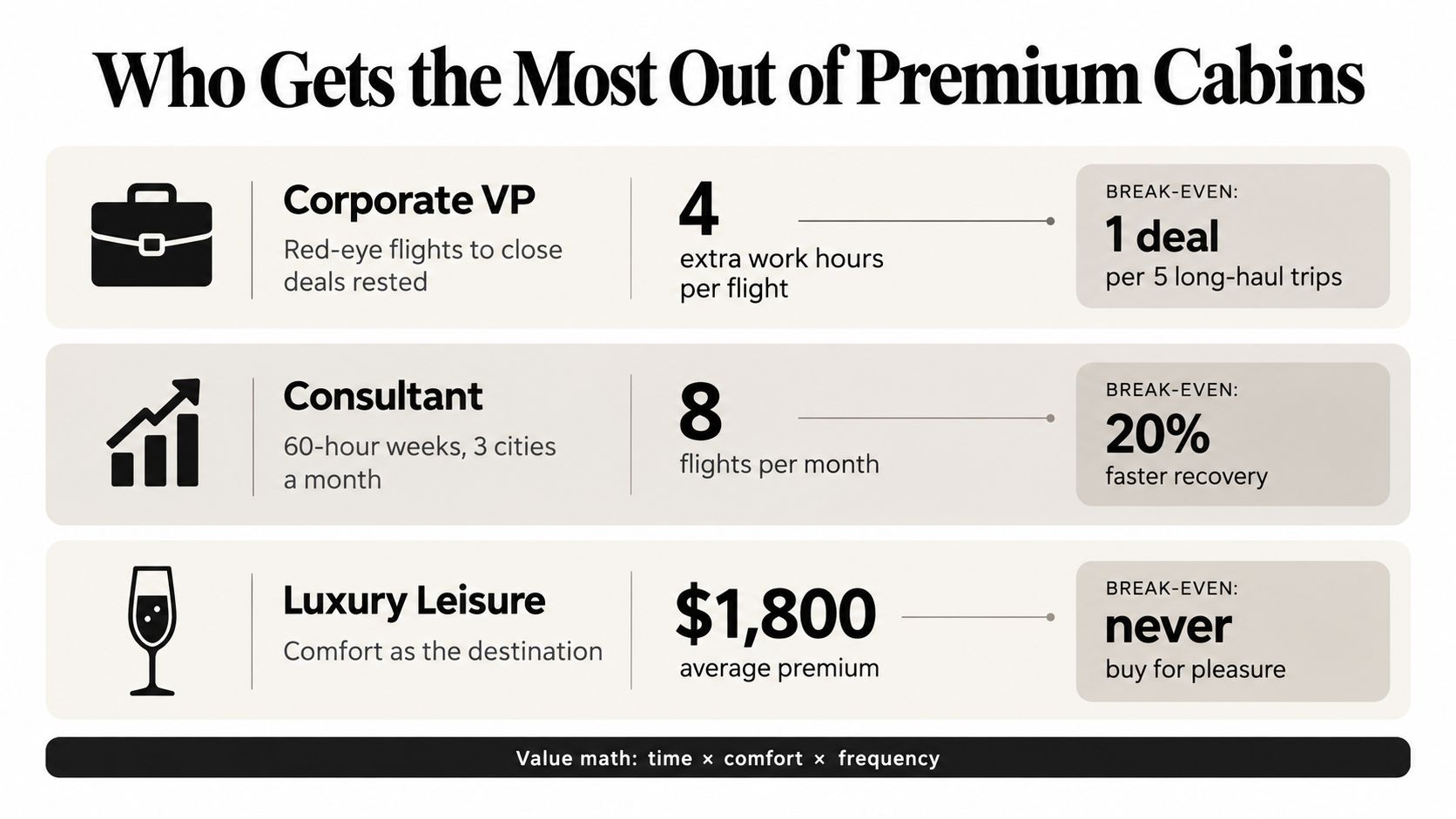
An infographic analyzing the value of premium airline cabins for corporate VPs, consultants, and luxury leisure travelers.

The corporate VP

A VP flying JFK to Tokyo for a Monday board meeting has a narrow decision. The fare matters, but the bigger issue is whether the traveler can arrive, shower, review the agenda, and make high-stakes decisions without spending the morning recovering.

For this profile, business class is strongest on an overnight itinerary with a meeting soon after arrival. The company shouldn't approve it because the cabin looks impressive. It should approve it when the arrival-day performance risk is higher than the fare premium.

A weekday schedule can also matter. A lower-demand departure may provide a more defensible premium fare than a peak return, especially when the airline is trying to fill protected inventory.

The consultant

The consultant flying between London, Singapore, and other client cities has a different equation. The cabin functions as a portable office and recovery room. A lie-flat seat may protect preparation time before a client session, while lounge access gives the traveler a controlled place to work between airport and aircraft.

This traveler should track the premium against the number of long-haul sectors in the schedule. A single expensive upgrade may be indulgent. Repeated overnight flights can turn small productivity losses into a recurring operating cost. The consultant should also distinguish between time that can be billed and time that merely feels more pleasant.

The luxury leisure traveler

A leisure traveler flying to Singapore may not have a business case at all. The reason to buy can be the experience: a flat bed, a quieter cabin, a better start to the trip, and less exhaustion on arrival. That's a valid purchase, but the traveler shouldn't disguise it as financial efficiency.

Pleasure is a legitimate reason to fly business. It just needs a pleasure budget, not a fabricated productivity calculation.

The attributes that predict strong value are consistent across profiles:

  • Overnight timing: The flight overlaps sleep.
  • Long distance: Economy fatigue has more time to accumulate.
  • Immediate obligations: A meeting, event, or first-day itinerary starts soon.
  • Flexible dates: You can avoid the most expensive departure and return patterns.
  • Discount access: The premium has fallen enough to match the trip's value.

Watch the video below for another visual perspective on the business-class decision.

Sample Fare Gaps on Real Long-Haul Routes

Business class is rarely worth its published premium. The better question is whether that premium has been inflated by demand, then cut far enough for the trip's value to justify buying it. Route snapshots without a travel date, airline, fare rules, and live inventory can mislead, so compare market relationships rather than invented prices.

KAYAK's global baseline, cited earlier, places typical international economy around US$868 and business around US$4,227, a gap of roughly US$3,359 per ticket. Independent analysis found business class averaging 250% more than economy across a sample of routes (Holidu's business-class fare analysis). That spread is the starting point, not a verdict. A discounted business fare can change the calculation completely.

A defensible route comparison

Route Economy (Shoulder) Business (Shoulder) Business/Economy Multiple Peak Premium Markup
New York to London Varies by date and fare rules Varies by date and fare rules Often materially above economy Can widen sharply on peak departures
Los Angeles to Tokyo Varies by date and fare rules Varies by date and fare rules Long-haul premium usually substantial Demand and aircraft product matter
Chicago to Frankfurt Varies by date and fare rules Varies by date and fare rules Discount events can compress the gap Business demand can rise around work travel
Sydney to Los Angeles Varies by date and fare rules Varies by date and fare rules Ultra-long-haul comfort can command a large spread School holidays and peak returns can inflate fares

The table avoids false precision. A single route price says little without the aircraft, cabin layout, connection, fare basis, and departure date. Judge the fare against the normal relationship for that city pair, then ask whether the compressed premium buys meaningful sleep, usable work time, or a better arrival.

Why the ratio moves

Airlines can price a Tuesday departure far below a Friday return because demand differs. A fare war may compress business class on one route, while a high-demand weekend keeps the forward cabin expensive. Flexible dates give you access to those gaps. Passport Premiere's business-class flight comparison can help compare the complete itinerary, including aircraft, seat layout, connection risk, baggage, lounge access, and change conditions.

Timing matters as much as the route. Watch for fare events before assuming the cabin is unaffordable, then compare the discounted fare with the cost of arriving exhausted or losing productive hours. A cheap business ticket with a poor connection can still lose to a slightly higher nonstop that protects sleep. The published fare is only the headline. The decision that matters is the price after the market has exposed its weakness.

Why Business Class Can Sometimes Beat Coach on Price

Business class can appear cheaper than coach, but the crossover is an exception created by fare mechanics, not the normal airline model. Skyscanner illustrates the usual relationship with an Air Canada example from Vancouver to Singapore: business started at about C$5,700, while economy started at C$425 on the same day (Skyscanner's business-class fare guidance).

The rare opposite result usually comes from mismatched fare buckets. A restricted economy fare may sell out, while a promotional business fare remains available. A carrier can then display business below that particular economy option, even though business remains above the broader economy market.

The empty-seat problem

Premium cabins aren't always full at the price airlines first publish. An industry analysis reported Emirates premium-cabin load factor at about 73% or higher in recent years, while revenue-management commentary describes airlines protecting high-yield premium inventory rather than discounting aggressively (Skift's premium-cabin analysis).

That creates a narrow opportunity. A carrier might hold a business seat at a high price while demand remains strong, then release lower fare inventory when the departure approaches and the seat still hasn't sold. The traveler sees a sudden price change, but the airline sees an inventory decision.

Other triggers can produce the same effect:

  • Fare wars: Competing airlines cut premium fares to defend a route.
  • Schedule changes: A revised timetable leaves flat-bed inventory on a less attractive departure.
  • Contract releases: Corporate seat blocks return to public inventory after booking patterns change.
  • Connecting-market pressure: The airline adjusts premium pricing to support broader network demand.

A price that is lower than one economy option still requires scrutiny. Check whether the business fare includes the same direction, dates, baggage, connection, and change conditions. The comparison must be like for like.

Advance-purchase rules can also affect the result, so review advance purchase excursion fares before assuming a displayed price is a genuine market anomaly. Timing alerts generally outperform static searches because a fare event may last only until the airline closes that inventory bucket.

When Business Class Pays Off and When to Skip It

My recommendation is simple: buy business class for protected performance, not vague comfort. The exception is a fare event that makes the premium small enough that comfort becomes a reasonable bonus.

The airline economics support discipline. McKinsey and IATA data show why premium seats command attention from carriers, while the UNC research shows why the average premium fare can be materially higher than economy. You shouldn't fight that pricing structure by paying whatever the first search result demands.

Use this decision table

Scenario Recommendation Fare Gap Trigger Passport Premiere Edge
Overnight long-haul, executive billing $300+ per hour Book if arrival-day performance matters Under $1,200 one-way is a strong starting threshold Surface fare events when premium inventory softens
Transcontinental hop under four hours Usually skip Skip when the flight is under three hours or daytime Compare only when the product materially changes the itinerary
Family leisure vacation under six hours Usually skip Skip when there are no work or sleep obligations Watch for an unusually low premium spread
Ultra-long-haul economy itinerary Consider business carefully Buy when a discount makes the premium fit your comfort budget Track changes instead of accepting the initial asking price
Same-day meeting after an overnight flight Strong case for business The fare can clear if it protects preparation and recovery Help identify when the published gap has compressed
Leisure trip with no schedule pressure Buy only for pleasure Skip when the premium exceeds your personal comfort budget Give you a market reference before purchasing

The $1,200 one-way trigger is not a universal law. It's a practical discipline point for a traveler who can attach real value to sleep and arrival-day work. A fare premium above $2,500 demands a much stronger reason, such as an unusually important meeting, an ultra-long sector, or a deliberate luxury purchase.

Don't confuse a cabin decision with broader travel-budget control. Corporate teams comparing approval thresholds, traveler productivity, and policy exceptions may also benefit from reviewing Snyp travel expense management as part of their travel-spend process.

Passport Premiere monitors premium fare movements, analyzes fare events, and helps travelers identify when business-class inventory is priced below its usual market relationship. Use it as a timing aid, not as permission to buy every discounted seat. The correct outcome may still be economy or premium economy.

Your final rule should be blunt. Skip business on short daytime flights, flexible leisure trips, and any itinerary where the fare premium is larger than the value of your arrival. Buy it on overnight long-haul routes when sleep protects work, when the fare gap has compressed, or when the experience itself is worth the money to you.


Passport Premiere tracks international business and first-class fare events so you can judge whether a premium price is inflated or genuinely attractive. Visit Passport Premiere to monitor discounted premium inventory and make your next cabin decision with a fare target instead of guesswork.

Business Class vs Economy Price: When Premium Pays Off

Most advice about business class vs economy price starts with the wrong comparison. It assumes the choice is cheap coach versus expensive premium. That’s often true for leisure travelers buying restricted economy far in advance. It’s often false for corporate travelers, consultants, and anyone booking flexibility at the last minute.

The hidden mistake is fare type blindness. People compare a low, restricted economy fare to a standard business fare and conclude business is always irrational. Airlines don’t price cabins like that. They price inventory by fare bucket, refundability, change rules, route demand, and how urgently they believe a traveler needs to fly. Once you compare fully flexible economy against discounted business, the logic changes fast.

That’s why “business class cheaper than coach” isn’t a gimmick. It’s a narrow but very real market condition created by airline revenue management. On some routes, the premium for flexibility in economy becomes so extreme that a discounted business fare costs less while delivering far more space, better baggage, and airport privileges. For travelers who buy time-sensitive tickets, that’s not a luxury story. It’s a procurement story.

A seasoned buyer doesn’t ask, “Is business class worth it?” The sharper question is, “Which fare bucket is overpriced right now, and which cabin is temporarily mispriced?” That’s where value appears.

The Surprising Truth About Premium Airfare

Business class is usually priced above economy. The mistake is assuming that relationship holds once fare rules change.

A better test is to compare what travelers buy. On British Airways' London Heathrow to Doha route, a fully flexible economy fare can price above a lower business class bucket. Google Flights has shown that pattern on this market, with Club World undercutting the highest economy fares on some dates, because the economy ticket includes broad refund and change rights while the business fare is sold from a discounted premium bucket, as documented in Google Flights.

Key insight: Once flexibility, refundability, and booking timing enter the equation, cabin hierarchy stops being a reliable guide to price hierarchy.

That matters for buyers who are not shopping advance-purchase leisure fares. A consultant flying on a client schedule, a project team waiting on contract signature, or a corporate traveler booking close to departure may be pushed into expensive economy inventory long before business class sells out. Airlines segment those customers differently. They reserve some economy buckets for travelers who need schedule protection and are less price-sensitive, while discounted business inventory can remain available to fill premium seats without cutting the top corporate fare.

The result is a pricing spread that looks irrational only if you compare cabin labels instead of fare conditions. Premium airfare is not priced as a simple comfort surcharge. It is priced as a revenue-management response to different traveler behaviors, and that is why a business class ticket can occasionally be the cheaper purchase even before you count bags, lounge access, or the cost of a missed meeting.

Deconstructing the Standard Price Multiplier

Before looking at the anomalies, it helps to understand the baseline. On comparable routes, business class usually does cost materially more.

Business class tickets typically cost 3 to 5 times more than economy class fares on comparable routes, with disparities reaching up to 10 times on long-haul flights, according to Dollar Flight Club’s business versus economy fare analysis. Airlines justify that gap with a completely different product. The premium cabin often includes lie-flat seating with over 60 inches pitch versus 30 to 34 inches in economy, seat width up to 21 inches versus 16 to 19 inches, upgraded meals, lounge access, and higher baggage allowances.

Comparison point Economy Business class What airlines are pricing
Typical fare relationship Lower base fare Usually 3 to 5 times higher Cabin space and yield
Seat pitch 30 to 34 inches Over 60 inches on lie-flat products Sleep and working comfort
Seat width 16 to 19 inches Up to 21 inches Personal space
Baggage allowance Lower Higher Included trip value
Airport experience Standard Lounge access, priority boarding Time and convenience
Onboard service Basic meal structure Gourmet multi-course dining Service differentiation

A split screen image showing an economy class airplane seat and a business class airplane seat.

Why the multiplier exists

Airlines aren’t only selling transportation. They’re selling space, schedule tolerance, and customer segmentation.

A business class seat occupies more cabin real estate and usually comes with more service cost. That pushes the airline to seek much higher revenue from each premium seat than from a coach seat. On long flights, the product difference becomes large enough that airlines can defend very wide price spreads, especially when corporate demand is strong.

This is why average comparisons can mislead. The standard multiplier reflects what airlines want premium seats to earn, not what every seat sells for.

Why the sticker price is only half the story

The common business class vs economy price conversation stops at the search result page. That’s where many buyers go wrong.

A restricted economy fare is a stripped product. A flexible economy fare is a different product. A discounted business fare is also a different product. Once you compare like with like, the neat hierarchy starts to fracture. The seat matters, but the fare rules often matter more.

Airlines don’t publish one economy price and one business price. They publish a ladder of prices inside each cabin, and those ladders move independently.

That’s why some travelers overpay for economy without realizing it. They’re not buying “coach.” They’re buying a very expensive version of coach.

The Hidden Mechanics of Airfare Pricing

Airline pricing looks chaotic from the outside because travelers see one number at a time. Inside the system, each cabin is a stack of separate fare buckets with different rules, availability controls, and target buyers.

A digital network illustration with interconnected glowing spheres representing complex data and dynamic pricing systems.

Global business class prices rose by an average of 18.2% in USD terms from 2024 to 2025, and some markets were still up 18.2% into 2026, while airlines used AI systems that can adjust business class prices every 2 to 6 hours, according to Julius Baer’s report on why business class flight prices have taken off. That tells you something important. Premium pricing is not static. It is continuously recalculated.

What buyers miss about fare buckets

A cabin isn’t one pool of seats. It’s a ladder.

Some seats in economy are designed for price-sensitive leisure demand. Others are reserved for travelers who need changes, refunds, or late access. Business works the same way. A discounted business bucket can coexist with an expensive economy bucket because the airline expects each fare to attract a different customer.

That’s why two travelers on the same flight, in the same cabin, can pay radically different prices and still make sense to the airline’s revenue system.

For a more technical breakdown of how airlines recalibrate fares during the day, dynamic pricing in the airline industry is the right framework to understand.

Why volatility creates opportunity

Pricing changes don’t happen because airlines are inconsistent. They happen because airlines are trying to protect future revenue while filling a perishable product. Once a flight departs, every unsold seat becomes worthless.

That creates conflicting incentives:

  • Protect premium demand: Airlines hold high fares when they expect corporate or urgent demand to materialize.
  • Stimulate weak flights: If premium demand doesn’t show up, they may open lower fare buckets.
  • Respond to competitors: Rival carriers can force price changes on specific city pairs.
  • Balance cabins: Strong coach sales don’t guarantee strong business sales. Each cabin gets managed separately.

A good short explanation of that logic is below.

The practical consequence

You’re not buying a seat in a vacuum. You’re buying a moment in a pricing cycle.

That’s why the same route can look absurdly expensive on Monday morning and rational by afternoon. It also explains why the cheapest premium opportunities often appear when business demand softens but airlines still need to protect the cabin’s overall yield. Instead of slashing every premium seat publicly, they open selected discounted fare buckets and let informed buyers take them.

The Crossover Point When Business Is Cheaper Than Coach

The counterintuitive deal in air travel is not cheap business class. It is overpriced flexibility in economy.

That distinction matters because airlines do not sell a single “economy” product or a single “business” product. They sell fare buckets with different rules, refundability, advance-purchase conditions, and change rights. On some flights, the fully flexible coach bucket climbs so high that it overtakes discounted business inventory in the same market.

An infographic comparing standard flight pricing against crossover scenarios where business class tickets become cheaper than economy.

The fare-rule inversion

A common crossover scenario looks like this: a traveler books close to departure, needs changes or a refund, and is searching on a route with steady corporate demand. In that setup, the relevant economy fare is usually near the top of the coach ladder. The business fare, by contrast, may still include lower booking classes because the premium cabin has unsold seats the airline wants to place without cutting every fare publicly.

The result can look irrational on the surface. It is rational inside the revenue system.

Flexible economy carries high value for buyers with schedule risk. A discounted business fare serves a different airline objective. It helps fill premium inventory while preserving the highest business-class buckets for travelers who will still pay them later. Once you compare the specific fare families instead of the cabin labels, the inversion is easier to explain.

Where the crossover usually happens

The pattern shows up most often in markets with three traits:

Fare type Typical buyer Pricing logic Risk to buyer Value outcome
Restricted economy Leisure traveler Fill seats at the lowest acceptable fare Strict change limits Low upfront price
Fully flexible economy Corporate traveler or late booker Charge for schedule certainty and refund rights High ticket cost Useful flexibility, weak comfort value per dollar
Discounted business Premium traveler on a flight with softer premium demand Sell selected premium seats without opening the very top buckets Limited availability Better inclusions and sometimes a lower total fare than flex coach

The crossover becomes more likely when a company travel policy requires changeable or refundable economy. That policy moves the buyer out of the cheap coach buckets and into the expensive ones. At the same time, a softer-than-expected business cabin can leave lower premium fare classes open.

Why buyers miss it

Search behavior hides the opportunity. Leisure travelers usually compare basic economy to business class and stop there. Corporate travelers often rely on policy filters or managed booking tools that default to approved economy options first, even when a lower business fare is available a few rows higher on the results page.

The expensive coach fare is driven by its rules and timing. The business fare is shaped by remaining premium inventory and bucket availability. Those pricing forces are separate, and they can produce a temporary overlap where business becomes the cheaper purchase for the trip being booked.

Practical rule: If you need flexible economy, run a direct comparison against discounted business on the same flight and date. Cabin hierarchy does not reliably predict the final price.

The point that changes the comparison

Many travelers use “business class is more expensive” as shorthand for its higher published ceiling. That shortcut misses how tickets are bought in practice. What matters is the transaction price for the fare conditions you need.

A same-week traveler with checked bags, change risk, and a full workday after arrival is not choosing between cheap coach and premium indulgence. Instead, the choice is often expensive, flexible economy versus a business-class fare in a lower premium bucket. In that narrower and more realistic comparison, business can come out ahead before you even account for lounge access, priority handling, or the value of arriving in better shape.

Calculating the Real ROI of Your Ticket

Once you move beyond sticker price, the decision gets more disciplined. The right question isn’t whether business class feels better. It’s whether the total trip cost is lower, or at least more defensible, when all trip inputs are counted together.

That’s especially relevant for corporate travel managers and small firms where one traveler’s performance after landing can affect meetings, revenue activity, and schedule reliability. A ticket is part of a work system, not just a transport purchase.

A better way to compare fares

Use a side-by-side model that captures what the fare includes and what the traveler would otherwise buy or lose. Focus on categories where business and flexible economy differ most.

Cost Factor Flexible Economy Discounted Business Notes
Ticket price Often high when booked for flexibility Sometimes lower than flexible economy Compare actual fare rules, not cabin labels
Change and refund value Usually included at a premium May also be included or partially included Read fare conditions carefully
Checked baggage May be extra or less generous Often more generous Included baggage changes total trip cost
Airport meals and workspace Usually paid separately Lounge access may cover both Relevant on long connections
Boarding and queue time Standard process Priority services included Time value matters for business trips
Rest and productivity Limited on long-haul Better chance to work or sleep Important before same-day meetings
Recovery after arrival More fatigue risk Better arrival condition Often felt as schedule resilience, not comfort

Where ROI often shows up first

Many companies treat premium travel as a soft benefit. That’s too narrow. The strongest business case usually shows up in four areas:

  • Schedule protection: A traveler with flexibility and priority handling is easier to rebook and less likely to lose productive time in transit.
  • Arrival quality: On long overnight sectors, a lie-flat seat can change whether the next day is usable.
  • Bundled value: Lounge access, baggage, and airport priority can replace separate trip spending.
  • Decision clarity: When discounted business undercuts flexible coach, the policy question becomes simple.

The most expensive ticket on paper isn’t always the most expensive trip in practice.

A disciplined review process

A procurement-minded travel manager can use a short checklist before approving or rejecting premium.

  1. Define the trip purpose. Client pitch, conference attendance, internal meeting cycle, or routine commute all justify different spending logic.
  2. Check the fare type, not just the cabin. Flexible economy and discounted business often solve the same operational need.
  3. Account for included services. If the business fare includes baggage and airport access, don’t price those at zero.
  4. Consider timing after landing. If the traveler goes straight into meetings, rest quality has business value.
  5. Reassess the policy trigger. A policy that allows flexible economy but bans discounted business can create irrational spend.

Where buyers get trapped

The most common error is evaluating all premium travel as discretionary comfort while treating all economy as prudent. In practice, some economy purchases are premium-priced products with a coach seat attached.

That distinction matters. A flexible economy fare may satisfy travel policy language while still producing a worse financial outcome than discounted business. When that happens, the cheaper-looking choice is only cheaper because the comparison ignored what the traveler needed.

Actionable Strategies to Find Premium Fare Deals

Finding premium value isn’t about luck. It’s about watching the parts of the market where airline pricing becomes unstable.

The useful mindset is simple. Don’t hunt “cheap business class” in the abstract. Hunt pricing mismatches between fare buckets, routes, and booking windows.

A person holds a tablet displaying a flight booking application with multiple travel options and prices.

Track routes where premium gaps shrink

On long-haul international routes, business class fares typically command a 3 to 4 times premium over economy, but fare wars can push premium cabin occupancy down to 20 to 30%, enabling buyers to capture 40 to 60% discounts. Outliers can be dramatic. ANA on Tokyo-Seoul has shown only an 82% premium, according to Travel-Dealz analysis of business class upcharges and fare-war discounts.

That matters because not every route behaves the same. Some city pairs are structurally friendlier to premium buyers because competition, capacity, or buyer mix keeps the gap narrower.

Use route screening as your first filter:

  • Competitive Asian markets: Some long-haul and regional markets soften faster when multiple premium carriers compete.
  • Corporate-heavy corridors: These can produce economy flexibility spikes and occasional business discount windows.
  • Seasonally uneven routes: Premium demand may underperform leisure demand at certain moments, opening better business inventory.

Use monitors, not one-off searches

One search tells you today’s price. It tells you almost nothing about the route’s pricing rhythm.

Tools that watch fares over time matter more than broad online travel agency snapshots because they help you identify whether the current premium fare is normal, inflated, or temporarily weak. One example is business class fare deals tracking, which focuses on monitoring premium-cabin changes rather than treating the first displayed price as the market truth.

Watch the route, not just the flight. The route’s behavior tells you whether a fare is expensive or merely unfamiliar.

What to do in practice

Try a working routine instead of random checking:

  • Start with fare type comparison: Pull restricted economy, flexible economy, and business on the same itinerary.
  • Check nearby departures: One day earlier or later can expose a very different premium inventory picture.
  • Watch for re-pricing windows: If a route weakens, airlines may open lower premium buckets before departure.
  • Review alternates on the same city pair: Competing carriers often create the pressure that makes discounts possible.
  • Escalate on thin gaps: If business is only modestly above the economy fare you need, analyze total trip value immediately.

Travel advisors handling high-end itineraries often combine this with service-led booking support, especially when clients want bespoke air travel experiences rather than generic search-engine results. That approach works best when comfort, timing, and fare construction all matter at once.

Don’t ignore the “small gap” opportunities

Many travelers wait for dramatic deals and miss the better category of opportunity: the compressed gap. If the premium difference is unusually narrow, the business ticket can become the rational buy even without a headline discount.

That’s where airfare intelligence beats bargain hunting. You’re not just looking for a lower number. You’re looking for a premium product sold at a price that no longer reflects its usual position in the market.

Real-World Scenarios and Sample Savings

The most useful way to understand business class vs economy price is to see how different buyers act when the market doesn’t follow the headline rules.

A corporate travel manager flying a team to Asia

A travel manager is sending two senior employees to meetings in Asia. Company policy allows flexibility because the schedule may move, but the finance team still expects cost discipline.

The weak move is to assume economy is the default and book flexible coach automatically. The stronger move is to compare the flexible economy fare against discounted business across several carriers on the same city pair. If premium inventory is soft on one carrier, the business fare may narrow enough that the total trip economics shift.

That manager should review:

Decision area Flexible economy instinct Smarter premium check
Policy compliance Book coach because it sounds cheaper Compare all flexible options first
Arrival readiness Accept fatigue as unavoidable Treat rest as part of trip output
Included services Ignore baggage and airport access Count what premium bundles into the fare
Change risk Pay more for coach flexibility Test whether business solves the same need

In this scenario, the savings may come from avoiding overpriced flexibility rather than finding an unusually cheap premium ticket. That’s the core procurement lesson.

A self-employed consultant crossing the Atlantic

Consultants often book later than leisure travelers and absorb travel costs directly. They feel every fare decision in cash flow, but they also feel every lost workday.

This traveler should think in terms of usable time after landing. If a flexible economy fare is high and a discounted business fare sits in reach, the business ticket may function as both transport and recovery tool. That matters if the traveler lands and goes straight to client work.

A freelancer’s airfare decision isn’t only about comfort. It’s about whether the next billable day survives the overnight flight.

The trap for this buyer is false frugality. A high flexible coach fare can look prudent because it preserves the image of economy spending. But if the traveler arrives depleted, buys add-ons separately, and loses productive hours, the cheaper-looking decision can cost more overall.

For travelers watching European premium routes, city-specific monitoring can help narrow the right windows. A route-focused reference like business class to Paris fare tracking can be useful when a buyer wants to understand whether a transatlantic premium fare is behaving normally or starting to soften.

A leisure traveler heading to Latin America

Leisure-heavy short-haul markets create a different kind of opportunity. On some Latin America routes, business class isn’t priced at the dramatic long-haul multiples many travelers expect.

Data from 2024 to 2025 showed US-Mexico business at $759 versus economy at $651, a $108 gap, while US-Costa Rica came in at $898 versus $579, or 1.55x, according to AranGrant’s review of short-haul routes where business gets close to economy. More broadly, on leisure-heavy short-haul routes to Latin America, the business multiplier can fall to 1.3 to 2.4x.

That creates a different decision framework:

  • For a short premium trip, a narrow gap can make business reasonable without requiring a dramatic sale.
  • For travelers checking bags, included benefits can materially shrink the price difference.
  • For couples or families with fixed dates, it can be smarter to watch for gap compression than to wait for a mythical business-class collapse.

What these scenarios reveal

These examples point to the same conclusion from different angles. The biggest airfare mistakes don’t come from buying premium. They come from buying the wrong version of economy and assuming the cabin label guarantees value.

A corporate manager can overpay by defaulting to flexible coach. A consultant can overpay by protecting cash in the wrong place. A leisure traveler can dismiss business too quickly on routes where the multiplier is already compressed.

The market doesn’t reward simple rules. It rewards comparison discipline.

That's the answer to the business class vs economy price question. Business usually costs more. Sometimes it costs less than the coach fare a serious traveler needs. And fairly often, even when it costs more, it delivers a stronger total-trip outcome than the sticker price suggests.


Passport Premiere helps travelers interpret premium-cabin fare behavior instead of reacting to headline prices. If you want a more systematic way to spot moments when business class drops below expensive coach or becomes a smarter buy, Passport Premiere offers airfare intelligence built around those pricing anomalies.