
Cheap Business Class Flights to London: Top Tips

Business class can cost less than economy to London. On a London Heathrow to Doha flight, a fully flexible business-class ticket was listed at GBP 3,029, approximately USD 4,118, while the remaining economy seats had risen to GBP 4,494, approximately USD 6,110, after cheaper economy inventory sold out. Business was therefore GBP 1,465 cheaper, or about 33% below the economy fare, as documented by Passport Premiere's London fare example.

That inversion isn't a booking glitch. Airlines sell cabins through separate inventory systems, so a premium seat can remain in a lower-priced business bucket while the last economy seats move into an expensive fare tier. Finding cheap business class flights to London therefore requires more than sorting results by cabin or checking one airport on one date. You need to compare fare rules, airports, timing, and the total cost of reaching your destination.

Why Business Class Can Cost Less Than Economy Coach to London

The usual assumption is simple: economy is the cheapest cabin, premium economy costs more, and business costs the most. That hierarchy describes the product, but it doesn't always describe the price available at the moment you search.

The Heathrow to Doha example shows why. The fully flexible business fare cost GBP 3,029, while the remaining economy inventory cost GBP 4,494. The business ticket was not merely cheaper than a flexible economy product. It was also more valuable in practical terms, with a different seat, service level, and ticket flexibility.
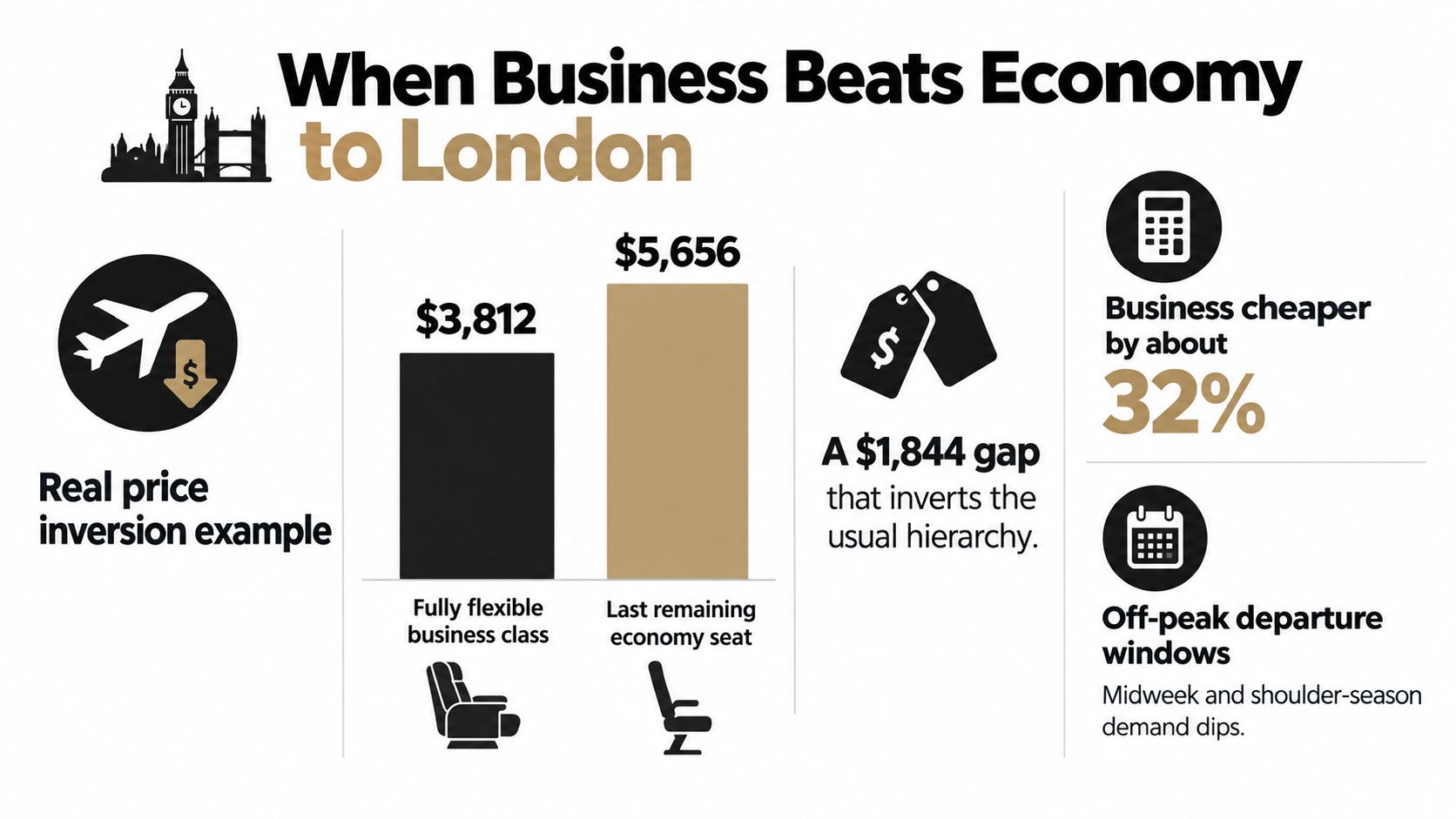
An infographic showing a price comparison where a business class flight is cheaper than an economy seat.

The cabin label doesn't set the fare

Airlines don't calculate every business fare as a fixed premium over economy. Each cabin has its own price levels, restrictions, and inventory availability. When lower economy tiers disappear, the booking system can display a much higher economy fare even though the aircraft still has unsold seats.

Business inventory may be moving differently. If demand for a particular flight's premium cabin is weaker, a lower business fare can remain available. The result is a temporary price inversion, not a permanent change in the value of either cabin.

Practical rule: Compare the fare conditions and cabin benefits side by side. Never assume that the lowest cabin must have the lowest usable price.

A single published fare can also mislead you because it represents one combination of date, airport, routing, fare family, and availability. A nearby departure or a different London arrival airport may expose a separate set of inventory. Once you find a promising itinerary, check the change, refund, baggage, seat, and connection conditions before treating it as a bargain.

Airport choice affects the value after landing, too. If a lower fare arrives at an airport that creates an expensive or time-consuming transfer, the saving may disappear. For a practical comparison of local transport options, consult your guide to affordable London transfers before booking an itinerary built around a secondary airport.

For a clearer explanation of what you're buying beyond the cabin label, see what premium cabin means. The central lesson is straightforward: business class can be cheaper than coach when inventory moves independently.

Understanding How Premium Cabin Inventory and Pricing Actually Work

Airlines manage seats by fare bucket, not just by physical seat count. A cabin can contain many open seats while its cheapest price tier is already closed. When that happens, the booking system offers the next available tier, which may be dramatically more expensive.

Economy and business class use separate inventories. A low economy bucket can sell out while a lower business bucket remains open, particularly when the airline expects different demand from leisure passengers, corporate travelers, and premium-conscious customers. The aircraft doesn't need to be full for economy pricing to rise.

Why physical availability isn't enough

Suppose an aircraft still has economy seats available. That fact alone doesn't tell you whether the cheapest economy fare remains for sale. The airline may have released only a limited number of seats at that price level, then moved the remaining inventory into higher fare categories as bookings accumulated.

Business class follows its own pattern. If business demand develops more slowly, the airline may leave a restricted or flexible business product available while economy prices climb. That can produce the counterintuitive result described above, where a business ticket undercuts the highest remaining economy fare.

The same mechanism can work in reverse. A business cabin with strong demand may close its lower fare buckets early, leaving only expensive premium products while economy remains relatively affordable. Searching by a simple cabin filter won't reveal why the gap exists unless you inspect the fare basis and conditions.

Read the rules behind the price

On major corporate routes such as New York to London, discounted business fares may require advance purchase of 14 to 60 days, along with conditions such as a Saturday-night stay or nonrefundable ticketing, according to AranGrant's explanation of business fare pricing. A fully flexible economy ticket purchased by a last-minute corporate traveler can cost substantially more than that restricted business fare.

That comparison is valid only when you understand the trade-off. A low business fare with no refund and severe change penalties may be unsuitable for a meeting schedule that can move. Conversely, a flexible economy fare may be rational for a traveler whose itinerary is uncertain, even when the headline price looks unattractive.

Look beyond the cabin name and record:

  • Fare family: Identify whether the product is restricted, changeable, or refundable.
  • Purchase deadline: Check how far ahead the fare must be ticketed.
  • Stay requirement: Confirm whether a Saturday-night or other minimum-stay rule applies.
  • Included benefits: Compare baggage, seat selection, lounge access, and rebooking terms.

Availability controls the displayed price. Seat count matters, but the open fare bucket matters first.

Choosing Your London Airport as a Pricing Variable

Airport choice changes the fare more than many travelers expect. If you search Heathrow only, you are not really pricing London. You are pricing one airport with its own demand mix, slot pressure, and ground access profile.

London's six commercial airports handled 177.7 million passengers in 2024, while Heathrow represented 47% of passenger arrivals and departures and 44% of take-offs and landings, according to the UK Civil Aviation Authority traffic review. Heathrow's airport-related charges also reached GBP 25.93 per passenger in 2025, and it was expected to handle about 84 million passengers against official annual capacity of 82 million. That mix helps explain why Heathrow often prices differently from Gatwick, Stansted, Luton, or London City, especially in premium cabins where schedule demand is strong.

Compare the airport and the journey

Run parallel searches across Heathrow, Gatwick, Stansted, Luton, and London City. If you are comfortable with more moving parts, test nearby European gateways too, but only when the positioning flight, connection, and baggage setup are realistic.

Search variable What to normalize
Arrival airport Transfer to your actual London district
Arrival time Ground transport availability and working hours
Connection Airport change, self-transfer, and missed-connection risk
Baggage Included allowance and additional charges
Fare flexibility Refund, change, and rebooking conditions
Productivity Time lost traveling to the office, hotel, or meeting

Two business-class fares to “London” can serve very different trips.

A fare into Gatwick can look strong on the results page, then lose its edge once you price the transfer to central London or Canary Wharf, especially after a late arrival. Stansted and Luton create the same kind of trade-off on some itineraries. London City can be extremely efficient for the right final destination, but its network is narrower, so the fare and schedule combination may not exist on the long-haul route you need.

Heathrow often wins when a nonstop arrival protects a full workday, when rebooking options are better, or when direct rail access cuts uncertainty. A secondary airport wins when the fare gap is wide enough to absorb the extra transport, added time, and any positioning cost without making the trip more fragile.

I would compare airports the same way I compare fare families. Hold the travel purpose constant, then measure the total trip. That means watching for the awkward connection that forces an overnight stay, the self-transfer that looks legal until baggage is delayed, and the cheaper ticket that lands so far from your meeting that you burn the savings on time and transport.

Judge every fare by the lowest reliable door-to-door cost it produces, because the smallest number in a flight search often hides the most expensive trip.

Timing Your Search and Monitoring Fare Cycles Properly

Cheap business class to London rarely appears on a neat schedule. It shows up when an airline needs to move a specific bucket of seats, on a specific route, for a specific set of dates. That is why premium fares can drop hard while economy stays stubbornly high. You are not shopping a fixed product. You are tracking inventory that keeps getting repriced.

On long-haul routes such as North America to London, I would start serious monitoring about two to four months before departure, while staying ready to buy earlier if the right fare appears. That booking window lines up with this business-class booking timing guide. The practical point is simple. Start early enough to see the fare pattern, but not so early that you mistake an opening ask for the market rate.
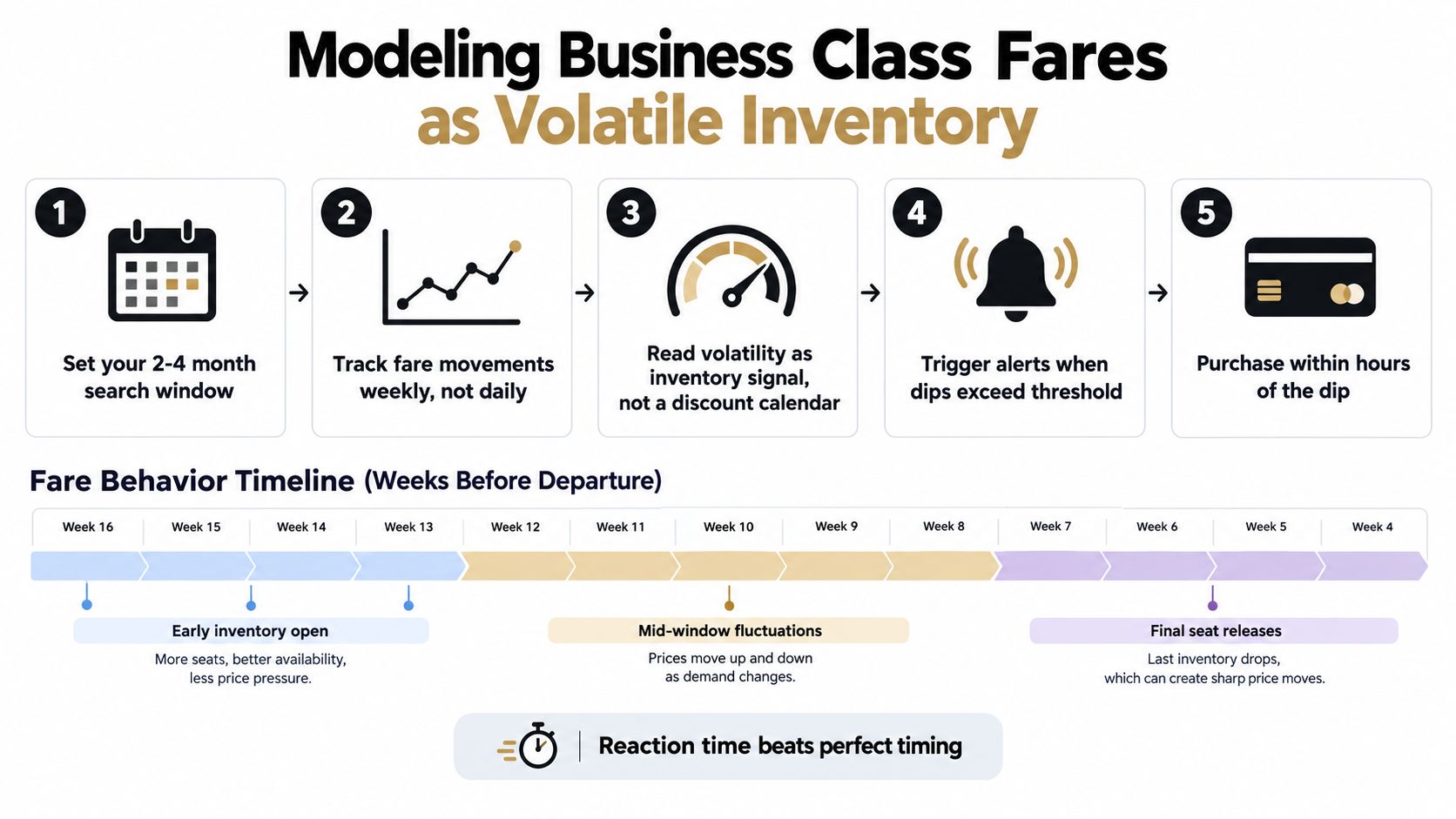
A five-step infographic guide on modeling business class fares as volatile inventory for better travel booking.

Build a repeatable search window

One search does not tell you what the market is doing. Check at least three outbound dates and three return dates. Test nonstop options against one-stop routings. If your trip allows it, compare a standard round trip with a legal open-jaw, especially when arriving in London and leaving from another airport or nearby city produces a better premium fare.

Then track what you saw. Memory is unreliable once multiple carriers and fare families enter the picture. Save the airline, flight number, airport, cabin, fare basis, booking class, baggage allowance, seat selection rules, connection details, and the change or refund terms. That is how you avoid treating a stripped-down business fare as if it were genuinely better value.

A search routine that works usually includes:

  1. Set a date band: Include midweek and weekend departures if your schedule allows.
  2. Check several routings: Compare nonstop, one-stop, and nearby gateway options.
  3. Save the fare conditions: Record flexibility, minimum stay, and ticketing deadlines.
  4. Review regularly: Watch movement over several weeks instead of reacting to one result.
  5. Define a purchase threshold: Decide in advance which mix of price and terms is good enough.

Seasonality still matters because it changes the baseline you are measuring against. January through early March and September through mid-November are often softer periods for London demand, while summer and major holiday weeks can push business-class pricing materially higher in some markets, as discussed in this guide on when to book business-class flights. Use that as context, not a promise. A strong tactical sale in a busy period can still beat a weak fare in a traditionally cheaper month.

Predicting the exact lowest fare is impossible; recognizing a meaningful dip quickly, and judging whether the product behind it is still usable, is not.

Using Fare Alerts, Market Signals, and Membership Intelligence

Business class to London can occasionally price below coach, but the useful signal is not the alert itself. The genuine edge comes from understanding why that fare appeared, whether it fits your trip, and how fast the window is likely to close.

A generic fare notification rarely answers the questions that matter. It will not tell you whether the ticket books into a restrictive fare family, whether the connection is realistic, or whether Heathrow, Gatwick, or another arrival point will create extra ground time that wipes out the savings. Experienced travelers treat alerts as a prompt to investigate, not a reason to book blindly.

Passport Premiere is a membership-based service focused on international Business and First Class deals, including cases where premium cabins can price below coach. Its published approach centers on tracking premium-cabin pricing cycles, spotting fare wars, and helping members judge the market value of unsold premium inventory before purchase, as described on the Passport Premiere website.
Screenshot from https://www.passportpremiere.com

Turn an alert into a buying decision

Passport Premiere states that fewer than 15% of premium-cabin seats are sold at their initial asking price, which is a useful reminder that the first fare you see is often an opening position, not the final market-clearing one. That does not mean every business-class seat will get cheaper. It means one-time searches miss how airlines move unsold premium inventory across fare buckets as departure patterns, competitor activity, and load expectations change.

That is where a specialist service can save time. The benefit is speed of interpretation. Instead of merely showing a fare drop, it helps narrow the gap between a market move and a practical judgment about whether the deal is real, usable, and worth acting on.

Use any alert system with discipline:

  • Verify the route: Confirm the origin, London airport, and travel window match your trip.
  • Check fare quality: Review changes, refunds, baggage, lounge access, and seat selection.
  • Measure trip cost: Include transfers, positioning flights, overnight stays, and lost working time.
  • Act by threshold: Book when the fare meets the price and flexibility rules you set in advance.

A broader monitoring routine can include dedicated business-class fare alerts. Chasing every discount wastes attention. The skill is recognizing when a lower fare reflects a real pricing opportunity, and when it just turns a cheaper ticket into a more expensive trip.

Evaluating Real Trade-offs When Booking Discounted Premium Cabins

A low business fare isn't automatically a good business fare. The ticket may save money while imposing restrictions that make it unsuitable for a client meeting, an uncertain project schedule, or a trip that depends on a specific arrival time.

Virgin Atlantic reported that more than 90% of seats in its premium and Upper Class cabins were filled and responded to sustained premium interest by expanding selected Boeing 787 cabin layouts. Its retrofit plan adds 13 Upper Class seats and 21 premium seats while reducing economy seating by 65 seats, according to Business Insider's report on the cabin changes.

Strong demand doesn't eliminate bargains

High premium demand and occasional cheap fares can coexist. Airlines make decisions at flight and fare-bucket level, not according to one annual average. Route competition, aircraft changes, departure timing, and the need to sell particular inventory can all create a lower business fare even when premium cabins generally perform well.

Additional premium seats may also change the selling problem. When an airline adds business or premium capacity on selected aircraft, it has more premium inventory to distribute across price levels. That can create targeted opportunities, although it won't guarantee a discount on your route or date.

A sale price matters only after the ticket conditions pass your real-world test.

Check the restrictions before celebrating

Separate the marketing label from the contract. A fare described as a sale may be nonrefundable, may charge for changes, may require a minimum stay, or may exclude the flexibility a company needs. Compare the full conditions with the value of arriving rested, using a lounge, taking a direct schedule, and protecting your time.

For corporate travelers, a restricted ticket may still work when dates are fixed and the savings are meaningful. For consultants moving between client sites, a flexible product may be worth paying more for. Leisure travelers should consider whether a missed connection or changed plan would consume the original saving.

The right comparison is not “business versus economy.” It is:

  • Product: What seat and service are included?
  • Flexibility: What happens if the trip changes?
  • Reliability: How risky is the connection?
  • Location: Does the airport suit the final destination?
  • Total cost: What will the trip cost after transport and disruption risk?

That framework prevents a cheap premium ticket from becoming an expensive inconvenience.

Building a Repeatable Strategy for Cheap Business Class Flights to London

Cheap business class flights to London become easier to find when you replace luck with a record of comparable decisions. Start with flexible dates, search Heathrow and the other London airports, and monitor the route during the two-to-four-month window used for long-haul fare comparisons. Keep earlier searches active when your schedule allows you to buy immediately if an unusually strong fare appears.

Record multiple fare observations for each itinerary over several weeks. Separate fully flexible, restricted, refundable, and changeable products instead of putting them into one average. Test nonstop and one-stop routes, then add ground transport, baggage, positioning, and time costs before deciding.

Book promptly when all of these conditions align:

  • The fare is materially below your recorded alternatives.
  • The airport and arrival time work for the actual trip.
  • The fare rules match your tolerance for changes and refunds.
  • The total door-to-door cost remains attractive.
  • The routing doesn't depend on a risky self-transfer.

Keep monitoring when the headline price is lower but the ticket has severe restrictions, an impractical airport, or a connection that undermines the purpose of traveling in business class. A useful bargain is a combination of price, timing, airport, and terms, not a cabin label beside a low number.


Passport Premiere helps travelers monitor international Business and First Class fare cycles, identify pricing anomalies, and assess discounted premium tickets before purchasing. Visit Passport Premiere to explore its fare intelligence and see whether its monitoring approach fits your next London trip.

Score a Discount Business Class Ticket to India: The Ultimate 2026 Guide

Finding a discount business class ticket to India isn't about luck; it's about strategy. The secret isn't just watching fare cycles—it's knowing how to exploit a specific quirk in airline pricing that can land you a business class seat for less than what others pay for coach. This isn't a travel myth; it's a playbook that regularly saves travelers 30-40% and makes premium travel more accessible than ever.

Why Business Class to India Can Be Cheaper Than Coach

It sounds completely backward, but a lie-flat seat for the long haul to India can, at times, cost less than a standard coach seat bought at the wrong moment. I've seen it happen for years. The old idea that premium cabins are always outrageously expensive just doesn't hold up anymore.

Airlines are in the business of maximizing revenue on every single flight, and to them, an empty business class seat is a massive financial loss. Because of this, they almost never sell the entire premium cabin at the full, eye-watering price you see months in advance. This creates a hidden market where a strategically purchased discount business class ticket can be cheaper than a last-minute, flexible economy ticket.

The Dynamics of Airline Pricing

Fewer than 15% of premium cabin seats are ever sold at their initial full price. The rest are sold through a dizzying process of price adjustments based on demand, the season, and what the competition is doing.

This is precisely where the opportunity for a discount business class ticket to India appears. The key is understanding what makes these prices move. A few factors are consistently at play:

  • Fare Class Differences: A last-minute, flexible economy ticket (a 'Y' fare) can cost over $2,500. A deep-discount, non-refundable business class ticket (a 'P' or 'Z' fare) on another airline for the same route might be $2,200. You get a better seat for less money.
  • Fare Wars: When several airlines fight for passengers on popular routes to Delhi or Mumbai, they drop premium fares aggressively to fill their planes.
  • Unsold Seats: As the departure date gets closer, an airline would much rather sell a business class seat at a deep discount than let it fly empty.

This is the market volatility that services like Passport Premiere are built to monitor. By tracking these patterns, we turn what looks like random price noise into predictable opportunities for savings. You can get a deeper look at the mechanics in our guide on dynamic pricing in the airline industry.

Real-World Savings: Business vs. Coach

The numbers tell the real story. A last-minute round-trip economy ticket from the U.S. to India can easily top $2,500. At the same time, strategic booking can uncover business class fares as low as $2,230 out of major hubs like New York (JFK).

That's the core of the strategy: finding moments where premium cabin discounts undercut the inflated prices of last-minute coach.

To give you a head start, here’s a quick summary of the core strategies that influence what you’ll pay for a business class flight to India.

Quick Guide to Finding Business Fares Cheaper Than Coach

Strategy Best Time to Act How It Beats Coach Prices
Book Off-Peak 4-6 months before travel in shoulder seasons (e.g., Aug-Oct) Off-peak business fares can dip below peak-season economy prices.
Monitor Fare Wars When alerts pop up, typically 2-4 months out Fierce competition drives premium fares down to economy levels.
Target Unsold Inventory Within 30-60 days of departure, but can be unpredictable Discounted 'P' or 'Z' class business seats become cheaper than last-minute 'Y' class coach.
Fly Mid-Week When booking flights for Tuesday, Wednesday, or Thursday Avoids weekend surcharge, making business fares more competitive.

Keep this cheat sheet handy. Timing your purchase around these events is the single most effective way to secure a lie-flat seat for the price of a cramped one.

The bottom line is simple: Overpaying for premium travel is a choice, not a necessity. With the right intelligence, you can consistently find a business class ticket to India for a price that rivals—and sometimes even beats—a standard coach fare.

Mastering the Calendar for India Flights

When it comes to landing a discount business class ticket to India, nothing matters more than when you buy. This isn't about the old advice to just "book early." To actually save serious money, you have to understand the specific fare seasons, day-of-week pricing quirks, and the ideal booking windows for routes to India.

You need to start thinking like a fare analyst. For corporate planners, this could be as simple as moving a quarterly meeting from December to January. For leisure travelers, it might mean shifting a family trip from a peak holiday into a quieter shoulder season. The difference in price can be staggering.

Unlocking Seasonal Savings on India Fares

Travel to India has a predictable rhythm, creating high and low seasons with enormous price swings. Flying during a peak time can easily cost thousands more than traveling just a few weeks earlier or later.

Knowing how to time your purchase is everything. While it's helpful to review broader travel data, like the cheapest months and booking windows for flights to Asia, the real deals come from targeting India's specific pricing troughs.

For instance, we consistently see fare dips in months like January and April that can slash $2,000-$3,000 off the average price. In these windows, finding a business class seat from the U.S. for around $3,000 is entirely possible. That's a world away from the $15,000+ you might see for last-minute peak travel. For Passport Premiere members, timing these predictable drops with our alerts is one of the main ways they save. You can dive deeper into these strategies in our complete guide on the best time to buy business class tickets.

The chart below shows just how powerful strategic timing can be.

Bar chart comparing average round-trip business class airfares: full price ($3,969) versus discount ($2,230).

As you can see, a discounted fare can be nearly half the cost of a standard ticket, putting over $1,700 back in your pocket on a single round-trip flight.

The Best and Worst Months to Fly

Let's get specific. The data is clear: certain months are consistently far cheaper for premium travel to India than others.

  • Low Season (Prime Booking Time): August is a fantastic sweet spot, with average business class fares dropping to $2,993. October is another excellent month, averaging around $3,167.
  • High Season (Avoid If Possible): December is by far the most expensive time to fly. Prices routinely surge by 30-60%, hitting an average of $4,184 or higher. The summer months of June and July also see major price hikes.

For corporate travel managers, this is critical information. Simply moving an annual leadership meeting from early December to mid-January could reduce travel costs by up to 40% per person. That's a huge win for the bottom line.

Day-of-Week Differences and Booking Windows

Beyond the month, the actual day you depart makes a real difference. Flying on a Saturday is almost always more expensive, with an average fare of $2,940.

But look what happens when you shift that departure to a Friday—the average price drops to just $2,268. That one small change can save you hundreds. Tuesdays and Wednesdays are often even cheaper for long-haul international flights.

The final piece of the puzzle is the booking window. Our analysis shows that booking 3 to 6 months in advance is the sweet spot, capturing up to 77% of potential savings off an airline's unrestricted fares. This is the period after promotional fares are released but before the last-minute demand sends prices soaring. As an example, Passport Premiere’s monitoring has caught fares like a last-minute September 7th flight for as low as $1,668.

Think Beyond Direct: Why Strategic Routing Slashes India Fares

A tablet displays a world map with smart routing paths and location pins, alongside a toy airplane and a 'SMART ROUTING' card.

If you want to find a truly cheap business class ticket to India, the first thing you need to do is forget everything you know about convenient travel. The fastest, most direct route is almost always the most expensive, especially up front. The real experts know the gold is found in the one-stop itinerary.

Most people start their search by filtering for non-stop flights on familiar US or European airlines. It feels logical, but it’s a costly mistake. Airlines know you’ll pay a premium for that convenience, and they price those seats accordingly. The secret is to look past the obvious and tap into the fierce competition between global carriers.

Let the Airlines Fight for Your Business

Airlines like Turkish Airlines, Emirates, Qatar Airways, and Ethiopian Airlines have built global empires by connecting passengers through their mega-hubs. They are constantly battling each other for travelers on lucrative routes to major Indian hubs like Mumbai (BOM), Delhi (DEL), and Bengaluru (BLR).

This creates a kind of permanent fare war. When one of these carriers lowers prices to fill seats, the others have to respond or risk losing out. For a savvy flyer, this dynamic is a cash cow, pushing premium fares thousands of dollars below what you’d pay for a direct flight.

Here’s a perfect example of how this plays out in the real world.

Case Study: Chicago to Bengaluru

  • The Obvious (and Expensive) Choice: A non-stop business class seat on a major carrier from Chicago (ORD) to Bengaluru (BLR) will routinely set you back $6,000–$8,000.
  • The Savvy One-Stop: For the same travel dates, a one-stop flight on an airline like Emirates (via Dubai) or Turkish Airlines (via Istanbul) could easily be found for around $3,500.

That’s a potential savings of over 50% on a single ticket. The trade-off is a few more hours of travel, but the perks go far beyond the price tag. Many of these carriers are famous for their world-class cabins, often featuring newer planes, incredible service, and better food than their direct-flight competitors. If you’re curious how they stack up, you can see our breakdown of which airlines have the best business class.

The Layover is Your Secret Weapon

Don't dread the layover—embrace it. The hub airports for these airlines—think Dubai (DXB), Doha (DOH), and Istanbul (IST)—are home to some of the planet's most luxurious business class lounges. These aren't just waiting areas; they're part of the premium experience.

You can expect amenities that completely transform your journey:

  • Spa services and private showers to refresh after a long flight.
  • Full-service restaurants with complimentary gourmet food and drink.
  • Quiet rooms and sleeping pods to get some real rest.

A well-planned layover doesn't just cut your costs; it enhances your entire trip. It breaks up the long journey, lets you stretch your legs, and gives you access to world-class amenities you've already paid for.

This strategy is how you find a discount business class ticket to India that can sometimes be cheaper than a last-minute economy ticket. By being flexible with your route, you unlock a completely different pricing structure—one driven by cutthroat competition, not just convenience. Having the confidence to book a one-stop flight is the most powerful tool in your arsenal.

The Pro-Level Playbook for Fares Cheaper Than Coach

A laptop displays 'FARE CLASS HACKS' with a pen, notebook, and book on a wooden desk.

Alright, this is where we graduate from simply being smart shoppers to playing the game at an expert level. These are the strategies that consistently turn up business class seats that actually cost less than what many people pay for a standard coach ticket.

To get there, you have to look past the dates and destinations and start speaking the airline's own language of pricing. It's the playbook we’ve perfected at Passport Premiere to land our members some serious savings.

The big secret? Not all business class tickets are the same. On any given flight, the person in the lie-flat seat next to you might have paid a wildly different price. That difference almost always comes down to the fare class—a hidden alphabet of codes that dictates the price and the rules for every single ticket sold.

Cracking the Airline Fare Code

Every ticket comes with a one-letter code attached. Think J, C, D, I, P, or Z. These aren't just for the airline's back-office; they are the very DNA of your ticket. Understanding what they mean is the key to unlocking the deepest discounts.

For instance, a full-fare, completely flexible business class ticket often falls into the 'J' class. It's the most expensive for a reason—it comes with zero restrictions. But on the other end of the spectrum, you might find a deep-discount 'P' class ticket that's 70% cheaper. The catch? It's probably non-refundable and has other strings attached.

Look, you don't need to become an airline pricing analyst. The real goal is to recognize that a true discount business class ticket to India will almost always be in one of these lower, more restrictive fare buckets (like I, P, or Z). Knowing this tells you why some deals are so phenomenal—and why you have to jump on them when they appear.

This is exactly how it’s possible to fly business for less than coach. A last-minute, flexible economy ticket (usually a 'Y' or 'B' class fare) can easily top $2,500. At the same time, a strategically booked 'P' class business fare on another carrier could pop up for just $2,200. You end up with a vastly better experience for less cash.

The Hunt for Unpublished Fares

Now for the next level. Beyond the publicly listed fare classes, there’s a whole other world of deals known as unpublished fares. You won't find these on Google Flights or the airline's website. They are special wholesale rates that airlines distribute through a private network of consolidators and specialized agencies.

These fares are a cornerstone of scoring a business class seat for less than coach. Airlines use them to quietly offload unsold premium seats without publicly slashing prices, which would damage their brand.

  • Consolidator Fares: These are bulk tickets sold at a steep discount to partners, who then resell them. The savings can be huge, but the rules are typically very strict.
  • Point-of-Sale Variation: This is an advanced trick, but sometimes a fare is cheaper if you buy it through a travel agent or website based in another country. It’s complex, but tapping into regional pricing can produce incredible results.

This is what services like Passport Premiere do all day. We’re plugged into these channels, constantly monitoring when airlines release these special fares. It gives our members access to prices the general public simply never gets to see. This is how you stop finding just good deals and start locking in exceptional ones.

A Real-World Walkthrough

Let's see how this all comes together with a common scenario. Imagine a consultant needs to fly from New York (JFK) to Mumbai (BOM) for a meeting in just three weeks.

First, a search for a standard, flexible coach ticket. With the short booking window, prices are high—around $2,600 round-trip. That’s our price to beat.

Next, a quick look at business class. A non-stop flight on a major carrier comes back at a painful $7,500. This is the price that makes most people close the browser and give up.

But here’s where the advanced strategy kicks in.

Instead of only looking at non-stops, we open the search to one-stop options. Immediately, Turkish Airlines appears with a fare through Istanbul for $3,400. A massive improvement, but we know we can do even better.

We then focus the search on specific fare classes, knowing that airlines often release deep-discount 'P' or 'Z' class fares on connecting flights to fill planes. A specialized fare alert is set up to watch for these codes on the JFK-BOM route.

Sure enough, an alert comes through. A consolidator just gained access to a block of 'P' class seats on another Middle Eastern airline. The price? A stunning $2,450 round-trip.

The result: our consultant books a lie-flat business class seat for $150 less than the going rate for an economy ticket. They get lounge access, premium meals, and a bed for the long haul—all by knowing how the pricing game is really played.

How Passport Premiere Turns Market Noise into Real Savings

Trying to master all the advanced strategies for finding a discount business class ticket to India can feel like taking on a second job. You could burn hours every day chasing fare cycles, comparing one-stop routes through the Gulf, and trying to make sense of cryptic fare codes.

Or, you can have a dedicated intelligence partner do the heavy lifting.

That’s what we do at Passport Premiere. We don’t sell you tickets. Our job is to give you the critical market intelligence that shows you exactly when to buy. We cut through the chaotic noise of airline pricing and deliver clear, actionable signals, so you don't have to become a fare-hunting expert to get an expert-level deal.

The idea is simple: we find the moments when business class gets cheaper than coach. It happens more often than you'd think, but these deals are gone in a flash. We make sure our members are ready to act when they appear.

From Static to Signal

The internet is drowning in "deals," but most of it is just static. Standard travel websites give you a snapshot of today's prices, which is almost never the whole story. We operate differently, focusing on the patterns behind the prices.

Our team monitors the entire premium travel market, watching for the specific triggers that cause prices to crater. This isn't just about a single cheap fare; it's about seeing the bigger picture.

We're looking for:

  • Emerging Fare Wars: We can spot when airlines like Turkish or Emirates start getting aggressive on routes to Delhi or Mumbai, which forces their competitors to follow suit. Members get an alert that a market-wide price battle has just kicked off.
  • Optimal Buying Windows: Our analysis pinpoints the exact—and often very brief—windows when airlines are most likely to drop their deepest discount fares. We let you know the window is opening so you can act decisively.
  • Unpublished Fare Drops: We have eyes on fare channels the public can't see, alerting you the moment consolidators release blocks of heavily discounted seats.

Instead of you having to search relentlessly day after day, we deliver the opportunity straight to your inbox.

A member recently saved over $4,000 on two business class tickets from the US to Bengaluru. The alert wasn't for a public sale. It was for a short-lived 'P' class fare a Middle Eastern carrier quietly released to fill a half-empty plane. Without that signal, the opportunity would have been gone forever.

We Arm You with Insider Knowledge

Finding a great deal is one thing. Understanding why it's a great deal is what gives you the confidence to book without hesitation. We believe in arming our members with the same intel our own analysts use every day.

Our platform is designed to make you a smarter buyer, not just a passive one. Two key resources work together to turn the airlines' price volatility into your strategic advantage.

The Passport Premiere Intel Hub

Resource What It Gives You How It Helps You Win
Video Gallery Short, no-nonsense video guides on fare classes, strategic routing, and purchase timing. It demystifies the complex world of airline pricing so you can spot a truly exceptional deal from a mediocre one.
News Updates Real-time analysis of industry trends, new routes, and brewing fare wars. You stay ahead of the curve, knowing which airlines are likely to offer discounts before they even hit the market.

For example, our Video Gallery has tutorials that break down the difference between a full-fare 'J' class seat and a deep-discount 'P' class fare. When you get a fare alert from us for a $2,300 ticket in 'P' class, you'll immediately know it's a rock-bottom price with very limited seats—and that you need to act fast.

Likewise, our news updates might flag a new route opening between a US hub and India. That's a clear signal that introductory fares are on the horizon, giving you a head start on planning. It's this combination of timely alerts and foundational knowledge that lets our members consistently book business class for less than what most people pay for economy.

Answering Your Questions About India Business Class Deals

Whenever I talk about scoring deeply discounted business class seats to India, the same questions always come up. There’s a lot of skepticism out there, which is understandable. So let’s tackle the most common concerns I hear from travelers.

You’re right to wonder if these deals are for real or if a one-stop flight is a hidden downgrade. The short answer is: the deals are legitimate, and the flights are often better. But you have to know how the game is played.

How Far in Advance Should I Book a Business Class Ticket to India?

It’s tempting to wait for a last-minute miracle, but that’s rarely the winning strategy. The data I’ve seen over the years consistently points to a clear sweet spot: book your flight 3 to 6 months before you plan to travel.

This is your prime window to catch early-bird promotional fares from the airlines. If you wait any longer, especially for peak travel between July and December, you’re walking right into price hikes that can inflate fares by 30-60%.

On the other hand, booking more than six months out is usually a mistake. Most airlines haven't even released their discount pricing cycles that far in advance, so you’re just looking at standard, overpriced fares.

Is It Really Possible to Find Business Class Cheaper Than Coach?

Yes, and it happens more often than you'd think. I’ve seen it countless times. The classic scenario is when you pit a strategically purchased discount business class fare against a fully flexible or last-minute economy ticket.

Think about it from a corporate perspective. A company needs to fly an employee to Mumbai tomorrow. They'll easily pay $2,500-$3,000 for a regular coach seat without blinking. Using the right timing and routing, it’s entirely possible to find a one-stop business class ticket for $2,200-$2,500. You get a lie-flat bed for the same price—or even less—than the person stuck in the back.

This isn't a myth; it's a direct result of airline pricing mechanics. The key is knowing how to find these fare anomalies, which is where specialized intelligence becomes invaluable.

Are One-Stop Flights on Airlines Like Turkish or Emirates Comfortable?

Absolutely. In fact, many seasoned travelers I know actually prefer them for the long haul to India. Carriers like Emirates, Qatar Airways, and Turkish Airlines have built their entire brand on having a superior business class product.

What you get is often miles ahead of a nonstop flight on an older aircraft:

  • Newer, more modern fleets.
  • Far better lie-flat seats with more privacy and space.
  • Award-winning service and food that puts other carriers to shame.

Sure, a connection adds a little time, but the layover is in a world-class airport with incredible lounges. For the thousands of dollars you save, a few hours on the ground is a fantastic trade for a better seat and a much more comfortable journey.

Can I Trust These Extremely Low Fares?

One hundred percent. These aren't scams or pricing errors. They are official, ticketable fares that come directly from the airline's own revenue management system. An airline would much rather sell a premium seat for a lower price than see it fly empty across the globe.

The catch is that these deals are almost never advertised. They pop up without warning and can disappear just as quickly. That's why you need constant, expert monitoring to catch them. Reputable services exist to track these opportunities, filter out the noise, and deliver verified deals you can actually book. The fares are real; the hard part is being in the right place at the right time to find them.


At Passport Premiere, we provide the market intelligence that turns these complex airline pricing strategies into your personal advantage. Stop overpaying and start flying smarter. Learn more about how our members save at https://www.passportpremiere.com.