
What Is Corporate Travel Management? Your 2026 Guide

You're staring at a travel spreadsheet that no longer tells the whole story. Employees have booked flights through different websites, hotel invoices arrived in inconsistent formats, policy exceptions sit in email threads, and nobody can confirm where every traveler is during a disruption. Meanwhile, finance sees costs after the money has already left the business.

That situation is common when business travel grows faster than its operating system. Corporate travel management replaces scattered decisions with a coordinated program for booking, policy, expenses, supplier relationships, traveler support, and risk visibility. The aim isn't to make every trip rigid or choose the cheapest option automatically. It's to make each decision visible, defensible, and aligned with business needs.

Introduction to Modern Travel Challenges

An unmanaged travel program often looks harmless at first. An employee books a convenient flight, chooses a familiar hotel, pays with a company card, and submits receipts later. Multiply that process across departments, booking channels, and destinations, and the travel manager inherits a maze rather than a program.

The costs appear in several places. Employees may select fares that don't match negotiated supplier terms, book outside approved channels, or choose a cabin without a clear business rationale. Finance then spends time reconstructing itineraries, matching invoices, and investigating exceptions instead of planning future spend.

Risk creates a second blind spot. If a traveler books independently, the company may not receive the itinerary data needed to contact that person during severe weather, a security event, or a major transport disruption. Duty of care still exists, even when the booking record doesn't.

A structured program brings those decisions into one operating model. Travelers get clear rules and support, managers gain visibility into spend and compliance, and suppliers receive a more consistent flow of business. The goal is controlled flexibility, not control for its own sake.

Practical rule: A travel policy works only when the approved booking path is easier to use than the workaround.

Understanding Corporate Travel Management

A corporate traveler may book a flight, change a hotel, and submit expenses through separate systems. Corporate travel management brings those steps into one operating process. It covers planning, booking, monitoring, reconciliation, air travel, accommodation, ground transportation, policy enforcement, supplier negotiations, expense data, and traveler support.

The function began in a largely manual setting. Before digital booking platforms, companies often relied on in-house travel desks, paper tickets, telephone calls, and fax machines. In 1994, Corporate Travel Management was founded in Brisbane, Australia, while those methods still shaped daily operations. That year also brought the first airline e-ticket, a practical move toward electronically managed reservations. Corporate Travel Management's market history and growth places this shift in the wider development of the sector.
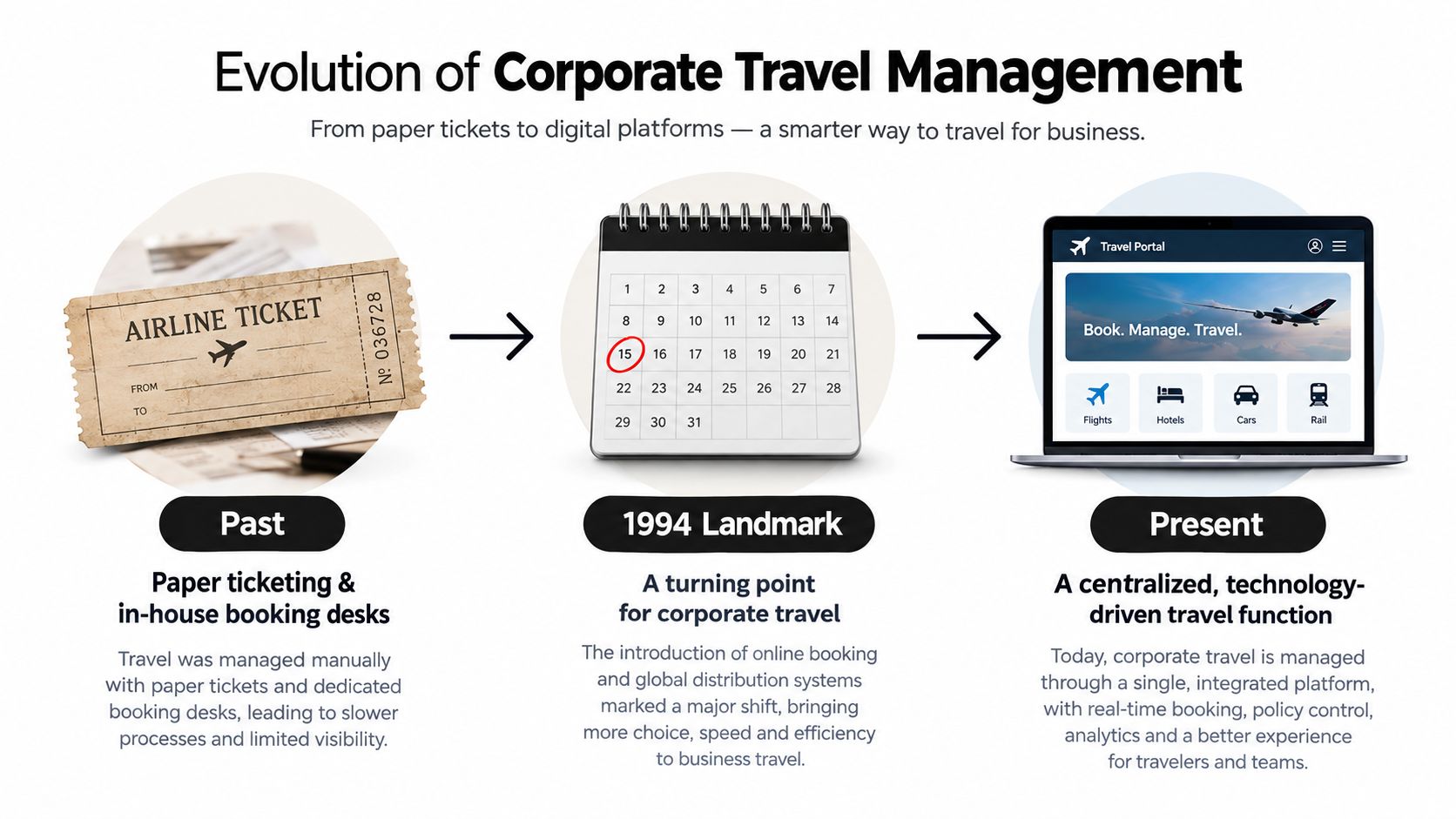
An infographic showing the evolution of corporate travel management from paper tickets to modern digital platforms.

Today, the program connects information that once lived in inboxes, spreadsheets, and separate supplier systems. An online booking tool can show approved choices and record itinerary details. A travel management company can handle complex routes and disruptions, while expense software can match transactions with accounting records. Together, these tools create a repeatable process instead of leaving each trip to individual judgment.

The market has grown as organizations invest in central policy and travel technology. One independent estimate values the global business travel management service market at $8.53 billion in 2025 and $9.06 billion in 2026, with 6.1% annual growth. The Business Research Company's market report helps explain why the function now involves procurement, finance, operations, and risk, alongside administration.

A travel manager coordinates those interests while protecting traveler productivity and company control. The role includes policy decisions, supplier negotiations, technology oversight, reporting, and traveler service. Specialized providers can also reveal savings that standard booking workflows miss. For example, Passport Premiere may help companies access hidden premium-cabin value when route, fare, and cabin choices are reviewed together.

Deloitte's 2024 corporate travel research found that travel spend could grow by 8% to 12% in 2024. Deloitte's corporate travel study reflects the broader shift toward a strategic travel-management role.

Core Components of an Effective Program

A reliable travel program works like a well-run procurement system. Procurement does more than ask employees to spend less. It defines approved suppliers, creates buying rules, captures transactions, measures results, and adjusts contracts. Corporate travel management applies the same logic to trips.

Policy creates useful guardrails

Start with rules that answer practical questions. Which booking channel should employees use? When does a trip require approval? What qualifies for flexible fares, premium economy, or business class? Which expenses require receipts, and how should exceptions be documented?

A strong policy doesn't treat every traveler or trip identically. It can distinguish between a short domestic meeting, a long-haul client visit, an urgent executive trip, and a journey requiring accessibility support. The policy should explain the reason for each rule, because employees follow systems more readily when the decision standard makes sense.

Booking tools turn rules into action

An online booking tool is the storefront of the program. It should display compliant choices first, show relevant fare conditions, route exceptions for approval, and capture itinerary data at the moment of purchase.

The tool also needs a human support path. Travelers with complicated connections, schedule changes, or urgent disruptions may need an agent rather than a self-service workflow. Resources covering essential travel agency services can help managers compare the support functions that sit alongside digital booking.

Duty of care keeps the traveler visible

Duty of care means the organization can locate travelers, communicate with them, and assist when circumstances change. It depends on complete booking records, emergency contacts, risk procedures, and support outside normal office hours.

Out-of-channel bookings weaken that visibility. A traveler may still be safe, but the company may not know the itinerary or have a reliable way to reach them. A managed program therefore treats channel adoption as a safety requirement as well as a financial control.

Expenses close the financial loop

Booking data shows what the traveler intended to purchase. Expense data shows what the company paid. Connecting the two lets finance compare the approved itinerary with final charges, identify missing receipts, and reconcile costs without rebuilding the trip manually.

For a deeper look at how booking records and reimbursement processes fit together, review corporate travel expense management. The key principle is simple: capture information once, then reuse it across approval, payment, reporting, and reconciliation.

Suppliers and TMCs provide leverage

Airlines, hotels, car rental companies, ground operators, and travel management companies each influence the traveler experience and the final cost. Managers should evaluate negotiated rates, cancellation terms, service levels, availability, reporting quality, and disruption support rather than focusing only on headline price.

Deloitte's research identifies travel managers as the people who set policy, negotiate supplier rates, and oversee technology. That combination makes the role a coordination function. Each pillar supports the others, and a cheap rate is less valuable if travelers avoid the booking channel or cannot receive help when plans fail.
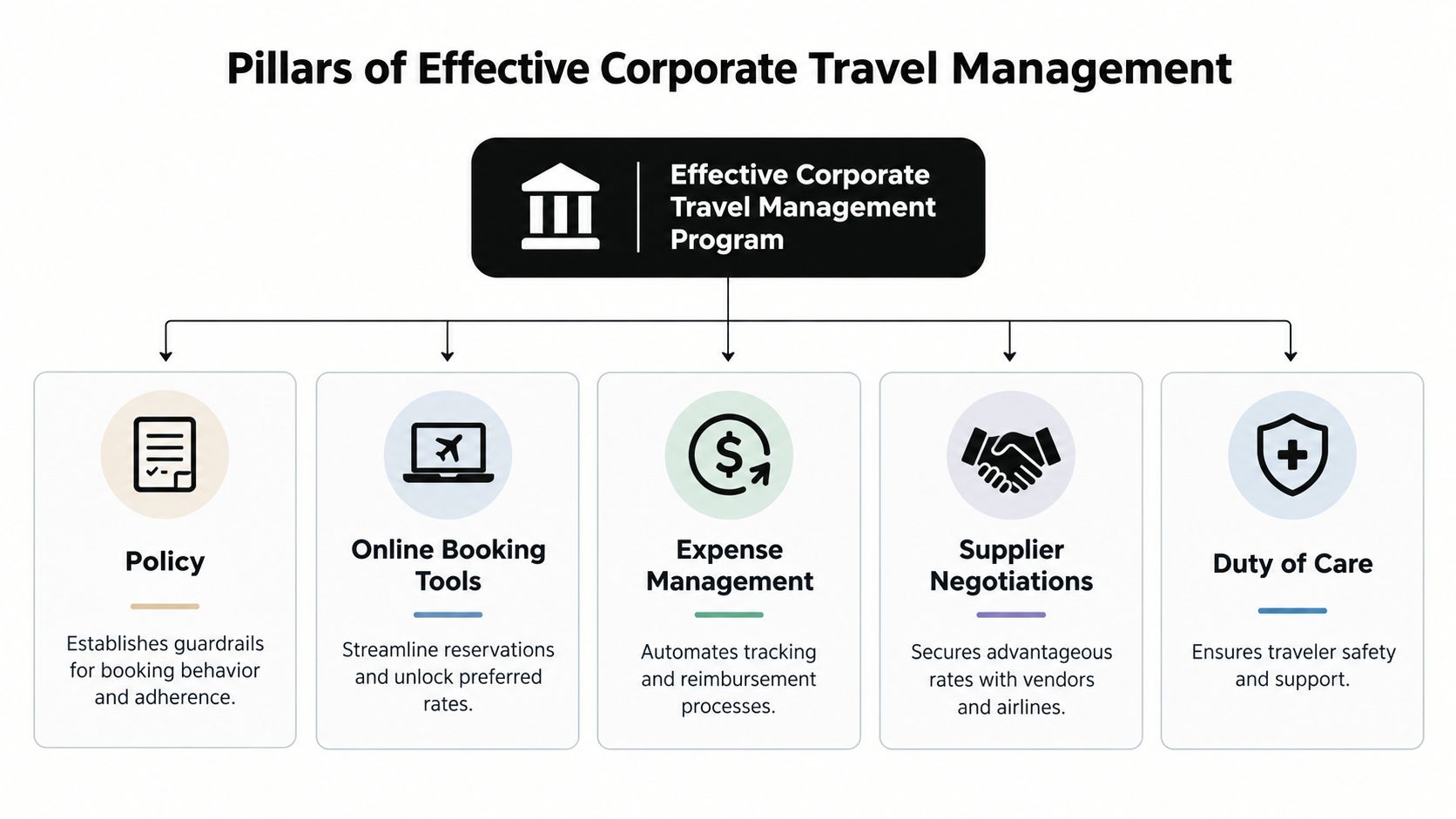
A diagram outlining the five pillars of an effective corporate travel management program, including policy and duty of care.

Benefits and ROI of Travel Management

A managed program earns its place by improving more than the ticket price. It can reduce leakage, make supplier performance visible, shorten reconciliation work, and help travelers arrive ready to perform.

The strongest ROI case connects travel decisions to business outcomes. For example, a lower fare may look attractive until it creates a restrictive change condition, an exhausting itinerary, or a missed meeting. Conversely, a premium cabin may be justified when comfort, arrival readiness, or schedule flexibility directly supports the trip's purpose.

Premium economy provides a useful middle ground. Premium economy bookings grew 35% year on year, and 67% of business travelers reported productivity gains from more comfortable seating, according to Business Travel Authority's 2026 outlook. Those figures support a broader evaluation of travel value, but they don't justify an automatic upgrade for every employee or itinerary.

Decision test: Compare the total trip outcome, not just the base fare. Include time, flexibility, comfort, support, and the cost of an employee arriving unable to work effectively.

A practical ROI model can track:

  • Avoided leakage: Compare managed-channel purchases with the unmanaged patterns they replace.
  • Supplier value: Review contracted rates, cancellation terms, service quality, and actual booking share.
  • Administrative effort: Measure how much time finance and travel teams spend on approvals, receipts, and reconciliation.
  • Productivity support: Assess whether cabin and itinerary choices help employees work effectively after long journeys.
  • Risk readiness: Confirm whether the company can identify and support travelers during disruptions.

Ground transportation belongs in the same analysis. A consistent supplier strategy can improve pickup reliability, invoice handling, and itinerary visibility, particularly for recurring airport or client transfers. Managers evaluating this category can use guidance on corporate rates for ground transfers when comparing supplier terms.
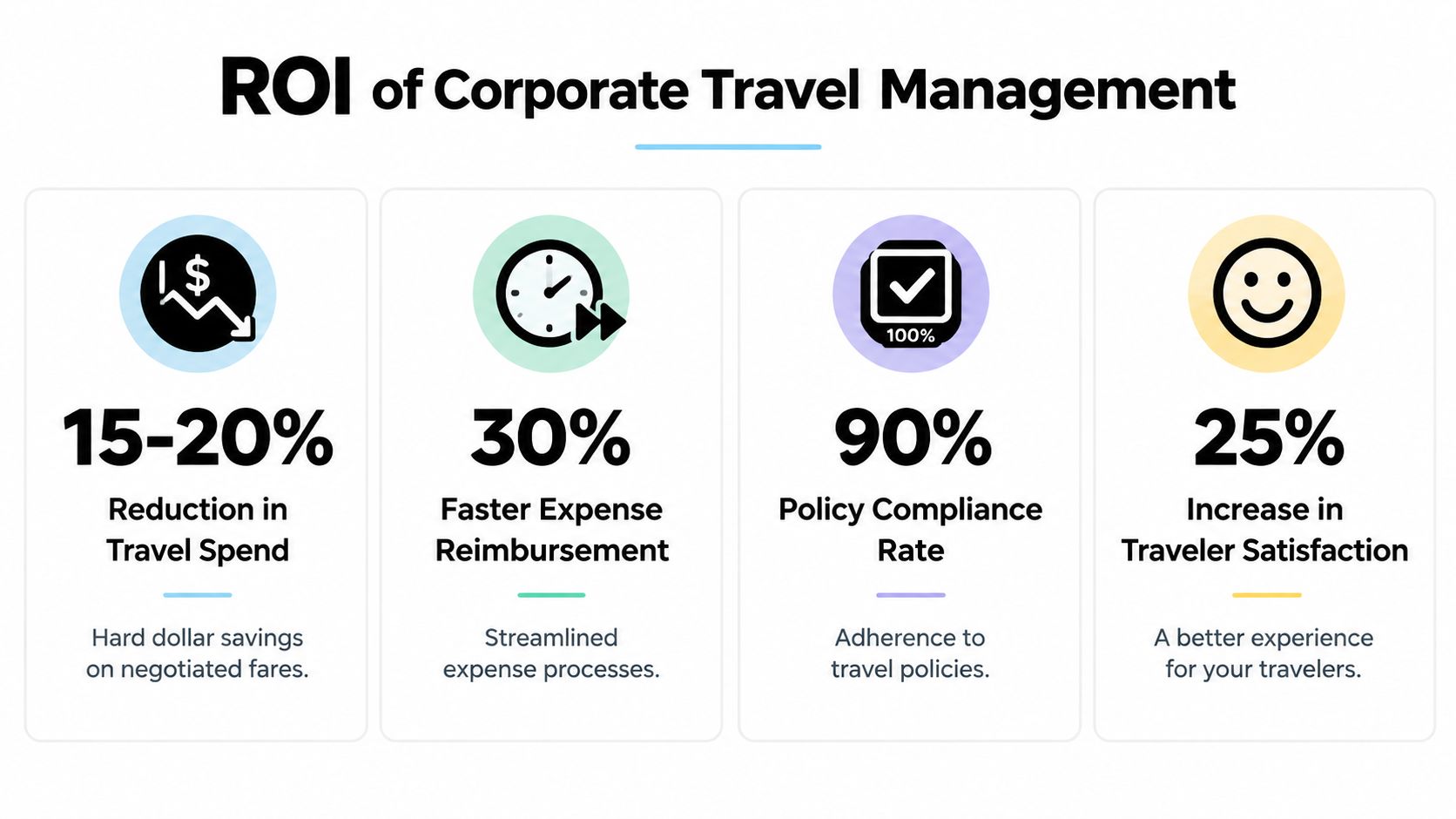
An infographic showing the ROI of corporate travel management with statistics on cost savings, efficiency, compliance, and satisfaction.

Technology and Metrics Driving Control

Technology becomes valuable when it changes a decision. A dashboard that merely displays monthly spend is a historical record. A dashboard that identifies out-of-policy bookings, supplier underperformance, or weak advance planning gives the travel manager a control mechanism.

Travel managers use closed-loop analytics to collect booking and expense records, analyze policy behavior, forecast demand, and turn findings into targeted changes. Navan's explanation of travel data analytics describes this approach as a way to connect raw records with compliance, spend control, and supplier performance.

Build the feedback loop

The operating sequence is straightforward:

  1. Capture: Bring booking, card, expense, and itinerary records into a common reporting environment.
  2. Analyze: Group spend by department, route, cabin, supplier, traveler type, and policy status.
  3. Diagnose: Find leakage points, such as bookings outside the approved channel or repeated exceptions.
  4. Act: Adjust policy wording, approval rules, supplier settings, or traveler communications.
  5. Review: Measure whether the intervention changed behavior and whether traveler friction increased.
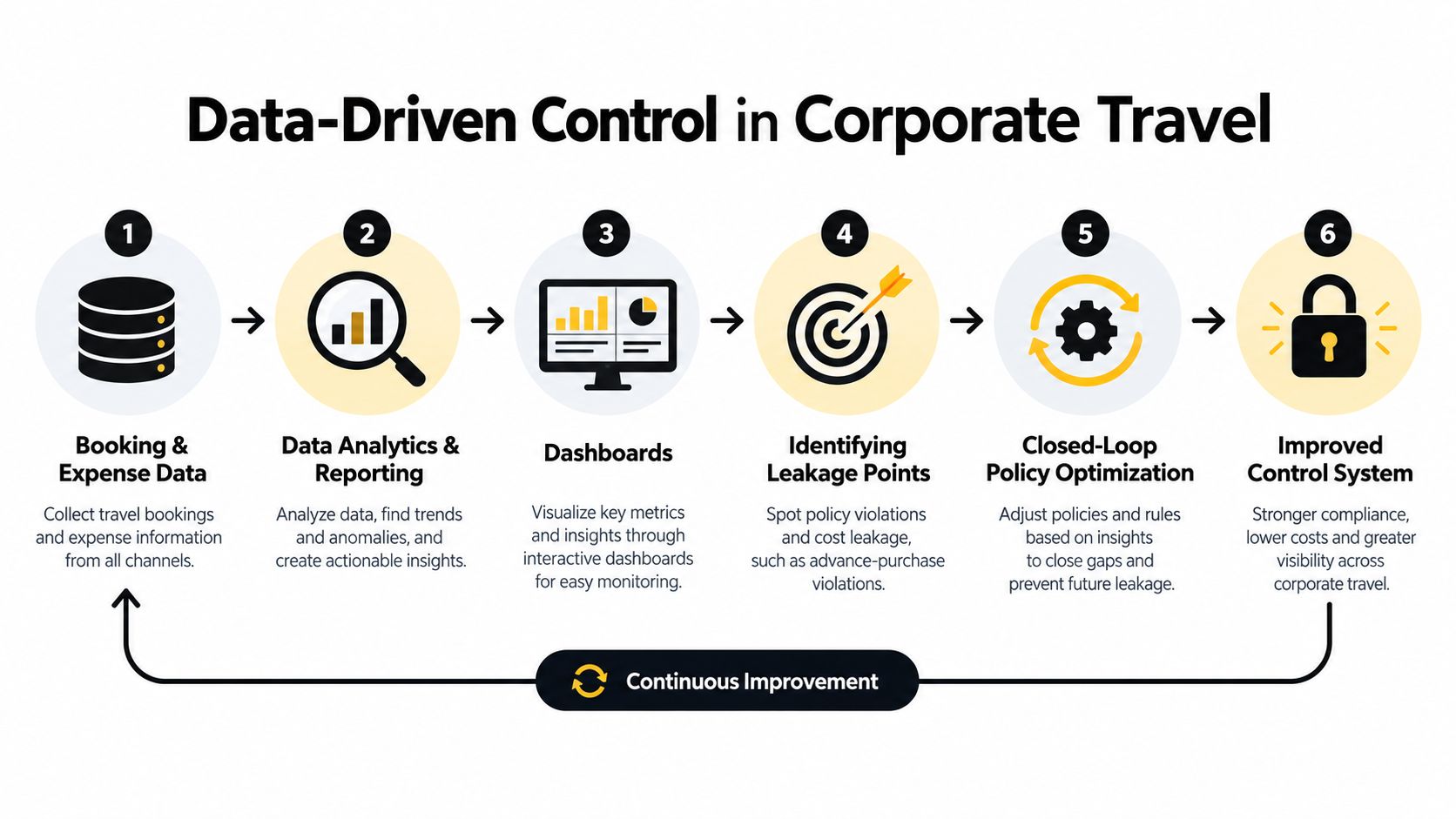
An infographic showing the six steps of data-driven control in corporate travel management for business efficiency.

Useful metrics include policy compliance, booking lead time, preferred-supplier usage, average fare by route, exception frequency, expense completion, and traveler support response. The manager shouldn't treat any single metric as the answer. A high compliance rate may hide poor traveler adoption if employees are booking outside the system and never entering the data set.

Real-time itinerary visibility adds a risk layer. If a flight disruption affects a destination, the travel team can identify exposed travelers, send relevant instructions, and coordinate alternatives. Calendar synchronization can also reduce operational friction by keeping itineraries aligned with meetings and availability. A guide to real-time calendar synchronization offers useful context for that workflow.

Premium fares deserve their own reporting view. Track cabin, route, fare family, purchase timing, flexibility, and the reason for approval. This prevents the organization from treating every business-class purchase as wasteful or every economy fare as efficient. For teams monitoring fare movements, airline price-drop alerts can fit into a broader exception and savings workflow.

Best Practices for Implementing a Travel Program

Implementation works best as a controlled rollout rather than a policy announcement. Begin by interviewing finance, HR, IT, security, executive assistants, frequent travelers, and employees who arrange complex trips. Each group sees a different failure point, and those perspectives reveal whether the program is practical before you configure a platform.

Start with a measurable baseline

Collect current booking, expense, supplier, cabin, and exception records. Identify where employees book, how invoices arrive, which routes create repeated problems, and where traveler support breaks down. Don't set targets until you know which data is complete and which bookings sit outside the managed record.

Next, write the policy in plain language. Include approval logic, preferred channels, cabin principles, flexibility rules, hotel and ground transportation guidance, receipt requirements, and emergency support. Corporate travel policy best practices can help structure that document without turning it into an unreadable rulebook.

Make the compliant choice convenient

Select a booking tool or TMC based on search quality, policy controls, traveler support, integrations, reporting, and international capability. Run a pilot with travelers who represent different trip types. Watch where they abandon the workflow, request agent help, or book outside the platform.

Train managers on exceptions, not just restrictions. A policy becomes more credible when it explains who can approve a premium cabin, what evidence supports the decision, and how the company evaluates the outcome afterward.

Treat premium cabins as an optimization problem

Long-haul premium-cabin demand has run 18% to 25% above 2019 levels, and business-class loads have stayed above 84% for four straight quarters, according to industry coverage of corporate travel management. Tighter availability makes timing and fare analysis more important than a simple cabin ban.

Set a decision framework based on route length, meeting requirements, traveler role, flexibility needs, and total trip value. Compare the full cost of coach, including upgrade miles, change restrictions, baggage, and lost productivity, with the available premium fare.

Business class can be cheaper than coach when fare inventory, restrictions, or upgrade economics differ. Airlines can set different prices across cabins, and the U.S. Department of Transportation consumer notice explains why a premium seat may sometimes cost less than an economy seat. USA Today's explanation of airline cabin pricing provides a clear example of that mechanism.

FCM Consulting reported that global business-class airfares fell by an average of $119, or 4%, from January to May 2025, while economy fares fell by $18, or 3%, in the same period. FCM's H2 2025 insights shows why managers should monitor fare cycles instead of assuming economy always offers the lowest total cost.

The Points Guy documented a Delta itinerary where a discount business-class fare cost $3,347, compared with an upgradeable coach fare priced at $3,256 plus 50,000 miles. The fare comparison demonstrates how an all-in comparison can change the decision.

Passport Premiere can be evaluated as a specialized supplier for international premium-cabin intelligence, using fare monitoring and market analysis to identify lower-priced business and first-class opportunities. Include its alerts in the sourcing process, require documented approval, and measure the resulting fare against the best compliant alternatives.

Conclusion and Next Steps

Corporate travel management turns scattered bookings into a governed operating system. Clear policies guide behavior, connected technology captures the data, supplier relationships improve purchasing, and duty-of-care processes keep travelers visible. Premium-cabin decisions also deserve analysis based on fare mechanics and business outcomes, not assumptions about cabin labels.

Start by auditing current spend and booking channels. Then pilot dashboards, formalize supplier standards, test traveler support, and create a documented premium-fare review process. As programs mature, managers can add more personalized recommendations, sustainability reporting, and connected traveler support without losing financial control.


Passport Premiere helps corporate travelers monitor international business and first-class fares, evaluate fare movements, and identify premium-cabin opportunities that may cost less than coach. Visit Passport Premiere to review its membership options and determine whether its fare intelligence fits your company's travel program.

International Business Travel: Fly Business Class for Less

Most companies still buy international air the wrong way. They treat business class as a policy exception and economy as the default safe choice, even when fare volatility creates short windows where premium seats price at or below coach on the same long haul trip.

That sounds improbable until you look at the scale and structure of the market. Global business travel spending reached $1.47 trillion in 2024 and was projected to rise to about $1.69 to $1.70 trillion by 2026, with some forecasts reaching $3.26 trillion by 2033 and a 6.7% CAGR from 2026 to 2033, according to CompaniesHistory's business travel market summary. In a market this large, airlines don't price every seat according to comfort alone. They price according to inventory pressure, route demand, competition, timing, and what they believe a buyer will tolerate.

That's the opening most travel programs miss.

Standard corporate booking logic asks one question: what is the lowest compliant fare right now? Smart international business travel programs ask a better one: what is the current market value of this seat, and is the airline mispricing premium inventory relative to coach?

Rethinking Your International Business Travel Strategy

The old mental model says business class is a luxury line item. The better model says it's a procurement category with timing risk.

On international routes, airlines often hold premium inventory at ambitious opening prices, then adjust when demand doesn't materialize as expected. That creates distortion. A late-purchased economy fare can become irrationally expensive while a discounted business fare becomes comparatively attractive, especially on routes with uneven demand, multiple carriers, or soft premium uptake.

Why the cheap fare is often the expensive choice

A “cheap” coach ticket can cost more than it appears to.

The traveler lands exhausted, loses the first day to recovery, needs tighter hotel timing because early check-in becomes mission critical, and often requires a more fragile meeting schedule. On paper, finance sees a lower airfare. In practice, the company buys a weaker operating outcome.

Practical rule: On long international trips, compare cabin choices against the cost of fatigue, schedule fragility, and change risk, not just the ticket line.

International business travel isn't a side function anymore. It's part of sales execution, supplier management, project delivery, recruiting, and cross-border leadership. Companies still need people in the room when stakes are high. Video handles status updates. It doesn't always close deals or repair strained partnerships.

A strategist's view of the trip

Treat each international trip as a small portfolio decision. You're balancing:

  • Cash cost against total trip value
  • Traveler performance against policy consistency
  • Flexibility against overpaying for unused optionality
  • Speed of booking against the risk of buying during a fare spike

That shift changes behavior fast. Instead of forcing every itinerary through the same lowest-fare funnel, you start segmenting trips by trip purpose, route volatility, and traveler recovery requirements.

A founder flying overnight to win a regional distributor isn't buying the same product as a manager attending an internal meeting with flexible timing. Both are “business travel.” They shouldn't be procured the same way.

What works and what doesn't

Here's the blunt version.

Approach What happens
Cheapest available fare policy Looks disciplined. Often buys poor timing and false savings.
Fixed cabin bans Easy to enforce. Misses discounted premium opportunities.
Market-aware buying Harder to build. Produces better trip economics on the right routes.

The useful shift is simple. Stop treating cabin as a status marker. Start treating it as a variable in a live market.

Understanding the Real Cost and Risk Drivers

International trips cost more because almost every component scales upward at once. Flight length rises. Hotel nights stretch. ground transport becomes less predictable. Visa handling may enter the workflow. Schedule disruption gets more expensive because there's less slack in the itinerary.

Global business travel is projected to reach $1.7 trillion in 2026, and international trips average $2,600 per trip versus $1,293 for U.S. domestic travel, according to Engine's business travel data roundup. That gap is why simplistic “book economy and save money” logic usually breaks down in cross-border travel.

A chart showing real cost and risk drivers for international business travel including financial and operational categories.

The visible costs

Airfare gets most of the attention because it's easy to compare. It's also the most misleading line item when taken alone.

Hotel cost often becomes the more stubborn problem on long-haul trips because rates don't behave like airfare. Airfare can drop sharply in short bursts. Hotels usually move more slowly and remain high longer in strong markets. Ground transport, roaming, insurance, and visa processing add friction that buyers tend to underestimate until reimbursement hits.

A useful way to think about the trip is to separate booked cost from trip cost.

  • Booked cost includes air, hotel, rail, car, and formal travel charges
  • Trip cost includes lost time, rebooking labor, compliance mistakes, fatigue, and missed work capacity

The hidden costs companies absorb anyway

Most unmanaged overspend doesn't come from one dramatic booking mistake. It comes from dozens of small failures.

A traveler books the “cheaper” flight with a bad arrival time. The hotel needs an extra night to protect rest. A meeting moves and the fare change rules become punitive. The trip is technically compliant but operationally weak.

Buy the itinerary that survives reality, not the itinerary that looked cheapest in the search results.

Process is essential. Teams that centralize approval, payment, and itinerary visibility can simplify international business travel by reducing handoffs between booking, expense, and compliance workflows. That's often more valuable than chasing a slightly lower published fare with no operational control behind it.

Where risk enters the budget

Risk isn't separate from cost. It becomes cost.

Consider the categories that can reshape a trip after booking:

  • Traveler safety risk changes routing, hotel choice, and local transport decisions
  • Compliance risk creates problems with immigration, tax, or documentation
  • Health risk can shorten productive time on arrival
  • Visibility risk leaves travel managers unable to spot policy leakage until after spend occurs

For international business travel, the true optimization target isn't “lowest airfare.” It's lowest total cost for a trip that still works under pressure.

Designing a Modern Corporate Travel Policy

A modern policy shouldn't force travelers into the cheapest visible option. It should create a decision framework that protects budget, traveler output, and duty of care at the same time.

That starts with one uncomfortable fact. A benchmark report cited by Fragomen found that 44% of organizations do not capture business travel costs at all, which weakens policy enforcement, duty-of-care tracking, and forecasting accuracy, as noted in Fragomen's travel benchmark reference. If you can't see the spend, you can't govern it. You're not running a policy. You're publishing a wish.

A professional holding a tablet displaying a corporate travel policy document in an office setting.

What old policies get wrong

Legacy policies usually make three mistakes.

First, they focus on fare minimization, not trip value. Second, they write rigid cabin rules with no room for market anomalies. Third, they build approval chains that are so slow that travelers end up booking late, which inflates the very fares the policy was supposed to control.

That's why many teams start with a working corporate travel policy template and then adapt it around route type, traveler role, and booking urgency instead of enforcing one flat rule for every trip. For a more operational framework, these corporate travel policy best practices are useful as a policy design reference.

What the policy should actually define

A strong policy answers practical questions before the trip gets booked:

  • Cabin eligibility
    Define when premium cabins are allowed based on route strain, overnight timing, business purpose, or schedule intensity. Don't reduce this to title alone.

  • Booking authority
    Clarify who can approve exceptions quickly. Slow approvals are expensive.

  • Approved flexibility
    Separate trips that need refundable structures from trips that don't. Many companies overpay for flexibility they rarely use.

  • Supplier strategy
    Decide whether you want strict preferred-carrier use or route-by-route discretion when market pricing shifts.

Policy language that works in practice

The best policy clauses aren't the strictest. They're the clearest.

Policy area Weak version Better version
Cabin rules Economy only unless executive Premium permitted when route conditions or trip purpose justify value
Booking timing Book early Book within defined windows unless fare monitoring indicates better value
Approval Manager approval required Named approvers with response expectations and escalation path
Exceptions Case by case Exceptions documented by route, timing, and operational rationale

A policy should tell a traveler what to do when conditions change, not just what to do when everything goes right.

Good policy doesn't ban business class. It makes business class provable.

Unlocking Premium Fares with Strategic Timing

Most savings are found not in generic advice about booking “as early as possible,” but in understanding that premium fares move in cycles and that unmanaged buyers rarely know when a route has entered a favorable buying window.

Independent industry reporting says only 35% of global business travel spending is booked through businesses with a travel management company, leaving a large unmanaged segment with limited fare intelligence, according to the Airbus-linked industry reporting referenced here. That unmanaged segment is exactly where buyers tend to overpay, because they're seeing only today's price, not today's price in context.

A strategic guide to unlocking premium airfare, outlining cost factors and booking approaches for business travelers.

Why premium pricing behaves differently

Coach demand is broad and constant. Premium demand is narrower and more erratic.

Airlines know some buyers must travel and will pay high walk-up fares for comfort, flexibility, or status. So carriers often open premium cabins at levels aimed at urgent or insensitive buyers. If those seats don't move as expected, the airline can refile fares, open lower inventory, package routing differently, or respond to competitor pressure. That's where outsized opportunities appear.

This is the practical distinction:

Buying mindset Question being asked
Standard booking What's the cheapest fare visible now?
Strategic booking Is this premium fare overpriced, fairly priced, or temporarily distressed?

That second question changes everything.

The signs a fare is worth waiting on

You don't need to predict every airline move. You need to recognize conditions where premium volatility is likely.

Look for combinations like these:

  • Uneven route competition where multiple carriers overlap on key long-haul city pairs
  • Soft premium demand periods where business traffic isn't filling front cabins as expected
  • Awkward departure timings that reduce natural demand for a premium seat
  • Roundtrip structures where one direction is priced aggressively and the return isn't
  • Late coach inflation that makes economy look artificially expensive

A buyer who only checks once won't see any of that. A buyer tracking fare behavior over time will.

Here's a visual walk-through of the strategic booking logic:

What standard booking tools don't tell you

Online booking tools are built for transaction control. They're not built to interpret premium inventory psychology.

They show policy, schedule, and current fare availability well enough. They usually don't answer the harder questions: Is this fare high for this route? Is a competitor undercutting in another filing? Is the premium seat empty because the price is wrong, not because the product lacks value?

That's why travel managers who care about premium-cabin control need a second layer. Not another booking site. An intelligence layer that watches fare movement and flags when the market has shifted. This is the same logic discussed in Passport Premiere's guide on when airlines drop prices.

How to buy against volatility instead of fearing it

Most companies use policy to suppress price risk. That only works partially. Better programs combine policy with timing.

Use this decision sequence:

  1. Qualify the trip
    Is this a high-output trip where arrival condition matters?

  2. Map the route
    Is the route competitive, seasonal, or supply constrained?

  3. Test coach against premium
    Not as categories, but as live market prices.

  4. Watch for buying events
    Temporary fare drops matter more than static cabin rules.

  5. Lock the seat when value appears
    Don't wait for the theoretical bottom. Buy when the premium seat is mispriced in your favor.

The buyer who wins premium airfare isn't the one with the strictest policy. It's the one who knows when the market is briefly wrong.

Mastering Your Pre-Travel Operational Checklist

A well-priced fare can still produce a bad trip if the operational basics are sloppy. International business travel punishes last-minute improvisation faster than domestic travel does.

Health is a good example. The CDC notes that pre-travel planning should address physical and mental health, and a GeoSentinel analysis cited by the CDC found common illnesses among ill business travelers included malaria (9%), unspecified diarrhea (8%), viral syndrome (6%), and bacterial diarrhea (5%) in the CDC's guidance for international business travelers. That doesn't mean every trip is medically risky. It means business travel planning should include health preparation, not just ticketing.

A checklist titled Mastering Your Pre-Travel Operational Checklist containing nine essential tasks for international travelers.

The non-negotiables before departure

Use a checklist that someone owns. Not a PDF buried in HR.

  • Passport and visa control
    Check validity, entry rules, business purpose restrictions, and any transit requirements before air is ticketed.

  • Insurance confirmation
    Verify what the company policy covers overseas, especially medical treatment, evacuation, and trip interruption.

  • Medical prep
    Travelers with prescriptions, sleep issues, or destination-specific concerns should sort that out before departure week.

  • Document redundancy
    Keep digital and offline copies of passport, itinerary, visa approvals, hotel details, and emergency contacts.

The details that reduce friction on arrival

The first hours after landing often determine whether the next day is productive or wasted.

I advise travelers to make these decisions before takeoff:

Item Good practice
Airport transfer Prearrange the first ride if arrival is late or unfamiliar
Connectivity Activate roaming, eSIM, or local SIM before landing
Payment backup Carry more than one payment method
Rest plan Protect first-night sleep instead of scheduling late meetings

Jet lag planning is part of trip design

Most companies still treat jet lag as a personal inconvenience. It's an operational variable.

If the traveler lands in the morning after an overnight haul, don't stack client-facing meetings into the same arrival window unless there's no alternative. If the trip is short, protect sleep and reduce unnecessary local movement. If the schedule is intense, cabin choice, hotel location, and arrival timing need to work together.

Arriving legally isn't the same as arriving ready.

A practical pre-travel sequence

Run the trip in this order:

  1. Validate entry and work-permitted activity
  2. Confirm insurance and health requirements
  3. Ticket the final itinerary
  4. Book the hotel for sleep and access, not just rate
  5. Lock ground transport for the first leg
  6. Brief the traveler on policy, local conditions, and emergency contacts

That sequence avoids the common mistake of buying the flight first and discovering operational problems after the trip is already committed.

Essential Tools for the Modern Travel Manager

The traditional travel stack was built around booking control. The modern stack has to handle control, visibility, safety, and fare interpretation.

That changes the tool mix. A booking tool alone can issue tickets and enforce basic policy, but it won't give you a complete view of premium opportunity, health preparedness, or post-booking risk.

The old stack versus the useful stack

Here's the practical comparison.

Need Traditional setup Modern setup
Booking Online booking tool Booking tool plus monitored approval rules
Expense capture Manual claims or delayed reconciliation Automated expense and central payment workflows
Duty of care Traveler emails itinerary manually Itinerary visibility and traveler tracking
Premium cost control Static policy restrictions Fare intelligence plus policy guardrails

The difference is less about software volume and more about workflow sequence. Good programs collect itinerary data early, tie it to payment, and push exceptions into review before the spend leaks into reimbursement.

The categories that actually matter

A useful stack usually includes these layers:

  • Booking and approval
    This is the operating system. It should route approvals fast and preserve itinerary visibility.

  • Expense capture
    If expense data arrives late or incomplete, policy analysis turns into guesswork.

  • Risk and traveler tracking
    You need to know where travelers are and how to reach them when conditions shift.

  • Fare intelligence
    This is the missing layer in many programs. It interprets market pricing instead of a mere display.

One option in that last category is Passport Premiere, which monitors international premium fare movement and helps members assess when a business or first-class fare reflects a temporary market opportunity rather than a normal published price. That's a different function from an online booking tool. It's not replacing the booking workflow. It's informing it.

What travel managers should stop tolerating

Stop accepting blind spots as normal.

If your program can't answer these questions quickly, the stack is incomplete:

  • Which routes produce the most premium-cabin leakage?
  • Which bookings were compliant but badly timed?
  • Which travelers book outside approved channels because the approved path is too slow?
  • Which trips required flexibility, and which paid for it by default?

A mature international business travel program doesn't just process bookings. It learns from fare behavior, policy exceptions, and trip outcomes.

How Fare Intelligence Converts Volatility into Savings

Consider a common scenario. A consulting firm needs to move a senior employee from North America to Asia for a short-notice client meeting. The traveler has to work on arrival, the schedule is compressed, and the default booking channel returns ugly prices.

In the usual workflow, the coordinator sees a painful choice. Book last-minute economy and preserve policy optics, or book business class and absorb obvious sticker shock. Neither option is attractive because both are being evaluated at a single moment in time.

Before fare intelligence

Without market context, the team tends to do one of three things:

  • Buy the visible economy fare and accept lower traveler readiness
  • Approve premium at a price they suspect is inflated
  • Delay the decision and risk even worse pricing later

That's what standard booking does poorly. It treats the displayed fare as reality instead of as one moment in a moving market shaped by airline revenue management. For a plain-language breakdown of that logic, this explainer on dynamic pricing in the airline industry is worth reading.

After fare intelligence enters the process

A more disciplined workflow watches the route instead of reacting to the first quote.

The travel manager tracks fare behavior, compares cabin spread, and waits for a viable buying event if the trip timeline allows it. When premium inventory softens, the team can move fast and book a seat that suddenly prices far closer to coach, or in some cases below an inflated last-minute economy option on the same general itinerary.

That's the core idea behind buying premium strategically. You're not asking for luxury approval. You're identifying mispriced inventory and acting before it disappears.

A simple scenario might look like this:

Booking method Typical outcome
Immediate purchase through a standard channel You pay the market's opening ask
Policy-first economy default You protect policy optics but may weaken the trip
Fare-aware monitored purchase You buy when the premium seat's price disconnects from its initial ask

The operational result matters too. The traveler arrives with a higher chance of functioning well, the company avoids paying blindly for flexibility it doesn't need, and the travel manager gains a repeatable method instead of relying on luck.

Connectivity is a small but useful example of this same thinking. A traveler who plans local data access before arrival avoids scrambling at the airport and can stay reachable through disruptions. If that piece is often overlooked in your program, a practical guide on how to manage your travel eSIM can help standardize that part of the trip.

The advantage of fare intelligence isn't just lower ticket cost. It's turning airline volatility from a budgeting problem into a sourcing opportunity.


Passport Premiere helps travelers monitor international premium-cabin fare swings so they can spot business and first-class buying opportunities before overpaying. If your team is trying to control long-haul travel costs without forcing every trip into coach, review Passport Premiere as one option for adding fare intelligence to your travel workflow.