How Do You Get Last Minute Flight Deals: A 2026 Guide

Last-minute business class can be cheaper than coach on the right international routes. A 2025 airline study found last-minute one-way tickets averaged $228.21, and some carriers priced them 8.3% below advance fares, while others raised prices sharply near departure.

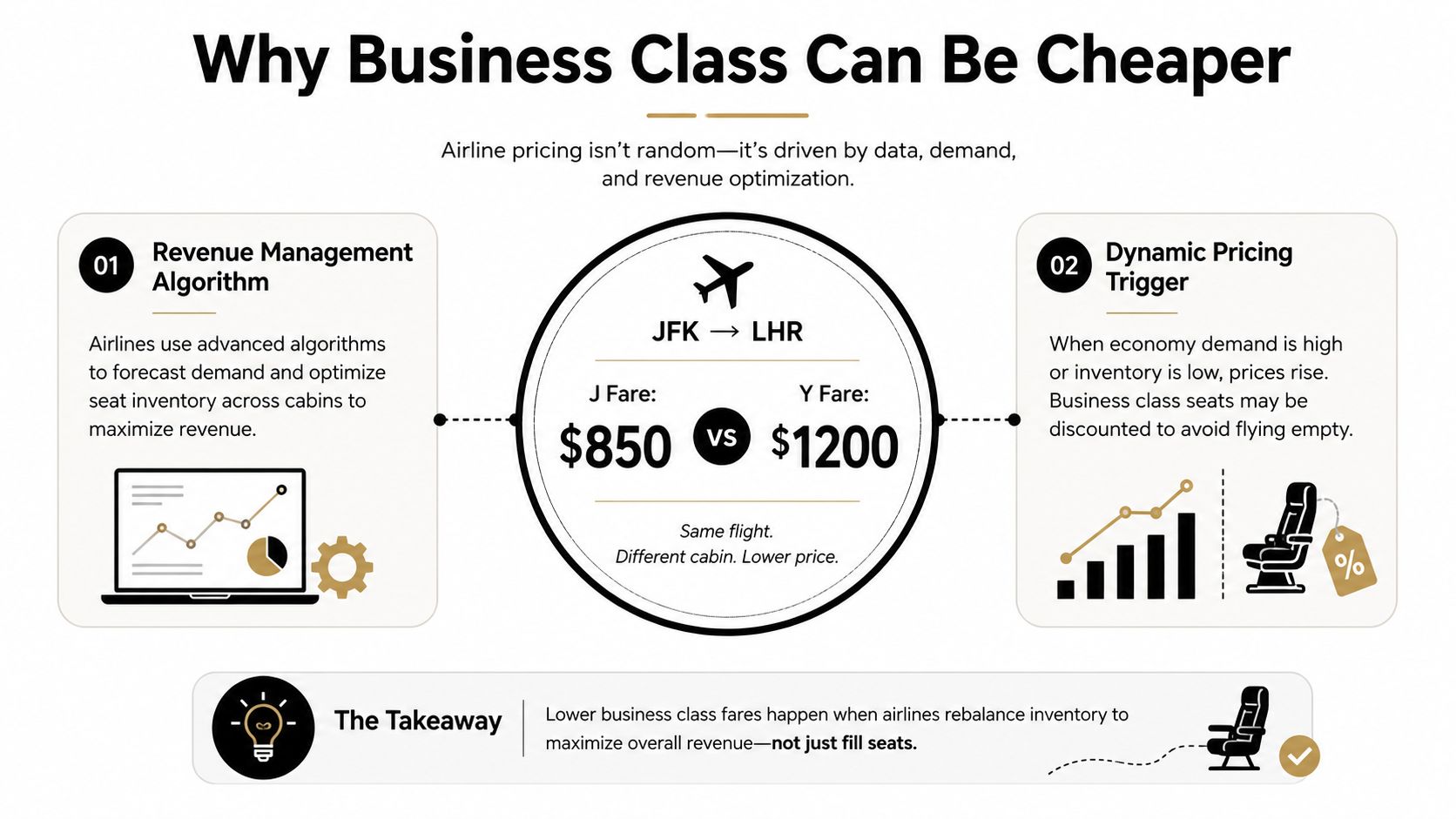
That sounds backward because most travelers associate late booking with panic pricing. Yet airlines sometimes need to clear unsold premium seats, particularly on competitive transatlantic and Pacific routes. A fare-pricing analysis found that carriers may slash business-class prices close to departure to avoid flying empty high-value seats, creating the unusual situation where a last-minute business-class ticket costs less than economy on the same aircraft. Passport Premiere's analysis of last-minute business-class fares documents this buying-event logic.

The answer to how do you get last minute flight deals isn't “wait until the day before and hope.” It's to identify routes where premium inventory can soften, monitor the fare against route history, and set a purchase threshold before the airline removes the opportunity.

What Last Minute Flight Deals Actually Mean in 2026
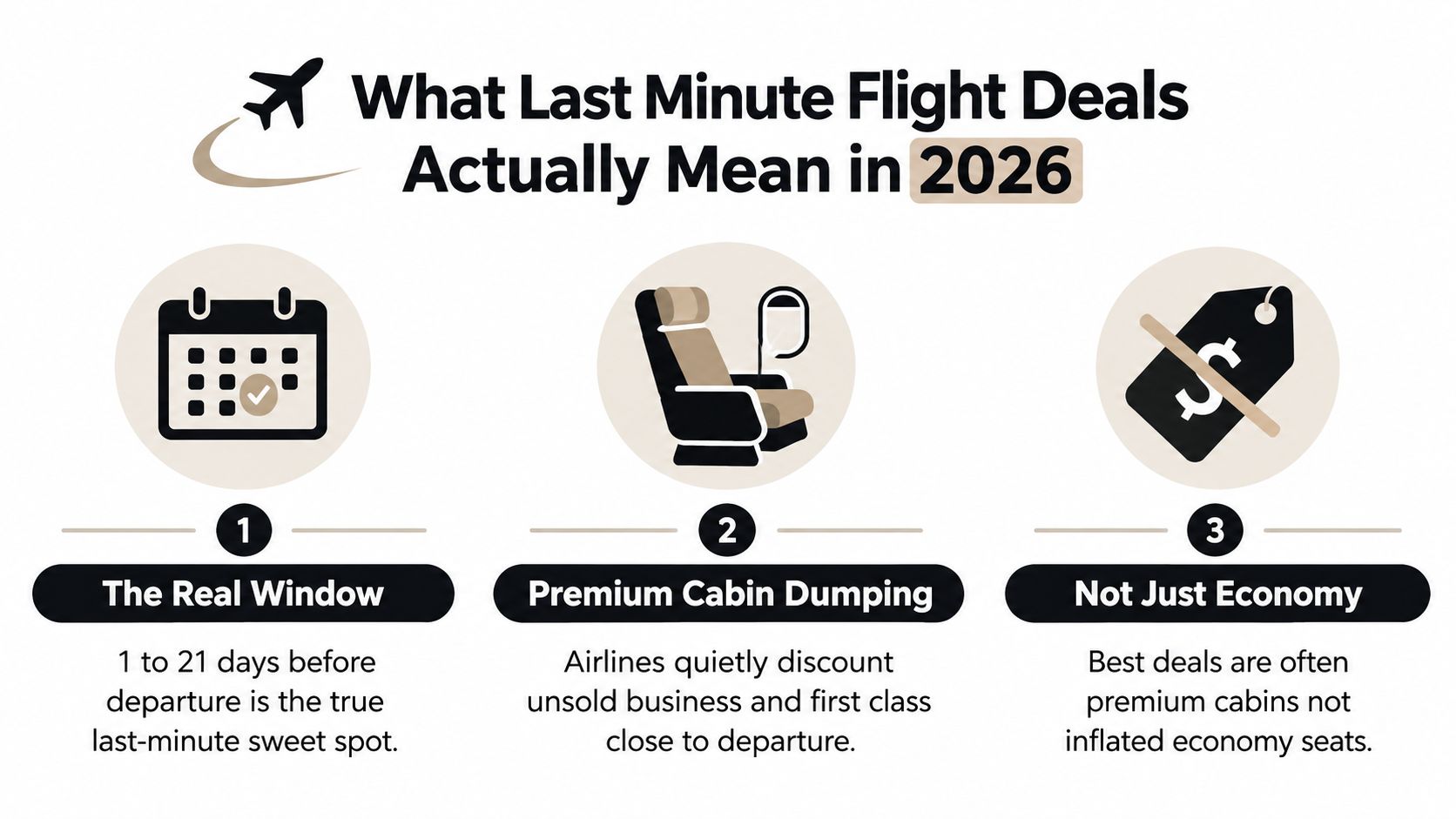
An infographic detailing the reality of booking last-minute flight deals in 2026, featuring three key strategic points.

Last-minute airfare is a premium-cabin buying event, not a universal economy strategy. For domestic economy travelers, booking late usually means accepting rising fares and fewer choices. For international business-class buyers, it can create a short opportunity to purchase unsold premium inventory before departure.

Use one to 21 days before departure as the practical international last-minute window. The strongest premium-cabin period is narrower, roughly four to 14 days before departure. Airlines still have time to fill empty seats, while urgent business travel, schedule changes, and spontaneous trips generate late demand.

Carrier behavior varies sharply. A 2025 study of major airlines found Spirit averaged $151.53 for the analyzed last-minute one-way tickets, compared with $160.89 for Frontier. JetBlue's last-minute fares were 29.9% higher than its advance fares, while United's were 15.6% higher. The airline-by-airline fare comparison supports a strict rule: wait only on routes and carriers with a history of late fare softness.

The premium opportunity

A widebody with empty business-class seats creates a different pricing decision. The airline may prefer a discounted premium sale to flying valuable inventory unused. Routes such as JFK to London, SFO to Tokyo, or LAX to Sydney can produce this opportunity, but none should be treated as a guaranteed pattern. Passport Premiere's analysis describes this buying-event logic and the conditions that can make last-minute business class attractive.

Set a route-specific fare threshold, then monitor premium inventory against the economy price. If business class approaches or falls below coach, buy before the airline removes the remaining seats.

Domestic routes require a separate policy. Fare-history guidance places stronger domestic and short-haul opportunities in the broader three-week to 2.5-month window, not necessarily the final days. The same guidance reports that some large datasets showed their lowest average fares around 42 to 54 days before departure, while fares in the final six days could be materially higher. Travel Agent Central's fare-timing analysis supports a firm operating rule: do not gamble on a same-day economy fare unless the schedule and budget can absorb a poor result.

Practical rule: Treat last minute as a premium-inventory strategy. Book economy earlier when the route's fare history shows late prices rising.

The Booking Curve and Why Last Minute Is Not One Window

Airfare behaves differently by market. Domestic North American pricing usually becomes less forgiving as departure approaches, especially after the main advance-purchase period. International premium cabins can follow a more uneven curve because airlines are balancing corporate demand, connecting traffic, loyalty inventory, and the cost of flying an empty business-class seat.

The useful comparison is not “early versus late.” It's today's fare versus the route's own history. Consumer tools can show about 60 days of recent price movement for a specific itinerary, while U.S. government aviation datasets offer decades of route-level history. This fare-history guidance explains why a current price needs context before you call it a deal.

A practical fare-position framework

The table below is deliberately qualitative. The available verified evidence supports distinct behavior by market, but it doesn't provide a standardized index for each booking window.

Booking Window Domestic Fare Index International Business Fare Index
More than two months out Often reasonable, but not automatically lowest Useful for establishing a baseline
About three weeks to 2.5 months out Frequently the strongest monitoring period Monitor, but don't assume the lowest premium fare appears here
Seven to 21 days out Usually rising or volatile A possible buying-event period on competitive long-haul routes
Final six days Often materially above the optimum window Can produce a premium dip, but inventory risk is high
Same day A poor economy strategy A specialist opportunity only when availability and fare rules are favorable

For domestic travel, start monitoring before the final month and act when the fare reaches a defensible level. A major study found that the lowest fare for a given flight changed an average of 71 times before departure, roughly every 4.5 days, with each move averaging about $33 up or down. That volatility favors regular checking over a single late search.

For international business class, establish a longer baseline, then watch closely inside the final three weeks. The right question is whether the fare has entered a historically favorable band, not whether the calendar says “last minute.” The guide to when airlines drop prices is useful for building that route-specific monitoring habit.

Setting Up Fare Alerts That Catch Real Drops

A fare alert is only useful when it's designed around the fare you want. Most travelers configure alerts for the cheapest economy result, then miss a premium-cabin buying event because the business-class price remains above an unrealistic general-market threshold.

Start 21 to 30 days before departure for an international premium search. Track the exact route, nearby airports, one-way combinations, and business-class cabin separately. Google Flights is useful for the broad market view, Hopper can provide movement notifications, and Scott's Cheap Flights, now operating under the Going brand, can surface broader sale activity. Use Kayak when you want another price-history perspective.

Set a percentage-based trigger rather than a fixed dollar amount. A 15% or larger drop is a sensible alert threshold for a premium fare because the value of the event depends on the route's baseline. A modest absolute reduction can matter on a low fare, while a larger premium ticket may move meaningfully without reaching the lowest economy price.

Read the graph before you react

A single downward tick isn't enough. Compare the current result with the recent pattern and ask:

  • Is the route falling broadly? A genuine market dip usually appears across nearby dates or competing carriers.
  • Is the change isolated? One low result may reflect a restrictive fare, a long connection, or an airport mismatch.
  • Does the fare class have real space? Booking buckets such as G, R, and Z can help you distinguish a genuine premium availability signal from a display that disappears at checkout.
  • Are the rules acceptable? A cheap business fare with severe change restrictions may not suit a corporate traveler.

Layer a route-specific alert with a trusted sale newsletter. Short-lived premium buying events can vanish before a routine daily email reaches you, so mobile notifications and an approval process matter. Corporate travelers should also decide in advance who can authorize a purchase when the fare appears.

For a more specialized monitoring workflow, review airline price-drop alerts alongside the general-purpose tools. The point isn't to subscribe to every service. It's to create overlapping coverage without confusing a marketing notification with a bookable fare.

Flexible Routing and Error-Fare Tactics

Flexible routing can uncover value, but it also introduces operational risk. Search the itinerary a corporate traveler can manage, then test alternatives separately rather than accepting every cheap construction the search engine displays.

The first tactic is hidden-city ticketing, such as searching JFK to FRA to HEL instead of a direct JFK to HEL itinerary. The second is throwaway ticketing, where a traveler buys a longer itinerary because the airline prices the desired first segment more cheaply inside that structure. The third is self-connecting across separate tickets, potentially combining different carriers or airports.

These methods can work, but they're unsuitable for checked bags, missed-connection protection, or complex corporate itineraries. This guide to multiple-leg flights is useful when comparing separate-ticket constructions with a conventional through fare.
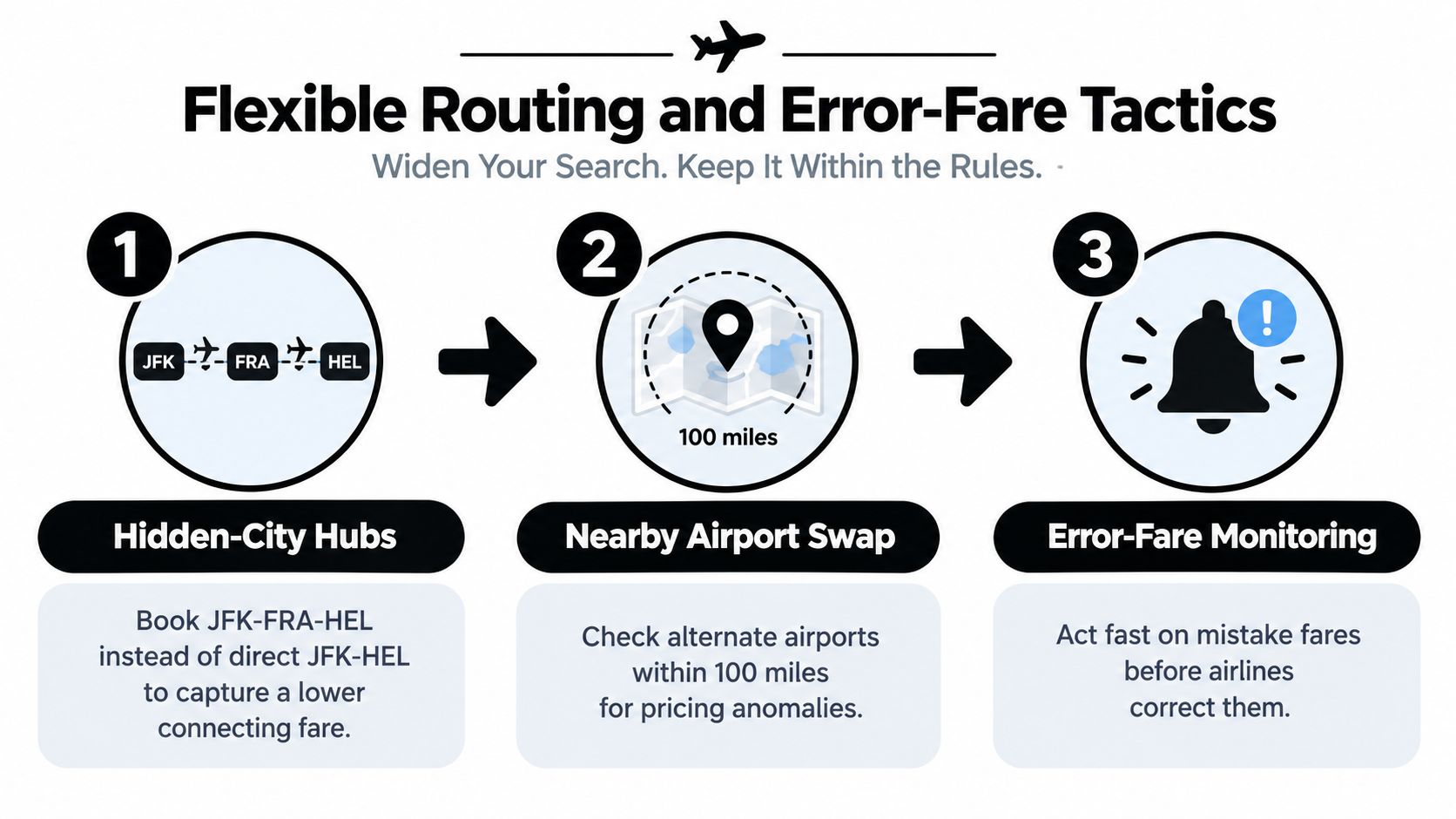
A graphic infographic explaining three strategies for finding cheaper airfare: hidden-city hubs, nearby airport swaps, and error-fare monitoring.

How error fares appear

Error fares can result from human pricing mistakes, currency-conversion glitches, or fuel-surcharge calculations that post incorrectly. They often disappear once the airline or distribution system corrects the filing. Routes that attract attention include long-haul low-cost-carrier services, transpacific itineraries, and Latin America positioning flights.

Use a disciplined sequence:

  1. Monitor discovery channels. Check Secret Flying, Fly4Free, and the @SecretFlying and @seats31 feeds.
  2. Rebuild the itinerary. Use an ITA Matrix search to verify that the fare exists beyond a single affiliate display.
  3. Confirm the booking class. Call the carrier and ask whether the displayed class is available.
  4. Check the contract. Review cancellation, change, baggage, and ticketing conditions before payment.
  5. Use a protected card. Choose a credit card with strong travel protections appropriate to the itinerary.

Airlines may honor an error fare, void the booking, or offer credit instead of a refund. Don't issue nonrefundable hotels, ground transport, or client commitments until the ticket is secure.

Hidden-city tickets carry an additional warning. Skiplagged-style itineraries can violate airline contract-of-carriage clauses and may lead to cancellation of later segments, including a return flight. Use them only when you understand the risk, preferably on a refundable or one-way ticket, and never with checked baggage.

For a separate destination where routing complexity matters, the Maximum Adventure Trails budget guide offers a useful example of why airport choice and ground transport must be evaluated together, not as isolated airfare tricks.

Loyalty Inventory and Premium-Cabin Buying Events

Cash pricing is only one pool of premium availability. Airlines may also release award seats close to departure when a business-class cabin risks flying empty. Corporate cancellations, partner allocations, and negotiated channels can expose inventory that never appears in a standard economy search.

The release pattern depends on the airline and program. Lufthansa may open more First Class award space inside 14 days of departure. Singapore Airlines is associated with premium award waves at T-355, T-30, and T-3. Air France-KLM Flying Blue Promo Rewards can place one-way business-class awards to Europe below 60,000 miles around two weeks before departure. These examples come from the cited industry guidance, and availability can disappear quickly. Going's 2026 travel report also distinguishes late award-seat availability from cash-fare behavior, an important distinction for premium searches.

Where to look

Use ExpertFlyer's award and upgrade screens, Seats.aero's alliance search, and the airline's own fare calendar. Filter for the relevant cabin and fare family instead of searching only for the lowest published result.

Airline or program Award release wave Sweet spot for business class Typical one-way miles
Lufthansa More First Class availability within 14 days Near departure, when award space appears Varies by program and route
Singapore Airlines T-355, T-30, and T-3 Monitor each release wave Varies by program and route
Air France-KLM Flying Blue Promo Rewards can appear around two weeks out Short-notice Europe travel Under 60,000 miles in qualifying examples

Passport Premiere's buying-event framework adds a cash-fare perspective. When a corporate block is canceled inside the final two weeks, an airline may need to clear premium seats through public, corporate, or consolidator channels. A business-class fare can then undercut a constrained coach fare, especially on a competitive long-haul route.

The baseline price gap explains why this feels so dramatic. A 2025 comparison reported that business class often costs five to 10 times more than economy, so a discounted premium fare can still be lower than a walk-up coach fare when economy inventory has tightened. The business-class versus coach comparison provides that baseline.

Hold a refundable coach ticket when the trip is unavoidable and premium availability is uncertain. Switch only after confirming the premium ticket's refund, change, baggage, and seat conditions.

When to Buy and When to Stop Waiting

For last-minute premium travel, waiting for the theoretical bottom is usually the wrong decision. Set a price threshold, then buy when the fare compensates for the risk of losing the seat. Passport Premiere's buying-event framework is useful here: a canceled corporate block can leave premium seats to be cleared publicly, through corporate channels, or via consolidators. On a competitive long-haul route, business class may briefly cost less than the remaining coach inventory.

For international premium cabins, watch the final 31 to 45 days closely. Published fare guidance reports a possible saving of about $190 compared with booking more than six months out, while also warning that last-minute discounts remain unusual. Prices commonly rise during the final two to three weeks, as airlines protect seats for late-booking business travelers. The premium-cabin booking guidance supports early monitoring followed by selective purchase.

Use a hard purchase rule

Buy as soon as one of these conditions is met:

  • The fare enters a historically cheap band for that route.
  • The current price sits clearly below its recent moving average.
  • Business class costs less than the available coach alternative.
  • The fare rules work, but remaining inventory looks fragile.
  • The itinerary is a competitive transatlantic or Pacific route where premium inventory can soften.

Fare drops often create a short buying window, not a long decline. Analysis of fare movements found that 75% of fare drops recovered within 24 hours, while the average meaningful drop was $38. The fare-movement analysis makes hesitation hard to justify when the current fare already meets the company's requirements.

The best deal is the fare you can verify, approve, and ticket before the inventory disappears.

Corporate travel managers should predefine an acceptable premium fare, maximum connection time, and required refund policy. Approval speed then becomes an operating advantage. Your team can act on a genuine drop instead of reopening the entire decision whenever the price changes.

A Repeatable Last Minute Deal Playbook

Use the same operating rhythm on every international booking. Consistency prevents the two common failures, searching too late and hesitating after a viable fare appears.

The six-step workflow

  1. Lock the flexibility window. Mark the dates and times you can move, then tag routes where premium inventory may soften, including JFK to Frankfurt and LAX to Tokyo. For urgent travel, preserve flexibility across departure times and nearby airports.
  2. Fire four alerts. Use Google Flights, Hopper, Kayak, and Scott's Cheap Flights, or Going, for the same route. Save price-history screenshots so your team can compare the new fare with the prior baseline.
  3. Scan flexible constructions. Check nearby airports, one-way combinations, and hidden-city possibilities. Use a hidden-city option only without checked bags and only when you can accept the contract and missed-segment risks.
  4. Verify the fare rules. Confirm the booking class, baggage allowance, change terms, refund conditions, and any applicable 24-hour cancellation or hold policy before issuing the ticket.
  5. Query award and buy-up inventory. Search United Polaris, ANA First, and Virgin Atlantic Upper Class through partner tools, then compare the miles requirement with the airline's published premium fare.
  6. Book when the evidence is sufficient. Don't chase a phantom drop after a fare has already entered your acceptable range. Check the ticket immediately, capture the fare basis, and communicate the decision to the traveler.
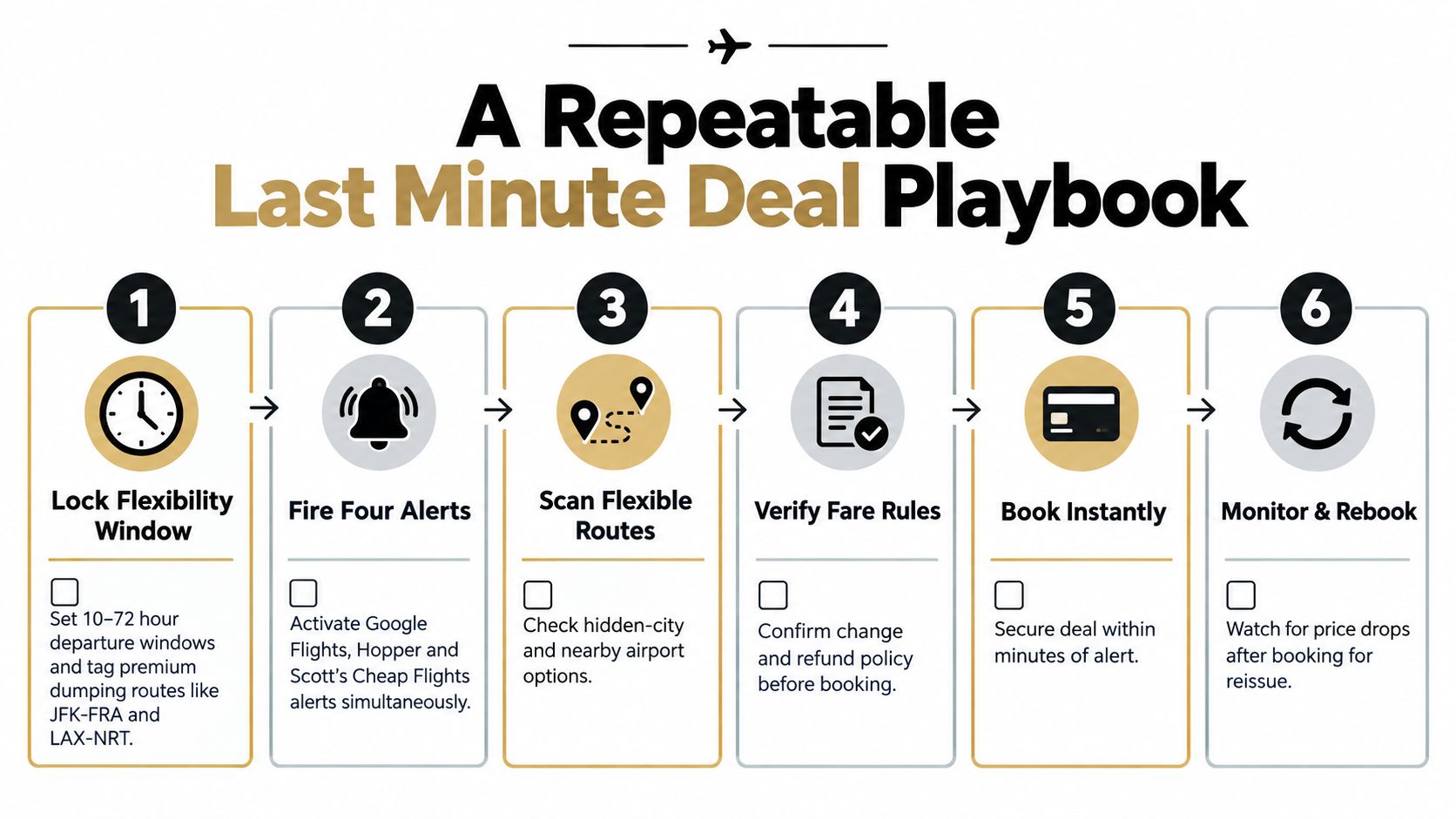
A six-step infographic guide titled A Repeatable Last Minute Deal Playbook for finding cheap airfare.

A checklist for the travel desk

Action Tool or evidence Time to action
Set route and cabin alerts Google Flights, Hopper, Kayak, Going Early in the monitoring period
Compare recent movement Saved fare-history screenshots At every alert
Validate unusual pricing ITA Matrix and airline confirmation Immediately
Review award inventory ExpertFlyer, Seats.aero, airline calendars During the premium search
Approve and ticket Fare rules and corporate policy As soon as the threshold is met
Recheck the itinerary Airline account and ticket record After booking

The workflow works because it separates discovery from judgment. Alerts find movement, historical data tells you whether the movement matters, and fare rules determine whether the apparent bargain is usable.

Passport Premiere offers members real-time premium-fare monitoring, downward fare alerts, international Business and First Class combinations, and a BUY IT NOW option for short-notice travelers who need immediate confirmation. If your team regularly books international travel inside the final weeks, visit Passport Premiere to evaluate whether its fare intelligence fits your approval and booking process.
Business Class Seat Availability and How to Track It

The most popular advice about business class seat availability is wrong: an empty-looking premium cabin doesn't mean a cheap seat is available. A seat map is not a fare quote, an award calendar, or proof that the airline will sell you the lowest business-class price.

The useful question is narrower and more practical: which seat is sellable on this aircraft, on this flight, at this fare, in this booking class, right now? That shift changes how you search, when you act, and why business class can occasionally cost less than coach.

Why Empty Premium Cabins Are Not the Same as Available Seats

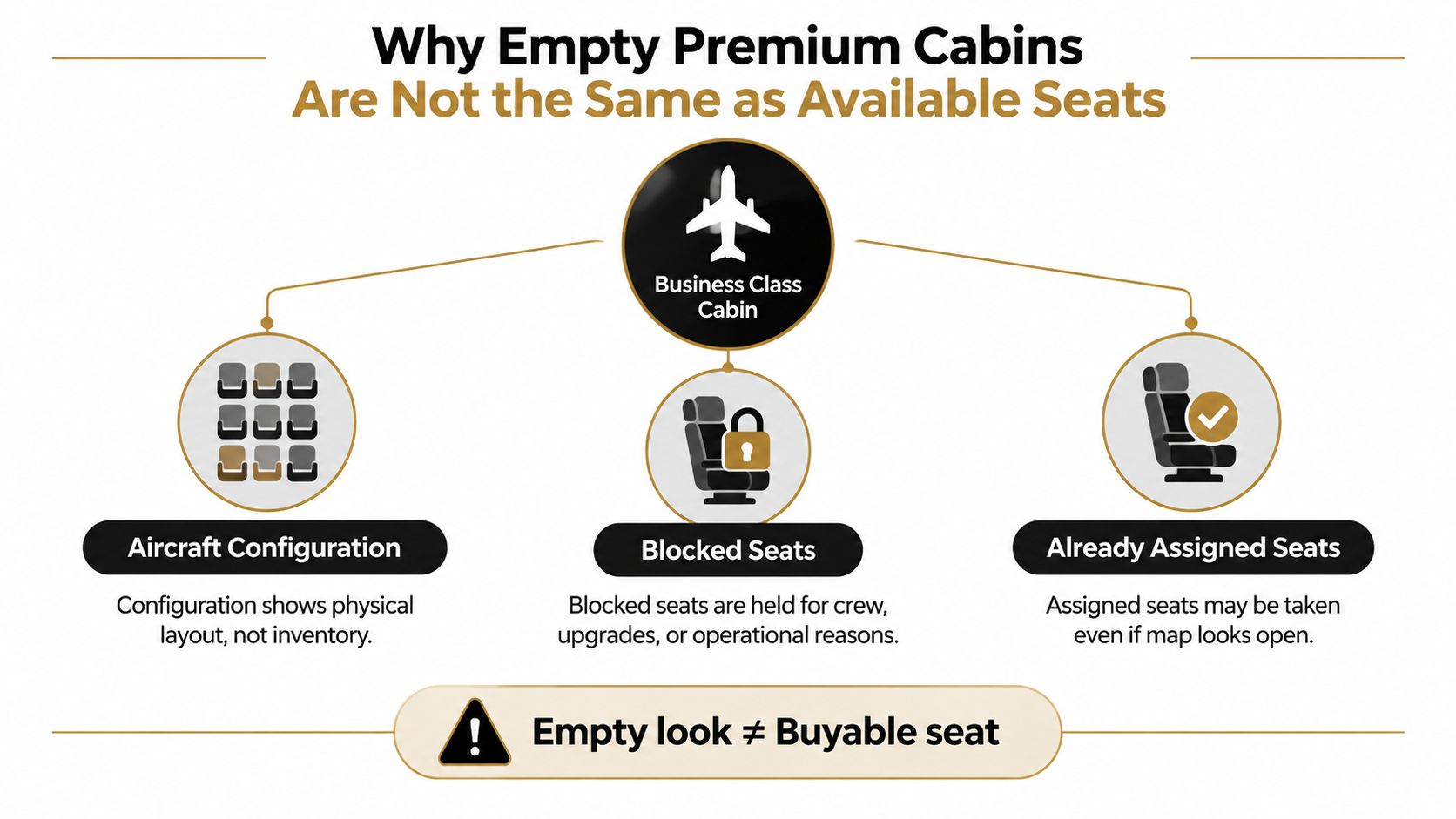
A seat map shows a physical layout, not the complete commercial inventory. It may display the aircraft configuration, seats already assigned to other travelers, and seats blocked for operational reasons. It usually won't tell you whether an unoccupied seat belongs to a discounted business fare, a flexible fare, an upgrade bucket, or an award class unavailable to your loyalty program.

The distinction matters because airlines sell the same cabin through separate inventory channels. A business seat might be available for a high cash fare but closed in the cheapest business booking class. It might be open for an upgrade but unavailable as an award. It could also be physically empty while the airline protects space for elite upgrades, operational recovery, or late-booking corporate demand.

Practical rule: Treat the seat map as a clue about the aircraft, never as proof that a buyable seat exists at your target price.

An infographic explaining why empty premium cabin seats displayed on maps may not be available for purchase.

The cabin can look empty for several reasons

An airline may block seats because of crew requirements, aircraft certification, service limitations, or a late equipment change. Recent coverage described Lufthansa's Allegris 787 business cabin flying with only 4 of 28 seats bookable, while 24 seats remained blocked because of certification delays, as reported by Mainly Miles' coverage of restricted premium-cabin seating. The aircraft had seats. Travelers couldn't treat all of them as normally sellable inventory.

Singapore Airlines has also been reported to block portions of its business cabin for certain fare types until 96 hours before departure, which means access can depend on both the ticket and the time remaining before takeoff, not merely on whether the seat map looks open. The same coverage explains why seat access is becoming a revenue-management tool rather than a simple occupancy display.

The reverse can happen too. A nearly full map may still produce a late award opening or a lower revenue fare if the airline changes inventory controls. Airlines can move unsold space between fare buckets, release an award seat, or assign previously blocked seats after an operational restriction clears.

Check the product, not the pixels

Start with the exact operating flight, date, aircraft, passenger count, and cabin. Then verify the live cash price or mileage quote. A seat map won't reveal the booking code, fare restrictions, cancellation terms, or whether the visible seat can be ticketed through your chosen program.

Business class is structurally scarce. Among the world's 50 leading full-service carriers, business class represented 9.2% of installed seats, rising to 12.2% on widebody aircraft, according to Mighty Travels' analysis of long-haul business-class seat availability. That limited physical supply gives airlines room to protect premium inventory, especially on long-haul routes.

The best search habit is simple: separate visual occupancy, paid availability, and award availability. Only the final live, bookable result counts.

How to Read Business Class Seat Availability Like a Pro

Professionals don't begin with the seat map. They work through the flight in layers, because every layer can change the answer.

Start with the aircraft and operating carrier

Confirm who operates the flight and which aircraft is scheduled. A codeshare search can display one carrier's flight number while the operating airline controls the actual cabin, seat layout, and inventory. Aircraft swaps can also change the number of business seats, the seat model, and which positions are blocked.

Next, inspect the cabin itself. Look for the business-class rows, blocked positions, bassinet locations, and unusual layouts. Don't assume every premium-looking section is the same product. A true long-haul business cabin, a regional recliner product, and a converted section can appear differently in search tools while carrying very different value.

Move from the map to the fare

Compare the fare family and booking class, not just the headline price. A discounted business fare might have stricter changes, limited refundability, or weaker upgrade eligibility than a higher fare in the same cabin. Your target is the cheapest acceptable product, not merely the first business result displayed.

For a useful primer on how airline fare letters affect ticket rules and upgrade eligibility, review this guide to flight class codes. Booking codes such as J, C, D, Z, and P can indicate different inventory levels, but the meaning and conditions vary by airline.

Check the full itinerary as well. A through-ticket can contain mixed cabins, married-segment logic, or a connection where only one flight offers business class. The total fare may be attractive while one segment remains in economy.

Validate the award separately

Award availability requires its own check. Confirm the points price, taxes, transfer path, cancellation rules, and partner booking class. Then search the operating carrier and relevant partner programs, because one program may show space another can't sell.

ExpertFlyer says it can search open award and upgrade inventory by flight and class, search up to 3 days on either side of a target date, and show how many seats are open before you transfer miles or apply a certificate, as described in its airline award and upgrade search features. Use that flexibility to scan broadly, then verify the exact date before booking.

Check What to verify Why it matters
Flight Operating carrier, flight number, date, aircraft Equipment and inventory can differ by flight
Cabin Business rows, blocked seats, product type A visible seat may not be commercially accessible
Fare Brand, fare family, total price, restrictions The cheapest business product may sit in another bucket
Booking class Revenue or award code The code controls availability and often ticket conditions
Itinerary Every segment and cabin Mixed-cabin or through-ticket rules can alter the result
Confirmation Live price, mileage quote, seat assignment Only a current, ticketable result proves availability

The professional sequence is route, aircraft, cabin, fare, booking class, restrictions, confirmation. Seat-map occupancy belongs in the middle, not at the end.

Award Space Versus Revenue Seats and Why It Matters

Cash inventory and award inventory share the same physical aircraft, but they don't share the same commercial rules. The airline's pricing engine manages revenue fares, while loyalty programs receive a separate pool of redemption inventory. That's why a flight can have unsold business seats and no saver awards, or award space while the cheapest cash fare remains expensive.

Two systems, two decisions

Revenue inventory is built to maximize ticket revenue. Airlines open and close fare buckets according to demand, competition, route economics, and remaining capacity. A lower business fare can appear after the airline decides that selling at a discount is better than leaving the seat unused.

Award inventory is more restricted. The operating carrier determines what it releases, while partner programs show only the space they're permitted to sell. A calendar marked “business” may hide partner limitations, taxes, transfer friction, or a booking class that isn't available through your preferred program.

Dimension Revenue seats Award space
Controller Airline revenue-management system Airline loyalty and partner inventory rules
Price Cash fare by brand and booking class Miles or points plus taxes and fees
Best use Fare sales, premium discounts, unusual price gaps High-value redemptions when cash prices are high
Main trap Cheap headline fare with harsh restrictions “Business” result that isn't accessible through your program
Verification Live fare quote and fare rules Live award quote, partner access, and transfer path

Search both channels in parallel. For revenue tickets, compare the total price, baggage, changes, cancellation terms, and booking class. For awards, compare the mileage requirement, taxes, transfer partners, cancellation rules, and operating-carrier access.

A visible business cabin is a lead. A confirmed fare or award is the result.

Flexibility improves the search. Check nearby dates, alternate airports, and competing carriers. ExpertFlyer's ability to search nearby dates is useful when a single-day search fails, while a separate award workflow can help identify whether the right redemption is available through United or another partner. The MileagePlus upgrade and award guide is useful when you're comparing an upgrade path with a direct award.

Don't transfer points until the award is confirmed and bookable. Award inventory can change before the transfer completes, and a points balance doesn't create space that the airline hasn't released.

Routes Where Business Class Drops Below Coach

Business class can be cheaper than coach. It's unusual, but it happens when flexible economy fares rise sharply while premium seats remain unsold, as explained by Australian Frequent Flyer's analysis of business fares undercutting economy.

The mechanism is straightforward. Airlines don't price cabins in a perfectly smooth ladder. Economy may close its cheaper buckets while business retains a promotional or distressed fare. A traveler comparing only the cheapest economy headline can miss the more expensive flexible economy options that make business class the better purchase.

Look for the gap, not a mythical route list

The strongest opportunities tend to appear on competitive international routes, off-peak widebody services, and markets where airlines are fighting for premium demand. Independent commentary reports that business fares on competitive transatlantic and transpacific routes can fall to two to three times the economy price during off-peak periods, while some leisure-heavy routes can price at less than twice economy, according to Winghoppers' discussion of premium fare gaps.

A route-level example is more useful than a broad promise. Holidu found Iberia's Madrid to Athens flight priced at £454 in economy and £562 in business class, a difference of £108, as shown in its business-class bargain analysis. That's not a universal pattern, but it demonstrates how narrow the gap can become when premium inventory needs stimulation.

Route pattern Typical gap Best window Trigger
Competitive transatlantic Business may approach two to three times economy in off-peak periods Lower-demand travel periods Premium fares remain flat while economy rises
Competitive transpacific Business can compress toward economy when demand softens Off-peak periods Rival capacity or weak premium bookings
Leisure-heavy international route Business can cost less than twice economy Shoulder or off-peak periods Unsold premium seats and aggressive competition
Madrid to Athens example £108 gap in the cited fare comparison The observed market window Iberia business inventory priced close to economy

The diagnostic signals matter more than the city names. Watch for an economy fare spike with no matching business increase, a new aircraft entering the route, or a schedule change that creates excess premium capacity. Don't assume more business seats guarantee a bargain. Reuters reported American Airlines increasing premium seating on 777 aircraft to 144 seats, about 44% of the aircraft, as carriers pursue higher-spending travelers, according to the Frequent Miler discussion of premium-cabin expansion. More seats can coexist with tight yield controls.

Timing Your Purchase Across the Fare Calendar

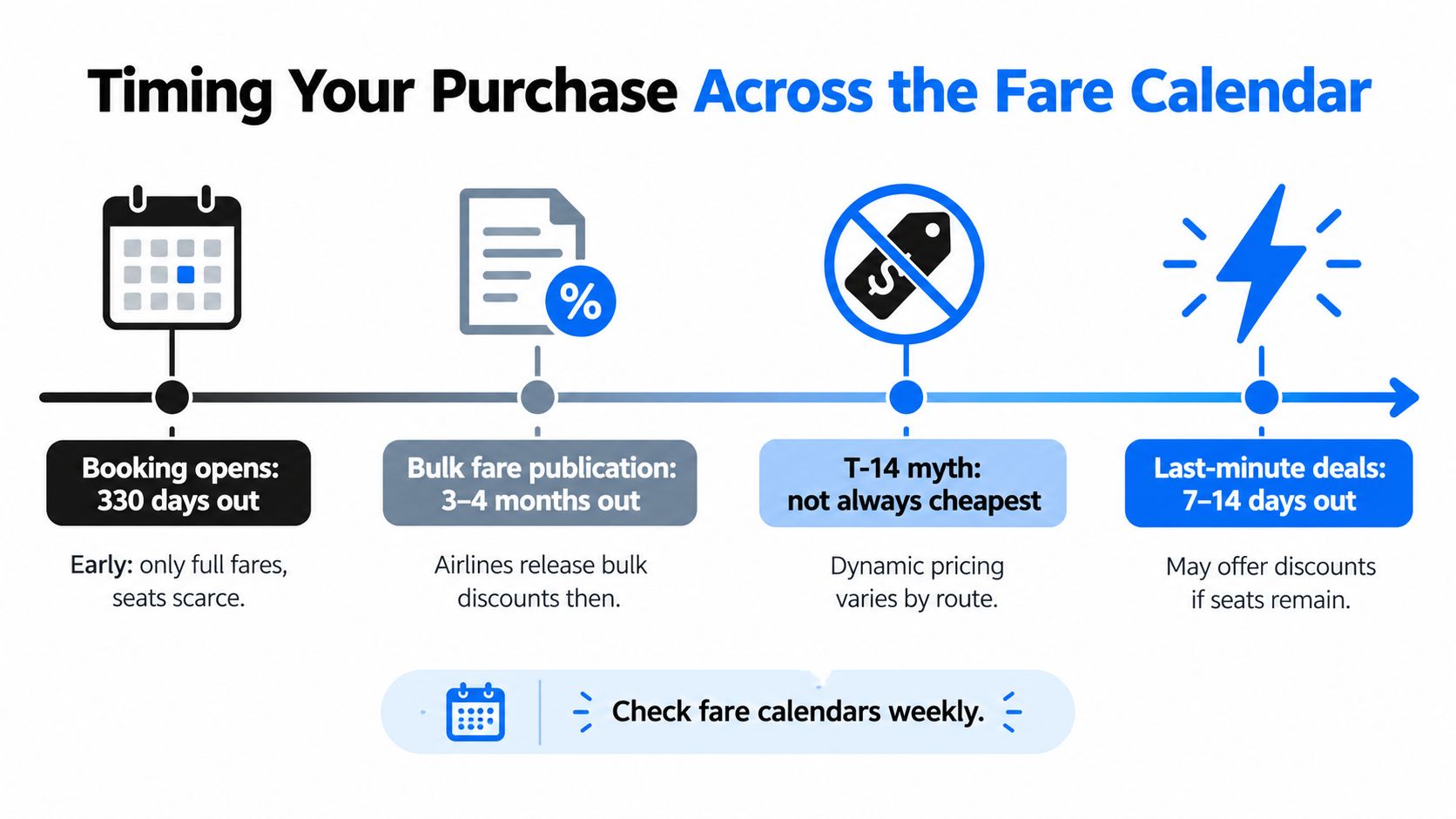
The myth that T-14 is always the cheapest window causes travelers to wait without a monitoring plan. Airlines adjust premium fares dynamically, and the right opportunity depends on the route, season, aircraft, and inventory bucket. A late discount can appear, but waiting until the final stretch can also leave you with fewer seats and harsher prices.

Start watching when the schedule opens. Don't expect the cheapest fare immediately. Early inventory may contain mostly higher-priced options, while the airline tests demand and protects premium space.

Use a horizon-based watchlist

Track the route through several windows rather than making one search on one day.

  • At schedule opening: Record the aircraft, cabin size, fare families, and initial business prices. This creates a baseline and exposes later changes.
  • Several months before departure: Recheck the fare calendar, especially during shoulder-season travel. Bulk discounts and competitive adjustments often appear before the final weeks.
  • Inside the final weeks: Monitor every target date more closely. A lower fare can emerge if premium seats remain unsold, but scarcity risk rises as departure approaches.
  • After a schedule change: Search immediately. Aircraft swaps, timing changes, and added or removed service can force an airline to rebalance inventory.

The global recovery pattern explains why patience must be selective. In 2022, global airline capacity recovered to about 86% of pre-crisis levels, while business-cabin capacity recovered to almost 84%, with another industry analysis placing business-cabin recovery at approximately 83%, according to Skift Research's premium-cabin capacity analysis. Premium supply was still lagging overall capacity, so travelers faced tighter conditions even as schedules returned.

An infographic showing the timeline for booking flight tickets to find the best business class seat availability.

Act immediately when the fare moves

When a useful business fare appears, don't admire it. Run this sequence:

  1. Verify the booking class and confirm every segment is in the intended cabin.
  2. Read the fare rules, including changes, refunds, baggage, and advance-purchase conditions.
  3. Check partner inventory if you're considering miles or an upgrade.
  4. Use a hold or refundable option where the airline makes one available.
  5. Compare the final total, then ticket before the bucket closes.

This video adds practical context for reading fare patterns and booking decisions.

Check fare calendars weekly, but increase the frequency once a target route enters an active sale or schedule-change period. The winning habit is not guessing the perfect day. It's seeing the change quickly and verifying the exact sellable product before someone else takes it.

Tools and Alerts That Catch Fare Drops First

No single tool sees every layer of premium inventory. Use each platform for the job it handles well, and assume every result needs a second verification.

Google Flights is the broad revenue-fare scanner. It's useful for comparing dates, carriers, airports, and visible business prices, but it may not expose every booking-class nuance or codeshare distinction.

ExpertFlyer is the specialist tool for flight-specific award, upgrade, and class inventory searches. Its value increases when you care about a particular flight or booking class, but it still reflects the inventory sources and programs available to it.

Seats.aero and AwardFares suit points-focused travelers scanning award calendars across programs. They can reveal patterns faster than manual searches, but partner access, married-segment rules, and final booking conditions still require confirmation.

FlightConnections is a route-discovery tool. It helps identify alternate hubs and competing carriers, not whether a particular business seat is sellable at a target fare.

Kayak price alerts are useful for broad cash-price movement. They're less precise when your strategy depends on a specific premium booking class rather than a general cabin price.

Airline-specific trackers can be valuable when you repeatedly fly one carrier, particularly if you understand its fare brands and loyalty rules. The weakness is fragmentation. You may need separate systems for revenue pricing, award space, seat maps, and partner inventory.

For travelers comparing premium trips with broader destination planning, guides for UAE adventures can help identify alternative cities and routing ideas before you begin the fare search.

Tool Tracks Business coverage Limitation
Google Flights Cash fares, dates, carriers, airports Broad business-fare visibility Booking-class and partner details can be limited
ExpertFlyer Flight-specific award, upgrade, and class inventory Strong for targeted cabin checks Requires careful interpretation of live inventory
Seats.aero Award calendars and program availability Useful for points-led scanning Partner and segment rules still need validation
AwardFares Award-space searches across programs Helpful for comparing redemption paths Displayed results may not equal final bookability
FlightConnections Routes, hubs, and competing services Indirect business-class value Doesn't prove fare or award inventory
Kayak alerts General cash-price changes Useful for broad monitoring Not designed around precise premium buckets
Airline trackers Carrier-specific fares and loyalty space Strong within one airline ecosystem Coverage is narrow and fragmented

Passport Premiere is one monitoring option for travelers who want premium-cabin fare alerts and notifications for situations where business class can undercut coach. Its role is to add a fare-monitoring layer to the manual checks above, not to replace live verification. Details on that approach appear in the business-class fare alerts resource.

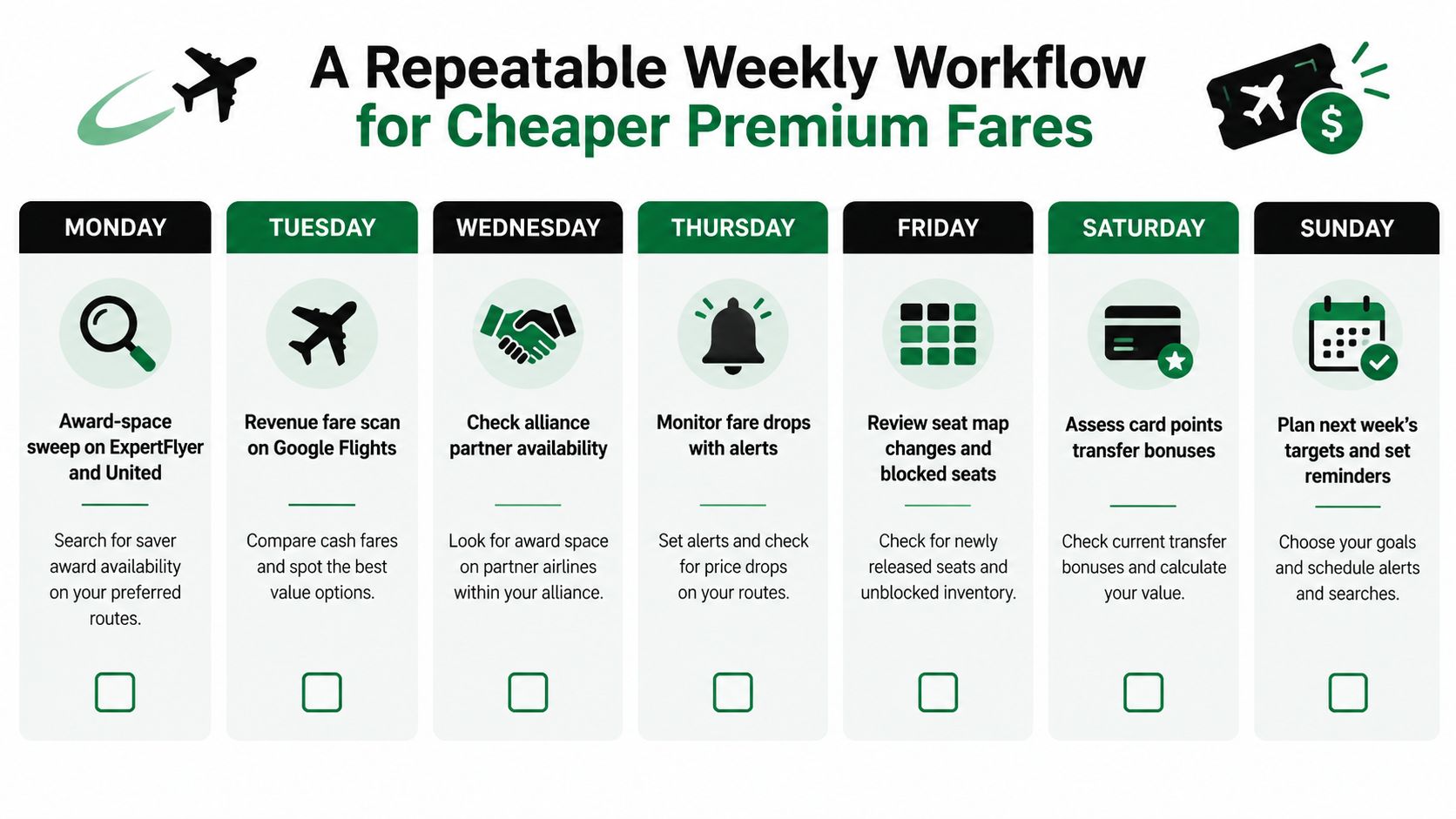
A Repeatable Weekly Workflow for Cheaper Premium Fares

A monitoring system works only when it's repeatable. Set fixed tasks for each day, log the result, and define what deserves immediate action. The objective isn't to search every airline endlessly. It's to maintain visibility across both revenue fares and award space before a short opening disappears.

Run the same loop every week

Monday is for awards. Search ExpertFlyer and United across your preferred routes, nearby dates, and passenger counts. Check whether the result is a true business award, identify the program displaying it, and record the mileage and restrictions.

Tuesday is for cash. Scan Google Flights and ITA Matrix across your next four travel windows. Compare business against both the cheapest economy fare and the flexible economy fare. Log the fare family, booking class when available, operating carrier, and aircraft.

Wednesday is for competitors. Check SeatSpy and FareAlert, then search alliance partners on the same route. A carrier may show no useful space while a partner exposes a different award path or a competing cash fare.

Thursday is for verification. Open the operating carrier's website and inspect the seat map, fare rules, and booking class. Confirm that the result is ticketable, rather than relying on a cached alert or a codeshare display.

A weekly infographic guide showing daily tasks to find cheaper premium flight fares and seat availability.

Friday is for anomalies. Review SecretFlying and relevant X accounts for mistake fares, route sales, and sudden premium-price movements. Treat every alert as unverified until the airline or booking channel produces a live fare with usable rules.

Saturday is for points. Check transfer bonuses available to your cards and compare the resulting redemption with the cash fare. Don't transfer speculatively.

Sunday is for planning. Review triggered alerts, remove dead routes, add new target dates, and set the next week's searches. A clean watchlist beats a huge one you never inspect.

Define your action threshold

Track J, C, D, Z, and P where the carrier uses those business booking classes, but don't assume the same letter means the same product across airlines. Record lower fare buckets, flexible alternatives, taxes, and the final cabin on each segment.

Act within 60 minutes when a target fare or award opens and the fare rules fit your trip. Premium inventory can change quickly, and delay is the most common reason travelers lose a verified opening.

The manual checklist should be your safety net. A monitoring service can run the background searches, surface J-class openings or revenue drops, and leave you with the decisions that require judgment: route quality, flexibility, aircraft, and ticket conditions.


Passport Premiere monitors international premium-cabin fare movements and alerts members to business-class opportunities, including cases where business class prices fall below coach. Visit Passport Premiere to add those signals to your weekly availability workflow and stop treating the seat map as the final answer.

Business Class Fare Search: A Practical Playbook for 2026

Business class can be cheaper than coach. A published example on ORD to LHR shows coach at $1,950 versus business class at $1,850, while LAX to NRT shows coach at $2,400 versus business class at $2,300, once the comparison accounts for the total fare rather than the cabin label alone (Passport Premiere's discounted business-class examples). That isn't an airline loophole you can exploit with a browser trick. It's the result of separate inventory, changing demand, fare rules, and route-level competition.

A useful business class fare search therefore starts with a different question. Instead of asking, “What's the cheapest business fare today?” ask, “How does this fare compare with the same route, cabin, fare class, and departure window?” Historical airfare providers can track more than 10 years of fare history and up to one year forward, recording cabin class, fare type, booking channel, and seat availability (historical premium-cabin fare data). That depth turns premium pricing from a snapshot into a market you can monitor.

Why Business Class Sometimes Costs Less Than Coach

Business class is not priced as coach plus a fixed upgrade charge. Airlines file separate fare products, each with its own restrictions, demand pattern, and remaining inventory. That structure can make the premium cabin cheaper on a particular search, even though it usually carries a higher published value.

The comparison has to be made at the fare level, not by cabin label alone. A coach ticket may come from a flexible or nearly full bucket while discounted business inventory remains available. A separate example of flexible pricing found a refundable coach fare above a business fare because the premium ticket was filed independently (route-specific fare example). The practical lesson is to compare the fare basis, rules, and itinerary before deciding that the cheaper headline price is the better purchase.

An infographic explaining why business class flights can sometimes be cheaper than economy based on airline demand algorithms.

The inventory problem most travelers miss

Airlines use multiple booking buckets, often including economy letters such as Y and B, and business letters such as J, D, and R. The exact meaning differs by carrier, but the letter identifies inventory and fare construction, not merely the visible seat.

A lower business bucket such as D may carry stricter cancellation or change terms than a full J fare. At the same time, cheaper economy space may have closed, leaving a search to return Y inventory. Compare the booking class and conditions before treating the price gap as a genuine saving.

Yield-management systems also respond to departure timing. An unsold premium seat has no value after departure, so an airline may reduce a business fare when expected demand does not arrive. That creates volatility, especially on competitive routes, but it does not make last-minute buying a dependable strategy. A low fare can disappear as quickly as it appears.

Control the variables that matter

Travelers cannot set an airline's revenue-management controls, but they can change departure date and, when practical, origin city. A nearby airport, another departure day, or a connecting itinerary may access a different fare filing. Search those variables deliberately instead of relying on repeated searches for one fixed itinerary.

The mechanics are explained in this guide to yield management pricing. Apply the idea operationally: compare like-for-like fares, inspect the rules, record the price and inventory, then decide whether the volatility justifies waiting. For a corporate traveler, the right fare is the one whose restrictions and schedule fit the trip, not the cabin with the lowest displayed price.

Building Your Search Stack With ITA Matrix and GDS Tools

ITA Matrix is useful because it exposes search structure that consumer booking pages often hide. It's a discovery tool first, not necessarily the place where you'll complete the purchase. Start with a route such as JFK to LHR, select business class, and search a flexible date range rather than anchoring yourself to one departure.

Start with broad discovery

Use Matrix to compare nonstop and connecting itineraries, nearby dates, and alternate airports. The display can be sorted by cost or by miles. Cost helps identify the cash opportunity, while miles helps reveal whether a longer routing creates a poor operational trade-off even when its fare looks attractive.

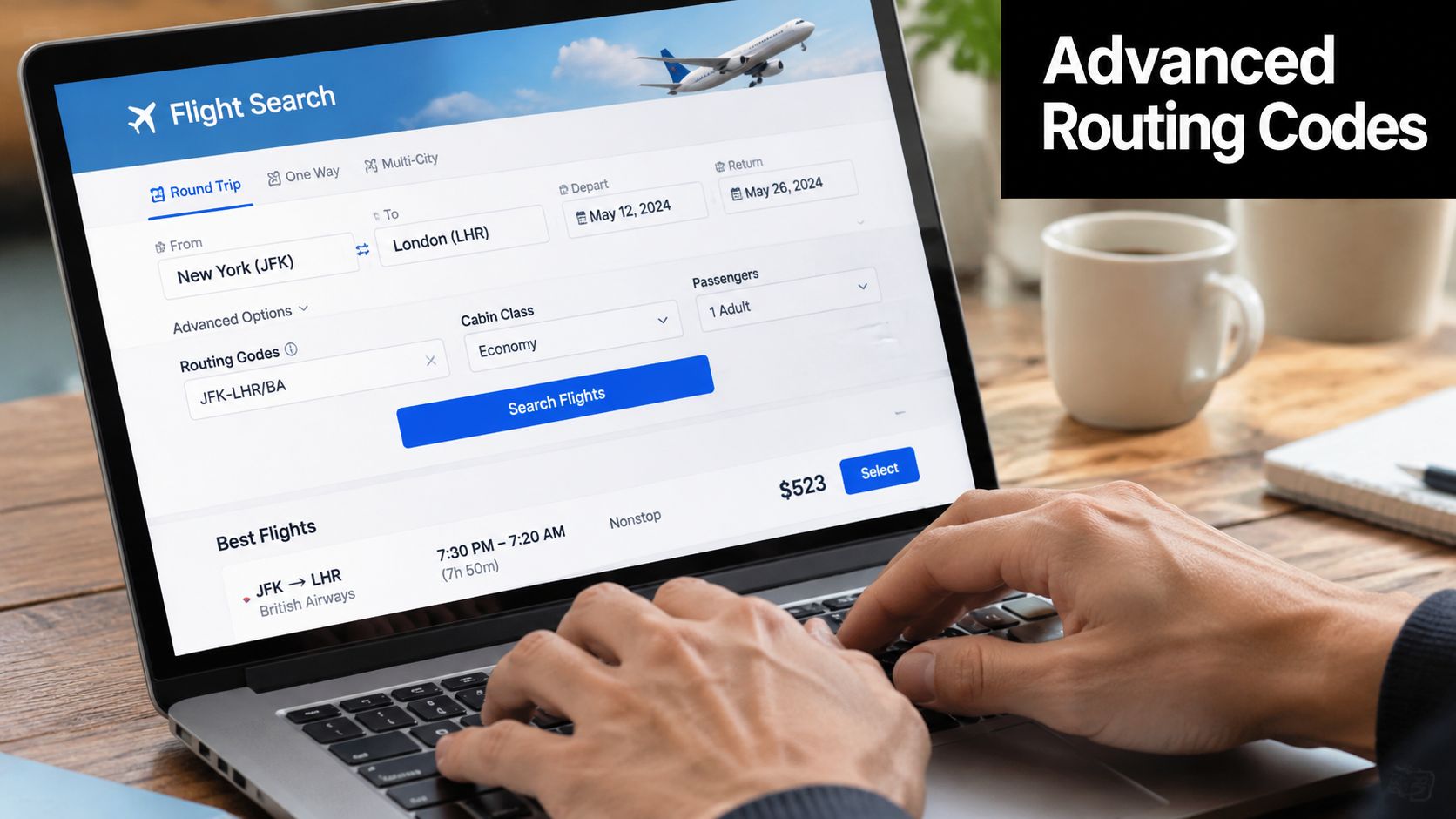
Advanced routing codes can narrow the results when you know what you're testing. An American search may use an AA carrier code with a fare-basis filter, Delta searches can be constrained similarly, and Air Canada searches may use connection or carrier coding. The syntax is powerful, but it's also easy to misread, so begin with a clean search and add one constraint at a time.

Screenshot from https://example.com/screenshots/ita-matrix-advanced-routing-codes.png

The “show separate tickets” option deserves caution. It can reveal a lower combined price by splitting an itinerary, but separate tickets remove much of the protection you'd have on one reservation if the first flight runs late. I use the result as a lead, then test whether the saving justifies the missed-connection exposure.

Confirm the cabin, not just the seat

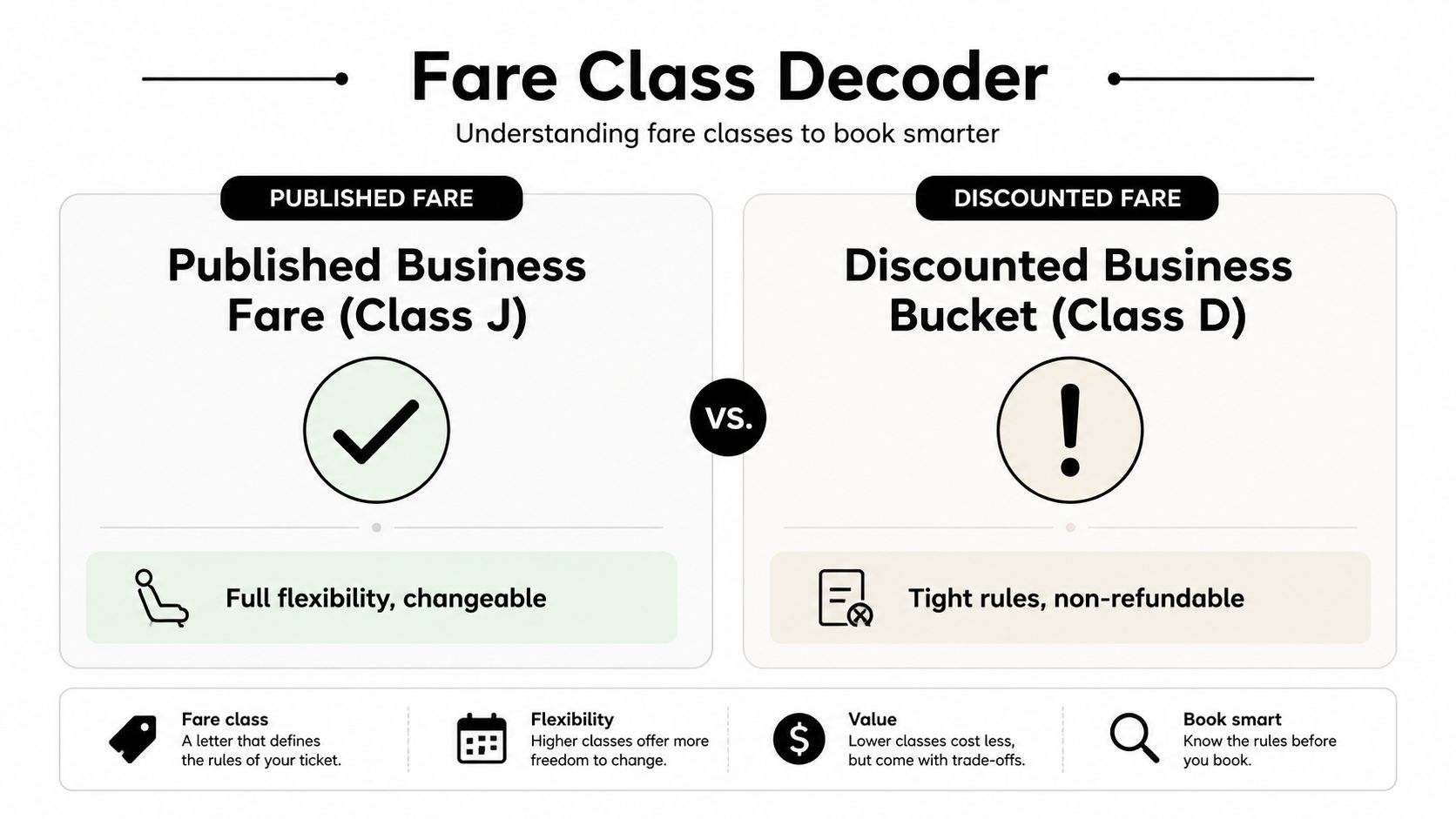
The fare-class column is the first verification point. A result showing J is generally a full business booking bucket, while D commonly indicates discounted business inventory. Neither letter alone tells you the complete cancellation policy, so open the fare rules before treating the result as usable.

The distinction between cabin and fare class is explained in this flight class code reference. A business cabin can contain several fare levels, and the cheapest one may have rules that make it unsuitable for a meeting-heavy itinerary.

My usual stack is layered:

  • Matrix for discovery: Find route combinations, date shifts, and unusual fare construction.
  • ExpertFlyer or KVS for verification: Check seat maps and whether the relevant premium fare bucket is available.
  • A meta-search engine or OTA for purchase: Confirm the price on a bookable channel, then look for a hold or the applicable booking protections.

That workflow is more reliable than repeatedly refreshing one airline page. Each tool answers a different question, and skipping the fare-class check is where many apparent bargains disappear.

Route Choice and Connection Trade-Offs

The cheapest business-class result is often not the nonstop. Connecting carriers through major hubs can undercut nonstop pricing by 10% to 20% (route and product comparison). That discount can be meaningful, but it buys something with a cost: more elapsed time, another airport operation, and a greater chance that the itinerary won't fit a meeting schedule.

A nonstop premium product may offer a simpler airport experience and a more predictable arrival. A one-stop itinerary through Doha, Istanbul, Abu Dhabi, or another major hub may provide a competitive lie-flat seat and a substantial fare reduction, but the quality of the connection matters as much as the seat itself.

Route Nonstop Lowest J Fare One-Stop Lowest J Fare Carrier Pair Approx. Savings
JFK to DXB Higher nonstop market price Lower connecting fare Nonstop carrier vs Middle East hub carrier 10% to 20%
LHR to SIN Higher nonstop market price Lower connecting fare Nonstop carrier vs Asian or Middle East carrier 10% to 20%

These are directional comparisons, not guaranteed quotes. Actual availability depends on the date, carrier, fare class, and booking channel. A lower fare only works if the connection preserves the arrival time, baggage treatment, and schedule flexibility the traveler needs.

Compare the product, not only the ticket

A connection may be worth taking for a leisure trip where the lounge, shower, or break in the journey adds value. For a consultant flying overnight before a client presentation, an extra airport stop can erase the benefit of a lower fare.

Hard-product differences also matter. Some aircraft provide direct aisle access throughout the cabin, while others use an older configuration with less privacy or fewer lie-flat seats. A premium cabin can be commercially attractive while still being a poor fit for sleep, work, or a tight arrival deadline.

Secondary-hub pricing can behave differently

Search secondary hubs deliberately rather than accepting the default nonstop result. Doha, Istanbul, and Abu Dhabi can produce fare combinations that don't resemble the pricing from the traveler's home carrier. These “fuel-dumper” style searches are really a form of origin and routing experimentation. They work when the fare filing is competitive, but they require careful checking of ticket construction, connection time, and protection across the whole itinerary.

Timing Your Search Around the Premium-Cabin Price Cycle

Premium fares can change direction before your travel plans do. IATA reports that international business-class fares typically decline during summer, rebound in September, and rise again from March through May as business travel returns after holiday periods and before summer slowdowns (IATA premium-class travel reporting). Use that pattern to set monitoring periods, not to predict an automatic sale.

A practical calendar has four watch windows, but each route needs its own baseline. Transatlantic markets may soften before premium-heavy Asia hubs. Australia and Japan can follow different patterns from Europe because carrier competition, local demand, and premium inventory vary.

Quarter Index vs Peak Softest Routes Firm Routes
First quarter Post-holiday trough or transition Transatlantic markets, selected Japan routes Premium-heavy Asia hubs
Second quarter Rebound risk from March through May Routes with competitive inventory Constrained Asia markets
Third quarter Summer shoulder-season softness Transatlantic, Australia, selected Japan routes Premium-heavy hubs
Fourth quarter Late-November volatility Routes with promotional competition Routes with limited premium inventory

Avoid percentage-drop targets without context. Build a route-specific baseline from the same booking class and a comparable itinerary, then flag fares that move below the recent range. A connecting itinerary should not become the benchmark for a nonstop trip.

Use a median, then verify the market

Set an alert around 75% of the prior 90-day median, and treat a move below 60% as a high-priority signal only after confirming that the fare is real and bookable. These are operating rules, not savings guarantees. A quote that exists only in coach inventory, disappears at checkout, or imposes unusable restrictions is not a successful alert.

For JFK to LHR, compare nonstop with nonstop, the same business fare family with the same family, and similar departure dates. For LAX to NRT, the published example of $2,400 coach versus $2,300 business shows why the comparison must include the actual cabin and total fare rather than a generic route average (LAX to NRT fare example).

Account for the direction of the market

A broad premium-market increase can coexist with a short-lived drop on one route. Industry reporting places premium fares at about 15% of passenger revenue, excluding ancillary income, while a major wealth and lifestyle report found business-class prices rose 18.2% in USD terms versus 2024. Those figures support a practical corporate rule: lock a fare when it is below your route baseline, the itinerary meets schedule requirements, and the fare rules permit the needed changes.

Keep watching only when the trip is flexible and the current quote sits near the route's normal range. Set an expiration point for monitoring, such as the moment schedule risk or internal approval time becomes more costly than a possible fare reduction.

Reading Fare Rules and Verifying a Real Deal

The price is only the first line of a business-class ticket. A fare can appear attractive because it uses a restricted booking bucket, requires a particular stay pattern, or is available only through a channel that can't complete the transaction. The rule screen tells you whether the deal fits the trip.

An infographic titled Fare Class Decoder explaining the differences between published business class fare and discounted business fare.

Decode the fare before comparing it

In a Matrix result, Y and B generally point to economy inventory, while J, D, and R commonly identify business-class inventory. The letter is not a universal promise of flexibility, though. Airlines assign their own conditions and mileage treatment, so the full fare basis and rule text matter more than the shorthand.

Check four items before you circulate the fare internally:

  • Advance purchase: Confirm how far before departure the ticket must be issued.
  • Minimum stay: Look for a Saturday-night or other stay requirement.
  • Changes and cancellation: Record the penalty, refundability, and reissue conditions.
  • Mileage treatment: Verify whether the fare earns the mileage or status credit your policy assumes.

A discounted D fare may be perfectly suitable for a fixed client trip. It may be a poor choice for a consultant whose meeting schedule changes frequently. The right fare is the one whose restrictions match the business purpose, not automatically the one with the lowest number.

Separate a real dip from phantom pricing

Use three diagnostic questions:

  1. Is the fare filed across multiple origins? A genuine competitive move often appears across a coherent market, while an isolated display may be a data error or narrow channel result.
  2. Can a GDS-connected channel book it? If the fare exists only on a direct page and fails during ticketing, treat it as unverified.
  3. Does premium inventory load? Confirm that the booking uses business inventory rather than coach space with a misleading cabin presentation.

Consider two hypothetical JFK to FCO results:

Test True J-class sale Phantom W-class result
Displayed price $2,200 $2,100
Inventory J business space W coach space
Rule profile Published business fare, possibly restricted Economy fare presented beside premium options
Booking test Should load through a bookable channel May disappear or reprice
Decision Continue verification and consider booking Reject as a business-class deal

The cheaper result isn't automatically better. If it doesn't load into the promised premium cabin, it isn't a business-class fare search win.

Alert Workflows and Real-World Search Scenarios

Monitoring works when the alert system has a job and a review cadence. Google Flights can provide a historical price view and exploration, Seat 31b can help with fare-class alerts, and ExpertFlyer can monitor fare-rule changes. Each tool should answer a different question rather than producing another duplicate stream of notifications.

Use a simple operating rhythm:

  • General routes: Review once a week.
  • Premium-heavy lanes: Review twice a week.
  • Known volatility windows: Check daily while the travel dates remain flexible.

The alert should identify a move. The traveler still needs to verify the fare class, rules, routing, and ticketing channel.

Scenario one

A Passport Premiere member monitoring SFO to SIN notices an 8% inventory bump during the late-March shoulder window and finds a $3,900 J fare with 7-day advance-purchase rules. The correct response isn't to assume the fare will remain available. The member checks the schedule, confirms the J inventory, reads the change terms, and locks the ticket if the meeting dates are firm.

Scenario two

Another member ignores a 12% Cathay Pacific dip on LAX to HKG because the alert arrives late. By the time the search is reviewed, the fare has loaded in P class, with less routing flexibility than the original opportunity. The lesson isn't that every alert must be booked instantly. It's that stale alerts need a timestamp, a fare-class record, and a clear escalation path.

The business-class fare alert service fits into this kind of stack as a route-monitoring layer. Configure one historical-chart tool, one real-time price tool, one rule-change alert, and one route-blocking tool. Route blocking prevents the system from flooding you with attractive but operationally unusable connections.

A Repeatable Decision Framework for Premium-Cabin Purchases

A corporate buyer needs more than a low-fare alert. The buyer needs a decision rule that survives changing schedules, handovers, approval limits, and incomplete information.

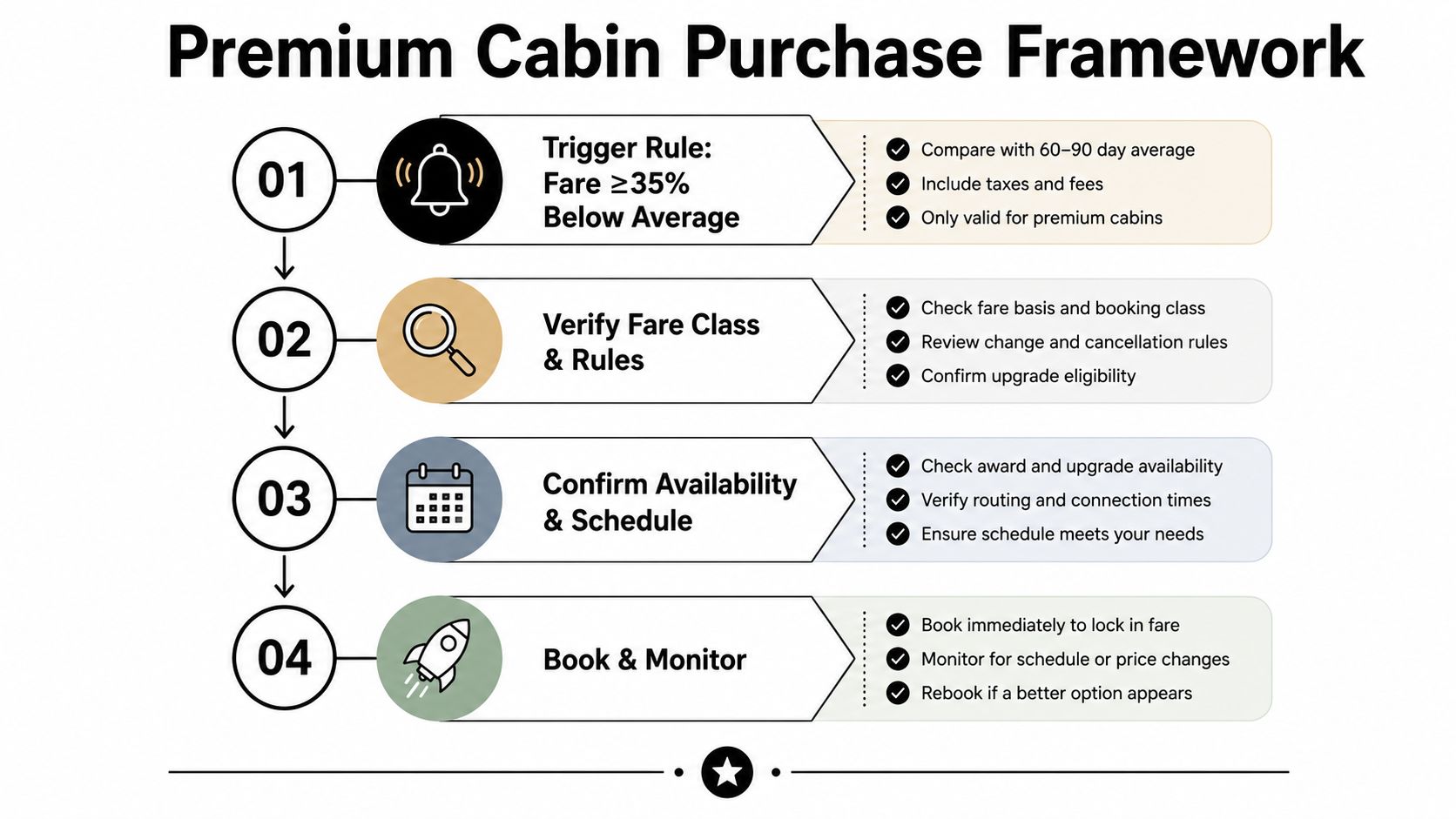
Start with a trigger: any fare 35% or more below the trailing 90-day median for the same fare class and routing moves to Stage 2 verification. Don't book from the alert alone. Cross-check the fare construction, cancellation terms, inventory, alliance-partner availability, and schedule-change exposure.

Use a route-specific booking window

Different long-haul markets deserve different watch periods:

  • Transatlantic: Monitor closely from 60 to 120 days before departure.
  • Transpacific: Use a broader 90 to 150 day observation window.
  • Ultra-long-haul to South America and Africa: Begin serious review around 120 to 180 days out.

These windows are workflow guardrails, not guaranteed price laws. A constrained route can remain firm, while a competitive market can produce an earlier opportunity. Lock when the fare clears the trigger and the rules fit the trip. Keep watching when the fare is merely interesting but the schedule or flexibility is weak.

Set a policy that finance can administer

A travel manager can cap unrestricted premium-cabin spend at the equivalent of three economy fares, auto-approve fares under that threshold, and send exceptions to one approver. That structure keeps decisions consistent without forcing every traveler to defend a reasonable premium fare from scratch.

A four-step infographic showing a premium cabin purchase framework for finding discounted business class flight fares.

Print the handover checklist

  • Source verification: Record where the fare appeared and when it was checked.
  • Fare-class confirmation: Save the booking class and complete fare basis.
  • Rule review: Note advance purchase, minimum stay, changes, refunds, and mileage treatment.
  • Schedule check: Confirm connection times, aircraft, arrival hour, and meeting viability.
  • Availability test: Verify that the fare still loads through a bookable channel.
  • Seat follow-through: Assign seats after ticketing and recheck them after any schedule change.

A disciplined business class fare search doesn't eliminate volatility. It gives the traveler a repeatable way to decide when volatility represents a usable opportunity.


Passport Premiere provides fare monitoring, market analysis, and member guidance for international business and first-class searches, including alerts when selected-route fares move downward. Visit Passport Premiere to review how its fare monitor and premium-cabin market tools can support your next booking decision.

Last Minute Business Flights: The Smart Fare Hunter’s

Business class can be cheaper than coach, but only in narrow fare-cycle windows. The trick isn't luck, it's reading premium-cabin repricing like a trading desk and buying when the market blinks.

Most travelers still think last minute business flights are a guaranteed premium tax. That's true in economy most of the time, but premium cabins follow a different rulebook, and airlines don't always protect their asking price when a flat-bed seat is sitting empty. The result is a market where the right route, the right airport, and the right hour can produce a fare that looks upside down.

Why the Last Minute Premium Fare Playbook Breaks the Rules

The lazy rule says late booking always gets more expensive. That rule is useful for coach, but it's too crude for premium cabins, where airlines would rather adjust the fare than leave a lie-flat seat unused. Fewer than 15% of premium cabin seats sell at their initial walk-up price, which means the sticker price is often just a starting position, not a final verdict on value. Passport Premiere's premium-cabin pricing model is built around that reality.

Why the seat, not the calendar, matters

Premium inventory is volatile because airlines manage it aggressively. If demand softens, they reprice unsold seats. If a route is hot, they hold the line. Either way, the point is simple, last minute business flights are not governed by one universal countdown clock.

That's why the old “book early or suffer” advice misses the mark in business class. A traveler can see a better fare on one departure and a worse one on the next, even on the same route. Airlines don't sell comfort as a charity, they sell it as inventory, and inventory gets repriced when it stops moving.

Practical rule: stop thinking about premium cabins as a fixed-price luxury product. Treat them like perishable inventory with occasional clearance windows.

The useful mindset is not “Should I wait because last minute is cheaper?” It's “Is this route in a price-dislocation phase right now?” That's where the savings live, and that's why people who watch fare cycles closely can occasionally beat coach pricing without doing anything reckless.

What “Last Minute” Actually Means for International Business Class

A timeline graphic explaining the availability and pricing of international business class flights when booking last minute.

“Last minute” is not one thing in premium cabins. For international business class, the decision points are the final 7 days, the 8 to 14 day band, and the 15 to 21 day window. Canadian corporate-travel analysis of 2.3 million airfares found that booking 7 days or less before departure cost 18% more on average than booking 15 days or more in advance, and it also showed that the 8-day mark could cut costs to about half the level seen in the 7-days-or-less window. That analysis is a reminder that the last week can be expensive, but the days just before it are often where the better buys show up.

Read the window, not the cliché

The right way to use “last minute” is as a search window, not a purchase trigger. If you're looking at premium cabins inside the final week, expect noise, not generosity. If you're looking in the 8 to 14 day band, you're closer to the part of the curve where airlines still reshuffle unsold seats.

That timing shift is real. A 2025 trend analysis reported that searches for “last-minute travel” and “last-minute flights” nearly doubled year over year at the end of summer 2025, and U.S.-based searches for flights departing within 48 hours rose 20% from July 2024 to July 2025. The same source said Hopper data showed travelers were booking overseas flights an average of 10 days closer to departure than they did before COVID-19. The broader trend piece shows that late shopping is more common, but it doesn't make late pricing kind.

If you want a practical benchmark for premium cabins, think in terms of short windows and quick decisions. You can also use resources like LoungeDeal's first class guide to keep the cabin-product side of the equation in view, because a cheap fare is only a win if the onboard experience is worth taking.

How to Build a Fare Monitoring System That Actually Catches Drops

Waiting around for a miracle is a bad strategy. The odds of a price drop within 72 hours of departure are only about 3%, so the smart move is to set your target before the fare gets twitchy and then watch the route like a trader, not a browser tab collector. That benchmark is why passive “maybe it'll fall” behavior usually wastes time.

Build the alert around a route, not a dream

Start with one route and one cabin. Pull a baseline from the recent fare range, decide what real value looks like on that route, and set your buy line before you start monitoring. If you don't have a target, every small dip will look like a deal.

Then use alerts for execution, not discovery. A fare monitor should tell you when a route crosses your threshold, not bombard you with irrelevant noise. For this kind of workflow, the airline price drop alerts page from Passport Premiere is the kind of tool you compare against general-purpose search engines, because premium-cabin pricing needs more context than a generic fare grid usually gives.

A workable routine looks like this:

  • Define the route first. Don't monitor the whole world. Premium fares only matter when the itinerary is realistic for your trip.
  • Set a hard ceiling. If the fare is above your threshold, ignore it.
  • Check at the same times each day. Consistency beats panic refreshing.
  • Book immediately when the target hits. Alerts don't stay good for long when premium inventory gets repriced.

Short version: if you need to “think about it,” the fare probably wasn't the one.

Manual monitoring still matters on routes you fly often. OTAs can help with convenience, but premium-cabin opportunities disappear quickly, and the route-specific baseline is what tells you whether the current fare is attractive or just less awful than yesterday.

Routing and Airport Strategies for Cheaper Long-Haul Premium Fares

A nonstop is convenient, but convenience is expensive when premium inventory is thin. If you want a lower business-class fare, route flexibility is usually the first lever to pull, because the same airline group can price one gateway aggressively and another one defensively. The fastest way to waste money is to assume the most direct itinerary is automatically the smartest one.

An infographic comparing the pros and cons of using last-minute airline travel upgrade paths with miles.

Compare the route, then compare the airport

Look at the nonstop first, then compare it against a same-alliance hub swap and a nearby alternate airport. A secondary international airport can price better than the primary hub on the same day, especially when corporate demand is concentrated around the obvious city pair. The point isn't to chase complexity for its own sake, it's to let the fare tell you which gateway the airline wants to fill.

Routing Strategy Typical Premium Fare Impact Time Penalty Best Use Case
Nonstop Usually the most expensive Lowest Tight schedules, elite status trips
Same-alliance hub swap Often lowers the fare Moderate Long-haul routes with strong alternate hubs
Alternate airport Can unlock materially better pricing Variable Metro areas with more than one viable gateway

If you want the practical version of this, compare the route map before you compare the seat map. A cheaper fare on a different airport or connection pattern is only worth taking if the arrival time and ground logistics still work for the trip. The multiple-leg flight strategy matters because airlines don't price all gateways the same way, and travelers who only search the obvious nonstop often miss the value.

Don't buy the wrong premium product

A discounted business-class fare is not automatically a good fare if the onboard product is weak. Some routes use older lie-flat cabins, some use regional aircraft, and some premium seats are better designed than others. That tradeoff can still make sense, but only if you're paying for the itinerary, not the marketing image of “business class.”

If the route is flexible, I'd rather see a traveler choose the better-priced alternate gateway than overpay for a nonstop with no real advantage beyond convenience. The savings often come from being willing to move one step off the obvious path, not from hoping the flagship route gets generous.

Upgrades, Waitlists, and Mileage Options in the Final Week

A traveler on a Monday-morning Frankfurt meeting does not have to accept the published business fare on Friday afternoon. The final week is usually a sequence of fallback options, and the right order matters more than the dream of a perfect deal. If you chase the wrong path first, you burn time and sometimes miss the only option that would have worked.

A comparison chart outlining the pros and cons of upgrades, waitlists, and mileage options for last-minute flights.

The practical ranking inside seven days

Start with anything already attached to your booking. That means upgrade certificates, bid upgrades, and airline app offers before you drift into the airport and start improvising. Those are the moves with the clearest connection to your existing ticket.

Then look at mileage space and partner inventory. If you already hold transferable points, the final week can expose opportunities that cash pricing hides, but award seats are still inventory, not a promise. The MileagePlus upgrade award guide is relevant here because mileage and upgrade logic is different from buying a cash fare outright.

A simple order of operations works better than hoping one magic door opens:

  1. Check your booking management page. If a paid or bid upgrade is there, evaluate it immediately.
  2. Review loyalty options. Award and upgrade availability can appear suddenly, then vanish.
  3. Ask about the gate only after the digital options. Airport offers are sometimes useful, but they're not where I'd start.
  4. Keep the economy fare as a fallback. Paying for a bad upgrade just to feel proactive is a mistake.

For travelers comparing points to cash, timing and flexibility matter more than headline glamour. If you're also considering a cash-heavy workaround, there are useful resources on how to use crypto for flight bookings, but the same rule applies, the booking method only helps if the underlying fare is sensible.

When I see people lose money on last-minute premium travel, it's usually because they wait too long to rank their options. The best move is the one you can execute before the inventory changes.

Working With Consolidators, OTAs, and Fare Intelligence Services

Most travelers only ever see the published fare. That's a mistake, because the premium-cabin market also lives in consolidator channels, OTA inventory, and fare intelligence services that watch price cycles instead of static listings. Passport Premiere's model is built around the fact that fewer than 15% of premium cabin seats are sold at initial asking price, and that members can turn fare volatility into savings by tracking premium-cabin fare cycles. That's the core premise of the service.

Match the channel to the trip

Use published fares when you need control and certainty. Use OTAs when convenience and fast comparison matter. Use consolidators when negotiated pricing is available and the booking rules fit the itinerary. Use a fare intelligence membership when the route is volatile and the timing matters more than the channel.

That's the cleanest way to think about it. The channel is not the strategy, the strategy is knowing which channel gives you the best odds on that specific route. In volatile premium cabins, the cheapest sellable fare is often hidden behind timing, not behind brand loyalty.

If you're mixing payment methods and travel tech, a resource like NomadCards' guide to paying for flights with crypto can help you compare booking mechanics, but don't let payment novelty distract from fare quality. The primary win is still the market price you pay for the seat.

My rule is simple. If the trip is rigid, prioritize certainty. If the route is flexible and the premium cabin is behaving erratically, bring in a fare-intelligence layer and let the alerts do the scanning. That's where a lot of the quiet savings sit.

Corporate Policy Alignment and Your Repeatable Last Minute Workflow

Corporate travelers need a process that saves money without creating policy chaos. Set exception thresholds before the trip, approve your monitoring tools in advance, and make sure every late premium booking can be explained against a baseline. A disciplined workflow beats ad hoc “I found a deal” decisions every time.

For individual travelers, the repeatable sequence is blunt:

  1. Define the route and cabin.
  2. Set your baseline fare.
  3. Turn on alerts.
  4. Compare routing and airport options.
  5. Check upgrade paths, then award paths.
  6. Choose the booking channel.
  7. Book when the target is hit.
  8. Log the result for the next trip.

That last step matters more than people admit. If you don't record what worked, you'll keep relearning the same route-specific patterns on every trip. The value compounds when you can see which routes tend to yield price drops, which airports usually win, and which cabins are worth the premium.

For teams moving people to and from airports on the ground, a service like book group airport transport NYC can help keep the trip chain clean when the flight timing gets tight. Good airfares still need solid ground coordination, especially when a last-minute itinerary leaves no room for sloppy logistics.

The discipline is the point. Monitoring beats hoping, and repeatable process beats one-off luck.


Passport Premiere helps travelers track premium-cabin fare cycles and spot the moments when business-class pricing stops making sense on the airline's side. If you're trying to buy smarter on last minute business flights, visit Passport Premiere and see how a fare-monitoring approach fits the way you already book.

When to Book Business Class Flights to Save the Most

Business class regularly prices below coach on real routes, and the winning window is 60 to 120 days before departure. If you wait for the “book early” crowd to feel safe, you usually miss the fare drop that happens when airlines finally admit an empty premium seat needs a price cut.

That's the part most travelers get wrong. They treat business class like economy, where early booking often helps, but premium cabins are managed through inventory pressure, fare cycles, and last-minute corporate demand. The first published fare is often just an opening number, not the market's true answer.

Why the First Price You See Is Almost Never the Best One

The standard advice to book as early as possible sounds disciplined, but it's usually wrong for business class. Airlines don't publish one honest price and keep it there. They load cabins with forecast pricing, then adjust as booking velocity and cabin fill rates change, which is why the first fare you see can be a placeholder rather than a deal.

That's also why business class cheaper than coach isn't a gimmick. It happens when premium inventory sits unsold and airlines would rather move the seat than protect a higher theoretical price. Once a cabin stays light, the price starts bending toward reality, especially in the middle months before departure, not on day one.

If you want a clean framing, stop asking, “How early should I book?” and start asking, “When does the seat look empty enough to get discounted?” That's the logic behind the airfare guide by MLR Worldwide Service, which fits the same market behavior you see in premium cabins. For a deeper look at the pricing logic itself, the mechanics of yield management pricing explain why airlines keep changing the number until demand becomes clearer.

Practical rule: the first fare is often the airline testing the market, not rewarding the traveler.

The best evidence in the brief points to repeated discount cycles, not one magic release day. One dataset recorded 250 verified business-class alerts in the last 12 months and about 20 alerts per full month, which is exactly what you'd expect from a market that reprices over and over instead of settling on one annual sale date. That's why waiting for the right cabin state matters more than celebrating an early purchase.

The 60 to 120 Day Sweet Spot for International Business Class

For most long-haul international trips, the cleanest answer is simple, book 60 to 120 days before departure. That's the band where airlines have enough visibility to price intelligently, but not so much final demand that they can squeeze you for every last dollar. Independent guidance also points to 3 to 6 months before departure for long-haul business class, and another source describes the international sweet spot as 2 to 4 months ahead, which lands in the same practical zone.

A timeline graphic illustrating the ideal 60 to 120-day booking window for international business class flights.

The way to use that window is straightforward. Start watching fares well before you're ready to buy, then be ready to act once the cabin enters the middle of that band. Booking earlier than four months usually means you're paying forecast pricing, not true market value, while waiting inside 60 days often means the cheapest fare buckets are already disappearing.

A useful mental model is that airlines are balancing two clocks at once. One clock is inventory release, the other is real demand from corporate travelers and flexible leisure buyers. When the cabin is still thin, the airline can afford to drop fares without surrendering control, but once the last seats start going, the price tightens fast.

Bottom line: if your route is normal long-haul, don't chase the earliest fare. Chase the middle of the curve.

For shorter trips, the calendar tightens. Long-haul international still favors the broader 60 to 120 day band, while short-haul business class behaves more like a 4 to 8 week play. If you're booking an international lie-flat seat, anchor your countdown to the middle window, then trade a little seat choice for a better fare if the numbers are strong.

The travel planning guidance at Passport Premiere's international flight timing guide fits this same logic, especially for travelers who'd rather watch fare movement than guess at a perfect date. The advantage comes from treating the booking window as a range, not a single day.

Route, Season, and Departure Day That Shift the Window

The right window changes by route, and that's where most generic advice falls apart. Transatlantic business class often peaks around 6 to 10 weeks before departure, while many Asia routes price best at 8 to 14 weeks. Short-haul business class runs on a tighter 4 to 8 week rhythm, so the route matters just as much as the calendar.

Route Best Booking Window Strongest Months Cheapest Departure Days
Transatlantic 6 to 10 weeks before departure January to March, May, September to November Tuesday, Wednesday
Asia 8 to 14 weeks before departure January to March, May, September to November Tuesday, Wednesday
Short-haul 4 to 8 weeks before departure January to March, May, September to November Tuesday, Wednesday

Seasonality is the other lever. Several analyses point to January to March, May, and September to November as lower-fare periods on transatlantic routes, while June to August and late December are usually more expensive. If your trip overlaps peak summer or the holiday rush, book earlier, because the cheap middle window gets crowded fast.

Departure day matters too. Tuesday and Wednesday flights tend to be cheaper than Friday, Sunday, or Monday departures because they dodge the heaviest business-travel demand. If you can move both the purchase date and the flight date, you're stacking the odds in your favor instead of relying on one lucky search.

Practical rule: route first, season second, weekday third. That order matters.

For buyers who want a cleaner shortcut, think like this. On transatlantic routes, start hunting in the middle of the market, then lean toward midweek departures. On Asia routes, give yourself a slightly longer runway. On short-haul premium cabins, don't wait around for months, because the best price cycle is much tighter.

The best-time-to-book business class guidance for UK travelers lines up with that route-specific approach, which is exactly why one universal rule never works.

Cash Fares Versus Award Tickets and How to Time Each

Cash fares and award tickets follow different clocks, so don't treat them like substitutes that peak at the same time. Revenue fares respond to cabin fill pressure and the 60 to 120 day cycle, while award space depends on when the airline releases saver-level inventory. That's why the cheapest cash fare and the cheapest mileage redemption rarely show up together.

A comparative infographic showing differences between cash fares and award tickets for booking travel.

Cash wins when a route is already discounted in the middle booking window and the award price is still stubbornly high. Miles win when saver space opens on a route you want and the cash fare hasn't dropped enough to justify paying out of pocket. If you're sitting on transferable points, the decision should be based on the actual cash fare, not the fantasy of “free” business class.

A good discipline is to keep both options in view at the same time. Watch cash prices during the 60 to 120 day band, and watch award availability on the same route, because one may move before the other. That matters even more if your dates are flexible, since award space can thin out quickly as departure gets closer.

Use miles when the seat is scarce and the cash fare is still stubborn. Use cash when the airline is clearly trying to move empty premium inventory.

If you're considering a transfer, do it only when the redemption is clearly better than the current cash offer. Otherwise, hold the points and keep monitoring. The point is not to burn miles just because you have them, it's to use them when the airline is still pricing the seat like a premium product instead of a nearly empty one.

Monitoring Fares, Alerts, and Buying Events That Actually Move Prices

If you want to book business class well, you need a routine, not a panic search. Set alerts on the exact cabin you want, check fare calendars for midweek departures, and ignore the tiny dips that don't change the bigger picture. Most of the savings come from catching the right cycle, not from refreshing a search engine all day.

The screenshot below is a good reminder that travel deals move in waves, not in one neat drop.

Screenshot from https://www.passportpremiere.com

The signals worth respecting are the ones that show real inventory behavior. A fare alert tells you when the published price moves. A fare calendar shows whether Tuesday or Wednesday is undercutting the weekend. A buying event tells you the airline is probably clearing unsold premium seats before the cabin gets tighter. If you're searching manually, that's the pattern to watch.

The Passport Premiere fare alert page fits this process because it focuses on timing premium-cabin purchases around airfare weakness. That's the right idea, regardless of which tool you use. You're not hunting every fluctuation, you're waiting for the point where the airline blinks first.

A few alerts are enough if you keep them disciplined.

  • Track the right cabin: Set alerts for business class, not generic premium results, or you'll miss the price you care about.
  • Watch the weekday spread: If Tuesday and Wednesday are cheaper, compare them before chasing a one-day fare drop.
  • Treat small changes as noise: A tiny dip that doesn't change the overall pattern isn't the same as a real cabin reset.
  • Stay ready for correction windows: When a fare suddenly drops on a route that's been expensive for weeks, that's the moment to act.

Business-class buying events usually matter most when a route has been sitting unsold and the airline wants the cabin moving. That's where monitoring pays off, because the fare can change before the seat map looks obviously empty. If you're not watching, you see the drop after everyone else does.

Decision Checklists for Leisure, Frequent Flyers, and Corporate Travel

Leisure travelers should buy around the trip, not around ego. If the route is long-haul, aim for the 60 to 120 day band, but move earlier for peak summer, Christmas, and major events. If the trip is on a shorter route, compress the search and start getting serious closer to 4 to 8 weeks out.

Frequent flyers need a different rule. Keep cash and awards in view together, because the right answer changes by day and by route. If the cash fare drops into the middle window and award space is thin, pay cash. If saver space opens and the cash fare is still stubborn, use miles and keep your cash for the next trip.

Corporate travel managers should build policy around fare timing instead of only around approved vendors. That means watching negotiated routes inside the favored booking band, leaning into midweek departures when schedules allow, and using alert systems before a seat gets too expensive. It also means accepting that premium cabins can occasionally price below coach on a live route, which is exactly why broad assumptions cost money.

The checklist below is the one I'd use.

  • Leisure traveler: Watch the route-specific window, then book when the fare settles into the middle of the curve.
  • Frequent flyer: Compare cash and award pricing side by side, and don't redeem points just because the trip feels urgent.
  • Corporate traveler: Set route alerts, review departure-day flexibility, and keep policy aligned with real market timing instead of old rules.

A travel booking checklist infographic showing recommended strategies for leisure travelers, frequent flyers, and corporate travelers.

The travel planning resources at Northern Spain Travel are a useful complement if you're comparing premium-cabin timing with broader trip planning. Good booking habits don't start with the flight search alone, they start with how early you're willing to watch the market.

Putting Timing, Monitoring, and Discipline Together

The mistake is thinking timing alone will solve business class pricing. It won't. The travelers who win are the ones who pair the 60 to 120 day sweet spot with disciplined monitoring, because that's when empty premium seats start looking cheap enough for airlines to move them.

Start this week with one habit, set alerts on your next international route and check them once a day. Use one rule to decide, if you're inside the favorable window and the fare drops into the range you'd be comfortable paying, book it instead of waiting for a perfect fantasy price. Hold out only when the route is still clearly overpriced and the cabin has room to soften.

That mindset changes everything. You stop treating business class like a fixed retail product and start reading it as unsold inventory that gets repriced until the airline likes the load factor. Once you think that way, you'll spot the buying windows faster and ignore the noise.

Passport Premiere is built for travelers who want to time premium-cabin purchases around fare weakness instead of overpaying for the first number on the screen. If you want a sharper read on when business class is worth buying, visit Passport Premiere and start tracking the fare cycles that matter.

Business Class Last Minute Deals That Beat Coach Prices

The cheapest business class ticket is often not the one you chase in the final 48 hours. The better money usually shows up earlier, when airlines are still trying to move unsold premium inventory, and the pricing gap can flip enough that business class last minute deals beat a walk-up coach fare on the same trip, especially when the comparison is against late-booking economy rather than an advance purchase (Passport Premiere's last-minute business class guide).

That's the part most travelers miss. They treat “last minute” like a panic state, when it works better as a disciplined pricing window. If you want to catch business class cheaper than coach, you need a timing system, not hope.

Why Last Minute Does Not Mean Cheaper

The final week is where many travelers make the wrong bet. Airlines usually protect premium cabins for higher-value demand, then release leftovers in controlled bursts. A projected 2026 review of business-class fare alerts suggests the actual bargains show up much earlier, with only 2 of 247 fares tied to travel within roughly a month of the alert, while 94% were available 3 or more months ahead and 74% were available 6 or more months ahead (Luxury Flight Club review). The same review reported a median discount of 53% off standard fare, with a middle range of 49% to 58%, plus a median saving of €1,840 per trip from an average standard fare of €3,510 to an average “from-price” of €1,636.

The late window is the worst window

The 30 to 7 day period before departure is usually the weakest place to hunt. A 2026 timing guide says cash fares often rise 40% to 80% in that span as airlines chase late-booking business travelers, while the deepest discounts usually appear 3 to 6 months out through contracted consolidator buckets that can run 30% to 60% below airline.com (BusinessClassTravel timing guide). Late deals do exist, but they are inconsistent and priced against urgency, not generosity.

Use this rule: search late only when you are watching a specific inventory release, not because you expect the fare to collapse on its own.

That is how the pricing engine works. Airlines protect premium seats for corporate buyers, then open small pockets of inventory when load factors look weak or a cabin is still undersold. The timing matters because that is the moment when a business-class seat can stop behaving like a retail product and start behaving like yield management pricing inventory.

An infographic titled Why Last Minute Does Not Mean Cheaper explaining why booking travel early saves money.

So stop treating “last minute” as a single panic window. The better approach is to watch the market in structured stages, read the load-factor pressure behind the fare, and buy when the odds shift in your favor.

The Three Timing Windows That Actually Work

Stop treating “last minute” as one sloppy bucket. The smart move is to monitor three windows, each with a different job. That structure keeps you from overreacting to a weak fare too early, and it keeps you from sleeping through the best release patterns later on.

Window one, 14 to 21 days out

This is the first real checkpoint. The market is still fluid enough that you can catch residual consolidator inventory and open award space before the scramble gets ugly. In this range, you're not looking for fantasy pricing, you're looking for a deal that still has room to move.

The guide data points to realistic savings of about 20% to 30% off the airline's published business fare in this late stage, though that's meaningfully weaker than the 30% to 60% gaps often available 3 to 6 months ahead (BusinessClassTravel last-minute deals guide). That's why this window matters. It's the last moment where you can still compare multiple paths without settling for retail.

Window two, 7 to 14 days out

This is the most interesting zone for premium hunters. Airlines may release unsold business seats as last-minute saver awards in this range, and those seats are often visible only through award calendars or specialist booking channels (BusinessClassTravel timing guide). If you've built your baseline early, the alerting system starts paying off.

Window three, under 7 days

Under a week, you're in cleanup mode. Meaningful cash discounts mostly disappear, and you should only stay in the game if you can tolerate retail pricing or you're waiting on a late load-factor offer. The operational play here is simple, watch for award releases, upgrade inventory, and very specific distressed-seat drops. Anything else is wishful thinking.

Under 7 days, don't “shop.” Verify inventory, compare upgrade paths, and buy only when the math beats your fallback.

A productivity infographic showing three daily timing windows for deep work, maintaining momentum, and recharging effectively.

The point of the three-window system is control. You stop refreshing fares randomly and start checking at the moments when airlines change the game.

Buy Business or Buy Economy and Upgrade

This is the decision most guides dodge, and it's the one that matters most. If you're flying a route like JFK to London, you shouldn't just ask what business costs. You should ask which path has the best expected value once you factor in cash, awards, and upgrade odds.

The three paths

A recent industry guide on last-minute upgrades says airlines can trigger discounted load factor offers when a business cabin is undersold within 24 to 48 hours of departure, with typical upgrade price ranges of $200 to $900 domestically and $500 to $1,500 on long-haul international routes (last-minute upgrade guide). That matters because a low upgrade fee can beat a brutal walk-up coach fare if you're already forced into late purchase mode.

Here's the part to anchor on. A 2026 business-class timing guide says last-minute consolidator fares around 10 days out on a sample route like JFK to London were typically $3,400 to $4,400, versus $2,400 to $2,900 booked about 4 months ahead (BusinessClassTravel timing guide). That tells you where the pressure sits. Late business is often still expensive, but it can still win against bad economy pricing.

Path Cash Outlay Award Needed Probability of Seat Best Window
Buy business outright Highest up front, unless a consolidator fare appears No High once ticketed 14 to 21 days, then 7 to 14 days
Buy economy and upgrade Lower at first, then variable depending on offer No, unless using miles for an award upgrade Medium to low, tied to load factor and status 24 to 48 hours before departure
Buy business with miles Lowest cash, but award inventory must exist Yes Depends on award space 7 to 14 days, sometimes earlier

The rule is blunt. If your route is premium-heavy and the cabin still looks empty close to departure, watch the upgrade path. If you see a real consolidator fare before the final week, buy business outright and stop gambling. If your company or your own ticket rules force you into flexible economy, then you're mainly playing the upgrade lottery.

Setting Up Fare Monitoring That Catches the Drop

The people who win this game do not search harder, they monitor better. Set the route baseline first, then let alerts tell you when the market shifts. Without that setup, you will mistake noise for opportunity and miss the fares that matter.

Build the route stack first

Start with two or three origin airports, not one. For New York trips, that usually means checking JFK, Newark, and a backup like Boston if the schedule can absorb it. Then define the fare class you are tracking, because a premium sale buried under economy results is useless to you.

A practical way to automate the comparison is to extract structured fare data from search results with Google Flights data extraction. Build a baseline from the exact route, cabin, and departure window you want, then compare every new result against that benchmark. If a “sale” only looks cheap because the search shifted airports, dates, or cabin, ignore it.

Set alerts across multiple channels

Use at least three monitoring layers, airline websites, a meta-search engine, and a consolidator or specialist channel. That mix catches public sales and off-market inventory. If you only watch one place, you are seeing one pricing philosophy, not the market.

Useful filter: If an alert does not show the cabin, route, and fare class clearly, it is a marketing ping, not a booking signal.

Treat currency noise carefully. If a fare moves only because the exchange rate shifted, that is not a booking trigger. Hold firm on your route and cabin definition, then widen the date range only when the alert system shows repeated misses across adjacent days. For readers who want a fast way to set that up, the checklist on airline price drop alerts gives a clean starting point.

Use the monitoring window like a decision tree. Track the 14 to 21 day range for early drops, keep the 7 to 14 day range live for late inventory releases, then watch the under 7 day window only if you are willing to act fast on either a fare drop or an upgrade offer. On a premium-heavy route with a low load factor, late economy plus upgrade can win on cash outlay, but only if the cabin is not already filling. On a fuller route, the cash business fare is the safer buy because the upgrade odds weaken as seats disappear.

The best alert is specific enough to trigger action and narrow enough to avoid fatigue. If every ping looks urgent, none of them are.

A Real Workflow for a New York to London Trip

A corporate travel manager gets a London trip three weeks out. That is enough time to work the market, but not enough time to waste it on one screen and one fare. Start with a disciplined search and make the first move across the route, not the airline.

Build the baseline the same day across JFK, Newark, and a backup like Boston, then check award space on alliance partners at the same time. That route sweep matters because New York to London can look thin on one carrier and still have usable premium inventory on another. For travelers who want a route-specific starting point, business class flights from New York gives the right baseline before you start comparing cash fares and upgrade paths.

An infographic detailing a ten-step travel workflow for a trip from New York to London.

The search sequence that actually works

Start with the 14 to 21 day window and set alerts that force a quick decision if a fare drops into range. If nothing usable appears, move straight into 7 to 14 days and watch for saver awards and late inventory releases. If the trip is still open inside seven days, use the fallback rule, buy the retail business fare if the price is acceptable, or compare that cash fare against economy plus a late upgrade bid.

That sequence keeps the search grounded in probability. On a route with softer premium load factors, the economy plus upgrade path can win on cash outlay because the cabin still has seats to clear. On a fuller flight, cash business usually makes more sense because the upgrade pool gets tighter as the cabin fills, and the odds fall with it.

Use the load picture to make the call, not the mood of the day. If premium seats are still visibly open and the fare drops early, act. If the cabin looks tight and the clock is running down, stop waiting for a bargain that is unlikely to appear.

For corporate travel managers, this workflow also leaves a clean paper trail. You can show why you waited, why you bought, and why a late upgrade offer did or did not justify the spend. That is far better than grabbing the first expensive seat that shows up and calling it strategy.

Where Passport Premiere Fits In

Most travelers lose money in one of three ways. They search too late, they search too few channels, or they don't know what a fair premium-cabin price looks like for their route. A membership-based monitoring layer solves all three by turning the fare cycle into something you can watch.

Passport Premiere's model is straightforward. It blends fare monitoring, market analysis, and member guidance to spot when an empty premium seat is being discounted before the wider market catches on. The brand says it also helps members understand that fewer than 15% of all premium cabin seats are sold at their initial asking price, which is exactly why the monitoring layer matters in the first place.

What the membership is really doing

The value isn't magic, it's compression. Instead of manually checking airline sites, consolidator channels, and award calendars every day, the service pulls those signals into one place. That helps a traveler compare the live offer against the timing windows already covered here, then act when the fare hits the right zone.

A subscription can make sense for frequent long-haul flyers and corporate teams. If you already know your route baseline, the service can surface volatility faster than a random search session. If you don't know your baseline, it still helps by showing whether the fare is drifting toward a genuine deal or just wobbling inside the normal range.

Choosing Your Approach and Common Questions

Pick one playbook and stick to it. If you're buying within three weeks of departure, use the 14 to 21 day, 7 to 14 day, and under 7 day windows in order, then decide in advance whether your fallback is an upgrade bid or a paid business fare. That single rule beats the usual last-minute scramble every time.

A comparison chart highlighting DIY, collaborate, and done-for-you service approaches with frequently asked questions.

The questions people ask most

Does business class really undercut coach? Yes, sometimes it does, especially when late economy is absurdly priced and premium inventory is still loose. That's not a gimmick, it's the side effect of airlines protecting seats for corporate demand and then cutting loose the leftovers.

How far ahead do the best deals appear? The strongest published timing evidence points to 3 to 6 months out for the deepest discounts, while the late windows are weaker and more volatile (BusinessClassTravel timing guide).

Are mileage redemptions realistic inside two weeks? Sometimes, but only if award space opens. The 7 to 14 day window is the one to watch if you're chasing saver releases.

What if award space never opens? Then stop waiting and compare the best cash fare against the upgrade offer. If the cabin stays empty and the airline pushes a load-factor deal, the late upgrade can still beat a bad coach purchase on the same flight.

For travelers who want an easier way to keep the monitoring stack running, it can also help to pair this routine with practical trip planning resources like browse SwiftNet Wifi deals, especially if you're managing work travel on the move and need dependable connectivity while fares are shifting.


Passport Premiere gives you fare monitoring, route intelligence, and premium-cabin signals in one place, which is exactly what business class last minute deals require. If you want to stop guessing and start watching the right windows, visit Passport Premiere and use a real monitoring setup for your next long-haul trip.

How to Fly Business Class for Less Than the Price of Coach

The whole idea of luxury travel on a budget sounds like an oxymoron, doesn't it? But it’s far more realistic than most people realize. It is absolutely possible to book a lie-flat business class seat for less than what others are paying for a standard economy ticket. This isn't about getting lucky; it's about knowing how airline pricing really works and when to make your move.

Business Class Cheaper Than Coach: The Ultimate Travel Hack

It might sound completely backward, but snagging a premium seat for less than a cramped coach ticket is a reality for travelers in the know. The opportunity exists thanks to the simple supply-and-demand economics that rule the airline industry. Think about it: an empty seat is a perishable good. Once that cabin door closes, its value plummets to zero.

Airlines would much rather sell a premium seat at a steep discount than let it fly empty. This entire practice, known in the industry as yield management, is the secret sauce for finding unbelievable deals. If you can figure out when an airline is getting desperate to fill a seat, you can position yourself to grab a fare that seems to defy all logic.

Why Do These Price Inversions Happen?

The biggest mistake travelers make is thinking airline prices are logical or fixed. They aren't. Prices are constantly shifting, managed by complex algorithms all trying to squeeze out the maximum revenue for the airline. This chaos creates the perfect storm for business class to become cheaper than coach.

Here are a few of the key factors at play:

  • Weak Initial Sales: Airlines often get it wrong and overestimate how many people will splurge on premium seats. When those seats are still empty as the departure date gets closer, prices get slashed to fill them.
  • Good Old-Fashioned Fare Wars: Intense competition on popular routes can set off a price war. We see it all the time. When carriers like Delta and British Airways are fighting for transatlantic passengers, you might see first-class tickets drop from $10,000 to as low as $2,500 round-trip.
  • Smart Timing: Flying mid-week or during a destination's "shoulder season" almost always means lower demand for premium cabins. This is when airlines get aggressive with discounts to entice flyers.

This isn't just a theory; it's a documented market reality. We've seen members grab business class seats from New York to London for just $1,800—often less than what people pay for a last-minute economy ticket on that same flight.

Sometimes, the price difference is so stark it's hard to believe. These "price inversions" happen more often than you'd think, especially on competitive international routes.

Business Class vs. Economy Price Inversion at a Glance

This table breaks down a few common scenarios where premium cabin fares can surprisingly undercut standard economy prices, highlighting the key factors that create these opportunities.

Scenario Typical Economy Price (Peak) Discounted Business Class Price Key Driver for Discount
Transatlantic Off-Season $1,500+ ~$1,800 Low leisure demand in premium cabins; high economy demand.
Last-Minute Business Trip $2,200 ~$2,000 Unsold premium seats on a business-heavy route.
Holiday Travel (Mid-Week) $1,800 ~$1,900 Business travelers are home; leisure travelers fill economy.
Airline Fare War $1,200 ~$2,500 Carriers aggressively discounting to gain market share.

As you can see, the "cheapest" ticket isn't always in the economy cabin, especially when you factor in last-minute bookings or peak travel dates.

It's Time to Change Your Booking Mindset

Scoring luxury travel for less requires a fundamental shift in how you look for flights. Stop searching for the absolute cheapest ticket. Your new goal is to find the greatest value. That advertised price you see first is almost never the final word.

Industry data confirms this: fewer than 15% of all premium cabin seats are ever sold at their initial, full-fare price.

That opens up a massive window of opportunity for the rest of us. There’s also a growing "frugal luxury" trend influencing the market. A 2026 outlook revealed that even high-income travelers are becoming more price-conscious, with 15% reporting negative financial sentiment. This shift is putting more pressure on airlines to make premium travel accessible with strategic price drops. To get a better handle on all the factors that go into a ticket price, you can dive into our detailed guide on the cost of a business class ticket.

This is precisely where a service like Passport Premiere comes in. We’re built to capitalize on this exact volatility. By using real-time fare tracking and deep market analysis, our members get alerted the moment business and first-class fares drop below economy prices. It turns the stressful hunt for a deal into a simple, automated process, proving you really can enjoy champagne service at coach prices. You can explore more about these travel industry trends in Deloitte's comprehensive report.

Mastering Fare Cycles and Market Signals

Knowing that airlines sell premium seats at huge discounts is one thing. Actually buying them is another. The real secret to flying up front for less comes down to one word: timing. Get it right, and you win.

Airline pricing isn't static. It’s a volatile, living thing that ebbs and flows with the day of the week, the month, and the season. Most travelers see this volatility as a risk. For us, it’s the single biggest opportunity to save a fortune. You just have to stop being a passive buyer and start thinking like a hunter, waiting for the exact moment to pounce.

Decoding Airline Fare Cycles

Airlines don't just guess prices. They use complex algorithms that react to competitor moves, historical trends, and, most importantly, real-time demand. You can’t see the code, but you can absolutely see the patterns it leaves behind.

The most obvious pattern is the mid-week slump. Fares booked on a Tuesday afternoon are almost always cheaper than the same seats booked on a Friday night. Why the gap? Business travelers are booking last-minute trips late in the week, and leisure travelers are planning over the weekend. That quiet window in the middle is when airlines get nervous and drop prices to keep seats filled.

The same logic applies to your travel dates. Flying business class on a Wednesday can be drastically cheaper than leaving on a packed Friday or Sunday.

A huge myth is that booking months and months ahead gets you the best deal. For premium cabins, the opposite is usually true. The real sweet spot for discounted business and first-class tickets is often just 30 to 90 days before you fly.

In this window, airlines have a crystal-clear picture of their unsold seats. That's when they get aggressive with pricing to avoid flying with an empty front cabin. We break this down even further in our guide on how far in advance to purchase airline tickets.

Reading the Market Signals for Price Drops

Beyond the weekly rhythm of airfare, certain market events are like giant flashing signs that scream "BUY NOW!" If you can spot these signals before everyone else, you’re positioned to grab the biggest discounts.

Here are the key signals I always watch for:

  • New Route Announcements: When an airline launches a new international flight, they often kick it off with incredibly low premium fares. It's a classic move to generate buzz and steal customers from competitors on that route.
  • Fare Wars: See two major carriers suddenly slash prices on the same route, like Chicago to Paris? That's a fare war. These can drive business class prices down by 50% or more, but the deals are often gone in hours.
  • Shoulder Seasons: This is the easiest win. A trip to Europe in May or September will almost always offer better value in the front of the plane than the same trip in peak-season July.

This simple chart shows exactly how it works. You see a high price, you wait for the signals, and you buy the dip.

Infographic illustrating the premium flight savings process: high initial price, followed by a price drop, then purchase.

Patience is your best friend here. The sticker price is almost never the price you should pay.

Automating the Hunt for Deals

Let’s be honest, manually tracking fare cycles and market news for multiple routes is a full-time job. It's tedious and just not practical for most people. This is where a smart service changes the game completely.

A fare monitoring tool like Passport Premiere does all the heavy lifting for you. Instead of you hunting for the deal, the deal finds you. Our systems watch the market 24/7. The moment a fare on your route drops into that perfect buying window—even if it's for just a few hours—you get an alert.

Here’s a real-world example:

A member was looking at a business class flight from Los Angeles to Tokyo, with fares hovering around the typical $8,000. They set an alert with us. One Tuesday morning, a competitor launched a flash sale, sparking a brief fare war. The price cratered to $3,200 round-trip.

Without an automated alert, that fare would have vanished before most people even knew it existed. Our member got the email, booked the flight, and saved nearly $5,000. That's not luck. It’s what happens when you combine market intelligence with smart automation.

Advanced Routing and Fare Intelligence Tactics

Flat lay of travel items: passport, smartphone showing a map, model airplane, and travel journals.

If you're ready to get past the basics of timing your purchase, let's talk about the real game-changers. The most experienced flyers I know have a few sophisticated strategies they use to unlock a completely different level of savings.

These tactics take a bit more legwork, I'll admit. But they can easily slice the cost of a premium ticket in half—sometimes more. This isn't about luck; it's about using market intelligence to find and exploit the soft spots in airline pricing. You're essentially playing chess with the airlines' pricing systems, and these are the moves that let you win.

Using Positioning Flights to Slash Costs

One of the single most effective strategies is the positioning flight. The idea is brilliantly simple: instead of starting your international trip from your expensive home airport, you take a cheap flight to a different city and begin your long-haul journey there.

So why does this work? Airline pricing has little to do with distance and everything to do with market demand. A business class seat from a major corporate hub like Chicago (ORD) to Paris (CDG) might run $7,000 because of heavy business traffic.

But that same airline, on the very same plane, might sell a ticket originating from Toronto (YYZ) for just $3,500. The demand from the Toronto market is simply different.

By booking a separate, cheap round-trip from Chicago to Toronto, you can pocket thousands in savings on that main business class ticket. It’s a bit of logistical juggling, sure. You’ll need to build in a safe buffer between flights and re-check your bags, but for a potential 50% discount, it’s an incredible tool.

Finding and Acting on Error Fares

Have you ever seen a $500 round-trip business class ticket to Europe? It sounds like a myth, but it’s not. These are error fares, and they are the holy grail for anyone trying to fly up front for less.

These fares are simply mistakes. They happen when an airline's pricing system glitches out or a human makes a typo. A currency conversion gets botched, a massive fuel surcharge is accidentally dropped, or someone types the wrong number. The result is a jaw-dropping price that might only be live for a few hours—or even just a few minutes—before it’s corrected.

We see a few common types of these mistakes:

  • Human Error: The classic "fat finger" fare, where a ticket is priced at $450 instead of $4,500.
  • Currency Conversion Glitches: A system miscalculates an exchange rate, leading to a massive, unintended discount in one currency.
  • Omitted Surcharges: The complex carrier surcharges, which can be hundreds or thousands of dollars, are accidentally left off the ticket price.

The cardinal rule of booking an error fare is to act fast and ask questions later. Never, ever call the airline to confirm the price. That just flags the mistake for them. Book the ticket, wait for your e-ticket number to arrive, and only then lock in other non-refundable plans.

Airlines occasionally cancel these tickets, but they are very often honored. The problem is, finding them on your own is like trying to catch lightning in a bottle. This is where getting specialized intelligence is a game-changer. Services like Passport Premiere are built to scan for these anomalies 24/7, and getting an instant alert can mean the difference between missing out and scoring the deal of a lifetime.

The Power of Specialized Fare Intelligence

Pulling off these advanced moves requires more than just knowing the theory. It requires solid, real-time data. You need to know which alternate airports are seeing low premium fares and get an immediate heads-up the second a rare error fare pops up.

This is exactly the void a dedicated intelligence service fills. Instead of you spending your own time hunting for positioning deals or chasing rumors of a pricing mistake, the actionable information is sent straight to you.

Here’s how it plays out in the real world:

A traveler based in San Francisco (SFO) wants to fly business class to Rome (FCO). The fares aren't budging from around $8,000. Then, a fare intelligence alert from Passport Premiere flags a massive price drop on the exact same route—but originating from Vancouver (YVR)—for only $3,800.

With that specific data, the traveler can book a cheap positioning flight from SFO to YVR and lock in the long-haul deal, saving over $4,000 on one ticket.

This is how flying in luxury for less becomes a repeatable strategy, not a one-off stroke of luck. It’s about having the right information at the right time to make a smart, strategic move. By combining advanced routing with real market signals, you can consistently put yourself at the front of the plane for a fraction of what everyone else is paying.

Strategic Use of Loyalty Programs and Upgrades

Most people think paying with points is the only game in town for affordable luxury travel, but they’re leaving a ton of value on the table. Simply racking up points and then cashing them in for the first flight you see is a rookie move. The real pros know that a sharp, strategic approach can turn a simple discount into a lie-flat seat.

It’s not just about how many points you have; it’s about knowing exactly how and when to play your hand. We’re going to look past the basic “earn and burn” and show you how to find hidden deals and upgrade cheap cash fares. This is how you make every single point work overtime.

Look Beyond Your Airline’s Website

One of the biggest secrets in the points world is the incredible power of partner airline redemptions. A lot of travelers just don't realize their points with one airline, like United, can be used to book flights on dozens of partner carriers in the same alliance—in this case, Star Alliance.

So why is this a big deal? The difference in value can be staggering.

An airline might demand 200,000 of its own miles for a business class ticket to Europe. But you could use those same miles to book a seat on a partner airline flying the exact same route and pay just 70,000 miles. It’s the same destination, same comfort, but at a fraction of the cost.

This happens because every airline partnership has its own unique set of rules and redemption charts. Uncovering these sweet spots means you have to dig deeper than the main booking page, but it’s the difference between taking one luxury trip or two.

The Art of the Upgrade

Another potent strategy is using points or your elite status to upgrade a ticket you bought with cash. Instead of trying to find an elusive award seat, you hunt down a cheap economy or premium economy fare and then use a much smaller number of points to jump into business class.

This method gives you two massive advantages:

  • Better Availability: Airlines make far more seats available for upgrades than they do for full award redemptions.
  • Earn Miles and Status: When you upgrade a cash ticket, you still earn frequent flyer miles and status credits on the fare you paid. That doesn't happen with a full award booking.

The key to making this work is starting with the absolute lowest possible cash fare. Sure, you can upgrade a $1,500 economy ticket, but upgrading a deeply discounted $700 ticket is how you really win the game.

This is where a service like Passport Premiere becomes essential. It’s designed to pinpoint the rock-bottom cash fare that is also eligible for an upgrade. By monitoring prices and alerting you to deals, it guarantees your starting cost is as low as it can get. That makes your points go much further and slashes the total cost of that lie-flat bed. For those looking to really master this, our guide on how to get upgraded to business class breaks it down step-by-step.

A Real-World Upgrade Scenario

Let’s say you want to fly from New York to Frankfurt. Business class award seats are nowhere to be found, and cash prices are north of $6,000. A basic economy ticket is sitting at $900.

Here’s how an expert plays it.

Using a fare monitor, you spot a premium economy "deal" on Lufthansa for $1,400. Crucially, you know this specific fare class is upgradeable.

Instead of burning 150,000+ miles for a full business award, you book that $1,400 premium economy ticket and immediately apply 30,000 miles to confirm your upgrade to business class. Your total outlay is $1,400 and 30,000 miles for a seat that was selling for four times that amount.

This is what smart loyalty program use is all about. It’s not about how many points you have—it's about how efficiently you use them. When you combine a low cash fare with a strategic upgrade, you unlock business class for a price that feels more like coach.

Real-World Savings from Real Travelers

Smiling couple using a laptop in a bright airport terminal, with luggage nearby.

Theories are one thing, but a boarding pass is proof. The whole idea of flying business class for less than the price of a coach ticket sounds great, but seeing it happen in the real world is what turns a neat concept into a repeatable strategy. These aren't just one-off lucky breaks. They’re the direct result of combining smart timing, market knowledge, and the right intelligence.

Here, we’re sharing a few stories from actual travelers who have put these principles to the test. They prove that getting luxury travel on a budget isn't just a fantasy—it’s a method you can use for your own trips.

A Corporate Win: Cutting Travel Spend by 40 Percent

Let’s talk about Sarah, a corporate travel manager at a mid-sized consulting firm. She had a common, and stressful, problem: a mandate to slash international travel costs without bumping executives out of the business class seats they needed to stay productive. Her old strategy was booking flights as far ahead as possible, a tactic that sometimes works for economy but often just locks in sky-high premium fares.

She decided to pivot, focusing instead on fare intelligence. Rather than booking months out, she started tracking the specific, high-traffic routes her team flew all the time—like New York to London and Chicago to Frankfurt—using Passport Premiere’s fare monitoring.

The results hit almost immediately.

  • The Alert: A notification flagged a sudden fare war between two major carriers on the JFK-LHR route. Business class tickets, which usually ran her company $7,500 per person, plunged to $4,200.
  • The Action: Sarah jumped on it and booked four tickets for an upcoming team trip. Just like that, she saved the company $13,200.
  • The Repeat: A few weeks later, another alert came through. A Chicago-Frankfurt flight saw prices drop due to weak off-season demand. She snagged another lie-flat seat for an executive at $3,800 instead of the typical $6,500.

By reacting to real-time market shifts instead of sticking to a rigid booking calendar, Sarah cut her firm’s international premium cabin spending by over 40% in the first six months. The execs stayed comfortable, and she delivered huge savings.

“It completely changed our approach. We stopped guessing and started making data-driven decisions. Now, we wait for the price to come to us, and the savings have been incredible.” – A Passport Premiere Member

A First-Class Honeymoon for Less Than Premium Economy

Now for a different kind of story. Meet Mark and Emily, a couple planning their dream honeymoon to Asia. They had saved diligently and budgeted for premium economy, assuming first and business class were totally out of their league. Their flight budget for two round-trip tickets from Los Angeles to Tokyo was $5,000.

As they searched, they got frustrated by how much even premium economy seats were costing. On a whim, they decided to try something else and set up alerts for both business and first class on their route, just to see what would happen.

For weeks, nothing. Then, an alert popped up that looked like a typo. A first-class fare on a top-tier airline had cratered from its normal $18,000 price tag to just $4,800 round-trip per person. This wasn’t a sale; it was almost certainly an error fare or a massive system adjustment.

They booked it on the spot. The total for their two first-class tickets came to $9,600. Yes, it was over their initial budget, but it bought them an experience they thought was impossible. More importantly, they looked back at the premium economy tickets they were originally eyeing—which were selling for $2,600 each ($5,200 total) at the time.

For a bit more than their original budget, they leaped from a slightly better economy seat to a private suite with champagne and a lie-flat bed. They essentially flew first class for what felt like a premium economy price, turning a special trip into something truly unforgettable. These stories show that mastering other travel hacks, like knowing how to travel lighter and pack smarter, can complement these savings by cutting down other fees.

Let's Tackle Your Biggest Questions About Flying Business Class for Less

I get it. Even after laying out all these strategies, you probably still have some questions. The world of airfares can feel impossibly complex, but trust me, locking in those premium seats for less is a lot more straightforward once you know the rules of the game.

So, let's clear the air and tackle the most common questions I hear. My goal is to give you the confidence to book your next premium flight without a second thought.

Can Business Class Really Be Cheaper Than Economy?

Yes. It absolutely can, and it happens more often than you'd ever guess. The airlines call it yield management, but here's what it really means: they would rather sell a business class seat for a shockingly low price than let it fly empty. An empty seat earns them nothing.

This "price inversion" isn't some mythical unicorn. We see it all the time, especially in a few key scenarios:

  • Mid-week, when the suits aren't flying.
  • During the "shoulder seasons" just before or after a destination's peak tourist rush.
  • When a good old-fashioned fare war erupts between two carriers on a popular route.

The trick is knowing the exact moment these price drops occur. A real-time fare monitor is your best friend here, alerting you the second a business class deal pops up—often for hundreds, if not thousands, less than a cramped economy seat on the very same plane.

How Far in Advance Should I Book to Get the Best Deal?

Throw out that old advice about booking six months in advance. That might work for economy, but the premium cabins play by a totally different set of rules. There's no single "magic" booking window.

Instead, the sweet spot for deals tends to fall within the 30 to 90-day window before the flight. This is the point where airlines get a real sense of their unsold inventory and start getting nervous—and aggressive with their pricing. We've also seen incredible last-minute deals pop up just one to three weeks out. The only winning strategy is to monitor fares continuously, because the perfect price can materialize at any time.

Do I Need a Ton of Points or Elite Status?

No, and this is probably the most important myth to bust. While points and status are great tools for upgrades, they are far from the only way to get to the front of the plane. In fact, the biggest savings almost always come from deeply discounted cash fares.

Many travelers I've worked with have zero airline status and just a handful of miles, yet they consistently book incredible business class deals. Their secret isn't loyalty; it's timing.

They simply know how to spot a fare sale or a price correction and act on it. This is what opens up affordable luxury travel to everyone, not just road warriors with a wallet full of elite status cards. You can pay with cash or use flexible credit card points to book the cheap fare, giving you more than one way to win.

Are These Deals Only on Weird, Obscure Airlines?

Not in the slightest. Some of the most spectacular deals we see are on top-tier global airlines—think British Airways, Emirates, Singapore Airlines, and Delta. These price drops often happen on the most popular international routes out there, especially when competition heats up and a fare war kicks off.

The challenge? These fares are incredibly volatile and can vanish in a matter of hours, sometimes minutes. This is where automated monitoring becomes non-negotiable. It's the only reliable way to catch a deal on the airline you actually want to fly before it's gone. Many travelers have also told me how much they save by mastering simple tactics like how to travel lighter and pack smarter, which cuts down on other travel costs.


Ready to stop overpaying for comfort and start finding those hidden deals? Passport Premiere gives you the intelligence to know exactly when to buy.

Join today and let the deals find you.