
How to Get First Class Tickets for Less

Most advice on how to get first class tickets starts with points, elite status, and waiting for a complimentary upgrade. That playbook is outdated. Airlines increasingly sell premium seats directly, award availability is inconsistent, and status alone won't rescue an expensive itinerary.

Treat first class like a volatile financial market, not a fixed luxury product. Published fares are often an opening position, not the true value of the seat. Your advantage comes from comparing cabins, monitoring routes, recognizing anomalies, and acting when the fare reflects weak demand rather than the airline's ideal price.

Business class can even be cheaper than coach on specific routes and dates. That sounds irrational only if you assume airlines price cabins in a simple upward ladder. They don't. Fare classes, competition, inventory, and demand can produce legitimate premium fares below economy, which is why disciplined monitoring beats loyalty alone.

Rethinking Premium Cabin Pricing and Value

First class isn't reserved exclusively for the ultra-wealthy or travelers with top-tier status. It is expensive, but it isn't always sold at the headline fare. Airlines manage several fare buckets at once, and the price you see today may reflect a temporary inventory decision rather than the lasting value of the seat.

The right question isn't, “Can I afford the published first-class fare?” Ask instead, “What is this seat worth on this route, for these dates, through this buying channel?” That shift prevents emotional decisions and makes premium travel comparable with any other major business expense.

A premium cabin can carry a high list price while still attracting weak demand. The airline must then choose between protecting the published fare and selling the seat at a lower transaction level. On many international routes, that second option is commercially sensible because an empty seat generates no passenger revenue.

Stop treating status as the product

Elite status may improve your experience, but it shouldn't be your primary acquisition strategy. Complimentary upgrades depend on the number of premium seats available, the fare class you purchased, competing elites, and the airline's decision to monetize inventory.

Delta executives described a major change in who occupies first class. About 15 years ago, roughly 12% of first-class passengers paid for their seats, while around 75% pay outright today, according to reporting on the decline of complimentary upgrades. That leaves fewer seats for automatic upgrades and makes historical advice less reliable.

Strategic rule: Buy the cabin you need at a market price you can defend. Treat an upgrade as upside, not as the plan.

For corporate travelers, value includes productivity, sleep, arrival condition, schedule flexibility, and the cost of lost working time. For leisure travelers, it may include privacy, rest, and a smoother long-haul experience. A useful overview of the distinction between premium cabins appears in this guide to premium-cabin products.

Don't pay for benefits you won't use. A stripped-down first-class fare may remove lounge access, flexibility, baggage benefits, or other features that once shaped the premium calculation. Read the fare conditions before you compare it with business class or a flexible economy ticket.

Analyzing the True Cost of First Class Fares

First-class pricing is a market, not a fixed premium attached to a better seat. Its structure dates to 1955, when TWA introduced a two-class service model on its Super Constellations after IATA rules changed in 1952 to permit different fare levels on one flight, as described in the history of first class in aviation). That decision established the cabin hierarchy airlines still price today.

On intercontinental round trips, first class often exceeds $10,000 or €10,000 per person, while business class commonly falls around $4,000 to $5,000 and economy around $300 to $2,000. Treat these as broad market references, not quotes for your itinerary. The important point is that a high initial fare may reflect public pricing rather than the value of the seat or the lowest available transaction.
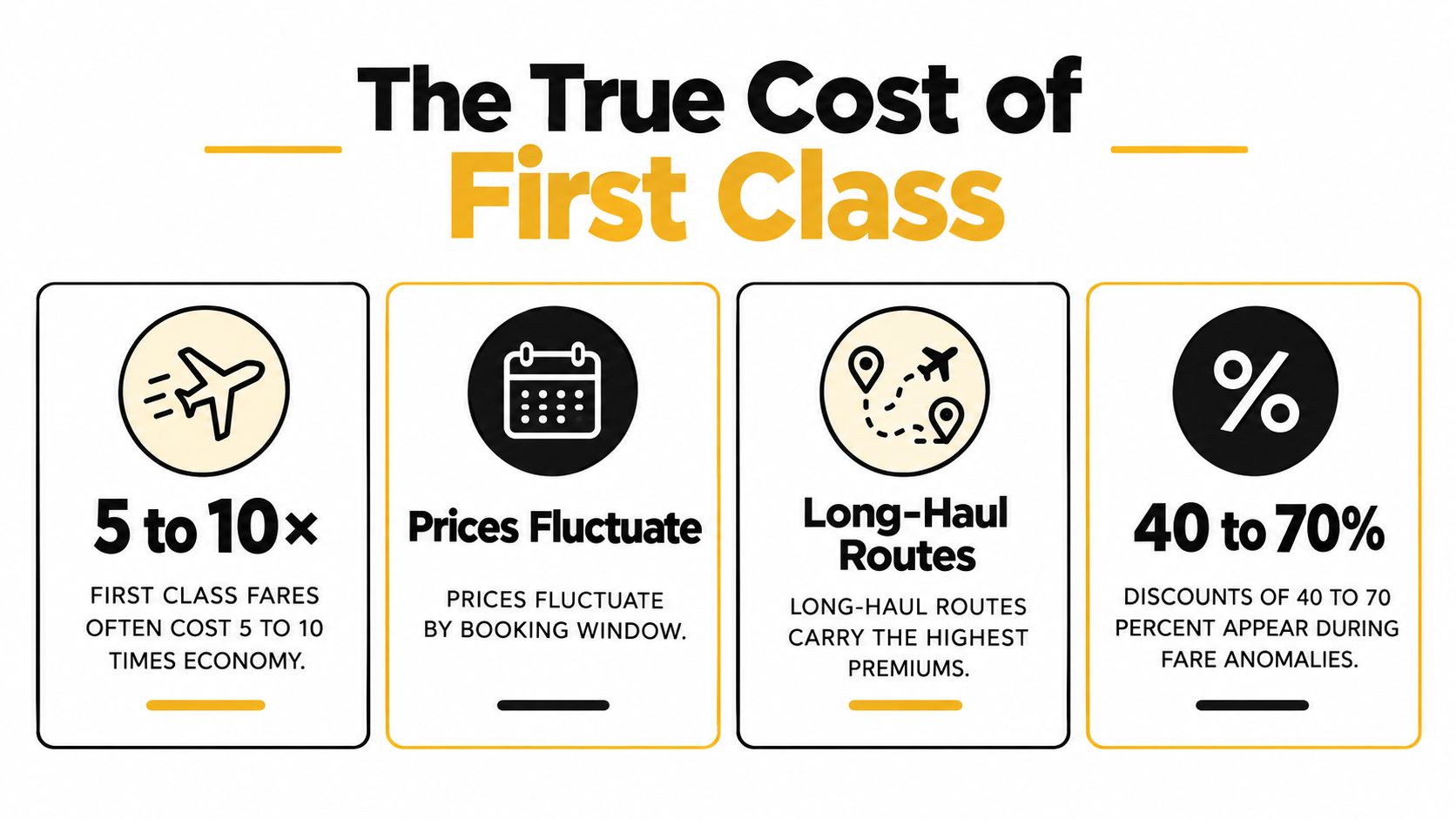
An infographic titled The True Cost of First Class detailing price fluctuations, route premiums, and ticket discounts.

Published fare versus transaction value

A September 2026 first-class index covering 25 routes found negotiated first-class fares averaging 43% below published fares. Its New York to London example fell from about $11,000 published to about $5,500 negotiated, a 50% reduction. Boston to Zurich fell from about $9,000 to about $6,500, a 28% reduction, according to the first-class fare index.

Use those examples as a pricing benchmark. A $10,000 quote can be normal public pricing and still be a poor purchase if comparable fares are materially lower. Record observed prices before booking so “deal” has a measurable meaning.

Compare three dimensions:

  • Cabin: Check first, business, premium economy, and coach on identical flights and dates.
  • Route: Test nearby airports, one-stop options, and competing carriers.
  • Timing: Track earlier schedule windows and later periods when airlines may adjust inventory.

Account for the surcharge structure

The displayed base fare does not represent the entire international ticket price. Carrier-imposed surcharges can widen or narrow the difference between cabins, so inspect the fare construction instead of comparing only the headline number. Use this explanation of carrier-imposed international surcharges to separate the underlying fare from added charges.

Judge the total against observed transaction levels, the benefits you will use, and the best business-class alternative. That comparison turns first-class shopping from points speculation into fare analysis.

Mastering Search Timing and Route Selection

The fastest way to overpay is to search one airport, one airline, and one date, then accept the first premium result. Airlines price each market independently, so your search needs enough flexibility to reveal where demand is weak and competition is forcing fares down.

Start with the route, not the loyalty program. Identify every practical departure airport, destination airport, nonstop option, and one-stop connection. Then search the same journey across several carriers and cabin combinations before deciding that first class is unaffordable.

A woman with a bun hairstyle working on a laptop at an airport gate near a window.

Use a two-window search

Monitor the itinerary when schedules first open, then check again as departure approaches. Early searches can reveal award space and attractive promotional inventory. Late searches can uncover reductions when the carrier needs to improve cabin occupancy, although waiting carries more risk if your dates and routing are fixed.

Don't confuse a low probability with a bad strategy. Premium pricing changes quickly, and a route that looks impossible on one day may produce a rational fare after a schedule adjustment, competitive response, or weak booking period.

Look actively for inverted cabin pricing

Business class cheaper than coach is a real market outcome, not a search-engine error. KAYAK's 2025 flight-class fare analysis lists average domestic economy at $316 and domestic business at $1,784, while also explaining that route and timing can produce unusual pricing. The normal hierarchy remains intact in many markets, but you shouldn't assume it applies to every itinerary.

Competition and weak business demand make inversions more likely. The Points Guy documented a once-weekly LATAM routing between Easter Island and Papeete where business-class cash fares could match or undercut economy, illustrating how route-specific supply and demand reshape the cabin ladder in this analysis of premium fares below economy.

Run this workflow for every serious trip:

  1. Search all cabins first. Record the total price, not just the cabin label.
  2. Test nearby airports. A different origin or destination can expose another carrier's fare competition.
  3. Compare one-way combinations. Separate tickets may produce a better premium value, but only use them when the connection risk fits your schedule.
  4. Check unusual dates. Move the outbound and return independently where business travel permits.
  5. Validate the result. A premium fare below coach can be legitimate. One Mile at a Time calls such pricing “not unheard of” and advises that it probably isn't a glitch in its analysis of premium-cabin anomalies.

Book only after confirming fare rules, connection protection, baggage treatment, and change conditions. A cheap premium cabin is still a bad purchase if it creates operational risk your company can't accept.

Navigating Award Inventory and Upgrade Realities

Points can reduce the cash cost, but hoarding them does not create premium seats. Start with a defined route, target cabin, transferable balance or usable miles, and a realistic view of each airline's award releases.

An analysis of 256,503 unique flights found an overall award-search success rate of only 11.7% across airlines. First-class results differed sharply: Delta domestic first class appeared in 30.8% of searches, American first or business searches succeeded 24.6% of the time, and Alaska first class succeeded only 8.6%, according to The Points Guy's award-availability analysis.
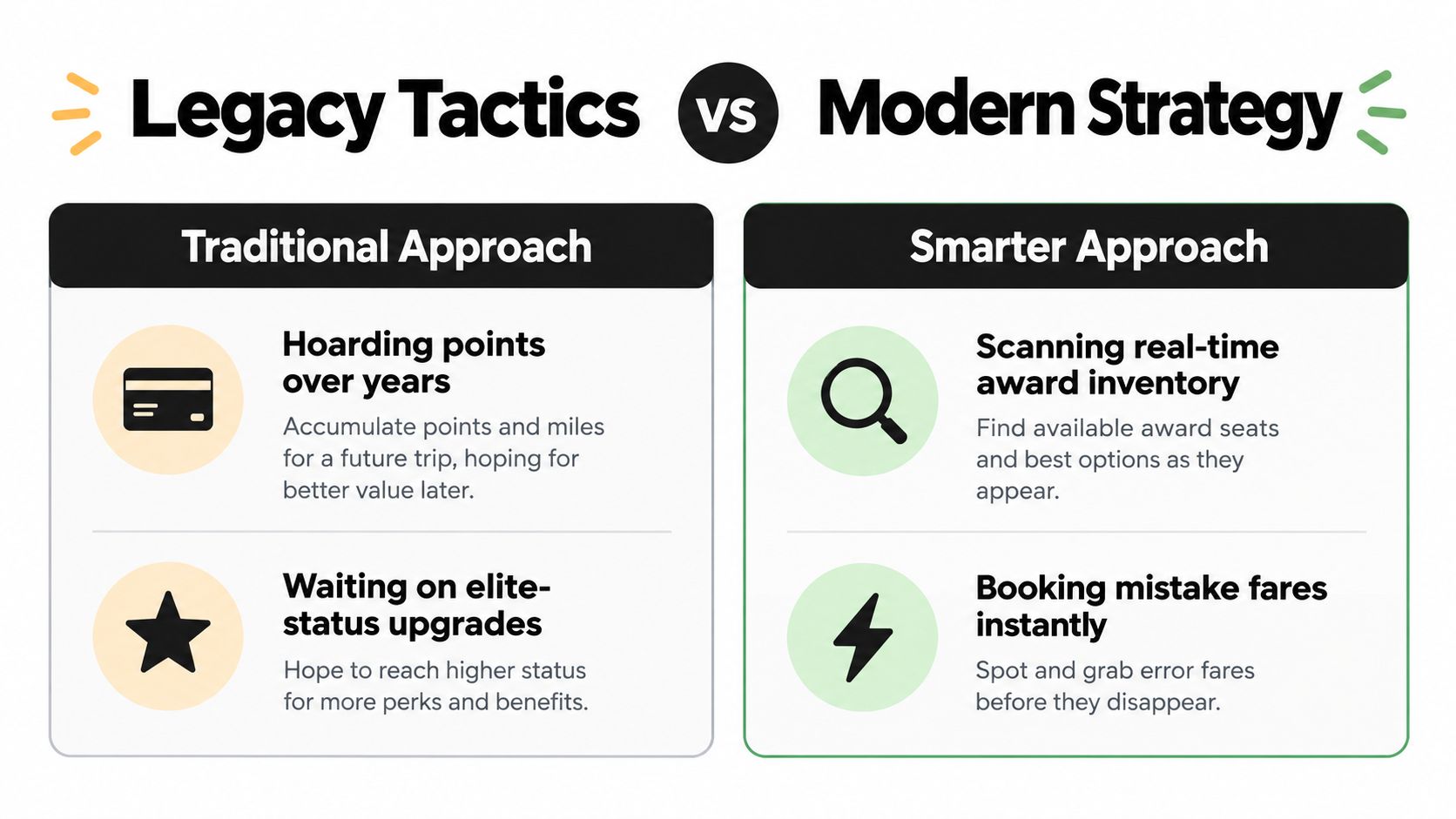
A comparison chart showing traditional legacy travel tactics versus a smarter modern strategy for booking flights.

Match the program to the route

Carrier-level differences make universal points advice unreliable. Search by airline and cabin, then learn the program's release pattern, routing rules, partner restrictions, and cancellation terms. Availability on one carrier says nothing about another.

Begin monitoring when schedules open and check again near departure. Premium award space can appear during both early-release and last-minute periods. Do not transfer flexible points speculatively. Confirm the transfer time and locate bookable space first.

Award inventory is an access problem before it is a currency problem. Miles without a route-specific search plan do not create a seat.

Replace upgrade optimism with price discipline

Premium cabins are increasingly sold through paid fares rather than complimentary upgrades. U.S. airline premium-seat capacity grew 69% over the past decade, and Delta sells over 70% of its first-class seats, according to reporting cited in the upgrade-market analysis. That shift makes elite status a poor booking plan.

For a step-by-step explanation of upgrade conditions, see this guide on how to get upgraded to first class. Check paid upgrade offers at booking and during check-in. Compare the offer with the fare difference, seat quality, included services, and value of arriving rested. If the price fails that test, keep monitoring the fare instead of waiting for status to rescue the itinerary.

Airlines also unbundle premium benefits. Compare flexibility, baggage, lounge access, seat selection, and onboard service before approving the purchase. Corporate travelers should measure the complete trip against company policy and schedule demands, not the cabin label alone. A monitored cash fare can be more dependable than an uncertain upgrade and may deliver the better financial result.

Leveraging Fare Monitoring for Hidden Discounts

Manual searching fails because premium fares can change before a traveler checks again. A better approach turns the itinerary into a monitored market with defined routes, acceptable cabins, target prices, and an action rule.

Global searches for first and business class flights rose 99% year over year in early 2026, while award availability remained limited, according to InsideFlyer's coverage of premium-cabin demand and award timing. More travelers are looking for premium seats, but that doesn't mean inventory is easy to secure. It means you need earlier signals and faster decisions.
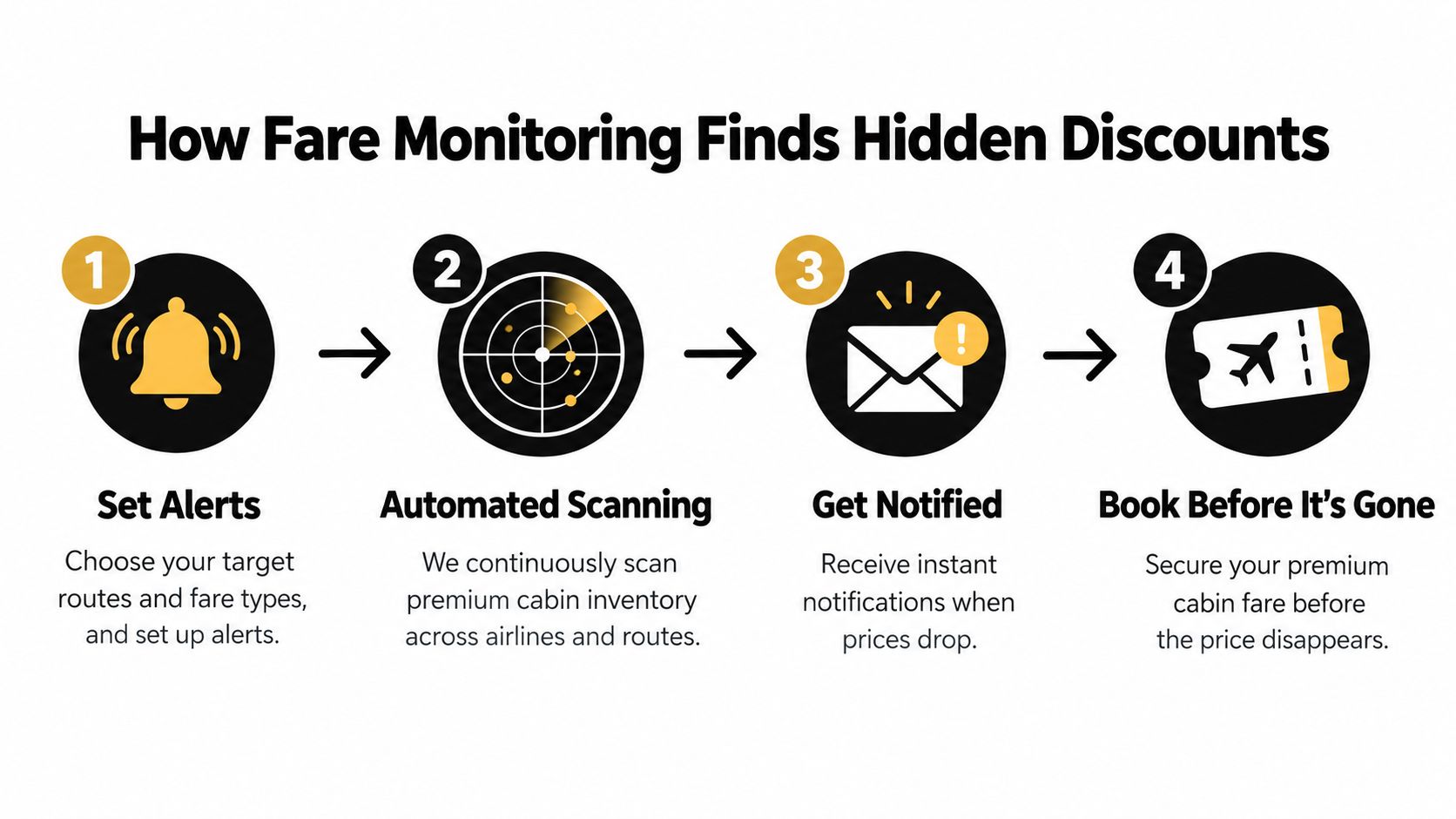
A four-step infographic illustrating how fare monitoring tools help travelers secure discounted premium cabin airline tickets.

Build the monitor around buying decisions

Define the market before you set an alert. Include acceptable departure airports, destination alternatives, maximum connections, preferred airlines, minimum cabin, travel dates, and the total price that would trigger action.

A useful monitor should do more than tell you that a fare changed. It should help you judge whether the new fare sits below the route's normal transaction value, whether the fare rules are usable, and whether the cabin includes the benefits your traveler needs.

Use a four-part operating rhythm:

  • Set route alerts: Include several viable airport pairs rather than one exact flight.
  • Scan premium inventory: Review first and business fares against coach and against competing carriers.
  • Inspect the notification: Confirm dates, aircraft, connection quality, fare conditions, and total charges.
  • Book decisively: Move when the fare meets your threshold and the itinerary passes your risk review.

Corporate buying rule: A fare alert is useful only when someone has authority to approve and ticket quickly.

Specialized services can combine fare monitoring with market analysis and member guidance. Passport Premiere, for example, tracks international business and first-class fare cycles, surfaces lower-priced premium fares and contract fare combinations from North America, and provides practical resources such as fare-monitor demonstrations and travel news.

The point isn't to chase every drop. It is to distinguish a genuine buying event from a cheap-looking fare with poor routing, restrictive rules, or missing benefits. For companies, document the approval threshold and traveler requirements in advance. For leisure trips, decide whether a lower business fare delivers enough comfort to make first class unnecessary.

Finalizing Your First Class Booking Strategy

A discounted first-class fare only creates value if you execute the purchase correctly. Travelers lose savings by selecting the wrong fare family, overlooking a surcharge, accepting an unsafe self-connection, or paying for premium benefits they don't need.

Use a final review that separates price from usefulness. First, verify the exact aircraft and seat. “First class” can describe very different products across airlines and routes, especially when a carrier sells a reduced fare with fewer inclusions.

Apply the booking checklist

Before payment, confirm:

  • Fare conditions: Check changes, cancellations, refunds, upgrade eligibility, and ticket validity.
  • Cabin continuity: Make sure every long segment is in the cabin you think you're buying.
  • Seat quality: Review the aircraft layout and confirm whether the seat offers the space, privacy, or lie-flat capability that justifies the purchase.
  • Included services: Verify baggage, lounge access, meals, priority handling, and seat selection instead of assuming the fare includes them.
  • Connection exposure: Reject an itinerary whose savings depend on an impractical transfer or unprotected separate ticket.
  • Policy fit: Corporate buyers should confirm the ticket meets approval rules and documentation requirements.
  • Payment and ticketing: Ensure the transaction produces a ticket number and that the itinerary appears correctly in the airline's system.

Don't compare first class only with economy. Compare it with business class, premium economy, and a better-timed coach itinerary. If business class is cheaper than coach on your route, the correct answer may be to book business and preserve cash, not force a first-class purchase because it sounds more luxurious.

Make the process repeatable

Maintain a simple record of routes, dates, observed fares, cabin differences, and booking outcomes. Over time, that record gives you a practical sense of which markets produce useful premium pricing and which consistently demand a premium.

Travel managers should create approved alternatives before monitoring begins. Give the traveler a route range, cabin floor, maximum connection tolerance, and purchase ceiling. That removes delay when a fare drops and prevents a rushed decision based on the first attractive number.

Luxury travelers should make the same distinction between comfort and theater. A premium seat matters most when it improves sleep, privacy, working ability, or arrival readiness. Lounge branding and a polished menu may add value, but they shouldn't justify a fare that fails your personal threshold.

The durable strategy is straightforward: monitor multiple routes, compare every cabin, understand the full fare, and buy when the total value is clear. Points and upgrades remain useful tools, but they belong inside that framework rather than replacing it.


Passport Premiere helps travelers monitor international Business and First Class fares, compare premium-cabin value, and identify fare drops before they disappear. If you're managing corporate travel or planning a long-haul trip, visit Passport Premiere to review its fare-monitoring approach and membership options.

Luxury Airline Tickets: Smart Strategies for 2026

Most travelers still treat premium airfare like retail. They see a high number, assume that's the fixed price of comfort, and either pay it or walk away. That's the wrong model.

Luxury airline tickets behave more like tradable inventory than luxury goods. Airlines continuously reprice them because an unsold premium seat loses all value once the aircraft departs. That matters in a market where premium demand is large, strategic, and intricately managed by revenue systems rather than by simple seat quality.

The spending context makes this worth taking seriously. In 2024, the average travel spend of American luxury travelers was around $16,000, and airfares plus lodging represented 64% of total luxury travel expenditure, according to AltexSoft's luxury travel market summary. If you improve the airfare side of that equation, you don't just save money. You change the economics of the entire trip.

When Business Class Is Cheaper Than Coach

Yes, business class can be cheaper than coach. Not as a universal rule, and not on every route, but often enough that serious travelers should stop thinking in cabin labels and start thinking in market states.

That sounds backwards until you look at how airlines sell seats. Economy isn't one product. Business isn't one product either. Each cabin is split into inventory buckets with different rules, change conditions, and commercial priorities. On some departures, a rigid or high-demand coach fare can sit above a discounted premium fare that an airline is pushing to stimulate demand, defend share, or clear inventory.

The key mistake is assuming the cabin name tells you the true market value. It doesn't. The cabin name tells you where you sit. The market tells you what the airline needs to accomplish.

Practical rule: Don't ask, "Is business class expensive?" Ask, "What kind of inventory is the airline trying to move today?"

That shift matters because premium airfare now sits inside a massive high-end travel economy, not a tiny indulgence niche. When travelers spend heavily on full trips, airlines know the airfare line item can absorb more value, but they also know some buyers are highly price-sensitive if the right premium offer appears.

Three situations make the "business cheaper than coach" scenario more plausible:

  • Restricted coach inventory: A last-minute coach fare may price high because cheap economy buckets are gone.
  • Distressed premium inventory: An airline may lower a premium fare bucket if too many high-yield seats remain unsold.
  • Unbundled premium products: A stripped-down business fare can undercut a fully flexible or late-booking economy fare on a route where the carrier is targeting leisure demand.

Luxury airline tickets aren't fixed-price indulgences. They're moving positions in a managed market. Travelers who understand that stop shopping emotionally and start buying tactically.

Defining the Premium Cabin Experience

Premium cabins get oversimplified. People talk about "business" and "first" as if each were a single, stable product. They aren't. Still, there is a core premium experience that matters because it gives you a benchmark for deciding whether a fare is attractive or merely expensive.

What you're actually buying

On long-haul flying, business class usually means a lie-flat seat, airport priority services, lounge access, upgraded meals, and a quieter service environment. Those features aren't cosmetic. They change how a traveler uses the flight. You can sleep, work, arrive less depleted, and reduce some of the friction around the airport itself.

First class operates on a different pricing logic. The seat may be larger and the service more individualized, but scarcity is the underlying product. Airlines don't price first class as a slightly improved version of business. They price it as a limited-access tier for travelers willing to pay for exclusivity.

A concrete route example shows the gap. On New York to Dubai, a business-class fare around $5,500 may correspond to a first-class fare near $22,000, and first class can cost about 60% to 200% more than business on the same route, according to Dollar Flight Club's guide to airline seat classes.

Business versus first by pricing logic

Cabin Typical pricing logic What you're mostly paying for
Business class Broad premium-market product Comfort, sleep, productivity, airport efficiency
First class Scarcity-driven exclusivity product Privacy, status, limited supply, elevated service

That distinction helps with valuation. If your goal is rest and productivity on a long-haul route, business class often captures the majority of the functional benefit. If your goal is the top tier of exclusivity, first class is a different purchase decision entirely.

Don't compare premium cabins by square inches alone. Compare them by what problem they solve for you.

The value benchmark that matters

A smart buyer defines the must-have elements before shopping:

  • Sleep value: Is a lie-flat seat the reason for the purchase?
  • Ground value: Does lounge access, fast-track treatment, or priority baggage matter on this itinerary?
  • Flexibility value: Will schedule changes be likely?
  • Privacy value: Are you buying comfort, or are you buying rarity?

Without that benchmark, travelers overpay for features they won't use and underpay for fares that look expensive but deliver high trip value.

That's the first hidden mechanic in luxury airline tickets. You're not buying "nice." You're buying a bundle of operational advantages, and the bundle only has value if it matches the trip.

The Hidden Economics of Airline Ticket Pricing

An airline seat is one of the cleanest examples of a perishable asset in commerce. Once the aircraft pushes back, every empty seat becomes unsellable inventory.

That creates the pricing behavior travelers misread as random. It isn't random. It's a constant series of revenue-management decisions made under time pressure. Airlines don't ask what a seat is "worth" in abstract terms. They ask what price best balances demand, competitive position, and the risk of flying that seat empty.

An infographic explaining how airlines use dynamic pricing to maximize revenue from perishable seat inventory.

Why premium cabins matter more than most travelers realize

This isn't a side business for airlines anymore. According to Morgan Stanley's analysis of global airlines and premium demand, premium tickets reached roughly 40% of Delta's total passenger revenues in 2024, up from about 29% in 2014, and the same analysis says premium ticket sales could surpass main-cabin sales by 2027. Morgan Stanley also noted that Delta's premium ticket revenues grew about 8% year over year for the nine months ended September 2024, and that Qantas' international RASK was running about 40% above pre-COVID levels in the current year, reflecting strong premium-cabin demand.

That changes how you should interpret fare volatility. If premium seats are a major revenue engine, airlines manage them aggressively. They aren't posting a luxury sticker price and hoping affluent travelers pay it. They're adjusting inventory to maximize route-level revenue.

For a deeper look at how these systems behave in practice, Passport Premiere's overview of dynamic pricing in the airline industry is a useful companion.

What the airline is trying to optimize

A premium fare can move sharply because the airline is balancing several live variables at once:

  • Demand mix: Corporate demand, leisure demand, and connecting demand don't book the same way.
  • Competitive pressure: A rival carrier's move can force repricing on overlapping routes.
  • Departure risk: As time runs down, the cost of unsold premium inventory becomes harder to ignore.
  • Cabin trade-offs: The airline may prefer a lower fare today if it improves expected total flight revenue.

This is why luxury airline tickets should be viewed as market prices, not list prices.

The number on your screen is not a verdict on what the seat is worth to you. It's the airline's latest attempt to solve a revenue problem.

Why volatility creates opportunity

Most travelers lose because they enter the market once, at the moment they need to buy, and accept the current quote as truth. Traders don't operate that way. They watch, compare, and wait for dislocations.

Premium airfare rewards the same mindset. If a cabin is strategically important to the airline and perishable at departure, then price swings aren't anomalies. They're openings. The buyer who understands the airline's pressure points has a better chance of finding them.

Decoding Fare Buckets and Unbundled Tickets

Two passengers can sit side by side in business class, eat the same meal, and lie flat in the same seat while holding tickets with very different rules. One can change without much pain. The other may face heavy restrictions. One may earn stronger mileage credit. The other may not. The difference is usually booking class, not cabin name.

A diagram illustrating airline seat inventory categories, explaining the hierarchy of booking classes from premium to economy.

The code behind the fare

According to Kayak's explanation of flight classes and fare codes, booking class is the airline's revenue-management control layer inside a cabin. Fare basis codes encode the ticket's price, refund and change rules, and often the miles earned. The first letter usually maps to the cabin bucket, such as Y for full-fare economy, W for full-fare premium economy, J for full-fare business, and F for full-fare first.

That means a premium ticket isn't defined just by the seat map. It's defined by the commercial permissions attached to the code.

A useful reference for reading those letters more confidently is this guide to flight class code meanings.

What to compare before you buy

When travelers say they found a "cheap business fare," they often mean they found a low headline price. That's not the same thing as finding good value.

Check these variables before judging any premium offer:

  • Change and refund rules: Cheap premium fares often become expensive when plans move.
  • Seat assignment terms: Some lower premium fares limit advance choice.
  • Lounge inclusion: Don't assume it's always included now.
  • Baggage and priority services: These can vary on unbundled products.
  • Mileage accrual: Important for travelers who value status and future redemptions.

This short explainer helps visualize how fare classes stack up in practice:

Why unbundling changed premium shopping

Airlines are no longer selling business class as one fixed bundle. According to Amadeus reporting on airlines unbundling business-class fares, carriers are actively unbundling business-class offers to target leisure travelers. That means travelers increasingly need to compare what is included, including seat, bags, lounge access, and flexibility, rather than relying on the cabin label.

Here's the practical takeaway:

Headline fare looks lower because But the traveler should verify
Lounge access may be stripped out Whether airport time savings still justify the purchase
Flexibility may be reduced Whether the trip dates are truly fixed
Some priority features may vary Whether the time value still holds
The seat is still premium Whether the full trip experience remains premium

Luxury airline tickets now require line-item analysis. The airline knows many buyers stop at the cabin label. The informed buyer doesn't.

Data-Driven Strategies for Lowering Premium Fares

Buying premium well isn't about finding one magic day to book. It's about building a process that puts you in front of price dislocations before other travelers react.

A travel infographic titled Unlock Premium Savings showing five data-driven strategies for finding affordable premium airline tickets.

Treat the fare like a market, not a quote

Most overpayment starts with urgency. A traveler needs a trip, checks one date pair, sees one fare, and books under the assumption that premium is just expensive. A better method is to define your acceptable trade zone before you spend.

That means identifying:

  • your target route
  • backup departure dates
  • nearby airport options
  • your minimum acceptable product
  • your essential fare rules

Without those guardrails, every fare looks like a one-off. With them, you can tell whether a quote is attractive or merely available.

Buying discipline: If you haven't compared the included benefits, alternate dates, and nearby gateways, you haven't priced the trip yet. You've only priced one version of it.

Use monitoring instead of manual checking

Premium fares can change quickly, and manual searches create a false sense of visibility. You're only seeing snapshots. Alerts and route monitoring create continuity, which is what reveals true movement.

Set tracking around the route, not just a single departure. Watch business and first separately. Track one-stop options alongside nonstops. If you're booking for a company, monitor repeated city pairs your travelers use often. That's where patterns become obvious.

For travelers who want structured monitoring, airline price drop alerts are one way to watch premium-cabin fare movement instead of checking blindly.

Compare the total premium proposition

Unbundling changed the math. A lower business-class fare can be excellent value, or it can be a stripped product that stops looking attractive once you add back what you need. As noted earlier in the article, airlines are actively separating premium benefits from the seat itself.

A useful decision filter is to compare these three scenarios side by side:

Option What to ask
Discounted business fare Does the lower price still include the features that matter for this trip?
Full business fare Are you paying for flexibility you'll actually use?
Premium economy alternative If sleep isn't essential, is this the smarter buy?

Use routing flexibility where it matters most

The biggest mistake premium travelers make is insisting on one exact itinerary too early. Flexibility creates arbitrage.

A one-stop itinerary may reveal a very different fare structure from a nonstop. A secondary airport can expose another competitive set. An overnight departure may align with weaker premium demand than a preferred business-traveler bank. None of that guarantees savings on every search, but it changes the field you are competing in.

For corporate travel managers, the right question isn't "What's the lowest fare today?" It's "Which version of this trip protects traveler productivity without paying a peak-market premium?"

Know when waiting is strategic and when it's reckless

The common advice to book early is incomplete. There are times when a late premium discount appears, especially if the cabin still has meaningful unsold inventory. The challenge is that a late-booking strategy is selective, not universal. It suits flexible leisure travelers better than fixed-date executive trips.

The sound approach is conditional:

  • Wait longer when your dates are flexible, alternatives are acceptable, and the premium cabin appears soft.
  • Book earlier when the trip is immovable, competition is limited, or schedule quality matters more than fare variance.
  • Avoid false bargains if the late offer blocks upgrades, limits changes, or removes core premium features.

Luxury airline tickets reward preparation, not optimism. Good buyers don't guess where prices will go. They create options, watch the market, and act when the fare aligns with the trip's real value.

Real-World Examples of Premium Fare Savings

A mid-sized firm's travel manager had to move two executives on short notice for a long-haul client meeting. The first instinct inside the company was familiar: book economy because premium would be too expensive that close to departure. Instead, the manager compared several versions of the trip rather than one exact nonstop.

The key move wasn't luck. It was separating must-haves from preferences. The executives needed rest, schedule reliability, and workable change terms. They didn't need one specific departure time, and they could tolerate a short connection. Once the manager widened the search to alternate gateways and monitored the premium cabin instead of assuming it was out of reach, a discounted business option became the rational buy. Coach on the preferred nonstop had become expensive and restrictive. Business on a slightly different routing delivered better trip utility.

The second example came from a couple planning an anniversary trip to Asia. They started months ahead, but they didn't rush to buy the first business fare they saw. They tracked several carriers on the route, compared business against premium economy, and paid attention to what each fare included.

A premium fare only becomes a bargain when the included features match the trip you are taking.

When one airline opened a more attractive premium fare, they didn't judge it by cabin name alone. They checked seat type, flexibility, lounge access, and airport timing. Competing airlines still offered premium economy at prices that looked reasonable at first glance, but the overall trip quality gap narrowed the difference in real value. The couple bought business because the market briefly priced sleep and comfort lower than expected relative to the alternatives.

These examples matter because they show how premium-fare savings usually happen. Not through secret coupons, and not through one universal booking rule. They happen when buyers understand that the first quote is only one point in a live market.

The traveler who shops by cabin label overpays. The traveler who shops by inventory conditions, routing flexibility, and fare rules has a chance to buy well.

Your Premium Traveler's Final Checklist

Luxury airline tickets stop being intimidating once you reduce the purchase to a repeatable checklist. The goal isn't to predict every fare move. The goal is to make fewer bad purchases.

A premium traveler's pre-flight checklist infographic with five numbered steps for comfortable and organized air travel.

Run this check before you book

  • Define your objective: Do you need sleep, flexibility, privacy, or just a better airport experience?
  • Compare the bucket, not just the cabin: Read the rules attached to the fare before treating it as a deal.
  • Check what the fare includes: Especially on unbundled business products, verify bags, lounge access, and change conditions.
  • Search alternate structures: Try nearby airports, one-stop options, and adjacent dates before committing.
  • Use a fallback plan: If you're waiting for a better premium fare, know what you will book if it doesn't appear.

For travelers flying with animals, premium planning gets more complicated because cabin comfort doesn't override airline rules. A practical companion resource is this guide to airline pet travel requirements, which helps you verify restrictions before you lock in the ticket.

Run this check before departure

Final review item Why it matters
Seat assignment The same cabin can feel very different by row and layout
Lounge eligibility Unbundled premium fares may not include it
Baggage rules Premium branding doesn't guarantee identical allowances
Change terms Important if meetings or onward plans may shift

Buy premium airfare the way a trader buys an asset. Know the product, know the rules, know your exit options, and never confuse the asking price with the fair price.


If you want a more systematic way to monitor international premium fares, Passport Premiere focuses on business and first class airfare intelligence, including fare monitoring and market analysis that can help travelers judge when a premium quote is high and when it's a genuine buying opportunity.