
What Is Multi City Flights

A multi-city flight is a single reservation that combines multiple flight segments into one itinerary, and some airline booking options support up to 6 destinations. Unlike a standard round trip, it can take you from one city to another, continue to additional destinations, and return from a different airport.

That flexibility creates an unexpected pricing possibility: business class can be cheaper than coach when airlines trigger fare wars on competitive international routes. The catch is that multi-city value doesn't come from adding stops indiscriminately. It depends on how the reservation is constructed, how each airline prices its segments, and whether the convenience of one booking outweighs the restrictions attached to it.

Redefining Air Travel Beyond Round Trips

A traditional round trip follows a familiar loop, A to B and back to A. It works well when one destination is the purpose of the journey, but it becomes inefficient when a traveler wants to visit several cities or travel overland between arrival and departure points. A multi-city booking replaces that rigid loop with a connected itinerary, such as A to B, B to C, and C to A.

The important distinction is that the traveler generally searches for these segments together instead of building the trip from unrelated one-way purchases. Major travel platforms describe multi-city flights as a single reservation that can include several destinations, while one airline example supports up to 6 destinations worldwide through its multi-city booking option, as described by KAYAK's multi-city flight guide.
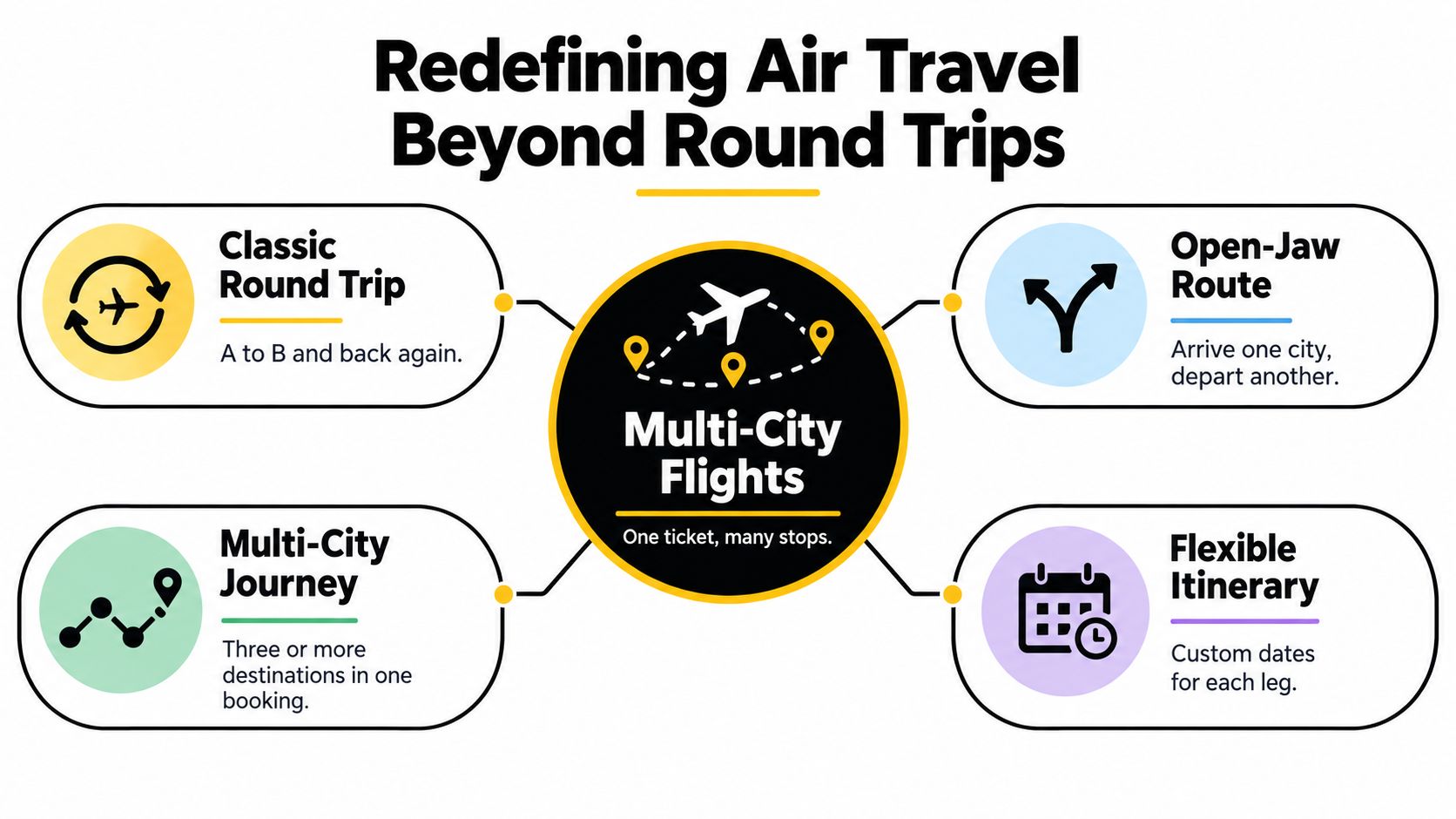
An infographic explaining different types of air travel options including round trips, multi-city flights, and flexible itineraries.

The route shapes that matter

There are three useful structures to separate:

  • Classic round trip: You fly from your origin to one destination and return to the same origin.
  • Open-jaw route: You fly into one city and depart for home from another, using rail, road travel, or another method between them.
  • True multi-city journey: You book several flight legs that connect multiple destinations in one itinerary.

An open-jaw trip is therefore best understood as one form of multi-city travel, not a competing category. Travelers often search for “multi-city” when their actual need is just to avoid backtracking. A route into one city and home from another can save travel time even when the traveler doesn't add another flight segment.

The booking format also changes the planning burden. With separate tickets, the traveler must compare each fare independently and manage each confirmation, policy, and carrier relationship. With a linked itinerary, the segments are presented as one planned journey, which makes date coordination and route comparison easier. For professionals balancing meetings across several cities, a practical guide for busy professionals can also help connect itinerary design with time management.

Planning principle: The cheapest-looking route isn't automatically the best route. A logical sequence that avoids backtracking can deliver more value than a lower fare attached to an awkward connection.

A round trip still has a place. If you're visiting one destination and returning directly, its simpler structure may be easier to price and manage. Travelers comparing that option with a multi-city booking can review what a round-trip flight means before deciding whether extra routing flexibility serves the trip.

Understanding the Core Mechanics of Multi-City Itineraries

A multi-city flight is not just a longer round trip. It is a single reservation combining multiple flight legs into one itinerary, often allowing a traveler to fly into one city, return from another, or continue to additional destinations, as explained by Skyscanner's comparison of multiple-city and multiple-ticket bookings.

Consider the difference between these two plans:

Booking structure How it works Main planning consequence
Round trip Origin to destination and back to origin Simple, but it may force backtracking
Multi-city Several flight legs appear in one reservation Dates and destinations are coordinated as one journey
Open-jaw Arrival and departure cities differ, with travel between them arranged separately Useful when ground travel replaces a flight segment
Separate one-way tickets Each leg is purchased independently More control, but more separate rules and confirmations

The reservation structure is the key. A traveler flying London to Rome, Rome to Athens, and Athens to London has a conventional multi-city pattern because each flight leg is part of the air journey. A traveler flying into Madrid, traveling by train to Seville, and flying home from Seville has an open-jaw pattern. Both may be entered through a multi-city search tool, but they don't create the same operational responsibilities.

Why open-jaw isn't the same thing

An open-jaw itinerary contains a gap between the arrival city and the departure city. That gap might be covered by rail, car, or another form of transport, and the traveler must arrange it independently. A true multi-city itinerary, by contrast, can link the destinations with additional flight segments.

The distinction affects price comparison, mileage accrual, and flexibility. A combined ticket may simplify the air portion, but separate one-way fares may sometimes offer a better fit for unusual dates or a route involving carriers that don't work well together. The correct comparison isn't “multi-city versus one-way” in the abstract. It's the total cost and risk of the exact route.

For travelers who want to understand the open-jaw structure in greater detail, this explanation of open-jaw flights provides useful terminology before they start comparing fares. Once the structure is clear, the next question is whether the booking remains manageable when more segments and airlines enter the plan.

Navigating the Risks of Complex Booking Structures

Flexibility has a limit. A multi-city search can produce an attractive total while concealing operational differences between segments. Neutral booking guidance notes that these itineraries can involve different baggage rules, cancellation policies, and airline combinations, as outlined in Booking.com's multi-city flight tips.

The traveler should inspect the itinerary in a deliberate order.

Start with the policies, not the headline fare

First, check the baggage allowance for every leg. One carrier may include a checked bag while another applies a separate charge or uses a different allowance. A single reservation doesn't guarantee identical baggage treatment across every flight, particularly when different airlines participate.

Next, compare cancellation and change conditions. A flexible fare on one segment doesn't necessarily make the entire itinerary flexible. If one leg carries stricter conditions, changing the overall journey may involve restrictions that aren't obvious from the first search result.

Finally, identify who operates each flight. The airline displayed during the search may not be the carrier flying the aircraft. Operating-carrier details matter for check-in, baggage procedures, disruption handling, and the practical location where a traveler must seek assistance.

Operational rule: Treat every leg as its own policy decision, even when the booking screen presents the journey as one itinerary.

Know when complexity stops paying

A multi-city structure becomes less attractive when the route zigzags, the traveler must pay separate baggage charges repeatedly, or a small schedule change creates consequences across later segments. The initial fare may still be lower, but the traveler has exchanged simplicity for exposure to more moving parts.

That doesn't mean travelers should avoid complex itineraries. It means the route should have a clear purpose. Add a flight when it replaces a difficult transfer, connects destinations that belong in the journey, or creates a meaningful pricing advantage. Don't add a segment merely because the search tool permits it.

Ground travel can also reduce complexity. An open-jaw route may allow a traveler to arrive in one city, move overland through a region, and depart from another. Those arrangements require separate planning, but they can eliminate an unnecessary return flight and make the itinerary more coherent. Travelers considering flexible ticket concepts can also review what an open-ended ticket means without assuming that flexibility in one product automatically applies to a multi-city reservation.

Evaluating Platform Flexibility and Market Trends

Multi-city search has moved beyond a niche tool for experienced travelers. Major platforms now advertise the ability to combine flights from different airlines and build itineraries with up to six or seven stops, according to KAYAK's overview of flexible multi-city searches. That capability reflects a clear consumer demand for customized routing, but availability doesn't make every combination financially sensible.

A platform can assemble more options than a traveler could reasonably evaluate manually. That helps when the journey crosses several regions or when the traveler wants to compare different arrival and departure airports. It also creates a risk: the search result may optimize the displayed airfare without adequately communicating the time, policy, and disruption cost attached to the arrangement.

Compare three versions of the same trip

The strongest approach is to price the itinerary in parallel:

  1. A standard round trip, which establishes the simplest benchmark.
  2. A multi-city ticket, which tests whether combining the segments improves the overall arrangement.
  3. Separate one-way tickets, which may expose promotional fares or alternative airline combinations.

The winner can change with the travel dates, route, and number of passengers. A multi-city fare may be attractive for one traveler but less compelling when several passengers need matching flights. Conversely, separate tickets can create more choice while requiring the traveler to manage each booking independently.

Flexibility should serve the route

The market's technical flexibility is most valuable when it solves a real routing problem. Flying into one city and out of another can remove backtracking. Combining carriers can open a useful schedule. Adding a stop can turn a connection into a destination. These are strategic uses of the search tool.

The weaker use is to treat every available segment as an invitation to expand the trip. More stops can increase coordination work, baggage exposure, and the consequences of a delay. A traveler should therefore judge a multi-city result by total trip value, not only the price shown beside the itinerary.

Decision test: If removing a segment makes the journey easier without reducing the trip's purpose, the segment probably doesn't belong in the booking.

The Counterintuitive Economics of Premium Travel

Economy is not always the cheaper cabin. On competitive international routes, airlines may reduce premium-cabin fares to fill unsold seats. Rival carriers can respond with matching or lower prices, creating a short window when business class is cheaper than a last-minute full-fare economy ticket, as explained in Passport Premiere's explanation of business-class fare sales.

A man in a business class airplane seat relaxing by the window while holding a drink.

The pricing does not follow a consistent discount ladder across cabins. Airlines control availability through fare classes, demand forecasts, and competitor responses. An unsold premium seat expires when the flight departs, so the carrier may lower its price to attract demand. Economy fares can remain high when late-booking or flexible travelers still need seats.

Why multi-city travelers should check the cabin above

Multi-city searches expose this pricing inversion because they place several booking structures side by side. The lowest economy total may not offer the best value after accounting for comfort, flexibility, or the cost of changing a ticket. A premium fare on one long segment can change the economics of the entire itinerary.

The opportunity depends on route competition, remaining inventory, fare rules, and booking timing. Business-class fare wars can reduce prices by 50% or more, with deals disappearing within hours, according to Passport Premiere's guide to luxury travel on a budget.

The practical test is simple: compare cabins before defining “cheap.” A restrictive economy fare can appear attractive until a premium option costs less than a flexible coach ticket. Travelers who search only economy cannot identify that inversion.

A short visual explanation can clarify how airlines adjust cabin pricing:

The same pricing logic applies across a multi-city itinerary, with one additional complication. Each segment needs its own cabin comparison. Business class may make financial sense for the long-haul portion, while economy remains appropriate on a short regional flight. The strongest result may therefore combine cabins rather than apply one cabin throughout the booking. The right choice follows the route, fare conditions, and actual price difference.

Strategic Framework for Smart Travel Planning

A strong multi-city strategy combines route logic, policy review, and cabin comparison. Start by defining the journey's purpose. If the trip requires several meetings, choose the sequence that reduces backtracking. If it combines leisure destinations, decide which movements should be flights and which are better handled by rail or road.

Then establish a price baseline with a round trip and separate one-way tickets. Compare that baseline against a multi-city reservation rather than assuming the bundled option wins. The booking format is a tool, not a guarantee of savings.

Use a disciplined comparison process

  • Map the essential legs: Remove any segment that doesn't add a necessary destination or meaningful convenience.
  • Review each fare rule: Check baggage, changes, cancellations, and operating carriers before treating the displayed price as final.
  • Test cabin alternatives: Compare economy and business class on the longest or most competitive international segments.
  • Protect the itinerary: Avoid tight connections when a disruption on one leg would undermine every later stop.
  • Watch timing: Premium fare wars can produce discounts of 50% or more, but those offers may vanish within hours, according to the documented fare-war pricing pattern.

Remote workers and extended travelers may also benefit from planning resources such as Global Pet Sitter's guide to working remotely while traveling, particularly when a multi-city route needs to support work schedules rather than only sightseeing.

The central conclusion is counterintuitive. A more complex itinerary can reduce waste when it removes backtracking, but complexity can erase the benefit when policies and disruptions become difficult to manage. At the same time, a premium cabin isn't automatically a luxury surcharge. Under the right fare conditions, business class can be cheaper than coach, especially when the alternative is a late, inflexible economy fare.

Use multi-city search to compare structures, not to justify more stops. Price the whole journey, inspect every segment, and treat premium-cabin inventory as something that can move independently from economy pricing.


Passport Premiere helps travelers monitor international Business and First Class fare cycles, evaluate premium-cabin market value, and identify opportunities where business class may cost less than coach. Visit Passport Premiere to explore fare intelligence for multi-city and premium travel planning.

When to Book Business Class Flights to Save the Most

Business class regularly prices below coach on real routes, and the winning window is 60 to 120 days before departure. If you wait for the “book early” crowd to feel safe, you usually miss the fare drop that happens when airlines finally admit an empty premium seat needs a price cut.

That's the part most travelers get wrong. They treat business class like economy, where early booking often helps, but premium cabins are managed through inventory pressure, fare cycles, and last-minute corporate demand. The first published fare is often just an opening number, not the market's true answer.

Why the First Price You See Is Almost Never the Best One

The standard advice to book as early as possible sounds disciplined, but it's usually wrong for business class. Airlines don't publish one honest price and keep it there. They load cabins with forecast pricing, then adjust as booking velocity and cabin fill rates change, which is why the first fare you see can be a placeholder rather than a deal.

That's also why business class cheaper than coach isn't a gimmick. It happens when premium inventory sits unsold and airlines would rather move the seat than protect a higher theoretical price. Once a cabin stays light, the price starts bending toward reality, especially in the middle months before departure, not on day one.

If you want a clean framing, stop asking, “How early should I book?” and start asking, “When does the seat look empty enough to get discounted?” That's the logic behind the airfare guide by MLR Worldwide Service, which fits the same market behavior you see in premium cabins. For a deeper look at the pricing logic itself, the mechanics of yield management pricing explain why airlines keep changing the number until demand becomes clearer.

Practical rule: the first fare is often the airline testing the market, not rewarding the traveler.

The best evidence in the brief points to repeated discount cycles, not one magic release day. One dataset recorded 250 verified business-class alerts in the last 12 months and about 20 alerts per full month, which is exactly what you'd expect from a market that reprices over and over instead of settling on one annual sale date. That's why waiting for the right cabin state matters more than celebrating an early purchase.

The 60 to 120 Day Sweet Spot for International Business Class

For most long-haul international trips, the cleanest answer is simple, book 60 to 120 days before departure. That's the band where airlines have enough visibility to price intelligently, but not so much final demand that they can squeeze you for every last dollar. Independent guidance also points to 3 to 6 months before departure for long-haul business class, and another source describes the international sweet spot as 2 to 4 months ahead, which lands in the same practical zone.

A timeline graphic illustrating the ideal 60 to 120-day booking window for international business class flights.

The way to use that window is straightforward. Start watching fares well before you're ready to buy, then be ready to act once the cabin enters the middle of that band. Booking earlier than four months usually means you're paying forecast pricing, not true market value, while waiting inside 60 days often means the cheapest fare buckets are already disappearing.

A useful mental model is that airlines are balancing two clocks at once. One clock is inventory release, the other is real demand from corporate travelers and flexible leisure buyers. When the cabin is still thin, the airline can afford to drop fares without surrendering control, but once the last seats start going, the price tightens fast.

Bottom line: if your route is normal long-haul, don't chase the earliest fare. Chase the middle of the curve.

For shorter trips, the calendar tightens. Long-haul international still favors the broader 60 to 120 day band, while short-haul business class behaves more like a 4 to 8 week play. If you're booking an international lie-flat seat, anchor your countdown to the middle window, then trade a little seat choice for a better fare if the numbers are strong.

The travel planning guidance at Passport Premiere's international flight timing guide fits this same logic, especially for travelers who'd rather watch fare movement than guess at a perfect date. The advantage comes from treating the booking window as a range, not a single day.

Route, Season, and Departure Day That Shift the Window

The right window changes by route, and that's where most generic advice falls apart. Transatlantic business class often peaks around 6 to 10 weeks before departure, while many Asia routes price best at 8 to 14 weeks. Short-haul business class runs on a tighter 4 to 8 week rhythm, so the route matters just as much as the calendar.

Route Best Booking Window Strongest Months Cheapest Departure Days
Transatlantic 6 to 10 weeks before departure January to March, May, September to November Tuesday, Wednesday
Asia 8 to 14 weeks before departure January to March, May, September to November Tuesday, Wednesday
Short-haul 4 to 8 weeks before departure January to March, May, September to November Tuesday, Wednesday

Seasonality is the other lever. Several analyses point to January to March, May, and September to November as lower-fare periods on transatlantic routes, while June to August and late December are usually more expensive. If your trip overlaps peak summer or the holiday rush, book earlier, because the cheap middle window gets crowded fast.

Departure day matters too. Tuesday and Wednesday flights tend to be cheaper than Friday, Sunday, or Monday departures because they dodge the heaviest business-travel demand. If you can move both the purchase date and the flight date, you're stacking the odds in your favor instead of relying on one lucky search.

Practical rule: route first, season second, weekday third. That order matters.

For buyers who want a cleaner shortcut, think like this. On transatlantic routes, start hunting in the middle of the market, then lean toward midweek departures. On Asia routes, give yourself a slightly longer runway. On short-haul premium cabins, don't wait around for months, because the best price cycle is much tighter.

The best-time-to-book business class guidance for UK travelers lines up with that route-specific approach, which is exactly why one universal rule never works.

Cash Fares Versus Award Tickets and How to Time Each

Cash fares and award tickets follow different clocks, so don't treat them like substitutes that peak at the same time. Revenue fares respond to cabin fill pressure and the 60 to 120 day cycle, while award space depends on when the airline releases saver-level inventory. That's why the cheapest cash fare and the cheapest mileage redemption rarely show up together.

A comparative infographic showing differences between cash fares and award tickets for booking travel.

Cash wins when a route is already discounted in the middle booking window and the award price is still stubbornly high. Miles win when saver space opens on a route you want and the cash fare hasn't dropped enough to justify paying out of pocket. If you're sitting on transferable points, the decision should be based on the actual cash fare, not the fantasy of “free” business class.

A good discipline is to keep both options in view at the same time. Watch cash prices during the 60 to 120 day band, and watch award availability on the same route, because one may move before the other. That matters even more if your dates are flexible, since award space can thin out quickly as departure gets closer.

Use miles when the seat is scarce and the cash fare is still stubborn. Use cash when the airline is clearly trying to move empty premium inventory.

If you're considering a transfer, do it only when the redemption is clearly better than the current cash offer. Otherwise, hold the points and keep monitoring. The point is not to burn miles just because you have them, it's to use them when the airline is still pricing the seat like a premium product instead of a nearly empty one.

Monitoring Fares, Alerts, and Buying Events That Actually Move Prices

If you want to book business class well, you need a routine, not a panic search. Set alerts on the exact cabin you want, check fare calendars for midweek departures, and ignore the tiny dips that don't change the bigger picture. Most of the savings come from catching the right cycle, not from refreshing a search engine all day.

The screenshot below is a good reminder that travel deals move in waves, not in one neat drop.

Screenshot from https://www.passportpremiere.com

The signals worth respecting are the ones that show real inventory behavior. A fare alert tells you when the published price moves. A fare calendar shows whether Tuesday or Wednesday is undercutting the weekend. A buying event tells you the airline is probably clearing unsold premium seats before the cabin gets tighter. If you're searching manually, that's the pattern to watch.

The Passport Premiere fare alert page fits this process because it focuses on timing premium-cabin purchases around airfare weakness. That's the right idea, regardless of which tool you use. You're not hunting every fluctuation, you're waiting for the point where the airline blinks first.

A few alerts are enough if you keep them disciplined.

  • Track the right cabin: Set alerts for business class, not generic premium results, or you'll miss the price you care about.
  • Watch the weekday spread: If Tuesday and Wednesday are cheaper, compare them before chasing a one-day fare drop.
  • Treat small changes as noise: A tiny dip that doesn't change the overall pattern isn't the same as a real cabin reset.
  • Stay ready for correction windows: When a fare suddenly drops on a route that's been expensive for weeks, that's the moment to act.

Business-class buying events usually matter most when a route has been sitting unsold and the airline wants the cabin moving. That's where monitoring pays off, because the fare can change before the seat map looks obviously empty. If you're not watching, you see the drop after everyone else does.

Decision Checklists for Leisure, Frequent Flyers, and Corporate Travel

Leisure travelers should buy around the trip, not around ego. If the route is long-haul, aim for the 60 to 120 day band, but move earlier for peak summer, Christmas, and major events. If the trip is on a shorter route, compress the search and start getting serious closer to 4 to 8 weeks out.

Frequent flyers need a different rule. Keep cash and awards in view together, because the right answer changes by day and by route. If the cash fare drops into the middle window and award space is thin, pay cash. If saver space opens and the cash fare is still stubborn, use miles and keep your cash for the next trip.

Corporate travel managers should build policy around fare timing instead of only around approved vendors. That means watching negotiated routes inside the favored booking band, leaning into midweek departures when schedules allow, and using alert systems before a seat gets too expensive. It also means accepting that premium cabins can occasionally price below coach on a live route, which is exactly why broad assumptions cost money.

The checklist below is the one I'd use.

  • Leisure traveler: Watch the route-specific window, then book when the fare settles into the middle of the curve.
  • Frequent flyer: Compare cash and award pricing side by side, and don't redeem points just because the trip feels urgent.
  • Corporate traveler: Set route alerts, review departure-day flexibility, and keep policy aligned with real market timing instead of old rules.

A travel booking checklist infographic showing recommended strategies for leisure travelers, frequent flyers, and corporate travelers.

The travel planning resources at Northern Spain Travel are a useful complement if you're comparing premium-cabin timing with broader trip planning. Good booking habits don't start with the flight search alone, they start with how early you're willing to watch the market.

Putting Timing, Monitoring, and Discipline Together

The mistake is thinking timing alone will solve business class pricing. It won't. The travelers who win are the ones who pair the 60 to 120 day sweet spot with disciplined monitoring, because that's when empty premium seats start looking cheap enough for airlines to move them.

Start this week with one habit, set alerts on your next international route and check them once a day. Use one rule to decide, if you're inside the favorable window and the fare drops into the range you'd be comfortable paying, book it instead of waiting for a perfect fantasy price. Hold out only when the route is still clearly overpriced and the cabin has room to soften.

That mindset changes everything. You stop treating business class like a fixed retail product and start reading it as unsold inventory that gets repriced until the airline likes the load factor. Once you think that way, you'll spot the buying windows faster and ignore the noise.

Passport Premiere is built for travelers who want to time premium-cabin purchases around fare weakness instead of overpaying for the first number on the screen. If you want a sharper read on when business class is worth buying, visit Passport Premiere and start tracking the fare cycles that matter.

Airline E Ticket: Your Key to Premium Fare Deals

A surprising truth about premium airfare is that some of the best business class deals fail for reasons that have nothing to do with the seat map and everything to do with the ticket record behind the booking. You can find a fare that looks spectacular, pay for it, receive an email, and still have a problem if the airline e-ticket never issued correctly.

That matters even more in a market where premium cabins sometimes price below coach on specific routes, dates, and fare buckets. Smart travelers usually focus on search tools, alerts, and timing. They should also focus on the airline e ticket itself, because that record is what turns a promising fare into an actual right to travel.

Your E-Ticket Is More Than Just a Confirmation

Most travelers treat the e-ticket email as paperwork. That's a mistake.

The useful way to think about an airline e-ticket is as the formal record that proves the airline system accepted payment, applied fare rules, and issued your right to fly. The confirmation email is only the surface layer. The underlying value sits underneath, inside the carrier or distribution system.

For premium cabin buyers, this distinction provides an advantage. If you're trying to secure a business class fare that prices lower than coach, you can't stop at “I got the email.” You need to confirm that the ticket exists, that it's attached to the reservation, and that any later changes were processed against the ticket record rather than just the itinerary.

Practical rule: If a fare feels unusually good, verify issuance first and celebrate second.

Experienced flyers separate themselves from casual shoppers by keeping both the booking reference and the ticket number. They check whether the airline website recognizes the reservation. They look for signs that the reservation is alive, but also ticketed.

A strong airline e ticket gives you three things that a generic confirmation does not:

  • Control over changes: Airlines process reissues, refunds, and coupon use against the ticket record.
  • Visibility into problems: When check-in fails, the issue often sits in the relationship between reservation and ticket.
  • Protection on expensive itineraries: The more valuable the fare, the more important it is to know whether the ticket is valid, reissued, or broken after a disruption.

Travelers who understand this rarely sound dramatic when something goes wrong. They sound precise. They can tell an airline agent, “The PNR is there, but I need you to verify the ticket status.” That one sentence often gets you to the actual problem faster.

What an Airline E-Ticket Actually Is

An airline e-ticket is the transport document the airline issues after a booking clears its ticketing checks. The email, PDF, or app screen you receive is only a traveler-facing copy of that record. The actual ticket resides within the airline's ticketing and reservation systems, where agents, airport staff, and partner carriers can validate it and service it.

IATA's push to retire paper tickets made this the industry standard, as summarized in LOT's guide to electronic flight tickets.

An infographic comparing an airline e-ticket, which enables travel, against a booking confirmation receipt.

The ticket is the document the airline can actually service

That distinction matters because airlines do not process changes, refunds, or flown status from a pretty itinerary email. They process them from the ticket record and its flight coupons.

A valid e-ticket usually sits on top of a reservation that already contains your flights, names, and fare details. But ticket issuance is a separate step with its own controls. Payment has to clear. The fare has to permit issuance. The carrier and any partner segments have to support the transaction the way the booking was built. On complex itineraries, especially discounted premium cabins, this is often where problems appear.

That is why a flashy confirmation message can still hide a weak booking.

Why savvy flyers care

For an inexpensive domestic roundtrip, a ticketing delay is annoying. For a business or first class fare that priced far below the usual market, it can decide whether you keep the deal.

Airlines can hold a reservation before they issue the ticket. Agencies can create an itinerary that still fails at the ticketing stage. Married segment logic, partner carrier restrictions, point-of-sale rules, and fare filing quirks can all interfere. Travelers who know that tend to verify the ticket number early, especially after buying a premium fare with unusual pricing or after using an online travel agency.

Understanding fare construction also helps here. If you already know how airline booking class codes affect fare rules and inventory, it becomes easier to see why a reservation can look confirmed while the ticket still needs to be issued cleanly.

What the e-ticket covers, and what it does not

The e-ticket ties together your right to travel under a specific fare, on specific flight segments, under specific conditions. It also tracks coupon status, which is how the system knows whether a segment is open, exchanged, flown, or refunded.

It does not replace check-in. It does not function as a boarding pass. And it does not guarantee that every later schedule change or agency modification was processed correctly. It only provides the airline a formal ticket record to work from.

That record is what protects you when something goes wrong. On a premium itinerary, that can mean the difference between preserving a rare fare and watching an agent rebuild the trip at today's much higher price.

Decoding the Anatomy of Your E-Ticket

Most travelers glance at an itinerary receipt and see clutter. Experienced flyers see a control panel.

The airline e ticket contains several data points, but a handful matter far more than the rest when you're managing a valuable booking. If you know where to look, you can tell whether the reservation is healthy, whether the fare is still the one you bought, and whether each segment is ready to fly.

An infographic diagram illustrating the seven essential components found on a standard airline electronic ticket.

The two numbers that matter most

The first distinction every premium traveler should learn is this: the 13-digit e-ticket number and the 6-character booking reference are not the same. AltexSoft explains that the ticket number starts with a 3-digit airline code assigned by IATA, while the booking reference retrieves the reservation file in the airline or CRS system in its airline ticketing guide.

Use them differently:

Item What it identifies Why you need it
E-ticket number The paid ticket record Reissues, refunds, and coupon status track here
PNR or booking reference The reservation file Pulls up itinerary, seats, and booking-level details

If you only keep the PNR, you're holding the map. If you keep the ticket number too, you're holding the legal document tied to the fare.

The fields worth reading

Beyond those two identifiers, several other elements deserve attention:

  • Flight details: These confirm the actual operating itinerary, including airports and times. After a schedule change, mismatches first become visible within these details.
  • Passenger information: Your name has to align with travel documents and booking records.
  • Fare basis code: Fare rules begin with this short code. It often tells trained eyes more than the cabin label does.
  • Payment information: Useful when sorting out whether a ticket issued, partially issued, or was voided and reprocessed.

If you want a clearer handle on the booking codes tied to cabin and fare structure, this guide to flight class codes is a good companion read.

Coupon status is the hidden signal

Coupon status is one of the least understood and most useful parts of an airline e ticket. Travelers usually ignore it until something breaks.

Each flight segment on a ticket is represented by a coupon. Those coupons move through statuses as the trip changes. In practice, that status tells airline staff whether a segment is still open for travel, already flown, exchanged into a new ticket, or otherwise unusable.

When an airline changes your itinerary, don't just check the new flight times. Check whether the underlying ticket coupons still make sense.

This matters on multi-airline itineraries and on premium deals with complicated routing. The reservation might display the new flights correctly while the ticket record still reflects the old structure. That's where trouble starts.

Why this matters more in premium cabins

On a simple domestic trip, a minor ticketing mismatch can be annoying. On an international premium itinerary, it can affect lounge access, seat assignment continuity, reissue options, and day-of-departure check-in.

Savvy flyers don't memorize every code on the ticket. They don't need to. They just need to know which identifiers to save and which fields to verify after any change.

How to Manage Changes Refunds and Check-In

The practical advantage of understanding your airline e ticket is that you can manage the booking with more precision and less guesswork. Once a ticket is issued, it becomes the hub for changes, service requests, and check-in through airline websites and apps.

By 2012, about 98% of travelers who browsed flights online also booked online, equal to roughly 117 million online bookers in the cited dataset, according to AltexSoft's history of flight booking. That shift is why the e-ticket now sits at the center of everyday trip management, not off to the side as back-office paperwork.

A traveler uses a digital airport kiosk to manage flight details on a touch screen display.

Start with retrieval, not assumptions

When you need to manage a booking, use the airline app or website and pull up the trip with the booking reference. If that fails, try the ticket number if the carrier supports it.

Look for these signals before doing anything else:

  • The itinerary matches what you expect
  • The cabin shown matches what you purchased
  • Seat assignments and passenger names are intact
  • The trip appears active, not canceled or pending

This is also where payment plans and deferred purchase strategies can complicate things. If you're using flexible booking approaches, make sure you understand when the booking becomes a fully issued ticket. That's especially important with options like book flight and pay later, where the booking flow and the final issued state may not be identical.

Changes are about itinerary and ticket together

A lot of travelers say “I changed my flight” when what happened was only half the job. In airline systems, changing the reservation and reissuing the ticket are related but separate actions.

Here's the practical difference:

  1. Reservation change
    The flight segments in the booking are modified.

  2. Fare recalculation
    The system checks whether the original fare still applies or whether a different fare must be used.

  3. Ticket reissue or exchange
    The ticket record is updated to reflect the new itinerary and fare conditions.

If step three doesn't happen properly, the booking may look correct while the ticket remains tied to old segments or old pricing logic.

Refunds depend on the ticket, not your memory of the deal

Refund handling lives at the fare and ticket level. That's why airline agents often ask for the ticket number when sorting out exchanges or cancellations.

A few practical habits help:

  • Save the original itinerary receipt: It gives you a baseline when flights later move around.
  • Document airline-initiated changes: If the carrier moves your schedule, that often affects servicing options.
  • Check after every modification: Don't assume the website completed the exchange just because the screen said “confirmed.”

A changed itinerary is not proof of a successful reissue. The ticket record has to catch up.

That sentence explains a huge share of post-change travel problems.

Check-in is where broken records get exposed

Many e-ticket issues stay hidden until online check-in opens. That's when the departure control system tries to match the reservation, the ticket, and operational requirements.

If check-in works, great. If it fails, don't jump straight to passport or visa panic. First ask whether the reservation and ticket are aligned.

A short explainer helps clarify that flow:

What works and what doesn't

What works well

  • Using the airline's own channels first: They usually show the most current reservation state.
  • Checking right after schedule notifications: Problems are easier to solve before airport day.
  • Keeping both identifiers handy: PNR for retrieval, ticket number for servicing.

What usually doesn't

  • Relying only on the OTA display: Third-party displays can lag behind airline records.
  • Assuming seat assignment equals ticket health: You can have a seat and still have a ticketing problem.
  • Waiting until the airport to investigate: Some issues require back-office reissue work that gate staff can't fix quickly.

For high-value trips, especially premium cabins, early verification is a form of risk management.

The E-Ticket's Role in Securing Premium Fares

The difference between a great premium fare and a travel headache is often the e-ticket, not the search result.

Travelers who buy business or first class well focus on more than the headline price. They check fare construction, ticketing conditions, and how easy the ticket will be to change if the airline touches the itinerary later.

A premium fare is a filed product with rules. The e-ticket is the record that proves that product was issued under the right conditions, in the right market, for the right passenger type. That matters because some of the best premium deals are also the most fragile.

A flow chart illustrating the steps to upgrade an existing economy airline e-ticket to a premium fare.

Cheap premium space only matters if the fare tickets cleanly

A low business class price on a search screen is only the opening signal. The deal is real only after the ticket issues.

In practice, premium fares fail at ticketing for predictable reasons. The sale may be restricted to a specific point of sale. A partner segment may require agreements that do not line up cleanly. The passenger type or payment setup may not match the fare rules. A complex itinerary can also price correctly at first and then break during issuance or reissue.

These problems show up most often on:

  • Multi-carrier premium itineraries
  • Deals filed for one market but booked from another
  • Long-haul routings with unusual connections
  • Premium bookings that need a reissue after schedule changes or upgrades

For expensive trips, that distinction matters. A screenshot shows an offer. An issued e-ticket shows you captured it.

Fare basis codes reveal the true conditions of the fare

Cabin labels tell you where you sit. Fare basis codes tell you what you bought.

Two business class tickets can look identical in search and behave very differently after purchase. One may allow a low-cost change, earn better mileage credit, and survive a schedule change with less friction. The other may be highly restrictive, difficult to reissue, or tied to narrow sales conditions. The e-ticket ties your reservation to that exact fare logic.

Premium buyers should check questions like these before they treat a deal as secure:

Question Why it matters
Is this fare changeable? A cheap premium fare loses value fast if a date shift triggers a painful reissue
Does the route involve another carrier? Partner flights can complicate ticketing, changes, and after-sales service
Was the fare sold for this point of sale? Some attractive fares do not issue cleanly outside their intended sales market
Is the ticket already issued? A booked itinerary is not the same as a ticketed one

Travelers tracking fare swings should also understand how airline dynamic pricing affects premium cabin deals. That pricing logic helps explain why premium fares can appear briefly, disappear fast, and reprice during servicing.

Why business class sometimes prices below coach

This surprises casual flyers, but it happens for rational reasons.

Airlines do not price every fare by cabin comfort alone. They file many products with different advance-purchase rules, refund terms, market targets, and competitive responses. In some city pairs, a restrictive business class fare can undercut a fully flexible economy fare, especially close to departure or in markets where premium demand is being stimulated.

That does not mean business class is usually cheaper than coach. It means fare logic can produce short-lived distortions, and informed travelers know how to spot them.

The e-ticket is what confirms whether you secured that anomaly under the intended rule set.

Premium fare buyers should verify three things after purchase: cabin, fare conditions, and issued ticket status.

Specialized fare intelligence closes the gap between pricing and ticketing

Search tools are useful for spotting availability. They are weaker at showing whether a premium fare is structurally sound, likely to survive repricing, or awkward to service later.

That gap matters most on international premium bookings, where the value can be huge and the repair work can be messy.

Some travelers use fare monitors, expert agencies, or membership services focused on premium cabins. Passport Premiere is one example. It focuses on international business and first class fare monitoring and trip management for travelers trying to buy premium seats below typical published pricing. The value is not just finding a low fare. It is understanding whether the ticket behind that fare is worth holding.

What experienced premium travelers actually do

The strongest buyers tend to follow the same habits:

  • They compare more than one sales channel. Airline sites, OTAs, and premium-focused services do not always show the same fare construction.
  • They confirm issuance fast. Premium fares can disappear from the reservation flow even after payment authorization.
  • They prefer simpler ticket structures when prices are close. A clean single-carrier ticket is often easier to change than an intricate interline build.
  • They inspect the fare after any schedule change. A premium ticket can keep its seat map and still need repair in the background.

That is the practical edge. Understanding the e-ticket gives you more than a definition. It gives you a way to judge whether a premium fare is merely attractive, or actually secure.

Solving Common E-Ticket Issues Before You Fly

The worst e-ticket problems usually appear after something changed. Maybe the airline moved a departure time. Maybe an agent rebooked a segment. Maybe the reservation still shows up, but check-in suddenly fails.

A frequent issue is when the reservation and ticket fall out of sync after a schedule change. As explained in View from the Wing's discussion of broken e-tickets, the e-ticket is the payment record while the boarding pass is the document that authorizes boarding. If those systems don't line up, check-in can fail.

Use this preflight check

If anything about your trip changed, do these steps before travel day:

  1. Open the booking on the airline's site and confirm the flights, dates, and cabin.
  2. Locate the ticket number and keep it separate from the booking reference.
  3. Ask the airline to verify ticket status if online check-in fails or the itinerary looks odd.
  4. Check each segment after rebooking on multi-airline trips, not just the first flight.
  5. Arrive earlier than usual if the itinerary was recently changed by the airline.

Two scenarios that deserve extra caution

  • You have a PNR, but the airline can't find the trip properly
    That can mean the reservation exists in one system but the ticket wasn't issued or synced correctly in another.

  • Your flight changed and the new itinerary looks fine online
    Don't assume that means the ticket was reissued cleanly. Ask directly if the ticket is attached and valid for all segments.

If a premium itinerary has been touched by a schedule change, treat it as a booking that needs inspection, not trust.

That habit turns you from a passive passenger into someone who can identify the actual failure point before the airport does.


If you're trying to buy international Business or First Class without overpaying, Passport Premiere is built for that exact problem. It helps members track premium fare movement, understand when a low premium fare is worth acting on, and manage booked itineraries with more clarity once the e-ticket is in place.