
Why Are International Flights So Expensive?

Fuel is a major reason international flights are expensive. IATA expects airline fuel costs to rise from about $252 billion in 2025 to roughly $350 billion in 2026, with jet fuel projected to average $152 per barrel, nearly 70% higher than in 2025. Yet the most useful answer to “why are international flights so expensive” starts with a counterintuitive fact: a discounted business-class seat can cost less than a late-purchased coach seat on the same route.

That reversal happens because airlines don't apply one permanent cabin premium to every seat. They price separate inventory buckets, adjust them as seats sell, and respond to route costs, competition, timing, and expected demand. A traveler who searches only for the cheapest economy fare may miss a premium-cabin opening while paying heavily for the last remaining coach inventory.

The Counterintuitive Truth About Cabin Pricing

Cabin class strongly influences value, but it doesn't always determine the final price. Consider a New York to London flight where a discounted business-class fare falls to $1,400 two months before departure, while the same carrier's economy seat rises past $1,900 when purchased the week before. That isn't a pricing error. It's the result of two cabin inventories moving independently.

Airlines divide seats into fare buckets, each with its own price and restrictions. Early in the sales cycle, a carrier might open lower-priced economy inventory to stimulate bookings. It may also release a promotional business fare if premium seats aren't selling quickly enough. As departure approaches, the cheaper economy buckets can close, leaving only expensive coach options. Unsold business seats, meanwhile, may still be available at a reduced rate.

Practical rule: Compare cabins every time you search. Don't assume economy is automatically the cheapest usable option.

The logic becomes clearer when you separate seat value from inventory scarcity. A business seat usually offers more space and service, but an empty business seat earns nothing. An airline may prefer a lower premium fare to an empty seat, especially when the alternative is leaving valuable cabin inventory unused. Conversely, a traveler who must leave on a specific date may have little choice but to buy the remaining economy fare.

This is why airline pricing can feel irrational from a passenger's perspective. The carrier isn't maintaining a fixed ratio between cabins. Its revenue system is protecting different revenue opportunities across the aircraft.

For a deeper explanation of how airlines adjust prices as inventory changes, see this guide to dynamic pricing in the airline industry. The broader lesson is important: international airfare reflects timing and route economics, not the location of your seat.

How International Airfare Is Built

An international ticket isn't one charge. It's a bundle that may include the carrier's base fare, carrier-imposed surcharges, government taxes, airport charges, security fees, and other route-specific amounts. The advertised price can therefore obscure how much the airline itself is collecting to operate the flight.

Start with four layers:

  1. Base fare: The operating carrier's charge for transportation, shaped by route economics and inventory.
  2. Carrier surcharges: Fees that help airlines recover fuel and other operating pressures.
  3. Government taxes: Departure, arrival, aviation, and passenger duties set by public authorities.
  4. Airport and security charges: Costs associated with terminals, navigation, handling, and security systems.

A $1,500 transatlantic ticket can have a base fare covering less than half of the total, with taxes and fees adding several hundred dollars or more depending on the itinerary. The exact split varies by origin, destination, connection points, cabin, and ticket rules, so shoppers should inspect the fare breakdown rather than treating the headline amount as the airline's net revenue.

Cost Layer Example Amount Who Sets It
Base fare Less than half of a $1,500 ticket in this example Airline
Carrier surcharge Route-specific, potentially substantial Airline
Government tax Several hundred dollars can accumulate on a long-haul ticket Government authorities
Airport and security charges Varies by airports and itinerary Airports and public agencies

The distinction matters when you're comparing airlines. Two carriers may advertise similar totals but allocate the money differently between base fare and surcharges. A refundable or flexible ticket may also carry a higher base fare even when mandatory taxes remain similar.

Travelers arranging complex itineraries or premium services may also benefit from reviewing high-end air travel via Haute Black, especially when the decision involves more than a basic point-to-point ticket. For the mechanics of one-way and round-trip fare construction, this explanation of OW and RT fares provides useful context.

The Cost Stack Behind Long-Haul Flying

A long-haul flight has to recover more than fuel. The airline pays for the aircraft, crews, maintenance, airport access, navigation, administration, and regulatory compliance before it earns a margin. International routes magnify those costs because the aircraft stays in the air longer and often makes fewer daily rotations.

Fuel remains the most visible pressure. IATA says fuel and oil account for 28.7% of global airline costs, while depreciation and amortization represent 9.1%, and flight crew salaries and expenses account for 8.6% (IATA cost data). Fuel's share reaches 36.3% in Latin America and the Caribbean, compared with 25.5% in North America, showing why the same oil shock can affect regional markets differently.

The largest operating inputs

  • Jet fuel: Prices can move sharply, and hedging programs may delay or soften the effect for some airlines while exposing others to different timing. IATA's outlook projects a fuel bill of roughly $350 billion in 2026, compared with about $252 billion in 2025 (IATA's fuel and disruption outlook).
  • Labor: Cockpit and cabin crews require long-haul staffing, rest arrangements, and international scheduling. Wage scales vary by region, but the expense follows every flight.
  • Aircraft and maintenance: Widebody aircraft such as the 787 and A350 require significant capital, depreciation, parts, inspections, and scheduled heavy-maintenance checks.
  • Airport and navigation fees: Landing, handling, terminal, and overflight charges add to the trip cost. IATA identifies airport and air-navigation charges as a major expense category, while infrastructure-cost differences explain about one-third of the overall airline cost gap (ACI Europe and ICF report).
  • Regulation and overhead: Emissions schemes, safety mandates, insurance, sales systems, administration, and marketing all need funding.

A 12-hour turn can burn roughly 80,000 kilograms of fuel, so distance compounds nearly every line in the operating budget. A domestic flight on the same airline may use a different aircraft, complete more rotations, and spread fixed costs across more segments. That helps explain why an international fare can remain high even when the cabin isn't full.
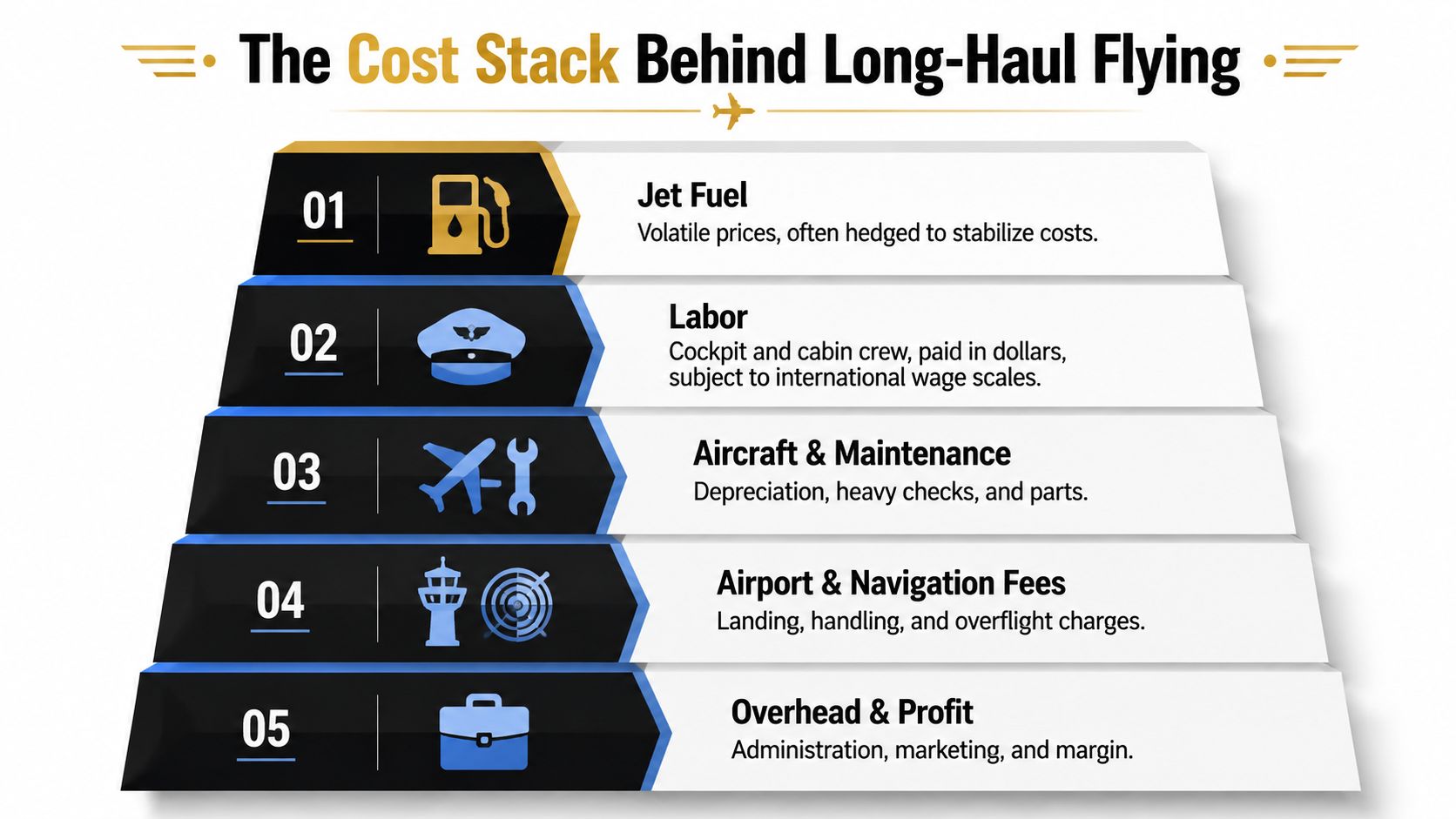
A tiered pyramid diagram illustrating the five major components of cost behind long-haul airline flight operations.

The following video offers another visual perspective on the economics behind airline pricing:

Competition Demand Capacity and Market Shifts

Two international routes can cover similar distances and still produce very different fares. A mid-size airport with one practical carrier may offer a high base fare because passengers have few alternatives. A major hub pair such as London to New York or Tokyo to Los Angeles can attract several airlines, alliance partners, and connecting options, giving carriers more reason to compete.

That creates a useful distinction:

Structural cost drivers Cyclical market forces
Limited competition on a city pair Holiday and seasonal demand
Expensive airport access Major events and schedule changes
Long runway and widebody requirements Temporary capacity reductions
Navigation and handling charges Currency movements
Regulatory and aircraft costs Fuel-hedging timing

Structural constraints don't disappear because a traveler searches on a different day. A route with a practical monopoly or duopoly may remain expensive across much of the year. Timing can still help, but it can't create a competing carrier where none operates.

Why the same route changes quickly

Short-term prices respond to seat availability, booking pace, departure dates, and the airline's confidence that it can sell remaining inventory. Holiday periods and major events can push demand into a narrow window. Capacity discipline can have the opposite effect from what travelers expect, too. If airlines keep seat counts constrained while demand returns, high load factors can coexist with limited availability and firm fares.

Cargo changes the calculation on freight-heavy routes. A widebody aircraft may earn revenue from both passengers and cargo, allowing an airline to evaluate the entire flight rather than relying only on passenger fares. That doesn't guarantee cheaper seats, but it can make some routes economically viable even when passenger pricing looks less aggressive.

Fuel hedging can produce different results across carriers. One airline may have temporary protection from a price spike, while another feels the increase sooner. Currency movements also change how expensive a ticket feels to travelers paying in different currencies, even when the airline's underlying costs haven't changed in the same way.

International agreements shape the competitive field as well. Open-skies arrangements can permit more carriers to serve a market, while bilateral restrictions, airport constraints, or antitrust approvals can limit available choices.
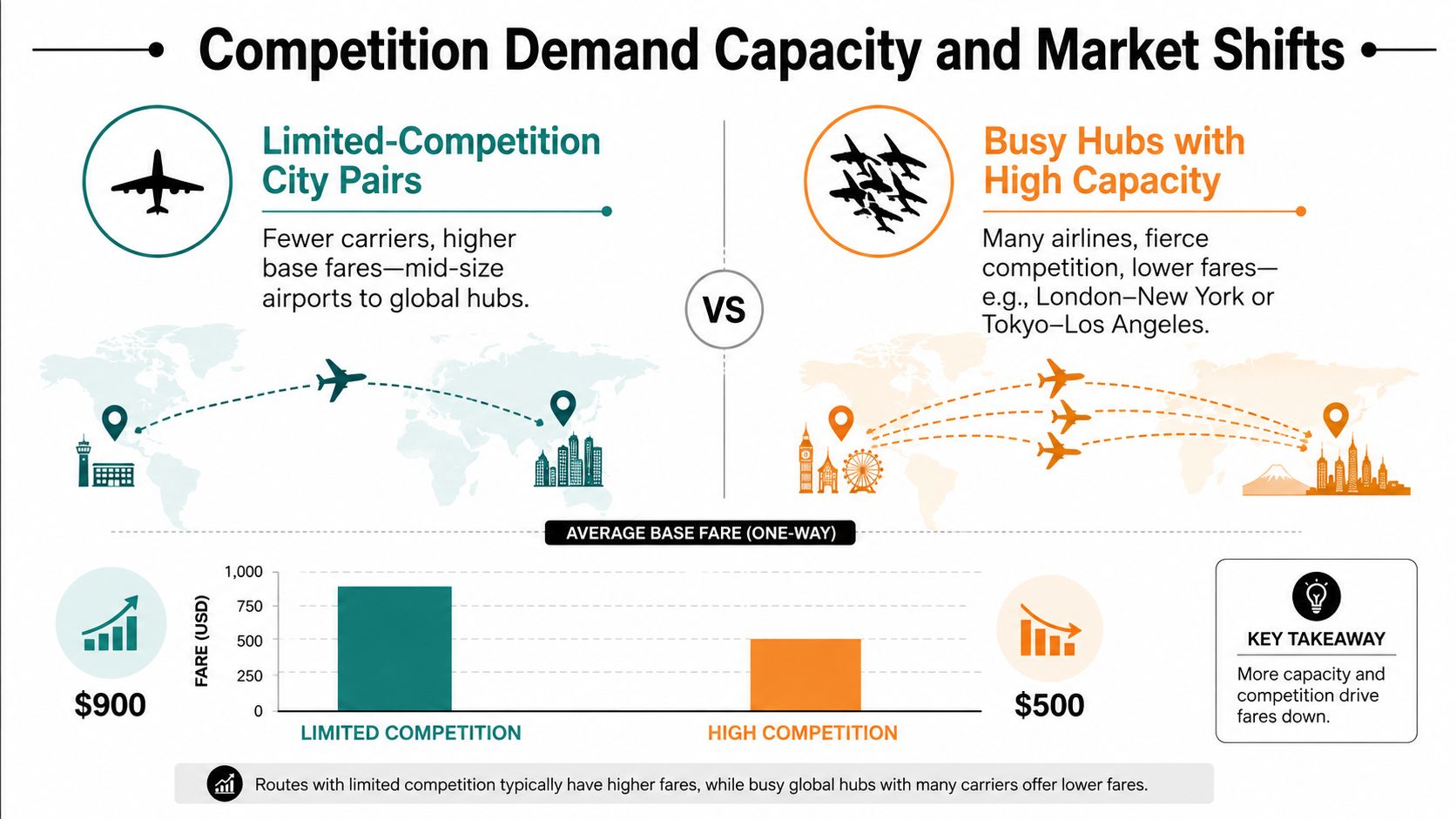
A bar chart comparing average one-way flight fares between limited competition routes and high competition hub routes.

Why Premium and Economy Prices Sometimes Reverse

A discounted business fare can beat a late-purchased economy fare because the airline is managing inventory, not enforcing a permanent cabin hierarchy. One comparison might show a $2,400 business-class fare against a $3,100 economy fare on a Europe to United States nonstop. Those figures illustrate the pricing mechanism, not a promise that every route will produce the same result.

A separate real-world comparison cited economy from San Francisco to Paris at about $780, while business cost about $7,419 (the fare comparison discussion). The contrast shows why cabin relationships depend on route, timing, and remaining fare inventory.

How the buckets move

Airlines assign booking classes to different price and flexibility levels. A lower economy bucket can sell out while a discounted business bucket remains open. If a traveler searches late, the system may display only expensive economy inventory, even though the airline has decided that a lower business fare is still useful for filling premium seats.

Airlines also weigh the opportunity cost of an empty premium seat. A business-class seat can support a high fare, but once departure is close, the carrier must choose between discounting it and flying with unused inventory. On a widebody with a cargo hold, the airline may evaluate premium passengers, economy passengers, cargo, and the total cabin mix together.

That doesn't mean airlines routinely make business class cheap. Season, departure day, route competition, aircraft type, corporate demand, and fare restrictions all matter. A low business fare may disappear quickly, and a restrictive ticket may not suit a traveler who needs changes or refunds.

The practical conclusion is simple. Search across cabins rather than assuming coach is the rational default. As guidance on business class costing less than economy explains, a discounted premium seat can undercut a last-available economy seat because airlines sell inventory dynamically.
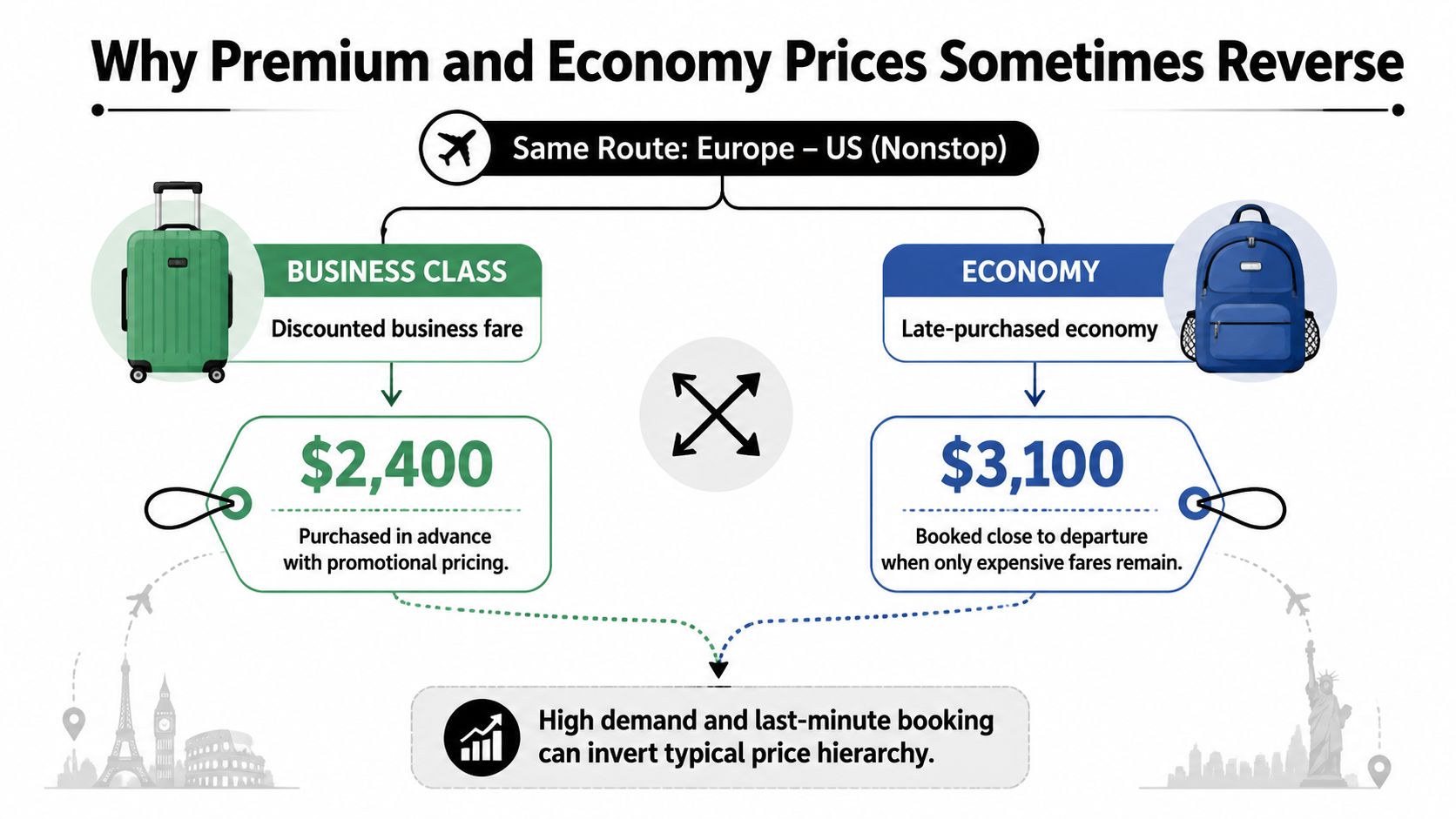
An infographic showing how last-minute economy tickets can be more expensive than discounted business class fares.

A Smarter Way to Time an International Purchase

Good timing starts with a better comparison. Don't judge a fare by the advertised base price alone, because baggage, seat selection, payment fees, connection costs, and change conditions can alter the total cost. Compare like with like, including the cabin, flexibility, baggage allowance, and airport itinerary.

Use a repeatable search process:

  1. Start with the all-in total. Record the complete price and restrictions before comparing carriers.
  2. Search competing airports. Check nearby origins, destinations, and connecting hubs. A larger airport may offer more carrier competition.
  3. Test the calendar. Shoulder-season dates and midweek departures can expose different inventory.
  4. Compare cabins. Check economy, premium economy, and business in the same search.
  5. Monitor specific opportunities. Track a route and cabin rather than relying on a broad alert that mixes unrelated fare types.

Searches made 6 to 10 weeks before departure can be useful for typical international routes, while premium-cabin shoppers may begin monitoring 3 to 6 months ahead. These are practical testing windows, not guarantees. The right moment depends on the region, airline, season, and remaining inventory.

Fare alerts work best when they're specific. A premium-cabin drop in one booking bucket may vanish within hours, so an alert should identify the cabin, route, dates, and acceptable fare conditions. If your dates are fixed, monitoring may be more valuable than waiting for a universal “best day” to buy.

Flexibility helps, but it can't erase a structural shortage of competition. On a monopoly route, timing may be the only meaningful lever.

For a fuller purchase-timing approach, review this guide to the best time to buy international flights. Use it as a starting framework, then validate the result against live fare behavior.
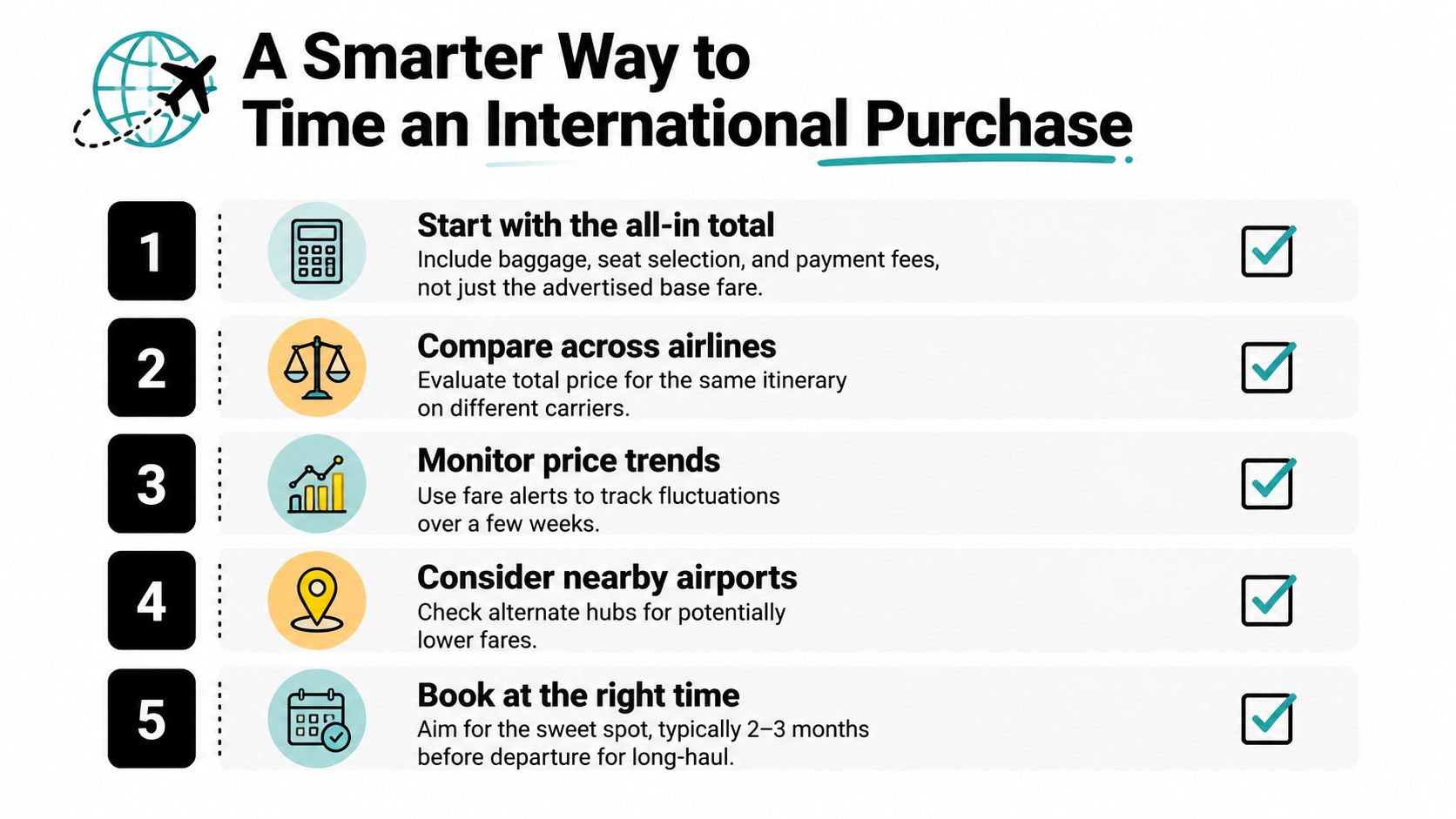
A five-step infographic showing how to save money when booking international flights for your next trip.

Fare Monitoring and Corporate Travel Buying

Fare volatility becomes more useful when you treat it as a signal rather than a nuisance. A monitoring system can compare current prices with route history, identify alert thresholds, and show when a premium fare has moved far enough to deserve immediate review. For example, a New York to London business fare falling from $4,200 to $2,950 for a one-week window is a specific buying event, not merely an anecdote.

Passport Premiere tracks premium-cabin fare cycles and can alert members to lower pricing opportunities. Its approach is relevant to travelers who want to compare premium fares against late economy inventory, while multi-city monitoring and cabin comparisons help reveal whether a fare is competitive for the route. The service also provides fare-monitoring demonstrations and educational material so members can evaluate the signal before booking.

Corporate buyers need more than a low price. A managed program should preserve traveler safety, approved carriers, reasonable connection rules, and documented authorization. It should also support traveler profiles, approval workflows, and reporting that shows why an exception was accepted.

Controls for managed travel

  • Policy rules: Define acceptable cabins, fare flexibility, preferred carriers, and route limits.
  • Approval paths: Send unusual premium fares to the right budget owner before purchase.
  • Duty of care: Keep traveler details and itinerary changes visible to the travel management process.
  • Reporting: Capture the booked fare, benchmark, cabin, and reason for selection.
  • Supplier coordination: Use monitored fares alongside negotiated corporate rates, not as a replacement for them.

Ground arrangements create another budget and duty-of-care consideration. Companies coordinating airport transfers may also review resources on streamlining corporate ground travel so the total trip remains organized beyond the airfare.

Before choosing any monitoring service, check four practical qualities:

  1. Data freshness, because stale fares create false opportunities.
  2. Alert customization, including cabin, route, dates, and price thresholds.
  3. Route coverage, particularly for the city pairs your travelers use.
  4. Export compatibility, so fare records can flow into travel management and finance reporting.

Deciding Whether an International Fare Is Too Expensive

“Expensive” has to be judged against three things: the route's structural cost, its competitive baseline, and the inventory available today. A $1,100 coach fare versus $1,600 premium economy may be reasonable on one competitive transatlantic market, while a $3,400 business fare versus $4,800 last-minute coach fare may represent a stronger premium opportunity on a capacity-constrained route. The numbers are examples of the decision logic, not universal benchmarks.

Start by identifying the normal economy range for your city pair. Then compare the live offer across cabins and ask whether the premium reflects genuine scarcity or a remaining fare bucket that hasn't adjusted. Finally, include flexibility, baggage, schedule quality, and connection risk in the value calculation.

Indicator What to Check Decision Signal
Route baseline Recent comparable economy fares Current price is high or ordinary for the market
Cabin gap Economy, premium economy, and business inventory Premium may be misaligned if the gap is unusually narrow
Competition Number of practical carriers and airports More alternatives may justify continued monitoring
Timing Distance from departure and seasonal demand Fixed dates increase the cost of waiting
Total value Fees, flexibility, schedule, and comfort A higher cabin may be rational if the price gap is modest

For individuals, fare data turns a vague feeling into a timing decision. For corporate managers, monitored fares work best when combined with negotiated agreements, policy controls, and traveler-safety requirements. The cheapest visible seat isn't always the cheapest responsible trip.


Passport Premiere helps travelers monitor international premium-cabin fare cycles, compare business and economy pricing, and identify moments when a premium seat may cost less than late-purchased coach. Visit Passport Premiere to review its fare-monitoring approach and decide whether it fits your next personal or corporate itinerary.

Will International Flights Get Cheaper in 2026

The popular advice says international flights will either get cheaper or they won't. That's the wrong question. The better question is whether your route, your cabin, and your booking window are under enough pressure for airlines to discount seats, because the data shows international fares can fall sharply in one market while rising in another, and premium cabins can sometimes get repriced below coach on the same itinerary.

Travelers who only watch headline airfare trends miss the part that matters most. Airlines don't price a Paris business-class seat the same way they price a Frankfurt economy seat, and they don't react the same way to extra capacity, weak demand, or fuel shocks. A trip planner also has to think beyond the flight itself, because a cheaper international fare can be offset by ground costs if you're careless with positioning and transfers, which is where resources like avoid one-way rental car fees can save you from paying for a decision you made to chase a flight deal.

The core takeaway is simple. International flights can get cheaper, but not evenly, not permanently, and not for every cabin. If you're trying to decide whether to buy now or wait, the evidence points to a route-specific answer, not a universal one.

Why International Fares Do Not Move in One Direction

International airfare behaves like a collection of local markets, not one global price tag. In Germany, international flights in the first half of 2024 were 3.1% cheaper than a year earlier, yet that headline hid very different moves by destination, with economy tickets to Central America down 15.8%, Asia and Australia down 12.3%, and North America down 7.4%, while fares to Europe rose 2.7% and Africa rose 4.1% according to Destatis. The same report also said those international flights were still 20.9% more expensive than in the first half of 2022, which means today's discounts are happening from a high base, not a clean return to old norms.

That pattern is exactly why a simple yes-or-no answer fails. A traveler flying from the U.S. to Asia can see falling fares while another traveler on a Europe-bound route sees stability or even an increase, and both are reading the same “cheaper flights” headlines.

Economy and premium cabins are separate markets

The cabin split matters even more than the destination split. Business and first-class inventory often follows a different pricing path because airlines protect premium revenue until they decide a seat is unlikely to sell at full fare. That's why a route can look expensive in coach and soft in business class at the same time, especially when airlines decide to clear premium inventory rather than let it go empty.

Practical rule: Don't ask whether international travel is cheaper in general. Ask whether your route, cabin, and departure window are under pricing pressure.

The U.S. booking environment showed the same fragmented behavior in 2024. The Bureau of Labor Statistics reported that export air passenger fares fell 2.5% in the year ending May 2024, with declines of 11.6% for Latin America and the Caribbean, 6.1% for Asia, and 4.0% for Europe, while import air passenger fares also fell 1.6% overall, as summarized in the BLS release. Those are not blanket price cuts. They're route-specific signals that should push you to compare markets, not assume one broad trend.

The Mechanics Behind Premium Cabin Price Drops

Airlines don't lower business-class fares because they suddenly become generous. They lower them because their seat maps and revenue systems tell them a premium cabin is at risk of going out with empty seats. That's where yield management matters, and the logic is straightforward, if a bit mechanical, airlines open lower fare buckets when they need to protect load factor and keep premium inventory from sitting unsold. For a concise explanation of the pricing logic behind that system, the internal guide on yield management pricing is the right conceptual backdrop.

A flow chart explaining the primary factors driving airline premium cabin price drops and their positive business outcomes.

Why fare inversions happen

A fare inversion is the counterintuitive moment when a business-class ticket costs less than economy on the same itinerary. That happens when the premium cabin is under more pressure than coach, often because there are more unsold premium seats than the airline wants to carry into departure. On long-haul international routes, the risk is bigger because the airline has more room to discount high-value seats without completely wrecking the economics of the flight.

Hopper data reported by CNBC showed U.S.-Asia fares fell 11% year over year to about $1,087 while capacity rose 6%, and U.S.-Europe fares fell 6% to about $754; that mix matters because extra seat supply usually weakens pricing power on long-haul routes, especially where premium cabins are a meaningful part of the revenue plan. You can see the same principle in broader market reporting that said global international fares were down 6% in the first half of 2024, with some routes like Australia to Indonesia down 18%, as noted in Business Times coverage of pricing power and fare pain.

Why premium seats can undercut coach

Business-class inventory is volatile because airlines would rather sell a premium seat at a discount than leave it empty. Coach fares may stay firm if the airline is defending a basic fare floor, while premium fares get trimmed to improve the aircraft's overall revenue mix. That's why a single route can show an inverted price relationship even when the broader market doesn't.

A premium cabin that looks “expensive” at search time can become the cheaper choice later, if the carrier decides unsold seats matter more than headline pricing.

The practical lesson is that premium-cabin deal hunting isn't about luck. It's about understanding when an airline's pricing system has more empty premium inventory than confidence.

Regional Fare Trends and Route-Specific Opportunities

If you want to find where international flights are getting cheaper, start with regions, not broad travel headlines. In the U.S.-linked data already in market, Asia, Latin America, and parts of Europe have shown softness, while some Europe and Africa routes have held up or risen. That's a much more useful map than a generic prediction, because it points you toward the markets where airlines are discounting.

International Fare Changes by Region Fare Change Trend
Central America -15.8% Lower
Asia and Australia -12.3% Lower
North America -7.4% Lower
Europe +2.7% Higher
Africa +4.1% Higher
Latin America and Caribbean -11.6% Lower
Asia -6.1% Lower
Europe -4.0% Lower

That split is exactly why timing advice needs a regional filter. A traveler asking when to fly internationally on a budget should not treat every destination the same, because the strongest discounts are showing up where capacity and demand are out of balance, not where a calendar says “international trip.”

Route detail beats blanket advice

Recent reporting on 2025 conditions also reinforced the same point. CNBC cited Hopper data showing U.S.-Asia fares down 11% and U.S.-Europe fares down 6%, while other coverage described international pricing as still uneven, with some routes moving lower and others resisting the trend. That mix matters for premium cabins because the cheapest business-class opportunities usually appear where an airline has both soft demand and enough seats to justify a sale.

One overlooked signal is that route softness can coexist with broader caution. Airfare can be trending lower in one corridor and still feel stubborn in another because airline networks, aircraft types, and local demand don't move together. If you're shopping for a premium cabin, the route itself is the market.

The cleanest reading of the data is this, look for long-haul routes with rising capacity and weaker demand, then compare coach and business fares side by side. That's where price inversions and unusually deep discounts are most likely to show up.

Timing Your Premium Cabin Purchase

The best time to buy international premium cabins is usually within the booking window where airlines are still managing demand, not just clearing out leftovers. Going's 2026 guidance says international fares are typically cheapest 2 to 8 months before departure, and that window is the most useful benchmark because airlines reprice inventory as departure gets closer and the seat map becomes clearer, according to Going's flight price guidance and Passport Premiere's guide to airline price drops. For premium cabins, that middle window is where the airline is still trying to balance revenue, not just empty-seat damage control.

A three-step infographic on how to save money on flights by setting alerts, monitoring trends, and booking.

The sweet spot is a moving target

That window matters because airlines often have enough time to discount unsold premium inventory without forcing a broad cut across the cabin. As departure gets closer, they can still change pricing, but the odds of a real bargain depend on how much premium supply remains unsold and whether the route is already under pressure.

Last-minute travel is a weak strategy for international premium cabins. Some routes hold their pricing or even rise as departure approaches, while others only see selective discounting. Waiting for the final few days can leave travelers facing the highest fare in the market instead of the lowest one.

What to watch as the calendar moves

Seasonality adds another layer. Afar reported that experts expected fares to fall by roughly 3% to 5% during the peak summer period and by 5% to 7% in the last quarter of the year, which suggests broad fare compression can create room for premium-cabin sales when airlines are defending load factors, as covered in Afar's airfare outlook. Those are not guarantees, but they do give you a calendar framework for watching your route more aggressively.

Booking rule: If your target route is soft, start tracking early and be ready to act inside the 2 to 8 month range. If the route is strong, do not assume a late discount will save you.

Developing a fare-monitoring habit pays off. The goal is to recognize when your itinerary enters a discount window and book before the market tightens again.

Actionable Strategies for Capturing Fare Drops

The smartest way to buy a premium cabin is to stop treating every fare drop as a lucky accident. Use alerts, compare cabins, and watch the same route across multiple booking windows so you can tell whether a sale is real or just a marketing headline. For travelers who want a specialized tracking layer, Passport Premiere's fare-monitoring approach is one option, and you can also compare it with tools that focus on broad airfare alerts or airline-specific pricing notifications.

An infographic titled Actionable Strategies for Capturing Fare Drops featuring eight numbered tips for finding cheap flights.

What to do before you buy

Start with the route, not the airline. Search the same city pair in coach, premium economy, and business class, then compare the spread across several dates inside the booking window. If the business fare starts converging toward coach, that's usually a sign the cabin is being repriced rather than held at a luxury premium.

Then set alerts. Use them to watch for genuine drops instead of checking once and guessing. Fare monitoring works best when you're comparing the same itinerary over time, because one-off screenshots miss the pattern.

What the pricing signals usually mean

A sharp reduction in one cabin and not the other usually means the airline is targeting a specific inventory problem. If business class gets cheaper while coach stays firm, the carrier may be protecting a base fare floor in economy while clearing premium seats. If both move down, the route may be under broader competitive pressure.

Compare the fare, then compare the cabin. The second comparison often tells you more than the first.

How to avoid fake bargains

A “sale” isn't a bargain if the underlying fare is still high relative to the route's recent trend. Check whether the route has been soft for a while or whether the airline has only just started trimming prices. You don't need a perfect forecast, you need enough context to know whether the current price is a real dip or a temporary marketing push.

The last step is discipline. If a route is showing a downward pattern inside the known booking window, don't wait for a magical deeper cut unless you're willing to lose the fare entirely. On premium cabins, hesitation often costs more than the price difference you were trying to save.

External Factors That Can Reverse Fare Declines

Fuel spikes and geopolitical shocks can reset international pricing quickly, especially on ultra-long-haul routes where fuel sits higher in the cost structure. Recent travel reporting noted that some foreign carriers were adding fuel-related surcharges and raising fares on ultra-long-haul routes after a sharp oil-price jump tied to conflict in the Middle East, while U.S. airlines had not broadly matched that move yet, as reported by Afar in 2026. A traveler asking when to fly internationally on a budget should consult regional analysis that accounts for seasonal variation, not just calendar recommendations.

That matters because fare declines can be local and temporary, while cost shocks can ripple through a network in uneven ways. If fuel rises enough, an airline may pull back discounts, especially where the flight already carries heavy exposure to long-stage operating costs. The effect usually shows up first on routes that are expensive to operate and hard to fill without premium pricing, including some long-haul business-class markets where carriers have less room to keep fares soft.

Geopolitics can create the same kind of reversal by suppressing demand in one corridor and forcing carriers to reprice quickly. The result is rarely a clean, across-the-board increase. It is more often a set of unstable pockets where a route that looked soft a month ago can turn firm fast.

Watch the route, not just the trend line. A fare drop can disappear faster than most travelers expect when external costs rise.

The practical response is to treat favorable pricing as time-sensitive. If your target market is showing softness, buy while the numbers still support the trip instead of waiting for a deeper cut that may not survive the next fuel or conflict headline.

Converting Fare Volatility into Consistent Savings

The market is too uneven for blind waiting, which is why fare intelligence beats guesswork. A service like how to save money on international flights helps travelers track premium-cabin fare cycles instead of checking prices randomly, and that matters because international business and first-class seats often change value faster than coach. Passport Premiere also fits this topic because it focuses on premium-cabin fare monitoring and market analysis rather than generic flight search.

A woman sitting on an airplane looking at her phone, representing travel savings through fare monitoring.

Why active monitoring beats passive searching

If you only search when you're ready to book, you'll miss the parts of the pricing cycle where savings happen. Premium cabins can soften early, then tighten again as the departure date approaches. That means the traveler who tracks the route sees the drop first and books into the window instead of reacting after the best fare is gone.

Corporate travel managers feel this most directly. A route that looks expensive at the moment of purchase can later show a softer premium cabin, and teams that monitor fare cycles can choose between buying immediately or waiting for a more rational price. Leisure travelers get the same benefit, they just feel it on a smaller number of trips.

What consistent savings actually look like

Consistent savings don't come from one lucky fare. They come from seeing which routes are repeatedly repriced, which cabins loosen first, and which departure windows tend to create better buying conditions. That's the difference between chasing deals and understanding the market.

If you're buying international premium travel regularly, the edge is not being the first person to search. It's being the person who knows when a fare is cheap relative to its recent pattern. That's how volatile pricing turns into repeatable savings.


If you're planning a long-haul trip and don't want to overpay for business or first class, visit Passport Premiere and review how its fare monitoring and market analysis can help you spot the right buying window. If you travel internationally for work or for a premium vacation, a clearer view of fare cycles can keep you from paying coach prices for a seat that should have cost less.

Business Class Cheaper Than Coach: The Ultimate Guide

Finding cheap first class international flights sounds like a fantasy, right? But what if I told you that you could snag a luxurious lie-flat seat for less than what the person in the back of the plane paid for their last-minute coach ticket? It’s not about luck. It’s about knowing how the system really works.

Once you learn to read the market and spot the right signals, you can unlock incredible travel experiences for a fraction of what you thought they’d cost.

The Surprising Truth About First Class Fares

Luxurious first class airplane cabin interior with a comfortable seat, side table, and scenic window view.

It seems completely backward, but it happens every single day. The trick is to stop thinking of airfare as a static price tag and start treating it like a volatile commodity, almost like playing the stock market. Airlines use incredibly complex algorithms that are constantly tweaking fares based on hundreds of inputs.

Here’s a little secret from inside the industry: fewer than 15% of premium seats are ever sold at their initial, eye-watering asking price. As the departure date gets closer, an airline's whole strategy shifts. An empty seat is pure, unrecoverable loss once those doors close. That creates a huge incentive for them to unload that seat, even at a massive discount, rather than let it fly empty.

Why Premium Seats Go on Sale

This is where the real opportunity opens up for savvy travelers. While a vacationer might book an economy ticket months in advance to lock in a low price, a business traveler often has to book a flexible, last-minute ticket. Those full-fare economy tickets can easily run into thousands of dollars—sometimes even more than a discounted seat at the front of the plane.

Airlines absolutely capitalize on that corporate urgency, but it also creates some wild pricing quirks. For instance, a last-minute round-trip from Chicago to Frankfurt in economy could easily be $2,500. At the same time, the airline might slash the price of a remaining Business Class seat to $2,200 just to get someone in it. That’s the moment you can find business class cheaper than coach.

Most people think of premium cabin pricing as straightforward and expensive, but the reality is much more nuanced. This disconnect between perception and reality is where the deals are born.

Pricing Myth vs Market Reality

Pricing Factor Common Perception Market Reality (The Opportunity)
Timing Booking far in advance is always cheapest. Last-minute premium seat deals often beat full-fare economy.
Value First Class is an unaffordable luxury. An empty seat has zero value, forcing airlines to discount heavily.
Availability Sales are rare and hard to find. Flash sales happen constantly but are short-lived.
Competition One airline sets the price. Fare wars on competitive routes drive prices down unexpectedly.

Understanding these realities is the first step. The next is knowing how to act on them.

The key is to shift your mindset from a typical consumer to a market analyst. Airlines aren't just selling transportation; they're managing perishable inventory. Your job is to buy when their inventory is most distressed.

Spotting Your Opportunity

To really take advantage of these situations, you have to know what signals to look for. Airlines frequently run unannounced fare sales to boost bookings on underperforming routes or to aggressively compete with a rival. These sales can cut premium cabin prices by 50-70%, but they might only last for a few hours.

Think about a real-world case: a company needs to fly an executive from New York to London for a critical meeting tomorrow. The standard last-minute economy fare is a staggering $3,000. Unbeknownst to most, a competing airline on that same route quietly launched a 24-hour flash sale, dropping its remaining business class seats to just $2,100. By monitoring the fare data, the company not only saves nearly a thousand dollars but also gives its traveler a massive upgrade.

You can dive deeper into how to track these market movements and discover current business class fare sales to pounce on similar deals. These aren't just lucky flukes; they are predictable patterns if you know where to look.

Decoding Airfare Cycles And Fare Wars

Man in an airport terminal working on a laptop displaying a financial chart, with a 'FARE CYCLES' sign.

Think of premium airfare less like a fixed menu and more like the stock market. It’s a landscape in constant motion, driven by the intense tug-of-war between supply and demand. Cracking this code is the secret to snagging those cheap first class international flights that most people write off as impossible.

Prices don't just change on a whim—they follow predictable patterns called fare cycles. These are the natural peaks and valleys in pricing for a specific route. A First Class seat from New York to London, for instance, has its own rhythm, rising and falling with seasonal demand, major holidays, and corporate travel schedules. When you learn to see these patterns, you stop being a reactive buyer and start acting like a strategic investor.

The Real Prize: Catching a Fare War

Beyond the regular ups and downs, the real jackpot is the fare war. This is when fierce competition on a hot route forces a sudden, dramatic, and usually brief price collapse. All it takes is one airline trying to fill empty seats by slashing its premium fares. The moment they do, their rivals have no choice but to follow suit or lose out.

For those in the know, these moments are a goldmine.

Imagine two legacy carriers fighting over the lucrative Los Angeles to Tokyo route. One morning, Carrier A launches a flash sale, dropping its business class fares by 60%. Carrier B’s pricing algorithms catch this instantly and match the price. Suddenly, a window opens where you can book a lie-flat seat for less than the price of a typical economy ticket.

Fare wars are not just about lower prices; they are a temporary breakdown of the standard pricing model. During these brief windows, the normal rules don't apply, and the value proposition for premium travel completely flips on its head.

This is exactly how you can find business class cheaper than coach. An airline would much rather sell that seat for a fraction of the sticker price than let it fly empty across the ocean.

Following the Data, Not the Hype

This isn't just a hunch; it's backed by mountains of data. The reality is, fewer than 15% of premium seats on long-haul international flights ever sell at their initial sky-high prices. The entire industry is built on discounts. To get good at this, you need to understand the fundamentals. You can sharpen your skills by exploring these actionable tips for booking international flights.

Some of the largest airfare databases out there track trillions of fares daily, and they all tell the same story: massive discounts are the norm, not the exception. The data clearly shows that the lowest average fares fluctuate week by week. The key isn't just knowing that prices drop, but knowing precisely when those dips are coming.

How to Time Your Purchase and Win

So, how do you put this into practice? It’s about ditching the guesswork and relying on data-driven signals. Instead of asking, "What's the best day to book?" you should be asking, "What's the real market value of this seat right now?"

Here’s how to start thinking like a pro:

  • Keep an eye on key routes. If you fly certain competitive routes often, watch them like a hawk. More competition almost always means better deals are on the horizon.
  • Learn to spot the first shot. A sudden, unannounced price drop from a single airline is often the opening move in a fare war.
  • Be ready to act fast. These deals don't last. The best prices in a fare war can vanish in a few hours, sometimes even minutes.

For business owners and corporate travel managers, this is a game-changer. It transforms booking from a simple expense into a strategic financial win. By tracking these patterns and acting decisively, you can secure top-tier travel for your team at a fraction of the going rate.

For a closer look, check out our guide on finding the best time to buy international flights. This kind of intelligence is the most powerful tool you have for turning airfare volatility into serious savings.

How Creative Routing Unlocks Hidden Savings

The shortest path between two points might be a straight line, but in air travel, it's almost never the cheapest. While a direct, non-stop flight is undeniably convenient, that convenience comes with a hefty price tag. If you're serious about landing a First Class seat without paying a fortune, you have to think beyond the obvious itinerary.

Airlines don't just price fares based on how far you're flying; they price them based on the demand between two specific cities. That's why a route like Chicago to Singapore is priced for corporate road warriors with bottomless expense accounts. But what if your journey didn't really start in Chicago? This is where creative routing becomes your secret weapon for finding cheap first class international flights.

Embrace the Power of Positioning Flights

The core concept here is brilliantly simple. Instead of flying from your expensive home airport, you book a separate, cheap flight (or even drive) to a different airport to kick off your international trip. This little hop is called a positioning flight.

Think of it this way: a First Class ticket from a major U.S. hub is priced for the local market—often full of Fortune 500 executives. But the very same seat on the long-haul leg of that journey might be priced thousands cheaper if it originates from a smaller city, or even a major hub in Canada or Mexico where the market dynamics are completely different.

An airline isn't just selling a seat from Point A to Point B. They're selling a complete, packaged itinerary. When you break that package apart and start from a more strategic "Point A," you can completely change the pricing game in your favor.

Let's say a non-stop First Class flight from Chicago (ORD) to Singapore (SIN) is listed at an eye-watering $15,000. But after a little digging, you notice the airline is running a promotion from Toronto (YYZ) to Singapore for just $7,000—on the exact same plane for the trans-pacific leg. A quick round-trip ticket from Chicago to Toronto might only set you back $300.

By booking these two trips separately, you've just saved a massive pile of cash. You might even find yourself in a situation where this luxurious journey becomes business class cheaper than coach when you compare it to a last-minute economy ticket on the direct route. It takes a bit more planning, sure, but the payoff is enormous.

Finding and Booking Fifth Freedom Routes

Here's another, more advanced tactic that savvy flyers use: hunting for "fifth freedom" routes. These are quirky flights operated by an airline between two countries where neither is its home base. A classic example is Singapore Airlines flying between New York (JFK) and Frankfurt (FRA) as a continuation of its flight from Singapore.

Because the airline’s main goal isn't to compete on the JFK-FRA route, they often price these seats aggressively just to fill the plane. This creates some of the absolute best value propositions in premium travel.

Some legendary fifth freedom routes include:

  • Singapore Airlines: New York (JFK) to Frankfurt (FRA)
  • Emirates: New York (JFK) to Milan (MXP)
  • Emirates: Newark (EWR) to Athens (ATH)

You're often flying on the carrier's flagship aircraft with top-tier service, getting a First Class experience that blows away what a domestic airline would offer on the same route—frequently for a fraction of the cost. The trick is simply knowing these routes exist and searching for them specifically.

Practical Steps for Creative Itineraries

This strategy is a game-changer, especially for leisure travelers with some wiggle room in their schedules or businesses looking to stretch their travel budgets. It’s all about shifting how you search and thinking more broadly about where your trip really begins and ends.

  1. Map Out Your Alternatives: Look at all airports within a few hours' drive or a short, cheap flight from your home. Don't forget major hubs in Canada and Mexico.
  2. Search in Segments: Use flight search tools like Google Flights with flexible date and multi-city functions to price out the individual legs. This is how you spot those pricing sweet spots.
  3. Build in a Buffer: This is critical. When booking positioning flights on separate tickets, leave plenty of time between connections. An overnight stay is ideal. If your domestic flight is delayed and you miss the international one, the airline is under no obligation to rebook you.
  4. Plan for Your Luggage: On separate tickets, you'll almost certainly have to collect your checked bags and re-check them for your international flight. Factor that extra step into your timing.

By building your own itinerary piece by piece, you wrest control away from the airline’s rigid pricing models. It’s a deliberate approach that rewards a bit of research with incredible value on a travel experience most people only dream of.

Playing The Points And Upgrades Game

So, you’ve hit a wall trying to find a rock-bottom cash price for that First Class suite. Don’t throw in the towel just yet. There’s a whole other world out there—a sophisticated game of points, miles, and strategic upgrades that can get you to the front of the plane. This isn't just about earning and burning; it's about knowing how to play the system to your advantage.

A lot of people think their airline miles are only good for a free economy ticket, but that’s where they’re missing the point. The real jackpot is cashing them in for premium seats. You just have to understand that not all miles are created equal, and more importantly, not all redemption options offer the same value. A little bit of insider knowledge can turn your points from a simple travel discount into a golden ticket.

Think Value, Not Just Volume

First things first, you need to completely reframe how you think about your points. Stop asking, "How many miles do I need?" and start asking, "How can I squeeze the most value out of every single mile?" This is where you hunt for what the pros call "sweet spots" in airline award charts—basically, incredible deals hiding in plain sight.

For instance, one of the best tricks in the book is booking a partner airline through another carrier's loyalty program. You might use points from Airline A to book a First Class seat on their partner, Airline B, for a fraction of the miles Airline B would charge you directly. It's this kind of arbitrage that lets seasoned flyers snag unbelievable value on cheap first class international flights.

A classic real-world example? Using points from a program like Air Canada's Aeroplan to book a seat in Lufthansa's legendary First Class. Because of their Star Alliance partnership, this often costs way fewer points than booking the exact same seat through Lufthansa’s own Miles & More program. You get the same lie-flat suite, the same caviar service, but you got there through a much smarter back door.

The Fine Art of the Upgrade

Positioning yourself for an upgrade is another killer strategy, but it’s more than just crossing your fingers at the gate. It all starts with the kind of ticket you buy in the first place.

Airlines slice and dice their economy cabins into different fare classes, and each one comes with its own price tag and rulebook. Those super-cheap "deep discount" tickets (think fare classes Q, N, or S) are almost always blacklisted from upgrades. But if you pay just a little more for a full-fare or flexible economy ticket (like a Y or B class), you suddenly become eligible for a very cost-effective upgrade using your miles.

The secret isn't just hoarding miles; it's about deploying them with surgical precision. A well-timed upgrade on the right fare class can land you a First Class experience for the price of a flexible economy ticket and a handful of miles.

This is also where co-branded airline credit cards really shine. They don't just help you rack up miles faster; many come with perks like annual upgrade certificates or give you a higher priority on the standby list. For a deeper look at the mechanics, our guide on how to get upgraded to business class breaks down even more of these strategies.

Targeting the Right Fare Classes

Knowing which fare class to book is half the battle. This info isn't always front and center when you're buying a ticket, but if you click on the "fare rules" or "details" link before you pay, you can usually find the single-letter code.

  • Good for Upgrades: Higher-priced economy fares are your best bet. Look for classes like Y, B, M, H, and K.
  • Usually a Dead End: The cheapest tickets are typically in classes like G, N, O, Q, S, and T. These are almost never upgradeable.

Once you understand this, you can make a calculated decision. Is it worth paying an extra $200 for a higher fare class if it gives you the chance to use miles to snag a seat worth $8,000? Absolutely. This is how you stop being a passive passenger and start playing the game like an expert.

Using Fare Monitoring And Data Intelligence

Stop refreshing airline websites. Seriously. If you’re trying to catch an incredible deal by manually searching, you’re going to miss it. The real secret to consistently finding cheap first class international flights is to flip the script: stop searching and start monitoring. Let automated, intelligent systems do the heavy lifting, and you’ll go from hoping for a deal to getting an alert the second one pops up.

Setting up fare alerts is a good first step, but not all alerts are created equal. The basic tools you find on consumer travel sites are fine for flagging a price drop on a coach ticket. But they just don't have the teeth to catch the fleeting, dramatic discounts that happen in first and business class—where a deal might only last for a couple of hours.

Beyond Basic Price Drop Alerts

To really win this game, you need more than a simple "the price went down" notification. Professional-grade market analysis gives you a much deeper story. Instead of just seeing today's price, these systems give you the historical context. They can tell you the true market value of that empty seat based on months of data, signaling when a price isn't just lower, but a genuine anomaly worth booking on the spot.

That kind of intelligence is what separates casual deal-finders from strategic buyers. It’s the difference between saving $200 and saving $5,000.

A simple alert tells you the price changed. True data intelligence tells you why it changed, how it stacks up against historical lows, and whether you should pull the trigger now or wait. It turns raw data into a decisive action plan.

Let’s say you’re tracking a First Class flight from New York to Paris. A basic alert might ping you when the price drops from $9,000 to $8,000. But a more sophisticated system, like what we use at Passport Premiere, would know that the historical rock-bottom price for that seat is closer to $3,500 during fare wars. It would tell you this is just a minor ripple, not the tidal wave you’re waiting for.

The Power of Real-Time Intelligence

Airlines drop their best deals—the ones that make business class cheaper than coach—at totally unpredictable times and for painfully short windows. These might be unpublished sales, error fares, or the first shot in a fare war. Most of the time, they’re invisible to public search engines until it’s way too late.

This decision tree shows the two main ways to land a premium seat: paying cash or using points.

Flowchart illustrating the decision process for finding affordable first class flights through cash or points.

The key takeaway here is that you need a game plan for both, and smart data monitoring is what tells you which path to take at any given moment.

Advanced monitoring can catch these deals within minutes of being released. Imagine getting a targeted notification for a 70% discount on a First Class fare to Europe. That's a deal that might only be bookable for a few hours before the airline fixes it or the inventory gets snatched up. Without a system watching the market 24/7, you wouldn't even know it existed.

Interpreting Market Signals

Today's airfare market is more volatile than ever, which is fantastic news if you know what to look for. While it might feel like prices are constantly climbing, the long-term trend, when adjusted for inflation, shows air travel has actually become more accessible. This volatility is exactly what creates the openings for massive discounts.

In fact, a recent analysis showed that U.S. airfares in January 2024 were actually down 2.6% compared to a decade ago, even as overall consumer prices shot up 37.4%. This is largely driven by fierce competition and the "unbundling" of fares, which creates a chaotic pricing environment where premium seats can suddenly appear for a bargain. You can dig into these pricing dynamics in NerdWallet's comprehensive travel price index.

This constant fluctuation isn't noise; it's a signal. With the right tools, you can read those signals to make incredibly smart buys. Services specializing in premium cabin intelligence don't just send you prices. They analyze the fare's characteristics, helping you understand if a specific deal is likely to stick around or if it's the start of a bigger sale. This elevates your strategy from just booking cheap tickets to investing in high-value travel at the absolute perfect moment.

Frequently Asked Questions

Figuring out the world of premium airfare can feel like a maze, but it's not as complicated as it seems once you have the right strategy. Here are some no-nonsense answers to the questions I hear most often about snagging cheap first class international flights.

How Far In Advance Should I Book International First Class?

Let's kill a common myth right now: there is no single "magic window" for booking. The best First Class deals don't pop up three months out like clockwork. They surface during short, aggressive fare sales or sudden dips in demand, which can happen anytime—from 11 months out to just a few weeks before takeoff.

Winning this game isn't about marking a date on your calendar. It's about being ready when the opportunity strikes. Airlines use complex pricing algorithms that react in real-time to what their competitors are doing and how many seats are being booked.

This is where a dedicated monitoring service becomes your secret weapon. It does the exhausting work for you, tracking these wild price swings 24/7. You only get an alert when the fare on your route hits a genuine, historically low price.

Are First Class Error Fares Real And Can I Book Them?

Yes, they are very real. But think of them as the white whales of airfare. They're incredibly rare and disappear almost as fast as they appear. These are the glitches—human or technical—that might mistakenly price a $10,000 ticket at $1,000.

The absolute golden rule for an error fare? Book it immediately. No hesitation. Finalize the booking, get that e-ticket confirmation in hand, and only then make other non-refundable plans. Airlines do occasionally cancel these, so wait for the ticket number.

Because these deals are gone in minutes, sometimes seconds, the odds of finding one by manually searching are next to zero. An automated, real-time alert system is realistically the only way you’ll ever have a shot at catching one.

Can I Really Find Business Class Cheaper Than Coach?

Absolutely. It happens more often than you'd think, especially on competitive international routes. It's the ultimate travel hack: finding business class cheaper than coach.

This kind of price flip usually happens in two scenarios:

  1. Last-Minute Bookings: A business traveler needs a flexible, last-minute economy ticket that can cost a fortune. At the same time, the airline gets desperate to sell its last few premium seats and slashes the price below that full-fare economy rate.
  2. Aggressive Fare Wars: When airlines battle over a route, they can drop premium cabin prices so low that they actually undercut the standard, flexible economy fares.

The trick is spotting these market inversions the moment they happen. It requires a different way of thinking—looking beyond the sticker price to see the true, immediate value of that seat.

What Is The Difference Between International First And Business Class?

While both are fantastic ways to fly, International First Class is a significant, noticeable leap in privacy and personal service. Think of Business Class as the comfortable, highly effective standard for premium travel. First Class is the absolute peak.

The main differences really come down to:

  • Privacy: First Class often means a private suite, sometimes with a closing door. Business Class is more likely to have open or semi-private pods.
  • Service: The crew-to-passenger ratio is much lower in First, which translates to incredibly attentive, personalized service where you rarely have to ask for anything.
  • Dining and Amenities: This is where it gets lavish. Expect things like caviar, premium champagne, much higher-end food, and exclusive airport lounges that are a world away from the (already good) Business Class ones.

Many airlines have actually dropped First Class for a beefed-up Business product, but the carriers that still have it reserve it for their most prestigious long-haul routes.


Ready to stop overpaying and start flying smarter? Passport Premiere provides the specialized airfare intelligence and timely alerts you need to convert price volatility into major savings on your next international trip. Learn more and become a member today at https://www.passportpremiere.com.