
First Class Last Minute Deals: How to Find and Book Them

Fewer than 15% of premium-cabin seats are sold at their initial asking price, and business class fares can drop below economy on select routes. That makes first class last minute deals possible, but not predictable, and the cheapest premium ticket usually goes to the traveler who understands inventory rather than just waits.

The mistake is treating a last-minute fare as a lucky accident. Airlines price each cabin through separate fare classes, forecast demand at different points before departure, and protect seats when they expect late-booking travelers to pay more. Sometimes that creates a genuine premium bargain. Sometimes it leaves an apparently empty seat priced beyond reach.

The practical question isn't “Will the airline panic and discount?” It's “Does today's fare represent good value for this route, itinerary, and set of restrictions?” That distinction matters for leisure travelers, frequent consultants, and corporate buyers approving expensive international trips.

Why Last-Minute Premium Deals Exist

Airlines don't sell a seat at one permanent price. They sell access to different booking classes, each with its own price, conditions, and availability. A business-class cabin can still have physical seats open while the cheaper business fare classes remain closed. Conversely, a carrier may release a lower fare when its forecast shows that premium demand is weaker than expected.

International premium travel is large enough to make those decisions strategically important. The International Air Transport Association reported 116.9 million business- and first-class international passengers in 2024, approximately 6% of all international passengers. Premium traffic grew 11.8% year over year, slightly ahead of the 11.5% growth recorded for international economy travel. A small share of travelers therefore represents a commercially important customer base, including corporate travelers, consultants, and affluent leisure passengers.
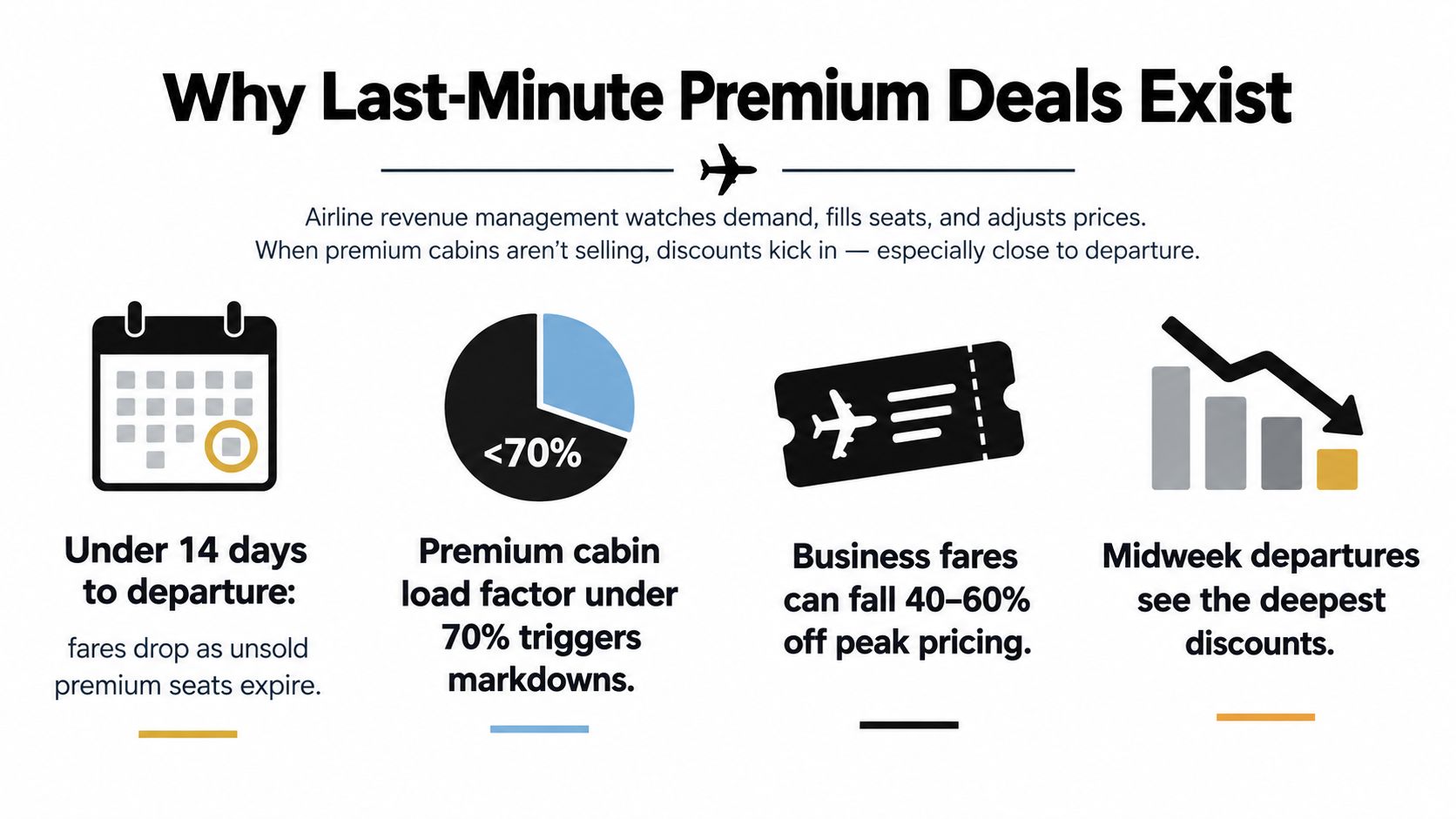
An infographic explaining why airlines offer last-minute discounts for premium cabin seats as departure dates approach.

Booking curves determine the pressure

Revenue managers compare actual bookings with historical booking curves. They examine how many seats typically sell around 180, 90, and 30 days before departure, then decide whether to protect remaining inventory for late demand or open lower fare classes. The IATA explanation of airline revenue management describes this as a recurring feedback loop involving forecasts, inventory controls, and pricing decisions.

If bookings trail the expected curve, an airline may stimulate demand through a lower fare, a targeted offer, or a change in inventory availability. If bookings run ahead, the carrier can close discounted classes and preserve seats for travelers booking closer to departure. That is why a flight that looked cheap months earlier can become expensive, while another route may produce a late premium opportunity.

A useful way to understand the process is through forecast error. The airline isn't discounting because an agent notices an empty seat. It is responding to the expected value of selling that seat later, measured against the risk of flying with it unsold.

Practical rule: An empty seat is evidence of physical capacity, not proof that a discount exists.

Why waiting can fail

Premium cabins attract travelers with different booking habits. Corporate passengers often book late and may accept higher fares for a specific schedule, nonstop routing, or flexible ticket. McKinsey describes the risk of premium-seat spillage, meaning an airline sells too early and loses higher-paying late demand, as potentially more damaging than leaving a seat empty. Its analysis of premium-cabin profitability helps explain why carriers may protect premium inventory instead of dumping it near departure.

This is also why a fare-monitoring strategy should focus on relative value, not a countdown clock. Departure proximity can produce volatility, but it doesn't guarantee a lower price. Travelers need to compare the current fare with the route's normal observed pattern, remaining inventory, competing schedules, and the cost of losing flexibility. The broader mechanics are also covered in airline capacity management, particularly the relationship between seat availability and revenue protection.

When Business Class Is Actually Cheaper Than Coach

Business class can cost less than coach on the same flight. That sounds like a pricing error, but the mechanism is straightforward: airlines maintain separate fare buckets inside each cabin, and the cheapest economy inventory can sell out while a lower-priced business bucket remains available.

A traveler comparing only cabin labels will miss this inversion. The correct comparison is between the lowest sellable fare for the complete itinerary, including the rules attached to it. A restrictive business fare may still be valuable, but it shouldn't be treated as equivalent to a flexible economy ticket without checking conditions.

Documented fare inversions

The following examples compare the same departure or itinerary, rather than comparing unrelated flights:

Route Economy Fare Business Fare Savings
Virgin Australia Canberra to Melbourne A$629 A$449 A$180, approximately 28.6%
Sydney to Christchurch A$489 A$462 A$27, approximately 5.5%
Published comparison example $575 $471 $104, approximately 18.1%
Separate published comparison flight $480 $373 $107, approximately 22.3%

The Virgin Australia fare examples show the clearest version of the pattern. Economy demand had pushed the lowest economy buckets out of reach, while promotional business inventory remained open. The additional published comparisons demonstrate that the inversion isn't limited to one airline or one domestic market.

This isn't a normal relationship between cabins. Business class generally carries higher service value and higher published fares. The exception appears when demand behaves unevenly. Economy may be popular with price-sensitive travelers, students, families, or short-haul passengers, while business inventory remains harder to fill. The airline then has a commercial reason to keep a promotional business fare available even after cheaper economy options disappear.

How to recognize a real bargain

Start with the exact flight number and departure time. Then compare the full itinerary, not just the first search result. A lower business fare may require a connection, a particular minimum stay, a nonrefundable ticket, or a separate ticketing deadline.

Also check whether the economy fare includes conditions that make it a poor alternative. If economy is expensive because only a flexible fare remains, a restricted business fare may be cheaper but less useful for a traveler whose plans could change. The price difference is real, yet the value depends on the trip's purpose.

This same cabin-by-cabin imbalance can reach premium economy. A 2019 fare report recorded Delta business class from Orlando to Brussels at $1,707 for July and August while comparable premium-economy pricing in the cited comparison was higher. The lesson is simple: search across cabins, then validate the rules.

How to Monitor and Time Premium Cabin Purchases

A disciplined search treats a premium ticket as an optimization problem involving booking-class inventory, fare rules, and departure proximity. Looking at a single fare on a single date gives you a price, but not enough context to decide whether it's a deal.
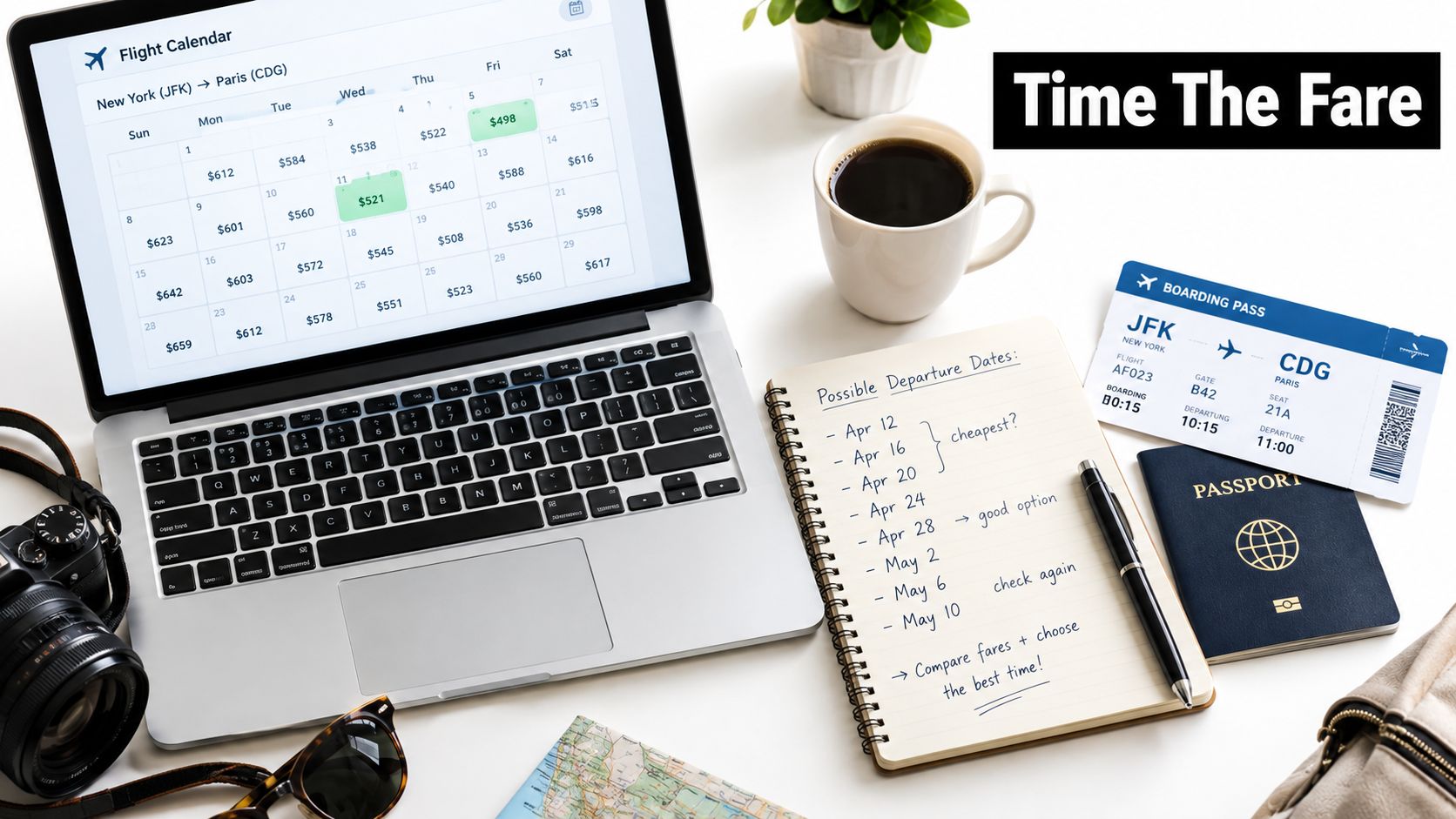
A travel planning flatlay featuring a laptop showing flight prices, a boarding pass, passport, and a notebook.

Build a comparable search set

Begin by writing down your boundaries before opening a booking engine:

  1. Choose acceptable airports. Include nearby departure and arrival airports only if the ground-transfer cost and time are acceptable.
  2. Define the cabin precisely. First class, international business class, and domestic recliner-style business products aren't interchangeable.
  3. Set connection limits. A cheap premium fare with an impractical connection may be worse than a higher nonstop fare.
  4. Test nearby dates. Flexible travelers should search several departure dates and retain an economy or premium-economy fallback.

Record the lowest available fare, operating carrier, flight number, and visible booking class for each search. You don't need an elaborate model to spot movement. A simple spreadsheet can show whether the fare is falling, whether a class has disappeared, and whether the cheaper result is tied to a different itinerary.

For broader trip planning, travelers can also find safari travel advice when comparing destination logistics, timing, and acceptable flexibility. The same principle applies to airfare: define the trip's practical constraints before judging the price.

Inspect the fare, not just the headline

The lowest number can conceal a poor contract. Compare:

  • Refundability, including whether the ticket is refundable before departure or only usable as a credit.
  • Change penalties, fare differences, and the deadline for making changes.
  • Minimum-stay requirements, especially on international itineraries.
  • Advance-purchase rules and ticketing deadlines.
  • Segment compatibility, because one unavailable fare class can invalidate the displayed price for the complete route.
  • Baggage and seat conditions, where the premium label may not tell the whole story.

IATA's research treats booking-class availability and fare rules as separate airline controls. That distinction matters. Monitoring only the price can leave you unaware that the fare class changed, the restrictions tightened, or the offer applies to only one segment.

Use a deadline instead of wishful waiting

There is no universal “best” last-minute booking day. A modeled study of premium-capacity sharing found its strongest revenue gains when premium capacity was released very late, around three days before departure, as described in the MIT study of late capacity release. That finding describes an airline optimization, not a promise that consumers will receive a discount.

Use the information as a risk warning. If the trip is flexible, continue monitoring multiple nearby dates and preserve a fallback. If the date is fixed, choose a firm purchase deadline before the final days. Recheck inventory after a meaningful price movement, then confirm the fare basis and ticketing deadline before payment.

Passport Premiere's airline fare prediction resource is relevant for travelers who want a structured way to interpret fare movements rather than rely on a single search snapshot. The tool or method matters less than the discipline: observe patterns, compare rules, and buy when the value is strong enough for the trip's actual constraints.

Corporate Travelers Weighing Savings Against Risk

For a corporate buyer, a lower premium fare isn't automatically a lower travel cost. The ticket price is only one part of the decision. A cheaper itinerary can create exposure through a restrictive cancellation policy, an inferior schedule, a connection that threatens a meeting, or a purchase delay that leaves the traveler without a workable seat.

Premium demand makes that risk more relevant. United reported premium-revenue growth of about 11% in 2025, while Delta's premium revenue growth was reported at roughly 9% in the third quarter, according to the reported industry discussion. Those figures don't prove that a particular flight will rise, but they weaken the assumption that airlines routinely slash every unsold premium seat close to departure.

A decision matrix for travel managers

A travel manager can score each option across four questions:

Decision factor Lower fare may be worthwhile when Higher fare may be safer when
Schedule The traveler has flexible arrival timing A meeting or event makes the arrival fixed
Changes The fare permits useful changes at a manageable cost The trip may move or cancel
Routing The connection has a reliable, practical schedule A missed connection would disrupt work
Availability A backup itinerary remains bookable The preferred cabin or route may disappear

The expected value is not just the fare reduction. It is the fare reduction minus the likely cost of rebooking, employee downtime, missed meetings, approval delays, and disruption management. A ticket that saves money but forces a traveler onto a poor connection can cost more in productive time than it saves in airfare.

Approval and duty of care

Last-minute purchasing also collides with internal controls. A fare may be available only until a ticketing deadline, while a corporate approval process takes longer. If the traveler waits for approval and the fare disappears, the company may need to buy a more expensive itinerary or split the journey across tickets.

Duty of care adds another filter. Travel managers should know whether the routing uses acceptable airports, whether the traveler can reach the destination after a disruption, and whether the fare's change terms support a rapid response. This is the same logic that applies when teams find affordable pet travel costs, where the headline amount doesn't capture handling requirements, restrictions, or contingency planning.

A corporate policy should therefore define a maximum waiting window, an approved list of acceptable routings, and a minimum flexibility standard. Passport Premiere's corporate travel cost savings guidance can sit alongside those controls as a fare-monitoring reference, but it shouldn't replace the company's approval and duty-of-care process.

Real-World Case Study Booking a Last-Minute Premium Deal

Consider a traveler with a flexible international trip, two acceptable departure airports, and a firm preference for business class. The traveler doesn't assume that an empty seat means a cheap fare. Instead, they record the lowest business and economy prices for several nearby dates, note the booking classes, and compare the conditions attached to each result.
A smiling woman works on her laptop while sitting in a luxurious first class airplane seat.

The first search shows a business fare that looks attractive, but it requires a connection and has restrictive change terms. Another date displays a higher headline price but offers a nonstop itinerary and more usable flexibility. A third date shows economy rising after its lowest fare bucket disappears, while business remains available at a lower price. That third result becomes the candidate, but not yet the booking.

The traveler then checks the complete origin-to-destination fare, confirms that every segment has matching inventory, and reviews the ticketing deadline. The seat map shows open premium seats, but the traveler treats that only as supporting evidence. The decisive signal is the sellable booking class combined with acceptable rules.

A fare becomes a deal only after the itinerary and its conditions survive inspection.

The traveler also keeps a fallback in premium economy and avoids building a self-connected itinerary around separate tickets. That choice limits the upside, but it protects against the common failure mode in last-minute searches: saving on the first segment while creating a much larger operational risk later.

The final purchase follows a meaningful price movement, not a superstition about a particular countdown. The traveler captures the fare basis, confirms the payment and ticketing status, and stores the change and cancellation terms. The result is a genuine last-minute premium booking because the price, routing, inventory, and restrictions all work together.

For a visual explanation of how this kind of fare search fits into a broader premium-cabin strategy, the following video provides additional travel context.

The case also shows what didn't work. Waiting for the seat map to look empty would have added false confidence. Chasing the lowest displayed number without reading the fare rules could have produced a cheaper ticket with worse business value.

Your First-Class Last-Minute Checklist

First-class last-minute deals reward preparation more than patience. Use the checklist below before you search, while you monitor, and immediately before you pay.
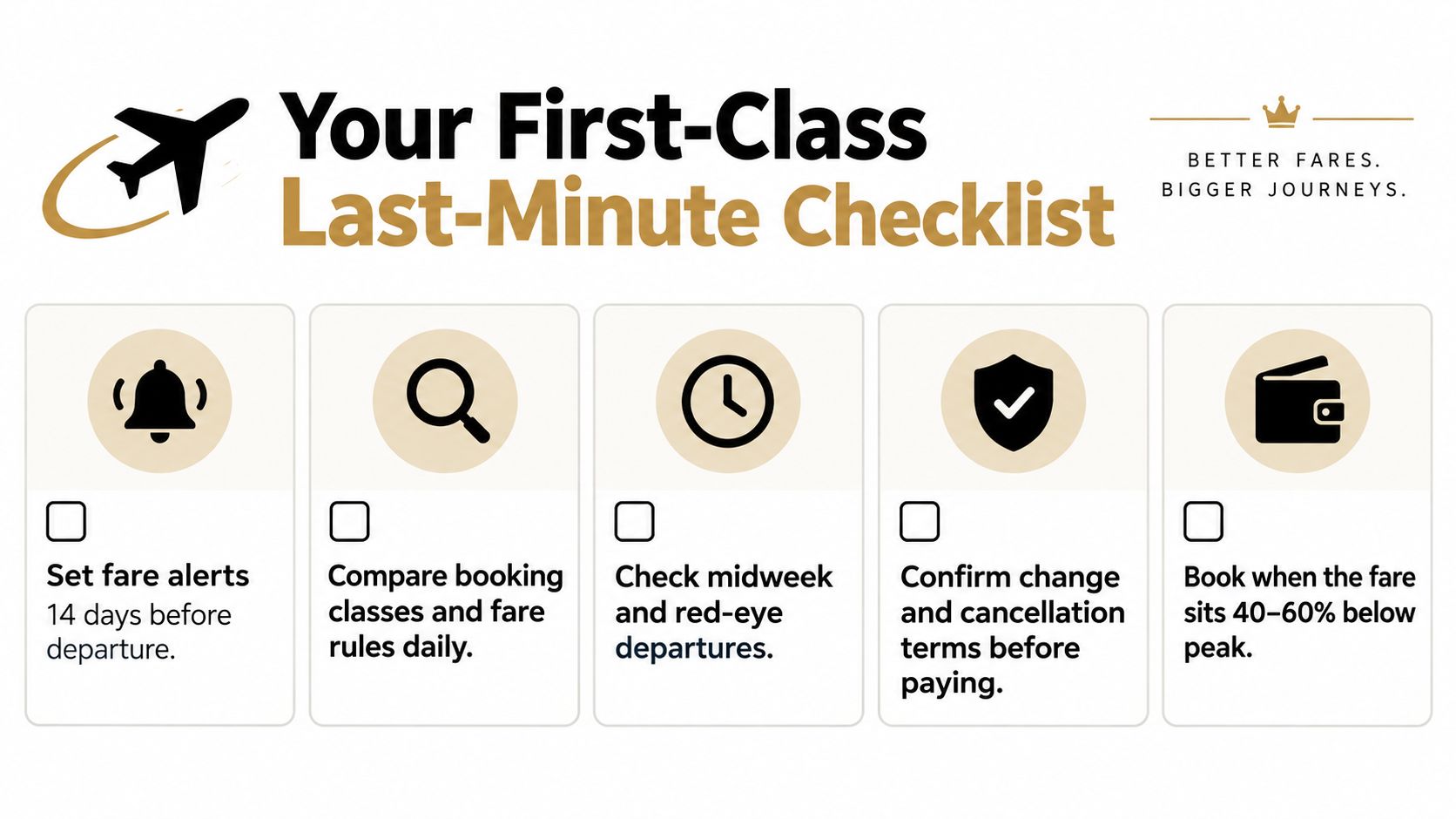
A checklist for booking first-class flights at the last minute with five key actionable travel tips.

  • Set alerts early: Begin monitoring before the final stretch and watch several acceptable dates.
  • Compare cabins: Check first class, business class, premium economy, and economy on the identical itinerary.
  • Track inventory: Record booking classes, not just the fare shown in the search results.
  • Read the contract: Confirm refundability, changes, minimum stay, ticketing deadlines, and segment compatibility.
  • Protect the trip: Keep a fallback when the date is fixed, and set a purchase deadline before the risk becomes unacceptable.
Booking window Primary focus Risk level
Earlier monitoring Establish route value and flexibility Lower
Near departure Watch fare-class movement and restrictions Moderate
Final days Buy only with a fallback or flexible plan High

A discounted business fare can beat coach, but only when the routing and rules fit. If the trip is fixed, the preferred itinerary matters, or approval takes time, a slightly higher fare may be the financially responsible choice.


Passport Premiere helps travelers monitor international Business and First Class fares, interpret fare movements, and identify premium-cabin opportunities that can sometimes price below coach. Visit Passport Premiere to review its fare-monitoring service and use the information when deciding whether to book now or keep watching.

Business Class Last Minute Deals That Beat Coach Prices

The cheapest business class ticket is often not the one you chase in the final 48 hours. The better money usually shows up earlier, when airlines are still trying to move unsold premium inventory, and the pricing gap can flip enough that business class last minute deals beat a walk-up coach fare on the same trip, especially when the comparison is against late-booking economy rather than an advance purchase (Passport Premiere's last-minute business class guide).

That's the part most travelers miss. They treat “last minute” like a panic state, when it works better as a disciplined pricing window. If you want to catch business class cheaper than coach, you need a timing system, not hope.

Why Last Minute Does Not Mean Cheaper

The final week is where many travelers make the wrong bet. Airlines usually protect premium cabins for higher-value demand, then release leftovers in controlled bursts. A projected 2026 review of business-class fare alerts suggests the actual bargains show up much earlier, with only 2 of 247 fares tied to travel within roughly a month of the alert, while 94% were available 3 or more months ahead and 74% were available 6 or more months ahead (Luxury Flight Club review). The same review reported a median discount of 53% off standard fare, with a middle range of 49% to 58%, plus a median saving of €1,840 per trip from an average standard fare of €3,510 to an average “from-price” of €1,636.

The late window is the worst window

The 30 to 7 day period before departure is usually the weakest place to hunt. A 2026 timing guide says cash fares often rise 40% to 80% in that span as airlines chase late-booking business travelers, while the deepest discounts usually appear 3 to 6 months out through contracted consolidator buckets that can run 30% to 60% below airline.com (BusinessClassTravel timing guide). Late deals do exist, but they are inconsistent and priced against urgency, not generosity.

Use this rule: search late only when you are watching a specific inventory release, not because you expect the fare to collapse on its own.

That is how the pricing engine works. Airlines protect premium seats for corporate buyers, then open small pockets of inventory when load factors look weak or a cabin is still undersold. The timing matters because that is the moment when a business-class seat can stop behaving like a retail product and start behaving like yield management pricing inventory.

An infographic titled Why Last Minute Does Not Mean Cheaper explaining why booking travel early saves money.

So stop treating “last minute” as a single panic window. The better approach is to watch the market in structured stages, read the load-factor pressure behind the fare, and buy when the odds shift in your favor.

The Three Timing Windows That Actually Work

Stop treating “last minute” as one sloppy bucket. The smart move is to monitor three windows, each with a different job. That structure keeps you from overreacting to a weak fare too early, and it keeps you from sleeping through the best release patterns later on.

Window one, 14 to 21 days out

This is the first real checkpoint. The market is still fluid enough that you can catch residual consolidator inventory and open award space before the scramble gets ugly. In this range, you're not looking for fantasy pricing, you're looking for a deal that still has room to move.

The guide data points to realistic savings of about 20% to 30% off the airline's published business fare in this late stage, though that's meaningfully weaker than the 30% to 60% gaps often available 3 to 6 months ahead (BusinessClassTravel last-minute deals guide). That's why this window matters. It's the last moment where you can still compare multiple paths without settling for retail.

Window two, 7 to 14 days out

This is the most interesting zone for premium hunters. Airlines may release unsold business seats as last-minute saver awards in this range, and those seats are often visible only through award calendars or specialist booking channels (BusinessClassTravel timing guide). If you've built your baseline early, the alerting system starts paying off.

Window three, under 7 days

Under a week, you're in cleanup mode. Meaningful cash discounts mostly disappear, and you should only stay in the game if you can tolerate retail pricing or you're waiting on a late load-factor offer. The operational play here is simple, watch for award releases, upgrade inventory, and very specific distressed-seat drops. Anything else is wishful thinking.

Under 7 days, don't “shop.” Verify inventory, compare upgrade paths, and buy only when the math beats your fallback.

A productivity infographic showing three daily timing windows for deep work, maintaining momentum, and recharging effectively.

The point of the three-window system is control. You stop refreshing fares randomly and start checking at the moments when airlines change the game.

Buy Business or Buy Economy and Upgrade

This is the decision most guides dodge, and it's the one that matters most. If you're flying a route like JFK to London, you shouldn't just ask what business costs. You should ask which path has the best expected value once you factor in cash, awards, and upgrade odds.

The three paths

A recent industry guide on last-minute upgrades says airlines can trigger discounted load factor offers when a business cabin is undersold within 24 to 48 hours of departure, with typical upgrade price ranges of $200 to $900 domestically and $500 to $1,500 on long-haul international routes (last-minute upgrade guide). That matters because a low upgrade fee can beat a brutal walk-up coach fare if you're already forced into late purchase mode.

Here's the part to anchor on. A 2026 business-class timing guide says last-minute consolidator fares around 10 days out on a sample route like JFK to London were typically $3,400 to $4,400, versus $2,400 to $2,900 booked about 4 months ahead (BusinessClassTravel timing guide). That tells you where the pressure sits. Late business is often still expensive, but it can still win against bad economy pricing.

Path Cash Outlay Award Needed Probability of Seat Best Window
Buy business outright Highest up front, unless a consolidator fare appears No High once ticketed 14 to 21 days, then 7 to 14 days
Buy economy and upgrade Lower at first, then variable depending on offer No, unless using miles for an award upgrade Medium to low, tied to load factor and status 24 to 48 hours before departure
Buy business with miles Lowest cash, but award inventory must exist Yes Depends on award space 7 to 14 days, sometimes earlier

The rule is blunt. If your route is premium-heavy and the cabin still looks empty close to departure, watch the upgrade path. If you see a real consolidator fare before the final week, buy business outright and stop gambling. If your company or your own ticket rules force you into flexible economy, then you're mainly playing the upgrade lottery.

Setting Up Fare Monitoring That Catches the Drop

The people who win this game do not search harder, they monitor better. Set the route baseline first, then let alerts tell you when the market shifts. Without that setup, you will mistake noise for opportunity and miss the fares that matter.

Build the route stack first

Start with two or three origin airports, not one. For New York trips, that usually means checking JFK, Newark, and a backup like Boston if the schedule can absorb it. Then define the fare class you are tracking, because a premium sale buried under economy results is useless to you.

A practical way to automate the comparison is to extract structured fare data from search results with Google Flights data extraction. Build a baseline from the exact route, cabin, and departure window you want, then compare every new result against that benchmark. If a “sale” only looks cheap because the search shifted airports, dates, or cabin, ignore it.

Set alerts across multiple channels

Use at least three monitoring layers, airline websites, a meta-search engine, and a consolidator or specialist channel. That mix catches public sales and off-market inventory. If you only watch one place, you are seeing one pricing philosophy, not the market.

Useful filter: If an alert does not show the cabin, route, and fare class clearly, it is a marketing ping, not a booking signal.

Treat currency noise carefully. If a fare moves only because the exchange rate shifted, that is not a booking trigger. Hold firm on your route and cabin definition, then widen the date range only when the alert system shows repeated misses across adjacent days. For readers who want a fast way to set that up, the checklist on airline price drop alerts gives a clean starting point.

Use the monitoring window like a decision tree. Track the 14 to 21 day range for early drops, keep the 7 to 14 day range live for late inventory releases, then watch the under 7 day window only if you are willing to act fast on either a fare drop or an upgrade offer. On a premium-heavy route with a low load factor, late economy plus upgrade can win on cash outlay, but only if the cabin is not already filling. On a fuller route, the cash business fare is the safer buy because the upgrade odds weaken as seats disappear.

The best alert is specific enough to trigger action and narrow enough to avoid fatigue. If every ping looks urgent, none of them are.

A Real Workflow for a New York to London Trip

A corporate travel manager gets a London trip three weeks out. That is enough time to work the market, but not enough time to waste it on one screen and one fare. Start with a disciplined search and make the first move across the route, not the airline.

Build the baseline the same day across JFK, Newark, and a backup like Boston, then check award space on alliance partners at the same time. That route sweep matters because New York to London can look thin on one carrier and still have usable premium inventory on another. For travelers who want a route-specific starting point, business class flights from New York gives the right baseline before you start comparing cash fares and upgrade paths.

An infographic detailing a ten-step travel workflow for a trip from New York to London.

The search sequence that actually works

Start with the 14 to 21 day window and set alerts that force a quick decision if a fare drops into range. If nothing usable appears, move straight into 7 to 14 days and watch for saver awards and late inventory releases. If the trip is still open inside seven days, use the fallback rule, buy the retail business fare if the price is acceptable, or compare that cash fare against economy plus a late upgrade bid.

That sequence keeps the search grounded in probability. On a route with softer premium load factors, the economy plus upgrade path can win on cash outlay because the cabin still has seats to clear. On a fuller flight, cash business usually makes more sense because the upgrade pool gets tighter as the cabin fills, and the odds fall with it.

Use the load picture to make the call, not the mood of the day. If premium seats are still visibly open and the fare drops early, act. If the cabin looks tight and the clock is running down, stop waiting for a bargain that is unlikely to appear.

For corporate travel managers, this workflow also leaves a clean paper trail. You can show why you waited, why you bought, and why a late upgrade offer did or did not justify the spend. That is far better than grabbing the first expensive seat that shows up and calling it strategy.

Where Passport Premiere Fits In

Most travelers lose money in one of three ways. They search too late, they search too few channels, or they don't know what a fair premium-cabin price looks like for their route. A membership-based monitoring layer solves all three by turning the fare cycle into something you can watch.

Passport Premiere's model is straightforward. It blends fare monitoring, market analysis, and member guidance to spot when an empty premium seat is being discounted before the wider market catches on. The brand says it also helps members understand that fewer than 15% of all premium cabin seats are sold at their initial asking price, which is exactly why the monitoring layer matters in the first place.

What the membership is really doing

The value isn't magic, it's compression. Instead of manually checking airline sites, consolidator channels, and award calendars every day, the service pulls those signals into one place. That helps a traveler compare the live offer against the timing windows already covered here, then act when the fare hits the right zone.

A subscription can make sense for frequent long-haul flyers and corporate teams. If you already know your route baseline, the service can surface volatility faster than a random search session. If you don't know your baseline, it still helps by showing whether the fare is drifting toward a genuine deal or just wobbling inside the normal range.

Choosing Your Approach and Common Questions

Pick one playbook and stick to it. If you're buying within three weeks of departure, use the 14 to 21 day, 7 to 14 day, and under 7 day windows in order, then decide in advance whether your fallback is an upgrade bid or a paid business fare. That single rule beats the usual last-minute scramble every time.

A comparison chart highlighting DIY, collaborate, and done-for-you service approaches with frequently asked questions.

The questions people ask most

Does business class really undercut coach? Yes, sometimes it does, especially when late economy is absurdly priced and premium inventory is still loose. That's not a gimmick, it's the side effect of airlines protecting seats for corporate demand and then cutting loose the leftovers.

How far ahead do the best deals appear? The strongest published timing evidence points to 3 to 6 months out for the deepest discounts, while the late windows are weaker and more volatile (BusinessClassTravel timing guide).

Are mileage redemptions realistic inside two weeks? Sometimes, but only if award space opens. The 7 to 14 day window is the one to watch if you're chasing saver releases.

What if award space never opens? Then stop waiting and compare the best cash fare against the upgrade offer. If the cabin stays empty and the airline pushes a load-factor deal, the late upgrade can still beat a bad coach purchase on the same flight.

For travelers who want an easier way to keep the monitoring stack running, it can also help to pair this routine with practical trip planning resources like browse SwiftNet Wifi deals, especially if you're managing work travel on the move and need dependable connectivity while fares are shifting.


Passport Premiere gives you fare monitoring, route intelligence, and premium-cabin signals in one place, which is exactly what business class last minute deals require. If you want to stop guessing and start watching the right windows, visit Passport Premiere and use a real monitoring setup for your next long-haul trip.

Can You Buy a Ticket at the Airport? What to Know for 2026

Yes, you can buy a plane ticket at the airport, but it's almost always the most expensive and riskiest way to fly. Airport ticket counters now account for only roughly 2–4% of total ticket sales, which tells you exactly what they are today: a backup channel, not a smart buying strategy.

If you're reading this while standing near a departures board, dealing with a missed connection, a family emergency, or a same-day client trip, the appeal is obvious. Walk up, talk to a human, get on a plane. That part is real. The problem is that airport ticketing feels simpler than it is.

A terminal purchase compresses everything that matters into the worst possible environment. Time pressure. Limited inventory. Fewer chances to compare options. More room for fare-rule mistakes. If you're flying internationally or trying to protect a business-class budget, that's where the airport counter turns from convenience into liability.

The Last Minute Dash Can You Buy a Ticket at the Airport

A traveler misses a connection in Chicago. Another gets a call about a family emergency and heads straight to the airport with a carry-on and passport. A consultant wraps a meeting early and wants to leave tonight instead of tomorrow morning. In all three cases, the same question comes up fast. Can you buy a ticket at the airport?

Yes. In many major airports, you still can.

What “possible” actually means

What usually happens is straightforward. You go to the operating airline's ticket counter, or sometimes a kiosk if the carrier supports same-day sales there. You show ID. For international travel, you'll need your passport and sometimes supporting travel documents depending on destination and routing. The agent checks inventory, prices the itinerary available in the airline's system, and issues the ticket if a sellable fare is open.

That's the mechanical answer. The practical answer is harsher.

Airport buying works best only when your priority is leaving now, not buying well. If your goal is the lowest fare, the most flexible fare basis, the cleanest routing, or the best premium-cabin value, the airport is usually the wrong place to start. Agents at the counter are solving an operational problem in real time. They aren't acting like your fare strategist.

Practical rule: Buy at the airport only when timing matters more than price, flexibility, and comparison shopping.

Who should treat it as a last resort

Some travelers assume a counter agent can uncover a hidden deal that websites miss. That's an old mental model from the paper-ticket era. Today, the airport channel is mainly there to handle disruption, exceptions, and passengers already inside the airline's operational workflow.

A same-day airport purchase can still make sense in a narrow set of situations:

  • Irregular operations: Your original trip fell apart and you need immediate re-ticketing.
  • Documentation issues: An international trip needs human review before ticketing.
  • Cash or in-person preference: Some travelers still want face-to-face service despite the trade-offs.

For everyone else, especially business travelers, the airport counter is usually a stress purchase. And stress purchases tend to be expensive ones.

How to Buy Your Ticket at the Airport Terminal

If you still need to do it, do it cleanly. Airport ticketing is less forgiving than booking from your laptop, so preparation matters.

Start with the airline counter

The most reliable option is the airline's own staffed counter. Go directly to the carrier you want to fly, not just the nearest desk with a short line. Have your government ID ready. For an international itinerary, bring your passport and know the exact spelling of your name as it appears on the document.

Tell the agent exactly what you need in plain terms:

  1. Destination and date
  2. Earliest acceptable departure
  3. Any cabin preference
  4. Whether you need flexibility for changes
  5. Whether this connects to an existing ticket

That last point matters. If you already hold part of the itinerary, say so immediately. Mixing a fresh airport purchase with an existing reservation can create complications if the segments don't align cleanly.

A smiling airline staff member helping a passenger with check-in at an airport ticket counter.

When kiosks help and when they don't

A self-service kiosk may let you book, but it's usually better for simple domestic transactions than for multi-leg or international trips. Kiosks are fine when the route is direct, the fare is standard, and the airline supports immediate issuance. They're weak when the trip involves fare choices, partner airlines, or special handling.

Airport counters no longer exist primarily to sell seats. According to USC Illumin on airline e-ticketing and distribution, airport ticket counters now account for roughly 2–4% of total ticket sales, and by 2008, more than 90% of all airline tickets were already being issued electronically via websites and travel agencies. That's why many counters feel geared toward check-in, rebooking, and exceptions rather than efficient comparison shopping.

Counter agents are often excellent at fixing travel-day problems. That doesn't mean the counter is the best place to shop.

If you want a primer on how digital issuance works before you head to the airport, this guide to airline e-tickets is useful. It helps to understand what can be changed electronically and what still needs an agent's touch.

What to verify before paying

Before the agent takes payment, confirm:

  • Exact airports: London, New York, Tokyo, and other major cities can involve multiple airports.
  • Baggage terms: Ask what's included, especially if the trip involves more than one carrier.
  • Change conditions: Don't assume you're buying something flexible just because it's expensive.
  • Ticketing status: Make sure the reservation is issued, not just held.

A clean airport transaction depends less on speed than on precision.

The Real Cost of Airport Ticket Purchases

The airport counter is expensive for a simple reason. It costs the airline more to sell there, and airlines usually don't absorb that cost out of kindness.

Offline channels like airport ticket counters can cost airlines several dollars more per booking than web-based channels, and some carriers pass that directly to the traveler. American Airlines, for example, has a documented $35 per-ticket fee for purchases made at an airport counter, as explained by Alternative Airlines' overview of airport ticket purchases.

An infographic detailing the reasons why purchasing airline tickets at the airport often costs more.

Why the number on the screen often gets worse at the terminal

Same-day inventory is usually tighter. The seats left are often priced for urgency, not value. Add in a staffed sales channel, and the economics lean the wrong way for the buyer.

Here's what pushes cost up in practice:

  • Late purchase timing: Airlines usually protect high-yield seats close to departure.
  • Reduced comparison shopping: At the counter, you're often evaluating one airline's options at a time.
  • Channel cost: Staff, facility space, and system overhead make in-person sales pricier.
  • Fewer promo paths: Web-only pricing structures and booking flows are easier to access online.

A quick trade-off table

Booking method Best for Main weakness
Airport counter Immediate, urgent departure Higher fares and fewer easy comparisons
Airline app Fast rebooking and direct control Can be harder for unusual documentation issues
Online travel agency Side-by-side shopping Post-booking changes can be less direct
Airline phone line Human help without terminal pressure Hold times and inconsistent agent skill

If you want to understand how fares move before you make any urgent purchase, it helps to know when airlines drop prices. Even when you can't wait for a perfect window, knowing whether you're looking at a routine fare spike or a normal market level changes the decision.

The airport counter doesn't just sell a seat. It sells urgency, and urgency is rarely discounted.

For premium cabins, this gets even tougher. Airlines don't usually use the counter to hand out surprise business-class bargains to walk-up travelers. They use pricing logic to protect revenue. That's why “I'll just ask at the airport” is often one of the costliest ideas in travel.

Hidden Risks Beyond the High Price Tag

The expensive fare is only part of the problem. The bigger issue, especially on international travel, is that a rushed counter transaction can create downstream damage you don't discover until much later.

Aviation consumer reports from 2023–2025 show that passengers who purchased or changed tickets at the airport were disproportionately represented in disputes over unexpected change fees, misclassified fare rules, and denied boarding due to mis-segmented itineraries, especially on international routes, as noted in this discussion of airport-counter ticket disputes and itinerary issues.

A stressed businessman in a suit sitting in an airport terminal while looking at his smartphone.

Where errors show up

Most travelers think a ticket is a ticket. It isn't. The fare basis, baggage logic, married segments, codeshare behavior, and change permissions all matter. At the airport, agents are often working under departure pressure with a line behind you. That's not the ideal setting for complex itinerary quality control.

Problems tend to cluster around a few areas:

  • Fare-rule mismatch: You thought you bought changeable. The record says otherwise.
  • Baggage confusion: One carrier's allowance doesn't always flow cleanly across partners.
  • Segment errors: Multi-leg reservations can be built incorrectly or not synced as expected.
  • Denied boarding disputes: The traveler shows up believing everything is in order, but the reservation structure says otherwise.

Why business travelers should be especially careful

Corporate travel managers and frequent consultants often care less about the base fare than the effective trip cost. One bad counter-issued change can trigger rework, lost productivity, hotel disruption, and reporting headaches. If a traveler is moving between partner airlines on a long-haul route, a sloppy same-day reissue can interfere with the rest of the journey.

A ticket bought in five rushed minutes can create five separate problems by the time the trip is over.

If you must buy or amend at the airport, slow the process down. Ask the agent to read back the routing. Confirm operating carrier versus marketing carrier. Check fare conditions before paying. On international trips, inspect every segment on the receipt before you walk away.

That extra minute at the desk can save an entire day of cleanup later.

Smarter Last Minute Booking Alternatives

If you need to move fast, there are better options than joining the terminal line and hoping a counter agent can solve everything. The smartest last-minute bookings usually happen before you walk into the airport, even if departure is only hours away.

What to use instead

The strongest option is usually the airline's own app or website. You can see live inventory, confirm fare rules with less pressure, and ticket the trip while you still have time to compare airports or departure times.

The second-best choice is the airline reservation line. It gives you human help without the noise of the terminal. That matters when the trip involves passport data, existing tickets, or a complicated change.

A reputable online agency can also help when speed and comparison matter more than loyalty to a single carrier. If you want a broader booking resource for urgent itineraries, you can book flights via NSB Tourism and compare options without being limited to the physical counters inside one airport.

A practical decision guide

Situation Best move
Same-day domestic trip, simple route Airline app
Existing ticket needs change Airline app first, then airline phone line
Multi-airline comparison needed fast Reputable online agency
International itinerary with document concerns Airline phone line before airport counter
You're already at the airport and boarding is near Counter only if digital options fail

Why these channels work better

Digital and phone channels give you breathing room. That sounds small, but it changes the quality of the decision.

  • You can compare: Airports are bad environments for methodical shopping.
  • You can screenshot and verify: Fare conditions are easier to inspect when they're on your device.
  • You can pivot faster: If one carrier is poor value, you can switch instantly.
  • You keep a paper trail: Confirmation emails and app records are easier to review than verbal explanations at a desk.

Set up tools before you need them. Keep airline apps installed. Save passport details securely. Turn on fare notifications where relevant. A simple system like airline price drop alerts won't solve every emergency, but it reduces the odds that you'll ever need to make a blind, expensive airport purchase in the first place.

The airport should be where you depart, not where you start shopping under pressure.

How Savvy Travelers Find Business Class Cheaper Than Coach

The most expensive ticket decisions usually happen when travelers go reactive. They wait until the trip becomes urgent, then buy whatever the airport or airline offers. Savvy travelers do the opposite. They watch fare behavior early enough to act when pricing gets irrational.

That matters because business class cheaper than coach isn't a fantasy. It's a real pricing anomaly that shows up when premium inventory needs to move and economy pricing stays stubborn.

Screenshot from https://www.passportpremiere.com

How that happens

During specific off-peak periods, business-class fares on major carriers can undercut the applicable economy fare by up to 10–20% when an airline is trying to clear otherwise empty premium-cabin capacity, according to this discussion of business-class fares undercutting coach during off-peak periods.

That sounds backward until you've watched premium fare inventory closely. Airlines don't price cabins according to common sense. They price by revenue logic, inventory pressure, competition, and fare-family strategy. On the wrong day for coach and the right day for premium, the “better” seat can cost less.

What experienced buyers do differently

They don't assume the listed cabin hierarchy tells them the best value. They check both cabins, especially on international long-haul routes, and they stay alert for odd windows when premium pricing softens.

A few habits separate strong buyers from rushed ones:

  • They monitor routes, not just trips: The route pattern matters as much as the travel date.
  • They compare cabins every time: Never assume economy is the cheaper buy.
  • They act on opportunity: Strange fare drops don't usually sit around waiting.
  • They prepare for the whole trip: If you're flying abroad, these international travel essentials help you avoid fixing one problem while missing another.

The video below is a useful companion if you're thinking more strategically about premium travel buying.

Don't measure value by cabin label alone. Measure it by what the market is doing that day.

That's the effective alternative to airport counter buying. Not just “book online instead,” but stop buying in panic mode. When you understand fare behavior, the airport counter becomes what it should be: an emergency tool, not your plan.


If you want a better way to track premium-cabin pricing before a trip turns urgent, Passport Premiere helps travelers spot international Business and First Class opportunities, including moments when premium fares can make more sense than coach. It's built for people who'd rather buy strategically than overpay at the terminal.

Are Flight Tickets Cheaper at the Airport: Are Airport

The popular advice is wrong for most travelers. If you're asking are flight tickets cheaper at the airport, the honest answer is usually no.

Airport counters aren't secret discount desks. They're sales and service points attached to a revenue system built to charge more when you show up late and ready to buy. That's why smart travelers book online, compare options, and watch fare movement instead of hoping for a walk-up bargain.

There is one narrow exception. Some ultra-low-cost carriers structure fees so that an in-person purchase can save money. But that exception has been stretched into a myth that hurts people flying full-service airlines, and it becomes especially expensive once you move into international Business and First Class.

The Enduring Myth of Cheaper Airport Tickets

The myth survives because it sounds logical. People assume that cutting out the website should cut out the markup. In practice, airline pricing doesn't work that way.

For most airlines, airport ticket prices are "almost always higher than expected", with no special deals, according to CheapOair's review of airport ticket pricing and BTS fare trends. The broad direction of airfare pricing has also moved toward online efficiency. Competitive digital distribution is where airlines expose and adjust lower fares most aggressively.

A young man looking intently at a computer screen inside an airport terminal with luggage nearby.

Why the myth feels believable

A counter agent looks authoritative. The airport feels like the source. And if you've ever dealt with canceled flights or standby questions, you've probably seen agents solve problems on the spot. That creates the impression that they can also provide better prices.

They usually can't. Their job is to issue what's available under current fare rules, not to shop the market for you.

Practical rule: If you're standing at an airport counter without a disruption forcing you there, you're usually negotiating from your weakest position.

The confusion gets worse because one small corner of the market does work differently. On certain budget airlines, skipping an online booking fee can make an airport purchase cheaper. That's real, but it's a niche tactic, not a general airfare principle.

Who gets hurt most by this myth

The travelers who overpay the most aren't backpackers chasing bare-bones fares. They're business travelers, consultants, founders, and luxury leisure flyers who assume the airport might help them snag a premium seat quickly.

That's where the myth becomes expensive. Premium travel follows a different pricing game entirely, and the savings don't appear at the counter. They appear in data, timing, and disciplined online monitoring. Travelers who want flexibility without overspending should think more like someone evaluating whether flying standby is actually cheaper and less like someone hoping the counter has unpublished magic.

How Airlines Really Price Their Seats

Airline seats behave like perishable inventory. Once the plane departs, every unsold seat is worthless. That doesn't mean airlines slash prices at the airport. It means they manage inventory carefully long before departure.

The key concept is yield management. Airlines don't sell "a seat" at one price. They sell access to a stack of fare buckets, each with different rules, availability, and urgency. Two passengers in the same cabin can pay very different amounts because they bought from different buckets under different conditions.

An infographic titled How Airlines Price Seats, illustrating factors like demand, supply, yield management, and operational costs.

Fare buckets, not one fare

Think of a flight as a shelf stocked with multiple versions of the same seat. Early buyers can sometimes access more restrictive, lower-priced inventory. Late buyers often see only the expensive options still open.

That is why airport shopping fails so often. By the time you're physically at the terminal, you're no longer competing for the same inventory a flexible online shopper saw days or weeks earlier.

A useful deep dive into this mechanism is dynamic pricing in the airline industry, especially if you've only ever looked at airfare as one changing number on a screen.

What the algorithms assume about you

When you buy at the airport, you signal urgency. Revenue systems read urgency as lower price sensitivity.

According to USC's explanation of airline pricing algorithms, airlines use dynamic pricing systems that reserve 10-20% of economy seats and higher percentages in premium cabins for high-yield, last-minute buyers. Those systems can upcharge walk-up customers by 50-200% over advance online rates because a late purchase signals inelastic demand.

That's the heart of the issue. The airport isn't where airlines offload cheap leftovers. It's where they often sell the most expensive remaining access.

Here is a simple way to understand it:

Buying context What the airline sees Likely result
Early online search Flexible shopper comparing options Broader access to lower fare buckets
Repeated online monitoring Price-aware buyer waiting for movement Better chance to catch drops and competitive adjustments
Walk-up airport purchase Urgent traveler who needs to fly now More exposure to unrestricted full-fare inventory

The pricing logic is easier to grasp when you see it explained visually, then hear it in plain language. This video does both well.

Why airport staff can't beat the system

Agents don't manually override a market just because you're standing in front of them. They work inside fare rules, inventory controls, and ticketing constraints. They can often reissue, rebook, or explain options. What they generally don't do is produce a hidden discount that the airline refused to show online.

The cheapest fare is often a timing outcome, not a location outcome.

That distinction matters. Travelers who focus on where to buy miss the more important question, which is when discounted inventory appears and how to catch it before it closes.

The Hidden Risks and Real Costs of Airport Purchases

The sticker price at the airport is only part of the problem. The bigger issue is that you lose almost every advantage modern fare shopping gives you.

The first risk is inventory shrinkage. By the time you buy in person, the lower booking classes may already be gone. What remains can be the least forgiving inventory on the plane, with stricter rules and higher pricing.

The second risk is zero comparison power. At a laptop or phone, you can check competing airlines, nearby departure windows, and alternate routings in minutes. At a single airline counter, you're hearing one offer from one seller inside one closed system.

The cost of buying blind

Online booking gives you context. Airport buying removes context. That matters because airfare isn't just a fare, it's a bundle of timing, routing, availability, and restrictions.

When travelers ask whether airport purchases save money, I usually ask a different question. How much are you paying for not being able to compare? That hidden cost can exceed any perceived convenience.

A few practical downsides show up repeatedly:

  • Limited airline visibility: You can't quickly scan the market the way you can online.
  • Weaker decision-making: You hear one quote without seeing whether a better itinerary exists elsewhere.
  • Pressure buying: The airport environment pushes urgency, and urgency leads to expensive choices.

The counter quote often isn't a bargain you discovered. It's the fare left after better shopping opportunities passed.

Convenience can become part of the cost

Even when the airport is already on your route, in-person buying still adds friction. You wait in line, work around counter hours, and gamble on staff availability. If you're making a trip to the airport solely to buy a ticket, your savings math gets worse fast.

That same logic applies to other travel gear decisions. Space-saving choices matter when you're optimizing every leg of a trip, which is why many frequent travelers also look at collapsible water bottles for space-saving travel instead of packing bulky extras they don't need.

Transparency matters more than travelers think

Airport purchases feel personal because you speak to a human. Online booking feels impersonal because you deal with screens. But pricing transparency is usually better online.

You can inspect fare conditions, compare cabin differences, and evaluate whether a schedule trade-off is worth it. At the counter, travelers just want a fast answer. That mindset makes them more likely to accept a bad one.

When Airport Purchases Can Actually Save You Money

There is a real exception to the rule, and it matters if you fly ultra-low-cost carriers. Some budget airlines add online fees that disappear when you buy in person.

Spirit is the clearest example in the verified data. According to MelaninisLife's breakdown of airport ticket savings on budget carriers, Spirit charges a passenger usage charge of around $22 per traveler each way for online bookings. Buying at the airport can avoid that fee, which means $44 saved on a round trip, $88 for a couple, or up to $176 for a family of four.

A traveler talking to an airline representative at an airport desk to rebook a flight.

When the math works

This works only when the fee you avoid is larger than the hassle and cost of showing up. If the airport is nearby and you're booking multiple travelers, the savings can be meaningful.

A simple side-by-side view makes the exception clearer:

Scenario Possible outcome
One traveler, short round trip Savings may be too small to justify the errand
Couple booking together Airport purchase can be worth considering
Family of four on Spirit Fee savings can become substantial
Premium or full-service airline This tactic usually doesn't apply

That distinction is essential. The exception exists because of a specific fee structure, not because airport counters usually have cheaper fares.

Necessary airport visits versus optional ones

Sometimes you go to the desk because you have to. Irregular operations, same-day disruptions, and rebooking needs can make the counter the right place to solve a problem. That's different from using the counter as a bargain-hunting tactic.

If you're dealing with a sudden trip and trying to think through better options, last-minute business class fares are a far more relevant angle than hoping an airport desk will produce a premium miracle.

Airport ticket buying makes sense when you're exploiting a known fee waiver or fixing a live travel problem. Outside those cases, it's usually a weak strategy.

The myth contains a grain of truth. The mistake is pretending that grain applies across the market. It doesn't.

The Premium Traveler Strategy Why the Airport Is a Trap

What works on a bare-bones budget airline doesn't translate to premium travel. In Business and First Class, the airport is usually the worst possible place to go looking for value.

The reason is simple. Premium inventory is managed aggressively, and the best opportunities show up through monitored fare movement, not through walk-up pricing. Counter agents on major airlines aren't there to hand out hidden discounts on premium cabins. They're there to sell what's ticketable under current conditions.

Why premium pricing rewards monitoring, not walking up

For premium cabins, the economics are inverted from the budget-airline airport trick. There's no small booking fee to dodge. There is, however, a huge gap between a well-timed online purchase and an urgent airport purchase.

According to Alternative Airlines' discussion of buying airline tickets at the airport, fewer than 15% of premium seats sell at their initial asking price, and the meaningful savings of 30-60% are found through monitored online fare drops. The same source notes that last-minute airport purchases in premium cabins can cost 2-3x more.

That is why experienced premium travelers don't chase counters. They track cycles.

The hidden world most travelers never see

Premium fares don't move in the neat, obvious way people expect. A Business Class fare can suddenly become more rational because of market competition, soft demand on a route, or inventory pressure. When that happens, the value can be striking enough that business class cheaper than coach stops sounding absurd.

Not cheaper than every coach ticket. Not cheaper on every route. But cheaper than the kind of fully flexible, late-booked, high-restriction coach fare many business travelers end up buying when they act too late.

Here's the practical distinction:

  • Walk-up coach can be punishing because urgency pushes you into expensive inventory.
  • Monitored premium can become attractive when fare drops open a window the average traveler never sees.
  • Airport premium combines the worst parts of both. Urgency, poor visibility, and expensive remaining inventory.

Premium value is usually discovered before departure day, not at the terminal.

Why corporate travelers should care

Corporate travel managers often focus on policy, compliance, and schedule protection. All fair concerns. But if they treat premium purchases as fixed luxury spending instead of volatile market inventory, they miss a major budget opportunity.

The strongest premium buys usually come from discipline. Someone tracks the route, understands how fares move, and buys when the market softens. The weakest premium buys happen when an executive decides at the airport that comfort is suddenly worth paying anything for.

That decision turns the airport into a luxury penalty zone. It feels efficient. Financially, it often isn't.

Unlocking Premium Value Practical Tactics for Smart Travelers

If the airport isn't where premium value lives, where should you look? In practice, value comes from process.

The winning approach is not glamorous. You watch routes. You compare cabins intelligently. You separate schedule urgency from buying urgency. And you stop assuming coach is automatically the budget option.

Build a premium-fare workflow

Most travelers shop only when they need a ticket. That habit keeps them reactive. Premium buyers do better when they build a repeatable workflow.

A strong process usually includes:

  1. Track the exact route, not just the destination. Nonstop and connecting itineraries can behave very differently in premium cabins.
  2. Compare premium against the coach fare you would buy. For business travelers, that may be a flexible or late-booked coach ticket, not the cheapest coach fare shown in a search ad.
  3. Watch repeatedly instead of checking once. Premium value often appears as a temporary window, not a permanent baseline.

Use tools that show movement, not just today's fare

General search sites are useful, but they often train travelers to think in snapshots. Premium shopping works better when you think in patterns.

That means using fare monitoring, market alerts, and route-specific observation. A one-time search tells you the current asking price. Ongoing monitoring tells you whether the price is normal, inflated, or unusually attractive.

A practical checklist helps:

  • Set alerts early: Don't wait until your travel week to start watching.
  • Check premium spreads: Compare Business or First against the fare family of coach you'd realistically choose.
  • Audit urgency: If your meeting date is fixed, book with strategy before urgency traps you.
  • Review nearby departure options: Small shifts in timing can change premium pricing materially, even when the destination remains the same.

Travelers save more when they stop asking "Where can I buy?" and start asking "What is this seat worth right now?"

Know when not to force the purchase

One of the biggest mistakes premium travelers make is buying just because they started looking. Experienced buyers stay selective.

If the market is offering poor value, wait if your trip allows it. If the route is volatile, monitor more closely instead of assuming the current fare is inevitable. If coach is irrationally expensive because of timing, check premium with fresh eyes rather than treating it as untouchable.

This is also where corporate policy can improve. Teams that define approved premium-buying logic around route, timing, and total trip value usually make better decisions than teams that rely on blanket assumptions.

The actual advantage comes from airfare intelligence. Not rumors, not airport folklore, and not wishful thinking at a ticket desk. Just disciplined monitoring and better timing.


Passport Premiere helps travelers turn that kind of airfare intelligence into action. If you want a smarter way to find international Business and First Class fares for less, sometimes even below the coach fares business travelers end up buying, explore Passport Premiere.