
Cheap Business Class Flights to London: Top Tips

Business class can cost less than economy to London. On a London Heathrow to Doha flight, a fully flexible business-class ticket was listed at GBP 3,029, approximately USD 4,118, while the remaining economy seats had risen to GBP 4,494, approximately USD 6,110, after cheaper economy inventory sold out. Business was therefore GBP 1,465 cheaper, or about 33% below the economy fare, as documented by Passport Premiere's London fare example.

That inversion isn't a booking glitch. Airlines sell cabins through separate inventory systems, so a premium seat can remain in a lower-priced business bucket while the last economy seats move into an expensive fare tier. Finding cheap business class flights to London therefore requires more than sorting results by cabin or checking one airport on one date. You need to compare fare rules, airports, timing, and the total cost of reaching your destination.

Why Business Class Can Cost Less Than Economy Coach to London

The usual assumption is simple: economy is the cheapest cabin, premium economy costs more, and business costs the most. That hierarchy describes the product, but it doesn't always describe the price available at the moment you search.

The Heathrow to Doha example shows why. The fully flexible business fare cost GBP 3,029, while the remaining economy inventory cost GBP 4,494. The business ticket was not merely cheaper than a flexible economy product. It was also more valuable in practical terms, with a different seat, service level, and ticket flexibility.
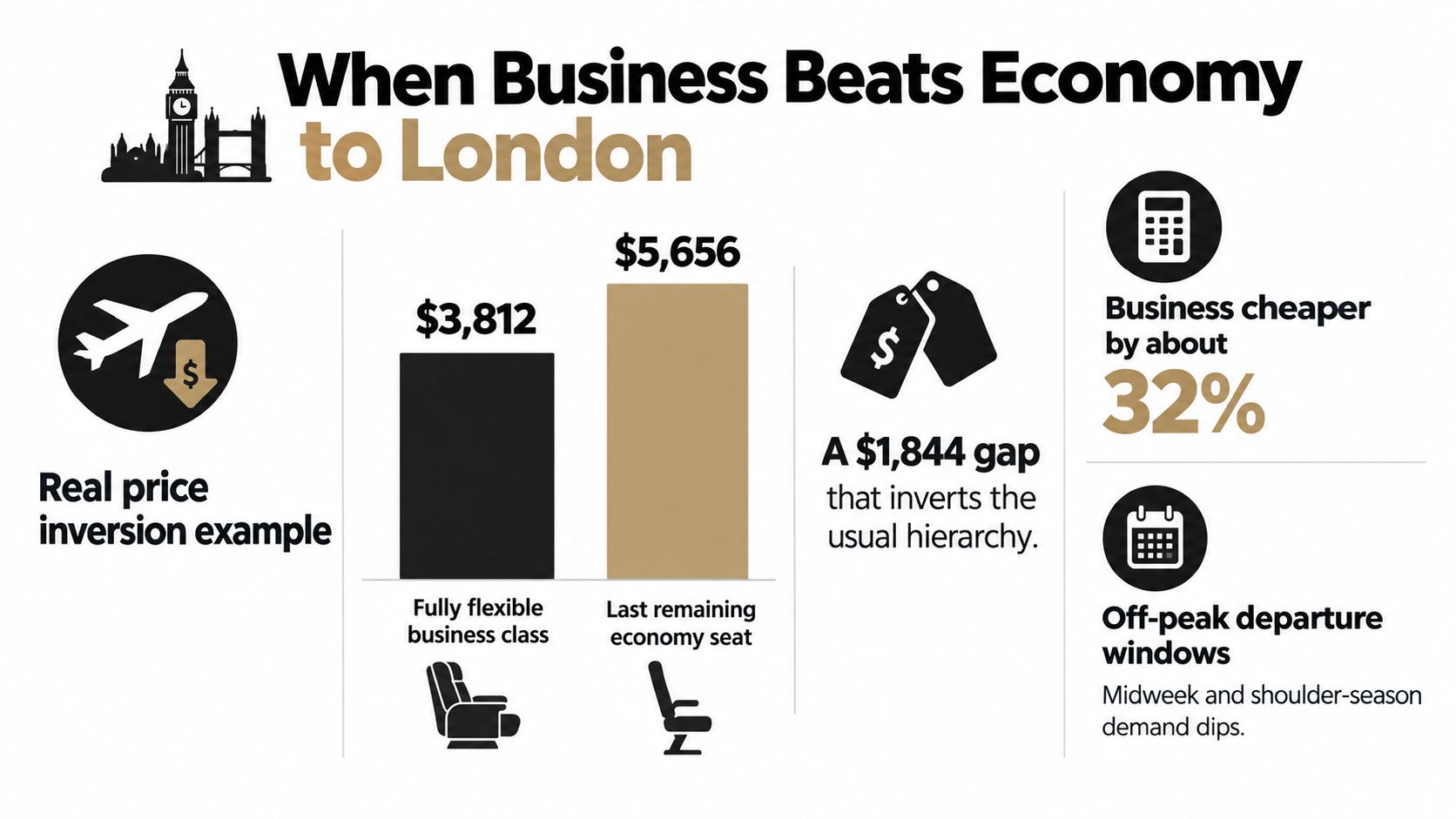
An infographic showing a price comparison where a business class flight is cheaper than an economy seat.

The cabin label doesn't set the fare

Airlines don't calculate every business fare as a fixed premium over economy. Each cabin has its own price levels, restrictions, and inventory availability. When lower economy tiers disappear, the booking system can display a much higher economy fare even though the aircraft still has unsold seats.

Business inventory may be moving differently. If demand for a particular flight's premium cabin is weaker, a lower business fare can remain available. The result is a temporary price inversion, not a permanent change in the value of either cabin.

Practical rule: Compare the fare conditions and cabin benefits side by side. Never assume that the lowest cabin must have the lowest usable price.

A single published fare can also mislead you because it represents one combination of date, airport, routing, fare family, and availability. A nearby departure or a different London arrival airport may expose a separate set of inventory. Once you find a promising itinerary, check the change, refund, baggage, seat, and connection conditions before treating it as a bargain.

Airport choice affects the value after landing, too. If a lower fare arrives at an airport that creates an expensive or time-consuming transfer, the saving may disappear. For a practical comparison of local transport options, consult your guide to affordable London transfers before booking an itinerary built around a secondary airport.

For a clearer explanation of what you're buying beyond the cabin label, see what premium cabin means. The central lesson is straightforward: business class can be cheaper than coach when inventory moves independently.

Understanding How Premium Cabin Inventory and Pricing Actually Work

Airlines manage seats by fare bucket, not just by physical seat count. A cabin can contain many open seats while its cheapest price tier is already closed. When that happens, the booking system offers the next available tier, which may be dramatically more expensive.

Economy and business class use separate inventories. A low economy bucket can sell out while a lower business bucket remains open, particularly when the airline expects different demand from leisure passengers, corporate travelers, and premium-conscious customers. The aircraft doesn't need to be full for economy pricing to rise.

Why physical availability isn't enough

Suppose an aircraft still has economy seats available. That fact alone doesn't tell you whether the cheapest economy fare remains for sale. The airline may have released only a limited number of seats at that price level, then moved the remaining inventory into higher fare categories as bookings accumulated.

Business class follows its own pattern. If business demand develops more slowly, the airline may leave a restricted or flexible business product available while economy prices climb. That can produce the counterintuitive result described above, where a business ticket undercuts the highest remaining economy fare.

The same mechanism can work in reverse. A business cabin with strong demand may close its lower fare buckets early, leaving only expensive premium products while economy remains relatively affordable. Searching by a simple cabin filter won't reveal why the gap exists unless you inspect the fare basis and conditions.

Read the rules behind the price

On major corporate routes such as New York to London, discounted business fares may require advance purchase of 14 to 60 days, along with conditions such as a Saturday-night stay or nonrefundable ticketing, according to AranGrant's explanation of business fare pricing. A fully flexible economy ticket purchased by a last-minute corporate traveler can cost substantially more than that restricted business fare.

That comparison is valid only when you understand the trade-off. A low business fare with no refund and severe change penalties may be unsuitable for a meeting schedule that can move. Conversely, a flexible economy fare may be rational for a traveler whose itinerary is uncertain, even when the headline price looks unattractive.

Look beyond the cabin name and record:

  • Fare family: Identify whether the product is restricted, changeable, or refundable.
  • Purchase deadline: Check how far ahead the fare must be ticketed.
  • Stay requirement: Confirm whether a Saturday-night or other minimum-stay rule applies.
  • Included benefits: Compare baggage, seat selection, lounge access, and rebooking terms.

Availability controls the displayed price. Seat count matters, but the open fare bucket matters first.

Choosing Your London Airport as a Pricing Variable

Airport choice changes the fare more than many travelers expect. If you search Heathrow only, you are not really pricing London. You are pricing one airport with its own demand mix, slot pressure, and ground access profile.

London's six commercial airports handled 177.7 million passengers in 2024, while Heathrow represented 47% of passenger arrivals and departures and 44% of take-offs and landings, according to the UK Civil Aviation Authority traffic review. Heathrow's airport-related charges also reached GBP 25.93 per passenger in 2025, and it was expected to handle about 84 million passengers against official annual capacity of 82 million. That mix helps explain why Heathrow often prices differently from Gatwick, Stansted, Luton, or London City, especially in premium cabins where schedule demand is strong.

Compare the airport and the journey

Run parallel searches across Heathrow, Gatwick, Stansted, Luton, and London City. If you are comfortable with more moving parts, test nearby European gateways too, but only when the positioning flight, connection, and baggage setup are realistic.

Search variable What to normalize
Arrival airport Transfer to your actual London district
Arrival time Ground transport availability and working hours
Connection Airport change, self-transfer, and missed-connection risk
Baggage Included allowance and additional charges
Fare flexibility Refund, change, and rebooking conditions
Productivity Time lost traveling to the office, hotel, or meeting

Two business-class fares to “London” can serve very different trips.

A fare into Gatwick can look strong on the results page, then lose its edge once you price the transfer to central London or Canary Wharf, especially after a late arrival. Stansted and Luton create the same kind of trade-off on some itineraries. London City can be extremely efficient for the right final destination, but its network is narrower, so the fare and schedule combination may not exist on the long-haul route you need.

Heathrow often wins when a nonstop arrival protects a full workday, when rebooking options are better, or when direct rail access cuts uncertainty. A secondary airport wins when the fare gap is wide enough to absorb the extra transport, added time, and any positioning cost without making the trip more fragile.

I would compare airports the same way I compare fare families. Hold the travel purpose constant, then measure the total trip. That means watching for the awkward connection that forces an overnight stay, the self-transfer that looks legal until baggage is delayed, and the cheaper ticket that lands so far from your meeting that you burn the savings on time and transport.

Judge every fare by the lowest reliable door-to-door cost it produces, because the smallest number in a flight search often hides the most expensive trip.

Timing Your Search and Monitoring Fare Cycles Properly

Cheap business class to London rarely appears on a neat schedule. It shows up when an airline needs to move a specific bucket of seats, on a specific route, for a specific set of dates. That is why premium fares can drop hard while economy stays stubbornly high. You are not shopping a fixed product. You are tracking inventory that keeps getting repriced.

On long-haul routes such as North America to London, I would start serious monitoring about two to four months before departure, while staying ready to buy earlier if the right fare appears. That booking window lines up with this business-class booking timing guide. The practical point is simple. Start early enough to see the fare pattern, but not so early that you mistake an opening ask for the market rate.
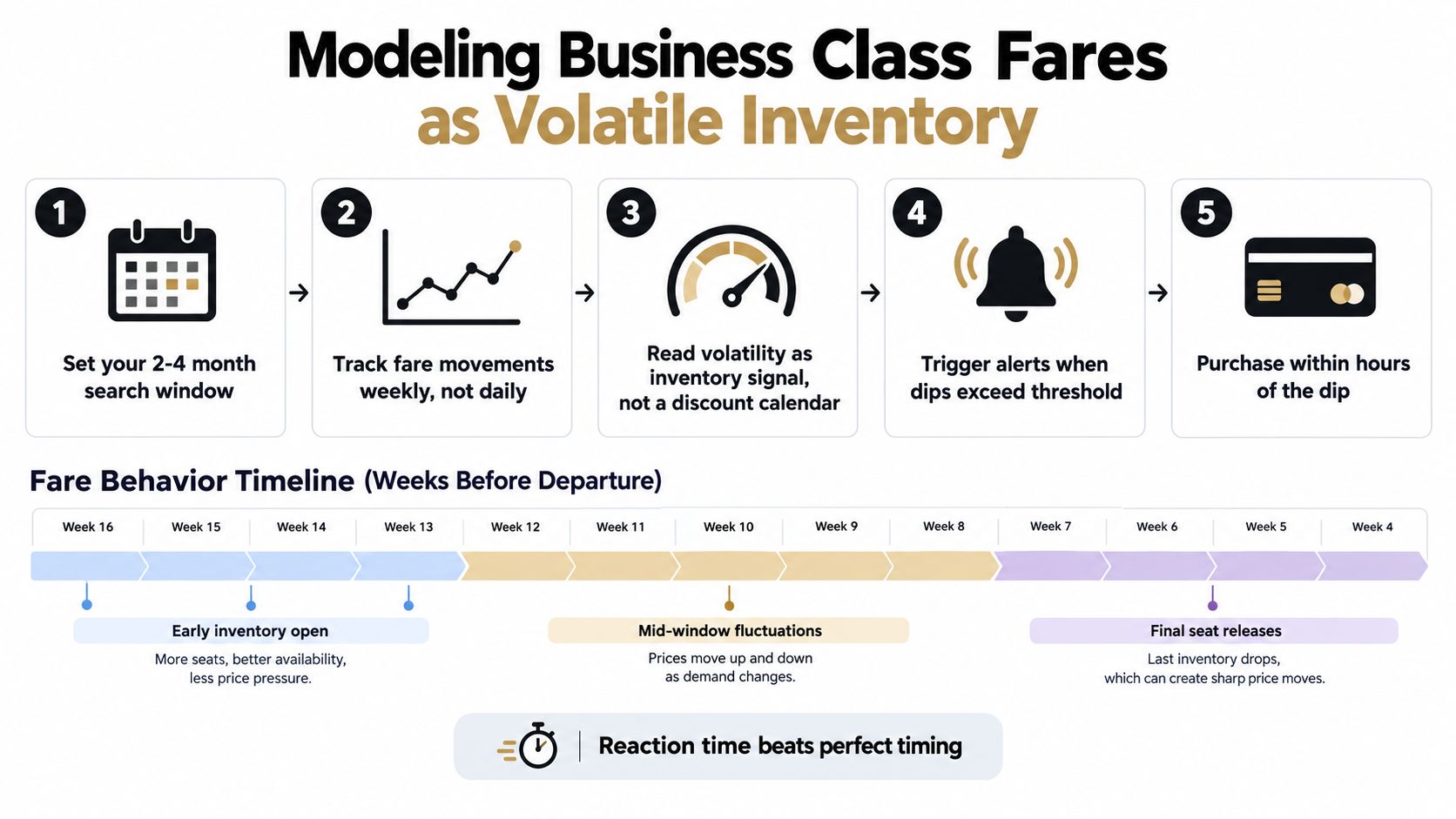
A five-step infographic guide on modeling business class fares as volatile inventory for better travel booking.

Build a repeatable search window

One search does not tell you what the market is doing. Check at least three outbound dates and three return dates. Test nonstop options against one-stop routings. If your trip allows it, compare a standard round trip with a legal open-jaw, especially when arriving in London and leaving from another airport or nearby city produces a better premium fare.

Then track what you saw. Memory is unreliable once multiple carriers and fare families enter the picture. Save the airline, flight number, airport, cabin, fare basis, booking class, baggage allowance, seat selection rules, connection details, and the change or refund terms. That is how you avoid treating a stripped-down business fare as if it were genuinely better value.

A search routine that works usually includes:

  1. Set a date band: Include midweek and weekend departures if your schedule allows.
  2. Check several routings: Compare nonstop, one-stop, and nearby gateway options.
  3. Save the fare conditions: Record flexibility, minimum stay, and ticketing deadlines.
  4. Review regularly: Watch movement over several weeks instead of reacting to one result.
  5. Define a purchase threshold: Decide in advance which mix of price and terms is good enough.

Seasonality still matters because it changes the baseline you are measuring against. January through early March and September through mid-November are often softer periods for London demand, while summer and major holiday weeks can push business-class pricing materially higher in some markets, as discussed in this guide on when to book business-class flights. Use that as context, not a promise. A strong tactical sale in a busy period can still beat a weak fare in a traditionally cheaper month.

Predicting the exact lowest fare is impossible; recognizing a meaningful dip quickly, and judging whether the product behind it is still usable, is not.

Using Fare Alerts, Market Signals, and Membership Intelligence

Business class to London can occasionally price below coach, but the useful signal is not the alert itself. The genuine edge comes from understanding why that fare appeared, whether it fits your trip, and how fast the window is likely to close.

A generic fare notification rarely answers the questions that matter. It will not tell you whether the ticket books into a restrictive fare family, whether the connection is realistic, or whether Heathrow, Gatwick, or another arrival point will create extra ground time that wipes out the savings. Experienced travelers treat alerts as a prompt to investigate, not a reason to book blindly.

Passport Premiere is a membership-based service focused on international Business and First Class deals, including cases where premium cabins can price below coach. Its published approach centers on tracking premium-cabin pricing cycles, spotting fare wars, and helping members judge the market value of unsold premium inventory before purchase, as described on the Passport Premiere website.

Screenshot from https://www.passportpremiere.com

Turn an alert into a buying decision

Passport Premiere states that fewer than 15% of premium-cabin seats are sold at their initial asking price, which is a useful reminder that the first fare you see is often an opening position, not the final market-clearing one. That does not mean every business-class seat will get cheaper. It means one-time searches miss how airlines move unsold premium inventory across fare buckets as departure patterns, competitor activity, and load expectations change.

That is where a specialist service can save time. The benefit is speed of interpretation. Instead of merely showing a fare drop, it helps narrow the gap between a market move and a practical judgment about whether the deal is real, usable, and worth acting on.

Use any alert system with discipline:

  • Verify the route: Confirm the origin, London airport, and travel window match your trip.
  • Check fare quality: Review changes, refunds, baggage, lounge access, and seat selection.
  • Measure trip cost: Include transfers, positioning flights, overnight stays, and lost working time.
  • Act by threshold: Book when the fare meets the price and flexibility rules you set in advance.

A broader monitoring routine can include dedicated business-class fare alerts. Chasing every discount wastes attention. The skill is recognizing when a lower fare reflects a real pricing opportunity, and when it just turns a cheaper ticket into a more expensive trip.

Evaluating Real Trade-offs When Booking Discounted Premium Cabins

A low business fare isn't automatically a good business fare. The ticket may save money while imposing restrictions that make it unsuitable for a client meeting, an uncertain project schedule, or a trip that depends on a specific arrival time.

Virgin Atlantic reported that more than 90% of seats in its premium and Upper Class cabins were filled and responded to sustained premium interest by expanding selected Boeing 787 cabin layouts. Its retrofit plan adds 13 Upper Class seats and 21 premium seats while reducing economy seating by 65 seats, according to Business Insider's report on the cabin changes.

Strong demand doesn't eliminate bargains

High premium demand and occasional cheap fares can coexist. Airlines make decisions at flight and fare-bucket level, not according to one annual average. Route competition, aircraft changes, departure timing, and the need to sell particular inventory can all create a lower business fare even when premium cabins generally perform well.

Additional premium seats may also change the selling problem. When an airline adds business or premium capacity on selected aircraft, it has more premium inventory to distribute across price levels. That can create targeted opportunities, although it won't guarantee a discount on your route or date.

A sale price matters only after the ticket conditions pass your real-world test.

Check the restrictions before celebrating

Separate the marketing label from the contract. A fare described as a sale may be nonrefundable, may charge for changes, may require a minimum stay, or may exclude the flexibility a company needs. Compare the full conditions with the value of arriving rested, using a lounge, taking a direct schedule, and protecting your time.

For corporate travelers, a restricted ticket may still work when dates are fixed and the savings are meaningful. For consultants moving between client sites, a flexible product may be worth paying more for. Leisure travelers should consider whether a missed connection or changed plan would consume the original saving.

The right comparison is not “business versus economy.” It is:

  • Product: What seat and service are included?
  • Flexibility: What happens if the trip changes?
  • Reliability: How risky is the connection?
  • Location: Does the airport suit the final destination?
  • Total cost: What will the trip cost after transport and disruption risk?

That framework prevents a cheap premium ticket from becoming an expensive inconvenience.

Building a Repeatable Strategy for Cheap Business Class Flights to London

Cheap business class flights to London become easier to find when you replace luck with a record of comparable decisions. Start with flexible dates, search Heathrow and the other London airports, and monitor the route during the two-to-four-month window used for long-haul fare comparisons. Keep earlier searches active when your schedule allows you to buy immediately if an unusually strong fare appears.

Record multiple fare observations for each itinerary over several weeks. Separate fully flexible, restricted, refundable, and changeable products instead of putting them into one average. Test nonstop and one-stop routes, then add ground transport, baggage, positioning, and time costs before deciding.

Book promptly when all of these conditions align:

  • The fare is materially below your recorded alternatives.
  • The airport and arrival time work for the actual trip.
  • The fare rules match your tolerance for changes and refunds.
  • The total door-to-door cost remains attractive.
  • The routing doesn't depend on a risky self-transfer.

Keep monitoring when the headline price is lower but the ticket has severe restrictions, an impractical airport, or a connection that undermines the purpose of traveling in business class. A useful bargain is a combination of price, timing, airport, and terms, not a cabin label beside a low number.


Passport Premiere helps travelers monitor international Business and First Class fare cycles, identify pricing anomalies, and assess discounted premium tickets before purchasing. Visit Passport Premiere to explore its fare intelligence and see whether its monitoring approach fits your next London trip.

Business Class Flights to London England For Less Than Coach

Most travelers think business class flights to london england sit in a separate pricing universe from coach. That belief is expensive.

The pricing data says otherwise. Fewer than 15% of premium cabin seats sell at their initial asking prices, and average round-trip business class search prices sit at $3,203 with lows of $420, which reveals the situation: premium fares are not fixed, they are volatile (Cheapflights business class price data for London). If you understand that one point, you stop shopping for “luxury” and start shopping for mispriced inventory.

That is how smart travelers end up in a lie-flat seat to London for less than someone else pays to squeeze into a bad economy fare booked at the wrong moment.

The Myth of Premium Airfare and Why Business Can Be Cheaper Than Coach

The sticker price on business class is often theater.

Airlines publish a high opening fare because they can. They know some corporate travelers book late, some travelers never compare properly, and some people assume the first listed premium price reflects the true market value of the seat. It does not.

A luxurious private airplane cabin featuring green patterned chairs and scenic ocean views through round windows.

The seat is perishable, not precious

A business class seat to London is a perishable asset. Once that aircraft pushes back, any unsold premium seat is worth nothing to the airline.

That is why the public “dream fare” you see months out is not the final answer. It is an opening position. Airlines keep adjusting because they would rather move distressed premium inventory at a lower price than let it depart empty.

The hard proof is simple. Fewer than 15% of premium cabin seats sell at their initial asking prices, according to the London business class search data cited above. If almost all premium seats close at something other than the opening price, then the opening price is not the market. It is bait.

Why coach can end up costing more

Economy travelers make a common mistake. They assume coach is always the budget option, then they book rigid dates, poor timing, and high-demand departures.

That is how they end up paying inflated economy fares while premium inventory gets marked down to clear. A traveler buying comfort strategically can beat a traveler buying coach emotionally.

Three forces create that gap:

  • Dynamic pricing: Airlines constantly reprice based on demand, competition, and booking pace. If you want a cleaner explanation of the mechanics, this overview of dynamic pricing in airline industry is worth reading.
  • Fare wars on major business routes: Carriers fighting for premium travelers often undercut each other.
  • Unsold premium inventory: Empty lie-flat seats become a problem the airline needs to solve.

The contrarian move is not “splurge on business class.” It is “wait for premium inventory to lose its ego.”

Stop treating the first fare as real

Travelers lose money because they anchor to the first price they see.

If a route shows business class at an eye-watering number, many travelers close the tab and assume the answer is no. Savvy buyers do the opposite. They treat that first fare as a placeholder and watch for the market to blink.

The same Cheapflights London business class data shows average round-trip searches at $3,203 and lows of $420. I would not read that as a promise of an easy bargain for every traveler. I read it as evidence of severe spread. The spread matters more than the average because it proves the same product can swing wildly depending on timing and inventory pressure.

The essential mindset shift

If you want cheaper business class flights to london england, stop asking, “What does business class cost?”

Ask better questions:

Better question Why it matters
Is this fare a true market price or an opening ask? Most premium seats do not sell at the first number shown.
Is the airline protecting yield or clearing inventory? Those are two very different pricing moments.
Is coach expensive because demand is compressed? That is when premium can suddenly look rational.
Is this a competitive route where airlines are forced to react? Competition creates pricing mistakes.

The hidden path is not luck. It is understanding that business class is often overpriced at publication and underpriced later.

People who consistently find underpriced premium seats are not doing magic. They are reading airline behavior correctly. They know a lie-flat seat to London is not always a luxury item. Sometimes it is just distressed inventory wearing a luxury label.

Mastering the Calendar The Art of Timing Your London Flight

Timing matters more than loyalty. It matters more than cabin branding. It matters more than obsessing over one exact airline.

If you miss the booking window, you can turn a smart premium purchase into a bad one fast.

Infographic

The only booking window I tell people to care about

For transatlantic premium travel, the most useful range is 60 to 120 days before departure, with an 85% success rate for securing below-peak fares according to AranGrant’s transatlantic booking analysis.

That is the zone where airlines have enough visibility to know how a flight is selling, but still enough time to adjust inventory and stimulate demand.

Book too early and you are often paying an aspirational fare. Book too late and you are volunteering to fund the airline’s yield strategy.

The calendar has three zones

I think of London premium booking in three simple phases.

The dead zone

This marks the far-out period where travelers congratulate themselves for “being early.”

Early is not the same as smart. At that stage, airlines are still testing high fare levels and protecting premium inventory. You may see availability, but not necessarily value.

This is when you should monitor, not rush.

The sweet spot

The 60 to 120 day range is the sweet spot. During this time, I want most buyers paying attention.

Airlines can see booking pace clearly by then. If premium demand is softer than expected, they start making practical decisions. That creates openings for lower business class pricing without forcing you into a risky last-minute gamble.

If you want sharper timing instincts, this guide on when do airlines drop prices lines up with the same market logic.

The danger zone

Inside 60 days, pricing can turn hostile. The AranGrant data says prices can surge 25% or more in this period, which matches what experienced travelers know from painful personal experience.

Late-booking business travelers distort the market. Airlines expect urgent corporate demand and price accordingly.

If your plan is “I’ll just see what happens next week,” you are not being flexible. You are becoming the airline’s favorite customer.

Midweek beats weekend logic

Departure day matters. A lot.

The same AranGrant analysis found that midweek departures from Monday to Wednesday yield 10% to 15% lower average fares. That makes sense because premium demand often clusters around classic business and leisure patterns, and airlines exploit those habits.

A practical rule:

  • Best target days: Monday, Tuesday, Wednesday
  • Use caution: Thursday
  • Usually worst value: Friday and Sunday
  • Situational play: Saturday can work, but I would still compare carefully

If you insist on a Friday departure and a Sunday return, do not complain that premium is “too expensive.” You chose the most commercially obvious pattern on the board.

Seasonality is not subtle on London

January is where disciplined travelers often do well. The verified fare data on London business class notes that low season in January offers optimal savings, and that matters because softer demand gives airlines more room to clear premium inventory without damaging route economics.

I also like shoulder periods when demand cools and the market loses some of its urgency. Summer transatlantic demand is a different animal. If your dates land in a major peak period, you need more flexibility in airport, day, and carrier to make the math work.

A clean timing checklist

Do this instead of guessing:

  1. Start tracking early
    Begin watching fares well before you intend to book. The point is not to buy early. The point is to recognize what “normal” looks like.

  2. Wait for the market to reveal itself
    You want to see whether the route is holding firm or softening.

  3. Focus your decision window
    Treat 60 to 120 days out as your prime buying range for business class flights to london england.

  4. Prefer midweek departures
    Build your search around Monday through Wednesday when possible.

  5. Avoid last-minute heroics
    Inside 60 days, assume the airline has the upper hand, not you.

Timing is a negotiation tool

Many fare guides reduce timing to a cliché like “book in advance.” That advice is lazy.

The effective move is more precise. You are not trying to be early. You are trying to buy when the airline starts doubting its own opening price. That usually happens when the booking calendar tightens, premium inventory remains unsold, and the carrier still has time to fill the seat without panicking.

That is when business class starts becoming cheaper than coach for travelers who know how to wait.

Strategic Routing and Carrier Selection for London

If you search one airport pair and one airline, you are not shopping. You are volunteering for whatever fare the system wants to show you.

London rewards broader thinking because carrier competition is intense on the right routes.

Follow the competition, not the branding

The strongest pricing opportunities usually appear where several airlines are chasing the same premium customer.

That is why Heathrow matters so much. It is the core battlefield for transatlantic premium traffic, and the market-share split tells you how active that fight is. American Airlines holds 28.34% of the market, British Airways 20.51%, Delta 13.36%, and United 12.74%, according to Skylux’s 2025 London business class market analysis.

No single carrier owns the field outright. That is good for buyers.

Heathrow is where pricing pressure becomes useful

On big trunk routes, especially JFK to Heathrow, airlines are not just selling seats. They are defending market position.

That changes behavior. Instead of pricing in a calm, orderly way, they react. One carrier pushes, another matches, a third tweaks inventory, and suddenly a premium fare that looked absurd begins to crack.

This is the reason I tell travelers to stop falling in love with one airline before they even see the market. Airline loyalty can be useful. Fare loyalty is expensive.

The best route for your trip is often the one with the most competitive tension, not the one with your favorite app.

Choose the carrier based on both seat and pricing behavior

You are not only buying a ticket to London. You are buying a product, and the product varies.

A quick strategic view helps:

Carrier Why travelers look at it
American Airlines Largest market share in the London premium space, which makes it central to fare competition.
British Airways Massive nonstop presence and strong route coverage into London.
Delta Important competitive pressure on major U.S.-London routes.
United Strong option for travelers coming from major U.S. hubs and corporate booking channels.

For a broader product comparison, this roundup of which airlines have the best business class is useful as a seat-quality reference.

Heathrow versus other London options

Heathrow is usually the first place to look because that is where premium competition is thickest and network strength is deepest.

That does not mean you should ignore alternatives entirely. If your origin city or final destination gives you flexibility, compare airport combinations and one-stop options. The trick is not to assume that a nonstop into Heathrow is automatically the cheapest premium move, or that a different London airport is automatically better. Let the market tell you.

Build a route portfolio, not a single search

Savvy travelers track several combinations at once.

Try this mindset:

  • Primary target: Your ideal nonstop to Heathrow
  • Secondary target: Alternate departure airport in the same metro area
  • Third target: Competing carrier on the same lane
  • Wildcard: A nearby date shift that changes the pricing structure

This portfolio approach matters because underpriced premium fares do not announce themselves politely. They appear in pockets. Sometimes one airline flinches. Sometimes one departure city gets loose inventory. Sometimes one day turns irrationally cheap compared with the rest of the week.

If you only search one exact itinerary, you miss all of that.

The traveler who finds the best business class flights to london england usually is not “better at searching.” They are comparing a wider set of plausible moves and letting competition work on their behalf.

A Step-by-Step Workflow for Finding and Booking Underpriced Fares

This is the part many travelers skip. They browse, react to random prices, and call that a strategy.

That is why they overpay.

A person using a laptop to search for travel bookings on a flight reservation website interface.

Step one, search like an analyst

Start with a broad brief, not a rigid itinerary.

I use four variables first: origin airport, London arrival airport, departure day range, and acceptable carriers. That gives you room to spot mispricing instead of forcing the market into one narrow path.

Your search should include:

  • A date range: A few days on either side of your preferred travel dates
  • Multiple carriers: Especially on heavily competed transatlantic routes
  • Multiple aircraft types: Because seat quality matters
  • A willingness to act: Underpriced premium fares do not always linger

If you want a general refresher on the basics of fare hunting, this guide on how to book cheap flights is a useful companion resource.

Step two, use alerts correctly

A fare alert is not a shopping convenience. It is a signal.

If you monitor premium-cabin fare cycles with a service such as Passport Premiere, the point is not just to get pinged when a fare drops. The point is to identify when the market starts clearing distressed premium inventory rather than defending a headline price.

That is a different mindset. You are reading intent.

What a useful alert tells you

Alert behavior What it may mean
Sudden premium drop on one carrier Competitive response or route-specific softness
Drop only on midweek departures Weak demand on less preferred travel days
Premium falls while coach stays high Strong sign of inventory imbalance
One aircraft type prices lower than another Seat quality may be suppressing demand

Step three, inspect the hardware before you celebrate

A cheap business fare is not automatically a smart business fare.

The most important quality filter is seat configuration. On U.S.-London routes, prioritize aircraft with 1-2-1 reverse herringbone layouts such as Boeing 777, Boeing 787, and Airbus A350, because they provide direct aisle access and seat specs around 78 to 82 inches of pitch according to The Points Guy’s comparison of business class products on U.S.-London routes.

Avoid old 2-3-2 layouts when possible. A discounted fare on outdated hardware can still be a bad buy if the comfort gap is meaningful.

Step four, compare against the practical alternative

Your benchmark is not “Is this lower than the airline’s original business fare?”

That benchmark is useless.

The right question is, “What would I otherwise buy for this trip?” Sometimes that is a standard economy fare. Sometimes it is flexible economy. Sometimes it is premium economy plus seat fees, baggage, airport purchases, and the hidden cost of arriving wrecked.

If business comes in lower than the practical coach alternative, book it. Do not overcomplicate the decision.

A good premium fare is not one that sounds impressive at dinner. It is one that beats the actual cost of the trip you were already going to take.

Step five, verify before payment

Before you click purchase, check these items:

  1. Aircraft type
    Confirm it matches the business class product you expect.

  2. Seat map
    Look for the 1-2-1 pattern.

  3. Fare rules
    Review change and cancellation terms carefully.

  4. Connection logic
    A cheap fare with a terrible transfer can erase the value.

  5. Airport timing
    London arrivals can be smooth or painful depending on your schedule.

To see cabin visuals before committing, this walkthrough is helpful:

Step six, book decisively

Once the fare checks out, move.

Travelers lose good premium opportunities because they want certainty that the fare is “the absolute lowest.” That is the wrong standard. The correct standard is whether the fare is underpriced relative to the trip you need and the product you want.

A repeatable workflow beats random bargain hunting every time:

  • Monitor broadly
  • Read alerts as market signals
  • Filter hard for seat quality
  • Compare against your true alternative
  • Book once the math works

That is how people consistently find business class flights to london england at prices that make coach look like the irrational choice.

Beyond the Ticket Price Corporate Policy and Total Trip Value

A finance team that focuses only on base airfare usually ends up approving bad travel decisions.

The smarter view is total trip value.

A diverse group of professionals collaborating together around a meeting room table with laptops.

Cheap on paper is often expensive in practice

If a traveler lands in London exhausted, sleeps badly, loses prep time, buys airport meals, pays extra baggage charges, and underperforms in a high-stakes meeting, the “cheap” economy ticket was not cheap.

That is why business travel policy should not ask, “Do we allow business class?”

It should ask, “When does premium represent better value than the practical economy alternative?”

For many firms, the right answer is not blanket approval or blanket rejection. It is a smart premium rule.

What a smart premium rule looks like

A workable internal policy can stay disciplined without being rigid.

Consider a framework like this:

  • Allow premium when the fare undercuts the relevant coach option
    Especially when economy has become expensive or inflexible.

  • Allow premium on critical trips
    Client pitches, investor meetings, same-day presentations, or compressed schedules justify a value-based review.

  • Require product screening
    If the seat is poor, the traveler should not pay a premium for the label.

  • Tie approval to trip purpose
    A strategic meeting deserves different treatment from a casual internal visit.

The UK ETA issue is not optional anymore

Travel intelligence now includes entry compliance, not just airfare.

A major blind spot is the UK’s Electronic Travel Authorisation, which as of late 2025 affects U.S. travelers, with a £10 to £16 fee and possible processing delays. A rejected application can wipe out a non-refundable $3,000+ premium fare, which is exactly why trip planning has to account for more than the ticket price (Emirates overview referencing London business travel and ETA implications).

That issue matters even more for premium travel because higher fares increase the cost of administrative mistakes.

A polished travel program does not stop at booking. It protects the trip from preventable friction.

Give finance a cleaner argument

If you need internal approval, do not pitch business class as comfort.

Pitch it as controlled value:

Talking point Why it works
Premium was lower than the practical coach option Frames the decision as cost control, not indulgence
The fare was selected through timing and market monitoring Shows discipline, not impulse
The product quality was verified before purchase Prevents paying premium for weak hardware
ETA and trip admin were handled upfront Reduces disruption risk

Finance teams also care about reporting consistency. If you need a simple operational companion for managing your travel expenses, use a process that captures fare, fees, and trip-related costs together instead of treating airfare in isolation.

Corporate travelers should stop apologizing for smart premium buys

The wrong policy forces travelers into expensive economy patterns and then calls that savings.

The better policy rewards judgment. If a traveler secures a strong premium fare, protects schedule reliability, and improves trip performance, that is not policy drift. That is intelligent procurement.

Business class flights to london england are easiest to justify when you stop measuring the ticket in a vacuum and start measuring the trip as a whole.

Your Action Plan for Premium London Travel on an Economy Budget

Business class to London is not “cheap” because airlines got generous. It gets cheap when inventory pressure, timing, and competition break the published price.

That is the advantage. Many travelers never wait for that moment.

Keep the plan simple

Use this checklist:

  • Reject the first fare
    Treat the opening business class price as an opening ask, not the actual market.

  • Buy in the right window
    Focus your attention on the proven booking range rather than booking blindly far out or dangerously late.

  • Search routes, not fantasies
    Compare carriers, departure days, and airport options instead of locking onto one exact itinerary.

  • Screen the seat
    A lie-flat seat with direct aisle access is the standard. Do not pay premium for a weak setup.

  • Think like a buyer, not a browser
    When premium undercuts the practical coach alternative, take it.

The bigger shift

The travelers who win this game are not richer. They are more disciplined.

They understand that airline pricing is unstable, that London is a competitive premium market, and that comfort becomes affordable when you buy at the point of inventory weakness rather than at the point of marketing hype.

If you apply that mindset, business class flights to london england stop looking like a luxury fantasy and start looking like a practical purchasing strategy.


If you want a structured way to track premium fare cycles and spot underpriced international business and first class inventory, Passport Premiere is built for that specific job. It fits travelers who want data-driven timing instead of guessing when the market will finally drop.