Business Class Cheaper Than Coach: The Ultimate Guide

Finding cheap first class international flights sounds like a fantasy, right? But what if I told you that you could snag a luxurious lie-flat seat for less than what the person in the back of the plane paid for their last-minute coach ticket? It’s not about luck. It’s about knowing how the system really works.

Once you learn to read the market and spot the right signals, you can unlock incredible travel experiences for a fraction of what you thought they’d cost.

The Surprising Truth About First Class Fares

Luxurious first class airplane cabin interior with a comfortable seat, side table, and scenic window view.

It seems completely backward, but it happens every single day. The trick is to stop thinking of airfare as a static price tag and start treating it like a volatile commodity, almost like playing the stock market. Airlines use incredibly complex algorithms that are constantly tweaking fares based on hundreds of inputs.

Here’s a little secret from inside the industry: fewer than 15% of premium seats are ever sold at their initial, eye-watering asking price. As the departure date gets closer, an airline's whole strategy shifts. An empty seat is pure, unrecoverable loss once those doors close. That creates a huge incentive for them to unload that seat, even at a massive discount, rather than let it fly empty.

Why Premium Seats Go on Sale

This is where the real opportunity opens up for savvy travelers. While a vacationer might book an economy ticket months in advance to lock in a low price, a business traveler often has to book a flexible, last-minute ticket. Those full-fare economy tickets can easily run into thousands of dollars—sometimes even more than a discounted seat at the front of the plane.

Airlines absolutely capitalize on that corporate urgency, but it also creates some wild pricing quirks. For instance, a last-minute round-trip from Chicago to Frankfurt in economy could easily be $2,500. At the same time, the airline might slash the price of a remaining Business Class seat to $2,200 just to get someone in it. That’s the moment you can find business class cheaper than coach.

Most people think of premium cabin pricing as straightforward and expensive, but the reality is much more nuanced. This disconnect between perception and reality is where the deals are born.

Pricing Myth vs Market Reality

Pricing Factor Common Perception Market Reality (The Opportunity)
Timing Booking far in advance is always cheapest. Last-minute premium seat deals often beat full-fare economy.
Value First Class is an unaffordable luxury. An empty seat has zero value, forcing airlines to discount heavily.
Availability Sales are rare and hard to find. Flash sales happen constantly but are short-lived.
Competition One airline sets the price. Fare wars on competitive routes drive prices down unexpectedly.

Understanding these realities is the first step. The next is knowing how to act on them.

The key is to shift your mindset from a typical consumer to a market analyst. Airlines aren't just selling transportation; they're managing perishable inventory. Your job is to buy when their inventory is most distressed.

Spotting Your Opportunity

To really take advantage of these situations, you have to know what signals to look for. Airlines frequently run unannounced fare sales to boost bookings on underperforming routes or to aggressively compete with a rival. These sales can cut premium cabin prices by 50-70%, but they might only last for a few hours.

Think about a real-world case: a company needs to fly an executive from New York to London for a critical meeting tomorrow. The standard last-minute economy fare is a staggering $3,000. Unbeknownst to most, a competing airline on that same route quietly launched a 24-hour flash sale, dropping its remaining business class seats to just $2,100. By monitoring the fare data, the company not only saves nearly a thousand dollars but also gives its traveler a massive upgrade.

You can dive deeper into how to track these market movements and discover current business class fare sales to pounce on similar deals. These aren't just lucky flukes; they are predictable patterns if you know where to look.

Decoding Airfare Cycles And Fare Wars

Man in an airport terminal working on a laptop displaying a financial chart, with a 'FARE CYCLES' sign.

Think of premium airfare less like a fixed menu and more like the stock market. It’s a landscape in constant motion, driven by the intense tug-of-war between supply and demand. Cracking this code is the secret to snagging those cheap first class international flights that most people write off as impossible.

Prices don't just change on a whim—they follow predictable patterns called fare cycles. These are the natural peaks and valleys in pricing for a specific route. A First Class seat from New York to London, for instance, has its own rhythm, rising and falling with seasonal demand, major holidays, and corporate travel schedules. When you learn to see these patterns, you stop being a reactive buyer and start acting like a strategic investor.

The Real Prize: Catching a Fare War

Beyond the regular ups and downs, the real jackpot is the fare war. This is when fierce competition on a hot route forces a sudden, dramatic, and usually brief price collapse. All it takes is one airline trying to fill empty seats by slashing its premium fares. The moment they do, their rivals have no choice but to follow suit or lose out.

For those in the know, these moments are a goldmine.

Imagine two legacy carriers fighting over the lucrative Los Angeles to Tokyo route. One morning, Carrier A launches a flash sale, dropping its business class fares by 60%. Carrier B’s pricing algorithms catch this instantly and match the price. Suddenly, a window opens where you can book a lie-flat seat for less than the price of a typical economy ticket.

Fare wars are not just about lower prices; they are a temporary breakdown of the standard pricing model. During these brief windows, the normal rules don't apply, and the value proposition for premium travel completely flips on its head.

This is exactly how you can find business class cheaper than coach. An airline would much rather sell that seat for a fraction of the sticker price than let it fly empty across the ocean.

Following the Data, Not the Hype

This isn't just a hunch; it's backed by mountains of data. The reality is, fewer than 15% of premium seats on long-haul international flights ever sell at their initial sky-high prices. The entire industry is built on discounts. To get good at this, you need to understand the fundamentals. You can sharpen your skills by exploring these actionable tips for booking international flights.

Some of the largest airfare databases out there track trillions of fares daily, and they all tell the same story: massive discounts are the norm, not the exception. The data clearly shows that the lowest average fares fluctuate week by week. The key isn't just knowing that prices drop, but knowing precisely when those dips are coming.

How to Time Your Purchase and Win

So, how do you put this into practice? It’s about ditching the guesswork and relying on data-driven signals. Instead of asking, "What's the best day to book?" you should be asking, "What's the real market value of this seat right now?"

Here’s how to start thinking like a pro:

  • Keep an eye on key routes. If you fly certain competitive routes often, watch them like a hawk. More competition almost always means better deals are on the horizon.
  • Learn to spot the first shot. A sudden, unannounced price drop from a single airline is often the opening move in a fare war.
  • Be ready to act fast. These deals don't last. The best prices in a fare war can vanish in a few hours, sometimes even minutes.

For business owners and corporate travel managers, this is a game-changer. It transforms booking from a simple expense into a strategic financial win. By tracking these patterns and acting decisively, you can secure top-tier travel for your team at a fraction of the going rate.

For a closer look, check out our guide on finding the best time to buy international flights. This kind of intelligence is the most powerful tool you have for turning airfare volatility into serious savings.

How Creative Routing Unlocks Hidden Savings

The shortest path between two points might be a straight line, but in air travel, it's almost never the cheapest. While a direct, non-stop flight is undeniably convenient, that convenience comes with a hefty price tag. If you're serious about landing a First Class seat without paying a fortune, you have to think beyond the obvious itinerary.

Airlines don't just price fares based on how far you're flying; they price them based on the demand between two specific cities. That's why a route like Chicago to Singapore is priced for corporate road warriors with bottomless expense accounts. But what if your journey didn't really start in Chicago? This is where creative routing becomes your secret weapon for finding cheap first class international flights.

Embrace the Power of Positioning Flights

The core concept here is brilliantly simple. Instead of flying from your expensive home airport, you book a separate, cheap flight (or even drive) to a different airport to kick off your international trip. This little hop is called a positioning flight.

Think of it this way: a First Class ticket from a major U.S. hub is priced for the local market—often full of Fortune 500 executives. But the very same seat on the long-haul leg of that journey might be priced thousands cheaper if it originates from a smaller city, or even a major hub in Canada or Mexico where the market dynamics are completely different.

An airline isn't just selling a seat from Point A to Point B. They're selling a complete, packaged itinerary. When you break that package apart and start from a more strategic "Point A," you can completely change the pricing game in your favor.

Let's say a non-stop First Class flight from Chicago (ORD) to Singapore (SIN) is listed at an eye-watering $15,000. But after a little digging, you notice the airline is running a promotion from Toronto (YYZ) to Singapore for just $7,000—on the exact same plane for the trans-pacific leg. A quick round-trip ticket from Chicago to Toronto might only set you back $300.

By booking these two trips separately, you've just saved a massive pile of cash. You might even find yourself in a situation where this luxurious journey becomes business class cheaper than coach when you compare it to a last-minute economy ticket on the direct route. It takes a bit more planning, sure, but the payoff is enormous.

Finding and Booking Fifth Freedom Routes

Here's another, more advanced tactic that savvy flyers use: hunting for "fifth freedom" routes. These are quirky flights operated by an airline between two countries where neither is its home base. A classic example is Singapore Airlines flying between New York (JFK) and Frankfurt (FRA) as a continuation of its flight from Singapore.

Because the airline’s main goal isn't to compete on the JFK-FRA route, they often price these seats aggressively just to fill the plane. This creates some of the absolute best value propositions in premium travel.

Some legendary fifth freedom routes include:

  • Singapore Airlines: New York (JFK) to Frankfurt (FRA)
  • Emirates: New York (JFK) to Milan (MXP)
  • Emirates: Newark (EWR) to Athens (ATH)

You're often flying on the carrier's flagship aircraft with top-tier service, getting a First Class experience that blows away what a domestic airline would offer on the same route—frequently for a fraction of the cost. The trick is simply knowing these routes exist and searching for them specifically.

Practical Steps for Creative Itineraries

This strategy is a game-changer, especially for leisure travelers with some wiggle room in their schedules or businesses looking to stretch their travel budgets. It’s all about shifting how you search and thinking more broadly about where your trip really begins and ends.

  1. Map Out Your Alternatives: Look at all airports within a few hours' drive or a short, cheap flight from your home. Don't forget major hubs in Canada and Mexico.
  2. Search in Segments: Use flight search tools like Google Flights with flexible date and multi-city functions to price out the individual legs. This is how you spot those pricing sweet spots.
  3. Build in a Buffer: This is critical. When booking positioning flights on separate tickets, leave plenty of time between connections. An overnight stay is ideal. If your domestic flight is delayed and you miss the international one, the airline is under no obligation to rebook you.
  4. Plan for Your Luggage: On separate tickets, you'll almost certainly have to collect your checked bags and re-check them for your international flight. Factor that extra step into your timing.

By building your own itinerary piece by piece, you wrest control away from the airline’s rigid pricing models. It’s a deliberate approach that rewards a bit of research with incredible value on a travel experience most people only dream of.

Playing The Points And Upgrades Game

So, you’ve hit a wall trying to find a rock-bottom cash price for that First Class suite. Don’t throw in the towel just yet. There’s a whole other world out there—a sophisticated game of points, miles, and strategic upgrades that can get you to the front of the plane. This isn't just about earning and burning; it's about knowing how to play the system to your advantage.

A lot of people think their airline miles are only good for a free economy ticket, but that’s where they’re missing the point. The real jackpot is cashing them in for premium seats. You just have to understand that not all miles are created equal, and more importantly, not all redemption options offer the same value. A little bit of insider knowledge can turn your points from a simple travel discount into a golden ticket.

Think Value, Not Just Volume

First things first, you need to completely reframe how you think about your points. Stop asking, "How many miles do I need?" and start asking, "How can I squeeze the most value out of every single mile?" This is where you hunt for what the pros call "sweet spots" in airline award charts—basically, incredible deals hiding in plain sight.

For instance, one of the best tricks in the book is booking a partner airline through another carrier's loyalty program. You might use points from Airline A to book a First Class seat on their partner, Airline B, for a fraction of the miles Airline B would charge you directly. It's this kind of arbitrage that lets seasoned flyers snag unbelievable value on cheap first class international flights.

A classic real-world example? Using points from a program like Air Canada's Aeroplan to book a seat in Lufthansa's legendary First Class. Because of their Star Alliance partnership, this often costs way fewer points than booking the exact same seat through Lufthansa’s own Miles & More program. You get the same lie-flat suite, the same caviar service, but you got there through a much smarter back door.

The Fine Art of the Upgrade

Positioning yourself for an upgrade is another killer strategy, but it’s more than just crossing your fingers at the gate. It all starts with the kind of ticket you buy in the first place.

Airlines slice and dice their economy cabins into different fare classes, and each one comes with its own price tag and rulebook. Those super-cheap "deep discount" tickets (think fare classes Q, N, or S) are almost always blacklisted from upgrades. But if you pay just a little more for a full-fare or flexible economy ticket (like a Y or B class), you suddenly become eligible for a very cost-effective upgrade using your miles.

The secret isn't just hoarding miles; it's about deploying them with surgical precision. A well-timed upgrade on the right fare class can land you a First Class experience for the price of a flexible economy ticket and a handful of miles.

This is also where co-branded airline credit cards really shine. They don't just help you rack up miles faster; many come with perks like annual upgrade certificates or give you a higher priority on the standby list. For a deeper look at the mechanics, our guide on how to get upgraded to business class breaks down even more of these strategies.

Targeting the Right Fare Classes

Knowing which fare class to book is half the battle. This info isn't always front and center when you're buying a ticket, but if you click on the "fare rules" or "details" link before you pay, you can usually find the single-letter code.

  • Good for Upgrades: Higher-priced economy fares are your best bet. Look for classes like Y, B, M, H, and K.
  • Usually a Dead End: The cheapest tickets are typically in classes like G, N, O, Q, S, and T. These are almost never upgradeable.

Once you understand this, you can make a calculated decision. Is it worth paying an extra $200 for a higher fare class if it gives you the chance to use miles to snag a seat worth $8,000? Absolutely. This is how you stop being a passive passenger and start playing the game like an expert.

Using Fare Monitoring And Data Intelligence

Stop refreshing airline websites. Seriously. If you’re trying to catch an incredible deal by manually searching, you’re going to miss it. The real secret to consistently finding cheap first class international flights is to flip the script: stop searching and start monitoring. Let automated, intelligent systems do the heavy lifting, and you’ll go from hoping for a deal to getting an alert the second one pops up.

Setting up fare alerts is a good first step, but not all alerts are created equal. The basic tools you find on consumer travel sites are fine for flagging a price drop on a coach ticket. But they just don't have the teeth to catch the fleeting, dramatic discounts that happen in first and business class—where a deal might only last for a couple of hours.

Beyond Basic Price Drop Alerts

To really win this game, you need more than a simple "the price went down" notification. Professional-grade market analysis gives you a much deeper story. Instead of just seeing today's price, these systems give you the historical context. They can tell you the true market value of that empty seat based on months of data, signaling when a price isn't just lower, but a genuine anomaly worth booking on the spot.

That kind of intelligence is what separates casual deal-finders from strategic buyers. It’s the difference between saving $200 and saving $5,000.

A simple alert tells you the price changed. True data intelligence tells you why it changed, how it stacks up against historical lows, and whether you should pull the trigger now or wait. It turns raw data into a decisive action plan.

Let’s say you’re tracking a First Class flight from New York to Paris. A basic alert might ping you when the price drops from $9,000 to $8,000. But a more sophisticated system, like what we use at Passport Premiere, would know that the historical rock-bottom price for that seat is closer to $3,500 during fare wars. It would tell you this is just a minor ripple, not the tidal wave you’re waiting for.

The Power of Real-Time Intelligence

Airlines drop their best deals—the ones that make business class cheaper than coach—at totally unpredictable times and for painfully short windows. These might be unpublished sales, error fares, or the first shot in a fare war. Most of the time, they’re invisible to public search engines until it’s way too late.

This decision tree shows the two main ways to land a premium seat: paying cash or using points.

Flowchart illustrating the decision process for finding affordable first class flights through cash or points.

The key takeaway here is that you need a game plan for both, and smart data monitoring is what tells you which path to take at any given moment.

Advanced monitoring can catch these deals within minutes of being released. Imagine getting a targeted notification for a 70% discount on a First Class fare to Europe. That's a deal that might only be bookable for a few hours before the airline fixes it or the inventory gets snatched up. Without a system watching the market 24/7, you wouldn't even know it existed.

Interpreting Market Signals

Today's airfare market is more volatile than ever, which is fantastic news if you know what to look for. While it might feel like prices are constantly climbing, the long-term trend, when adjusted for inflation, shows air travel has actually become more accessible. This volatility is exactly what creates the openings for massive discounts.

In fact, a recent analysis showed that U.S. airfares in January 2024 were actually down 2.6% compared to a decade ago, even as overall consumer prices shot up 37.4%. This is largely driven by fierce competition and the "unbundling" of fares, which creates a chaotic pricing environment where premium seats can suddenly appear for a bargain. You can dig into these pricing dynamics in NerdWallet's comprehensive travel price index.

This constant fluctuation isn't noise; it's a signal. With the right tools, you can read those signals to make incredibly smart buys. Services specializing in premium cabin intelligence don't just send you prices. They analyze the fare's characteristics, helping you understand if a specific deal is likely to stick around or if it's the start of a bigger sale. This elevates your strategy from just booking cheap tickets to investing in high-value travel at the absolute perfect moment.

Frequently Asked Questions

Figuring out the world of premium airfare can feel like a maze, but it's not as complicated as it seems once you have the right strategy. Here are some no-nonsense answers to the questions I hear most often about snagging cheap first class international flights.

How Far In Advance Should I Book International First Class?

Let's kill a common myth right now: there is no single "magic window" for booking. The best First Class deals don't pop up three months out like clockwork. They surface during short, aggressive fare sales or sudden dips in demand, which can happen anytime—from 11 months out to just a few weeks before takeoff.

Winning this game isn't about marking a date on your calendar. It's about being ready when the opportunity strikes. Airlines use complex pricing algorithms that react in real-time to what their competitors are doing and how many seats are being booked.

This is where a dedicated monitoring service becomes your secret weapon. It does the exhausting work for you, tracking these wild price swings 24/7. You only get an alert when the fare on your route hits a genuine, historically low price.

Are First Class Error Fares Real And Can I Book Them?

Yes, they are very real. But think of them as the white whales of airfare. They're incredibly rare and disappear almost as fast as they appear. These are the glitches—human or technical—that might mistakenly price a $10,000 ticket at $1,000.

The absolute golden rule for an error fare? Book it immediately. No hesitation. Finalize the booking, get that e-ticket confirmation in hand, and only then make other non-refundable plans. Airlines do occasionally cancel these, so wait for the ticket number.

Because these deals are gone in minutes, sometimes seconds, the odds of finding one by manually searching are next to zero. An automated, real-time alert system is realistically the only way you’ll ever have a shot at catching one.

Can I Really Find Business Class Cheaper Than Coach?

Absolutely. It happens more often than you'd think, especially on competitive international routes. It's the ultimate travel hack: finding business class cheaper than coach.

This kind of price flip usually happens in two scenarios:

  1. Last-Minute Bookings: A business traveler needs a flexible, last-minute economy ticket that can cost a fortune. At the same time, the airline gets desperate to sell its last few premium seats and slashes the price below that full-fare economy rate.
  2. Aggressive Fare Wars: When airlines battle over a route, they can drop premium cabin prices so low that they actually undercut the standard, flexible economy fares.

The trick is spotting these market inversions the moment they happen. It requires a different way of thinking—looking beyond the sticker price to see the true, immediate value of that seat.

What Is The Difference Between International First And Business Class?

While both are fantastic ways to fly, International First Class is a significant, noticeable leap in privacy and personal service. Think of Business Class as the comfortable, highly effective standard for premium travel. First Class is the absolute peak.

The main differences really come down to:

  • Privacy: First Class often means a private suite, sometimes with a closing door. Business Class is more likely to have open or semi-private pods.
  • Service: The crew-to-passenger ratio is much lower in First, which translates to incredibly attentive, personalized service where you rarely have to ask for anything.
  • Dining and Amenities: This is where it gets lavish. Expect things like caviar, premium champagne, much higher-end food, and exclusive airport lounges that are a world away from the (already good) Business Class ones.

Many airlines have actually dropped First Class for a beefed-up Business product, but the carriers that still have it reserve it for their most prestigious long-haul routes.


Ready to stop overpaying and start flying smarter? Passport Premiere provides the specialized airfare intelligence and timely alerts you need to convert price volatility into major savings on your next international trip. Learn more and become a member today at https://www.passportpremiere.com.

7 Ways to Find Business Class Cheaper Than Coach in 2026

Imagine stretching out in a lie-flat bed, sipping champagne, and arriving refreshed and ready to go, all for less than the price of a cramped economy ticket. This isn’t a travel fantasy; securing the best business class flight deals often makes this an achievable reality. The key isn't luck, it's about having the right strategy and tools. Airlines rarely sell their entire premium cabin inventory at the initial, sky-high prices. This creates a volatile market where dramatic price drops are common, presenting incredible value for savvy travelers who know where to look and how to find business class cheaper than coach.

This guide is your direct route to those savings. We'll bypass the generic advice and dive straight into the seven most effective platforms and services that transform premium cabin fare volatility into your advantage. From advanced, data-driven fare monitoring to specialized deal alert subscriptions, each method is designed to help you locate and book luxury travel without the luxury price tag. For each tool, we provide screenshots, direct links, and actionable steps, so you can start your search immediately. While this guide focuses on discounted premium seats, applying broader strategies on how to plan a family vacation on a budget can also help make your entire trip more affordable. Prepare to change how you find and book flights forever.

1. Passport Premiere

For frequent flyers, corporate travel managers, and discerning leisure travelers, Passport Premiere offers a sophisticated, data-driven approach to securing the best business class flight deals. Instead of acting as a simple booking engine, it functions as an intelligence service, transforming airline pricing volatility into a strategic advantage for its members. The platform operates on a core principle: premium-cabin seats are perishable assets, and fewer than 15% sell at their initial high price. Passport Premiere equips its members to capitalize on the inevitable price drops that occur as departure dates approach.

This membership-based service provides the tools and insights necessary to purchase international Business and First Class tickets for significantly less, with the company noting that fares can often be found for cheaper than coach. It achieves this by combining continuous, automated fare monitoring with deep airline market analysis, signaling the optimal moments to book.

Passport Premiere Fare Monitor showcasing business class flight deals

Why It Stands Out: From Price Volatility to Tangible Savings

Passport Premiere distinguishes itself by focusing exclusively on the premium cabin market, where price fluctuations are most dramatic. Rather than just finding today's lowest fare, its system analyzes historical data and market trends to predict when prices are likely to fall, helping members avoid overpaying. The service is built for those who understand that timing is everything in airfare purchasing.

The platform's proprietary Fare Monitor is the engine behind its success. Members can track specific routes and receive alerts when prices dip below a certain threshold or when a "fare war" is detected. This proactive approach empowers travelers to act with confidence, backed by data, not guesswork. The site's transparent model and educational resources, including a video gallery and detailed demonstrations, demystify the complex world of airline pricing.

Core Features & How to Use Them Effectively

To get the most out of the service, members should actively engage with its tools.

  • Fare Monitor: Set up alerts for your desired international routes (e.g., New York to London, San Francisco to Tokyo). The system will continuously track fares and notify you of significant drops, allowing you to book at the optimal time.
  • Market Analysis: Pay attention to the market insights provided. This context helps you understand why prices are dropping, whether it’s due to a new competitor on a route or seasonal demand shifts.
  • Educational Resources: Before joining, watch the Fare Monitor demo on their website. It provides a clear overview of how the service converts market data into actionable savings. The platform's video gallery and news updates further equip members to make informed decisions.

Membership and Accessibility

Passport Premiere operates on a clear membership model with published fees, catering to different types of travelers.

Membership Tier Ideal User Key Benefit
Premiere Frequent individual travelers, luxury leisure planners Core fare monitoring and alert capabilities
Premiere Pro Corporate travel managers, travel advisors, SMB owners Advanced analytics, multi-user access, and reporting

The service requires a membership fee, and the savings are realized through active monitoring and timing, not a one-time discount code. This structure is ideal for those who fly premium cabins internationally multiple times a year, where the savings on a single ticket can easily exceed the annual membership cost.

Pros and Cons

Pros:

  • Specialized Premium Focus: Concentrates exclusively on Business and First Class, where the most substantial savings are possible.
  • Data-Driven Timing: Moves beyond simple price comparison to help members buy when fares are at their market-driven low point.
  • Transparent Model: Published membership fees and a wealth of educational resources help users understand the value proposition before committing.
  • High Credibility: Backed by real member testimonials citing significant savings, media coverage, and a professional interface.

Cons:

  • Membership Required: Access to the core tools and insights is behind a paywall.
  • No Price Guarantees: Savings are dependent on market volatility and a member's ability to act on alerts; not every trip will yield a massive discount.

For a deeper dive into how their system works, you can explore more about their approach to finding business class flight deals directly on their site.

Website: https://www.passportpremiere.com

2. Google Flights

For a powerful, free tool that puts vast amounts of airline data at your fingertips, Google Flights is an essential starting point. As a metasearch engine, it aggregates fares directly from airlines and online travel agencies (OTAs), offering a comprehensive, real-time snapshot of the market. This transparency makes it one of the best places to begin your search for premium cabin deals, allowing you to compare options side-by-side without bias.

Its interface is clean and intuitive, making complex searches simple. You can easily filter for business or first class, and even drill down into specific amenities. This feature is crucial for ensuring you book a true, long-haul business class product, letting you see at a glance which flights offer lie-flat seats, Wi-Fi, and in-seat power.

Google Flights business class search interface showing filters for stops, airlines, and amenities like lie-flat seats.

How to Use Google Flights for Premium Deals

The real power of Google Flights lies in its data-driven tools that help you identify value and optimal booking times.

  • Price Graph & Date Grid: These visual tools allow you to quickly see how prices fluctuate over weeks or months. You can instantly spot cheaper travel days, potentially saving hundreds or even thousands of dollars just by shifting your departure or return by a day or two.
  • Track Prices Feature: If you’re not ready to book, this is your best friend. Set an alert for your desired route and cabin, and Google will email you when prices change significantly. It also provides insights on whether the current fare is low, typical, or high based on historical data.
  • Explore Map: For flexible travelers, the Explore feature is a goldmine. You can set a departure point, select "Business Class," and see prices populate on a world map. This is perfect for discovering destinations where premium fares are unusually low.

Uncovering Hidden Value

Google Flights excels at uncovering fare anomalies that can lead to incredible deals. By searching for "Premium Economy" and then checking the price of a business class upgrade on the airline's site, you can sometimes find a backdoor route to a cheaper lie-flat seat. In rare but rewarding cases, glitches or unadvertised sales can even lead to a scenario where you can find business class cheaper than coach.

Pro Tip: Always cross-reference prices. After finding a deal on Google Flights, which deep-links you to the airline or OTA, open a separate tab and check the airline's website directly. Sometimes, booking direct can offer better terms, more loyalty points, or even a slightly lower price.

While Google Flights doesn't handle the booking itself-it passes you off to the airline or OTA-its powerful discovery and monitoring capabilities make it an indispensable tool for finding the best business class flight deals on the web.

Website: https://www.google.com/flights

3. Skyscanner

For travelers who prioritize casting the widest possible net, Skyscanner is a powerful metasearch engine that excels at comparing a vast network of airlines and online travel agencies (OTAs). It aggregates fares from a massive inventory of partners, often unearthing booking options and price points that other search tools might miss. This makes it a go-to platform for cross-market comparisons, ensuring you see a comprehensive view of available business class seats from multiple sellers.

The platform allows you to specify your desired cabin class, such as business or first, right from the initial search page. Once results are displayed, you can further refine them with filters for stops, airlines, and departure times, making it easy to narrow down the options to fit your specific travel needs. Its strength lies in presenting multiple booking paths for the same flight, clearly showing if it’s cheaper to book via the airline or a specific OTA.

Skyscanner's search interface displaying business class flight options with filters for stops, duration, and airlines.

How to Use Skyscanner for Premium Deals

Skyscanner’s true value for premium cabin hunters comes from its flexible search capabilities and broad OTA comparisons, which can reveal significant savings.

  • Whole Month & Cheapest Month View: If your dates are flexible, these features are invaluable. You can view prices across an entire month or even find the absolute cheapest month to travel, instantly highlighting the best time to buy business class tickets for your route.
  • Price Alerts: Similar to other search engines, you can set up price alerts for a specific route and cabin class. Skyscanner will notify you via email when the price drops, allowing you to act quickly on a deal. An account is required to use this feature.
  • Multi-City Search: This tool is particularly useful for complex itineraries, allowing you to piece together a trip with multiple destinations while still searching for premium cabin availability across all legs of the journey.

Uncovering Hidden Value

Because Skyscanner queries so many different OTAs across various countries, it can sometimes uncover fare discrepancies based on the point of sale. This can lead to surprisingly low prices, especially on international routes served by multiple carriers. In some rare instances, these fare anomalies can even result in finding a business class cheaper than coach ticket offered by a specific online travel agent.

Pro Tip: Pay close attention to the booking provider. While Skyscanner may find a fantastic deal through a lesser-known OTA, always perform due diligence. Check reviews for the travel agency before purchasing, as customer service levels and booking flexibility can vary significantly compared to booking directly with an airline.

While Skyscanner itself is just the search tool and not the booking agent, its extensive reach across hundreds of OTAs and airlines makes it an essential resource for finding some of the best business class flight deals available online.

Website: https://www.skyscanner.com

4. Momondo

For travelers willing to explore a wider network of online travel agencies (OTAs), Momondo often uncovers business class fares that other metasearch engines miss. It functions similarly to its competitors by aggregating prices from across the web, but its key advantage lies in its ability to find unique combinations and deals from lesser-known international OTAs. This can lead to significant savings, especially for complex or long-haul international routes.

Momondo’s interface is vibrant and user-friendly, designed to visually guide you toward a better price. It prioritizes transparency, showing you a range of booking options from various suppliers for the same flight. This allows you to weigh the savings offered by a smaller OTA against the security of booking directly with a major airline, empowering you to make the best decision for your needs.

How to Use Momondo for Premium Deals

Momondo’s strength is in its creative deal-finding tools that go beyond standard search parameters to deliver some of the best business class flight deals.

  • Mix & Match: This is Momondo's standout feature. It automatically searches for one-way tickets on different airlines or from different sellers for your outbound and return journeys. By booking two separate tickets instead of a traditional round-trip, you can often construct an itinerary for a fraction of the standard cost.
  • Price Calendar: Similar to other engines, this feature provides a clear, color-coded calendar view of prices over a month. For business class travel, where a single day's difference can alter the price by thousands, this tool is invaluable for identifying the most cost-effective travel window.
  • Price Forecast & Alerts: Momondo uses historical data to advise whether you should book now or wait for a potential price drop. You can also set up alerts for your specific route and receive notifications when the fare changes, ensuring you don’t miss a deal.

Uncovering Hidden Value

The platform's deep network of OTAs is its greatest asset. These smaller agencies sometimes have access to negotiated fares or fare classes that aren't available elsewhere. While it requires an extra layer of diligence to vet the OTA, the savings can be substantial. In some cases, these unique fare constructions can result in a rare but highly sought-after find: business class cheaper than coach on the same route when booked through a specific combination.

Pro Tip: When using the Mix & Match feature, be aware that you are making two separate bookings. This means that if you need to change or cancel your trip, you will have to manage each ticket independently, which can add complexity. Always check the change and cancellation policies for both OTAs or airlines before booking.

While the booking is ultimately handled by a third party, Momondo’s powerful search algorithm and unique Mix & Match capability make it an essential tool for any serious deal hunter looking to secure premium travel at the lowest possible price.

Website: https://www.momondo.com

5. American Express Travel – International Airline Program (IAP)

For those holding premium American Express cards, the International Airline Program (IAP) offers exclusive access to discounted premium fares that aren't available to the general public. This program leverages Amex's relationships with over 25 world-class airlines to provide special pricing on international first, business, and premium economy tickets. It’s a powerful, often-overlooked benefit for eligible cardmembers that transforms the Amex Travel portal from a standard booking site into a source for proprietary deals.

The key advantage is that these are negotiated contract rates, meaning the discounts are applied directly to the base fare, often resulting in significant savings compared to booking directly with the airline or through other travel agencies. This makes it an essential tool for anyone in the Amex ecosystem looking for the best business class flight deals.

American Express Travel – International Airline Program (IAP)

How to Use IAP for Premium Deals

Accessing IAP deals is straightforward for eligible cardmembers. You simply log into the Amex Travel portal and search for an international premium cabin flight. The portal automatically flags and displays IAP-eligible fares, making them easy to identify.

  • Eligibility is Key: This program is exclusively available to U.S.-based holders of The Platinum Card, The Business Platinum Card, and the Centurion Card. The discounts apply to bookings for the cardmember and up to seven additional passengers on the same itinerary.
  • Earn Double Rewards: One of the most compelling aspects of IAP is the ability to stack rewards. You not only get the discounted fare but also earn airline miles and elite status credit by adding your frequent flyer number to the booking. Additionally, eligible flights booked with your card through Amex Travel earn 5X Membership Rewards points.
  • Compare with Public Fares: Always run a parallel search on Google Flights or the airline’s website. While IAP often provides the best price, especially on last-minute or traditionally expensive routes, it's wise to confirm you're getting a superior deal.

Uncovering Hidden Value

The IAP shines on routes where premium fares are typically high and rarely discounted, such as direct flights to Europe or Asia on flagship carriers like Emirates, Etihad, or Cathay Pacific. The fixed discount can turn a prohibitively expensive ticket into a justifiable expense.

While IAP deals are typically focused on the front of the plane, the combined value can be surprising. When stacked with other Amex offers or when a particular route has a deep IAP discount, it can create unique value propositions. Though rare, the significant IAP discount on a premium economy ticket, when paired with an airline sale, could theoretically make it competitive with full-fare economy, creating a scenario where a more comfortable journey is priced similarly to, or even cheaper than, coach.

Pro Tip: Don't just search for round-trip tickets. IAP discounts apply to one-way and multi-city itineraries as well. This flexibility is perfect for complex business trips or open-jaw leisure travel, where IAP can provide savings on each premium segment of your journey.

For eligible Amex cardholders, the International Airline Program is a must-check resource that provides direct, tangible savings on premium international travel, combining discounts with robust rewards earning.

Website: https://www.americanexpress.com/en-us/travel/international-airline-program/

6. Going (Elite)

For travelers who prefer to have deals delivered directly to them, Going (formerly Scott's Cheap Flights) offers a premium subscription called Elite. This service is a proactive deal-finding powerhouse that saves you countless hours of searching. Instead of you hunting for deals, a team of human experts finds and vets deeply discounted premium economy, business, and first-class fares, sending them straight to your inbox. This curated approach is ideal for time-sensitive travelers who need to act fast on exceptional offers.

The service's value lies in its human touch and speed. Alerts often include rare mistake fares and unadvertised sales, which can disappear in a matter of hours. By focusing on both cash and award availability, Going Elite provides a comprehensive solution for finding the best business class flight deals, whether you're paying with money or points.

Going (Elite) email alert showing a business class deal to Europe.

How to Use Going (Elite) for Premium Deals

Success with Going Elite hinges on preparation and speed. The service does the hard work of finding the deal, but you must be ready to book it.

  • Set Up Your Alerts: Customize your home airports in the settings. While Elite sends deals from all U.S. airports, prioritizing your local hubs ensures you see the most relevant offers first. Use the mobile app for instant push notifications.
  • Act Immediately: The best deals, especially mistake fares, don't last. When you receive an alert, review it quickly. The email will detail the airlines, travel dates, and estimated deal longevity. Book first and ask questions later.
  • Leverage the 24-Hour Rule: Going's alerts consistently remind members of the U.S. Department of Transportation's 24-hour cancellation rule. This allows you to lock in a phenomenal fare without risk while you finalize your plans.

Uncovering Hidden Value

The true magic of Going Elite is its ability to uncover fares that are simply not findable through standard search methods. These are often the result of "fat finger" errors or complex pricing glitches that can result in unbelievable savings. While not a daily occurrence, the service has a track record of finding deals where business class is cheaper than coach.

Pro Tip: Be flexible with your departure airport. A phenomenal deal from a city a short flight away can still represent a massive saving. The alert may be from an airport three hours away, but the thousands saved on the international business class ticket could make the connecting flight a worthwhile investment. You can learn more about how to find cheap international business class flights and apply those strategies here.

While Going Elite requires an annual subscription fee, a single booked deal can pay for the service many times over. It transforms the deal-finding process from an active hunt into a passive alert system, ensuring you never miss an opportunity to fly premium for less.

Website: https://www.going.com/elite

7. Thrifty Traveler Premium

For travelers who prefer to have deals delivered directly to them, Thrifty Traveler Premium is a powerful subscription-based alert service. Unlike search engines where you actively hunt for fares, this service does the heavy lifting for you, sending curated cash and award-space alerts straight to your inbox. It specializes in finding deeply discounted fares, mistake fares, and rare award availability, making it a favorite for those seeking exceptional value in premium cabins.

The service's U.S. and Canada focus means that alerts are highly relevant for North American travelers. Members select their home airports from over 200 options, ensuring the deals they receive are actionable. This targeted approach saves you from sifting through irrelevant offers and allows you to act quickly when a deal from your local airport appears.

Thrifty Traveler Premium deal alert showing business class flights to Europe for under $2,000.

How to Use Thrifty Traveler Premium for Premium Deals

Success with this service relies on speed and flexibility. The best deals, especially mistake fares, don't last long, so being prepared to book is key.

  • Set Up Your Airport Alerts: Upon subscribing, immediately select your home airport(s). This is the most crucial step to ensure you only receive alerts that are relevant to you.
  • Enable Instant Notifications: Configure your email to send you instant notifications for Thrifty Traveler alerts. For the most time-sensitive "Unicorn" or mistake fares, members receive a text message, giving them a critical head start.
  • Act on Both Cash and Points Deals: The alerts cover both cash fares and award space. Each alert includes clear, step-by-step instructions on how to find and book the deal, whether it's on Google Flights or through an airline's loyalty program.

Uncovering Hidden Value

Thrifty Traveler Premium excels at uncovering fares that are nearly impossible to find with manual searches. Their team constantly scours for pricing anomalies, such as unpublished sales or system glitches. This is where you'll find incredible deals like transatlantic business class for under $2,000 roundtrip or even rare instances where business class is cheaper than coach due to a fare filing error.

Pro Tip: Have your frequent flyer numbers and credit card information ready. The best premium cabin mistake fares can disappear in minutes, not hours. Being able to complete a booking within 5-10 minutes of receiving an alert significantly increases your chances of securing the deal.

While it is a paid service, a single successful booking can easily cover the annual subscription cost many times over. For travelers who value their time and want access to some of the most exclusive best business class flight deals, Thrifty Traveler Premium is a must-have tool.

Website: https://thriftytraveler.com/premium

Top 7 Business Class Deal Comparison

Tool Complexity 🔄 Resources & Speed ⚡ Expected Outcomes ⭐📊 Ideal Use Cases 💡 Key Advantages ⭐
Passport Premiere Moderate–High — membership + active monitoring required Paid subscription + time investment to act on signals ⭐⭐⭐ High upside for premium‑cabin savings on volatile routes; no guaranteed outcome Frequent/corporate travelers who buy Business/First and can time purchases Specialized premium fare monitoring, market analysis, educational demos
Google Flights Low — self‑serve metasearch with intuitive tools Free; fast searches and price‑track alerts ⭐⭐ Reliable discovery and timing insights; must complete booking externally Shoppers comparing airlines/dates and tracking premium fares Real‑time metasearch, strong filters, price tracking, AI deals tool
Skyscanner Low — simple search then redirect to seller Free; quick cross‑market lookups (alerts optional) ⭐⭐ Good cross‑market visibility; experience and results can vary Travelers seeking OTA vs airline price comparisons and flexible dates Broad partner coverage, multi‑currency/OTA paths
Momondo Low–Medium — standard metasearch; Mix & Match adds complexity Free; may require managing split bookings for best price ⭐⭐ Often surfaces OTA combos and split‑ticket savings; booking may be more complex Flexible planners and last‑minute searchers willing to handle separate tickets Price Calendar, Mix & Match combos, broad fare discovery
American Express IAP Medium — must be eligible cardmember and book via Amex Travel Requires Amex Platinum/Centurion; booking through Amex ⭐⭐⭐ Contract discounts on base fares + points potential; savings vary by route U.S. Amex cardholders booking international premium cabins Member‑only contract rates, 5X MR on eligible IAP bookings, companion booking options
Going (Elite) Medium–High — subscription alerts require rapid action Paid alerts; fast booking required to capture short‑lived deals ⭐⭐⭐ High chance of deep discounted/mistake fares if acted on quickly Deal‑hunters flexible on dates/airports and able to book instantly Human‑vetted premium deals, deal quality labels, 24‑hour cancellation guidance
Thrifty Traveler Premium Medium — subscription + tailored alerts per airport Paid subscription; targeted alerts to home airports; rapid response needed ⭐⭐⭐ High alert volume for cash/award premium deals; time‑sensitive availability Members at selected gateways who can act fast on cash or award alerts Frequent, instructional premium cabin alerts and award opportunity coverage

Transform Your Travel from Coach to First Class

Navigating the complex world of premium air travel no longer requires insider connections or sheer luck. As we've explored, finding the best business class flight deals is a skill that can be mastered with the right strategy and a powerful toolkit. The journey from the back of the plane to a lie-flat bed at the front is paved with data, strategic timing, and proactive monitoring.

The core takeaway from this guide is simple yet profound: premium cabin airfare is not static. Prices fluctuate wildly due to airline revenue management systems, seasonal demand, and even currency exchange rates. This volatility isn't a barrier; it's your single greatest opportunity. By leveraging the tools we've detailed, you transform from a passive price-taker into an active, informed buyer, ready to pounce when the price is right.

Recapping Your Path to Premium Savings

Let’s distill the key strategies that will change how you book travel:

  • Proactive Monitoring Over Passive Searching: Tools like Passport Premiere fundamentally shift your approach. Instead of sporadically searching for deals, you set your parameters and let technology monitor the market 24/7, alerting you when prices drop into your desired range. This is the difference between hoping for a deal and engineering one.
  • A Multi-Tool Approach: No single platform is the silver bullet. Combine the broad-spectrum search capabilities of Google Flights and Skyscanner with the member-exclusive deals from services like Going (Elite), Thrifty Traveler Premium, and Amex’s IAP. Each serves a unique purpose in your deal-finding arsenal.
  • Flexibility is Your Ultimate Currency: Whether it’s your travel dates, departure airport, or even your destination, a willingness to be flexible can unlock savings of 50% or more. Use tools like Momondo's 'Anywhere' search to discover where your budget can take you in style.
  • Embrace the "Cheaper Than Coach" Reality: We've demonstrated through real-world examples that it's not a myth. By capitalizing on fare anomalies, mistake fares, and deeply discounted sales, you can and will find business class seats that cost less than a last-minute economy ticket. This mindset shift is crucial; stop assuming premium is out of reach.

Putting Your Toolkit into Action

So, how do you choose the right starting point? Your traveler profile will guide your decision.

  • For the Data-Driven Planner (Corporate or Leisure): If you have specific, recurring routes and a longer planning horizon, Passport Premiere is your essential tool. Its historical data and continuous monitoring provide the deep insights needed to strike at the optimal moment, maximizing your budget.
  • For the Spontaneous and Flexible Traveler: If your destination is less important than the deal itself, subscription services like Going (Elite) or Thrifty Traveler Premium are perfect. They bring the deals to you, sparking travel ideas you might not have considered.
  • For the Hands-On Deal Hunter: If you enjoy the thrill of the chase, master the advanced features of Google Flights and Skyscanner. Use their calendar views, multi-city search functions, and price alerts to manually uncover hidden gems.

Ultimately, securing an incredible business class deal is just the first step in elevating your travel experience. The true goal is to arrive at your destination feeling rested, recharged, and ready to go. Beyond just finding the best business class flight deals, true transformation in your journey comes from arriving refreshed; choosing the right comfortable clothing for long haul flights is essential for this. Pairing a great fare with in-flight comfort creates a truly seamless and luxurious journey from door to door.

The era of paying full price for business class is over. With the strategies and tools outlined in this article, you are now fully equipped to fly better, smarter, and for significantly less.


Ready to stop searching and start saving on every premium flight? Let Passport Premiere do the heavy lifting by continuously monitoring fares for your specific routes and alerting you the moment your target price is reached. Turn market volatility into your personal savings tool and make luxury travel your new standard.

How to Find Business Class Flights Cheaper Than Coach

Here's a little secret most travelers don't know: finding cheap international business class flights isn't about luck. It's a repeatable strategy.

And no, I'm not talking about just a small discount. I mean securing a lie-flat bed in a premium cabin for less than what some people pay for a standard coach ticket. This isn't a myth. It's simply about understanding how airlines really work and knowing exactly when to pull the trigger.

Forget What You Think You Know About Business Class Pricing

The biggest mistake travelers make is assuming the sticker price on a premium seat is the final word. They see a five-figure fare and immediately give up, thinking it's completely out of reach. But the airline industry is far more complex than that.

The truth is, the vast majority of seats in those fancy cabins are sold at a deep discount. This creates a huge opening for anyone willing to look past the first search result.

This guide will show you how to find those openings. We’re not talking about hoping for a lucky glitch. We're talking about actionable intelligence—how airlines react to demand, how to use fare volatility to your advantage, and how to spot the moments when business class is genuinely cheaper than coach.

How Can Business Class Ever Be Cheaper Than Economy?

It sounds crazy, right? How could a seat with premium dining, lounge access, and a bed cost less than one in the back of the plane? The answer is all about revenue management.

Airlines live by a simple rule: they would much rather sell an empty seat for something than let it fly empty and make nothing. An unsold premium seat is a lost opportunity they're desperate to fill.

A few key market dynamics create these strange pricing situations.


Why Premium Fares Can Drop Below Economy Prices

This table breaks down the core market dynamics that create opportunities for finding business class deals cheaper than standard economy tickets.

Market Factor Impact on Business Class Fares How You Can Benefit
Unsold Inventory As the departure date gets closer, an airline's focus shifts from maximizing profit to just filling the plane. An empty seat is a perishable good, and they'll drop prices to avoid zero revenue. By monitoring fares closer to departure (but not last-minute), you can catch these "desperation" discounts as the airline tries to fill the cabin.
Aggressive Fare Wars When rival airlines start a price war on a competitive route, the deep discounts often bleed into the premium cabins as they fight for high-value customers. Set up alerts for popular transatlantic or transpacific routes. A fare war can drop a $6,000 ticket to $2,500 overnight.
Economy Demand Imbalance If the economy cabin on a specific flight is almost full, the last few seats can skyrocket in price due to high demand. A discounted business class seat can suddenly look cheap in comparison. When searching, always compare the price of the last few economy seats against the available business class fares. You might be shocked at the result.

This isn't just a theory; we see it happen all the time. The market has shifted dramatically, with average global business class fares dropping 10-15% in recent years.

On the hyper-competitive New York to London route, for instance, we’ve seen average business class fares fall to around $2,800—a 12% drop. The key takeaway? Data shows that fewer than 15% of premium seats ever sell at their initial, full asking price. The rest are all sold at a discount. You can find more global business class flight data and pricing trends to see just how these market shifts create new opportunities.

It's All Strategy, Not Luck

The key is to stop thinking like a typical passenger and start acting like a strategic buyer. It means being flexible and knowing that the value goes way beyond just a bigger seat.

If you're curious about the real, tangible benefits you get upfront, you can check out our deep dive into airline seat pitch and comfort.

Ultimately, the goal is to stop overpaying. It's time to fly smarter by using the same market forces the airlines use to set their prices. This guide gives you the playbook to do exactly that.

Mastering Fare Cycles and Strategic Timing

If there’s one secret to finding cheap international business class flights, it’s this: timing is everything. It’s the absolute foundation of any smart booking strategy. Forget about luck or stumbling upon a random deal. The best fares are almost always part of a predictable pattern, and learning the rhythm of these cycles is how you turn a $7,000 ticket into a $2,500 one.

Most people book flights based on their own schedule, and that's exactly why they overpay. Airlines, on the other hand, play a completely different game. They use massive amounts of historical data and predictive algorithms to set their prices. To beat them, you have to think like them and anticipate the dips in their pricing before they happen.

This goes way beyond the old "book on a Tuesday" advice. While there's a kernel of truth to it—leisure travelers often hunt for deals on weekends, and corporate fares get filed mid-week—the real money is saved by understanding the much larger booking windows and seasonal trends.

The Myth of the Last-Minute Business Class Deal

Let's get one thing straight right away: waiting until the last minute to book a premium cabin is a terrible idea. It’s probably the worst thing you can do.

Unlike economy, where an airline might frantically slash prices to fill a few last seats, business class prices almost always skyrocket as the departure date gets closer. Why? Because airlines know that last-minute premium travelers are usually corporate flyers whose companies are footing the bill. They’re banking on these folks paying top dollar because they have no other choice. Your real opportunity is to book long before that final price surge even begins.

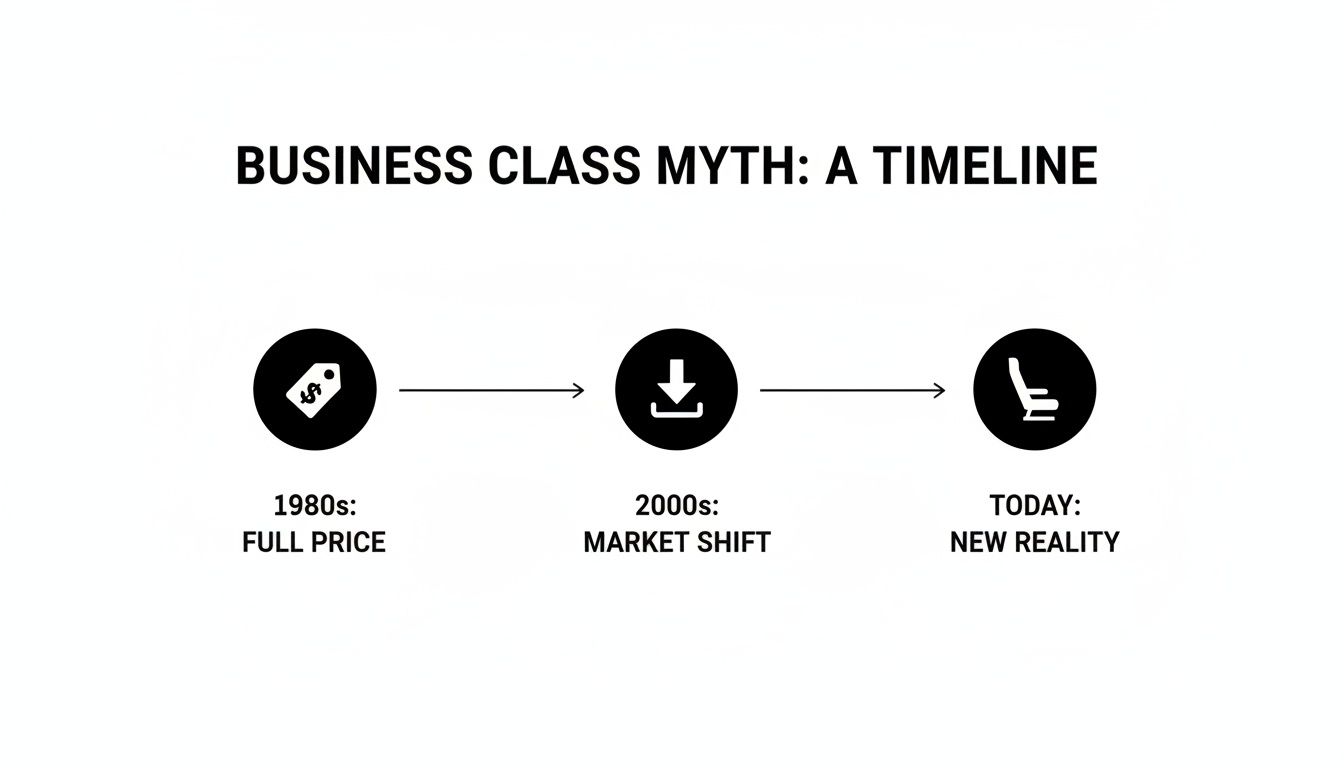
This timeline really shows how the game has changed. The old model of fixed, sky-high premium fares is gone, creating a new reality where smart timing can unlock incredible value.

A timeline showing the evolution of business class from full price in the 1980s to today's new reality.

The market has shifted dramatically. What was once a fixed, non-negotiable price is now a dynamic number that you can influence with the right strategy.

Finding the Optimal Booking Window

The sweet spot for booking international business class isn't a specific day, but a window of time. And this window shifts depending on where you're going, reflecting different travel seasons and demand patterns.

Based on what I’ve seen tracking fares for years, here are some solid guidelines for popular routes:

  • Flights to Europe: The magic window here is usually 3 to 6 months out. This is your best chance to lock in a great price before the summer and holiday rush sends fares through the roof.
  • Flights to Asia: You'll want to plan a bit further ahead for Asia. The best deals pop up 4 to 7 months in advance, especially if you’re trying to hit a peak event like cherry blossom season in Japan.
  • Flights to South America: Things are a little more forgiving here. A window of 2 to 5 months is often enough, as demand isn't quite as rigid as on the big transatlantic or transpacific routes.
  • Flights to Australia/New Zealand: These are ultra-long-haul flights, so start your search early. The prime booking window is typically 5 to 8 months before you plan to fly.

The biggest mistake people make is treating these windows like they're set in stone. The real pro move is to start monitoring fares at the start of the window and be ready to pounce the moment you see a significant drop. Hesitating and hoping it drops further is a gamble that almost never pays off.

Capitalizing on Shoulder Seasons and Fare Wars

Beyond just when you book, when you fly makes a massive difference. Traveling during the shoulder season—those perfect months right before or after peak season—can lead to some truly incredible deals. Think Europe in April or October instead of the chaos of July. With lower demand, airlines are much more willing to discount their premium seats.

For instance, a business class flight from New York to Rome in August can easily hit $6,000. That exact same seat in October? I’ve seen it drop to $3,500 or even less. And you get better weather and fewer crowds as a bonus. We dive deeper into these seasonal patterns in our guide on booking business class to Europe.

But the ultimate prize for a strategic timer is catching a fare war. This is when competing airlines get into a pricing battle on a specific route, aggressively slashing fares to steal customers from each other. These events are almost always unannounced and don't last long, but they can cut business class prices by 50% or more.

A fare war usually looks like a sudden, dramatic price drop across multiple airlines on the exact same route. This is where having fare alerts set up is your secret weapon. It allows you to act instantly, sometimes within hours, before the sale vanishes and prices snap back to normal.

Unlocking Savings with Creative Routing Techniques

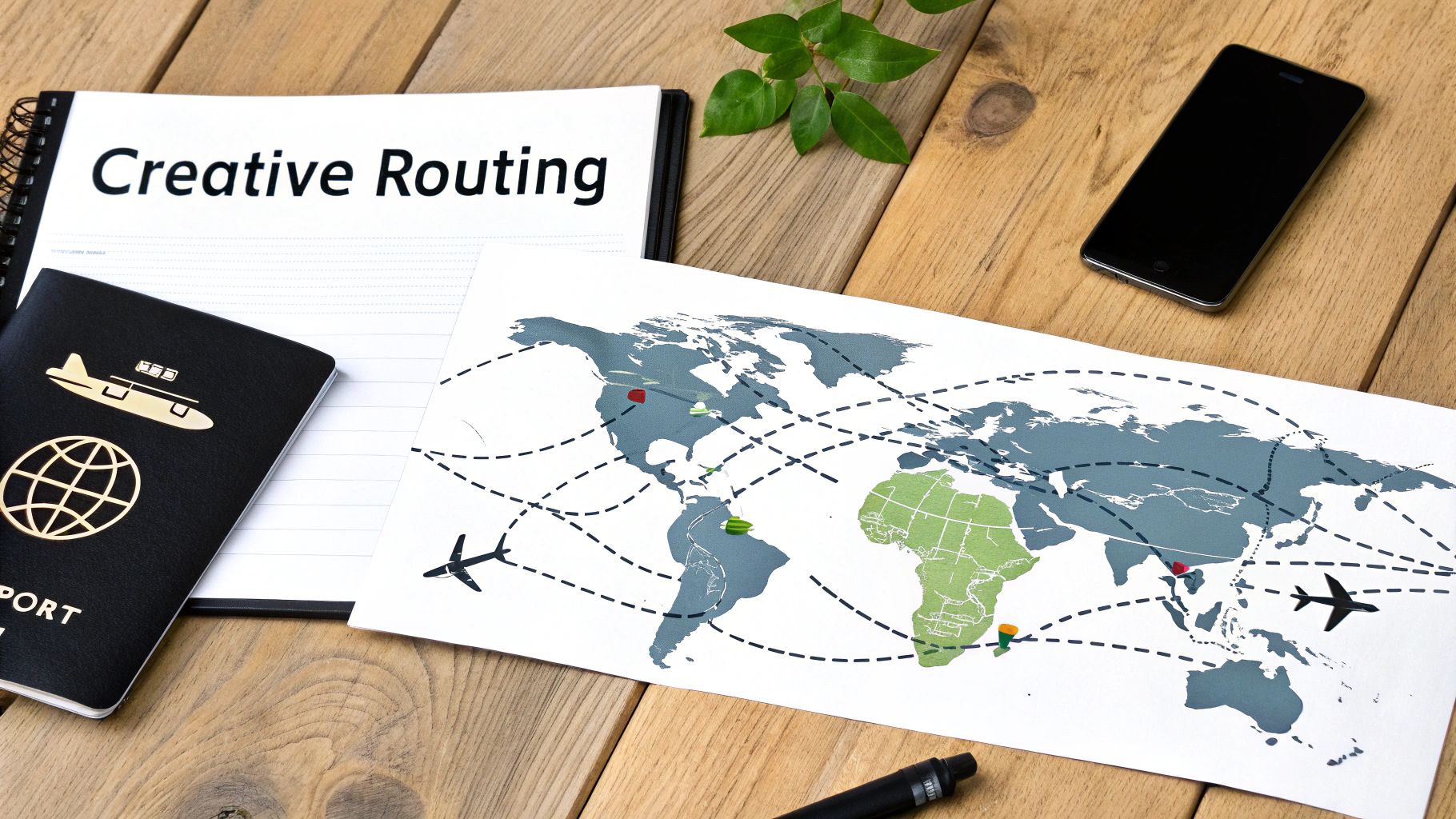
A passport, notebook with 'Creative Routing', world map with flight routes, and smartphone on a wooden desk.

This is where the real magic happens. Forget simple round-trip searches; creative routing is how savvy travelers consistently find deals that others miss. It's about rethinking the journey itself and knowing how to manipulate fare rules to your advantage. A little bit of planning here can literally slash thousands off the final price.

Airlines sort their premium seats into different categories, or "buckets," each with a specific letter code like J, C, or D. These aren't just random letters; they dictate the price, flexibility, and availability of your ticket. Getting a handle on these is the first step to snagging those deeply discounted seats before anyone else.

Understanding Fare Buckets

Think of fare buckets as different inventory lanes for the same lie-flat seat. A J bucket is usually the full-fare, no-questions-asked ticket with maximum flexibility. A C bucket often signals a sale price but with decent availability, while the elusive D bucket is where you find those shockingly cheap fares with tighter rules.

Here's a quick cheat sheet:

  • J bucket: Highest price, most flexible. The 'walk-up' business class fare.
  • C bucket: Moderate restrictions, but can offer 20-30% discounts.
  • D bucket: Strictest rules, but where you find flash sale fares at 40-60% off.

The key is that these buckets are dynamic. Airlines constantly shift inventory between them. When you see a fare drop from a C to a D bucket, that’s your signal. It’s time to book.

Positioning Flights For Big Savings

A positioning flight is simply a separate, cheap ticket you buy to get to another city to start your main international journey. Sounds like a hassle, but the savings can be enormous. For instance, a direct flight from Los Angeles (LAX) to Hong Kong might be outrageously expensive, but starting that same trip from Seattle could be thousands cheaper.

The strategy is simple:

  1. Find the low-cost international flight (e.g., SEA to HKG).
  2. Book a separate, cheap positioning flight to get there (e.g., LAX to SEA).
  3. Compare the total cost against the direct flight.

Often, a domestic hop only adds $150-$200 to your trip but can carve $1,000 or more off the long-haul segment. You're basically arbitraging regional airline promotions.

Using Multi-City and Open-Jaw Itineraries

Don't box yourself into a simple round-trip. Multi-city and open-jaw tickets are powerful tools for finding cheap international business class flights.

They let you do things like:

  • Fly into one city and out of another, avoiding high departure taxes.
  • Build in a stopover in a city with lower fares.
  • Stitch together flights from different partner airlines for a single, cheaper fare.

These aren't just for complex vacations; they are strategic cost-cutting maneuvers.

To see just how effective these strategies are, let's compare them to a standard booking. The difference is often staggering.

Advanced Routing Strategies Vs Standard Booking

Booking Strategy Example Itinerary (e.g., LAX to Paris) Typical Business Class Cost Potential Savings
Standard Round-Trip LAX to Paris, direct return $6,000 $0
Positioning Flight LAX→SFO→Paris→SFO→LAX $3,800 $2,200
Open-Jaw Multi-City LAX→Paris; London→LAX $4,200 $1,800

The takeaway is clear. Getting creative with your route can easily shave 30-40% off premium airfare if you know what you're doing.

I put this to the test on a recent trip to Bangkok. A direct LAX to BKK flight was quoted at $5,200. Instead, I booked a multi-city ticket: LAX to Bangkok via Vancouver, with an open-jaw return from Singapore back to LAX. The final price? $3,100. That’s a $2,100 savings—a 40% discount—for a bit of extra clicking.

Maximizing Miles and Upgrades

Stop thinking about upgrades as a last-minute perk at the gate. The best value comes from searching for award availability in premium fare buckets from the get-go. Many airlines release more award seats around five months out.

  • Air France/KLM's Flying Blue program has off-peak awards to Asia for as low as 50,000 miles one-way in business class.
  • Alaska Mileage Plan is fantastic for finding partner award seats, sometimes as low as 55,000 miles.
  • Use your miles to cover the short positioning legs for next to nothing, keeping your cash for the main ticket.

By blending a savvy cash fare with a partial award ticket, it's possible to get your total cost under $2,000 for routes that typically cost triple that.

Framing Savings For Corporate Approvals

Getting your company to approve a more complex itinerary can be a challenge, but it’s all about how you frame it. A simple comparison chart works wonders.

  1. Show the standard, direct-flight cost versus your creatively routed, cheaper option.
  2. Highlight that the core benefits—lie-flat seat, lounge access, priority services—are exactly the same.
  3. Point out that the added flexibility can even help accommodate meeting changes without huge rebooking fees.

One corporate travel manager I work with put it perfectly: “Routing ingenuity unlocked a 45% reduction on our business class travel budget last year.”

It definitely takes more effort than a quick search on Google Flights, but the rewards are undeniable. When you combine these routing tactics with smart timing and the right tools, you can consistently find cheap international business class flights for less than what most people pay for economy.

Next, we’ll dive into the specific tools and alerts I use to monitor these fares and automate much of this process.

Using the Right Tools and Airline Alliances

Endlessly searching for deals by hand is a surefire way to get frustrated and miss out. The real secret to consistently finding cheap international business class flights isn’t about brute force—it’s about using smarter tools to let the deals come to you. This is where a little tech and industry know-how give you a massive advantage.

You can actually automate the hunt with professional-grade fare monitors. These aren’t your everyday travel websites. Think of them as powerful platforms built to track specific routes, dates, and even fare classes, shooting you an alert the second a price drops into your sweet spot. That real-time intelligence is what lets you pounce on a deal before it’s gone.

Setting Up Your Digital Toolkit

The goal is to build a system that does the heavy lifting for you. Instead of randomly checking fares, you’ll get a ping when that New York to Milan business class seat drops below $2,800 or when a fare war suddenly breaks out on a route to Asia.

Your essential toolkit should include:

  • Fare Monitors and Alerts: This is non-negotiable. Set up precise alerts for your dream routes, specifying your target price, travel window, and cabin class.
  • Points and Miles Trackers: A good service keeps all your loyalty accounts in one place. It helps you see at a glance if you have enough miles for an award ticket or an upgrade when an opportunity pops up.

Beyond the usual platforms, savvy flyers use a few other tricks. For instance, you can learn to use a VPN for cheaper flights to unlock some serious savings. By changing your virtual location, you can sometimes tap into fares priced for entirely different markets, which can be dramatically cheaper.

Leveraging the Power of Airline Alliances

You have to think bigger than just one airline. The three major global alliances—Star Alliance, oneworld, and SkyTeam—are much more than just marketing fluff. They're powerful networks you can use to find better availability, more creative routes, and ultimately, lower prices.

Let’s say you’re looking for a flight on United (a Star Alliance member) and their own site shows zero award seats. A deeper dive might reveal a fantastic business class seat on a partner like Turkish Airlines or Lufthansa for the exact same route, often for fewer miles. This happens all the time, and basic searches almost always miss it.

This strategy is a game-changer for complex trips. You can stitch together flights from multiple partner airlines on a single ticket, often unlocking pricing you’d never find by booking them separately. It gives you an exponentially larger pool of seats to choose from. For a more personal take on navigating these strategies, you might be interested in reading Ryan D's insights on premium travel.

Knowing When to Use Points vs. Cash

The classic points-versus-cash dilemma is at the heart of finding true value. While using miles to upgrade an economy ticket sounds great, it's often a terrible deal. Many airlines force you into a super-expensive, full-fare economy ticket (think Y or B class) just to be eligible. That can end up costing nearly as much as a discounted business class ticket would have in the first place.

The smartest move is often paying cash for a deeply discounted business class fare. Save your miles for when cash prices are ridiculously high. An award ticket is a fantastic value during peak season when revenue tickets are north of $8,000, but a good cash deal is almost always the winner for off-season travel.

This dynamic is only getting more relevant as demand for premium travel grows. International premium class has seen impressive growth, with business and first-class traffic climbing 11.8% year-over-year, even outpacing economy's 11.5% growth. With Europe alone representing 39.3 million premium passengers, airlines are fighting hard for your business, which means more opportunities for fare sales. You can learn more about these global premium travel trends and regional growth.

By combining these automated tools with a solid understanding of airline alliances, you stop being a passive price-taker and become an active deal-hunter, ready to jump on the market’s next move.

Your Game Plan for Booking Premium Fares

A 'Booking Checklist' sign with a clipboard showing two checked boxes, a smartphone, and office supplies.

All the theory in the world doesn't matter if it doesn't save you money. This is where we turn strategy into action. Think of this as your repeatable game plan, a checklist to run through every single time you start looking for a flight. Follow it, and you'll stop missing out on those incredible premium fare deals.

This isn't just a to-do list; it’s your roadmap to consistently finding cheap international business class flights. Working through these steps methodically will transform you from a passive fare-checker into a strategic deal hunter, ready to pounce the moment the right opportunity appears.

Phase One: Define Your Search

Before you even start plugging in destinations, you need to get your own plans in order. Your greatest asset in this game is flexibility, so figuring out just how flexible you can be is the first, non-negotiable step. A rigid plan is a recipe for paying top dollar.

  • Map Out Your Flexibility Window: What are your absolute earliest departure and latest return dates? Even giving yourself a buffer of +/- three days can open up a completely different, and much cheaper, world of fares.
  • Identify Your Alternate Airports: Make a list of at least two or three other airports you're willing to fly from or into. A short positioning flight can often slash the total cost, especially since some airports have significantly lower taxes and fees.
  • Set a "Buy Now" Price: Know your route. Based on what you’ve seen, decide on a target price that makes you pull the trigger instantly. The best deals don't last—they’re often gone in a matter of hours.

Don’t just hunt for the lowest price; hunt for the best value. A flight that's slightly more expensive but has better timing, a superior aircraft, or grants you lounge access during a long layover can be a far better deal than the absolute rock-bottom fare.

Phase Two: Execute the Hunt

Alright, now you’re ready to start the active search. This is all about using the right tools and comparing your options across different platforms and alliances. The biggest mistake people make is checking only one airline's website, which leaves you blind to countless deals offered through their partners.

  1. Set Your Fare Alerts: Get a fare monitoring tool working for you. Track your desired routes within that flexible date window you defined earlier. Make sure you set specific alerts for the business class cabin and your target price.
  2. Dig into Alliance Partners: Don't just look for a direct flight on a single carrier. Use alliance search tools to see what’s available on partner airlines. This is often where you'll find cheaper seats or more creative routing options.
  3. Test Multi-City and Open-Jaw Scenarios: Get creative. Try flying into one city and out of another. This simple trick can often break the fare rules in your favor, leading to a much lower overall ticket price.

The global aviation industry is booming again. We recently saw a peak of 123,798 commercial flights in a single day—a 3.06% annual jump that puts us well past pre-pandemic numbers. Carriers like American Airlines are leading the charge with an average of 6,360 daily flights. More planes in the sky means more premium seats to fill, which forces competition and creates more opportunities for us to find a deal.

Phase Three: Justify and Finalize

If you're traveling for work, this is your final hurdle: getting the green light. The key here is to frame your find not as an indulgence, but as a smart, value-driven decision for the company. It’s all in how you present the numbers.

Pull together a quick comparison. Show the cost of a standard, full-fare economy ticket right next to the discounted business class fare you found. Emphasize the productivity gains—arriving rested and ready to go straight into a meeting. When you can show a premium ticket that costs the same or just slightly more than a last-minute coach seat, it makes the decision a no-brainer for any manager.

And while you're focused on the flight, don't forget the small things that add up. A little prep can help you avoid roaming charges on your international trip and keep you connected without a nasty surprise on your phone bill.

Once you get approval, book it. Immediately. The best fares wait for no one.

You've learned the strategies, you've seen the tools—now let's tackle the questions that probably just popped into your head. After years of doing this, I've heard them all.

This isn't just a recap; it's the final briefing before you go out and snag your own premium flight deals. Let's clear up any lingering doubts so you can book with total confidence.

Can You Really Find Business Class Flights Cheaper Than Economy?

Absolutely. It doesn’t happen every day on every flight, but it happens way more often than most people think. For those of us who know where to look, it’s a golden opportunity.

So, how can this happen? Think of it from the airline's perspective. They might have a flight where the economy cabin is packed and selling at top dollar, but the business class cabin is wide open. An empty lie-flat seat is a perishable good—once that plane takes off, the revenue is lost forever. Slashing the price to get some money for that seat is better than getting nothing at all.

This is especially true when you factor in strategies like positioning flights or jumping on a sudden fare war between two rival carriers. It's not uncommon to see a business class ticket on one airline drop below the price of a full-fare economy seat on another. It's all about finding those specific imbalances in the market.

What Are the Biggest Mistakes People Make When Hunting for Premium Fares?

It almost always boils down to two things: being inflexible and using the wrong tools.

Most people plug one specific route and one specific date into a basic search engine, see a sky-high price, and just give up. The real secret to unlocking cheap international business class flights is to be willing to play with your dates, departure airports, and maybe even your final destination. Shifting your travel by just a day or two, or flying out of a different nearby city, can literally save you thousands.

The other major mistake is relying on the same travel sites everyone else uses. You're completely missing out on historical pricing data, fare cycle trends, and the crucial real-time alerts that specialized fare monitors provide. And a final classic blunder: waiting until the last minute. Unlike coach, last-minute business class "deals" are a myth. Those prices almost always skyrocket in the final weeks before departure.

How Much Time Do I Really Need to Spend to Find These Deals?

There’s a bit of a learning curve at the very beginning, sure. But the goal here isn't to chain yourself to your computer for hours every day. The whole point is to set up smart, automated systems that do the heavy lifting for you.

The real shift is moving your time away from tedious manual searching and toward strategic monitoring. Once you set up a few targeted fare alerts for trips you’re interested in—which only takes a few minutes—the deals come straight to your inbox. Your only job is to be ready to pull the trigger when the right one hits.

That small initial time investment can pay off with thousands of dollars in savings on a single trip. It’s easily one of the most valuable travel skills you can develop.

Are These Discounted Tickets "Real" Business Class with All the Perks?

Yes, 100%. Let me be crystal clear: a discounted fare never means a discounted experience. The price you pay is simply a function of the ticket's fare code and market demand when you book. It has absolutely nothing to do with the service you'll get on board.

Whether you paid the eye-watering full fare or found an incredible deal for less than the guy in coach, you get the exact same treatment. You'll get the lie-flat seat, full lounge access, the multi-course meal, the champagne—all of it. You are getting the complete, undiluted business class experience, just for a much, much smarter price.


At Passport Premiere, we connect the dots for our members. We blend constant fare monitoring, deep market analysis, and years of expertise to pinpoint the exact moment to buy. We track the fare cycles, spot the fare wars as they erupt, and deliver the kind of airfare intelligence that turns market volatility into your advantage. Stop overpaying. Start flying smarter. Learn more at https://www.passportpremiere.com.