Business class can cost less than coach. A published transatlantic example compares a $1,950 coach total, including bags and seat selection, with a $1,850 discounted business-class fare, making the premium cabin cheaper outright (Passport Premiere's fare analysis). That isn't a pricing error in the usual sense. It's the visible result of airline inventory, demand forecasting, ancillary fees, and international timing colliding at the right moment.
Most travelers treat the economy fare as the market's baseline and assume every premium option must sit above it. That assumption fails because airlines don't price cabins as a simple ladder. They manage each inventory pool for a different customer, and those pools can move in opposite directions. The practical question, therefore, isn't whether business class normally costs more. It's whether the price gap still reflects the airline's current demand for the empty premium seat.
Understanding the Premium Cabin Paradox
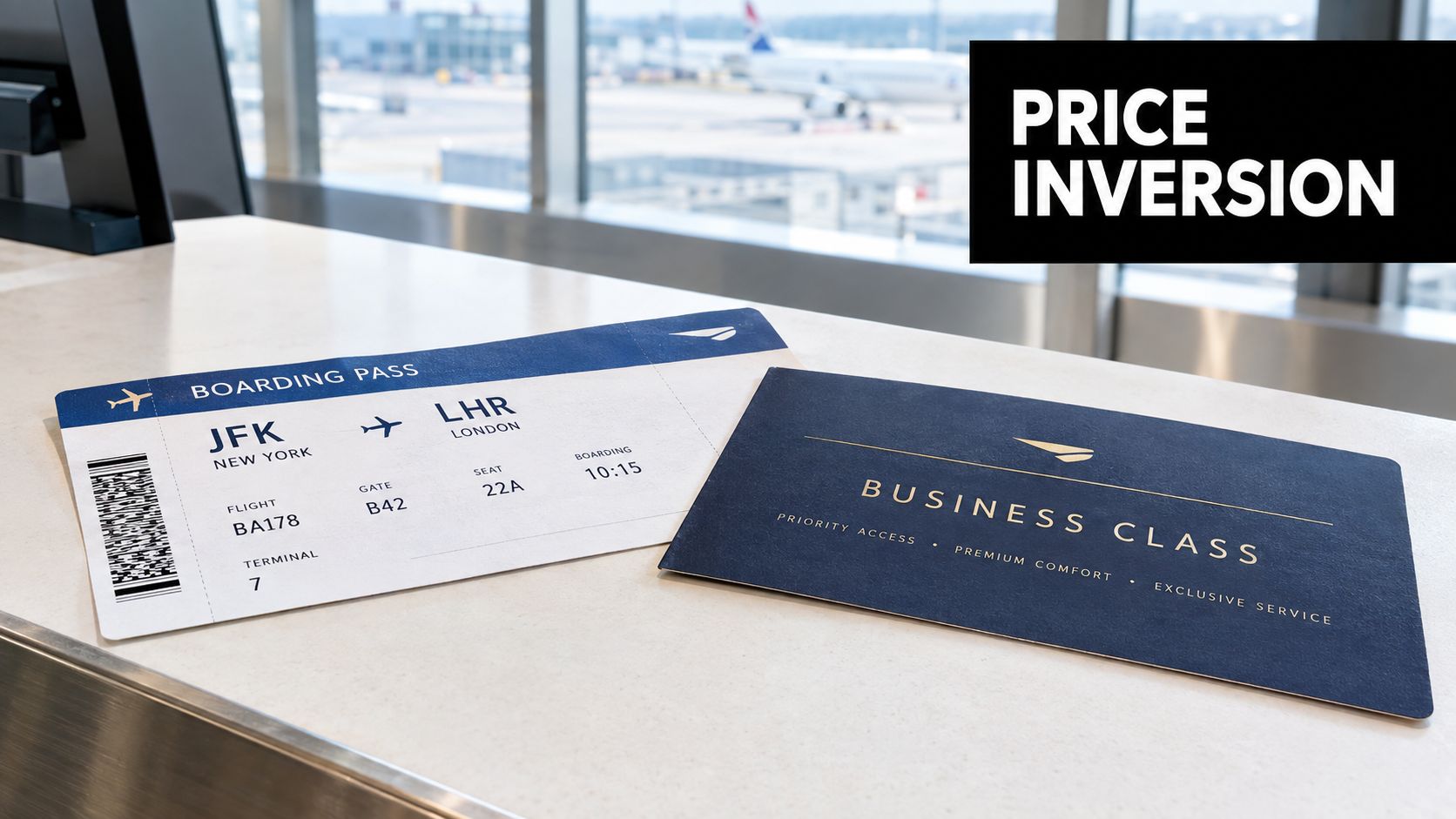
The price inversion paradox occurs when a business-class fare falls below the total cost of an economy itinerary. It sounds rare because travelers usually compare headline fares, not the full transaction. Coach may carry separate charges for baggage, seat selection, or other services, while a discounted premium fare can bundle more of the journey into one price.
Passport Premiere states that fewer than 15% of premium-cabin seats are sold at their initial asking price. That point changes the way a buyer should interpret the first fare displayed in a search result. The opening price is a market signal, not necessarily a reliable valuation of the seat.
Why the cabin ladder breaks
Airlines sell economy seats to a broad mix of leisure and price-sensitive travelers. Premium cabins depend more heavily on customers who value schedule, flexibility, status, or comfort, including corporate travelers and long-haul leisure passengers. Those customers don't arrive at the same time, and their willingness to pay can change sharply as departure approaches.
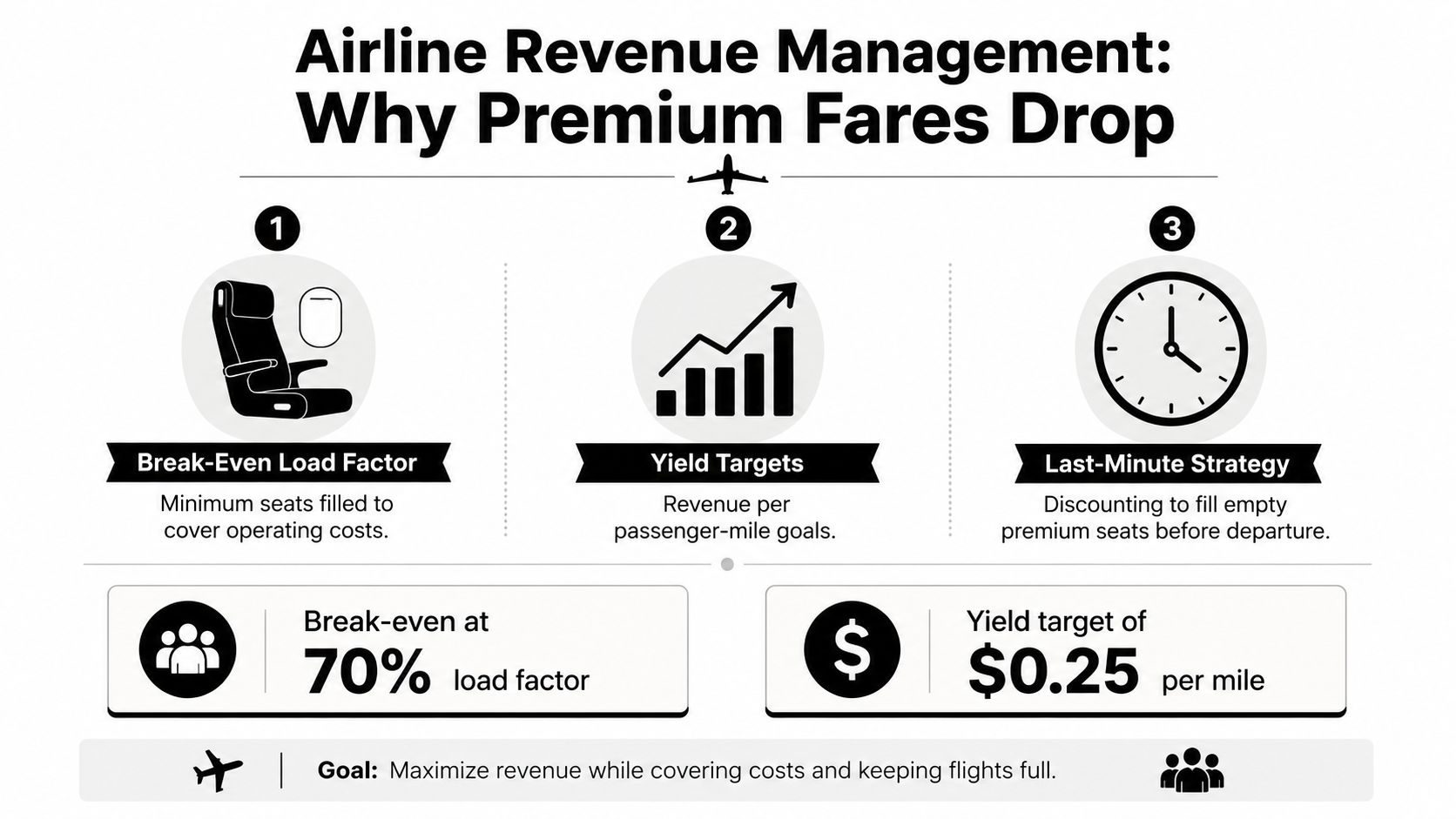
A carrier may protect business-class inventory early because it expects high-yield demand later. If that demand doesn't materialize, the airline has an empty seat that can't be stored for another flight. A late fare reduction can then make commercial sense, even if the lower price appears to undermine the cabin hierarchy.
Practical rule: Treat the empty premium seat as perishable inventory, not as a luxury product with a permanent price premium.
Airfare behaves like a volatile asset
The analogy to an asset class is useful, with one limitation. A flight seat has no resale value after departure, so the airline must continually adjust its price before the asset expires. Demand forecasts, competitive fares, seasonality, corporate traffic, and remaining inventory all influence the adjustment.
This is why a traveler who accepts the first listed business-class fare may overpay, while a traveler who monitors the route can encounter a correction. The correction won't appear on every itinerary, and it isn't guaranteed to persist. But it is structurally possible, which makes international timing more valuable than a simple “book economy early” rule.
The executive takeaway is straightforward: compare total trip cost by cabin, monitor the route's behavior, and define a purchase threshold before emotions or urgency take over. Business class cheaper than coach is an outcome to test for, not a claim to assume.
The Strategic Booking Timeline
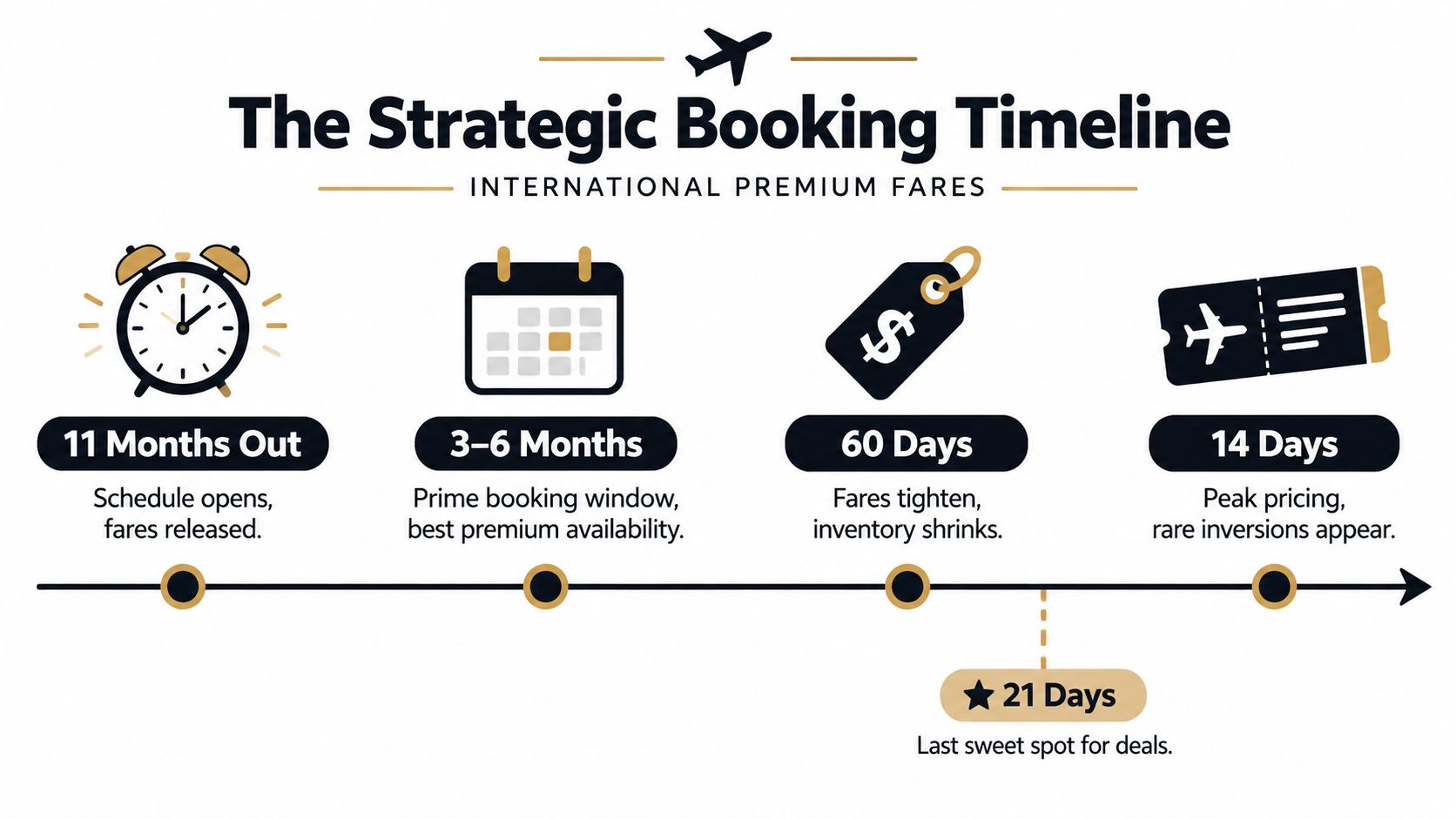
Premium fares reward a calendar-based process rather than a single search session. Independent travel guidance places a practical booking band at roughly 2 to 8 months before departure, with business and first class often performing best in the 3 to 8 month range (premium booking timing guidance). Airlines can load inventory roughly 330 to 361 days in advance, but the cheapest premium booking classes may appear later as demand becomes clearer.
Start with the early loading phase
When a schedule first opens, the airline makes seats available and establishes an initial pricing structure. That phase is useful for understanding dates, routing, and baseline availability, but it isn't automatically the right moment to buy. A traveler with fixed dates or an important corporate commitment may value certainty more than a possible fare correction.
Use the early phase to record:
- Schedule options: Identify nonstop and connecting itineraries, nearby airports, and acceptable departure times.
- Cabin availability: Check whether business class is present across the dates you could use.
- Price context: Save the fare without treating it as the route's final value.
The point is to build a reference, not to chase a low price that hasn't appeared.
Monitor the demand-testing phase
The middle of the cycle is where monitoring becomes most useful. The 3 to 8 month window gives the airline time to observe bookings while leaving room for premium inventory to be repriced. Route-specific conditions still matter, so a broad rule should become a watchlist with clear decision boundaries.
Set a target that reflects the complete trip, not only the base fare. Compare the same itinerary in economy and business class, include unavoidable extras, and note whether the fare has change or cancellation restrictions. A lower fare with severe limitations may not offer the same business value as a slightly higher flexible ticket.
Decide during the inventory-release phase
The period closer to departure requires discipline. McKinsey reports that, at one large U.S. airline, about half of premium seats were booked more than 21 days before departure, reflecting early leisure demand (McKinsey analysis of premium cabins). That means waiting can expose you to shrinking inventory, even though it may also create a final opportunity for a correction.
A sensible operating rule is to monitor actively through the broader 2 to 8 month range, become more decisive around the route's observed low points, and avoid relying on a last-minute rescue. The closer you get to departure, the more important flexibility becomes, because the remaining seats may be scarce even when a temporary deal appears.
Economics of Dynamic Pricing Models
Airline pricing looks chaotic to passengers because different cabins respond to different demand signals. Economy fares often react visibly to search demand, remaining seats, travel dates, and competitive activity. Premium fares also change dynamically, but carriers manage them through a separate yield strategy shaped by corporate contracts, seasonal expectations, and the risk of losing high-value customers.
The central mistake is comparing the cheapest economy bucket with the most expensive business bucket, then concluding that the cabin difference is permanent. A better comparison asks how each inventory pool is behaving at the same moment.
| Economy behavior | Premium-cabin behavior |
|---|---|
| Responds strongly to broad leisure demand | Responds to premium demand, corporate patterns, and cabin availability |
| Can become expensive when low fare classes disappear | Can remain high while the carrier protects inventory |
| Total cost may rise through bags and seat fees | A reduced fare can narrow or reverse the cabin gap |
| Price pressure is often visible in headline searches | Corrections may require route monitoring and timing |
Why late economy can hurt
A traveler buying late may encounter a nearly full coach cabin, especially on a popular international departure. The remaining economy seats can sit in expensive fare classes, while the carrier still has unsold premium seats that need a different solution. Those two conditions can coexist without contradicting the airline's revenue strategy.
The result is counterintuitive. Coach becomes expensive because its discounted inventory has disappeared, while business class becomes comparatively attractive because the airline wants to stimulate premium demand. The fare difference isn't a statement about comfort. It reflects separate inventory decisions.
For a useful vocabulary primer, this explanation of dynamic airline pricing helps frame fares as changing inventory categories rather than fixed product prices.
A correction isn't the same as a bargain
A genuine correction should survive a basic audit. Check the exact itinerary, baggage rules, connection, fare conditions, and ticketing deadline. Then compare the fare with nearby dates and alternative airports. A displayed reduction may reflect a restrictive class, a different routing, or a temporary filing that disappears before payment.
A low premium fare matters only after the traveler verifies that the ticket solves the same transportation problem as the cheaper-looking coach option.
The economic logic is therefore less about predicting a universal lowest day and more about recognizing when the two cabins have become misaligned. That's the moment international timing can turn a premium upgrade into a rational purchase.
Fare Wars and Market Corrections
A fare war begins with competition, but it ends in an inventory decision. When multiple carriers serve the same international corridor, each airline must defend its schedule, connecting network, and share of high-value travelers. A premium fare reduction can attract bookings without forcing the carrier to lower every economy price on the route.
This is why a business-class sale isn't necessarily an act of generosity. The airline may be trading some yield per seat for a better chance of filling capacity. An empty business-class seat produces no revenue after departure, so a targeted discount can be preferable to preserving a published price that few customers will pay.
What creates the opening
Several conditions can produce a correction:
- Overestimated premium demand: The carrier protected seats for corporate or event traffic that doesn't arrive at the expected level.
- Competitive pressure: Another airline introduces a more attractive premium offer, forcing a response.
- Uneven seasonal demand: Economy remains active while premium demand softens, or the reverse.
- Network imbalance: A connecting itinerary has unsold premium capacity on one segment and needs stimulation.
These conditions don't guarantee that business class will undercut coach. They explain why the possibility exists and why route monitoring is more productive than relying on a fixed booking myth.
The timing signal is relative
A traveler shouldn't ask only whether a business fare is “cheap.” The stronger question is whether the premium fare has weakened relative to its own recent behavior and relative to the complete economy alternative. That comparison captures both airline strategy and the buyer's actual cost.
The most useful signal can be a narrowing cabin gap rather than an absolute price floor. If economy rises because its lower inventory is gone while business remains stable, the premium cabin may become the better value without any dramatic business-class sale. If business drops while coach remains steady, the inversion becomes more obvious.
A fare war also has an expiration risk. Once bookings accelerate, the airline can close discounted inventory and restore higher fare classes. Buyers need a purchase rule before the correction appears, such as a maximum acceptable total, an acceptable connection, and a deadline tied to their travel purpose.
The non-obvious conclusion is that competition can create a premium opportunity even for travelers who aren't loyal to a particular airline. A carrier doesn't need to offer the lowest economy fare to win the price-sensitive customer. It can instead use a targeted premium filing to capture someone who compares total value across cabins.
Case Studies in Price Inversion
The clearest evidence comes from itinerary-level comparisons. On one published last-minute transatlantic example, the coach total reached $1,950, made up of a $1,700 fare, $150 in bags, and $100 for a seat, while discounted business class cost $1,850 (documented business-class price inversion). The premium cabin was therefore cheaper by $100 after ancillary charges.
The lesson isn't that every traveler should wait until the final days. It's that the headline coach fare can conceal the actual cost of choosing economy. A business-class comparison becomes financially rational when it includes the services the traveler would otherwise purchase separately.
A transatlantic decision
A leisure traveler with flexible departure dates might search a transatlantic route and see a coach fare that looks acceptable at first glance. After adding a checked bag and preferred seat, the total moves closer to the available business fare. The rational decision then depends on more than cabin prestige.
Business class may provide a better financial trade if the traveler values the included services, lounge access, onboard work environment, or ability to arrive rested. The fare comparison also needs to account for restrictions, because a cheaper premium ticket can still be inferior if it cannot be changed when plans are uncertain.
An Asian corridor near departure
A separate analysis describes a Tokyo to Singapore example in which close-in business-class fares can fall into the $1,900 to $2,600 range (last-minute premium fare analysis). The same source identifies the 7 to 21 day pre-departure period as a window in which carriers may try to clear unsold premium seats.
That window creates opportunity and risk simultaneously. A traveler with flexible dates may find a meaningful correction, but a traveler with fixed dates could discover that the remaining inventory has disappeared instead. The practical response is to monitor before the final window and buy when the fare meets the trip's predefined value threshold.
Award pricing can invert too
Cash fares aren't the only setting where the cabin hierarchy breaks. The Points Guy describes a case in which a traveler saved 32,000 Delta SkyMiles by booking first class instead of coach on New York-JFK to Orlando-MCO, while also discussing international scenarios where business-class cash fares can equal or beat economy (award and cash fare inversion example).
That example widens the analysis. Travelers should compare the redemption cost, taxes, fees, and availability of each cabin rather than assume coach always offers the better use of points. In both cash and award markets, the correct question is the marginal cost of moving into the premium cabin.
The Value of Specialized Intelligence
Airlines know their own inventory position, competitor filings, booking pace, and revenue targets. Individual travelers see only the fares exposed through a search at a particular moment. That information asymmetry makes timing difficult, especially for executives who need a reliable decision process rather than repeated manual searches.
Specialized monitoring can reduce the workload by turning a moving fare market into a set of signals. The useful output is not merely “business class is available.” It's whether a route appears weak, whether a lower fare may emerge, and whether the observed price is attractive compared with the full economy alternative.

From raw volatility to a decision
A corporate travel manager can use a monitoring service to define preferred routes, cabin requirements, acceptable connections, and purchase limits. A frequent consultant can separate trips that require flexibility from trips where a temporary fare reduction justifies immediate commitment. A leisure traveler can monitor a destination without guessing whether the current price reflects a real correction.
Passport Premiere combines fare monitoring and market analysis, and its business-class fare alerts are designed to surface premium fare opportunities. Its Fare Monitor also provides a daily progress report when lower fares are anticipated at a future date, according to the publisher's product description.
What intelligence should answer
A useful alert or analyst should help resolve four practical questions:
- Is the fare actionable: Can the traveler book it now under the required conditions?
- What is the comparison point: Does it beat the complete economy cost or only the base fare?
- How much flexibility is required: Can the traveler accept a nearby date, airport, or connection?
- What could invalidate the signal: Are seats disappearing, restrictions severe, or ticketing rules tight?
The value lies in compressing observation time and improving the quality of the decision. It doesn't eliminate uncertainty, and no service can guarantee that a lower fare will appear. It can, however, help a buyer avoid treating the airline's first quoted price as the final word.
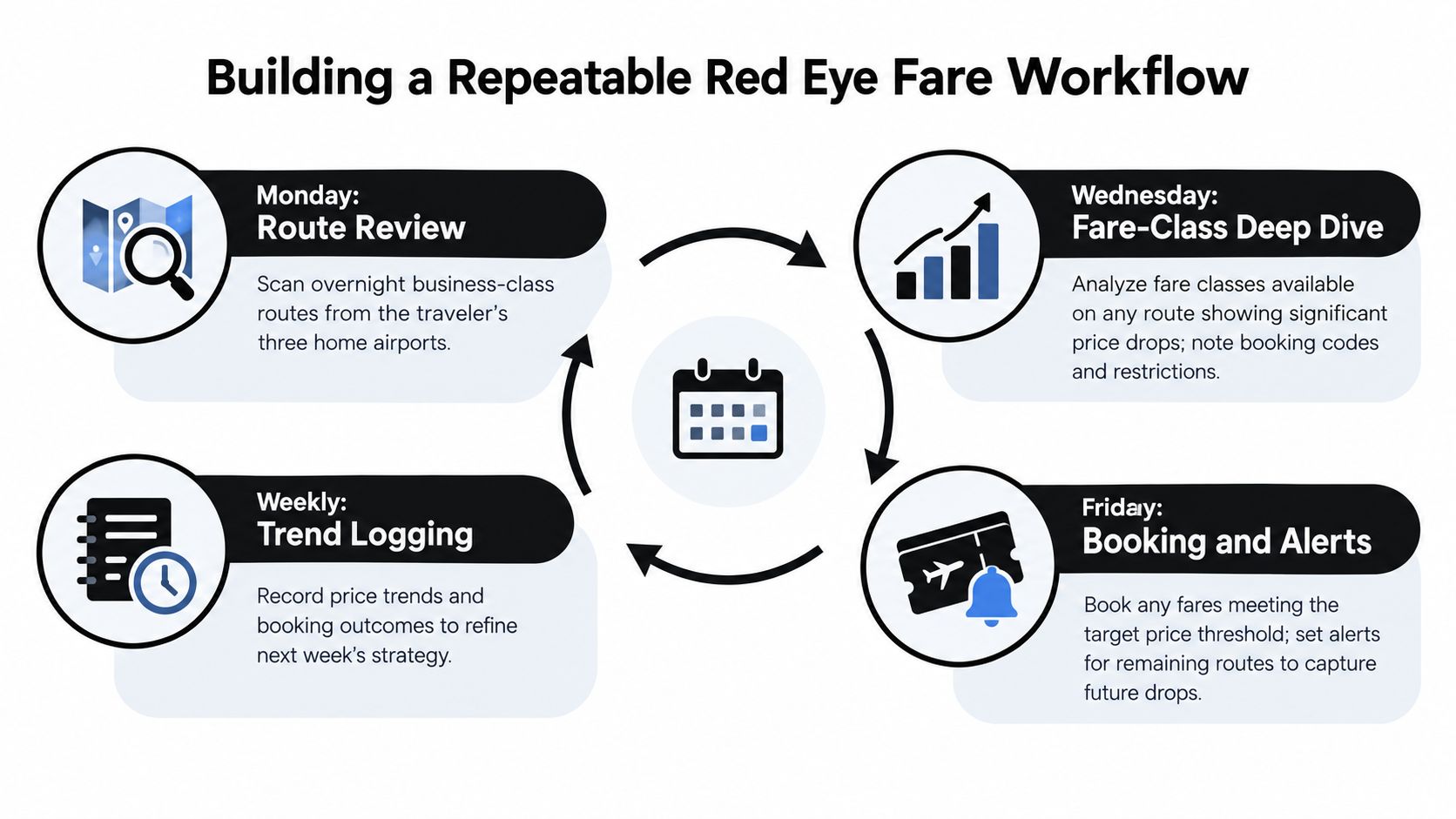
For companies, that distinction has operational value. A repeatable process makes premium travel budgets easier to govern because travelers can document why they bought, what alternatives they compared, and which conditions triggered the decision.
Mastering Your International Travel Timing
International timing works best as a controlled buying process:
- Start early enough to observe: Use the broad 2 to 8 month range as the monitoring horizon, with particular attention to the 3 to 8 month premium window.
- Compare complete costs: Add baggage, seat selection, and other unavoidable economy charges before judging the cabin gap.
- Track relative movement: Look for a business fare that weakens against its own route history or approaches the total economy alternative.
- Respect inventory risk: Premium seats can sell early, so waiting for a last-minute inversion is a tactical gamble, not a default strategy.
- Use informed triggers: Decide in advance what fare, routing, flexibility, and cancellation terms justify purchase.
The deeper conclusion is that business class cheaper than coach isn't a contradiction. It's a market outcome created when cabin demand, inventory protection, competitive pressure, and ancillary fees stop moving in parallel. Travelers who recognize that structure can make premium comfort a measured financial choice rather than an indulgence bought at the first displayed price.
For broader planning beyond premium-cabin monitoring, these international flight savings tips offer useful context on comparing routes, dates, and booking decisions. The strongest strategy combines that general discipline with route-specific observation and a clear threshold for action.
Passport Premiere offers fare monitoring and market analysis for travelers seeking international Business and First Class fares at lower prices, including opportunities where premium fares can approach or undercut coach totals. Visit Passport Premiere to review how its Fare Monitor and member insights can support a more disciplined international timing strategy.